Clinical trial data sharing and FDA review documents literacy: how to read Drugs@FDA approval packages, complete response letters, EPARs and data-sharing statements for GLP-1 medicines

A GLP-1 approval leaves a long paper trail. Behind the press release and the journal article sit FDA's own reviews of the evidence, sometimes hundreds of pages long, plus approval letters, complete response letters, European assessment reports and, for some trials, participant-level data that qualified researchers can request. US law requires FDA to post the action package for a new active ingredient within 30 days of approval, FDA has published complete response letters on openFDA since July 2025, Europe and Canada publish many clinical study reports, and journals and ClinicalTrials.gov ask every trial to state whether it will share individual participant data. This guide explains what each layer contains, where to find it, why parts are blacked out, how to read the reviews for Wegovy, Zepbound and other GLP-1 medicines, and what research says about the gaps between these documents and what gets published. Educational only: no doses, no treatment advice and no legal advice.
UPDATED 22 NOV 2026 · 35 MIN READ
KEY TAKEAWAYS
- Clinical evidence is published in layers: press releases, journal articles, registry results, the label, regulators' review documents, clinical study reports and individual participant data. Each deeper layer has more detail and usually tighter access.
- Under 21 U.S.C. 355(l), FDA must post the action package for an approved drug with a new active moiety within 30 days of approval, and for other approvals within 30 days of the third FOIA request. The package must include a summary review that documents conclusions, critical issues and disagreements.
- A Drugs@FDA approval package typically holds the approval letter, labeling, summary review, clinical, statistical, clinical pharmacology, nonclinical and product quality reviews, other reviews, an officer/employee list and administrative correspondence. Newer applications may have a single multidisciplinary or integrated review instead.
- Black boxes marked (b)(4) or (b)(6) are FOIA exemption codes: (b)(4) covers trade secrets and confidential commercial information, and (b)(6) covers personal privacy. Manufacturing details are usually redacted; clinical findings are mostly readable.
- FDA published more than 200 complete response letters in July 2025, added 89 letters for pending or withdrawn applications in September 2025, and said it will release new letters promptly. The openFDA dataset listed 466 letters as of its November 18, 2026 update.
- FDA does not routinely publish clinical study reports or participant-level data. EMA (Policy 0070) and Health Canada publish many clinical study reports after a regulatory decision, and companies such as Novo Nordisk and Lilly share anonymized data through controlled-access platforms like Vivli.
- ICMJE journals have required a data sharing statement in trial reports submitted since July 1, 2018, and a data sharing plan in the registration of trials enrolling from January 1, 2019. On ClinicalTrials.gov this appears as the IPD Sharing Statement.
- Research comparing regulatory documents with publications has found unpublished trials, more favorable published results and understated adverse events. Reading FDA reviews alongside the paper is one of the best checks a reader can make.
Why the documents behind a GLP-1 approval matter
When FDA approved Wegovy for chronic weight management on June 4, 2021, most people learned about it from a press release and, before that, from the STEP 1 paper in the New England Journal of Medicine. When FDA approved Zepbound on November 8, 2023, the story was similar: a press release, the SURMOUNT-1 paper and news coverage built around a single average weight-loss figure. Those sources are useful, but they are summaries written for a purpose. Press releases are written by companies or agencies to announce a decision. Journal articles are written by investigators, often with sponsor involvement, and are limited by word counts.
Underneath sits a much larger body of material. FDA reviewers read the sponsor's full application, rerun analyses, question assumptions and write down what they found, including disagreements. For Wegovy, the public clinical review alone runs to 392 pages and the statistical review to 42. For Zepbound, the clinical review is 267 pages and the statistical review 57. These documents show which trials FDA relied on, how missing data were handled, which adverse events reviewers looked at closely and why the label says what it says.
Beyond FDA's reviews are the sponsor's clinical study reports (CSRs), the detailed reports of each trial that regulators receive, and below those, the individual participant data (IPD): the de-identified records of each person in a trial. US regulators do not routinely publish either, but European and Canadian regulators publish many CSRs, and sponsors increasingly allow qualified researchers to analyze IPD through controlled-access platforms.
GLPWiki has separate guides on reading the label, the ClinicalTrials.gov record, advisory committee meetings and FDA review timelines. This guide connects them by focusing on the documents themselves: what is public, what is redacted, what you can request, and how to read regulatory reviews and data-sharing statements for GLP-1 and obesity medicines without overinterpreting them.
The transparency layers, from press release to participant-level data
It helps to think of trial information as a stack of layers. Each layer down is longer, more technical and closer to the raw data, and each is produced by a different party under different rules. The figure below summarizes the layers discussed in this guide.
No single layer is complete. A label is concise by design and reflects FDA's final judgment, but it omits most of the reasoning. A review explains the reasoning but is written for regulators and may be heavily redacted in manufacturing sections. A CSR is the most complete description of a trial short of the data, but it is the sponsor's document. IPD allows independent reanalysis but only under agreements, often only for approved indications and only after a waiting period.
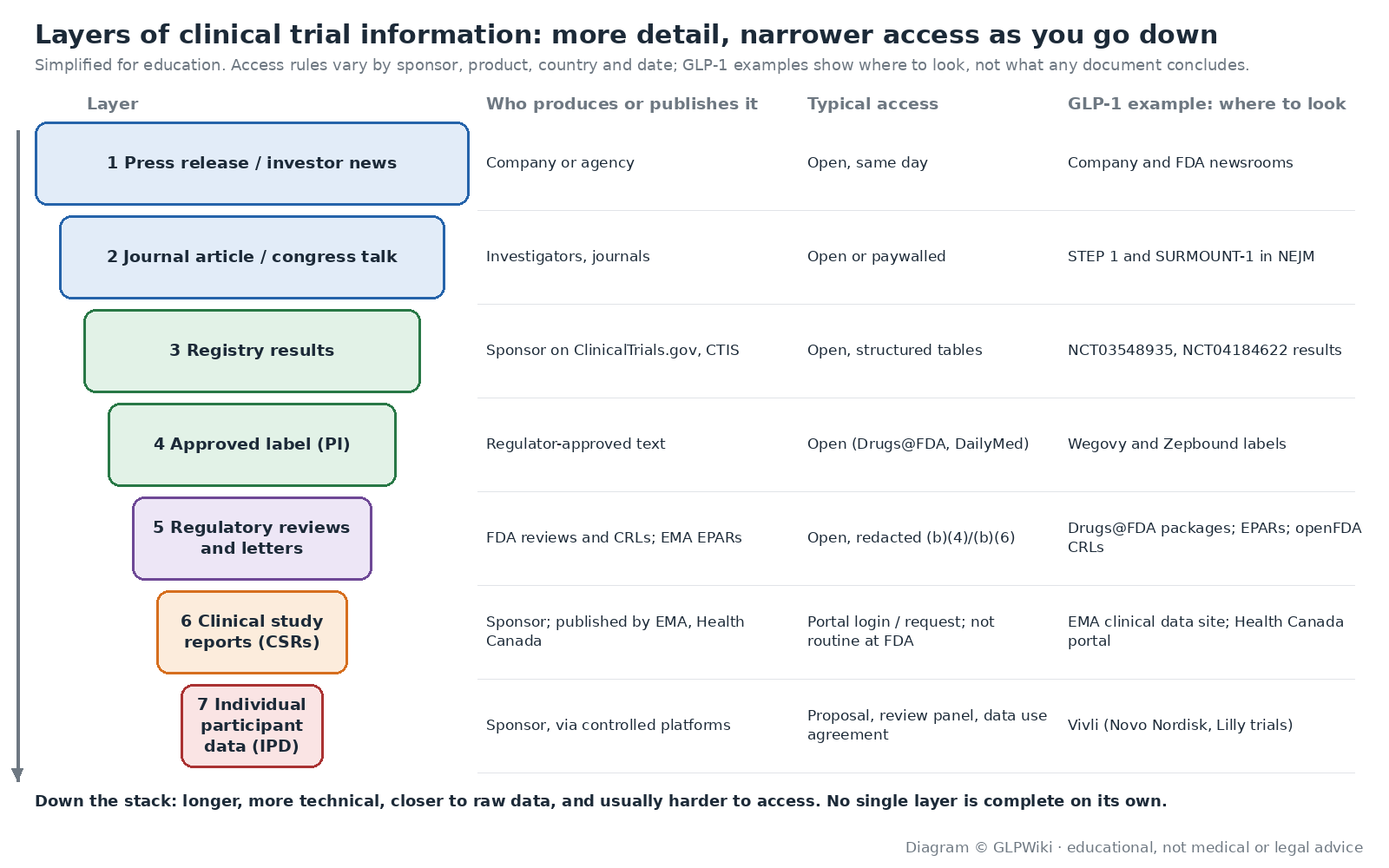
- Press releases and investor statements: fastest and shortest; written to announce, not to document.
- Journal articles and conference presentations: peer reviewed, but limited by space and the choices of authors and editors.
- ClinicalTrials.gov results and other registry entries: structured summary results, including all serious adverse events, in a fixed format.
- The FDA label (Prescribing Information): the regulator-approved summary of evidence needed to use the product, covered in GLPWiki's labeling guides.
- Regulatory review documents: FDA approval packages and complete response letters, and European public assessment reports (EPARs).
- Clinical study reports: full trial reports, published by EMA and Health Canada in many cases but not routinely by FDA.
- Individual participant data: de-identified patient-level records, shared under controlled access through platforms such as Vivli or YODA, if at all.
What the law says FDA must publish after an approval
The core US rule is section 505(l) of the Federal Food, Drug, and Cosmetic Act, codified at 21 U.S.C. 355(l). It was strengthened by the Food and Drug Administration Amendments Act of 2007. Paragraph (l)(2) requires FDA to publish the 'action package for approval' on its website not later than 30 days after approval when no active moiety of the drug has been approved in any other application (for biologics, no active ingredient previously licensed). For any other drug, FDA must publish the package not later than 30 days after it receives the third Freedom of Information Act request for it.
The statute lists what an action package must contain: FDA documents related to review of the application; documents about the format and content of the application generated during development; the labeling submitted by the applicant; a summary review documenting conclusions from all reviewing disciplines, noting critical issues and disagreements with the applicant and within the review team and how they were resolved; the Division Director's and Office Director's decision document, including any disagreement or added analysis; and the names of FDA officers or employees who took part in the decision and consented to be named. The summary review must be posted within 48 hours of approval unless it needs redaction.
Two further provisions shape what you read. A scientific review 'is considered the work of the reviewer and shall not be altered by management or the reviewer once final', which is why a package can contain reviews that disagree with each other. And the provision 'does not authorize the disclosure of any trade secret, confidential commercial or financial information, or other matter' exempt under FOIA, which is why parts are blacked out.
FDA's regulation at 21 CFR 314.430 fills in the details for drug applications (21 CFR 601.51 is the counterpart for biologics). FDA will not disclose that an application exists before approval unless the sponsor has already made it public. Even when the application is public knowledge, data in it are generally not released before approval, although the Commissioner may disclose summaries for a specific public issue, such as an open advisory committee meeting. After approval, summaries of safety and effectiveness data, protocols (unless shown to be trade secrets), adverse reaction reports with identifying information removed, and correspondence with the applicant become available. Manufacturing methods and similar confidential commercial information generally remain protected. Full safety and effectiveness data can become available in specific circumstances, for example once a first generic version referring to the drug could be approved.
Inside a Drugs@FDA approval package
Approval packages live on Drugs@FDA, FDA's database of approved drugs. Search by brand name, active ingredient or application number, open the application, and look for links labeled 'Review' or 'Approval Package' under the original approval or a later supplement. For original approvals, the package is usually a contents page with separate PDFs; supplements are often posted as a single long PDF.
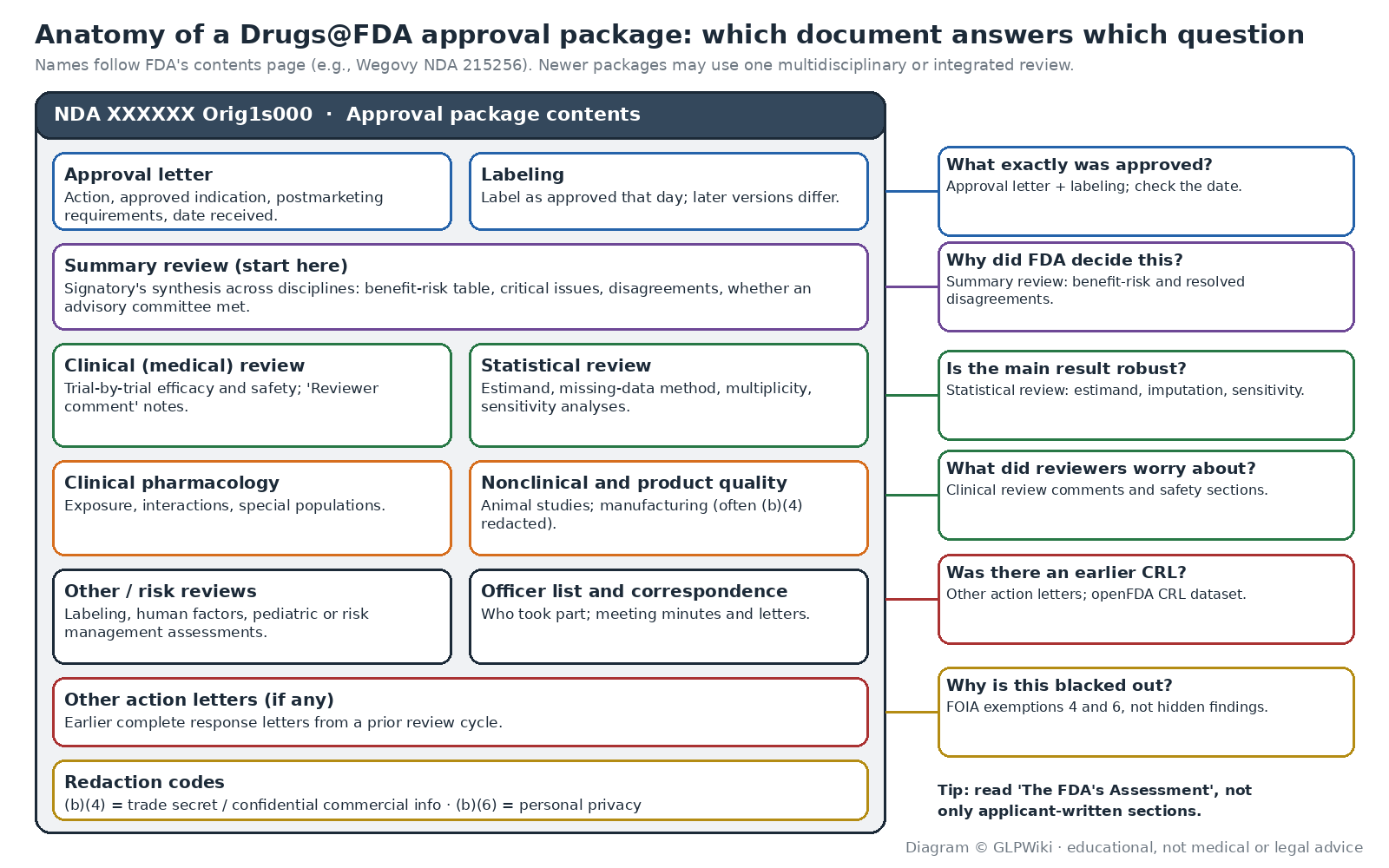
The contents page uses a standard checklist. For Wegovy (NDA 215256) and Zepbound (NDA 217806), both packages include an approval letter, labeling, summary review, officer/employee list, clinical review, product quality review, nonclinical review, statistical review, clinical pharmacology review, other reviews, proprietary name review and administrative/correspondence documents. Neither lists an office director memo, a cross-discipline team leader review or other action letters. The Mounjaro (NDA 215866) and Saxenda (NDA 206321) packages also include a risk assessment and risk mitigation review.
The documents and what each answers
Each document type has a job. Knowing which one to open first saves hours.
- Approval letter: the formal action, the approved indication, required postmarketing studies and commitments, and the date the application was received.
- Labeling: the label as approved on that date. Later versions are on Drugs@FDA and DailyMed; see GLPWiki's label version tracking guide.
- Summary review: the signatory's synthesis across disciplines, usually the best place to start. It often opens with a benefit-risk table and explains whether an advisory committee was convened.
- Clinical (medical) review: trial-by-trial assessment of efficacy and safety, often with 'Reviewer comment' notes where FDA's clinical reviewer gives an independent view.
- Statistical review: FDA's assessment of the analysis plan, estimands, missing-data handling, multiplicity and the robustness of the primary results.
- Clinical pharmacology review: exposure, drug interactions, special populations and the basis for dosing recommendations in the label.
- Nonclinical (pharmacology/toxicology) and product quality reviews: animal studies, and chemistry and manufacturing. The quality review is often the most heavily redacted.
- Other reviews and risk assessment reviews: for example, labeling, human factors, pediatric or risk management assessments.
- Officer/employee list and administrative correspondence: who participated, plus meeting minutes and letters exchanged during development and review.
- Other action letters: earlier complete response letters, if the application was not approved on the first cycle.
Multidisciplinary and integrated reviews
Newer packages may look different. FDA has moved away from separate reviews written by each discipline. A multidisciplinary review (sometimes called a Unireview) collects the disciplines in one document; the Integrated Review, part of CDER's New Drugs Regulatory Program Modernization, goes further. FDA describes the Integrated Review as replacing both the separate discipline reviews and the Unireview, with three parts: an executive summary of FDA's conclusions and benefit-risk determination, an interdisciplinary assessment of the key issues including dissenting interpretations, and additional analyses with discipline-specific appendices and separate reviews by reviewers who disagree. FDA has said it uses this format for new molecular entities, original BLAs and selected efficacy supplements.
The Foundayo (orforglipron) package from April 2026 shows the multidisciplinary format: one 564-page 'Multi-Discipline Review' covering the summary, clinical, nonclinical, statistical and clinical pharmacology reviews. It carries an important disclaimer that readers often miss: sections labeled 'Data' and 'The Applicant's Position' are written by the applicant and 'do not necessarily reflect the positions of the FDA'. FDA's own view appears under headings such as 'The FDA's Assessment'. Reading only the applicant sections can give a misleading picture of what FDA concluded.
How to read an FDA review without getting lost
Reviews are long because they are working documents, not articles. A practical order is: approval letter for the bottom line, summary review for the reasoning, then the clinical and statistical reviews for the specific question you care about. Use the PDF's search function rather than reading front to back.
Start with the summary review's benefit-risk section. The Zepbound summary review opens with a 'Benefit-Risk Integrated Assessment' table that states the condition, the unmet need, the evidence of benefit and the key risks in a few paragraphs. The same review explains, under 'Advisory Committee Meeting', that no meeting was convened because the development program followed FDA's draft weight-management guidance and 'no new efficacy or safety issue arose during review'. The Wegovy summary review uses almost identical wording. That is useful context when someone suggests an approval was rushed or controversial.
In the clinical review, search for 'Reviewer comment'. These notes are where FDA's clinician explains whether a design choice, analysis or finding is adequate. In the Zepbound clinical review, for example, one comment notes that FDA recommends an intention-to-treat population rather than a modified one, and then records that in the two pivotal trials the modified population was equivalent to intention-to-treat because it included all randomized participants. That single note answers a question a careful reader of the paper might have.
In the statistical review, look for the estimand and the missing-data method. FDA's Wegovy statistical review describes a 'treatment policy estimand', the effect in all randomized participants regardless of adherence or use of other weight-loss treatments, with multiple imputation for missing data and sensitivity analyses such as jump-to-reference and tipping-point imputation. The Zepbound review describes a 'treatment-regimen' or 'hybrid' estimand and retrieved-dropout multiple imputation. These choices change the size of the reported effect, and the review is often the clearest public explanation of them.
Compare numbers carefully. For STEP 1, FDA's statistical review table reports a treatment difference in percent body-weight change of -12.44 percentage points (95% CI -13.26 to -11.61) versus placebo, while the NEJM paper reports -12.4 percentage points (95% CI -13.4 to -11.5). They are close but not identical. When numbers differ, check whether the documents use the same population, estimand, imputation method and data cut before deciding that one is wrong.
- Note the 'Reference ID' at the foot of FDA pages. It identifies the archived version of that document.
- Expect dosing terminology in reviews. GLPWiki does not reproduce doses; use the current label and your clinician for anything about use.
- Watch for template artifacts. FDA reviews are working documents, and text-extraction glitches or broken cross-references occasionally appear; they are not hidden content.
- Check the date. A review describes the evidence at the time of the action; later supplements, label changes and safety communications may update it.
Worked examples: GLP-1 and obesity approval packages
The examples below are drawn from the Drugs@FDA contents pages and documents cited in the sources. 'Date created' is the date shown on the package page, which is not necessarily the first day any document was posted.
- Saxenda (liraglutide), NDA 206321: approved December 23, 2014; package page dated October 1, 2015. It includes clinical, statistical, clinical pharmacology, microbiology and risk assessment reviews. The 2014 advisory committee materials are covered in GLPWiki's advisory committee guide.
- Wegovy (semaglutide), NDA 215256: application received December 4, 2020, approved June 4, 2021; package page dated December 27, 2021. Semaglutide had already been approved in another application, so the 30-day new-active-moiety rule did not apply. The summary review (50 pages), clinical review (392 pages) and statistical review (42 pages) cover the STEP program.
- Mounjaro (tirzepatide), NDA 215866: approved May 13, 2022 for type 2 diabetes; package page dated June 15, 2022. As the first approval of tirzepatide, it falls under the 30-day posting rule for a new active moiety.
- Zepbound (tirzepatide), NDA 217806: application received May 8, 2023, approved November 8, 2023; package page dated April 16, 2024. The reviews cover SURMOUNT-1 and SURMOUNT-2.
- Wegovy supplement S-011: approved March 8, 2024, adding cardiovascular risk reduction based on SELECT. It is posted as one 300-page PDF containing the approval letter, labeling, clinical review, statistical review and other reviews, and the letter is headed both as a supplement approval and as fulfillment of postmarketing requirements.
- Foundayo (orforglipron), NDA 220934: approved April 1, 2026 under the Commissioner's National Priority Voucher pilot; package page dated May 15, 2026. The 564-page multidisciplinary review lists a review completion date of March 31, 2026 and a PDUFA goal date of January 20, 2027, and records 'Not applicable' under advisory committee meetings.
Why parts are blacked out: (b)(4), (b)(6) and FOIA
Redaction boxes in FDA documents usually carry a small label such as '(b) (4)' or '(b) (6)'. These refer to exemptions in the Freedom of Information Act, 5 U.S.C. 552(b). Exemption 4 covers 'trade secrets and commercial or financial information obtained from a person and privileged or confidential'. Exemption 6 covers 'personnel and medical files and similar files the disclosure of which would constitute a clearly unwarranted invasion of personal privacy'. FDA's own rules in 21 CFR Part 20, including 21 CFR 20.61 on trade secrets and confidential commercial information, apply these exemptions to agency records.
In practice, (b)(4) redactions cluster in product quality and manufacturing sections, in proposed indication wording that was not approved, and in future development plans. (b)(6) redactions usually remove the names of patients, investigators or staff, and sometimes small details that could identify a participant. Both the Wegovy and Zepbound clinical reviews contain dozens of such markers, yet the efficacy and safety analyses are largely readable. The Foundayo multidisciplinary review even redacts the formulation and parts of the proposed indication on its title page.
A redaction is not evidence that something bad was hidden. It shows that FDA, after consulting the company where required, judged the material to fall within an exemption. If a redaction blocks the question you care about, the clinical and statistical sections, the label, the registry results and the journal article may answer it from a different angle.
Complete response letters and the openFDA database
When FDA finishes a review cycle and cannot approve an application in its present form, it sends a complete response letter (CRL) under 21 CFR 314.110 for drugs. The letter lists deficiencies and, where possible, what the applicant could do to address them. Historically, CRLs for applications that were never approved stayed confidential, and the public relied on the company's description.
That changed in 2025. On July 10, 2025, FDA published more than 200 CRLs issued for applications submitted between 2020 and 2024 that were later approved, citing a 2015 FDA analysis that found sponsors' public announcements omitted 85% of FDA's safety and efficacy concerns. On September 4, 2025, FDA released 89 previously unpublished CRLs from 2024 onward associated with pending or withdrawn applications and said it would release future CRLs promptly after issuing them, redacted for confidential commercial information, trade secrets and personal information but showing company names. The letters are available as a dataset on openFDA, which listed 466 letters as of its November 18, 2026 update.
The underlying research is Lurie and colleagues' 2015 BMJ study of 61 CRLs that CDER issued between August 2008 and June 2013. Press releases matched only 14% of the statements in the letters; 18% of letters had no press release at all; of 32 letters calling for a new trial, 59% had a press release mentioning it; and of seven letters reporting higher mortality in treated participants, only one press release mentioned that fact.
Reading a CRL takes some care. The openFDA text is extracted from scanned letters, so it can contain recognition errors, and redactions can remove product names or entire pages. For example, a July 10, 2024 CRL to Novo Nordisk for BLA 761326, an unapproved application, identifies the product only by a code name, notes a major amendment that extended the review goal date by three months, and lists facility-inspection and manufacturing deficiencies, with several pages substantially redacted. A CRL describes the application at that moment; many products receive approval after a resubmission. GLPWiki's review timelines guide explains how CRLs fit into the review cycle.
Advisory committee briefing documents
When FDA convenes an advisory committee, it publishes briefing documents from FDA and the sponsor before the meeting, usually through the Advisory Committee Calendar. For pending applications this is one of the few times FDA discloses detailed data before an approval decision, which 21 CFR 314.430(d)(1) expressly allows for open committee sessions. FDA briefing documents often preview the issues that later appear in the reviews.
Many GLP-1 approvals had no committee meeting. The Wegovy and Zepbound summary reviews both state that no meeting was convened, and the Foundayo review records it as not applicable. For past GLP-1 and obesity-drug meetings, how votes work and how to read briefing packages, see GLPWiki's advisory committee guide rather than this one.
Asking for records: FOIA and FDA's reading rooms
Anyone can ask FDA for records under FOIA. FDA asks that requests be submitted through its online portal or FOIA.gov, in writing, with the requester's contact details, a description of the records 'as specifically as possible' and a statement about willingness to pay fees. FDA notes that specific requests for releasable records are processed much more quickly, and usually cost less, than requests for 'all information' on a subject. By statute, an agency generally has 20 working days to decide whether to comply, although complex requests can take far longer.
Check first whether the record is already public. FDA's Electronic Reading Room indexes frequently requested documents by center, and its CDER entries point to the CDER FOIA reading room and to FDA's drug approval databases. Because 21 U.S.C. 355(l) requires posting an action package after the third FOIA request, documents for older or supplemental approvals often appear online once enough people have asked.
FOIA has limits that matter for clinical data. The exemptions for trade secrets and personal privacy apply, data from unapproved applications are generally not available unless the application has been abandoned or otherwise falls within the circumstances in 21 CFR 314.430, and in 2019 FDA said that review documents for efficacy supplements and generic applications are posted after they have been redacted and released in response to a FOIA request, rather than proactively.
What FDA does not routinely publish
FDA's reviews summarize the sponsor's data, but FDA does not routinely publish the clinical study reports or the individual participant data it receives. In January 2018 FDA launched a Clinical Data Summary Pilot to post summary portions of sponsors' CSRs for pivotal trials alongside approval packages. According to FDA's 2019 Federal Register notice, one sponsor agreed to take part, and all other contacted sponsors declined. The single posting, a redacted CSR for Janssen's Erleada SPARTAN trial, remains on Drugs@FDA.
This is a key difference from Europe and Canada. A 2021 legal and policy analysis by Egilman and colleagues concluded that clinical data, including CSRs, submitted to the European Medicines Agency and Health Canada are routinely made publicly available, unlike in the United States. For a US-only reader, that means the most detailed public description of a GLP-1 trial may sit on a European or Canadian portal rather than on an FDA site.
Europe and Canada: EPARs, Policy 0070, CTIS and Health Canada's portal
Regulators outside the US publish more of the underlying clinical documents. For GLP-1 medicines authorized in the EU or Canada, these portals can add detail that is not on Drugs@FDA, though access rules, timing and coverage differ.
European public assessment reports (EPARs)
For centrally authorized medicines, EMA publishes a European public assessment report: a medicine overview, the product information, a public assessment report written by EMA's scientific committee, the risk management plan summary and a history of later procedures. Wegovy received a CHMP opinion on November 11, 2021 and an EU marketing authorisation on January 6, 2022. Mounjaro received a CHMP opinion on July 21, 2022 and its authorisation on September 15, 2022. The EPAR public assessment report is roughly the European counterpart of an FDA review, and comparing the two can show where regulators weighed the same evidence differently.
EMA Policy 0070: clinical data publication
Since October 2016, EMA has published clinical data submitted to support marketing authorisation applications under Policy 0070. The published package normally includes the clinical overview, the clinical summary and the clinical study reports, with three CSR appendices: the protocol, a sample case report form and documentation of statistical methods (CTD modules 2.5, 2.7 and 5.3). The policy covers applications submitted from January 1, 2015, and new indications and line extensions from July 1, 2015. Documents are anonymized and accessed on EMA's clinical data website after logging in with an EMA account.
Publication has not been continuous. EMA temporarily suspended publication for all but COVID-19 medicines, then resumed it for medicines with new active substances that received a CHMP opinion from September 2023 onward, with packages available from January 2024 and a further expansion planned from April 2025. A 2022 study by Paludan-Müller and colleagues found a median of 511 days to publication across 148 data packages, with only 2 (1.4%) published within EMA's planned timeline. Before relying on Policy 0070 for a specific GLP-1 product, search the clinical data website rather than assuming a package exists.
Separately, EMA's Policy 0043 allows anyone to request access to documents EMA holds, under EU access-to-documents law. Doshi and Jefferson's 2016 case series of 12 requests found that EMA released data for 11 of them, but the nine completed requests took a median of 43 weeks.
EU trial results in CTIS
Under the EU Clinical Trials Regulation (Regulation (EU) No 536/2014), sponsors submit a summary of results in the Clinical Trials Information System (CTIS) within 12 months after the end of the trial (6 months for paediatric trials), plus a lay summary. The CTIS public portal has been searchable since January 31, 2022, and revised transparency rules have applied since June 18, 2024. GLPWiki's trial registration guide covers these clocks in more detail.
Health Canada's Public Release of Clinical Information
Canada's Public Release of Clinical Information (PRCI) regulations, SOR/2019-62, provide that clinical information in a drug submission ceases to be confidential business information once Health Canada issues a notice of compliance or the submission ends in certain withdrawal or non-compliance outcomes, and allow the Minister to disclose it without the manufacturer's consent. Health Canada's guidance says it releases clinical overviews, clinical summaries and clinical study reports (eCTD modules 2.5, 2.7 and 5.3), plus the protocol, sample case report forms and statistical analysis plan appendices. Health Canada launched its Clinical Information Portal in March 2019 and said it aims to release drug information within 120 days of completing a review; older submissions can be requested.
A 2021 CMAJ commentary by Egilman, Ross and Herder discussed how to make better use of the portal. Privacy is managed by anonymization: in a 2020 test of a CSR anonymized under EMA and Health Canada guidance, re-identification attempts targeting 500 US patients produced six suspected matches, all with low confidence, at about 24 hours of effort each.
Data-sharing statements: ICMJE, ClinicalTrials.gov and NIH
The International Committee of Medical Journal Editors (ICMJE) says there is an ethical obligation to share data responsibly because participants put themselves at risk. Its requirements, set out in a June 2017 editorial, are about statements rather than mandatory sharing. Since July 1, 2018, manuscripts reporting clinical trials submitted to ICMJE journals must contain a data sharing statement. Trials that began enrolling on or after January 1, 2019 must include a data sharing plan in their registration. The statement should say whether de-identified individual participant data will be shared, what data, whether related documents such as the protocol and statistical analysis plan will be available, when and for how long, and by what access criteria.
On ClinicalTrials.gov, this appears in the IPD Sharing Statement module. Its fields are Plan to Share IPD (yes, no or undecided), a description, the supporting information types (study protocol, statistical analysis plan, informed consent form, clinical study report or analytic code), a time frame, access criteria and a URL. A separate 'Available IPD' field can link to datasets that are already shared.
In the US, NIH adds a funder requirement. The NIH Policy for Data Management and Sharing, released October 29, 2020 and effective January 25, 2023, requires NIH-funded researchers to submit a Data Management and Sharing Plan and comply with it. Industry trials of GLP-1 medicines are generally not NIH-funded, so for them the company's own policy and the journal requirement matter more.
What GLP-1 trial records say
The pivotal GLP-1 trials show two common patterns, each pointing to a company policy rather than a promise of open data.
- STEP 1 (NCT03548935) and SELECT (NCT03574597), both Novo Nordisk: Plan to Share IPD 'Yes', with the description 'According to the Novo Nordisk disclosure commitment on novonordisk-trials.com' and a link to that site.
- SURMOUNT-1 (NCT04184622) and SURMOUNT-2 (NCT04657003), both Lilly: 'Yes'. Anonymized individual patient-level data are to be provided in a secure access environment after a research proposal is approved by an independent review panel and a data sharing agreement is signed. The record lists the protocol, statistical analysis plan and CSR, and says data are available 6 months after the primary publication and approval of the indication in the US and EU, whichever is later, with Vivli as the URL.
- TRIUMPH-1 (NCT05929066), Lilly's phase 3 retatrutide trial: the same Lilly wording, but with no results posted yet and no approved indication. Under that time frame, data would not become available until after publication or approval.
Controlled-access platforms: Vivli, YODA and CSDR
Most industry IPD is shared through controlled-access platforms rather than open downloads. Researchers submit a proposal, a review panel assesses it, the requester signs a data use agreement, and analysis usually happens inside a secure online environment so that the raw data never leave the platform. The 2023 PhRMA/EFPIA Principles for Responsible Clinical Trial Data Sharing commit member companies to share patient-level data, study-level data and protocols for medicines and indications approved in the US and EU with qualified researchers, with independent scientists involved in reviewing requests. They also allow companies to decline when there is a reasonable likelihood that patients could be re-identified.
Vivli
Vivli, described in a 2016 NEJM article as a global, neutral platform, is the route both Novo Nordisk and Lilly name for their trials. Its general request process has up to three steps: an administrator check that the form is complete and that a qualified statistician is on the team, a data contributor review of feasibility, and review by an independent panel or scientific committee. Requesters complete data access training and sign a data use agreement.
Novo Nordisk's Vivli page says anonymized IPD and redacted study documents may be requested for its phase 2 to 4 studies that started after January 2014, provided that results have been posted on ClinicalTrials.gov and the indication is approved in its major markets. It lists reasons it may reject requests, including commercial or litigious aims, insufficient anonymization, ongoing regulatory activity and competition with internal research or publication plans, and it requires a biostatistician on the research team.
Lilly's Vivli page says it lists phase 2 to 4 studies of medicines and indications approved in the US and EU, generally 6 months after approval in both regions and acceptance of the primary manuscript, whichever is later. It may exclude some rare-disease and single-site studies from proactive listing because anonymization is harder, will not provide data for commercial purposes or where there is a conflict of interest, and will not provide data to build an AI or machine-learning model intended as the foundation of a commercial product.
YODA and CSDR
The Yale University Open Data Access (YODA) Project has facilitated access to clinical trial data since 2013, starting with Medtronic and Johnson & Johnson. A 2026 decade review reported that, as of March 31, 2025, 482 trials were available, 485 requests had been submitted, 463 (95.5%) had been approved, investigators gained access a median of 82.5 days after submission, and 139 approved requests (30.0%) had produced at least one peer-reviewed article.
ClinicalStudyDataRequest.com (CSDR) is a multi-sponsor platform. Its independent review panel reported that from 2014 to January 2019 it received 473 research proposals, 364 passed initial checks and 291 were approved. Of 90 teams that had finished their analyses by January 2018, 41 had reported a publication, and less than half of the studies ever listed had been requested.
What research shows about the gaps
The case for reading regulatory documents comes largely from studies that compared them with the published literature. In a 2008 NEJM study of 74 antidepressant trials registered with FDA, 31% were unpublished. The published literature made 94% of trials look positive, while FDA's analysis classified 51% as positive, and effect sizes were 32% larger overall in the journal data. The same year, Rising, Bacchetti and Bero found that many trials submitted to FDA were still unpublished five years after approval, and that discrepancies between FDA-reviewed and published information tended to favor the drug.
CSRs tend to be more complete than other sources. Wieseler and colleagues found that CSRs gave complete information for 90% of reporting items, while registry reports and publications each had gaps. A follow-up concluded that public sources gave insufficient information on patient-relevant outcomes compared with CSRs. In orlistat trials, Schroll and colleagues found that published papers appeared to systematically understate adverse events compared with protocols and CSRs. Schwartz and Woloshin argued in 2009 that important information in FDA reviews often does not reach clinicians.
Data sharing helps but is uneven. Among 37 trials in two journals with full data-sharing policies, data were available for 17 (46%), and 14 of those 17 were fully reproduced on their primary outcomes. When researchers requested IPD for 62 main studies cited in EMA assessment reports, they received data for 10 after a median of 253 days, so only 16% could be reproduced. Among 2,040 trials first posted on ClinicalTrials.gov between January 1 and June 6, 2018, 94.5% did not indicate an intent to share IPD. For 316 trials supporting the 30 highest-revenue medicines of 2021, 64% were confirmed eligible for sharing, with higher rates among companies using independent platforms such as Vivli.
Shared data also need scrutiny. A 2025 study compared data-request proposals with the resulting publications on four platforms. On Vivli, ClinicalStudyDataRequest.com and YODA, only 29.9%, 18.9% and 23.1% of publication-request pairs, respectively, were fully concordant on the trials analyzed, the study objectives and the statistical methods. A reanalysis of shared data is not automatically more reliable than the original; it deserves the same questions about prespecification and outcome switching.
A step-by-step reading workflow for a GLP-1 claim
Suppose you read that a GLP-1 medicine produced a particular result or caused a particular side effect. A structured check might look like this.
- Identify the trial and its NCT number, then open its ClinicalTrials.gov record: registered primary outcome, posted results, adverse event tables and IPD Sharing Statement.
- Find the approval on Drugs@FDA: which application, which supplement and which date. Note whether the claim concerns an approved use.
- Read the approval letter and summary review first, then search the clinical and statistical reviews for the outcome or adverse event in question.
- Compare FDA's numbers with the paper's: same population, estimand, imputation method and data cut?
- Check for complete response letters in Other Action Letters or the openFDA dataset, and for advisory committee briefing documents if a meeting was held.
- For EU-authorized products, open the EPAR public assessment report and search EMA's clinical data website; for Canadian products, search Health Canada's clinical information portal.
- If the question needs participant-level analysis, read the sponsor's data-sharing policy: eligibility, waiting period and review process. This route is for qualified research teams, not individual patients.
- Check the label's current version and any later safety communications, because a review describes evidence at the time of the action.
Common misreadings to avoid
Regulatory documents are powerful because they are detailed, and that detail makes them easy to misread.
- Treating 'The Applicant's Position' in a multidisciplinary review as FDA's conclusion.
- Reading a single reviewer comment or concern as the agency's decision. The summary review and action letter state the decision.
- Assuming redactions hide safety problems. Most redactions protect manufacturing details or personal information.
- Treating a complete response letter as a permanent rejection. Many applications are later approved after resubmission.
- Assuming 'Plan to Share IPD: Yes' means the data are downloadable today. It usually means an application process with conditions.
- Comparing numbers across documents without checking population, estimand, missing-data method and data cut.
- Using any of these documents as a guide to personal treatment, doses or product choice. They describe evidence for regulators and researchers; decisions about use belong with a licensed clinician and the current label.
Scope, disclaimer and review date
This guide is general educational information about public clinical trial and regulatory documents, mainly in the United States, the European Union and Canada. It is not medical advice, legal advice or a regulatory compliance opinion, and it does not recommend or rate any product, company, study, platform, investigator or clinician. It contains no dosing information. Decisions about any medicine belong with a licensed clinician who knows your history. Questions about FOIA requests or data access agreements belong with the relevant agency, platform or a qualified professional.
Statutory and regulatory text is quoted from the US Code, the eCFR and FDA, EMA, Health Canada, ICMJE, NIH and platform sources current at the time of review; approval details come from the cited Drugs@FDA documents; trial details come from the cited ClinicalTrials.gov records; research findings come from the cited peer-reviewed papers. Policies, databases and platform rules change, so check the originals. Last reviewed: November 22, 2026.
Frequently asked questions
- What is a Drugs@FDA approval package?
- It is the set of FDA documents posted for an approved application: typically the approval letter, approved labeling, a summary review, discipline reviews (clinical, statistical, clinical pharmacology, nonclinical, product quality and others), an officer/employee list and administrative correspondence. Under 21 U.S.C. 355(l), FDA must post it within 30 days of approval for a new active moiety, or within 30 days of the third FOIA request for other approvals.
- Where do I start in a long FDA review?
- Start with the approval letter for the decision and the summary review for the reasoning and benefit-risk assessment. Then search the clinical review for 'Reviewer comment' notes and the statistical review for the estimand and missing-data method behind the result you care about. In multidisciplinary reviews, read 'The FDA's Assessment' sections, not only the applicant-written 'Data' and 'Applicant's Position' sections.
- What do (b)(4) and (b)(6) mean in FDA documents?
- They are Freedom of Information Act exemption codes. (b)(4) protects trade secrets and confidential commercial or financial information, which is common in manufacturing sections. (b)(6) protects personal privacy, such as the names of patients or staff. A redaction is not by itself evidence that safety information was hidden.
- Does FDA publish complete response letters now?
- Yes. FDA published more than 200 CRLs for later-approved applications on July 10, 2025, released 89 CRLs for pending or withdrawn applications on September 4, 2025, and said it would release new CRLs promptly after issuing them, with confidential commercial information, trade secrets and personal information redacted. They are available through openFDA.
- Can I get the full clinical study report for Wegovy or Zepbound from FDA?
- FDA does not routinely publish clinical study reports; its 2018 pilot to post CSR summaries attracted only one participating sponsor. FDA's reviews summarize the trials in detail. EMA and Health Canada publish many CSRs after a regulatory decision, but availability for a specific product depends on timing and policy, so search their portals directly.
- What does 'Plan to Share IPD: Yes' on ClinicalTrials.gov mean?
- It means the sponsor or investigator states an intention to share de-identified individual participant data, usually under conditions. For example, Lilly's SURMOUNT-1 record says anonymized data will be provided in a secure environment after an independent panel approves a research proposal and a data sharing agreement is signed, 6 months after publication and approval in the US and EU, whichever is later. It does not mean the data can be downloaded freely.
- Can a patient or journalist request GLP-1 trial data on Vivli?
- Vivli and similar platforms are designed for qualified research teams. Sponsors typically require a scientific proposal, a statistician on the team, independent review and a signed data use agreement, and they may refuse requests with commercial or litigious aims. Individuals can still read public documents such as FDA reviews, EPARs, registry results and, where available, published CSRs.
- Why might an FDA review and a journal article report different numbers for the same trial?
- They may use different analysis populations, estimands, missing-data methods or data cuts, and FDA sometimes reruns analyses itself. For STEP 1, FDA's statistical review reports a treatment difference of -12.44 percentage points (95% CI -13.26 to -11.61), while the NEJM paper reports -12.4 (95% CI -13.4 to -11.5). Check the methods before concluding that either is wrong.
SOURCES
- 0121 U.S.C. 355(l) – Public disclosure of safety and effectiveness data and action package— Legal Information Institute, Cornell Law School
- 025 U.S.C. 552 – Freedom of Information Act (public information; agency rules, opinions, orders, records)— Legal Information Institute, Cornell Law School
- 0321 CFR 314.430 – Availability for public disclosure of data and information in an application— eCFR
- 0421 CFR 601.51 – Confidentiality of data and information in applications for biologics licenses— eCFR
- 0521 CFR 314.110 – Complete response letter to the applicant— eCFR
- 0621 CFR Part 20 – Public Information— eCFR
- 0721 CFR 20.61 – Trade secrets and commercial or financial information which is privileged or confidential— eCFR
- 08Drugs@FDA: FDA-Approved Drugs (database)— U.S. Food and Drug Administration
- 09Drugs@FDA Glossary of Terms— U.S. Food and Drug Administration
- 10Drug Approval Package: Saxenda (liraglutide), NDA 206321— U.S. Food and Drug Administration
- 11Drug Approval Package: Wegovy (semaglutide), NDA 215256 (approved June 4, 2021)— U.S. Food and Drug Administration
- 12Wegovy NDA 215256 Approval Letter and approval package cover— U.S. Food and Drug Administration
- 13Wegovy NDA 215256 Summary Review— U.S. Food and Drug Administration
- 14Wegovy NDA 215256 Clinical (Medical) Review— U.S. Food and Drug Administration
- 15Wegovy NDA 215256 Statistical Review— U.S. Food and Drug Administration
- 16Wegovy NDA 215256/S-011 approval package (cardiovascular risk reduction, March 8, 2024)— U.S. Food and Drug Administration
- 17Drug Approval Package: Mounjaro (tirzepatide), NDA 215866— U.S. Food and Drug Administration
- 18Drug Approval Package: Zepbound (tirzepatide), NDA 217806— U.S. Food and Drug Administration
- 19Zepbound NDA 217806 Approval Letter and approval package cover— U.S. Food and Drug Administration
- 20Zepbound NDA 217806 Summary Review— U.S. Food and Drug Administration
- 21Zepbound NDA 217806 Clinical (Medical) Review— U.S. Food and Drug Administration
- 22Zepbound NDA 217806 Statistical Review— U.S. Food and Drug Administration
- 23FDA Approves New Medication for Chronic Weight Management (Zepbound, November 8, 2023)— U.S. Food and Drug Administration
- 24Drug Approval Package: Foundayo (orforglipron), NDA 220934— U.S. Food and Drug Administration
- 25Foundayo NDA 220934 Multi-Discipline Review— U.S. Food and Drug Administration
- 26New Drugs Regulatory Program Modernization: Integrated Assessment of Marketing Applications and Integrated Review Documentation— U.S. Food and Drug Administration
- 27Integrated Assessment of Marketing Applications and Integrated Review Documentation; Request for Comments (89 FR 74967, Sept. 13, 2024)— Federal Register
- 28Improving Approval Package Documentation and Communication (Clinical Data Summary Pilot and integrated review; June 27, 2019)— Federal Register
- 29Redacted clinical study report for Erleada (apalutamide) SPARTAN trial, posted under the Clinical Data Summary Pilot (2018)— U.S. Food and Drug Administration
- 30FDA Embraces Radical Transparency by Publishing Complete Response Letters (July 10, 2025)— U.S. Food and Drug Administration
- 31FDA Announces Real-Time Release of Complete Response Letters, Posts Previously Unpublished Batch of 89 (September 4, 2025)— U.S. Food and Drug Administration
- 32openFDA Complete Response Letters (transparency API)— openFDA, U.S. Food and Drug Administration
- 33How to Make a FOIA Request— U.S. Food and Drug Administration
- 34FDA Electronic Reading Room— U.S. Food and Drug Administration
- 35FOIA.gov – submitting and tracking Freedom of Information Act requests— U.S. Department of Justice
- 36Advisory Committee Calendar— U.S. Food and Drug Administration
- 37STEP 1: semaglutide in adults with overweight or obesity (NCT03548935)— ClinicalTrials.gov
- 38SURMOUNT-1: tirzepatide in participants with obesity or overweight (NCT04184622)— ClinicalTrials.gov
- 39SURMOUNT-2: tirzepatide in participants with type 2 diabetes and obesity or overweight (NCT04657003)— ClinicalTrials.gov
- 40SELECT: semaglutide effects on heart disease and stroke (NCT03574597)— ClinicalTrials.gov
- 41TRIUMPH-1: retatrutide in participants with obesity or overweight (NCT05929066)— ClinicalTrials.gov
- 42ClinicalTrials.gov API: Study Data Structure (IPD Sharing Statement module)— ClinicalTrials.gov, National Library of Medicine
- 43ICMJE Recommendations: Clinical Trials (registration and data sharing)— International Committee of Medical Journal Editors
- 44Data Sharing Statements for Clinical Trials: A Requirement of the ICMJE (June 2017 editorial)— International Committee of Medical Journal Editors
- 45Final NIH Policy for Data Management and Sharing (NOT-OD-21-013)— National Institutes of Health
- 46NIH Data Management and Sharing Policy overview— National Institutes of Health
- 47Joint statement on public disclosure of results from clinical trials (May 18, 2017)— World Health Organization
- 48Clinical data publication (Policy 0070)— European Medicines Agency
- 49EMA clinical data website— European Medicines Agency
- 50Access to documents (Policy 0043)— European Medicines Agency
- 51Wegovy: European public assessment report (EPAR)— European Medicines Agency
- 52Mounjaro: European public assessment report (EPAR)— European Medicines Agency
- 53Clinical Trials Information System (CTIS)— European Medicines Agency
- 54CTIS public portal: search for clinical trials— European Medicines Agency / European Commission
- 55Regulation (EU) No 536/2014 on clinical trials on medicinal products for human use— EUR-Lex
- 56Public Release of Clinical Information: guidance document— Health Canada
- 57Regulations Amending the Food and Drug Regulations (Public Release of Clinical Information), SOR/2019-62— Canada Gazette, Part II
- 58Health Canada finalizes regulations to provide public access to clinical information on drugs and medical devices (March 13, 2019)— Health Canada
- 59Vivli: Center for Global Clinical Research Data— Vivli
- 60Request Data from Vivli (review process and Data Use Agreement)— Vivli
- 61Novo Nordisk A/S: data sharing on the Vivli platform— Vivli
- 62Lilly: data sharing on the Vivli platform— Vivli
- 63Our commitment to share information about clinical studies— Novo Nordisk
- 64The YODA Project (Yale University Open Data Access)— Yale University
- 65PhRMA/EFPIA Principles for Responsible Clinical Trial Data Sharing (2023)— EFPIA and PhRMA
- 66Taichman DB et al. Data Sharing Statements for Clinical Trials: A Requirement of the ICMJE. N Engl J Med. 2017 (PMID 28581902)— PubMed
- 67Wilding JPH et al. Once-Weekly Semaglutide in Adults with Overweight or Obesity (STEP 1). N Engl J Med. 2021 (PMID 33567185)— PubMed
- 68Jastreboff AM et al. Tirzepatide Once Weekly for the Treatment of Obesity (SURMOUNT-1). N Engl J Med. 2022 (PMID 35658024)— PubMed
- 69Lincoff AM et al. Semaglutide and Cardiovascular Outcomes in Obesity without Diabetes (SELECT). N Engl J Med. 2023 (PMID 37952131)— PubMed
- 70Turner EH et al. Selective publication of antidepressant trials and its influence on apparent efficacy. N Engl J Med. 2008 (PMID 18199864)— PubMed
- 71Rising K, Bacchetti P, Bero L. Reporting bias in drug trials submitted to the FDA. PLoS Med. 2008 (PMID 19067477)— PubMed
- 72Schwartz LM, Woloshin S. Lost in transmission – FDA drug information that never reaches clinicians. N Engl J Med. 2009 (PMID 19846841)— PubMed
- 73Lurie P et al. Comparison of content of FDA letters not approving applications and associated public announcements. BMJ. 2015 (PMID 26063327)— PubMed
- 74Wieseler B et al. Impact of document type on reporting quality: registry reports, clinical study reports and journal publications. BMJ. 2012 (PMID 22214759)— PubMed
- 75Wieseler B et al. Completeness of reporting of patient-relevant outcomes: unpublished clinical study reports vs public sources. PLoS Med. 2013 (PMID 24115912)— PubMed
- 76Schroll JB, Penninga EI, Gøtzsche PC. Adverse events in protocols, clinical study reports and published papers of orlistat trials. PLoS Med. 2016 (PMID 27529343)— PubMed
- 77Doshi P, Jefferson T. Open data 5 years on: 12 freedom of information requests to the EMA. Trials. 2016 (PMID 26865363)— PubMed
- 78Paludan-Müller AS et al. Substantial delays in clinical data published by the EMA. J Clin Epidemiol. 2022 (PMID 35292351)— PubMed
- 79Ferran JM, Nevitt SJ. EMA Policy 0070: data utility in clinical study reports for academic research. BMC Med Res Methodol. 2019 (PMID 31690260)— PubMed
- 80Branson J et al. Re-identification risk of a clinical study report anonymized under EMA Policy 0070 and Health Canada regulations. Trials. 2020 (PMID 32070405)— PubMed
- 81Egilman AC et al. Transparency of regulatory data across the EMA, Health Canada and US FDA. J Law Med Ethics. 2021 (PMID 34665102)— PubMed
- 82Egilman AC et al. Optimizing the data available via Health Canada's clinical information portal. CMAJ. 2021 (PMID 34426449)— PubMed
- 83Zarin DA, Tse T. Sharing individual participant data (IPD) within the context of the trial reporting system. PLoS Med. 2016 (PMID 26784335)— PubMed
- 84Statham EE et al. Primed to comply: individual participant data sharing statements on ClinicalTrials.gov. PLoS One. 2020 (PMID 32069305)— PubMed
- 85Bierer BE, Li R, Barnes M, Sim I. A Global, Neutral Platform for Sharing Trial Data. N Engl J Med. 2016 (PMID 27168194)— PubMed
- 86Ross JS et al. Overview and experience of the YODA Project with clinical trial data sharing after 5 years. Sci Data. 2018 (PMID 30480665)— PubMed
- 87Taherifard E et al. A Decade of the YODA Project. Sci Data. 2026 (PMID 42436174)— PubMed
- 88Kochhar S et al. Clinical trial data sharing: here's the challenge (ClinicalStudyDataRequest.com metrics). BMJ Open. 2019 (PMID 31439612)— PubMed
- 89Naudet F et al. Data sharing and reanalysis of randomized controlled trials in journals with a full data sharing policy. BMJ. 2018 (PMID 29440066)— PubMed
- 90Siebert M et al. Data-sharing and re-analysis for main studies assessed by the EMA (EPARs). BMC Med. 2022 (PMID 35590360)— PubMed
- 91Modi ND et al. The state of individual participant data sharing for the highest-revenue medicines. Clin Trials. 2025 (PMID 39410781)— PubMed
- 92Vazquez E et al. Concordance between clinical trial data use request proposals and corresponding publications. Clin Trials. 2025 (PMID 40396503)— PubMed
EDUCATIONAL REFERENCE ONLY · Not medical advice. Nothing here diagnoses, treats, cures or prevents any disease, and nothing here is a dosing recommendation. Consult a licensed clinician before any treatment decision.