Clinical trial registration and results-reporting literacy: what FDAAA 801 and 42 CFR Part 11 require, how the 21-day and 1-year clocks work, and how to check a GLP-1 trial's registry record

Every large GLP-1 and obesity trial you read about, from STEP 1 and SURMOUNT-1 to SELECT and retatrutide's TRIUMPH-1, has a public ClinicalTrials.gov record, and US law decides when that record must appear, what it must say and when the results have to follow. Section 801 of the Food and Drug Administration Amendments Act of 2007 (FDAAA 801) and its regulation, 42 CFR Part 11, require the responsible party for an applicable clinical trial to register it no later than 21 calendar days after the first participant enrolls and, in general, to submit summary results no later than one year after the primary completion date. Certifications and extensions can move that deadline, FDA can issue Notices of Noncompliance and civil money penalties, and journals, NIH, WHO and the EU add their own rules. This guide explains the system, shows how to read the dates and results sections on real GLP-1 trial records, and explains why comparing a registry with a paper is one of the best defenses against outcome switching. Educational only: no doses, no treatment advice and no legal advice.
UPDATED 21 NOV 2026 · 37 MIN READ
KEY TAKEAWAYS
- FDAAA 801 (42 U.S.C. 282(j)) and its final rule, 42 CFR Part 11 (effective January 18, 2017), require registration and summary results reporting on ClinicalTrials.gov for 'applicable clinical trials', not for every study.
- For drugs and biologics, an applicable clinical trial is an interventional, controlled study other than phase 1, of an FDA-regulated product, with a US connection: a US site, a US IND, or a product made in and exported from the US for the study.
- Registration is due no later than 21 calendar days after the first participant is enrolled. Journals that follow ICMJE policy go further and expect registration at or before the time of first patient enrollment.
- Results are generally due no later than one year after the primary completion date, the date the last participant was examined or treated to collect data for the primary outcome. A certification can delay results while a sponsor seeks approval, but generally for no more than two years after the certification is submitted.
- Results on ClinicalTrials.gov follow a fixed structure: participant flow, baseline characteristics, outcome measures with statistical analyses, and three adverse event tables (all serious adverse events, other adverse events above 5% in any arm, and all-cause mortality), plus the protocol and statistical analysis plan for trials covered by the final rule.
- Noncompliance is a prohibited act under 21 U.S.C. 331(jj). FDA uses Pre-Notices and Notices of Noncompliance; its public table listed 11 Notices of Noncompliance as of October 2026, and in March 2026 it sent reminders to more than 2,200 sponsors and researchers about missing results.
- Studies have repeatedly found incomplete and late reporting: a 2020 Lancet cohort found 40.9% of due trials reported within the one-year deadline, and outcome-reporting studies found primary outcomes changed, added or dropped between protocol and publication.
- On any trial record, compare the dates (first submitted, primary completion, results first submitted, results first posted, certification), the registered primary outcomes, and the record history with what a press release or paper emphasizes.
Why trial registration and results reporting matter to GLP-1 readers
Most of what people know about GLP-1 and obesity medicines comes from a handful of very large trials. STEP 1 randomized 1,961 adults. SURMOUNT-1 enrolled 2,539. SELECT enrolled 17,604 people and followed them for years. TRIUMPH-1, a phase 3 trial of the investigational drug retatrutide, enrolled 2,335. Headlines tend to report one number from each, usually the percentage weight change, and they rarely mention what else the trial measured, when it was planned or whether every planned result was published.
Trial registries exist to answer those questions. A registry record created before a trial starts fixes, in public, what the trial is going to study, which outcome matters most, how many people it plans to enroll and when it expects to finish. A results record posted after the trial ends summarizes who took part, what happened to them and which adverse events occurred, in a standard format that does not depend on a journal accepting a paper or on a company deciding a result is worth announcing.
In the United States this is not just good practice; for many trials it is a legal obligation with specific deadlines. Knowing those rules helps you read the record with more confidence. If a trial's results are not on ClinicalTrials.gov, is it late, legally delayed, or simply not covered? If a paper's main outcome differs from the registered primary outcome, when did that change happen? If a sponsor says results are coming, is there a deadline?
This guide focuses on the compliance system: who must register, what is due and when, how deadlines can be delayed, how the rules are enforced, how the US system relates to journal, WHO and EU requirements, and what research says about how well it works. GLPWiki's ClinicalTrials.gov guide already explains how to search the site and read status and phase fields, and its peptide study guide explains endpoints and evidence quality; this piece builds on both and does not repeat them.
How we got here: from publication bias to a legal registry
The idea of registering every trial before it starts is decades old. In 1986 R. J. Simes made 'the case for an international registry of clinical trials' in the Journal of Clinical Oncology, arguing that meta-analyses built only on published studies could be biased because positive trials are more likely to be published. In 2003 Kay Dickersin and Drummond Rennie argued in JAMA that a comprehensive register of initiated trials, each with a unique identifier, would directly address publication bias, and that investigators, institutions, journal editors and lawmakers all needed to act to make it happen.
Two forces changed that. The first was the medical journals. In 2004 the International Committee of Medical Journal Editors (ICMJE) announced that its member journals would require registration in a public trials registry as a condition of publishing a trial. Because almost every sponsor wants its pivotal trials in major journals, that policy turned registration from optional to expected almost overnight.
The second was legislation. The Food and Drug Administration Amendments Act of 2007 added section 402(j) to the Public Health Service Act, now codified at 42 U.S.C. 282(j). It expanded the ClinicalTrials.gov data bank run by the National Library of Medicine, required registration of 'applicable clinical trials' initiated after September 27, 2007 (or ongoing on December 26, 2007), and created a results database. The law also added prohibited acts to the Federal Food, Drug, and Cosmetic Act and civil money penalties for violating them.
Many details were left to rulemaking. NIH published the final rule, Clinical Trials Registration and Results Information Submission, in the Federal Register on September 21, 2016 (81 FR 64982), codified as 42 CFR Part 11 and effective January 18, 2017. The rule clarified which trials are covered, expanded the required registration and results data elements, required results for trials of unapproved as well as approved products, added the protocol and statistical analysis plan to the results submission, and set out the procedures for delays, extensions and corrections. ClinicalTrials.gov's leadership summarized the rule's main changes in the New England Journal of Medicine in 2016. Days before the rule was published, NIH issued a complementary policy, NOT-OD-16-149, extending registration and results expectations to all NIH-funded clinical trials, including ones the law does not cover.
Which trials the law covers: 'applicable clinical trials'
FDAAA 801 does not cover every study on ClinicalTrials.gov. Most of its obligations attach to an applicable clinical trial (ACT). For drugs and biological products, 42 CFR 11.10 defines an applicable drug clinical trial as a controlled clinical investigation, other than a phase 1 clinical investigation, of a drug or biological product regulated under the FD&C Act or the PHS Act. Expanded access use is expressly not an applicable clinical trial.
For trials initiated on or after January 18, 2017, 42 CFR 11.22(b) turns that definition into four practical conditions, and the NIH's published ACT checklist asks them as yes-or-no questions. A drug trial is an ACT if all of these are true:
- The study type is interventional: participants are assigned to an intervention by the protocol, rather than observed.
- The study phase is something other than phase 1 (phase 1/2, 2, 2/3, 3 and 4 trials can all qualify).
- The trial studies a US FDA-regulated drug or biological product.
- There is a US connection: at least one facility in the United States or a US territory, a US IND, or a product manufactured in and exported from the US for study in another country.
What this means for GLP-1 trials
Almost every late-stage GLP-1 or obesity trial run by a large sponsor meets those conditions, because the drugs are FDA-regulated, the trials are interventional and beyond phase 1, and most enroll at US sites or run under a US IND. The registry records for STEP 1, SURMOUNT-1, SELECT, SURMOUNT-OSA and TRIUMPH-1 all list the study as studying an FDA-regulated drug product.
Phase 1 trials are the big exception. First-in-human safety studies, many pharmacokinetic studies and early dose-finding studies of new incretin molecules are not ACTs, so the law does not require them to be registered or to report results. Many sponsors register them anyway, and NIH policy, journal policy, WHO guidance and EU law may require it, but a missing phase 1 result is not evidence of a legal violation.
Studies without a US connection, such as a trial run entirely outside the US without a US IND, are also outside the law, although they are usually registered somewhere because of journal and national requirements. Device feasibility studies are excluded on the device side, and purely observational studies are not ACTs at all.
The ACT checklist is a self-assessment tool. NIH notes that its outcome is not retained by the agency and is not binding on anyone. Whether a specific trial is covered is a legal determination for the responsible party and, ultimately, FDA.
Who is responsible: the 'responsible party'
The law places its obligations on the responsible party. Under 42 CFR 11.10 that is the sponsor of the clinical trial, as defined in FDA's informed consent regulations (21 CFR 50.3), or the principal investigator if the sponsor, grantee, contractor or awardee designates the investigator. A principal investigator can be designated only if the investigator is responsible for conducting the trial, has access to and control over the data, has the right to publish the results and can meet all the reporting requirements.
For industry GLP-1 trials the responsible party is almost always the company. The records for STEP 1 and SELECT list Novo Nordisk A/S as the sponsor and responsible party; those for SURMOUNT-1, SURMOUNT-OSA, the retatrutide phase 2 trial, TRIUMPH-1 and ATTAIN-1 list Eli Lilly and Company. For academic or investigator-initiated trials, the responsible party may be a university or an individual investigator, which is why FDA's list of Notices of Noncompliance includes individual physicians as well as companies.
Two related obligations sit outside ClinicalTrials.gov itself. Under 42 U.S.C. 282(j)(5)(B), certain FDA applications and submissions must be accompanied by a certification that the applicable ClinicalTrials.gov requirements have been met; FDA created Form FDA 3674 for this and recommends it accompany INDs, new protocols submitted to an IND, NDAs, BLAs, their efficacy supplements and several device submissions. And under 21 CFR 50.25(c), informed consent documents for applicable clinical trials must include a fixed statement telling participants that a description of the trial will be available on ClinicalTrials.gov, that the site will not include information that can identify them, and that at most it will include a summary of the results.
Registration: what is due and when
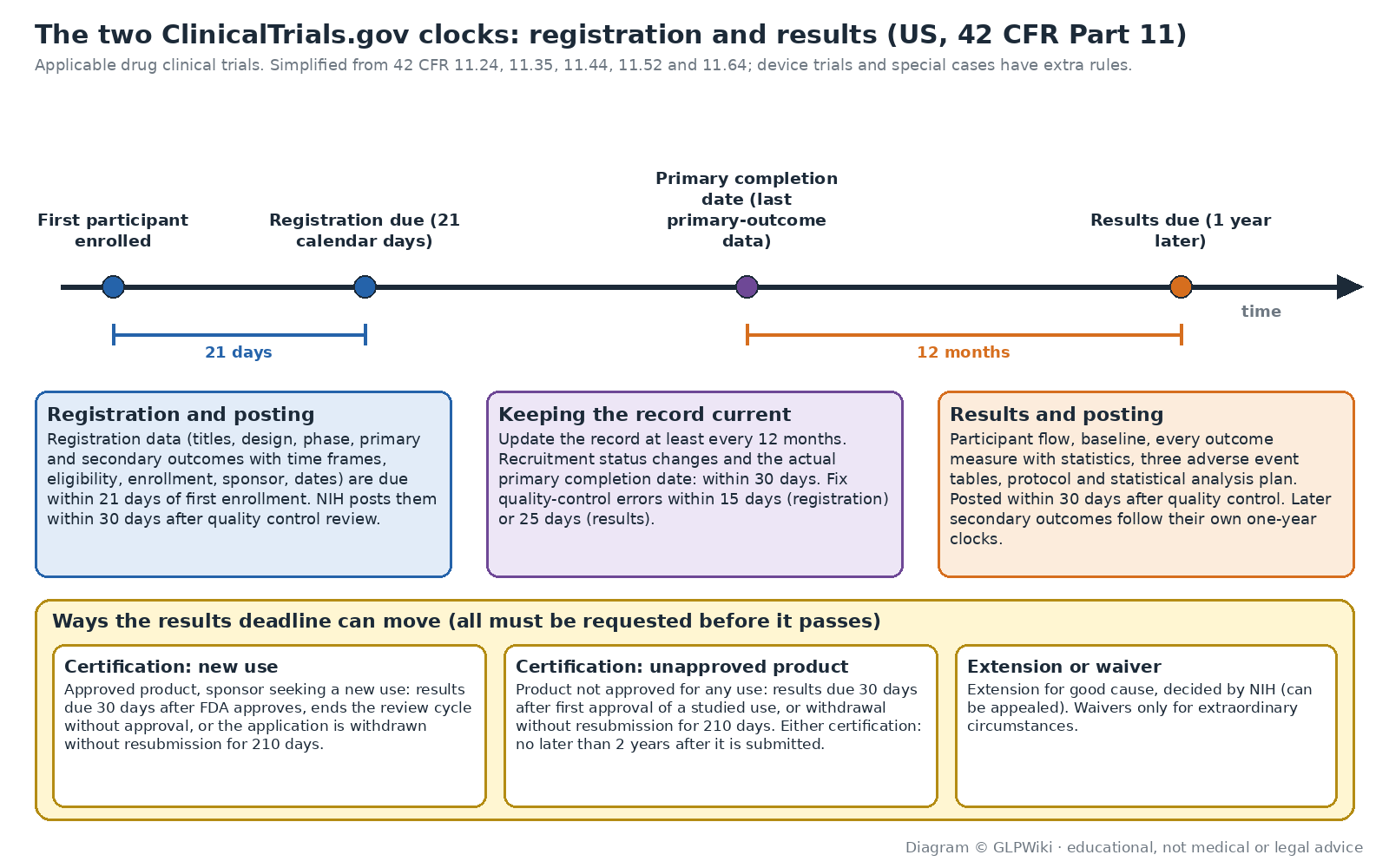
The core registration deadline is short. Under 42 CFR 11.24, the responsible party must submit registration information no later than 21 calendar days after the first human subject is enrolled. The clock starts with enrollment, not with protocol approval or the first site opening, so a trial that registers before enrolling anyone is comfortably early, while one that registers months after the first participant is late.
The registration record is detailed. 42 CFR 11.28 lists the required data elements for trials initiated on or after January 18, 2017. They fall into descriptive information (brief and official titles, a brief summary, primary purpose, study design, phase, study type, primary and secondary outcome measures with time frames, and the intervention names), recruitment information (eligibility criteria, sex, age limits, whether healthy volunteers are accepted, overall recruitment status and enrollment), location and contact information, and administrative data such as the sponsor, the responsible party, IND status and the dates that later anchor the results deadline.
Posting is not immediate. Under 42 CFR 11.35, NIH will post registration information for an applicable drug clinical trial no later than 30 calendar days after it is submitted, after a quality control review by ClinicalTrials.gov staff. That is why records show both a 'first submitted' date and a 'first posted' date.
Keeping the record current
Registration is not a one-time event. 42 CFR 11.64 requires the responsible party to update the record at least once every 12 months, and sooner for specific changes. Overall recruitment status must be updated within 30 calendar days of any change, for example from recruiting to active, not recruiting. The primary completion date must be updated within 30 calendar days after the trial reaches its actual primary completion date, which matters because that date sets the results deadline. Other items, such as intervention names when a non-proprietary name is established and the study start date when the first participant enrolls, have their own 30-day update rules.
Errors get their own clocks. If ClinicalTrials.gov's quality control review flags apparent errors, deficiencies or inconsistencies, the responsible party must correct or address them within 15 calendar days for registration information or 25 calendar days for results information. A responsible party that discovers other errors has the same 15- and 25-day windows.
All information submitted must be truthful. 42 CFR 11.6 says clinical trial information 'shall not be false or misleading in any particular', and submitting false or misleading information is itself a prohibited act.
Results: what is due and when
The standard results deadline in 42 CFR 11.44(a) is no later than one year after the primary completion date. The rule defines primary completion date by reference to 'completion date': the date the final participant was examined or received an intervention for the purposes of final collection of data for the primary outcome, whether the trial finished as planned or was terminated. If a trial has several primary outcomes that finish at different times, it is the date when data collection is complete for all of them.
That definition explains a common source of confusion. Many GLP-1 trials have a primary completion date well before their overall study completion date, because follow-up continues for extension periods, safety visits or secondary outcomes. SURMOUNT-1's record, for example, lists an actual primary completion date of April 1, 2022 and an actual study completion date of July 6, 2024. The one-year results clock runs from the first date, not the second.
Since the final rule, results are required for applicable clinical trials whether or not the product is approved. 42 CFR 11.42 requires results for ACTs of approved, licensed or cleared products, and, for trials with a primary completion date on or after January 18, 2017, for ACTs of products that are not approved. That second category is what brings trials of investigational drugs such as retatrutide within the results requirement.
What a results submission contains
42 CFR 11.48 sets out the results data elements, and they are the same for every trial, which is what makes ClinicalTrials.gov results comparable across sponsors. There are four main modules plus documents:
- Participant flow: how many people started, completed and did not complete each arm or period, with reasons for not completing.
- Baseline characteristics: age, sex, race and ethnicity where collected, and other measures by arm, with the number of participants analyzed.
- Outcome measures and statistical analyses: the result of every primary and secondary outcome measure listed at registration, by arm, with the analysis population and, where the protocol specified them, the statistical tests and results.
- Adverse event information: the time frame and collection approach, and three tables by arm: all serious adverse events grouped by organ system, all other adverse events exceeding 5% frequency in any arm, and all-cause mortality.
- Protocol and statistical analysis plan: for trials covered by the final rule, a copy of the protocol and the statistical analysis plan, including approved amendments, with the NCT number and date on the cover page. Names and confidential commercial information may be redacted.
Secondary outcomes, late adverse events and posting
If data for a secondary outcome or additional adverse event information are still being collected at the primary completion date, the responsible party submits the primary results on the main deadline and the remaining results later. Under 42 CFR 11.44(d), secondary outcome results are generally due one year after the final participant is examined or treated to collect data for that outcome. That is why some GLP-1 records show results that are updated in stages.
Once submitted, results go through ClinicalTrials.gov quality control review and, under 42 CFR 11.52, are posted no later than 30 calendar days after submission. The review checks for apparent errors, inconsistencies and missing information. It is not peer review and it does not judge whether a trial was well designed or whether its conclusions are right.
Delays that are allowed: certifications, extensions and waivers
The one-year deadline has three legal escape valves, and each leaves a visible trace on the record.
Certification to delay results
A responsible party can submit a certification before the results deadline that delays results while FDA is considering, or will consider, the product. There are two versions in 42 CFR 11.44.
The first, in 11.44(b), covers a product that is already approved for some use when the manufacturer, as sponsor, has filed or will file within one year an application for the new use studied in the trial. Results are then due 30 calendar days after the earliest of three events: FDA approves the new use, FDA issues a letter that ends the review cycle without approving it, or the application is withdrawn without resubmission for at least 210 days.
The second, in 11.44(c), covers a product that was not approved for any use before the trial's primary completion date when the sponsor intends to keep developing it and is seeking, or may seek, approval. Results are then due 30 calendar days after the earlier of FDA approval for a use studied in the trial or withdrawal of the application without resubmission for at least 210 days.
Both carry the same cap: results must be submitted no later than two years after the date the certification was submitted, apart from the partial-results rules for later secondary outcomes and adverse events. A certification therefore postpones results while a product or new use is under development or review; it does not let a sponsor keep them private indefinitely.
Extensions and waivers
Under 42 CFR 11.44(e), a responsible party can request an extension for good cause before the deadline, explaining why results cannot be provided on time and estimating when they will be. NIH decides whether good cause is shown, and a denied request can be appealed. More than one extension can be requested for the same trial.
Waivers under 42 CFR 11.54 are rare. They require extraordinary circumstances, and the request must explain why granting it would be consistent with protecting public health or in the interest of national security.
ClinicalTrials.gov's data structure records this in a field labeled 'Certification/Extension (aka Delayed Results) First Submitted Date'. If you see that date on a record, the sponsor used one of these routes before the original deadline; it is not, by itself, a sign of noncompliance.
Enforcement: Pre-Notices, Notices of Noncompliance and penalties
The legal consequences are spelled out in 42 CFR 11.66. Under 21 U.S.C. 331(jj), it is a prohibited act to fail to submit the required certification to FDA or knowingly submit a false one, to fail to submit required clinical trial information, or to submit clinical trial information that is false or misleading in any particular. Prohibited acts can lead to civil or criminal judicial action.
Money penalties come from 21 U.S.C. 333(f)(3). The statute sets a civil money penalty of not more than $10,000 for all violations adjudicated in a single proceeding, and, if a violation is not corrected within 30 days after notification, an additional penalty of not more than $10,000 for each day the violation continues. Federal civil penalties are adjusted for inflation; the HHS table at 45 CFR 102.3 lists a 2025 maximum adjusted amount of $15,107 for each of those two penalties. For trials funded by HHS, 42 CFR 11.66(c) adds a grant consequence: if required registration and results submissions cannot be verified, remaining or future grant funding can be withheld after a 30-day opportunity to correct.
How FDA actually uses its tools
FDA's approach, described in its August 2020 guidance on civil money penalties relating to the ClinicalTrials.gov data bank, is risk-based and stepwise. It may first send a Preliminary Notice of Noncompliance (Pre-Notice) describing potential noncompliance and asking the responsible party to fix it within 30 days. If FDA then determines that a violation exists, it can issue a Notice of Noncompliance. If adequate corrective action is not taken within 30 calendar days of that Notice, FDA says it can pursue regulatory or enforcement action, including civil money penalties, injunctions and criminal prosecution.
FDA publishes both lists. The Pre-Notice table, updated in October 2026, lists more than 300 NCT numbers. The Notices of Noncompliance table, current as of October 30, 2026, lists 11 Notices. The first was sent to Acceleron Pharma on April 27, 2021; later ones went to companies, a research foundation and two individual physicians, and three were dated October 2026. Most entries have a posted response letter. The table lists Notices only; it does not show any penalty amounts.
In 2026 FDA added a step. On April 13, 2026 it announced that on March 30 it had sent messages to more than 2,200 companies and researchers, associated with more than 3,000 registered trials, that did not appear to have submitted required results or may not have completed quality control review. FDA said an internal analysis found that 29.6% of studies highly likely to be subject to mandatory reporting had no results information submitted. The messages sought voluntary compliance before any further regulatory action.
For readers, the practical point is that a Notice of Noncompliance is posted publicly and linked to a specific trial, so it is something you can check. Its absence does not prove a trial is compliant, because enforcement is selective and many deadline questions turn on details, such as certifications or extensions, that are visible only on the record itself.
How well the system works: what compliance studies found
Independent researchers have measured compliance several times, and the results have been consistently disappointing, though improving in some sponsor groups.
A 2015 New England Journal of Medicine study by Anderson and colleagues at Duke identified 13,327 trials highly likely to be applicable clinical trials that ended between January 2008 and August 2012. Only 13.4% reported summary results within 12 months of completion, and 38.3% had reported at any time by September 2013. Industry-funded trials met their obligations more often than trials funded by NIH or other government or academic institutions.
After the final rule took effect, DeVito, Bacon and Goldacre published a cohort study in The Lancet in 2020 covering 4,209 trials that were due to report under the rule. 1,722 (40.9%) reported within the one-year deadline and 2,686 (63.8%) had submitted results at any time. Industry sponsors had about three times the odds of being compliant compared with non-industry, non-government sponsors, and sponsors running many trials did much better than small ones. The median delay from primary completion to submission was 424 days. The authors attributed poor compliance in part to lack of enforcement and built a public tracker, FDAAA TrialsTracker, that reports compliance trial by trial.
Europe has the same problem. A 2018 BMJ study of the EU Clinical Trials Register found that of 7,274 trials where results were due, 49.5% had reported, with commercial sponsors far more likely to post results than non-commercial ones (68.1% versus 11.0%).
Publication in journals does not fill the gap. A 2012 BMJ study of NIH-funded trials registered on ClinicalTrials.gov found that only 46% were published within 30 months of completion and a third remained unpublished after a median of 51 months. A 2013 BMJ study of 585 large registered trials found 29% unpublished, with an estimated 299,763 participants; 78% of the unpublished trials had no results on ClinicalTrials.gov.
These studies cover all therapeutic areas, not GLP-1 trials specifically, and they predate FDA's 2026 outreach. They are useful mainly as context: large industry sponsors, which run most GLP-1 programs, did better than average in these studies, while gaps were most common among smaller and non-industry sponsors.
Beyond US law: journals, NIH, WHO and the EU
Several other rule sets overlap with FDAAA 801, and they explain why trials that the US law does not cover are still usually registered.
ICMJE journal policy
ICMJE recommends that journal editors require registration in a public registry at or before the time of first patient enrollment as a condition of considering a trial for publication, which is stricter than the law's 21-day window. ICMJE uses the date registration materials were first submitted as the registration date. Its definition of a clinical trial is broad, covering any study that prospectively assigns people to a health-related intervention, including behavioral and dietary interventions, and it counts pharmacokinetic measures and adverse events as health outcomes, so early-phase trials fall within it.
ICMJE accepts registration in ClinicalTrials.gov or in any WHO primary registry that collects the 24-item WHO Trial Registration Data Set. It states that the purpose of registration is to prevent selective publication and selective reporting of outcomes, and that retrospective registration at the time of manuscript submission meets none of those purposes. It also says it is the authors', not editors', responsibility to explain discrepancies between results reported in registries and in journal publications, and it recommends that journals print the trial registration number at the end of the abstract.
NIH policy
NIH's Policy on the Dissemination of NIH-Funded Clinical Trial Information, effective January 18, 2017, expects all NIH-funded clinical trials to be registered and to submit results information to ClinicalTrials.gov, whether or not they are applicable clinical trials under the law. That includes phase 1 drug trials and trials of behavioral and other interventions not regulated by FDA, using the same timelines as the regulation.
WHO ICTRP
The World Health Organization's International Clinical Trials Registry Platform (ICTRP) is not itself a registry. It sets standards for primary registries around the world and runs a search portal that pulls their records, including ClinicalTrials.gov's, into one place. Its minimum dataset, the WHO Trial Registration Data Set, currently has 24 items.
WHO's 2015 Statement on Public Disclosure of Clinical Trial Results says that trials of any phase should be registered before the first participant receives the first intervention, that main findings should be submitted for publication within 12 months of study completion and published within 24 months at most, and that key outcomes should be posted to the registry's results section within 12 months. It is a statement of expectations rather than law.
The EU Clinical Trials Regulation and CTIS
In the European Union, Regulation (EU) No 536/2014 governs trials of medicines, and its public database is the Clinical Trials Information System (CTIS), which went live with a searchable public website on January 31, 2022. Article 37 requires the sponsor, irrespective of the outcome, to submit a summary of results within one year of the end of the trial in all Member States concerned, accompanied by a summary written for laypersons. If a trial was intended to support a marketing authorisation, the clinical study report is also due after the authorisation decision.
Two practical points follow. First, the EU clock runs from the end of the trial in all Member States, not from a primary completion date, so the US and EU deadlines for the same multinational GLP-1 trial can differ. Second, EU lay summaries can be among the most readable public documents about a trial. Older trials under the previous Directive remain on the EU Clinical Trials Register.
Worked examples: what GLP-1 trial records show
The dates on real records make these rules concrete. The following examples come from the public ClinicalTrials.gov records as retrieved on November 21, 2026. They describe what the records show, not whether any sponsor met any particular legal obligation, which depends on details not all visible to the public.
- SURMOUNT-1 (tirzepatide, NCT04184622): first submitted December 2, 2019, two days before the actual start date of December 4, 2019. Actual primary completion date April 1, 2022; results first submitted March 30, 2023, just inside one year; results first posted April 24, 2023 after quality control. Study completion came later, on July 6, 2024, because the record includes a longer follow-up period.
- STEP 1 (semaglutide, NCT03548935): first submitted May 25, 2018, before the June 4, 2018 start. Actual primary completion date March 30, 2020. The record shows a certification or extension first submitted on March 3, 2021, before the one-year mark; results were first submitted June 16, 2021 and posted August 11, 2021. FDA approved semaglutide for chronic weight management on June 4, 2021, and results were first submitted 12 days after that approval.
- SELECT (semaglutide, NCT03574597): first submitted June 21, 2018, before the October 24, 2018 start. Actual primary completion date June 21, 2023; results first submitted June 18, 2024, inside one year; first posted August 30, 2024. The record also lists 'Has Data Monitoring Committee: Yes' and includes the protocol and statistical analysis plan.
- Retatrutide phase 2 obesity trial (NCT04881760): actual primary completion date May 16, 2022. A certification or extension was first submitted on May 10, 2023, just before the one-year mark, and results were first submitted August 23, 2023 and posted September 13, 2023, after the main paper was published online in June 2023. Retatrutide is not FDA-approved, so this shows that a sponsor can post results before a certification would require it.
- SURMOUNT-OSA (tirzepatide, NCT05412004): actual primary completion date March 12, 2024; results first submitted March 11, 2025; first posted April 30, 2025.
- ATTAIN-1 (orforglipron, NCT05869903): actual primary completion date July 25, 2025; results first submitted July 23, 2026 and posted August 14, 2026, while the overall study, with an estimated completion in October 2027, is still listed as active, not recruiting.
- TRIUMPH-1 (retatrutide, NCT05929066): first submitted June 26, 2023, before the July 10, 2023 start. The record lists four primary outcomes, including weight change and separate outcomes for sleep apnea and knee osteoarthritis subsets, an actual primary completion date of April 6, 2026, and status Completed. As of November 21, 2026 it shows no posted results and no certification date. Under the standard rule results would be due by April 6, 2027, unless a certification or granted extension changes that.
Patterns worth noticing
Three patterns stand out. First, the large sponsors in this field generally register before the first participant and submit results close to the one-year mark, which is consistent with the compliance studies' finding that big industry sponsors do better than average. Second, the gap between 'results first submitted' and 'results first posted' is often several weeks to a few months, reflecting quality control review; a recently completed trial with no posted results may already have submitted them. Third, the certification and extension field is the key to reading delays: without it, a results date more than a year after primary completion can look late when it was legally postponed.
These records also show why registry data and press releases differ. A press release for a trial like TRIUMPH-1 may highlight one primary outcome. The registry lists all four, which is the commitment the sponsor made in public.
How to read the compliance-relevant parts of a record
GLPWiki's ClinicalTrials.gov guide covers searching and the basic layout of a study page. For compliance questions, a smaller set of fields does most of the work.
Dates
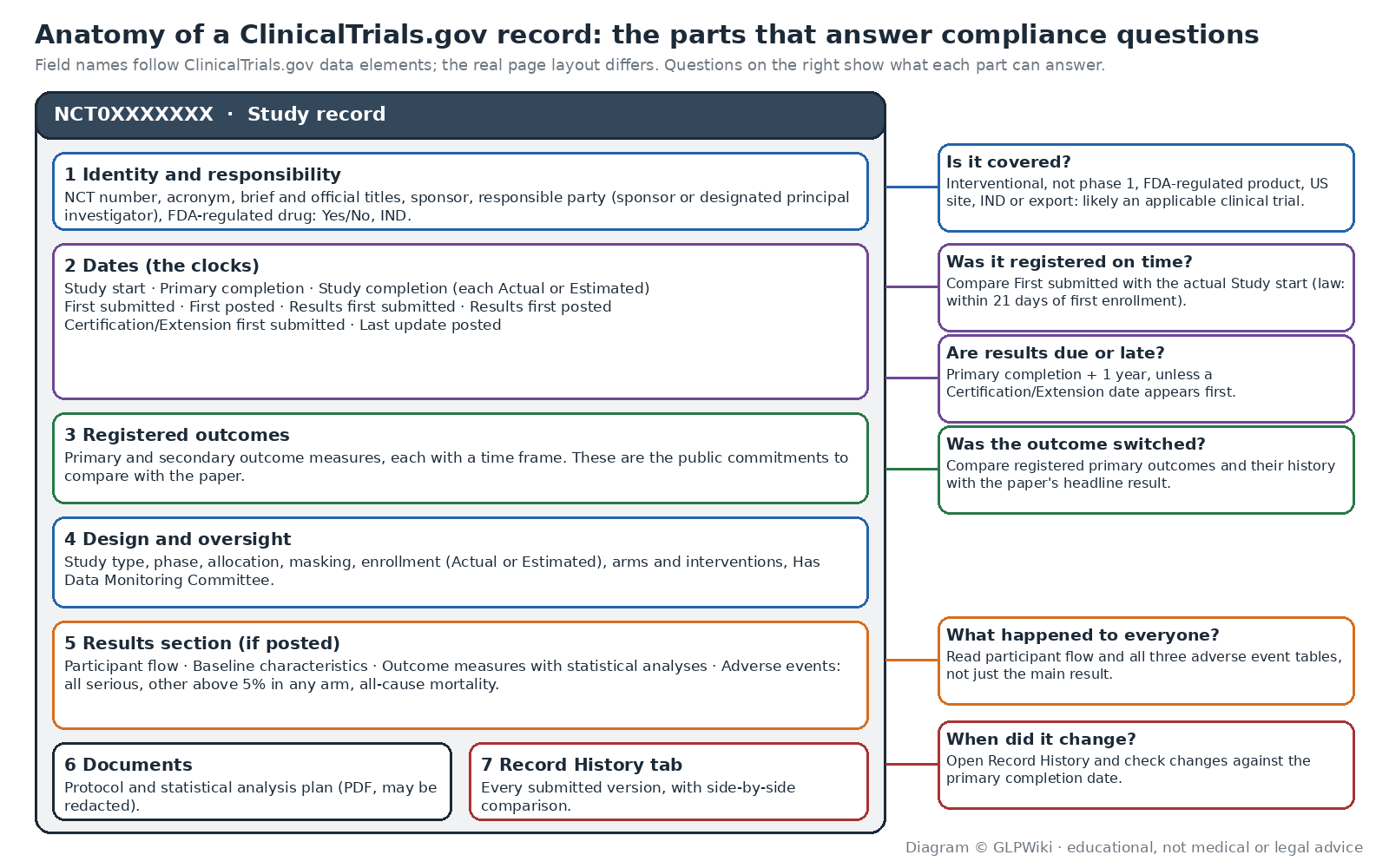
The study details include the study start date, the primary completion date and the study completion date, each marked actual or estimated. The record's dates also include the first submitted and first posted dates, the results first submitted and results first posted dates, the certification or extension first submitted date if one exists, and the last update posted date. Comparing the first submitted date with the actual start date tells you whether registration was prospective. Comparing the actual primary completion date with the results first submitted date, and checking for a certification date, tells you how the results deadline played out.
Outcomes
The outcome measures list shows the registered primary and secondary outcomes with their time frames. Registered outcomes are only as useful as they are specific. A 2011 New England Journal of Medicine analysis by ClinicalTrials.gov staff found that 61% of a sample of 100 registered outcome measures lacked specificity in describing the metric used in the planned analysis. Because a record can be edited, the current version may not be the original. The Record History tab lists every submitted version and lets you compare two of them, so you can see whether a primary outcome was changed, added or dropped, and when that happened relative to the primary completion date.
Results and documents
If results are posted, the results section shows participant flow, baseline characteristics, every outcome measure with its analysis population and statistical analysis, and the adverse event tables. For trials covered by the final rule, the documents section usually includes the protocol and statistical analysis plan as PDFs, often redacted. These can be compared directly with the paper's methods section.
Remember what these results are not. They are summary data supplied by the sponsor, checked for consistency but not peer reviewed. They do not include individual participant data, and they are not FDA's analysis. On a study page, 'Results Submitted' means results are under review and not yet posted. A 2018 BMJ article by National Library of Medicine authors, 'How to avoid common problems when using ClinicalTrials.gov in research', is a good guide to the database's limits.
Outcome switching and reporting bias: why the registry matters
Registration exists largely because of reporting bias: the tendency for positive results, favorable outcomes and successful trials to be published more often, more quickly or more prominently than others. The evidence that this happens is strong.
In a 2004 JAMA study, Chan and colleagues compared 102 trial protocols approved by Danish ethics committees with 122 resulting publications. Statistically significant outcomes were more likely to be fully reported than nonsignificant ones, and 62% of trials had at least one primary outcome that was changed, introduced or omitted between protocol and publication. When surveyed, 86% of responding authors denied the existence of unreported outcomes despite clear evidence to the contrary.
Registration has not eliminated the problem. A 2009 JAMA study of 323 trials in high-impact journals found that only 45.5% were adequately registered before the end of the trial with a clearly specified primary outcome, and that 31% of adequately registered trials showed some discrepancy between registered and published outcomes; where the effect could be assessed, the discrepancies favored statistically significant results in 82.6% of cases. In the COMPare project, published in Trials in 2019, researchers checked 67 trials in five leading journals against their pre-specified outcomes; 58 (87%) had discrepancies requiring a correction letter, and only 40% of those letters were published.
The consequences show up in the evidence base. A 2008 New England Journal of Medicine study of antidepressant trials registered with FDA found that the published literature made 94% of trials look positive, while FDA's analysis showed 51% were positive, and that selective publication inflated apparent effect sizes by 32% overall. A 2010 BMJ study of Cochrane reviews found that a third contained at least one trial with high suspicion of outcome reporting bias for the review's primary outcome. A 2013 updated systematic review in PLOS ONE found that, across cohorts comparing publications with protocols, 40% to 62% of studies had at least one primary outcome changed, introduced or omitted.
Not every change is misconduct
Protocols are legitimately amended. Outcomes are refined, time points change, and new primary outcomes can be added for good scientific or regulatory reasons, especially in long trials. The question is whether a change was made transparently and before the results were known, and whether the paper explains it. Reporting guidelines push in the same direction. SPIRIT 2025 sets out what a trial protocol should prespecify, and CONSORT 2025, a 30-item checklist for trial reports, added a new section on open science; both were updated in 2025 and are meant to make it easier to compare what was planned with what was reported.
For GLP-1 readers, the practical habit is simple: when a paper, press release or social media post highlights a result, check whether it was a registered primary outcome, a registered secondary outcome, or something else, and whether the registry shows when it was added.
A reader's checklist for registry and results claims
When a GLP-1 or obesity trial is in the news, or someone cites one to support a claim, these questions help you use the registry the way it was intended.
- Find the NCT number. Most papers print it at the end of the abstract; ICMJE recommends this. Without an identifier, be cautious about any claim of a 'trial'.
- Was it registered prospectively? Compare the first submitted date with the actual study start date.
- Is it an applicable clinical trial? A phase 1 study, an observational study or a trial with no US connection may not be covered by the law's results requirement.
- What were the registered primary outcomes and time frames? Check whether the headline result is one of them, and open the Record History tab if the outcome looks different.
- When was the primary completion date? Results are generally due one year later. Look for a certification or extension date before calling results late.
- Are results posted? Look at all outcomes and the three adverse event tables, not just the primary result, and note the number of participants analyzed.
- Do the paper and the registry match? ICMJE says authors must explain discrepancies. Unexplained differences in outcomes, sample sizes or analysis populations are worth noting.
- Is there an enforcement record? FDA's Notices of Noncompliance table is public; trackers such as FDAAA TrialsTracker report trial-level compliance using their own methods.
- For multinational trials, check other registries through the WHO ICTRP search portal, and look for an EU lay summary in CTIS if the trial ran in the EU.
- Keep the registry in its place. A registry record is not FDA approval, not a recommendation to use any product and not an invitation to enroll; posted results are not peer-reviewed conclusions.
What this guide cannot tell you
This guide describes the rules and what public records show. It cannot tell you whether any specific trial, sponsor or investigator is or was compliant, because that depends on facts such as IND status, certifications, extension decisions and correspondence that are not always public, and on legal interpretations that belong to FDA and the courts. Dates in the worked examples are as shown on ClinicalTrials.gov on November 21, 2026 and can change when sponsors update records.
Device trials, pediatric postmarket surveillance studies and expanded access records have additional rules not covered in detail here, and non-US requirements are summarized only at a high level. The compliance studies cited cover all therapeutic areas and specific time periods. Nothing here says whether any GLP-1 medicine is appropriate for any person.
Scope, disclaimer and review date
This guide is general educational information about how clinical trial registration and results reporting work, mainly under US law. It is not medical advice, legal advice or a regulatory compliance opinion, and it does not recommend or rate any product, company, study, investigator or clinician. It contains no dosing information. Decisions about any medicine belong with a licensed clinician who knows your history. Questions about obligations under FDAAA 801 or 42 CFR Part 11 belong with ClinicalTrials.gov, FDA or a qualified professional.
Regulatory text is quoted from the eCFR, the US Code and FDA, NIH, WHO, ICMJE and EU sources current at the time of review; trial dates come from the cited ClinicalTrials.gov records; research findings come from the cited peer-reviewed papers. Check the originals for full context. Last reviewed: November 21, 2026.
Frequently asked questions
- What is FDAAA 801?
- It is section 801 of the Food and Drug Administration Amendments Act of 2007, which added section 402(j) to the Public Health Service Act (42 U.S.C. 282(j)). It requires registration of applicable clinical trials on ClinicalTrials.gov and submission of summary results, and it makes failure to comply a prohibited act subject to civil money penalties. Its implementing regulation is 42 CFR Part 11, effective January 18, 2017.
- Does every clinical trial have to be registered on ClinicalTrials.gov?
- No. The US law covers applicable clinical trials: for drugs, interventional studies other than phase 1, of an FDA-regulated product, with a US site, a US IND or a product exported from the US for the study. Phase 1 and observational studies are not covered by the law, although NIH policy, ICMJE journal policy, WHO guidance and EU law often require registration anyway.
- How soon must a trial be registered?
- Under 42 CFR 11.24, no later than 21 calendar days after the first participant is enrolled. ICMJE journals expect registration at or before the time of first patient enrollment, and WHO says registration should happen before the first participant receives the first intervention.
- When are results due?
- Generally no later than one year after the primary completion date, which is the date the last participant was examined or treated to collect data for the primary outcome. A certification can delay results while FDA approval of a new product or new use is pending, but generally for no more than two years after the certification is submitted, and extensions can be granted for good cause.
- What does 'Certification/Extension First Submitted' mean on a record?
- It is the date the sponsor or investigator first submitted a certification or an extension request to delay results submission. It means a legal delay route was used before the original deadline. It is not a finding of noncompliance, and results may still be posted early, as happened with the retatrutide phase 2 trial.
- What happens if a sponsor does not report results?
- Failing to submit required information is a prohibited act under 21 U.S.C. 331(jj). FDA may send a Pre-Notice asking for correction within 30 days and then a Notice of Noncompliance; if the problem is not corrected within 30 days of that Notice, FDA can seek civil money penalties, up to $10,000 per proceeding plus up to $10,000 per day under the statute, adjusted for inflation to $15,107 in the 2025 HHS table. HHS-funded grantees can also have funding withheld.
- What is outcome switching?
- It is when the outcomes reported in a paper differ from those specified in advance in the protocol or registry, for example a primary outcome that is changed, demoted, added or dropped. Studies have found it often favors statistically significant results. Comparing the registry's outcomes and record history with the paper is the main way readers can spot it.
- How do I check a GLP-1 trial like SURMOUNT-1 or TRIUMPH-1?
- Search ClinicalTrials.gov for the NCT number (NCT04184622 for SURMOUNT-1, NCT05929066 for TRIUMPH-1) or the trial acronym. Check the start, primary completion and results dates, the registered primary outcomes, any certification date, the posted results and adverse event tables, the protocol documents and the Record History tab. A registry record is not FDA approval or medical advice.
SOURCES
- 0142 U.S.C. 282(j) – Expanded clinical trial registry data bank (FDAAA 801)— Legal Information Institute, Cornell Law School
- 0221 U.S.C. 331(jj) – Prohibited acts relating to ClinicalTrials.gov— Legal Information Institute, Cornell Law School
- 0321 U.S.C. 333(f)(3) – Civil monetary penalties for ClinicalTrials.gov violations— Legal Information Institute, Cornell Law School
- 0442 CFR Part 11 – Clinical Trials Registration and Results Information Submission— eCFR
- 0542 CFR 11.10 – Definitions (applicable clinical trial, responsible party, primary completion date)— eCFR
- 0642 CFR 11.22 – Which applicable clinical trials must be registered— eCFR
- 0742 CFR 11.24 – When registration information must be submitted (21 days)— eCFR
- 0842 CFR 11.28 – Clinical trial registration information— eCFR
- 0942 CFR 11.42 – Trials for which results must be submitted— eCFR
- 1042 CFR 11.44 – Results deadlines, certifications and extensions— eCFR
- 1142 CFR 11.48 – Clinical trial results information— eCFR
- 1242 CFR 11.54 – Waivers of results requirements— eCFR
- 1342 CFR 11.64 – Updates and corrections— eCFR
- 1442 CFR 11.66 – Legal consequences of noncompliance— eCFR
- 1545 CFR 102.3 – HHS civil monetary penalty inflation adjustment table— eCFR
- 1621 CFR 50.25 – Elements of informed consent (ClinicalTrials.gov statement, 50.25(c))— eCFR
- 17Clinical Trials Registration and Results Information Submission – Final Rule (81 FR 64982, September 21, 2016)— Federal Register
- 18NIH Policy on the Dissemination of NIH-Funded Clinical Trial Information (NOT-OD-16-149)— National Institutes of Health
- 19Requirements for Registering and Reporting NIH-Funded Clinical Trials— National Institutes of Health
- 20Checklist for Evaluating Whether a Clinical Trial or Study is an Applicable Clinical Trial (ACT)— ClinicalTrials.gov (NLM/NIH)
- 21FDAAA 801 and the Final Rule— ClinicalTrials.gov (NLM/NIH)
- 22Results Data Element Definitions— ClinicalTrials.gov (NLM/NIH)
- 23How to Read a Study Record— ClinicalTrials.gov (NLM/NIH)
- 24ClinicalTrials.gov API and study data structure— ClinicalTrials.gov (NLM/NIH)
- 25FDA's Role: ClinicalTrials.gov Information— U.S. Food and Drug Administration
- 26ClinicalTrials.gov – Notices of Noncompliance— U.S. Food and Drug Administration
- 27ClinicalTrials.gov – Pre-Notices for Potential Noncompliance— U.S. Food and Drug Administration
- 28Civil Money Penalties Relating to the ClinicalTrials.gov Data Bank (guidance, August 2020)— U.S. Food and Drug Administration
- 29Form FDA 3674 – Certifications To Accompany Drug, Biological Product, and Device Applications/Submissions (guidance)— U.S. Food and Drug Administration
- 30FDA Reminds More Than 2,200 Sponsors and Researchers to Disclose Trial Results (April 13, 2026)— U.S. Food and Drug Administration
- 31FDA Approves New Drug Treatment for Chronic Weight Management, First Since 2014 (June 4, 2021; archived)— U.S. Food and Drug Administration
- 32ICMJE Recommendations: Clinical Trials – Registration— International Committee of Medical Journal Editors
- 33International Clinical Trials Registry Platform (ICTRP)— World Health Organization
- 34WHO Trial Registration Data Set (24 items)— World Health Organization
- 35WHO Statement on Public Disclosure of Clinical Trial Results (April 9, 2015)— World Health Organization
- 36ICTRP Search Portal— World Health Organization
- 37Regulation (EU) No 536/2014 on clinical trials on medicinal products for human use— EUR-Lex
- 38Clinical Trials Information System (CTIS)— European Medicines Agency
- 39EU Clinical Trials Register— European Medicines Agency
- 40FDAAA TrialsTracker— Bennett Institute, University of Oxford
- 41SURMOUNT-1: A Study of Tirzepatide in Participants With Obesity or Overweight (NCT04184622)— ClinicalTrials.gov
- 42STEP 1: Semaglutide in People With Obesity (NCT03548935)— ClinicalTrials.gov
- 43SELECT: Semaglutide Effects on Heart Disease and Stroke in Patients With Overweight or Obesity (NCT03574597)— ClinicalTrials.gov
- 44A Study of LY3437943 (retatrutide) in Participants Who Have Obesity or Are Overweight – phase 2 (NCT04881760)— ClinicalTrials.gov
- 45SURMOUNT-OSA: Tirzepatide in Participants With Obstructive Sleep Apnea and Obesity (NCT05412004)— ClinicalTrials.gov
- 46ATTAIN-1: Orforglipron in Adults With Obesity or Overweight (NCT05869903)— ClinicalTrials.gov
- 47TRIUMPH-1: Retatrutide in Participants Who Have Obesity or Overweight (NCT05929066)— ClinicalTrials.gov
- 48Simes RJ. Publication bias: the case for an international registry of clinical trials. J Clin Oncol. 1986;4:1529-41— PubMed
- 49Dickersin K, Rennie D. Registering clinical trials. JAMA. 2003;290:516-23— PubMed
- 50De Angelis C, et al. Clinical trial registration: a statement from the ICMJE. N Engl J Med. 2004;351:1250-1— PubMed
- 51Zarin DA, et al. The ClinicalTrials.gov results database – update and key issues. N Engl J Med. 2011;364:852-60— PubMed
- 52Zarin DA, et al. Trial Reporting in ClinicalTrials.gov – The Final Rule. N Engl J Med. 2016;375:1998-2004— PubMed
- 53Anderson ML, et al. Compliance with results reporting at ClinicalTrials.gov. N Engl J Med. 2015;372:1031-9— PubMed
- 54DeVito NJ, Bacon S, Goldacre B. Compliance with legal requirement to report clinical trial results on ClinicalTrials.gov: a cohort study. Lancet. 2020;395:361-369— PubMed
- 55Goldacre B, et al. Compliance with requirement to report results on the EU Clinical Trials Register: cohort study and web resource. BMJ. 2018;362:k3218— PubMed
- 56Ross JS, et al. Publication of NIH funded trials registered in ClinicalTrials.gov: cross sectional analysis. BMJ. 2012;344:d7292— PubMed
- 57Jones CW, et al. Non-publication of large randomized clinical trials: cross sectional analysis. BMJ. 2013;347:f6104— PubMed
- 58Chan AW, et al. Empirical evidence for selective reporting of outcomes in randomized trials. JAMA. 2004;291:2457-65— PubMed
- 59Mathieu S, et al. Comparison of registered and published primary outcomes in randomized controlled trials. JAMA. 2009;302:977-84— PubMed
- 60Goldacre B, et al. COMPare: a prospective cohort study correcting and monitoring 58 misreported trials in real time. Trials. 2019;20:118— PubMed
- 61Turner EH, et al. Selective publication of antidepressant trials and its influence on apparent efficacy. N Engl J Med. 2008;358:252-60— PubMed
- 62Kirkham JJ, et al. The impact of outcome reporting bias in randomised controlled trials on a cohort of systematic reviews. BMJ. 2010;340:c365— PubMed
- 63Dwan K, et al. Systematic review of the empirical evidence of study publication bias and outcome reporting bias – an updated review. PLoS One. 2013;8:e66844— PubMed
- 64Tse T, Fain KM, Zarin DA. How to avoid common problems when using ClinicalTrials.gov in research: 10 issues to consider. BMJ. 2018;361:k1452— PubMed
- 65Chan AW, et al. SPIRIT 2025 statement: updated guideline for protocols of randomised trials. Lancet. 2025;405:e19-e27— PubMed
- 66Hopewell S, et al. CONSORT 2025 statement: updated guideline for reporting randomised trials. BMJ. 2025;389:e081123— PubMed
- 67Wilding JPH, et al. Once-Weekly Semaglutide in Adults with Overweight or Obesity (STEP 1). N Engl J Med. 2021;384:989-1002— PubMed
- 68Jastreboff AM, et al. Tirzepatide Once Weekly for the Treatment of Obesity (SURMOUNT-1). N Engl J Med. 2022;387:205-216— PubMed
- 69Jastreboff AM, et al. Triple-Hormone-Receptor Agonist Retatrutide for Obesity – A Phase 2 Trial. N Engl J Med. 2023;389:514-526— PubMed
- 70Lincoff AM, et al. Semaglutide and Cardiovascular Outcomes in Obesity without Diabetes (SELECT). N Engl J Med. 2023;389:2221-2232— PubMed
- 71Malhotra A, et al. Tirzepatide for the Treatment of Obstructive Sleep Apnea and Obesity (SURMOUNT-OSA). N Engl J Med. 2024;391:1193-1205— PubMed
- 72Wharton S, et al. Orforglipron, an Oral Small-Molecule GLP-1 Receptor Agonist for Obesity Treatment (ATTAIN-1). N Engl J Med. 2025;393:1796-1806— PubMed
EDUCATIONAL REFERENCE ONLY · Not medical advice. Nothing here diagnoses, treats, cures or prevents any disease, and nothing here is a dosing recommendation. Consult a licensed clinician before any treatment decision.