Clinical reference library
Full-length explanations rather than summary cards. Each guide states its sources, separates human trial evidence from animal and cell work, and links back to the relevant reference entries and calculators.
LITERACY · HANDLING · EVIDENCE CHECK · COMPARISON · EXPLAINER · REFERENCE · SAFETY · DOSING MATH
 LITERACY
How to read Highlights of Prescribing Information: the half-page front of an FDA label, line by line
Every modern FDA prescription label opens with a box of dense, bold, bulleted text titled "HIGHLIGHTS OF PRESCRIBING INFORMATION." It is the most-read part of the label and the easiest to misread. Over the last several weeks GLPWiki has walked through the numbered sections of the Full Prescribing Information one at a time. This guide covers the part that sits in front of all of them: what 21 CFR 201.57(a) requires Highlights to contain, how to decode the title line, the "Initial U.S. Approval" year, the summarized Boxed Warning, Recent Major Changes and the revision date, and why Highlights is designed as a signpost rather than a substitute for the Full PI. Label-reading literacy only: no doses, no treatment recommendations, no medical advice.
UPDATED 2026-10-26 · 12 MIN · 25 SOURCES
 LITERACY
How to read the Drug Abuse and Dependence section on peptide labels (Section 9): controlled-substance status, abuse vs misuse vs addiction, and why GLP-1 labels skip it
GLPWiki's how-to-read-fda-peptide-labeling hub maps the whole Prescribing Information, and our Day 44 guide covered Section 10 Overdosage. This companion explains the section that sits just before it: Section 9 Drug Abuse and Dependence. What 21 CFR 201.57(c)(10) requires in 9.1 Controlled Substance, 9.2 Abuse and 9.3 Dependence; how the DEA schedule symbol shows up on the Highlights title line; the precise label meanings of abuse, misuse, addiction, physical dependence and tolerance; and why current GLP-1 and most peptide labels have no Section 9 at all. Label-reading literacy only: no doses, no treatment recommendations, no medical advice.
UPDATED 2026-10-25 · 12 MIN · 21 SOURCES
 LITERACY
How to read the Indications and Usage section on peptide labels (Section 1): the indication sentence, Limitations of Use, and what "approved for" really means
GLPWiki's how-to-read-fda-peptide-labeling hub maps the whole Prescribing Information, and our GLP-1 indication guides list which product carries which use. This companion goes one level deeper on Section 1 itself: what 21 CFR 201.57(c)(2) requires an indication to contain, how to read an indication sentence in parts, why 'adjunct to diet and exercise' and 'reduce the risk of' are deliberate wording, how Limitations of Use differ from contraindications and from off-label use, what accelerated-approval wording signals, and why a molecule name is never an indication. Label-reading literacy only: no doses, no treatment recommendations, no medical advice.
UPDATED 2026-10-24 · 13 MIN · 25 SOURCES
 LITERACY
How to read the Overdosage section on peptide labels (Section 10): what it says, what it leaves out, and who to call
GLPWiki's how-to-read-fda-peptide-labeling hub maps the whole Prescribing Information. This companion goes deep on Section 10 Overdosage: what 21 CFR 201.57(c)(11) requires, what current semaglutide, tirzepatide and liraglutide labels actually say, why the observation period is tied to the half-life, how Section 10 connects to Sections 2, 5, 12 and 17, why pen design and compounded vial-and-syringe dosing errors matter, and the one action that applies to everyone: call Poison Help at 1-800-222-1222, or 911 in an emergency. Label-reading literacy only: no doses, no treatment instructions, no medical advice.
UPDATED 2026-10-23 · 12 MIN · 21 SOURCES
 LITERACY
How to read the Description section on peptide labels (Section 11): active ingredient, structure, salt forms and inactive ingredients
GLPWiki's how-to-read-fda-peptide-labeling hub maps the whole Prescribing Information. This companion goes deep on Section 11 Description: what 21 CFR 201.57(c)(12) requires, how the proprietary and established names relate, what the chemical description, molecular formula and molecular weight of a peptide tell you, how inactive ingredients are declared, why salt forms matter, why multiple-dose presentations list preservatives, and how a Description section differs from a research-peptide certificate of analysis. Label-reading literacy only: no strengths, doses, product picks, or medical advice.
UPDATED 2026-10-22 · 13 MIN · 17 SOURCES
 LITERACY
How to read Dosage Forms and Strengths on peptide labels (Section 3): forms, strength expressions and package types
GLPWiki's how-to-read-fda-peptide-labeling hub maps the whole Prescribing Information. This companion goes deep on Section 3 Dosage Forms and Strengths: what 21 CFR 201.57(c)(4) requires, how the Highlights version under 201.57(a)(8) is condensed, how Section 3 differs from Section 2 Dosage and Administration, Section 16 How Supplied and the carton, how injectable strengths are written (total per total volume, then per mL), what single-dose, multiple-dose and single-patient-use mean, and why mixing up milligrams, milliliters and syringe units has caused real errors. Label-reading literacy only: no strengths, doses, product picks, or medical advice.
UPDATED 2026-10-21 · 13 MIN · 15 SOURCES
 LITERACY
How to read Nonclinical Toxicology on peptide labels (Section 13): animal carcinogenicity, genotoxicity and fertility findings
GLPWiki's how-to-read-fda-peptide-labeling hub maps the whole Prescribing Information. This companion goes deep on Section 13 Nonclinical Toxicology: what 21 CFR 201.57(c)(14) requires in 13.1 Carcinogenesis, Mutagenesis, Impairment of Fertility and 13.2 Animal Toxicology and/or Pharmacology, how animal findings are reported relative to human exposure, why a rodent finding is not automatically a human finding, how rodent thyroid C-cell tumor findings for GLP-1 receptor agonists became a Boxed Warning and an MTC / MEN 2 contraindication, how to read a genotoxicity battery, why fertility findings sit in Section 13 while embryo-fetal findings sit in Section 8, and how to cross-check it all on Drugs@FDA and DailyMed. Label-reading literacy only: no doses, animal dose numbers, product picks, or medical advice.
UPDATED 2026-10-20 · 15 MIN · 16 SOURCES
 LITERACY
How to read Patient Counseling Information, Medication Guides and IFUs on peptide labels (Section 17)
GLPWiki's how-to-read-fda-peptide-labeling hub maps the whole Prescribing Information. This companion goes deep on its last numbered section, Section 17 Patient Counseling Information, and on the FDA-approved patient labeling it points to: what 21 CFR 201.57(c)(18) requires, what a Medication Guide is under 21 CFR Part 208 and when FDA requires one, how a Patient Package Insert and Instructions for Use differ, where each one lives in a label, how to find the current versions on Drugs@FDA, DailyMed, and FDALabel and compare revision dates, and why compounded or research products have no FDA-approved Medication Guide or IFU. Label-reading literacy only: no doses, schedules, injection steps, product picks, or medical advice.
UPDATED 2026-10-19 · 14 MIN · 14 SOURCES
 LITERACY
How to read How Supplied / Storage and Handling on peptide labels (Section 16)
GLPWiki's how-to-read-fda-peptide-labeling hub maps the whole Prescribing Information. This companion goes deep on Section 16 How Supplied / Storage and Handling: what 21 CFR 201.57(c)(17) requires it to contain, how to read the presentation and package tables, what the three segments of a National Drug Code (NDC) mean, how to cross-check an NDC in the FDA NDC Directory and on DailyMed, where storage and handling wording appears across the label (Section 16, Section 2, the Medication Guide, Instructions for Use, and the carton), and why compounded or research products have no FDA-approved Section 16. Label-reading literacy only: no doses, schedules, product picks, or storage instructions of our own.
UPDATED 2026-10-18 · 14 MIN · 16 SOURCES
 LITERACY
How to read Clinical Studies on peptide labels (Section 14)
GLPWiki's how-to-read-fda-peptide-labeling hub notes that Clinical Studies in a label are selected evidence, not the whole literature. This companion goes deeper on Section 14 itself: what 21 CFR 201.57(c)(15) requires it to contain, how to read study design, enrolled population, endpoints, and results tables or figures, why primary-versus-secondary labels matter less than prospectively defined endpoints, why label results are trial-population averages rather than personal predictions, why separate trials of different products are not head-to-head evidence, and how to cross-check a Section 14 trial against its ClinicalTrials.gov NCT record and PubMed paper. Educational only: no doses, schedules, product picks, or outcome promises.
UPDATED 2026-10-17 · 15 MIN · 17 SOURCES
 LITERACY
How to read Use in Specific Populations on peptide labels (Section 8)
GLPWiki's how-to-read-fda-peptide-labeling hub already maps PLR sections. This companion goes deeper on Section 8 Use in Specific Populations under the Pregnancy and Lactation Labeling Rule (PLLR): how 8.1 Pregnancy, 8.2 Lactation, and 8.3 Females and Males of Reproductive Potential are structured; what 8.4–8.7 Pediatric / Geriatric / Renal / Hepatic answer as labeled CONCEPTS; why old pregnancy letter categories A–X are removed; and a product-specific verify path on Drugs@FDA and DailyMed. Educational only: no pregnancy advice, lactation advice, doses, or medical recommendations.
UPDATED 2026-10-16 · 15 MIN · 16 SOURCES
 LITERACY
How to read Drug Interactions on peptide labels (Section 7)
GLPWiki's how-to-read-fda-peptide-labeling hub already maps PLR sections. This companion goes deeper on Section 7 Drug Interactions: how it differs from Contraindications / Warnings and Precautions and from Clinical Pharmacology 12.3 PK tables; what "clinically significant" and "predicted" mean in labeling rules; food and laboratory-test interference; delayed gastric emptying oral-medication caution as CONCEPT literacy only; and a product-specific verify path on Drugs@FDA and DailyMed. Educational only: no doses, schedules, or medical recommendations.
UPDATED 2026-10-15 · 15 MIN · 17 SOURCES
 LITERACY
How to read Warnings, Precautions, and Adverse Reactions on peptide labels
GLPWiki's how-to-read-fda-peptide-labeling hub already teases that Boxed Warning, Warnings and Precautions, and Adverse Reactions answer different safety questions. This companion goes deeper: how Contraindications (Section 4), Warnings and Precautions (Section 5), Adverse Reactions (Section 6), and a Boxed Warning (when present) differ; how to read incidence tables and denominators; why rates never transfer across brands sharing an API nickname; and how MedWatch reporting relates to — but is not the same as — approved labeling. Educational only: no doses, schedules, or medical recommendations.
UPDATED 2026-10-14 · 15 MIN · 13 SOURCES
 LITERACY
How to read Clinical Pharmacology on peptide labels (Section 12)
GLPWiki's how-to-read-fda-peptide-labeling hub maps the whole Prescribing Information. This companion goes deeper into Section 12 Clinical Pharmacology — where mechanism (12.1), pharmacodynamics (12.2), and pharmacokinetics (12.3) live — and how to read absorption, bioavailability, Tmax, food effect, distribution, half-life, elimination, drug-interaction tables, and specific-population statements on peptide and GLP-1 labels. Literacy examples include why semaglutide's ~1-week half-life underlies weekly labeling CONCEPTS, tirzepatide's ~5-day half-life, oral semaglutide food/water absorption literacy, and delayed gastric emptying language that links Section 12 to Section 7 oral-medication caution. Educational only: no doses, schedules, or medical recommendations.
UPDATED 2026-10-13 · 16 MIN · 13 SOURCES
 LITERACY
SNAC and oral peptide absorption: formulation science primer
Most therapeutic peptides degrade in the gut and absorb poorly as tablets. SNAC (salcaprozate sodium) is the absorption enhancer co-formulated in FDA-approved oral semaglutide tablets. This primer goes deeper than GLPWiki's oral-peptides and oral-vs-injectable companions: what SNAC is chemically, the Buckley et al. Sci Transl Med 2018 stomach mechanism (local pH buffering, monomerization, transient transcellular permeability), why absolute bioavailability stays on the order of ~1% or less and is highly sensitive to food and water conditions as label literacy, how C10/sodium caprate and enteric designs differ, and why small-molecule oral GLP-1 receptor agonists such as orforglipron are a different strategy. Educational only: no doses, schedules, or product recommendations.
UPDATED 2026-10-12 · 15 MIN · 12 SOURCES
 HANDLING
BAC water basics: benzyl alcohol, multi-dose vials and diluent literacy
Bacteriostatic Water for Injection (often called BAC water) is a sterile diluent that typically contains benzyl alcohol as a preservative and is supplied in multiple-dose vials. This guide explains what BAC water is and is not, how it differs from Sterile Water for Injection, how multi-dose beyond-use framing works at a concept level, and why labels warn against neonate use — including the historical gasping-syndrome reports. Educational only: no reconstitution volumes, doses or product recommendations.
UPDATED 2026-10-11 · 12 MIN · 10 SOURCES
 EVIDENCE CHECK
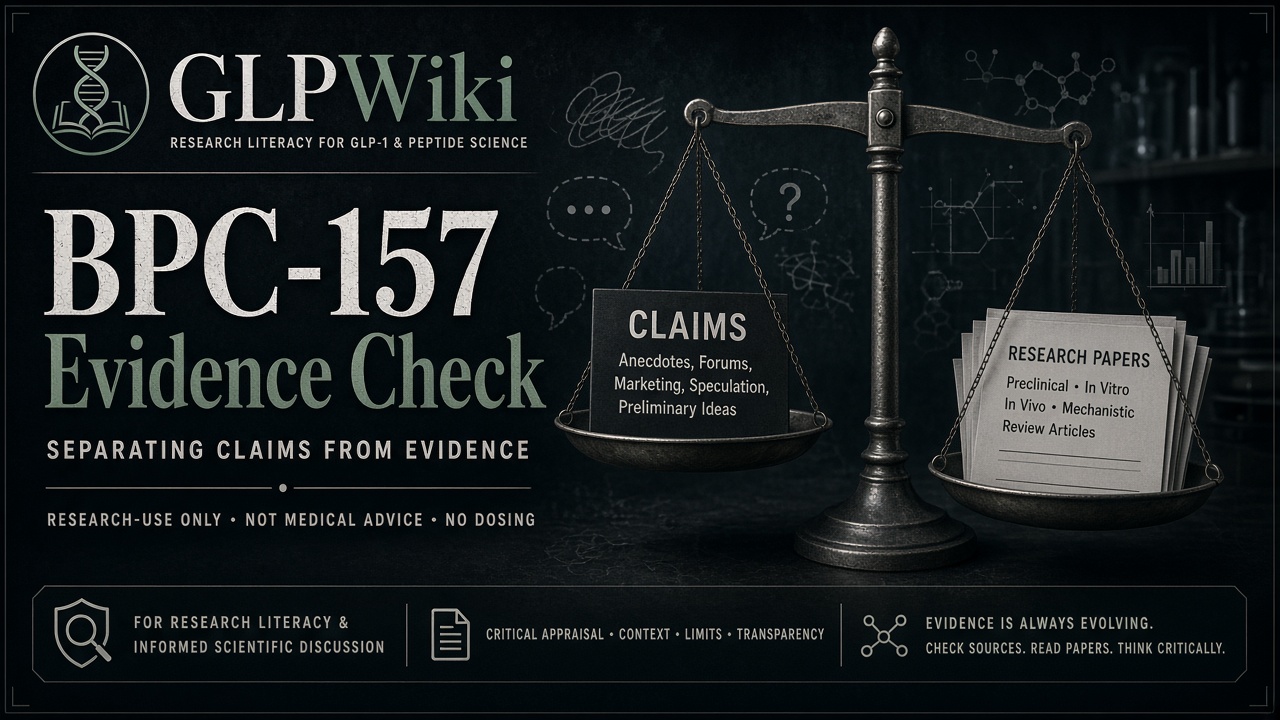
BPC-157 evidence check: claims, animal literature and the thin human record
Body Protection Compound-157 is a synthetic gastric pentadecapeptide with a large rodent literature and almost no rigorous human efficacy trials. This guide maps claim domains against evidence type, lists verified ClinicalTrials.gov records, summarises FDA compounding safety communications, and separates animal findings from medicine status. Educational only: no doses, protocols or product recommendations.
UPDATED 2026-10-10 · 14 MIN · 15 SOURCES
 COMPARISON
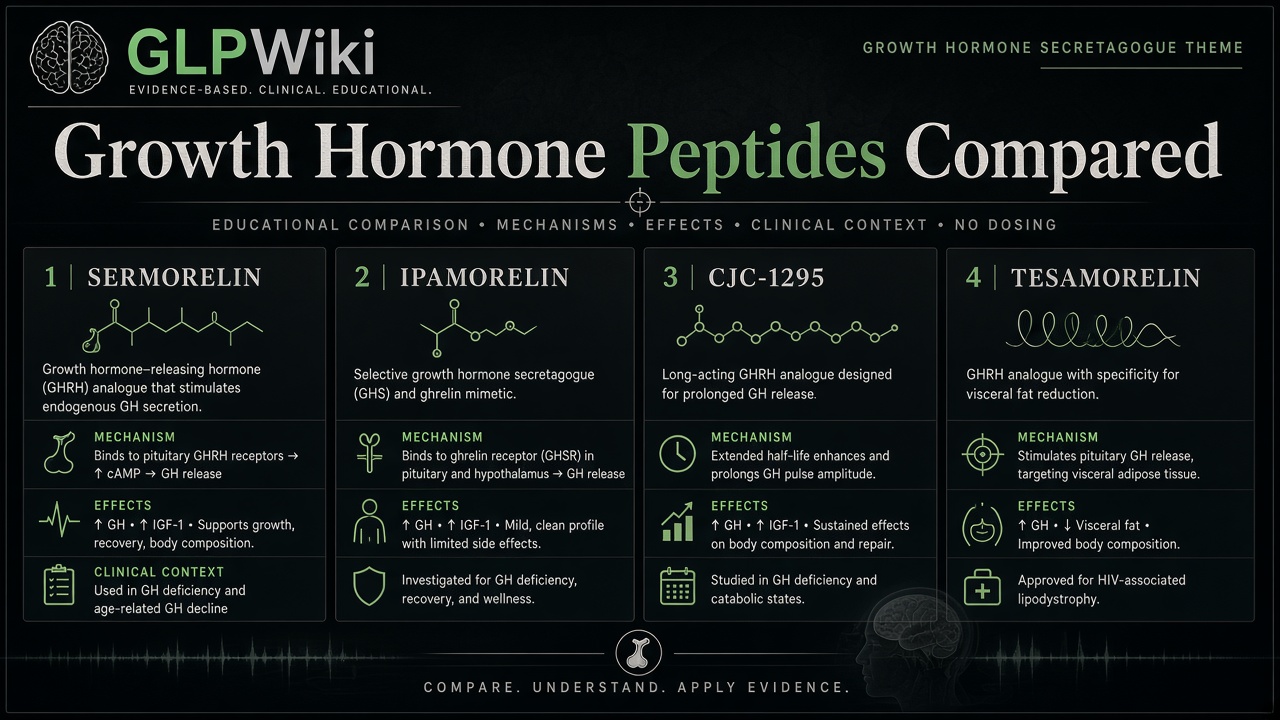
Growth hormone peptides compared: tesamorelin, sermorelin, ipamorelin, CJC-1295 and related secretagogues
Several peptides raise growth hormone, but they are not interchangeable. This guide separates GHRH-receptor analogues from ghrelin-receptor (GHS-R1a) agonists, maps FDA-approved tesamorelin against historically approved then withdrawn sermorelin, and summarises the thinner human evidence for ipamorelin, CJC-1295 (with and without DAC) and hexarelin. Educational only: no doses, schedules or product recommendations.
UPDATED 2026-10-09 · 15 MIN · 20 SOURCES
 EVIDENCE CHECK
GLP-1 medicines and muscle: lean-mass loss data, protein, resistance training and investigational add-ons
Weight lost on GLP-1-based medicines is not all fat. This guide walks through the body-composition (DXA) data from semaglutide and tirzepatide trials, explains why 'lean mass' is not the same as muscle, ranks the evidence for resistance training and protein, and summarises the Phase 2 results for investigational muscle-preserving add-ons such as bimagrumab, apitegromab, trevogrumab and enobosarm. None of those add-ons is approved. Educational only: no doses, schedules or product recommendations.
UPDATED 2026-10-08 · 16 MIN · 27 SOURCES
 EXPLAINER
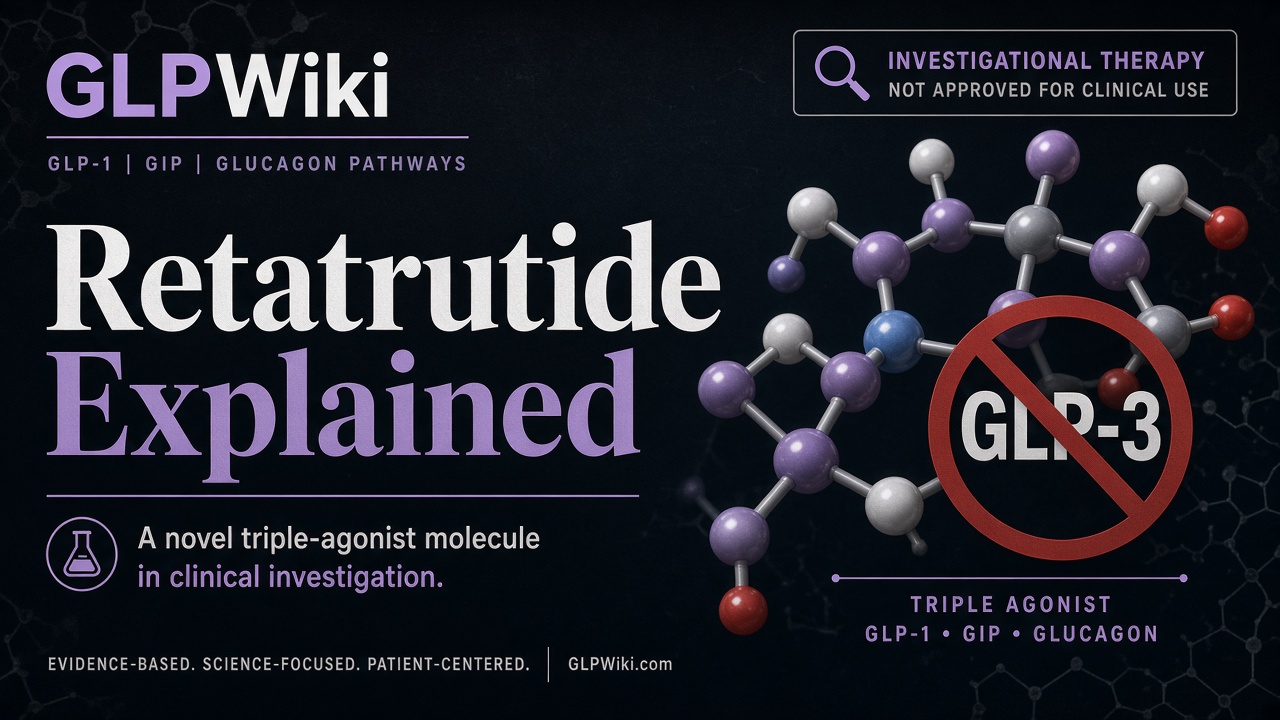
Retatrutide explained: the GIP, GLP-1 and glucagon triple agonist, its trials and its status
Retatrutide (LY3437943) is an investigational Eli Lilly peptide engineered to activate three hormone receptors at once: GIP, GLP-1 and glucagon. This rebuilt guide explains the mechanism at concept level, walks through the published Phase 2 and Phase 3 TRIUMPH evidence with trial names and registry numbers, lists the safety signals trials have reported, and shows how to check its regulatory status yourself. As of October 7, 2026 it is not FDA-approved. Educational only: no doses, schedules or sourcing.
UPDATED 2026-10-07 · 18 MIN · 27 SOURCES
 REFERENCE
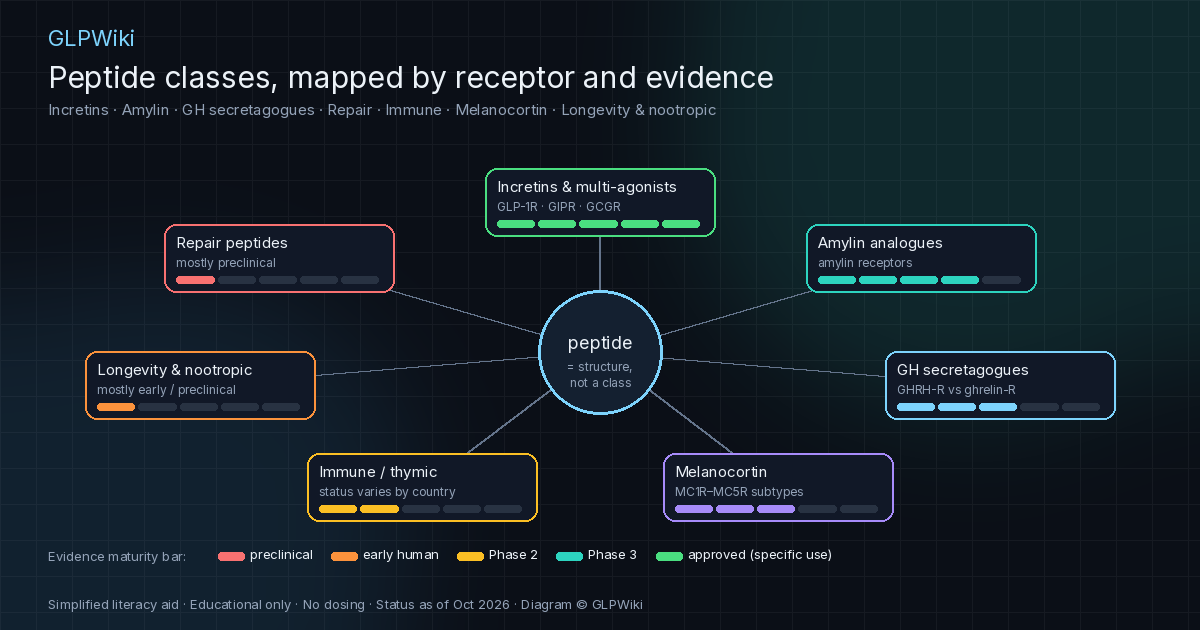
Peptide classes overview: incretins, amylin, secretagogues, repair, melanocortin and more
"Peptide" describes a chemical structure, not what a molecule does. This refreshed reference organizes the peptides discussed across GLPWiki by receptor target and physiological system, adds a receptor map for the incretin family (GLP-1, GIP, glucagon, amylin), and places each class on an evidence-maturity ladder so approved medicines are never confused with preclinical research compounds. Educational only: no doses, protocols, or sourcing.
UPDATED 2026-10-06 · 17 MIN · 19 SOURCES
 SAFETY
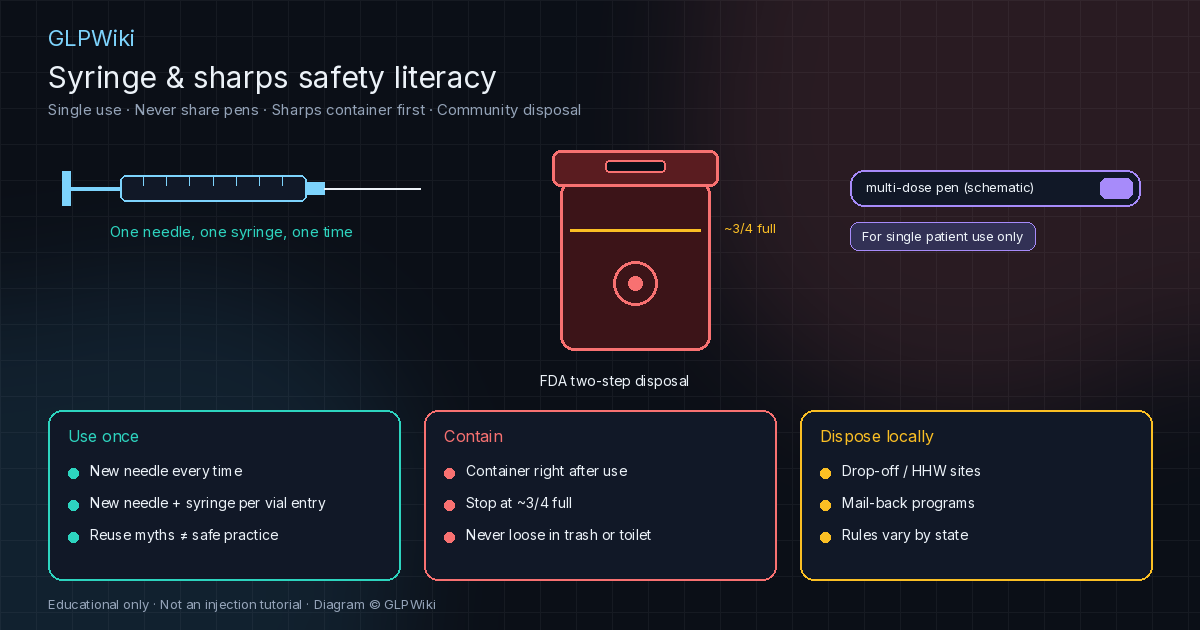
Syringe and sharps safety: single use, never sharing, and how disposal works
GLPWiki already explains syringe scales (insulin vs tuberculin, U-100 units) and aseptic vial handling. This companion covers what happens around the sharp itself: why needles and syringes are single use, why multi-dose pens are labeled for a single patient even when the needle is changed, what the evidence says about needle reuse, and how FDA's two-step consumer disposal flow works. Educational and YMYL-safe only — not an injection-technique tutorial, not a dosing guide, and local disposal rules vary.
UPDATED 2026-10-05 · 11 MIN · 13 SOURCES
 LITERACY
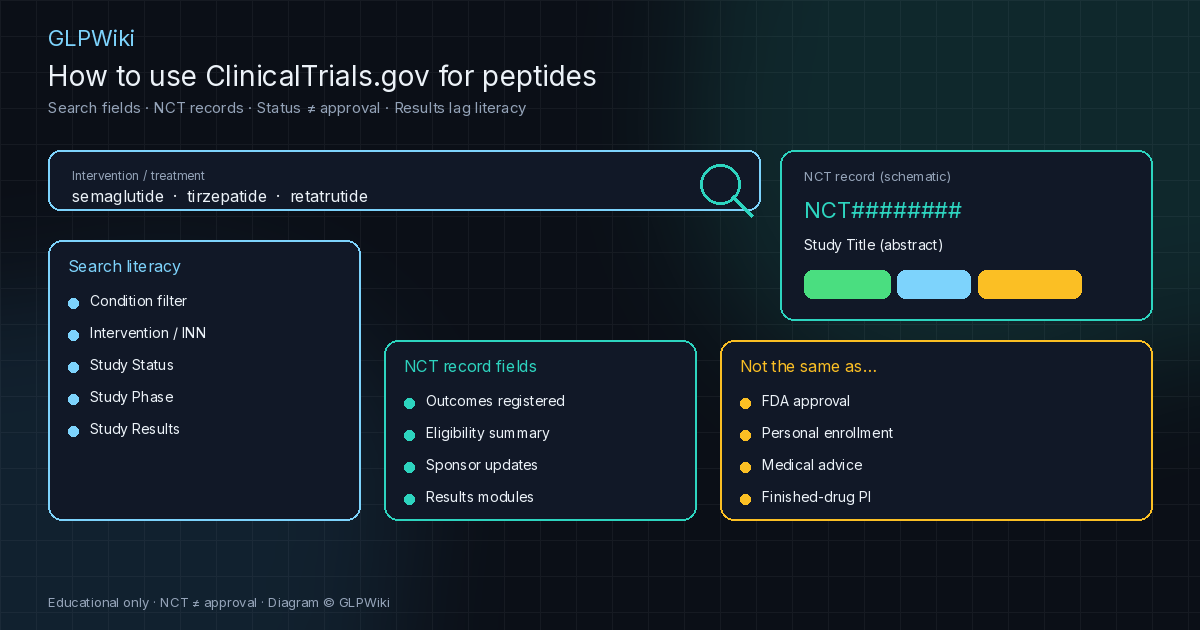
How to use ClinicalTrials.gov for peptides: search, NCT records, and status literacy
The already-live how-to-read-a-peptide-study guide teaches paper and evidence literacy: endpoints, phases, absolute vs relative change, CONSORT, and registration as a transparency habit. This companion teaches the registry tool itself — how to search ClinicalTrials.gov for peptide and incretin interventions, read an NCT study record, interpret Study Status / Phase / Results fields, and avoid collapsing a registry entry into FDA approval, self-enrollment, or medical advice. Educational and YMYL-safe only — always open the live ClinicalTrials.gov page; sponsors update records; results modules can lag.
UPDATED 2026-10-04 · 13 MIN · 10 SOURCES
 LITERACY
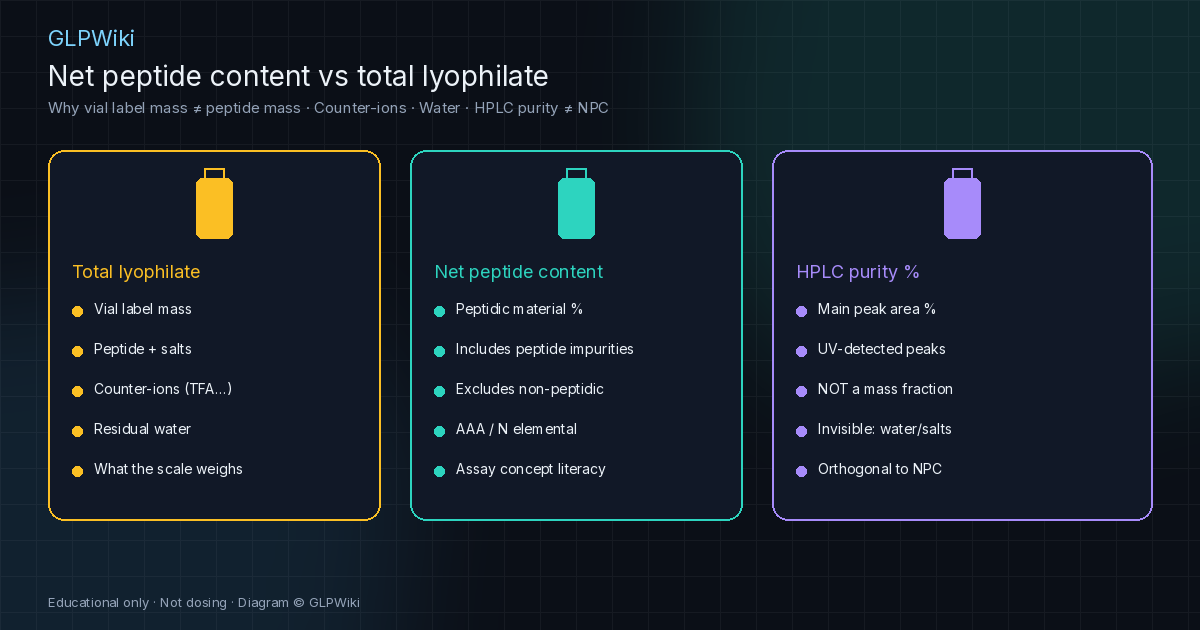
Net peptide content explained: vial mass vs peptide mass
The already-live how-to-read-a-peptide-coa guide has a short Step 4 on net peptide content versus HPLC purity. This companion deepens that literacy: why vial label mass / total lyophilate is not the same as net peptide content; how counter-ions (TFA, acetate, HCl), residual water, and salts change the weighed solid; how NPC is typically estimated (elemental nitrogen and amino acid analysis concepts at high level); why HPLC area% is not a mass fraction; and how ambiguous mass inputs break reconstitution arithmetic literacy — concept only, no doses. Educational and YMYL-safe only — verify COAs and approved labels; research catalogs are not finished-drug PI.
UPDATED 2026-10-03 · 14 MIN · 7 SOURCES
 LITERACY
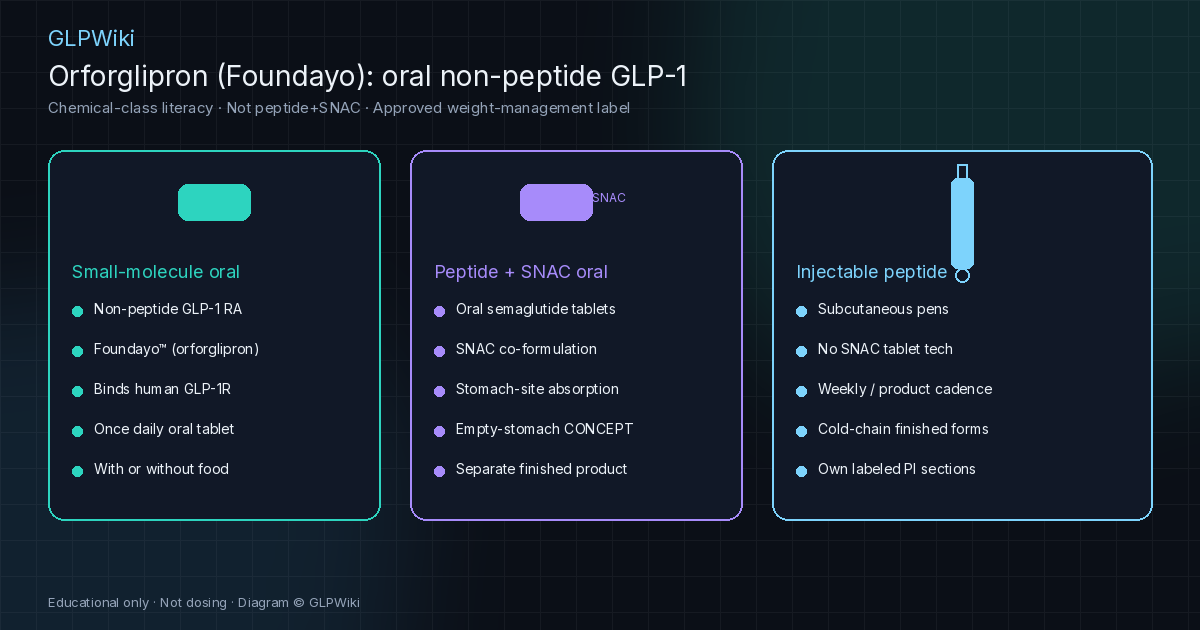
Orforglipron (Foundayo): oral non-peptide GLP-1 literacy
Orforglipron (brand Foundayo™) is a once-daily oral GLP-1 receptor agonist that is a small molecule — not a peptide tablet co-formulated with SNAC. This companion is distinct from the oral-peptides-absorption explainer and from oral-versus-injectable semaglutide route literacy: it focuses on chemical-class literacy, labeled administration CONCEPT contrast (with or without food versus SNAC fasting-window concepts), and clear approved-versus-investigational status for Foundayo. Educational and YMYL-safe only — verify DailyMed / Drugs@FDA; no doses or schedules.
UPDATED 2026-10-02 · 14 MIN · 9 SOURCES
 LITERACY
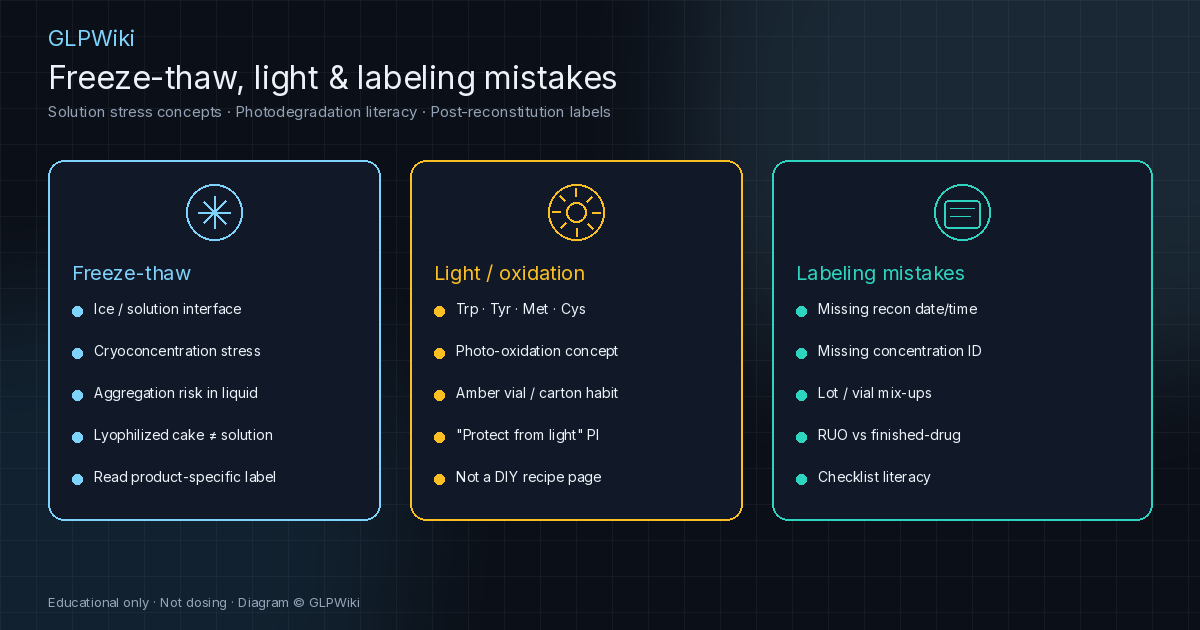
Peptide freeze-thaw, light, and post-reconstitution labeling mistakes
The already-live peptide storage and handling guide covers cold-chain basics. This companion deepens three high-error literacy topics: why freezing a reconstituted vial is not automatically safe, how light and oxidation-sensitive residues (Trp, Tyr, Met, Cys) motivate "protect from light" labeling, and which post-reconstitution labeling mistakes confuse identity, concentration, lots, and research-use versus finished-drug context. Educational and YMYL-safe only — verify DailyMed / Drugs@FDA for approved finished products; no reconstitution recipes or pharmacy advice.
UPDATED 2026-10-01 · 13 MIN · 11 SOURCES
 LITERACY
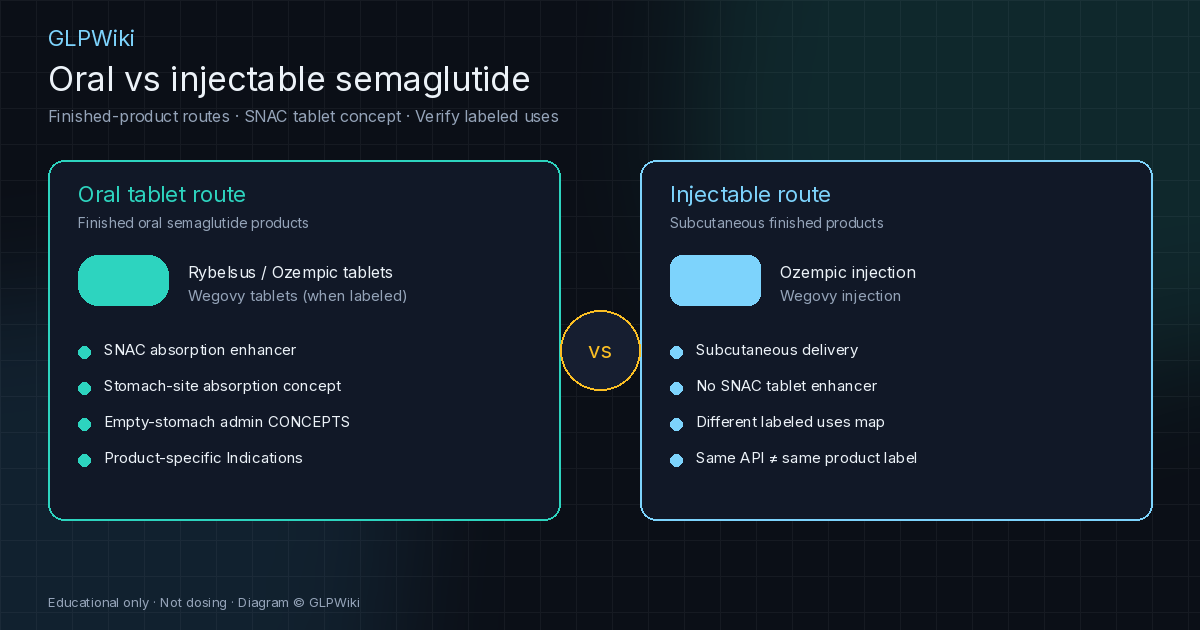
Oral semaglutide vs injectable: Rybelsus, Wegovy tablets, and injection literacy
Semaglutide is one active ingredient that appears in multiple FDA-approved finished products with different routes — oral tablets co-formulated with the absorption enhancer SNAC, and subcutaneous injections without that tablet technology. This literacy guide is distinct from the general oral-peptides-absorption explainer: it maps finished-product route differences, SNAC versus injection framing, product-specific labeled uses (including oral Wegovy tablets when labeled), fasting/admin CONCEPT literacy without doses, and how approved oral peptide-formulated products differ from research "oral peptide" marketing claims.
UPDATED 2026-09-30 · 14 MIN · 12 SOURCES
 LITERACY
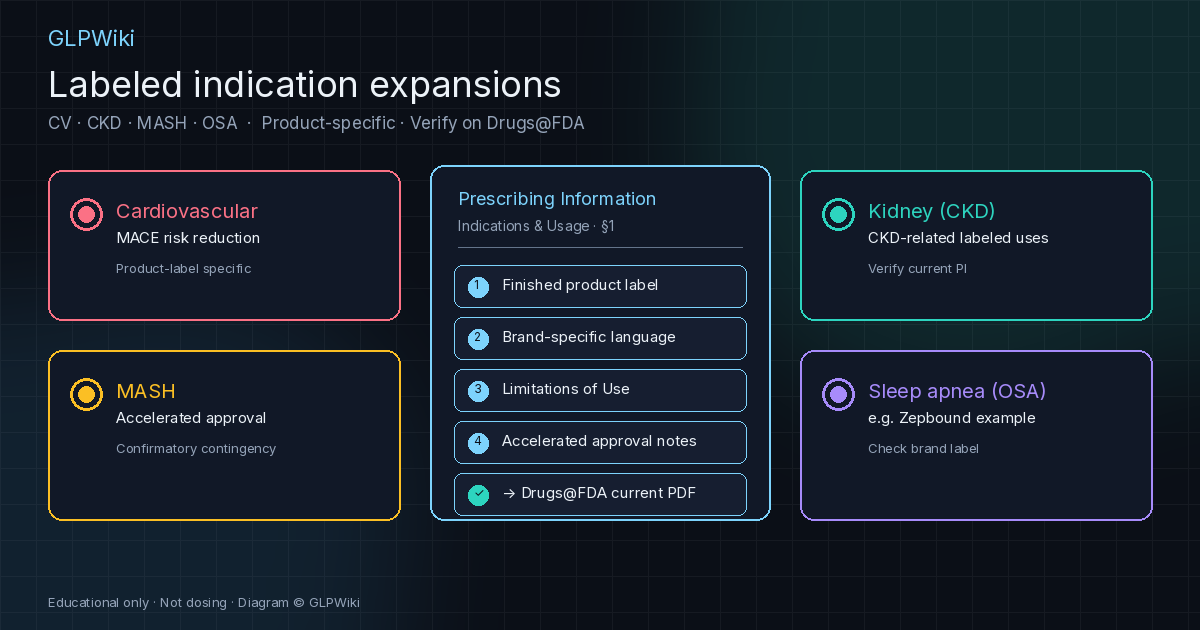
GLP-1 labeled indication expansions: CV, CKD, MASH, and OSA literacy
Beyond classic glycemic-control and weight-management shorthand, some FDA-approved GLP-1 and related incretin products carry additional labeled uses — cardiovascular risk reduction, chronic kidney disease–related language, MASH under accelerated approval, and obstructive sleep apnea. This literacy companion to Day 19's medications-by-indication guide teaches that those expansions attach to specific finished-product labels, may use accelerated-approval language, change over time, and must be verified on Drugs@FDA — never assumed from molecule name, another brand, or headlines.
UPDATED 2026-09-29 · 14 MIN · 12 SOURCES
 LITERACY
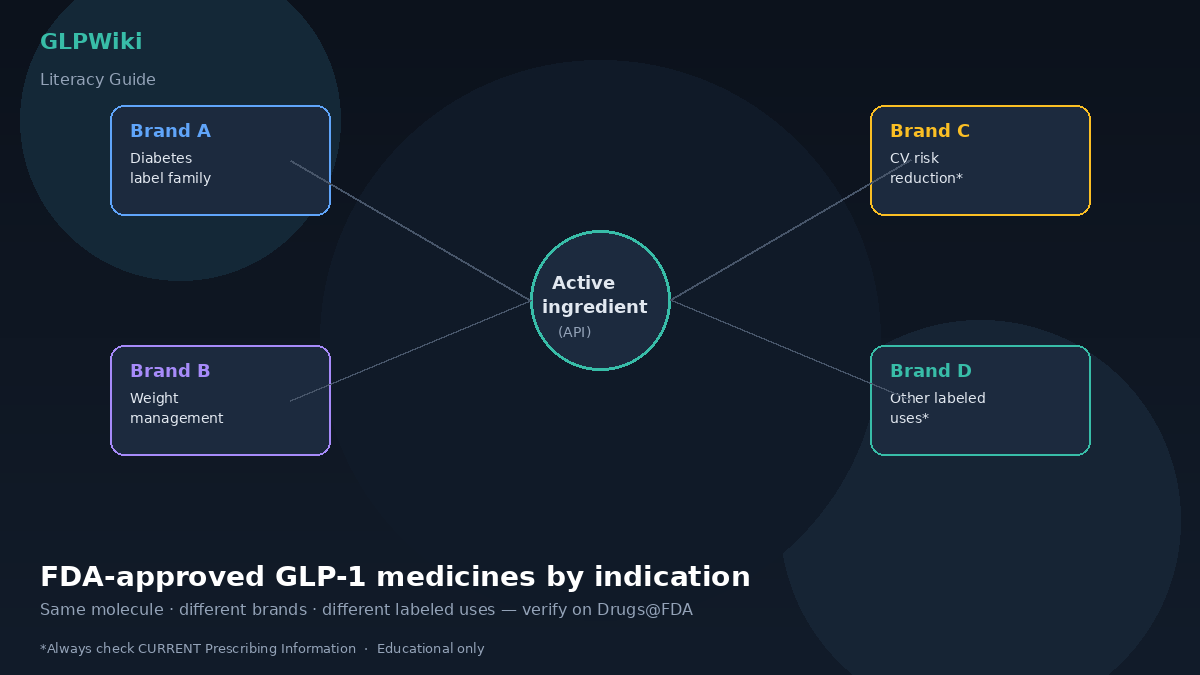
FDA-approved GLP-1 medicines by indication: diabetes, weight, and beyond
The same active ingredient can appear under different brand names with different labeled indications. This literacy companion to the /medications hub explains how to read Indications & Usage and Limitations of Use on Prescribing Information via Drugs@FDA — without doses, schedules, or product recommendations.
UPDATED 2026-09-28 · 13 MIN · 10 SOURCES
 LITERACY
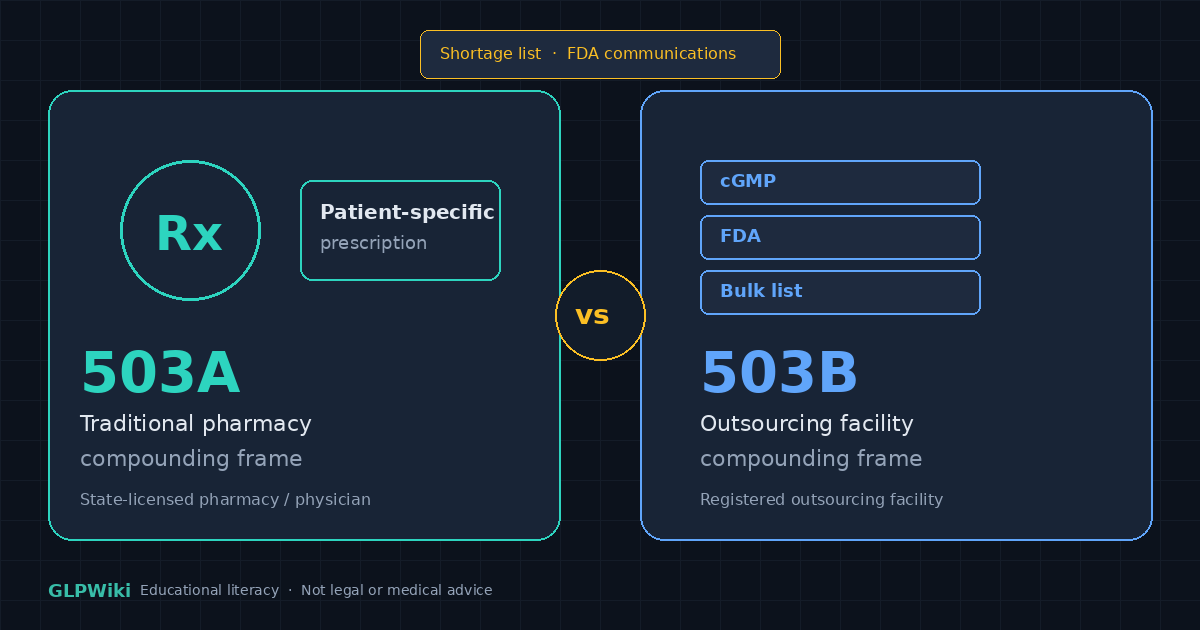
503A vs 503B compounding for GLP-1 medicines: shortage rules and what changed
Sections 503A and 503B of the FD&C Act frame pharmacy compounding differently. This literacy guide explains the high-level differences for GLP-1 medicines, how shortage status interacted with compounding, what FDA has said about "essentially a copy," and how to read current public FDA communications — without legal advice, medical advice, doses, or product recommendations.
UPDATED 2026-09-27 · 14 MIN · 10 SOURCES
 LITERACY
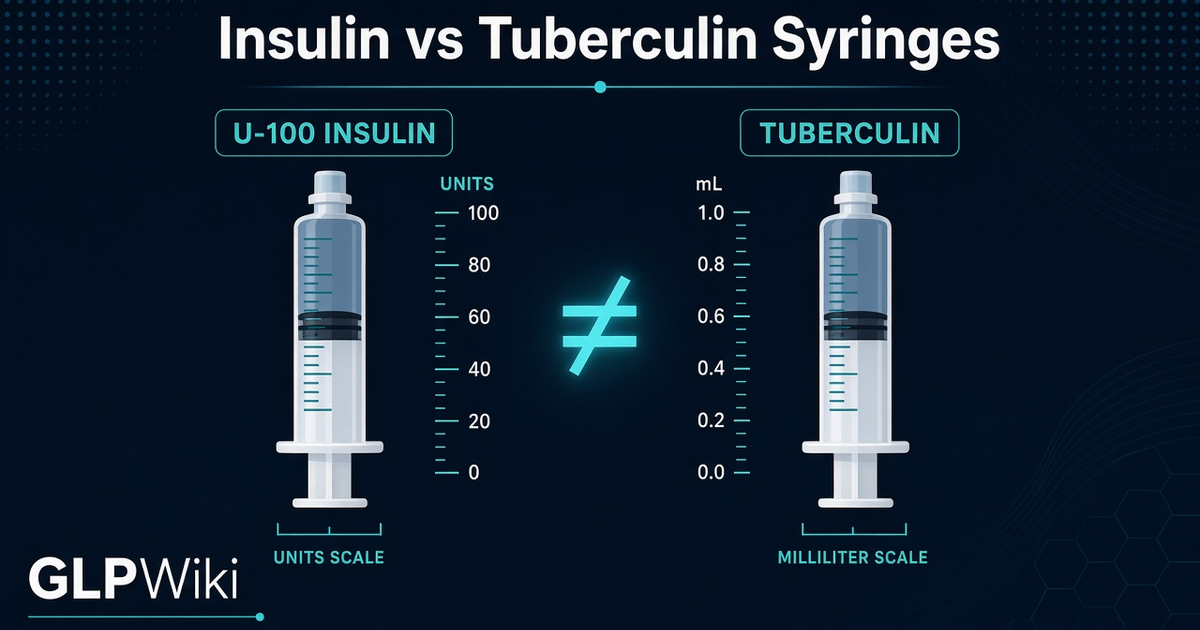
Insulin vs tuberculin syringes: markings, mix-up risks, and scale literacy
Insulin syringes and tuberculin syringes can look alike but speak different measurement languages — units versus milliliters. This literacy guide explains how to identify each scale, why misreads appear in patient-safety advisories, and how that framing relates to peptide calculator assumptions — without doses, product picks, or administration instructions.
UPDATED 2026-09-23 · 12 MIN · 7 SOURCES
 LITERACY
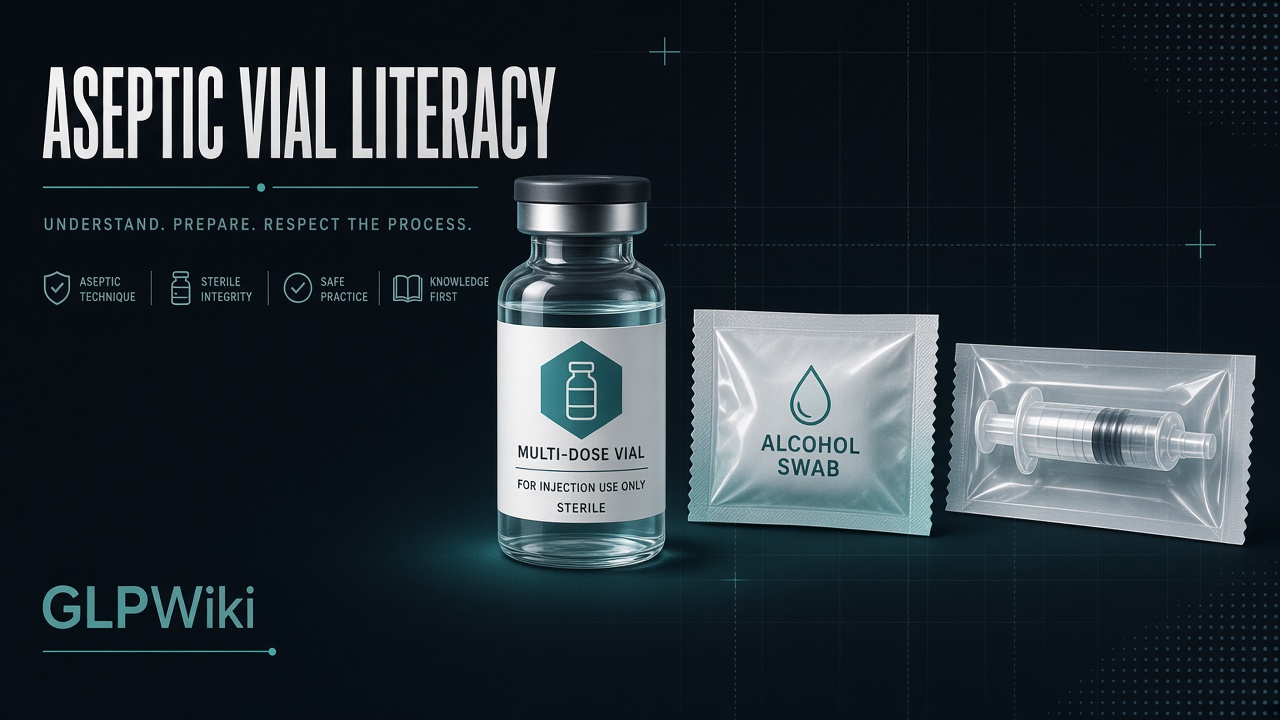
Aseptic technique for peptide vials: multi-dose literacy, contamination pathways, and beyond-use concepts
Multi-dose vials are designed for more than one withdrawal — which also means contamination risk can travel back into the remaining contents. This literacy guide explains aseptic technique concepts, single-dose vs multi-dose labeling, and beyond-use framing from CDC injection-safety education — without doses, reconstitution recipes, or administration protocols.
UPDATED 2026-09-22 · 13 MIN · 9 SOURCES
 LITERACY
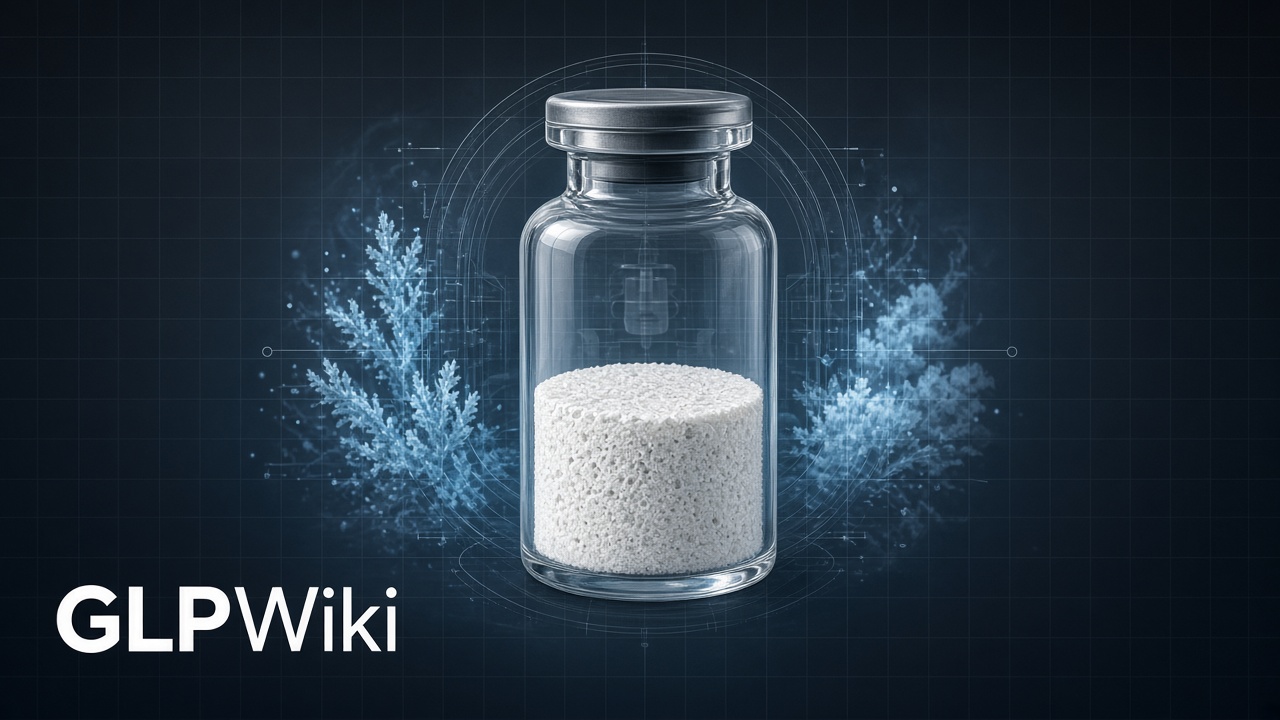
Peptide lyophilization explained: freeze-drying, cake structure, and why technique matters
Lyophilization removes water from a frozen peptide formulation under vacuum to create a dry, porous cake. This science-foundation guide explains the process, why manufacturers use it, what cake appearance can and cannot prove, and how handling and storage context change after reconstitution. Educational only: no doses, protocols, recipes, or product recommendations.
UPDATED 2026-09-21 · 13 MIN · 8 SOURCES
 LITERACY
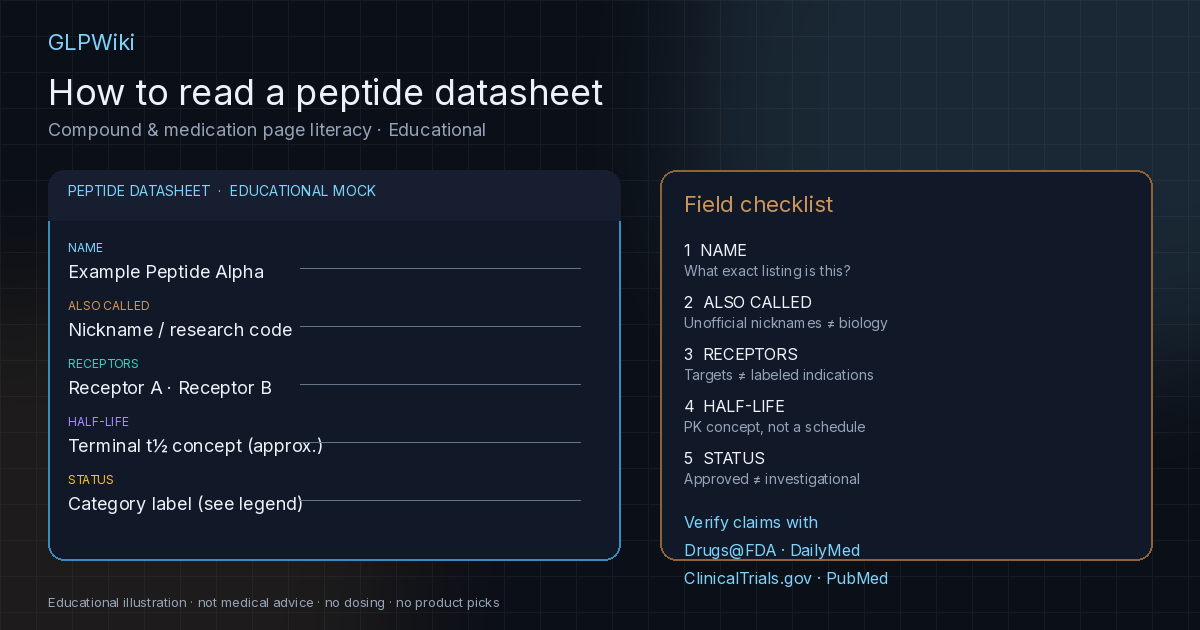
How to read a peptide datasheet (compound and medication pages)
Compound cards and medication pages compress identity, pharmacology shorthand, approximate pharmacokinetics, and status into a few labeled fields. This literacy guide explains what each field answers, why nicknames are not biology, why half-life is not a dosing clock, and how to verify claims with the right official document type. Educational only: no dosing, no protocols, no product picks.
UPDATED 2026-09-20 · 14 MIN · 8 SOURCES
 LITERACY
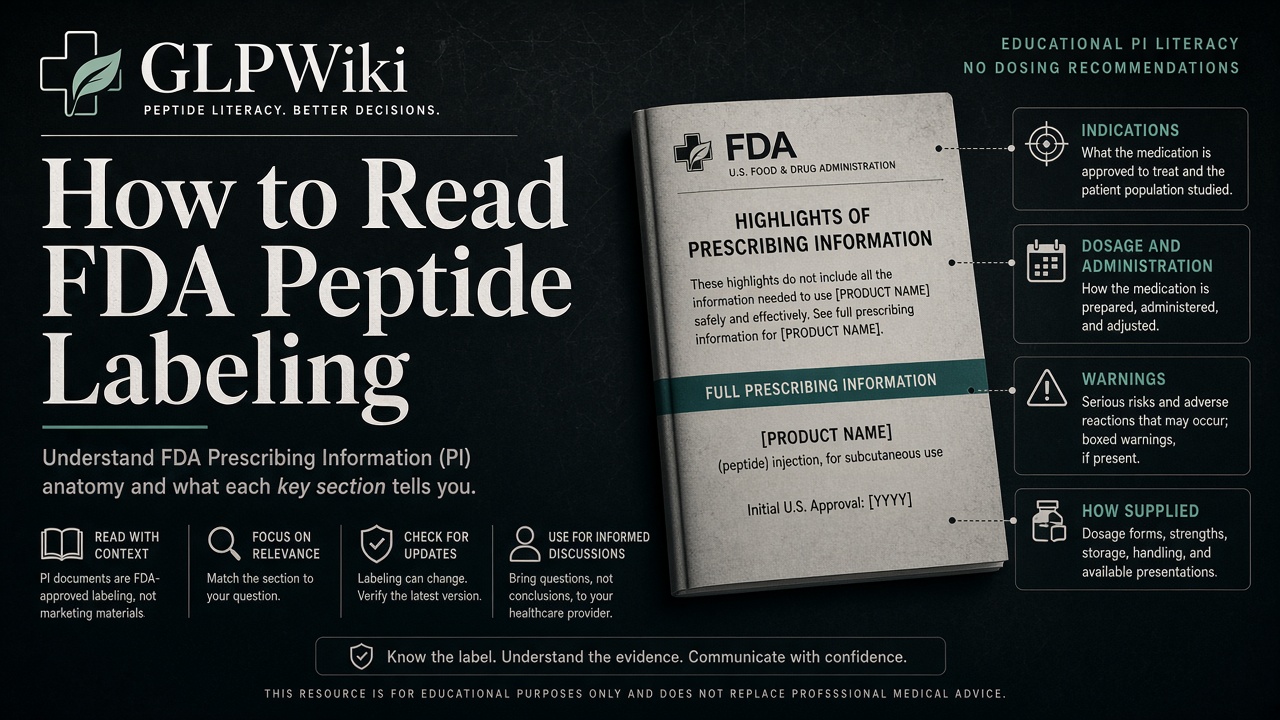
How to read FDA Prescribing Information for peptide medicines
Online peptide claims often quote a molecule name as if it were an approved finished-drug label. This literacy guide explains what FDA Prescribing Information is, how PLR-format labels are organized, how to find current labels on Drugs@FDA and DailyMed, and why a trial paper is not the same document as approved labeling. Educational only: no dosing, no protocols, no product picks.
UPDATED 2026-09-19 · 15 MIN · 8 SOURCES
 LITERACY
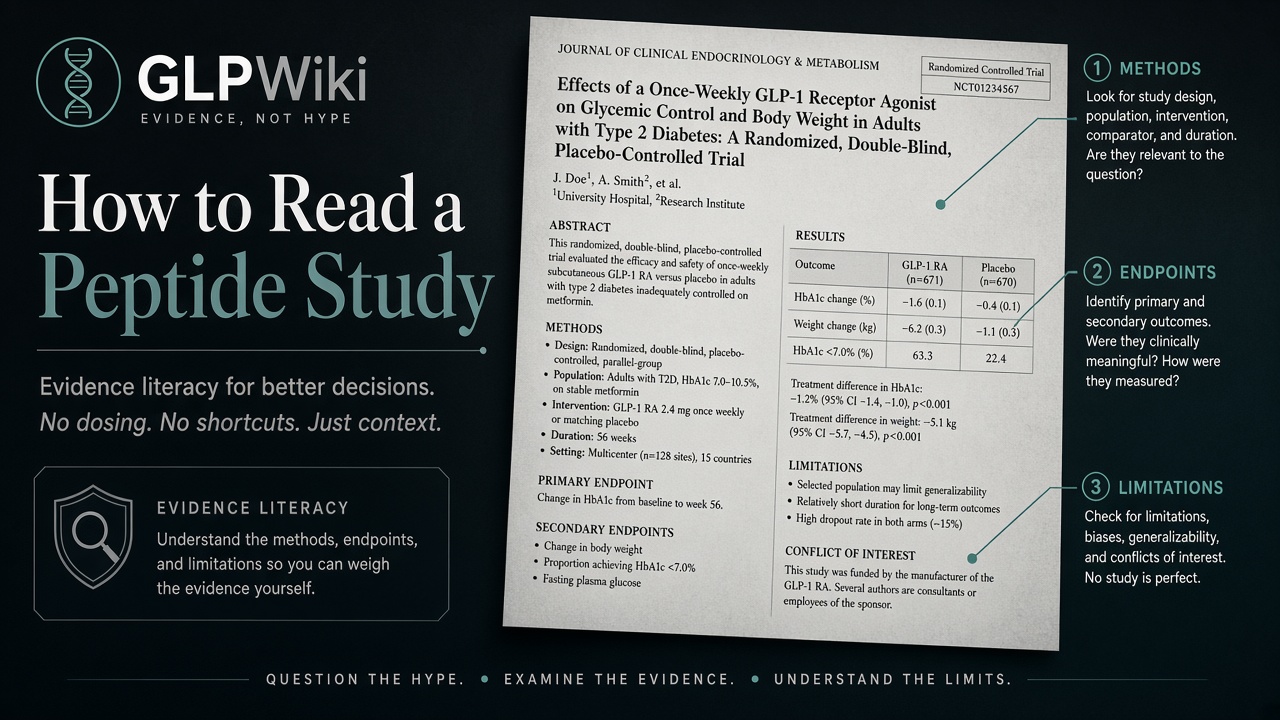
How to read a peptide clinical study: trial design literacy for endpoints, phases, and evidence
Peptide claims online often collapse press releases, preprints, Phase 2 signals, and FDA-approved labeling into one confident sentence. This literacy guide explains how to read a clinical study's structure — methods before headlines, primary before secondary, absolute before relative — and how to verify status on ClinicalTrials.gov, PubMed, and Drugs@FDA. Educational only: no dosing, no protocols, no product picks.
UPDATED 2026-09-18 · 16 MIN · 10 SOURCES
 LITERACY
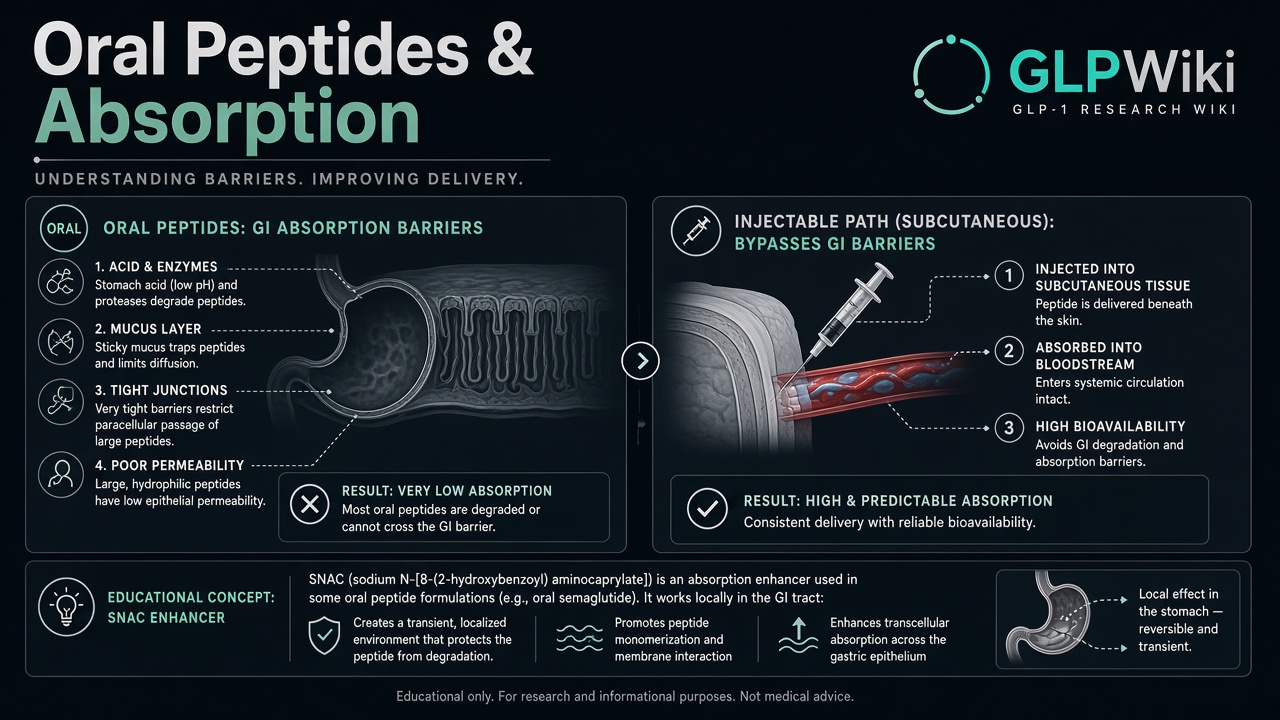
Oral peptides and absorption: why tablets are hard, and what SNAC vs non-peptide agonists change
Most therapeutic peptides degrade in the gut and absorb poorly as tablets. Oral semaglutide uses an absorption enhancer (SNAC) with strict labeled dosing conditions and low absolute bioavailability. Non-peptide oral GLP-1 receptor agonists are a different chemical class with different absorption pharmacokinetics. This literacy guide explains the concepts and where to verify status — without recommending any product, dose, or schedule.
UPDATED 2026-09-17 · 14 MIN · 8 SOURCES
 LITERACY
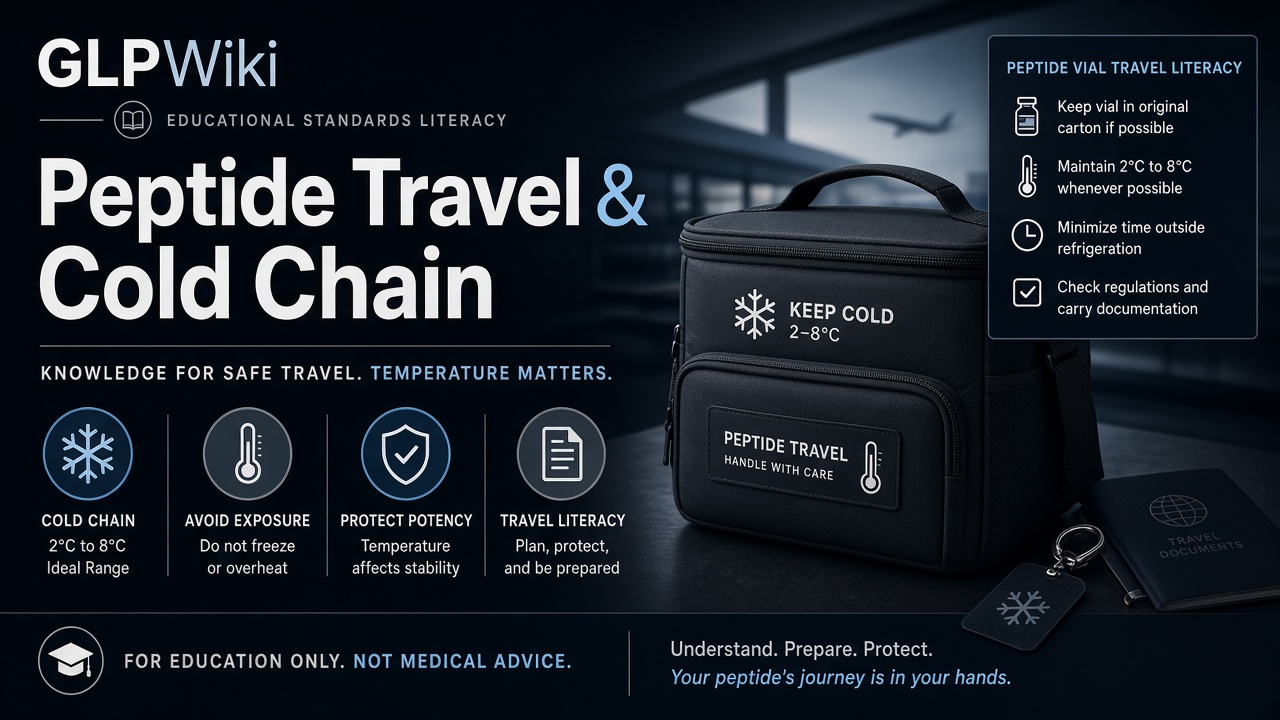
Peptide travel and cold chain: what labels and standards actually say
Cold chain is a temperature-controlled path from manufacture through storage and use. For FDA-approved peptide injectables, the product label — not a forum tip — defines refrigeration, room-temperature windows, and freeze rules. This literacy guide explains the concepts and where to verify them.
UPDATED 2026-09-15 · 13 MIN · 8 SOURCES
 LITERACY
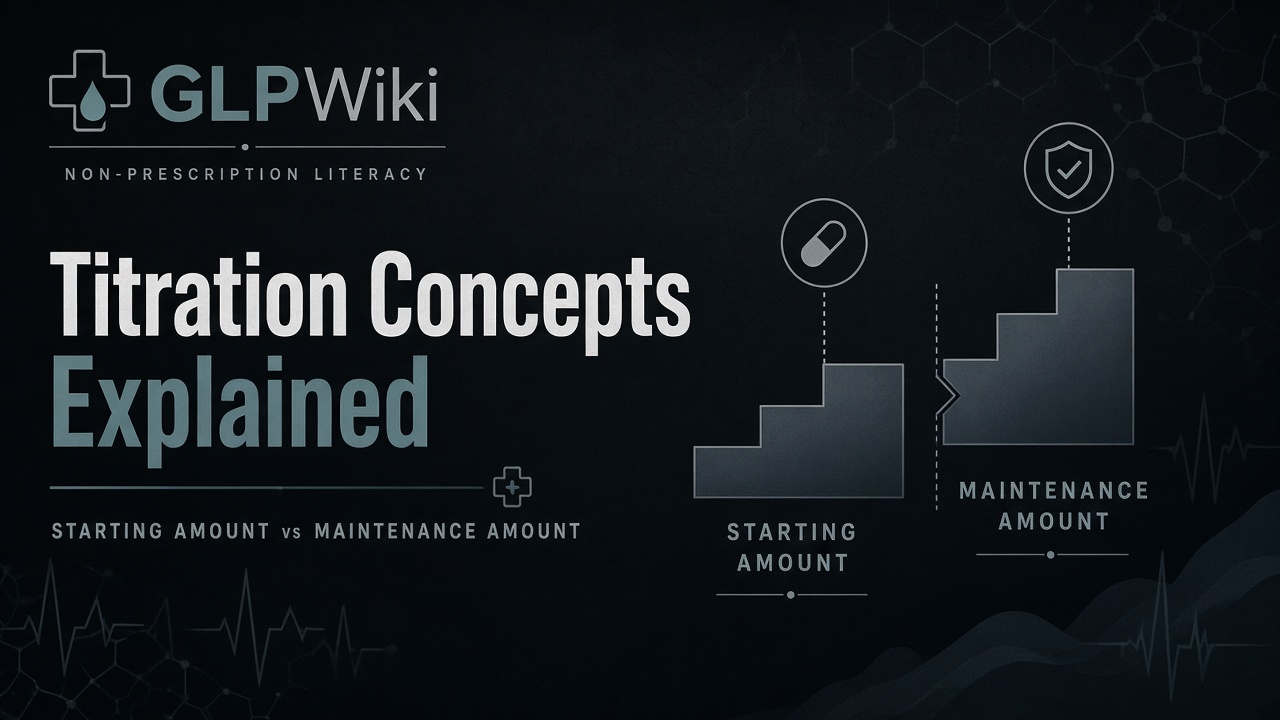
Titration concepts explained: what dose escalation means on labels
On FDA prescribing information, titration usually means a planned, stepwise change in labeled amount over time — often starting lower, then escalating, then settling at a maintenance concept. This literacy guide explains what those words mean and why labels escalate slowly, without recommending any dose, schedule, product, or protocol.
UPDATED 2026-09-14 · 12 MIN · 9 SOURCES
 LITERACY
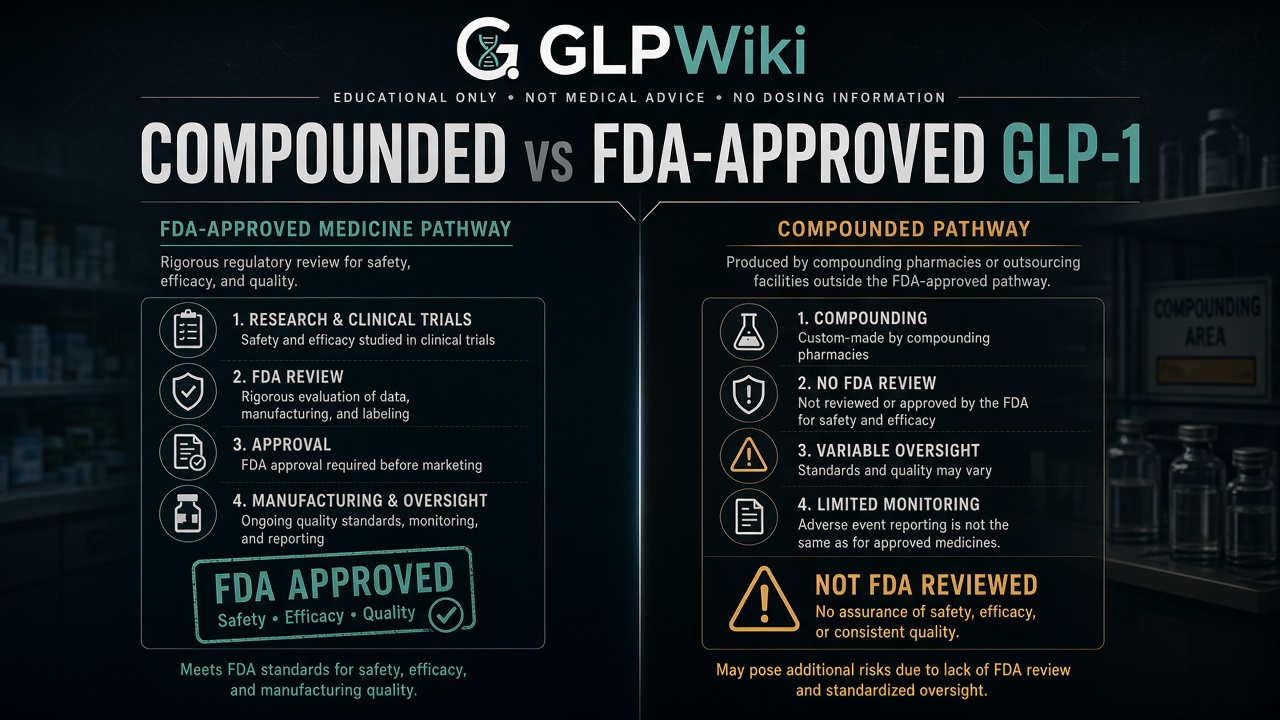
Compounded vs FDA-approved GLP-1 medicines: what's the difference?
FDA-approved GLP-1 receptor agonists are reviewed finished drugs with official labels. Compounded preparations are not FDA-approved as finished products. This literacy guide explains the distinction, the questions FDA has raised about unapproved versions, and how to verify status — without recommending any product, dose, or seller.
UPDATED 2026-09-13 · 14 MIN · 6 SOURCES
 EXPLAINER
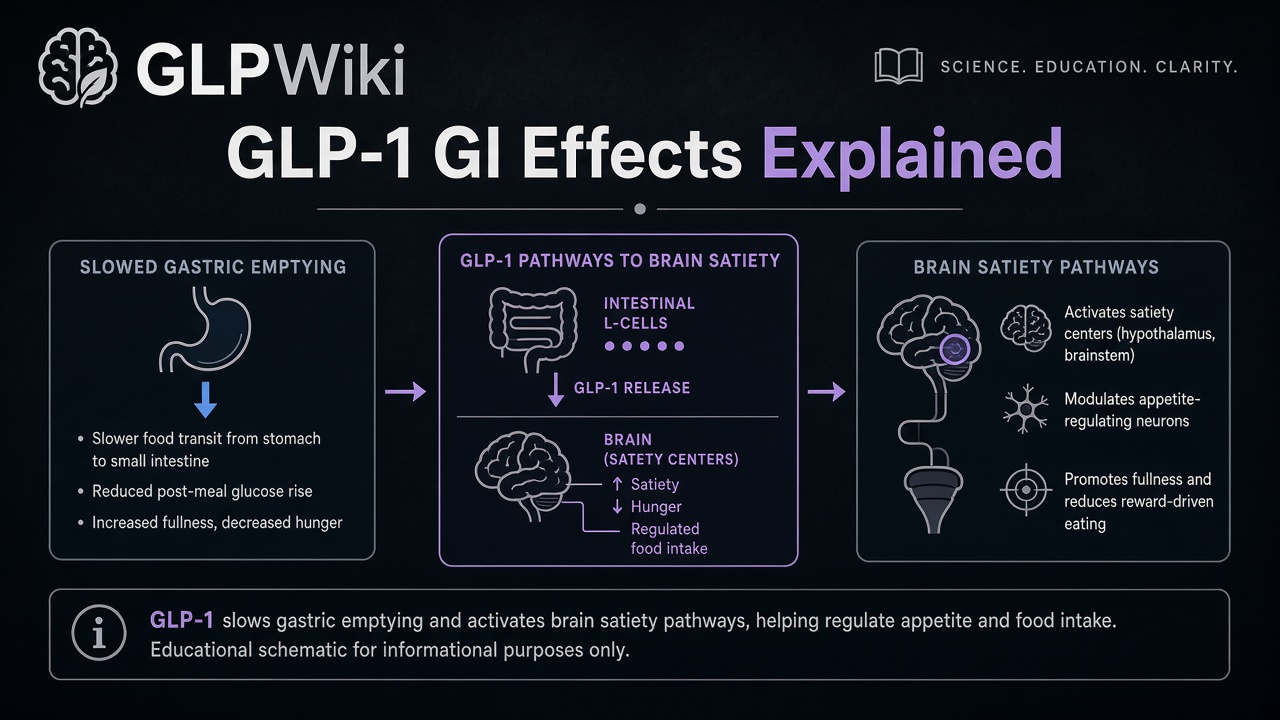
Why GLP-1 medicines cause nausea and other GI effects (mechanism explainer)
Nausea and related GI effects are among the most common labeled adverse reactions for GLP-1 receptor agonists. This guide explains the mechanisms discussed in labels and research — delayed gastric emptying and central aversion pathways — without recommending any dose, schedule, or home remedy.
UPDATED 2026-09-12 · 14 MIN · 6 SOURCES
 LITERACY
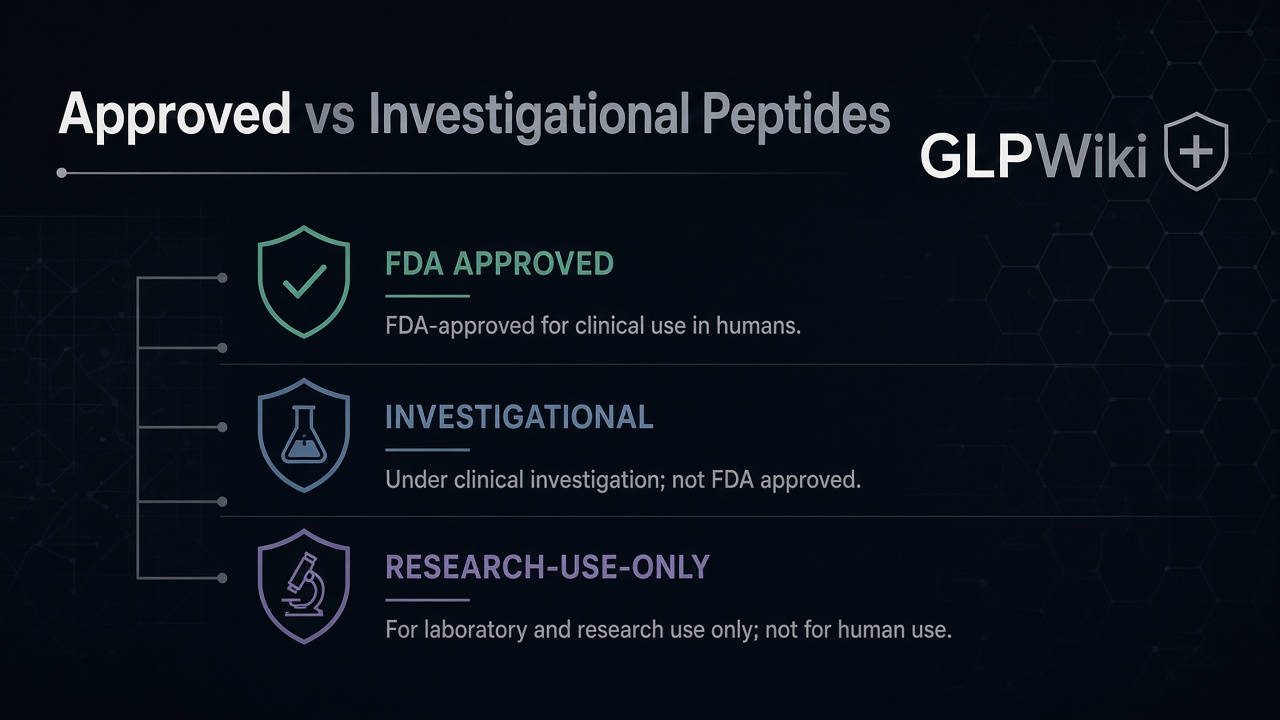
Approved vs investigational peptides: how to tell the difference
The same amino-acid sequence name can appear as an FDA-approved medicine, as an investigational trial drug under an IND, or as research-use catalog material. This literacy guide explains what each status actually means, how to verify it, and which paperwork answers which question.
UPDATED 2026-09-11 · 13 MIN · 6 SOURCES
 LITERACY
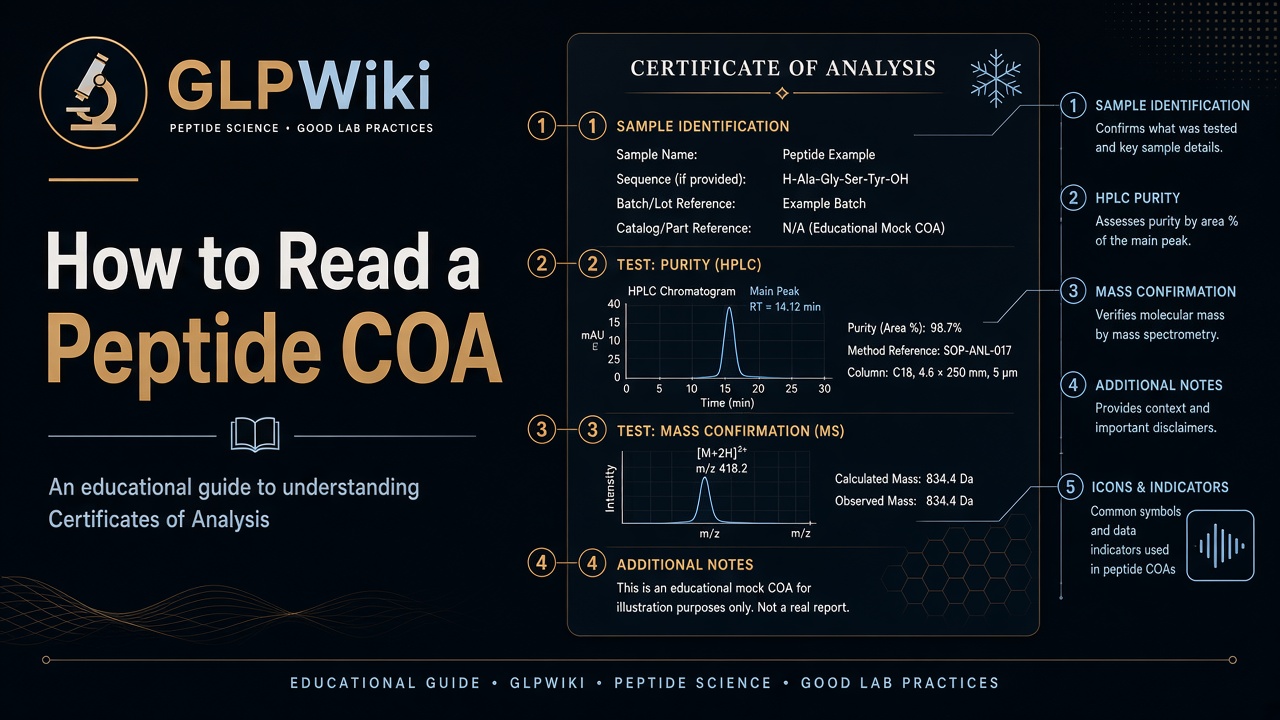
How to read a peptide Certificate of Analysis
A Certificate of Analysis is only useful if it is lot-specific, method-documented, and matched to the vial in your hand. This guide is a field-by-field checklist: what a COA is, what HPLC and mass spectrometry each answer, why purity is not content, and which red flags mean the paperwork is not doing its job.
UPDATED 2026-09-10 · 14 MIN · 4 SOURCES
 LITERACY
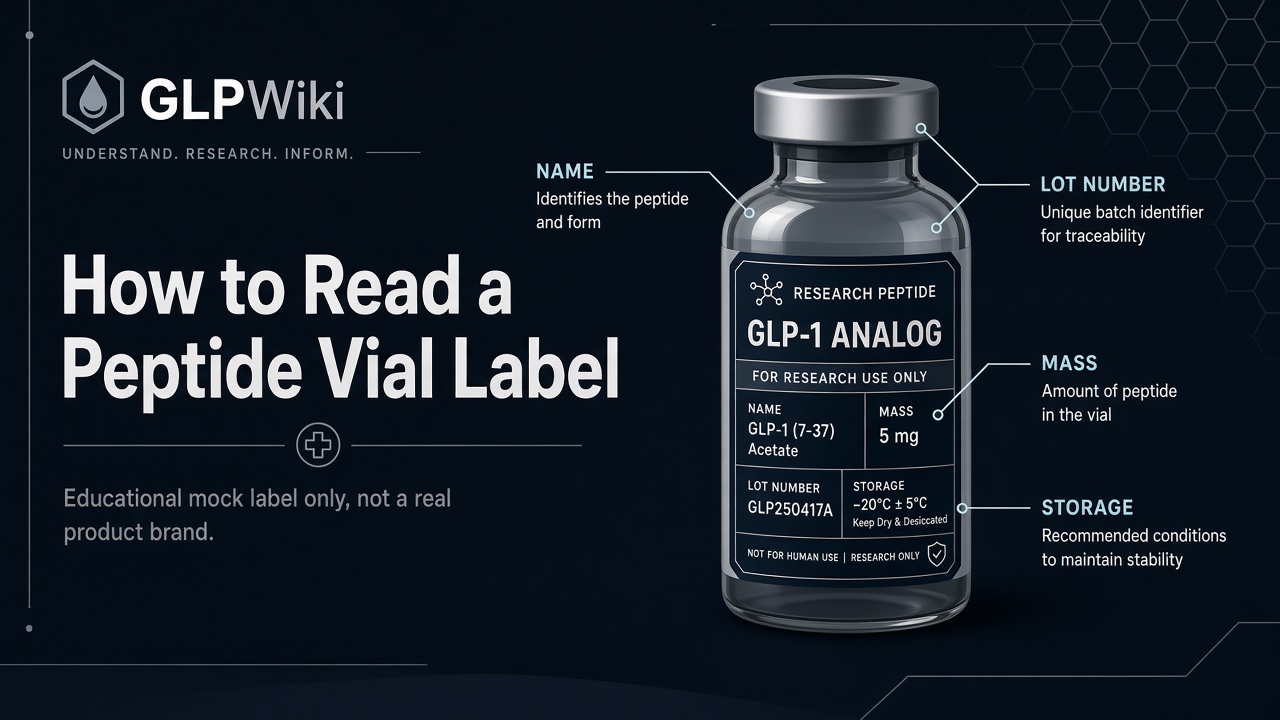
How to Read a Peptide Vial Label
A vial sticker is not a Certificate of Analysis. This checklist covers the fields that matter on a peptide vial label—name, mass, lot, storage, and research-use statements—and how to check them against the COA and the listing before you treat the paperwork as describing the vial in your hand.
UPDATED 2026-09-10 · 12 MIN · 4 SOURCES
 HANDLING
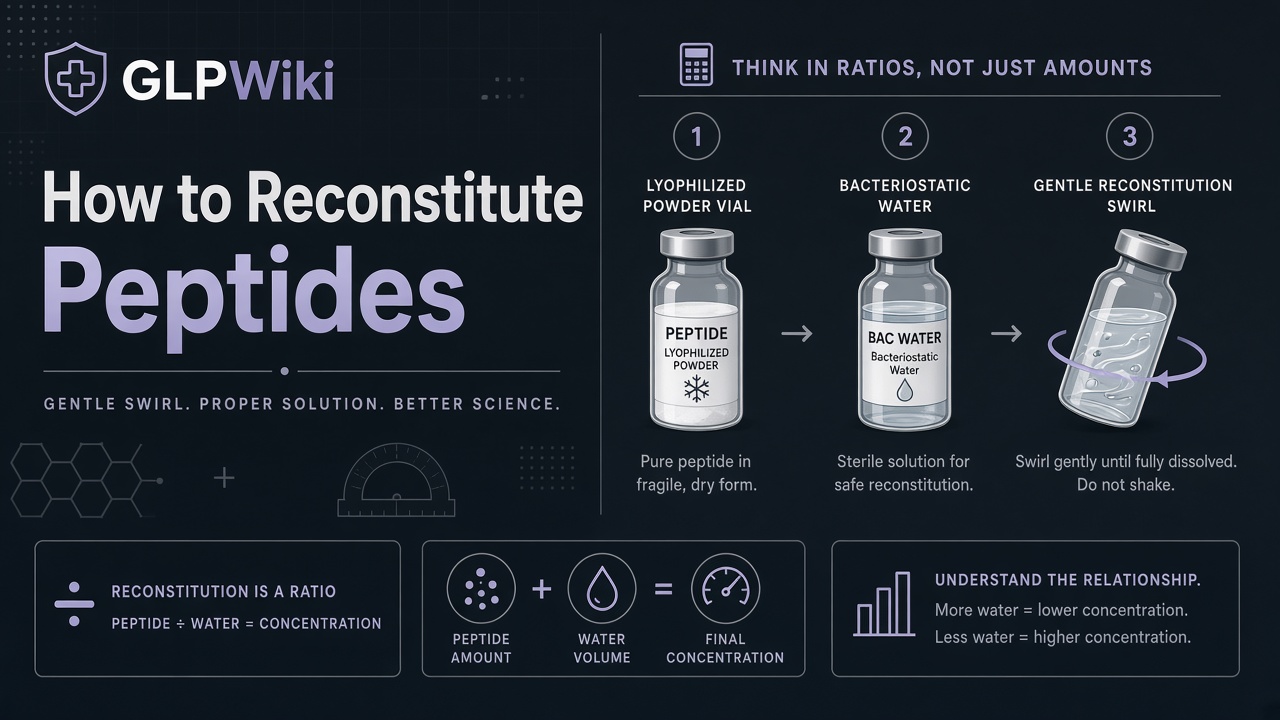
Peptide reconstitution and bacteriostatic water: a step-by-step educational guide
A plain-English walkthrough of how lyophilised peptides are dissolved for research use, including the concentration math, common mistakes, and why the diluent you choose matters.
UPDATED 2026-09-09 · 11 MIN · 5 SOURCES
 DOSING MATH
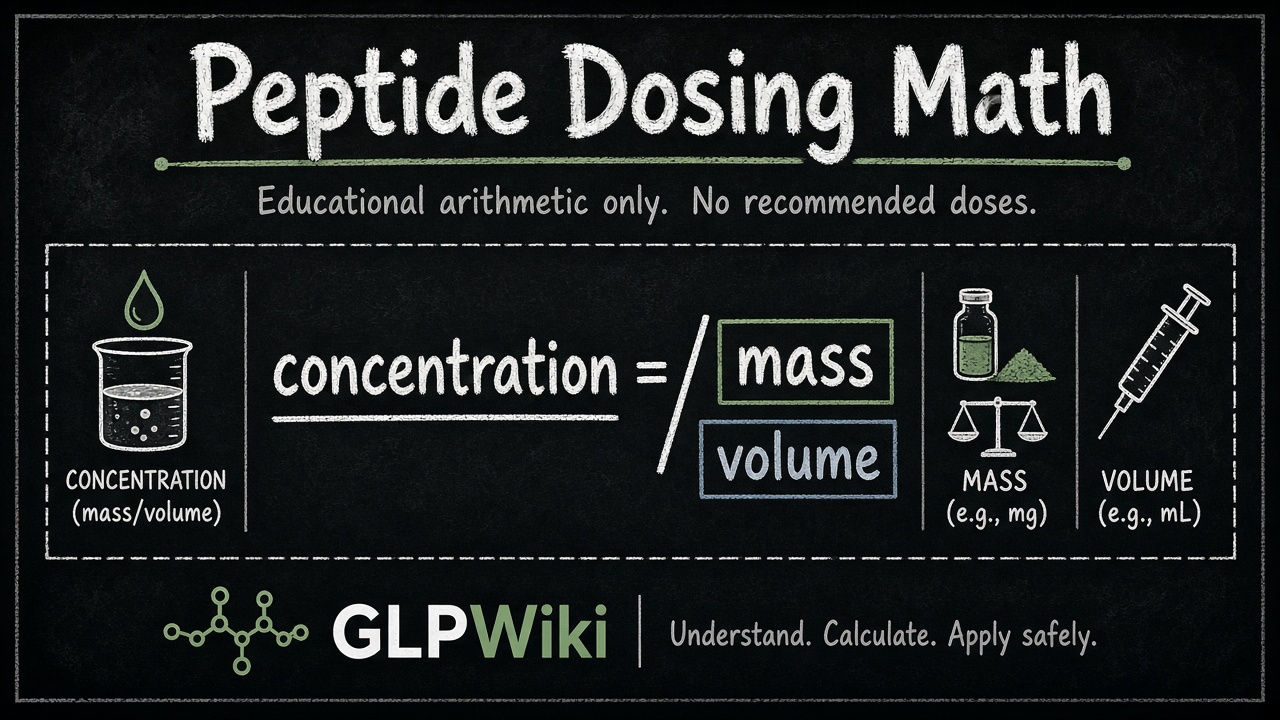
Peptide dosing math: concentration, volume and units
Concentration, volume, and syringe unit markings are three different quantities that are easy to conflate. Here is the arithmetic that connects them, explained through worked examples rather than any recommended amount.
UPDATED 2026-09-09 · 12 MIN · 6 SOURCES
 DOSING MATH
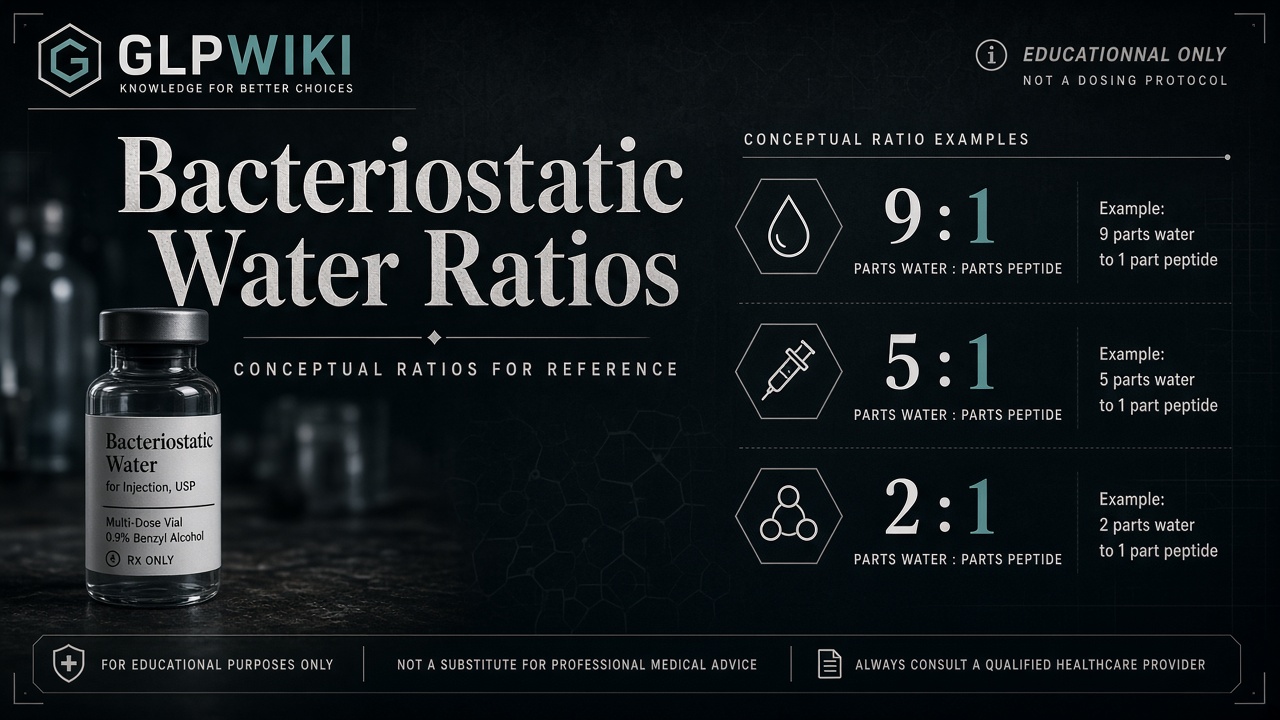
Bacteriostatic water ratios explained
Choosing how much bacteriostatic water to add to a vial does not change the total amount of peptide it contains — it changes the concentration, and with it, how readable the resulting draw volumes are. Here is the reasoning behind common ratio choices.
UPDATED 2026-09-09 · 11 MIN · 6 SOURCES
 HANDLING
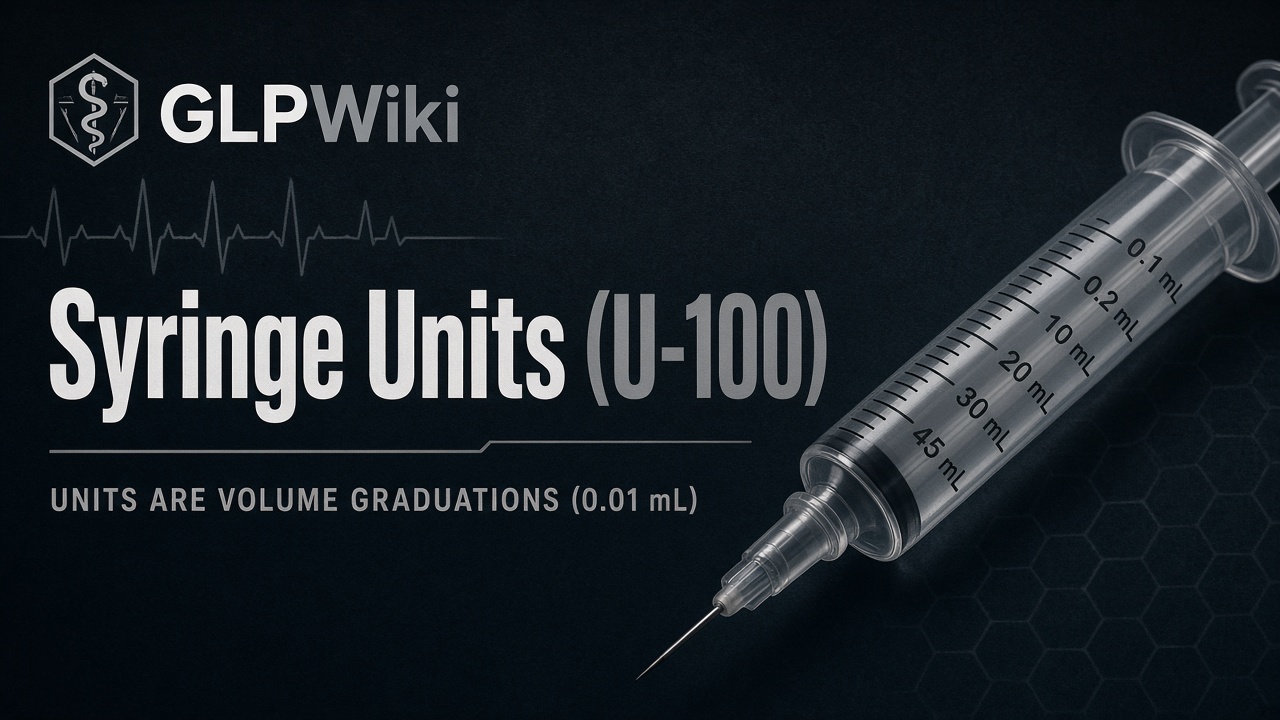
How to read a U-100 insulin syringe
Insulin syringes are graduated in 'units,' not milligrams or millilitres, and mixing those concepts up is one of the most common sources of confusion in research settings. Here is how the markings actually work.
UPDATED 2026-09-09 · 10 MIN · 5 SOURCES
 DOSING MATH
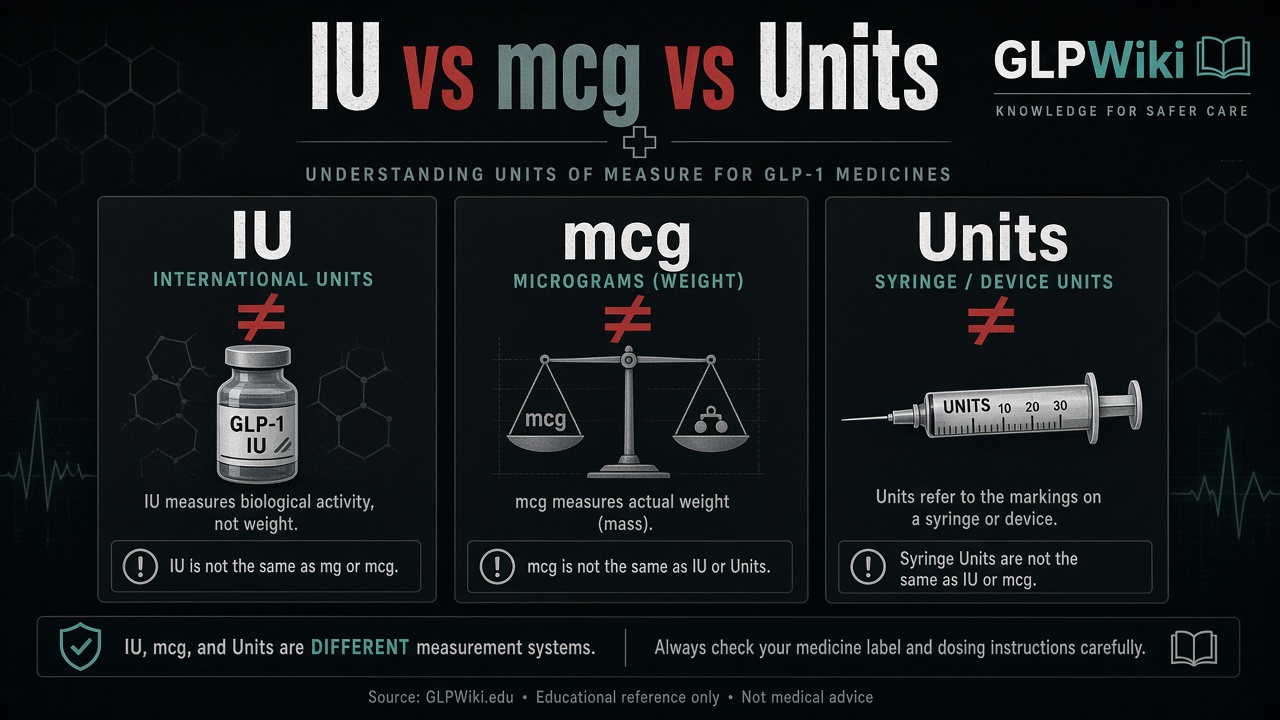
IU vs mcg vs syringe units: what each means
The word 'unit' shows up in at least three unrelated contexts — international units of biological activity, syringe volume markings, and colloquial shorthand — and conflating them is a well-documented source of confusion. Here is how each is actually defined.
UPDATED 2026-09-09 · 11 MIN · 6 SOURCES
 COMPARISON
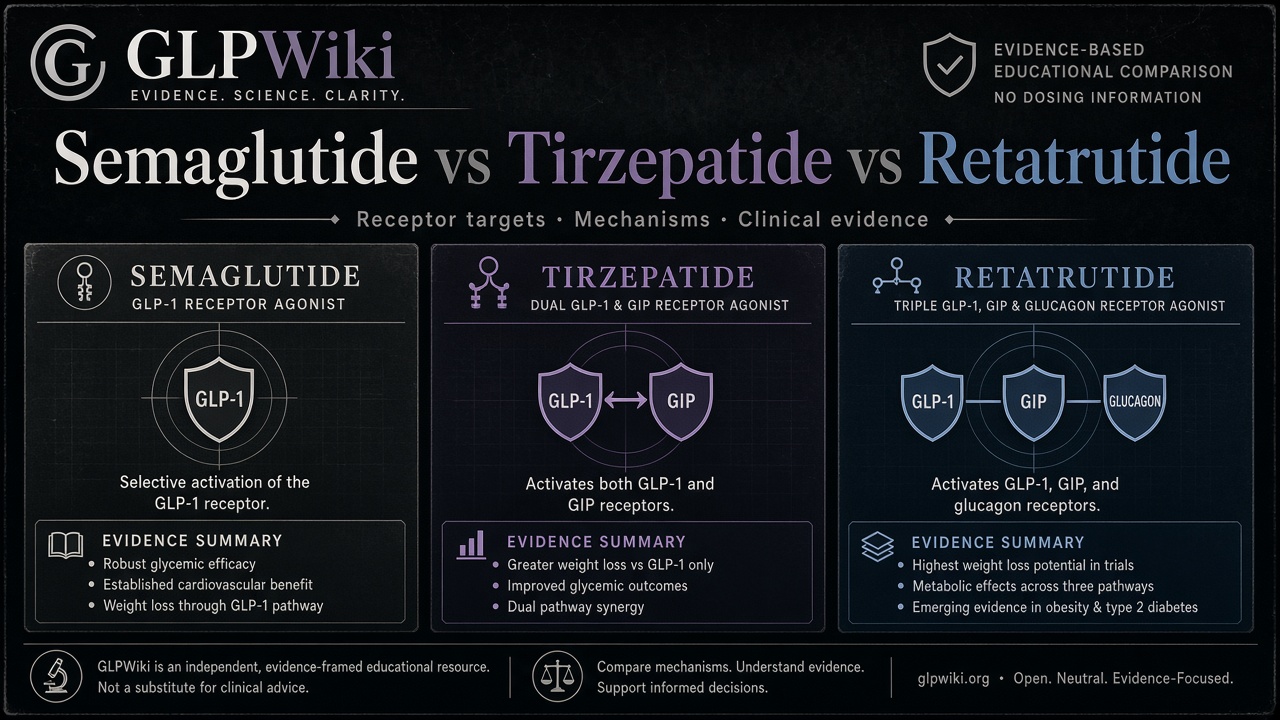
Semaglutide vs tirzepatide vs retatrutide: what the evidence shows
Three incretin-based molecules dominate current obesity and diabetes research and practice. Here is what their trial programmes actually show — and where cross-trial comparisons break down.
UPDATED 2026-09-09 · 14 MIN · 10 SOURCES
 EXPLAINER
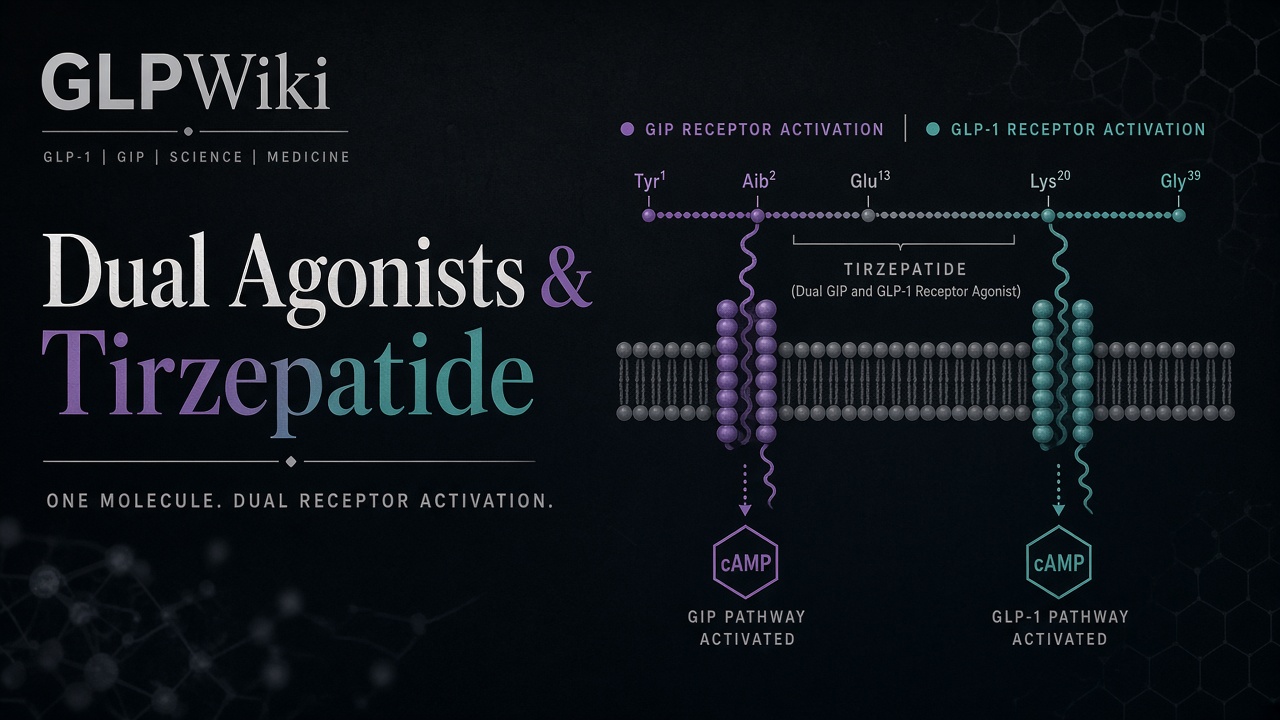
Dual agonists explained: how tirzepatide combines GIP and GLP-1
Tirzepatide activates two incretin receptors instead of one. Here is the mechanistic case for dual agonism and what the human trial data actually shows.
UPDATED 2026-09-09 · 11 MIN · 6 SOURCES
 HANDLING
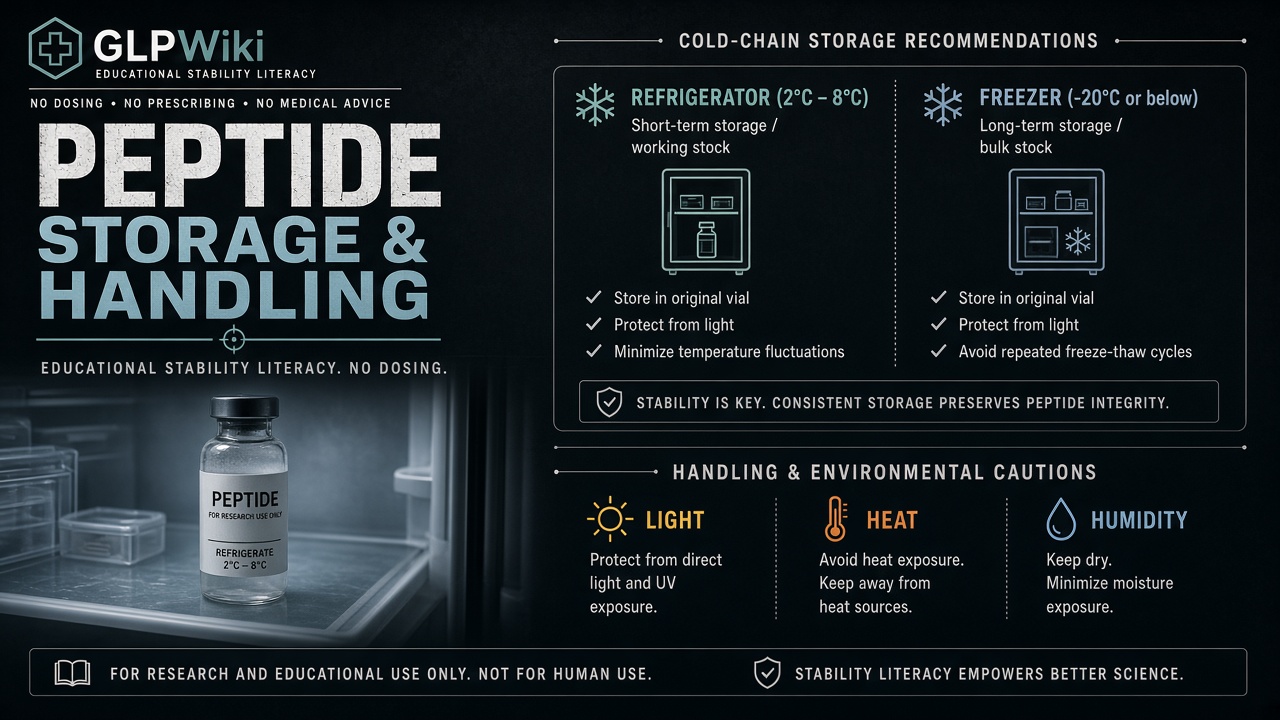
Storage, stability and research handling basics
Peptides are chemically fragile molecules. Understanding temperature, light, agitation, and container-material effects is central to keeping a research sample interpretable and consistent.
UPDATED 2026-09-09 · 11 MIN · 6 SOURCES
Working through the arithmetic?
The reconstitution, bacteriostatic water and syringe draw calculators sit alongside these guides and share the same worked examples.
Open the calculators