How to read the Overdosage section on peptide labels (Section 10): what it says, what it leaves out, and who to call

GLPWiki's how-to-read-fda-peptide-labeling hub maps the whole Prescribing Information. This companion goes deep on Section 10 Overdosage: what 21 CFR 201.57(c)(11) requires, what current semaglutide, tirzepatide and liraglutide labels actually say, why the observation period is tied to the half-life, how Section 10 connects to Sections 2, 5, 12 and 17, why pen design and compounded vial-and-syringe dosing errors matter, and the one action that applies to everyone: call Poison Help at 1-800-222-1222, or 911 in an emergency. Label-reading literacy only: no doses, no treatment instructions, no medical advice.
UPDATED 23 OCT 2026 · 12 MIN READ
KEY TAKEAWAYS
- If you think someone has taken too much of any medicine, call Poison Help at 1-800-222-1222 (free, confidential, 24/7 in the U.S.) or use poisonhelp.org or poison.org. Call 911 right away if the person has trouble breathing, collapses, has a seizure, or cannot be woken up. This page is not a substitute for either.
- Under 21 CFR 201.57(c)(11), Section 10 Overdosage must be based on human data (or, if none exist, appropriate animal and in vitro data) and covers six kinds of information: signs, symptoms and lab findings; complications; concentrations and factors that influence toxicity; threshold amounts if known; whether the drug is dialyzable; and general treatment principles.
- The same rule says unqualified recommendations for which data are lacking must not be stated. That is why GLP-1 Section 10 text is short: it names effects that have been reported, says to start supportive treatment based on signs and symptoms, and points to the Poison Help line or a medical toxicologist. No GLP-1 label names a specific antidote.
- Saxenda (liraglutide) and Wegovy (semaglutide) labels say reported overdose effects have included severe nausea, severe vomiting and severe hypoglycemia. Poison center studies of GLP-1 exposures likewise find mostly gastrointestinal effects, with hypoglycemia in a small share of cases.
- Section 10 ties the observation period to the half-life: approximately 1 week for semaglutide and approximately 5 days for tirzepatide, per the labels. The half-life itself is explained in Section 12 Clinical Pharmacology.
- Section 10 is read with Section 2 (the intended dosage an error is measured against), Section 5 (hypoglycemia with insulin or insulin secretagogues such as sulfonylureas, severe GI reactions, kidney injury from fluid loss, never sharing a pen), Section 12 (half-life), and Section 17 plus the Instructions for Use (how the device is meant to be used).
- FDA has received reports of overdoses with compounded semaglutide, many from measuring doses out of multiple-dose vials with syringes and confusing milliliters, milligrams and units, with some patients taking 5 to 20 times the intended amount. Compounded products are not FDA-approved and have no FDA-approved Section 10.
First: what to do in a real situation
This guide teaches how to read a section of drug labeling. It is not a response plan. If you think you or someone else has taken too much of a GLP-1 medicine or any other medicine, do not use this page, a forum, or a chatbot to decide what to do. Contact the people trained for it.
- Emergency signs: if the person has trouble breathing, collapses, has a seizure, or cannot be woken up, call 911 right away.
- Any possible overdose or dosing mistake, with or without symptoms: call Poison Help at 1-800-222-1222. America's Poison Centers describes the line as free, confidential expert advice 24 hours a day, every day, from toxicology specialists including nurses, pharmacists and physicians. Online tools are at poisonhelp.org and poison.org (webPOISONCONTROL, from the National Capital Poison Center).
- Have the product, its carton or vial label, and any pharmacy label nearby so you can read exactly what it is. Poison center staff will ask.
- Afterward, tell your prescriber or pharmacist what happened before your next dose. Do not adjust doses yourself to make up for a mistake.
What this guide covers (and how it differs from sister pages)
How to read FDA peptide labeling already explains PLR Highlights vs Full Prescribing Information, Drugs@FDA vs DailyMed, and the overall section map. This Day 44 guide is the deep companion for Section 10 Overdosage: the section that summarizes what is known when someone has taken more than intended.
It explains what the regulation requires, quotes the approach current GLP-1 labels take, and shows where the details Section 10 depends on actually live. It deliberately reproduces no doses or strengths and gives no treatment steps beyond contacting Poison Help or emergency services. It is distinct from the Warnings, Precautions and Adverse Reactions guide (Sections 5 and 6), the Clinical Pharmacology guide (Section 12), and the Patient Counseling guide (Section 17), each of which this page links to rather than repeats.
What Section 10 is: 21 CFR 201.57(c)(11)
In the PLR format, Section 10 is paragraph (c)(11) of 21 CFR 201.57. The regulation says the section must be based on human data, and that appropriate animal and in vitro data may be used only if human data are unavailable. It then lists six kinds of specific information:
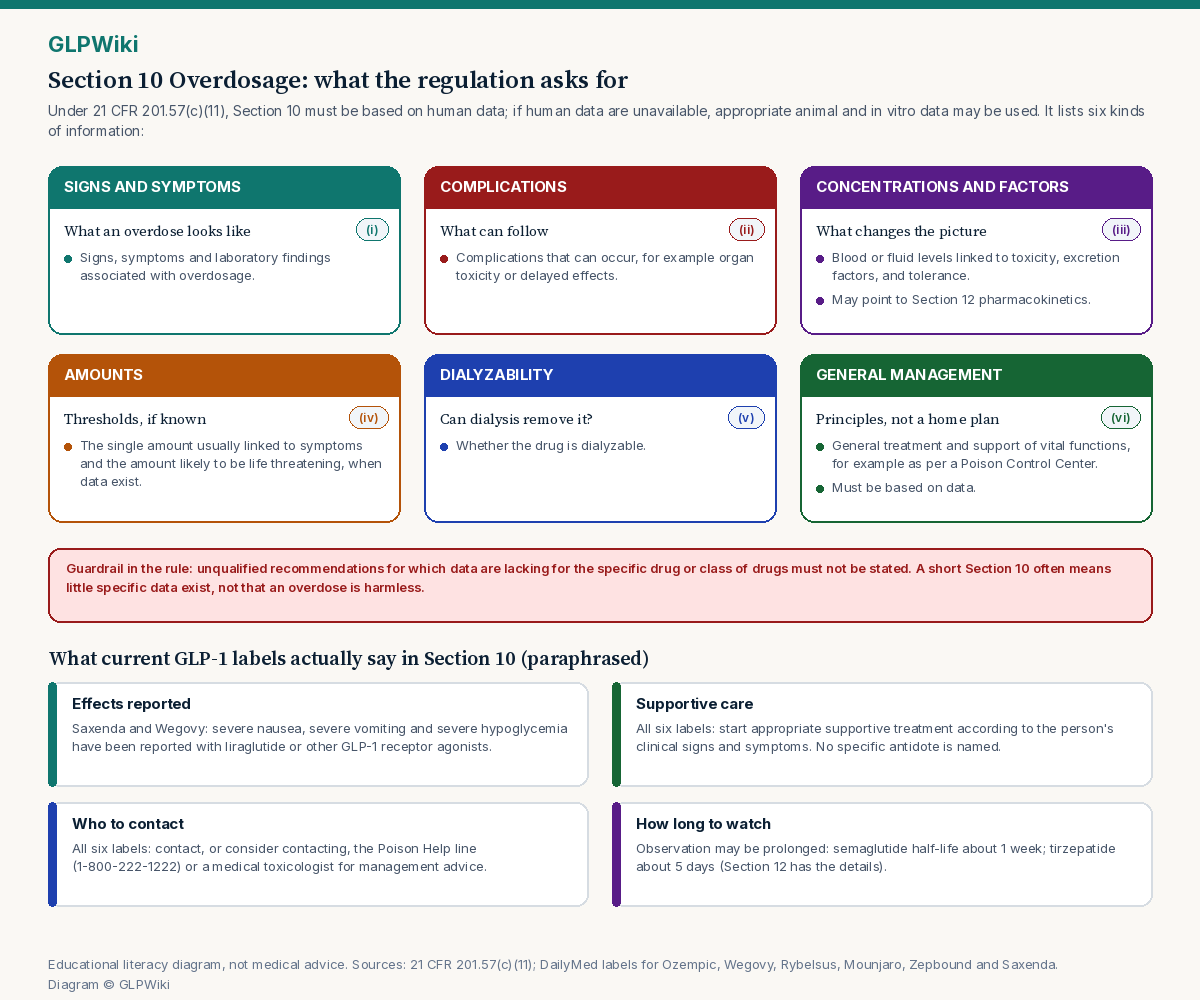
- (i) Signs, symptoms and laboratory findings associated with an overdosage of the drug.
- (ii) Complications that can occur with the drug, for example organ toxicity or delayed acidosis.
- (iii) Concentrations of the drug in biologic fluids associated with toxicity or death; physiologic variables that influence excretion, such as urine pH; and factors that influence the dose-response relationship, such as tolerance. Pharmacokinetic data from Clinical Pharmacology may be referenced here if relevant to overdoses.
- (iv) The amount in a single dose ordinarily associated with symptoms of overdosage, and the amount likely to be life threatening.
- (v) Whether the drug is dialyzable.
- (vi) Recommended general treatment procedures and specific measures for support of vital functions, for example proven antidotes, gastric lavage, forced diuresis, or as per a Poison Control Center. These must be based on data for the specific drug or experience with pharmacologically related drugs.
The data guardrail: why Section 10 can be short
The last sentence of 201.57(c)(11) matters most for readers: unqualified recommendations for which data are lacking for the specific drug or class of drugs must not be stated. Section 10 is not allowed to fill space with generic advice. If there is no proven antidote, the label does not invent one. If dialyzability, toxic blood concentrations or a life-threatening amount have not been established, the label can simply omit them.
So a brief Overdosage section should be read as 'this is what the evidence supports', not as 'overdose is not a concern'. For peptide medicines like GLP-1 receptor agonists, many of the classic poisoning items in the rule (toxic blood levels, dialysis, gastric lavage) are designed around small-molecule poisonings and do not appear at all.
Two practical reading habits follow. First, notice whether a label says overdoses have been reported for this drug, for a related drug, or not at all; the wording tells you what kind of evidence sits behind it. Second, notice what the label points you to instead, which for GLP-1 medicines is supportive care, Poison Help or a medical toxicologist, and an observation window.
What current GLP-1 labels actually say
Reading Section 10 across the current DailyMed labels shows a consistent template with small, meaningful differences. Paraphrased, without doses:
- Ozempic (semaglutide injection) and Rybelsus (oral semaglutide): start appropriate supportive treatment according to the patient's clinical signs and symptoms; consider contacting the Poison Help line (1-800-222-1222) or a medical toxicologist; a prolonged period of observation and treatment may be necessary given the long half-life of approximately 1 week.
- Wegovy (semaglutide): the same elements, plus a first sentence that overdoses have been reported with other GLP-1 receptor agonists, with effects including severe nausea, severe vomiting and severe hypoglycemia.
- Saxenda (liraglutide): overdoses have been reported in clinical trials and postmarketing use of liraglutide, with effects including severe nausea, severe vomiting and severe hypoglycemia; consider the Poison Helpline or a medical toxicologist; initiate supportive treatment.
- Mounjaro and Zepbound (tirzepatide): contact (Zepbound) or consider contacting (Mounjaro) the Poison Help line or a medical toxicologist; initiate supportive treatment; a period of observation and treatment may be necessary given the tirzepatide half-life of approximately 5 days.
Reading the differences
'Reported with other GLP-1 receptor agonists' (Wegovy) and 'reported in clinical trials and post-marketing use of liraglutide' (Saxenda) are different evidence statements. The first borrows class experience, which 201.57(c)(11)(vi) allows; the second describes the drug itself. Neither label lists an amount that causes symptoms or is life threatening, and none of the six labels names an antidote or says whether the drug is dialyzable.
Every label names the same contact point: the Poison Help line, 1-800-222-1222, or a medical toxicologist. That is the part of Section 10 written to be actionable for anyone reading it.
Why the observation period follows the half-life
Section 10 on semaglutide and tirzepatide labels links how long observation may be needed to the drug's half-life: approximately 1 week for semaglutide and approximately 5 days for tirzepatide. The Ozempic label's Clinical Pharmacology section adds that, with a half-life of about a week, semaglutide will be present in the circulation for about 5 weeks after the last dose. Liraglutide, by contrast, has an elimination half-life of about 13 hours on the Saxenda label.
For literacy, the point is simple: these are long-acting peptides that cannot be removed quickly, so effects such as nausea and vomiting after too large an amount may last for days, and the label anticipates a longer watch period than for a short-acting drug. Poison center case series describe exactly that: symptoms lasting days after unintentional semaglutide overdoses. How long any one person should be observed is a clinical decision for Poison Help, a toxicologist, or the treating clinician.
The pharmacokinetic background, including albumin binding as the main reason for semaglutide's long half-life, is covered in GLPWiki's Clinical Pharmacology (Section 12) guide.
Hypoglycemia, GI effects and the Section 5 link
GLP-1 receptor agonists lower glucose in a glucose-dependent way, which is one reason a toxicology case series noted that the potential for hypoglycemia after GLP-1 overdose alone is unclear. Section 5 Warnings and Precautions states the better-established risk: people also using insulin or an insulin secretagogue such as a sulfonylurea have an increased risk of hypoglycemia, including severe hypoglycemia.
That is why reading Section 10 in isolation can mislead. The overdose effects named in Section 10 (severe nausea, severe vomiting, severe hypoglycemia) map onto Section 5 warnings: severe gastrointestinal adverse reactions, acute kidney injury due to volume depletion (which can follow severe vomiting or diarrhea), and hypoglycemia with concomitant insulin or insulin secretagogues. Section 5 is where the label explains those risks; Section 10 only flags them in the overdose context.
Poison center data point the same way. A national study of 5,713 single-substance GLP-1 receptor agonist cases reported to U.S. poison centers in 2017 to 2022 found most were therapeutic errors and most involved no or minimal effects, but 6.2% had serious medical outcomes, including one death. A single-center study found hypoglycemia in 3.4% of GLP-1 exposures.
Section 10 in context: Sections 2, 5, 12 and 17
Because Section 10 is short, its meaning comes from the sections around it. Use this map when reading any GLP-1 label:
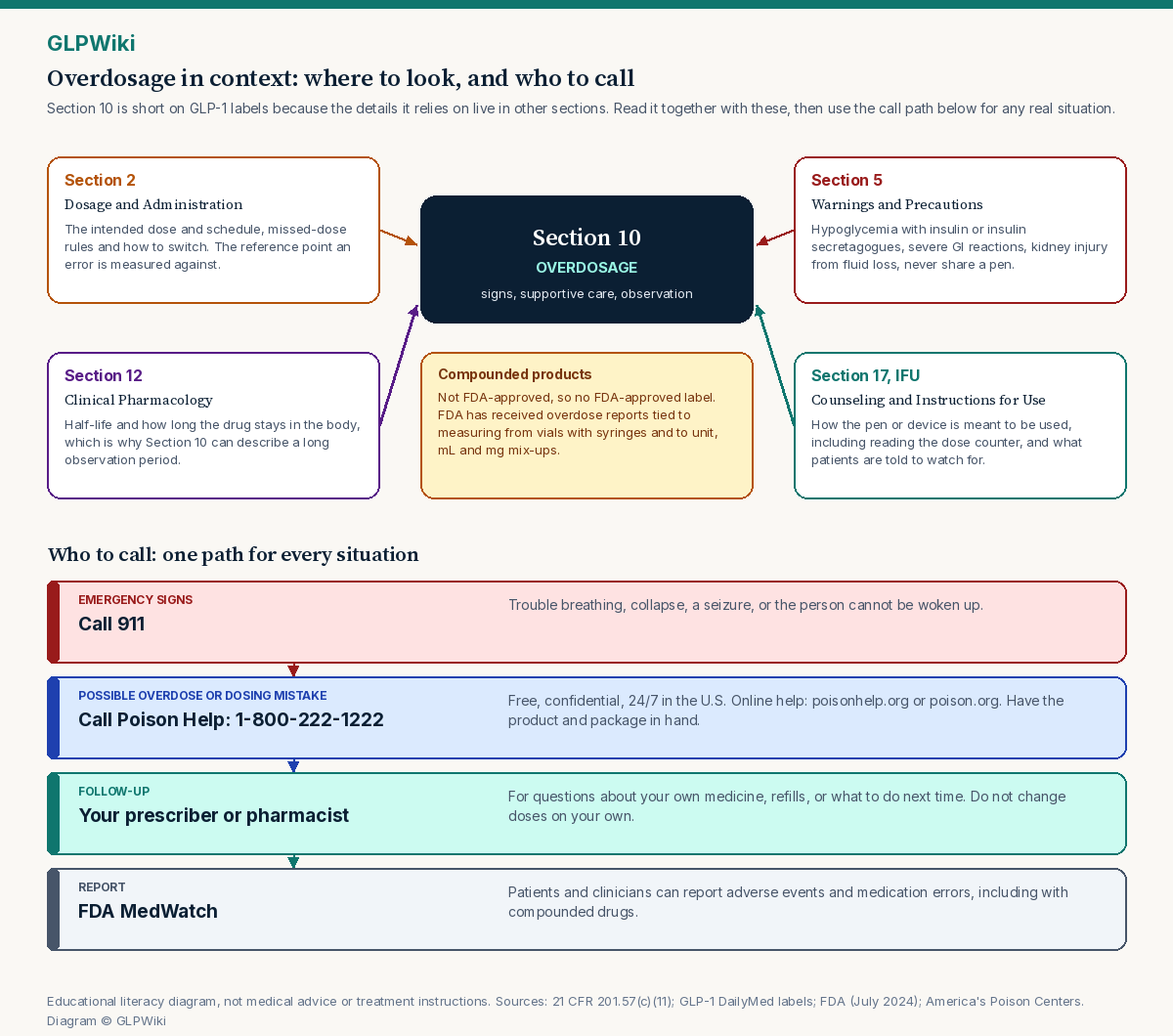
- Section 2 Dosage and Administration: the intended dose, schedule and missed-dose instructions. It is the reference point an error is measured against. Read it only with your prescriber's instructions; GLPWiki does not reproduce dosing here.
- Section 5 Warnings and Precautions: hypoglycemia with insulin or insulin secretagogues, severe GI reactions, acute kidney injury from volume depletion, and a 'Never Share' warning for pens.
- Section 12 Clinical Pharmacology: half-life and elimination, which explain the observation language in Section 10.
- Section 17 Patient Counseling Information, the Medication Guide and the Instructions for Use: how the pen or device is designed to be used, including reading the dose counter, and what patients are told to watch for and report.
- Section 16 How Supplied: package types (single-dose vs multiple-dose pens or vials), which shape how dosing errors can happen.
Pens, dose counters and why device design is part of overdose literacy
FDA-approved injectable semaglutide and tirzepatide come in prefilled pens, and tirzepatide is also supplied in single-dose vials. FDA's July 2024 alert notes that FDA-approved injectable semaglutide products are dosed in milligrams, have standard concentrations, and were at that time available only in prefilled pens. Some pens are single-dose and deliver a preset dose; others are multiple-dose pens for single-patient use, where the user selects a dose and reads a dose counter.
That design is deliberate. FDA's guidance on product design to minimize medication errors asks manufacturers to consider the whole user interface (container, controls, displays, labels and instructions) and to test how real users interact with it before the design is final. The Instructions for Use for multiple-dose semaglutide pens tell users who are blind or have poor eyesight and cannot read the dose counter not to use the pen without help, and to get help from a person with good eyesight who is trained to use the pen.
For readers, the literacy point is that Section 10 tells you what happens after an error, while the device, the Instructions for Use and the package type term tell you how errors are meant to be prevented. If a pen or counter is confusing, ask a pharmacist to walk through the Instructions for Use; GLPWiki does not provide device steps.
Compounded GLP-1 dosing errors: what FDA reported
In July 2024, FDA alerted health care providers, compounders and patients to adverse events, some requiring hospitalization, that may be related to overdoses from dosing errors with compounded injectable semaglutide. Most reports described patients drawing up more than the prescribed dose from a multiple-dose vial during self-administration, in some cases 5 to 20 times the intended amount. Other reports described health care providers miscalculating doses when converting from milligrams to units or milliliters. FDA said confusion between milliliters, milligrams and 'units', and unfamiliarity with drawing medicine from a vial into a syringe, may have contributed.
FDA's page on unapproved GLP-1 drugs adds reports of adverse events in people prescribed compounded semaglutide or tirzepatide in doses beyond what the FDA-approved labels describe, including larger single doses, more frequent doses or faster dose increases, with effects such as nausea, vomiting, diarrhea, abdominal pain and constipation. A separate FDA compounding alert explains how a label that shows concentration per milliliter more prominently than the total amount per container can lead to overdoses.
Peer-reviewed case series tell the same story. A poison center case series described 10-fold self-administration errors with compounded semaglutide, with nausea, vomiting and abdominal pain lasting days, and noted that vials do not have the safety features of prefilled manufactured pens. Another case series of unintentional semaglutide overdoses at treatment start found nonspecific GI symptoms and attributed the errors to gaps in patient and prescriber knowledge.
The literacy takeaway: compounded drugs are not FDA-approved, so they have no FDA-approved Section 10, no FDA-reviewed Instructions for Use, and no standardized concentration. An approved label's Overdosage section describes the approved product, not a different preparation with the same ingredient name. If a measurement on any product is unclear, stop and ask the pharmacist or compounder before using it.
What Poison Help is, and why every GLP-1 label names it
The Poison Help line, 1-800-222-1222, connects callers anywhere in the United States and its territories to their local poison center. America's Poison Centers says callers get free, confidential, expert medical advice 24 hours a day, seven days a week, from toxicology specialists including nurses, pharmacists, physicians and poison information providers. Calls are for emergencies and for questions; you do not need to have symptoms to call.
Poison centers have seen GLP-1 calls rise with use. America's Poison Centers reports a large increase in GLP-1 agonist exposure cases since 2019 and notes that overdose signs and symptoms are similar to the usual side effects but may last longer, and that in severe cases dehydration or hypoglycemia can occur, especially with insulin or sulfonylureas. The national 2017 to 2022 study found the case rate per million U.S. residents rose 80.9% from 2021 to 2022.
That is the practical reason 201.57(c)(11)(vi) mentions management 'as per Poison Control Center', and why every current GLP-1 Section 10 names the Poison Help line or a medical toxicologist. It is the one recommendation in the section that applies to everyone.
Reporting a dosing error or adverse event
Separate from getting help, FDA collects reports of adverse events and medication errors through MedWatch, its safety information and adverse event reporting program. FDA encourages health care professionals, patients and compounders to report adverse events or quality problems with any medicine, including compounded GLP-1 products, to MedWatch online or by form. Reporting does not replace calling Poison Help or 911 for a current exposure.
Cross-checking Section 10 on Drugs@FDA and DailyMed
To read Section 10 for a specific approved product:
- Open the current label on DailyMed or Drugs@FDA and confirm the product name, dosage form and revision date.
- Find 10 OVERDOSAGE in the Full Prescribing Information. Highlights does not have an Overdosage heading.
- Note whether overdoses are described for this drug, for related drugs, or not at all, and note the contact point and any observation language.
- Jump to Section 12 for half-life and to Section 5 for the warnings Section 10 echoes, then to Section 17 and the Instructions for Use for device information.
- Treat Section 10 as background. For any actual exposure, call Poison Help or 911 rather than interpreting the label yourself.
Common misreadings
- Reading a short Overdosage section as proof that an overdose is harmless.
- Treating Section 10 as home-treatment instructions. It describes general principles for clinicians and points to Poison Help or a medical toxicologist.
- Assuming symptoms will pass in a day. Labels for long half-life peptides describe a prolonged observation period.
- Forgetting that other diabetes medicines change the picture. Section 5 describes higher hypoglycemia risk with insulin or insulin secretagogues such as sulfonylureas.
- Applying an approved label's Section 10 to a compounded or research product with the same ingredient name.
- Waiting for symptoms before calling. Poison Help takes calls about possible mistakes with or without symptoms.
- Adjusting the next dose to 'make up' for a mistake without talking to the prescriber.
Scope, disclaimer and review date
This guide is educational. It maps how to read Section 10 Overdosage on FDA peptide and GLP-1 Prescribing Information under PLR: what 21 CFR 201.57(c)(11) requires, what current semaglutide, tirzepatide and liraglutide labels say, how the observation period relates to half-life, how Section 10 connects to Sections 2, 5, 12, 16 and 17, and what FDA and poison centers have reported about dosing errors. It does not provide doses, strengths, titration schedules, preparation or injection steps, treatment instructions, product or pharmacy recommendations, or individual medical advice, and nothing here recommends starting, stopping, switching or continuing any medicine or research chemical. In any possible overdose, call Poison Help at 1-800-222-1222, or 911 for emergency signs, and follow your prescriber's and pharmacist's instructions.
Last reviewed: October 23, 2026. Labeling, approval status and FDA communications may have changed since; verify with Drugs@FDA, DailyMed, and your pharmacist or clinician.
Frequently asked questions
- What should I do if I think I took too much of a GLP-1 medicine?
- Call Poison Help at 1-800-222-1222 (free, confidential, 24/7 in the U.S.) or use poisonhelp.org or poison.org. Call 911 right away for trouble breathing, collapse, a seizure, or if the person cannot be woken up. Then tell your prescriber or pharmacist. This page cannot assess your situation.
- What is Section 10 Overdosage?
- It is the section of the PLR Prescribing Information governed by 21 CFR 201.57(c)(11). Based on human data where available, it covers signs and symptoms, complications, concentrations and influencing factors, threshold amounts if known, whether the drug is dialyzable, and general treatment principles supported by data.
- Why is the Overdosage section on GLP-1 labels so short?
- The regulation forbids unqualified recommendations for which data are lacking. GLP-1 labels therefore state reported effects where known, advise supportive treatment based on signs and symptoms, name the Poison Help line or a medical toxicologist, and describe an observation period tied to half-life. Short does not mean harmless.
- What effects do GLP-1 labels list for overdose?
- Saxenda and Wegovy say reported overdose effects have included severe nausea, severe vomiting and severe hypoglycemia. Poison center studies mostly report gastrointestinal effects, with hypoglycemia in a small share of cases and a higher hypoglycemia risk when insulin or sulfonylureas are also used.
- Why do labels mention the half-life in the Overdosage section?
- Because semaglutide (about 1 week) and tirzepatide (about 5 days) stay in the body a long time, effects can last and observation may need to be prolonged. Section 12 explains the pharmacokinetics. How long a specific person should be watched is decided by Poison Help or a clinician.
- Is there an antidote for a GLP-1 overdose?
- None of the current semaglutide, tirzepatide or liraglutide labels names a specific antidote. They describe supportive treatment based on signs and symptoms and point to the Poison Help line or a medical toxicologist.
- Why are compounded GLP-1 products linked to overdose reports?
- FDA has received reports of patients drawing up too much from multiple-dose vials with syringes, sometimes 5 to 20 times the intended amount, and of providers miscalculating conversions between milligrams, milliliters and units. Compounded products are not FDA-approved and have no FDA-approved Section 10 or Instructions for Use.
- Should I call Poison Help even if I feel fine?
- Yes, you can. Poison centers take calls about possible mistakes and questions with or without symptoms, and America's Poison Centers notes overdose symptoms can resemble usual side effects but last longer.
- Can this page tell me how to treat an overdose or adjust my dose?
- No. It teaches how to read Section 10. It gives no doses and no treatment instructions. Contact Poison Help or emergency services for any exposure, and your prescriber or pharmacist for dosing questions.
SOURCES
- 0121 CFR 201.57 — Specific requirements on content and format of labeling (PLR), including (c)(11) 10 Overdosage— U.S. Government Publishing Office / eCFR
- 02Labeling for Human Prescription Drug and Biological Products — Implementing the PLR Content and Format Requirements (guidance, February 2013)— U.S. Food and Drug Administration
- 03Prescribing Information Resources (PLR section map)— U.S. Food and Drug Administration
- 04Ozempic (semaglutide) injection — Sections 5, 10 and 12 (DailyMed)— U.S. FDA / DailyMed
- 05Wegovy (semaglutide) injection and tablets — Sections 5, 10 and 12 (DailyMed)— U.S. FDA / DailyMed
- 06Rybelsus (semaglutide) tablets — Section 10 Overdosage (DailyMed)— U.S. FDA / DailyMed
- 07Mounjaro (tirzepatide) injection — Sections 10 and 12 (DailyMed)— U.S. FDA / DailyMed
- 08Zepbound (tirzepatide) injection — Sections 5, 10 and 12 (DailyMed)— U.S. FDA / DailyMed
- 09Saxenda (liraglutide) injection — Sections 10 and 12 (DailyMed)— U.S. FDA / DailyMed
- 10FDA alerts health care providers, compounders and patients of dosing errors associated with compounded injectable semaglutide products (July 26, 2024)— U.S. Food and Drug Administration
- 11FDA's concerns with unapproved GLP-1 drugs used for weight loss (dosing concerns with compounded semaglutide and tirzepatide)— U.S. Food and Drug Administration
- 12Differences in strength expression on product labels of compounders and conventional manufacturers may lead to dosing errors (compounding risk alert, updated May 21, 2024)— U.S. Food and Drug Administration
- 13Safety Considerations for Product Design to Minimize Medication Errors (guidance for industry, April 2016)— U.S. Food and Drug Administration
- 14MedWatch: The FDA Safety Information and Adverse Event Reporting Program— U.S. Food and Drug Administration
- 15Lambson JE, Flegal SC, Johnson AR. Administration errors of compounded semaglutide reported to a poison control center — case series. J Am Pharm Assoc (2003). 2023;63(5):1643-1645 (PMID 37392810)— Journal of the American Pharmacists Association / PubMed
- 16Wiener BG, Gnirke M, Vassallo S, Smith SW, Su MK. Challenges with glucagon-like peptide-1 (GLP-1) agonist initiation: a case series of semaglutide overdose administration errors. Clin Toxicol (Phila). 2024;62(2):131-133 (PMID 38470137)— Clinical Toxicology / PubMed
- 17Gaw CE, Hays HL, Kemp CA, et al. Glucagon-like peptide-1 receptor agonist cases reported to United States poison centers, 2017-2022. J Med Toxicol. 2024;20(2):193-204 (PMID 38421490)— Journal of Medical Toxicology / PubMed
- 18Muschler K, Muschalek R, Hoyte C. Characterization of glucagon-like peptide-1 (GLP-1) agonist exposures reported to a single United States poison center. Clin Toxicol (Phila). 2025;63(2):133-136 (PMID 39803696)— Clinical Toxicology / PubMed
- 19Get Poison Help (Poison Help line 1-800-222-1222 and PoisonHelp.org)— America's Poison Centers
- 20GLP-1 agonist exposure tracking and take-action guidance— America's Poison Centers
- 21webPOISONCONTROL online tool and call guidance— National Capital Poison Center (poison.org)
EDUCATIONAL REFERENCE ONLY · Not medical advice. Nothing here diagnoses, treats, cures or prevents any disease, and nothing here is a dosing recommendation. Consult a licensed clinician before any treatment decision.