How to read Clinical Pharmacology on peptide labels (Section 12)
GLPWiki's how-to-read-fda-peptide-labeling hub maps the whole Prescribing Information. This companion goes deeper into Section 12 Clinical Pharmacology — where mechanism (12.1), pharmacodynamics (12.2), and pharmacokinetics (12.3) live — and how to read absorption, bioavailability, Tmax, food effect, distribution, half-life, elimination, drug-interaction tables, and specific-population statements on peptide and GLP-1 labels. Literacy examples include why semaglutide's ~1-week half-life underlies weekly labeling CONCEPTS, tirzepatide's ~5-day half-life, oral semaglutide food/water absorption literacy, and delayed gastric emptying language that links Section 12 to Section 7 oral-medication caution. Educational only: no doses, schedules, or medical recommendations.
UPDATED 13 OCT 2026 · 16 MIN READ
KEY TAKEAWAYS
- Section 12 Clinical Pharmacology on a modern PLR label is organized as 12.1 Mechanism of Action, 12.2 Pharmacodynamics, and 12.3 Pharmacokinetics — each answers a different question about the finished product.
- Common PK terms (Cmax, Tmax, AUC, bioavailability, half-life) are exposure descriptors for a labeled finished drug. Quote the current product PI, not a molecule nickname shared across brands or research listings.
- Semaglutide injection labels cite absolute bioavailability ~89%, Tmax 1–3 days, and elimination half-life of approximately 1 week (present in circulation about 5 weeks after the last dose; Wegovy 2.4 mg labeling often cites about 5–7 weeks). Those half-life facts underpin weekly administration CONCEPTS and long washout language elsewhere on the label.
- Tirzepatide labels cite mean absolute bioavailability ~80%, Tmax typically around 24 hours (range 8–72 hours), and elimination half-life of approximately 5 days (Zepbound labeling often ~5–6 days), enabling once-weekly dosing CONCEPTS on those finished products.
- Oral semaglutide tablet labeling describes stomach-localized absorption with SNAC, Tmax near ~1 hour, and low absolute bioavailability (~0.4–1% for classic Rybelsus R1 strengths; ~1–2% for certain oral Ozempic tablet strengths on cited labels) with food/water/timing sensitivity under Absorption / Effect of Food literacy — verify the current PI.
- Delayed gastric emptying in 12.2 often cross-links to Section 7 Oral Medications caution: coadministered oral drugs may have altered absorption; label tables in 12.3 report studied interaction results. This page does not publish monitoring or dose-change advice.
- This page publishes no doses, titration schedules, fasting recipes as advice, compounding recipes, or product recommendations.
What this guide covers (and how it differs from sister pages)
How to read FDA peptide labeling already explains PLR Highlights vs Full PI, Drugs@FDA vs DailyMed, Indications, Warnings, and why a trial paper is not an approved label. That hub stays in place. This Day 34 guide is the Clinical Pharmacology deep-dive: how to navigate Section 12, what each PK parameter means in plain English, and how food-effect, half-life, drug-interaction, and specific-population statements on peptide / GLP-1 labels should be read as literacy — never as DIY instructions.
- Primary sources: current Prescribing Information Clinical Pharmacology for Ozempic, Wegovy, Rybelsus / oral semaglutide tablets, Mounjaro, and Zepbound (Drugs@FDA / DailyMed); FDA Clinical Pharmacology Section of Labeling guidance; FDA food-effect clinical pharmacology guidance; Overgaard et al. oral semaglutide PK (PMID 33969456); Dahl et al. oral semaglutide gastric emptying (PMID 33710717).
- Two original GLPWiki diagrams: Section 12 anatomy map (12.1 / 12.2 / 12.3 and where food effect, half-life, DDI, and specific-population facts live), and a PK-parameter literacy ladder (Cmax, Tmax, AUC, bioavailability, half-life).
- Out of scope: doses, titration schedules, fasting or water-volume instructions as advice, compounding recipes, and product or pharmacy recommendations.
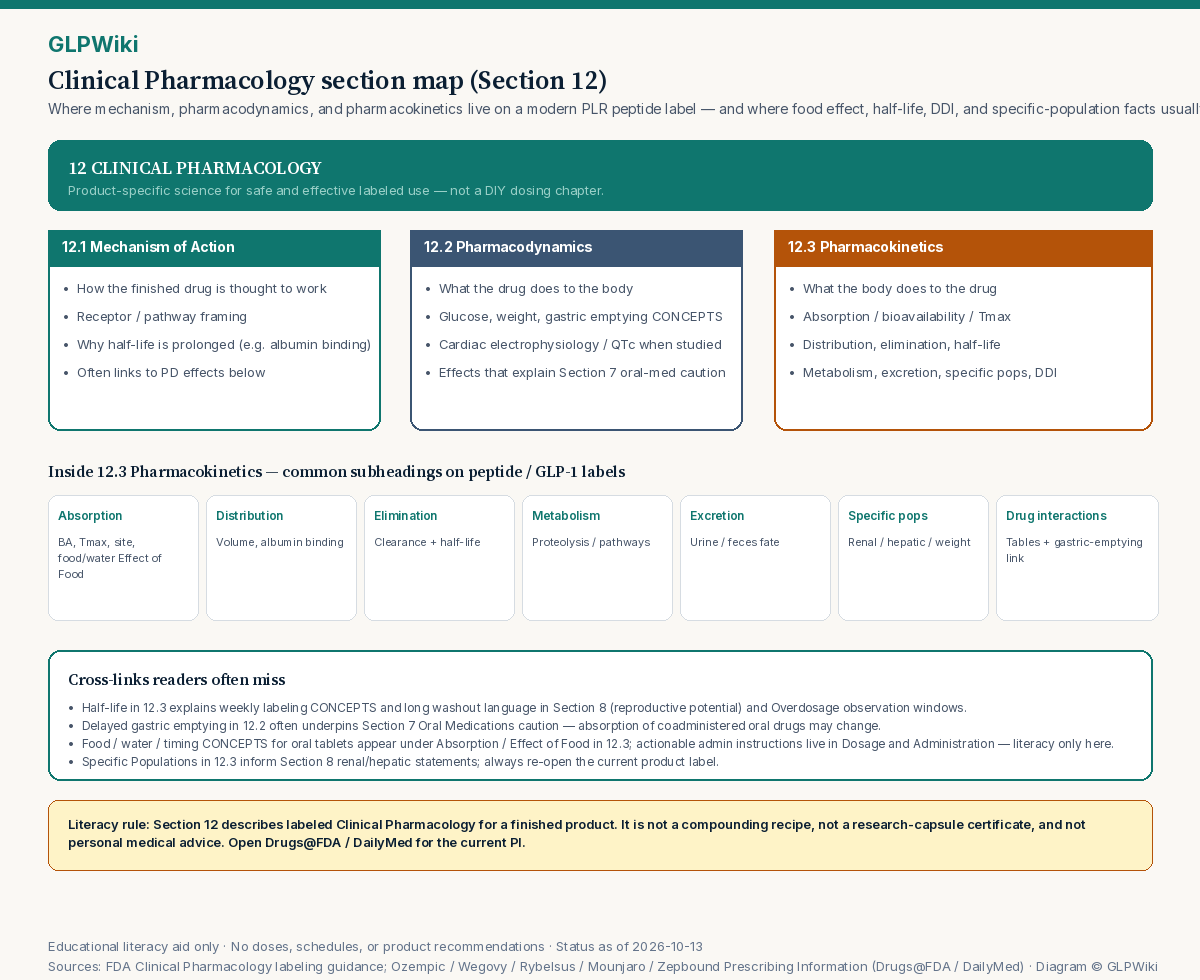
Section 12 anatomy: 12.1, 12.2, and 12.3
FDA's Clinical Pharmacology Section of Labeling guidance describes how sponsors should present clinically relevant pharmacology in Section 12 of PLR-format Prescribing Information. On peptide and incretin finished-drug labels you will typically find three numbered subsections with distinct jobs.
12.1 Mechanism of Action explains how the finished drug is thought to work — receptor targets, pathway framing, and often why exposure is prolonged (for example albumin binding that decreases renal clearance and protects against metabolic degradation for semaglutide and tirzepatide labeling).
12.2 Pharmacodynamics describes what the drug does to the body under labeled study conditions: glucose and weight effects, gastric emptying CONCEPTS, and cardiac electrophysiology / QTc when studied. Delayed early postprandial gastric emptying language here is the pharmacodynamic bridge that often supports Section 7 oral-medication caution.
12.3 Pharmacokinetics describes what the body does to the drug: absorption (including bioavailability, Tmax, and Effect of Food when relevant), distribution, elimination and half-life, metabolism, excretion, specific populations, and drug-interaction study summaries. Literacy habit: read 12.3 as product-specific exposure science, then cross-check related CONCEPTS in Dosage and Administration, Drug Interactions, Use in Specific Populations, and Overdosage without treating this encyclopedia page as instructions.
How to read PK parameters in plain English
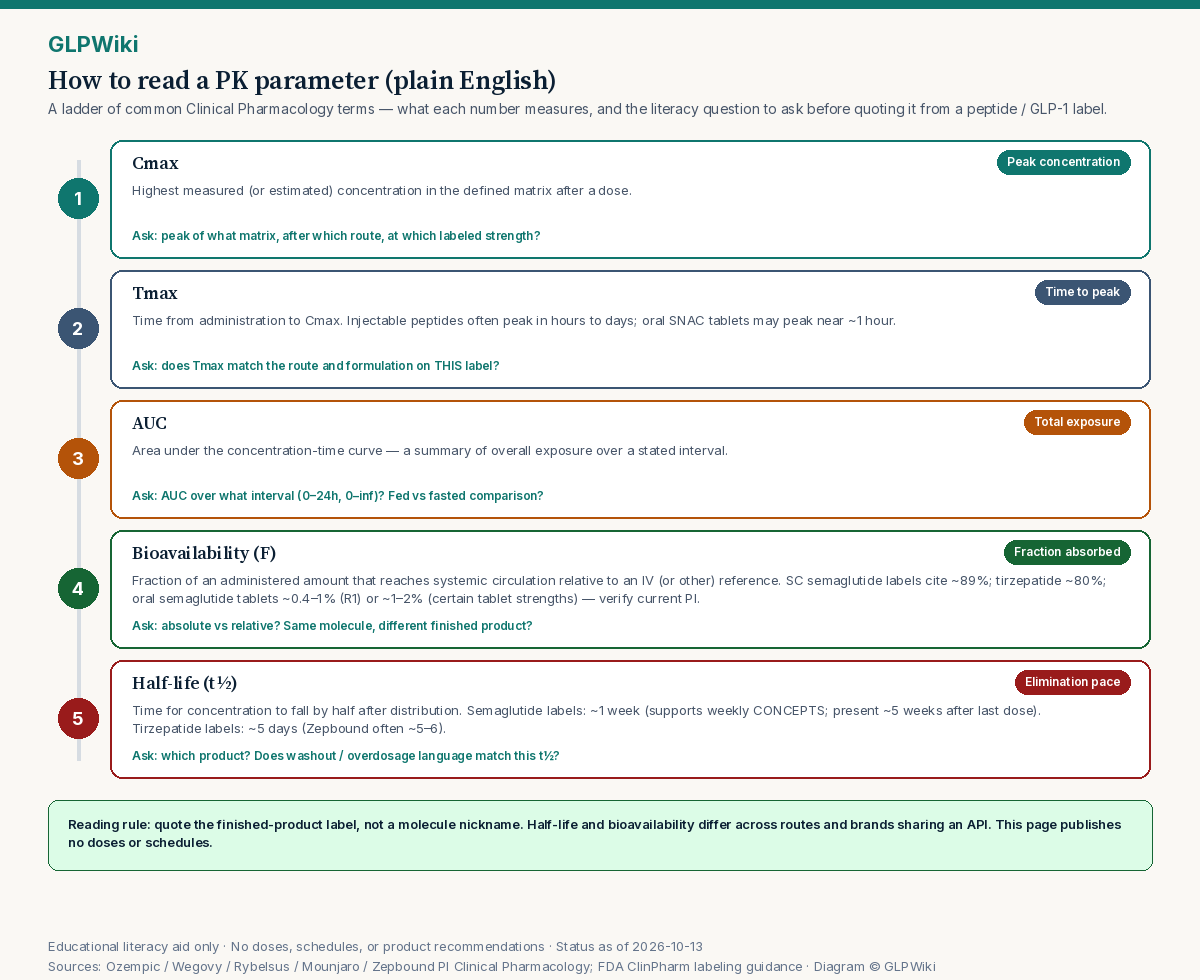
Clinical Pharmacology tables and prose use a small set of recurring exposure terms. Quoting them correctly means naming the finished product, route, and matrix — not pasting a number next to a molecule nickname from a forum.
Cmax is the peak concentration observed or estimated after a dose. Tmax is the time from administration to that peak. AUC (area under the concentration-time curve) summarizes overall exposure over a stated interval. Absolute bioavailability is the fraction of an administered amount that reaches systemic circulation relative to an intravenous (or other stated) reference. Elimination half-life is the time for concentration to fall by about half after distribution processes, and it often explains weekly labeling CONCEPTS and washout windows elsewhere on the PI.
On cited U.S. labels: subcutaneous semaglutide absolute bioavailability is about 89% with maximum concentration 1–3 days post dose; subcutaneous tirzepatide absolute bioavailability is about 80% with median Tmax around 24 hours (range 8–72 hours); oral semaglutide tablets reach maximum concentration near about 1 hour after administration. Always re-open the current Drugs@FDA / DailyMed PI — ranges and wording can differ by product and revision.
- Cmax / Tmax: peak and timing — route and formulation matter.
- AUC: total exposure over a defined window; used in food-effect and DDI comparisons.
- Bioavailability: fraction reaching circulation; SC vs oral finished products differ by orders of magnitude for the same API family.
- Half-life: elimination pace; links to weekly CONCEPTS, washout, and overdosage observation language.
Half-life literacy: why ~1 week and ~5 days matter on labels
Semaglutide injection Prescribing Information states an elimination half-life of approximately 1 week and notes that semaglutide will be present in the circulation for about 5 weeks after the last dose (Wegovy 2.4 mg labeling often cites about 5 to 7 weeks). That long half-life is the Clinical Pharmacology reason weekly administration CONCEPTS appear on those finished products, and why Overdosage sections mention a prolonged observation window. Section 8 reproductive-potential language on several semaglutide labels likewise ties a multi-month pre-pregnancy discontinuation CONCEPT to the long washout — read the current product PI for exact wording.
Tirzepatide (Mounjaro / Zepbound) labeling cites an elimination half-life of approximately 5 days (Zepbound often approximately 5–6 days) that enables once-weekly dosing CONCEPTS, with steady-state plasma concentrations described after about 4 weeks of once-weekly administration. Overdosage sections again reference that half-life when discussing observation periods.
Literacy only: these are labeled exposure facts for finished drugs. They are not DIY interval calculators, not permission to invent a personal schedule, and not transferable to a research-use vial that shares a molecule name.
Oral peptide absorption and food/water Effect of Food literacy
Oral semaglutide tablet labels state that the tablets are co-formulated with SNAC (salcaprozate sodium), that absorption predominantly occurs in the stomach, and that estimated absolute bioavailability is approximately 0.4% to 1% for classic Rybelsus strengths and approximately 1% to 2% for certain oral Ozempic tablet strengths on cited labels. Maximum concentration is reached approximately 1 hour after oral administration. Those numbers live in 12.3 Absorption — they are finished-product Clinical Pharmacology, not a certificate that any research capsule will absorb similarly.
FDA food-effect guidance and Clinical Pharmacology labeling practice place Effect of Food under Absorption in 12.3 when meal conditions change exposure. Oral semaglutide labeling and supporting PK analyses (for example Overgaard et al., Clin Pharmacokinet, PMID 33969456) describe how fasting duration and water volume strongly influence bioavailability. Actionable administration CONCEPTS appear in Dosage and Administration; this encyclopedia page does not restate volumes, wait times, or missed-dose rules as advice.
For deeper SNAC mechanism literacy, see the SNAC and oral peptide absorption primer. For finished-product tablet-versus-injection comparison literacy, see oral semaglutide vs injectable. This page stays focused on how to read the ClinPharm section itself.
Delayed gastric emptying, Section 7, and drug-interaction tables
Pharmacodynamics sections for semaglutide and tirzepatide finished products describe a delay of early postprandial gastric emptying. That PD effect is why Drug Interactions sections often caution that oral medications may have altered absorption when coadministered — and why some Warnings discuss residual gastric contents in the perioperative setting. The Clinical Pharmacology DDI subsection then reports what was actually studied (for example oral co-medications evaluated at steady-state exposure) and whether clinically relevant changes were observed under those trial conditions.
On cited Ozempic labeling, Section 7.2 notes that Ozempic delays gastric emptying and may impact absorption of concomitantly administered oral medications, while 12.3 drug-interaction study summaries report that evaluated oral medications did not show clinically relevant absorption changes under the studied conditions — with caution still advised. Oral semaglutide tablet labeling describes increased levothyroxine exposure in a drug-interaction study and advises considering increased clinical or laboratory monitoring for narrow-therapeutic-index oral drugs — again, clinician-facing label literacy, not encyclopedia instructions.
Reading rule: Section 7 states the caution; Section 12.3 shows the measured interaction data; neither section is a personal medication plan. Discuss coadministration questions with a licensed clinician or pharmacist using the current PI.
Specific populations: renal, hepatic, and other covariates
Inside 12.3, Specific Populations (and related Section 8 Use in Specific Populations statements) summarize whether intrinsic factors meaningfully change exposure. For subcutaneous semaglutide, labeled population-PK and dedicated impairment studies commonly state that renal impairment and hepatic impairment do not have a clinically relevant effect on semaglutide pharmacokinetics under the studied conditions — which is why many Section 8 entries say no dose adjustment is recommended for those impairment categories on those products. Body weight may still appear as a covariate affecting exposure while labeled strengths are described as providing adequate exposure across evaluated weight ranges.
Pediatric, geriatric, pregnancy, and lactation statements live primarily in Section 8 but often cross-reference 12.3. Literacy habit: open both sections for the exact finished product rather than assuming one GLP-1 brand's wording applies to another API or route.
A practical ClinPharm verification path
Start with the exact finished product name and dosage form. Open Drugs@FDA for the Agency-posted PI PDF, then optionally DailyMed for structured SPL text. Jump to Section 12 and read 12.1 → 12.2 → 12.3 in order before mining a single number.
For each PK claim you want to cite, record: product, section/subsection, parameter name, numeric range, population, and document revision date. If the claim is about food, water, or coadministered oral drugs, also read Dosage and Administration and Drug Interactions on the same label so Clinical Pharmacology context is not separated from labeled CONCEPTS.
For mechanism papers and population-PK analyses, use PubMed / PMC with the real PMID. For investigational programs without an approved PI, use ClinicalTrials.gov — and do not treat an NCT record as Clinical Pharmacology labeling.
- Approved finished-product ClinPharm: Drugs@FDA label PDF Section 12.
- Structured SPL search: DailyMed / FDALabel — still verify against the Agency-posted PI when precision matters.
- Primary PK papers: PubMed (e.g., Overgaard PMID 33969456; Dahl PMID 33710717).
- Investigational only: ClinicalTrials.gov — not a substitute for approved labeling.
Scope, disclaimer and review date
This guide is educational. It maps how to read Clinical Pharmacology (Section 12) on FDA peptide and GLP-1 Prescribing Information: 12.1–12.3 anatomy, plain-English PK parameters, half-life and weekly labeling CONCEPTS, oral absorption / food-effect literacy, gastric-emptying links to Section 7, and specific-population statements. It does not provide doses, titration schedules, fasting or water-volume instructions as advice, compounding recipes, administration tutorials, sourcing advice, or individual medical advice, and nothing here recommends starting, stopping, or combining any medicine or research chemical. Decisions about health care belong with a licensed clinician and, for approved medicines, the official label.
Last reviewed: October 13, 2026. Labeling, approval status, and literature may have changed since; verify with Drugs@FDA, DailyMed, ClinicalTrials.gov, PubMed, and your clinician or pharmacist.
Frequently asked questions
- What is Section 12 Clinical Pharmacology?
- On modern PLR Prescribing Information, Section 12 presents clinically relevant pharmacology for the finished product: 12.1 Mechanism of Action, 12.2 Pharmacodynamics, and 12.3 Pharmacokinetics (absorption, distribution, elimination, metabolism, excretion, specific populations, and drug interactions).
- What is the difference between pharmacodynamics and pharmacokinetics?
- Pharmacodynamics (12.2) describes what the drug does to the body (for example glucose effects or delayed gastric emptying CONCEPTS). Pharmacokinetics (12.3) describes what the body does to the drug (absorption, bioavailability, half-life, clearance, and related exposure measures).
- Why do semaglutide labels mention an approximately 1-week half-life?
- Cited injection labels state an elimination half-life of approximately 1 week, with drug present in circulation for about 5 weeks after the last dose (longer windows appear on some Wegovy strengths). That Clinical Pharmacology fact underpins weekly administration CONCEPTS and long washout / overdosage observation language elsewhere on the PI — verify the current product label.
- What half-life do tirzepatide labels cite?
- Mounjaro labeling cites approximately 5 days; Zepbound labeling often cites approximately 5–6 days. Labels describe that half-life as enabling once-weekly dosing CONCEPTS for those finished products.
- Where do food and water rules for oral semaglutide live?
- Exposure sensitivity appears under Absorption / Effect of Food literacy in Section 12.3; actionable administration CONCEPTS live in Dosage and Administration on the current PI. This page does not restate volumes, wait times, or schedules as advice.
- Why do GLP-1 labels caution about other oral medications?
- Because delayed gastric emptying (12.2) can alter absorption of coadministered oral drugs. Section 7 states the caution; Section 12.3 reports studied interaction results. Discuss personal coadministration questions with a clinician using the current label.
- Do renal or hepatic impairment always change peptide PK?
- Not necessarily. Several semaglutide injection labels state no clinically relevant PK change in dedicated renal or hepatic impairment studies and no dose adjustment recommended for those categories on those products. Always read Specific Populations for the exact finished product — wording is product-specific.
- Is Clinical Pharmacology the same as a PubMed PK paper?
- No. Section 12 is product-specific approved labeling (or the Agency-posted PI). A PubMed paper is published research. Both can be useful; they are different document types.
- Does this page give doses or administration instructions?
- No. GLPWiki publishes educational label literacy only. Doses, schedules, fasting recipes as advice, compounding instructions, and product sourcing are out of scope.
SOURCES
- 01Clinical Pharmacology Section of Labeling for Human Prescription Drug and Biological Products — Content and Format (FDA guidance)— U.S. Food and Drug Administration
- 02Assessing the Effects of Food on Drugs in INDs and NDAs — Clinical Pharmacology Considerations (FDA guidance)— U.S. Food and Drug Administration
- 03Ozempic (semaglutide) injection Prescribing Information — Clinical Pharmacology / Drug Interactions (Drugs@FDA / DailyMed)— U.S. FDA / DailyMed
- 04Wegovy (semaglutide) injection Prescribing Information — Clinical Pharmacology (Drugs@FDA / DailyMed)— U.S. FDA / DailyMed
- 05Rybelsus / oral semaglutide tablets Prescribing Information — Clinical Pharmacology absorption / bioavailability (Drugs@FDA label PDFs, NDA 213051)— U.S. FDA / Drugs@FDA
- 06Mounjaro (tirzepatide) injection Prescribing Information — Clinical Pharmacology (DailyMed)— U.S. FDA / DailyMed
- 07Zepbound (tirzepatide) injection Prescribing Information — Clinical Pharmacology (DailyMed / Drugs@FDA)— U.S. FDA / DailyMed
- 08Overgaard RV, et al. Clinical Pharmacokinetics of Oral Semaglutide: Analyses of Data from Clinical Pharmacology Trials. Clin Pharmacokinet. 2021;60(10):1335-1348. PMID 33969456. PMC8505367— Clinical Pharmacokinetics / PubMed
- 09Dahl K, et al. Oral semaglutide improves postprandial glucose and lipid metabolism, and delays gastric emptying, in subjects with type 2 diabetes. Diabetes Obes Metab. PMID 33710717. PMC8251575— Diabetes, Obesity and Metabolism / PubMed
- 10Drugs@FDA— U.S. Food and Drug Administration
- 11DailyMed— U.S. National Library of Medicine
- 12ClinicalTrials.gov— U.S. National Library of Medicine
- 13MedWatch: FDA Safety Information and Adverse Event Reporting Program— U.S. Food and Drug Administration
EDUCATIONAL REFERENCE ONLY · Not medical advice. Nothing here diagnoses, treats, cures or prevents any disease, and nothing here is a dosing recommendation. Consult a licensed clinician before any treatment decision.