How to read FDA Prescribing Information for peptide medicines
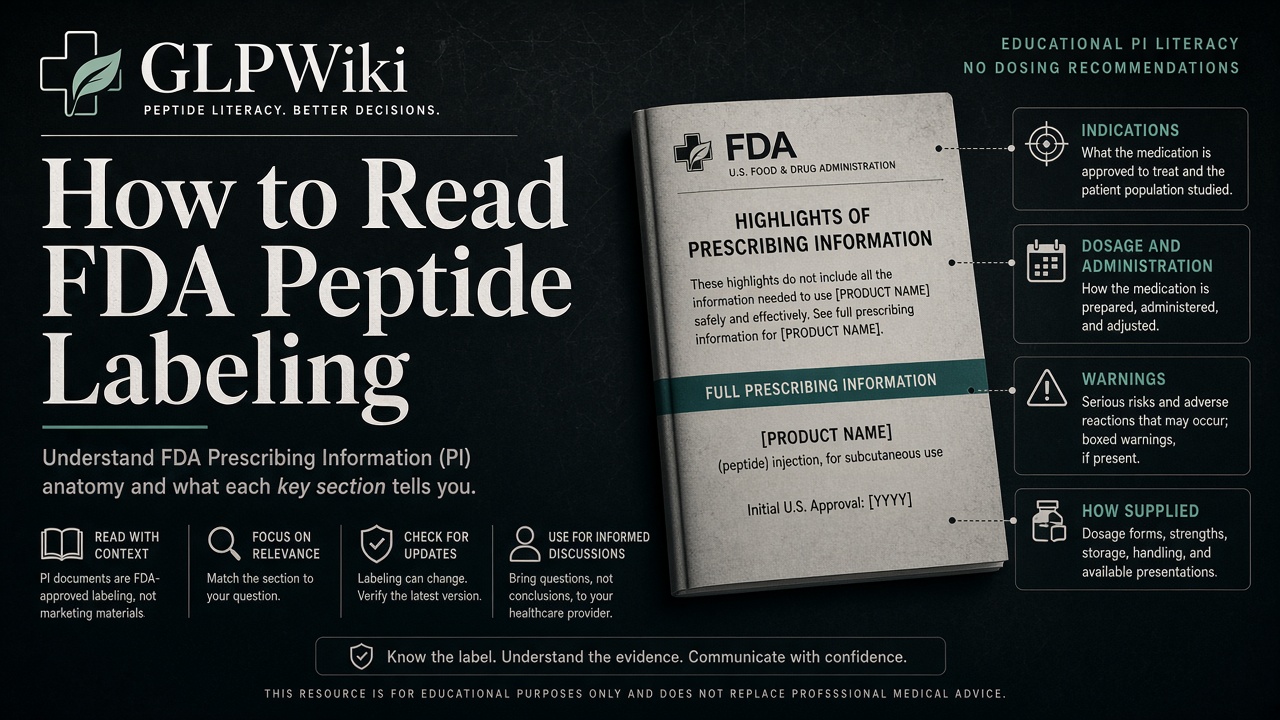
Online peptide claims often quote a molecule name as if it were an approved finished-drug label. This literacy guide explains what FDA Prescribing Information is, how PLR-format labels are organized, how to find current labels on Drugs@FDA and DailyMed, and why a trial paper is not the same document as approved labeling. Educational only: no dosing, no protocols, no product picks.
UPDATED 19 SEPT 2026 · 15 MIN READ
KEY TAKEAWAYS
- Prescribing Information (PI) summarizes essential scientific information for safe and effective use by healthcare professionals; it is about a finished product, not every study ever run on a related molecule.
- Most modern U.S. human prescription labels use the Physician Labeling Rule (PLR) format: Highlights, Table of Contents, and Full Prescribing Information with numbered sections.
- Drugs@FDA posts FDA-approved labeling and review packages for many human drugs; DailyMed posts company-submitted "in use" Structured Product Labeling (SPL) that may differ from the most recent FDA-approved PI.
- Indications and Usage define approved uses; a molecule name alone is not an indication.
- Boxed Warnings, Warnings and Precautions, and Adverse Reactions answer different safety questions — read them as labeled categories, not social-media summaries.
- Clinical Studies in the label are selected evidence supporting labeled claims; they are not a scrapbook of every exploratory analysis.
- A ClinicalTrials.gov record or PubMed paper is not interchangeable with approved labeling.
- This page publishes no doses, schedules, stacks, compounding recipes, or product picks.
Why label literacy matters for peptide and incretin claims
A peptide or incretin name can appear in several very different contexts: an FDA-approved finished medicine, an investigational clinical program, a compounded preparation, or a research-use-only listing. Online discussions often flatten those categories into a single molecule name, then borrow a claim from one context and apply it to another. That shortcut hides the document, product, formulation, indication, and regulatory status that make a claim meaningful.
Prescribing Information is product-specific. It describes an approved finished drug under defined conditions of use; it is not a universal biography of a chemical name. A molecule discussed in a trial paper does not automatically have an approved use, and an item sharing that molecule name does not automatically inherit an approved product's labeling.
Label literacy means identifying the exact finished product, locating the current authoritative document, and reading each claim in the section designed to answer that question. This guide supports that verification process. It does not recommend any medicine, product, dose, schedule, source, or course of action.
What Prescribing Information is
FDA describes prescription medicine labeling as the principal communication tool for essential scientific information needed by healthcare professionals to use an approved medicine safely and effectively. The Prescribing Information, often called the PI or professional label, is part of the approved finished product's regulatory record. It is revised as approved labeling changes, so a saved screenshot or old PDF may not represent the current version.
The PI is written primarily for healthcare professionals. Related patient-facing documents can include a Medication Guide, Patient Package Insert, or Instructions for Use. Those documents serve different audiences and purposes. Their existence does not turn an educational summary into instructions, and this page does not reproduce administration steps or amounts.
The label is both scientific and regulatory. It identifies approved indications, important limitations, contraindications, warnings, adverse-reaction information, clinical pharmacology, and selected clinical-study evidence, among other product details. It should be read as a structured whole rather than mined for one favorable sentence.
PLR anatomy: Highlights, contents, and Full Prescribing Information
Most modern U.S. prescription labels follow the Physician Labeling Rule format. The front matter includes Highlights of Prescribing Information, followed by a Table of Contents and the Full Prescribing Information. Highlights is a concise gateway to major labeled information; it does not replace the numbered Full PI, where context, definitions, evidence, and qualifications live.
The Full PI is organized into numbered sections with distinct jobs. Indications and Usage defines approved uses. Contraindications identifies circumstances in which the medicine should not be used. Warnings and Precautions describes clinically important risks and risk-management information. Adverse Reactions summarizes observed adverse-event information under the label's stated evidence and reporting limits. Clinical Pharmacology explains pharmacologic and pharmacokinetic information. Clinical Studies summarizes selected evidence supporting labeled claims.
Dosage and Administration is a clinician-facing section describing labeled conditions of use and administration. Knowing its purpose is part of document literacy; this guide intentionally does not quote amounts, schedules, titration sequences, preparation instructions, or administration protocols.
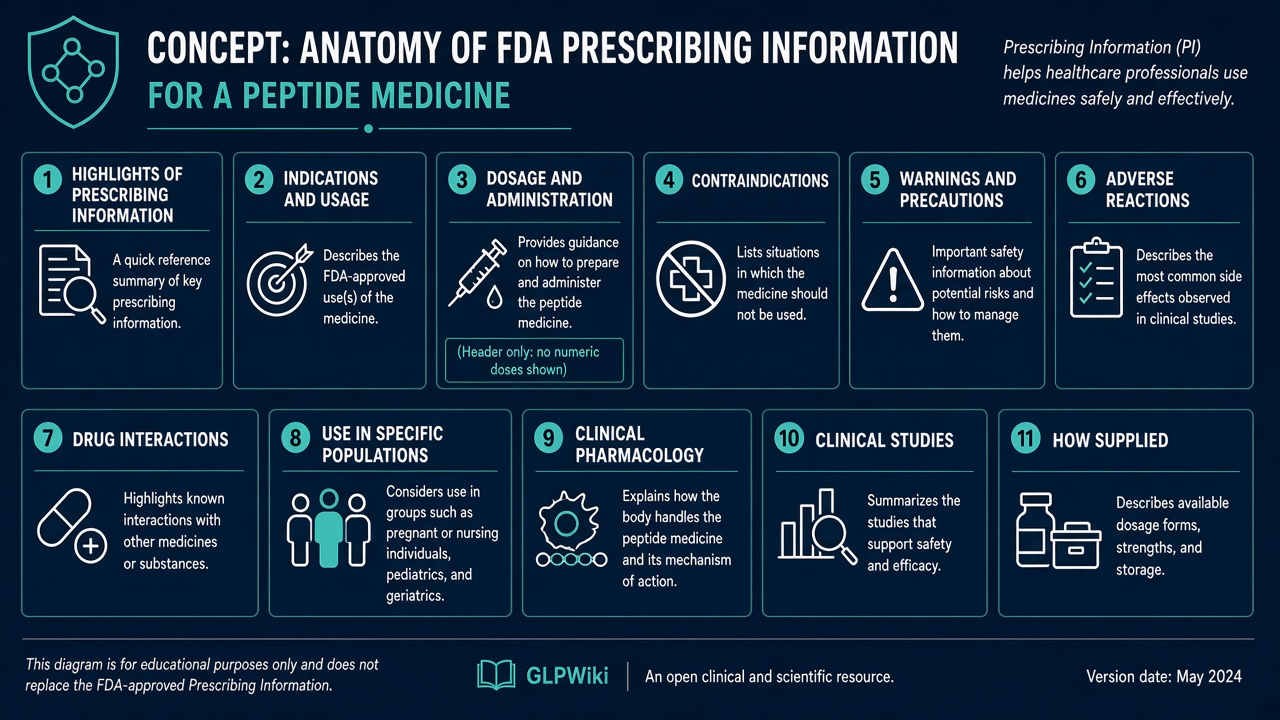
- Highlights: quick orientation to selected major labeling information.
- Table of Contents: map to the numbered Full PI.
- Full PI: the detailed, product-specific approved labeling context.
- Read sections by purpose; do not treat isolated excerpts as the whole label.
Drugs@FDA vs DailyMed vs FDALabel
Drugs@FDA is the best starting point when the question is whether a finished human drug is FDA-approved and what labeling the Agency posts for it. Product records may include approval history, current FDA-posted labeling, and review documents. Those review packages can provide more detail about the evidence and regulatory reasoning than the PI itself, but they remain different document types.
DailyMed provides labeling in Structured Product Labeling (SPL) format submitted to FDA by companies. NLM describes DailyMed as presenting labeling currently "in use" and warns that it may not be identical to the most recent FDA-approved labeling available through Drugs@FDA; its contents have not necessarily been verified by FDA. DailyMed is useful for searchable structured labels, but document provenance still matters.
FDALabel is an FDA full-text search tool for drug product labeling. It can help locate and compare SPL content across many labels. Search convenience is not the same as regulatory status: when the precise question is the Agency-posted approved PI for a product, return to that product's Drugs@FDA record.
Indications and Usage vs a molecule name
An indication is an approved use stated in the labeling for a specific finished product. It is not simply a molecule, receptor target, social-media nickname, or therapeutic category. Two products associated with the same active ingredient can have different presentations, labeling histories, approved uses, or regulatory records.
The Indications and Usage section answers what the approved product is indicated for and may identify relevant populations or limitations. It does not authorize every claim made in literature about the molecule. A mechanistic paper, exploratory endpoint, or trial in another population cannot silently expand the approved indication.
When a claim says a peptide is approved, ask: which finished product, for which labeled indication, in which current PI? If the answer points only to a molecule name or a study record, approval has not been verified.
Reading the safety sections as distinct categories
A Boxed Warning, when present, highlights certain serious or life-threatening risks. Contraindications identify situations in which the labeled product should not be used. Warnings and Precautions describes important hazards, monitoring considerations, or risk-management information. These sections are related but not interchangeable.
Adverse Reactions summarizes adverse-event information from the evidence and reporting systems described in the label. A listed event does not by itself prove causation in every person, and absence from a viral summary does not mean absence from the current PI. Read the section's denominators, study setting, and limitations rather than comparing decontextualized lists.
Label literacy does not mean diagnosing or managing a reaction at home. For individual symptoms or risk questions, contact a licensed clinician. Suspected serious problems can be reported through FDA MedWatch using current official channels; this guide does not provide treatment or dose-adjustment advice.
Clinical Studies in the label vs the full literature
The Clinical Studies section summarizes selected evidence supporting the labeled claims for the approved finished product. It is curated for the regulatory purpose of the label. It is not intended to reproduce every study, subgroup, exploratory analysis, abstract, or later paper concerning the molecule.
A trial publication may provide fuller methods, supplementary analyses, and academic interpretation. An FDA review may show regulatory analysis in greater depth. A press release may announce top-line results before a paper exists. These sources can be useful, but none should be mislabeled as the PI.
Read a label claim within its indication, population, endpoint, comparator, duration, and limitations. If an online claim relies on an endpoint absent from the label, follow the citation to the actual study and describe it as study evidence rather than approved labeling.
Approved labeling vs investigational, compounded, and research-use claims
Investigational compounds and unapproved uses can appear in ClinicalTrials.gov records and PubMed papers without having FDA-approved labeling for that claim. Trial registration shows that a study exists; publication shows that authors reported findings. Neither is an approval decision for a finished product.
Compounded preparations are not FDA-approved finished products and do not acquire an approved product's PI because a familiar active-ingredient name appears on a label or listing. Research-use-only materials are likewise outside the approved medicine pathway and should not be presented as though approved human labeling applies to them.
For the category boundaries, read the approved versus investigational peptides guide and the compounded versus FDA-approved GLP-1 guide. For evaluating the trial itself, use the companion guide on how to read a peptide clinical study. Keeping those layers separate prevents a true statement about one document from becoming a false claim about another product.
A practical document-verification path
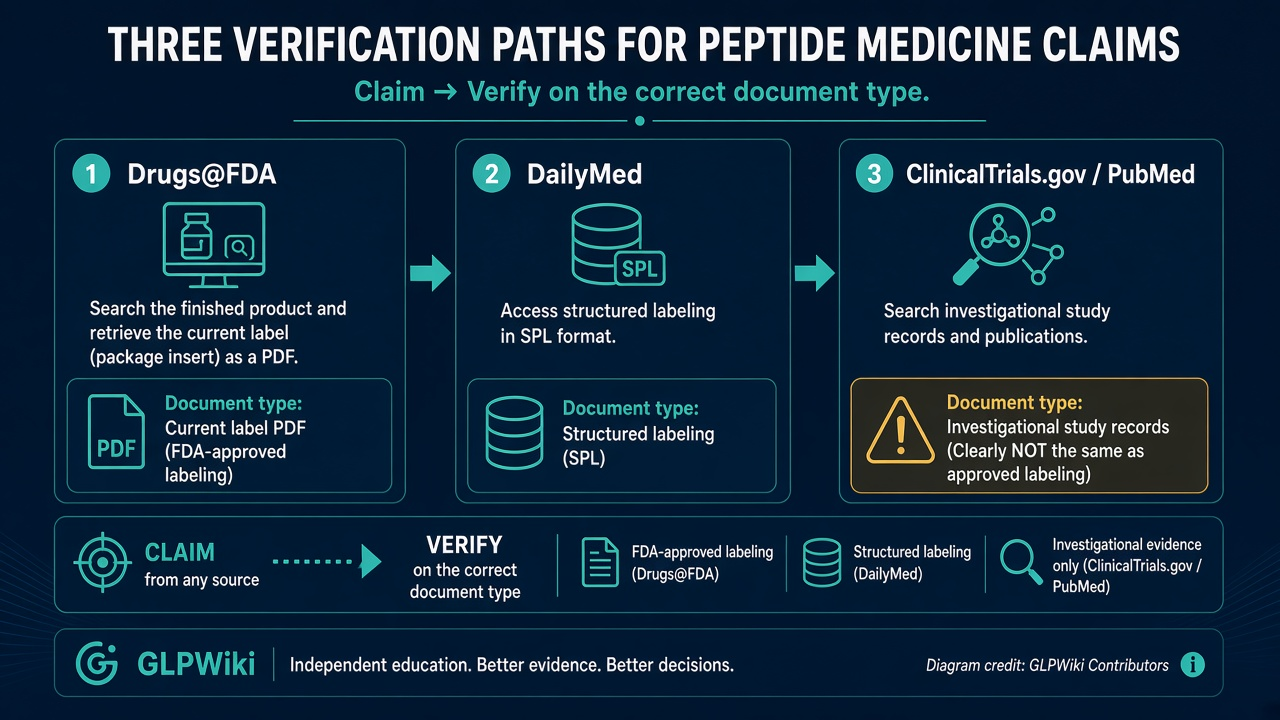
Start with the claim, then identify the document type needed to verify it. For U.S. approval status and Agency-posted labeling, search the exact finished product in Drugs@FDA and open its current label. Note the product name, application, approval history, and document date rather than relying on a search-result snippet.
Use DailyMed when structured SPL text and current in-use labeling are useful, and FDALabel when full-text SPL searching helps locate a section or compare records. Preserve the source distinction: DailyMed or FDALabel content is not automatically the same file as the most recent FDA-approved PI posted in Drugs@FDA.
For investigational studies, search ClinicalTrials.gov and record the NCT identifier, status, outcomes, and sponsor. For published evidence, find the paper in PubMed and read beyond the abstract. Then describe the claim with its correct label: approved labeling, FDA review, registry record, peer-reviewed paper, or another clearly named document type.
- Approval or current approved PI: Drugs@FDA.
- Structured in-use SPL: DailyMed; full-text SPL search: FDALabel.
- Investigational study record: ClinicalTrials.gov.
- Published study: PubMed, with full methods whenever available.
- Never let a shared molecule name erase the document type or product status.
What this page does not do
This guide teaches document literacy. It does not recommend a medicine, product, manufacturer, pharmacy, telehealth service, or research material. It publishes no numeric doses, schedules, titration programs, stacks, administration instructions, compounding recipes, or product comparisons framed as personal choices.
It also does not replace the current PI, patient labeling, a licensed clinician, or emergency services. Labels change. Always verify the current official record for the exact finished product and use qualified clinical guidance for personal decisions.
Next reading
Continue with approved versus investigational peptides for regulatory category literacy, then compounded versus FDA-approved GLP-1 medicines for finished-product distinctions. How to read a peptide clinical study explains trial phases, endpoints, registration, and evidence framing.
The titration concepts guide explains how labels use initiation, escalation, maintenance, and tolerability language without reproducing schedules. Together, these guides separate product status, label structure, and trial evidence so each claim can be checked against the right source.
Frequently asked questions
- What is FDA Prescribing Information?
- Prescribing Information, or PI, is FDA-approved professional labeling for a specific finished prescription product. It communicates essential scientific information healthcare professionals need for safe and effective labeled use. It is product-specific and is not a universal summary of every study involving the molecule.
- What is the difference between PLR Highlights and the Full PI?
- Highlights is a concise front section drawing attention to selected major labeling information. The Full Prescribing Information contains the numbered sections, detail, context, and qualifications. Highlights does not replace reading the Full PI.
- Are Drugs@FDA and DailyMed the same?
- No. Drugs@FDA provides FDA-posted approved labeling and regulatory records for many human drugs. DailyMed publishes company-submitted in-use Structured Product Labeling. NLM notes that DailyMed labeling may differ from the most recent FDA-approved labeling and is not necessarily verified by FDA.
- Does a PubMed paper equal an FDA-approved label?
- No. A PubMed record points to published research. FDA-approved labeling is a separate product-specific regulatory document. A paper can inform understanding of evidence without becoming an approved indication or replacing the current PI.
- What is an indication?
- An indication is an approved use stated in the labeling for a specific finished product. A molecule name, receptor mechanism, trial topic, or online nickname is not by itself an indication.
- Can I use this page to decide a dose or schedule?
- No. This page intentionally provides no numeric doses, schedules, titration sequences, administration instructions, stacks, or compounding recipes. Use the current official labeling and a licensed clinician for individual care.
- Why do peptide names cause confusion?
- The same or similar molecule name may appear in an approved finished medicine, an investigational trial, a compounded preparation, or a research-use listing. Those categories have different evidence and regulatory status, so the exact product and document type must be named.
- Where can I verify whether a peptide medicine is FDA-approved?
- Search the exact finished product in Drugs@FDA and inspect its application record and current FDA-posted labeling. Use DailyMed or FDALabel for structured labeling searches, and use ClinicalTrials.gov or PubMed for studies without treating those study records as approval.
SOURCES
- 01Frequently Asked Questions about Labeling for Prescription Medicines— U.S. Food and Drug Administration
- 02FDA's Labeling Resources for Human Prescription Drugs— U.S. Food and Drug Administration
- 03Drugs@FDA— U.S. Food and Drug Administration
- 04DailyMed— U.S. National Library of Medicine
- 05About DailyMed (including Drugs@FDA vs DailyMed differences)— U.S. National Library of Medicine
- 06FDALabel: Full-Text Search of Drug Product Labeling— U.S. Food and Drug Administration
- 07ClinicalTrials.gov— U.S. National Library of Medicine
- 08PubMed— U.S. National Library of Medicine
EDUCATIONAL REFERENCE ONLY · Not medical advice. Nothing here diagnoses, treats, cures or prevents any disease, and nothing here is a dosing recommendation. Consult a licensed clinician before any treatment decision.