Titration concepts explained: what dose escalation means on labels
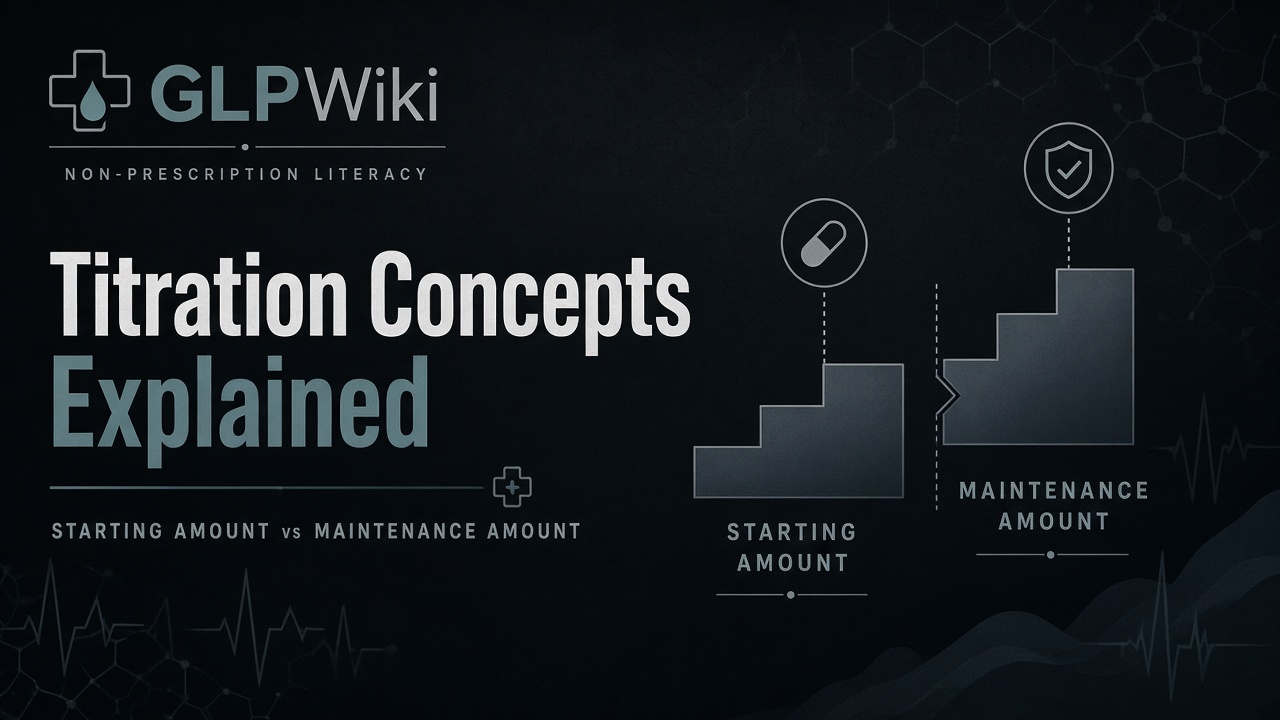
On FDA prescribing information, titration usually means a planned, stepwise change in labeled amount over time — often starting lower, then escalating, then settling at a maintenance concept. This literacy guide explains what those words mean and why labels escalate slowly, without recommending any dose, schedule, product, or protocol.
UPDATED 14 SEPT 2026 · 12 MIN READ
KEY TAKEAWAYS
- Titration (dose escalation) on a label is a regulatory concept describing how a finished approved product is intended to be started and adjusted over time — not a DIY recipe.
- Many GLP-1 and related incretin labels escalate slowly because gastrointestinal adverse reactions are common and often concentrate during escalation.
- Labels distinguish initiation or starting concepts from maintenance concepts; the starting phase is frequently described as not the long-term target amount.
- Official prescribing information is product-specific. Reading another product's schedule, a forum post, or a compounded vial's instructions is not a substitute for the current label.
- Investigational and compounded preparations are not interchangeable with FDA-approved labeled products; they do not carry the same reviewed titration language.
- This page is educational only: no doses, no week-by-week schedules, no stacks, no product recommendations, and no clinical decision support.
What "titration" means when you see it on a label
In clinical pharmacology and on FDA prescribing information, titration generally means adjusting the labeled amount of a medicine over time according to a defined plan — most often starting at a lower labeled initiation amount, then increasing in steps (escalation), then continuing at a maintenance concept for the labeled use. The word does not mean "find your own dose" or "stack compounds until something happens." It is a structured statement by a regulator about how a specific finished product was studied and how the manufacturer is permitted to describe its use.
For readers who encounter GLP-1 and dual-agonist product names online, titration language is one of the most commonly misunderstood pieces of labeling. Forums and marketing copy often compress a multi-step labeled plan into a single number, or treat another person's amount as a template. Official labels do the opposite: they separate initiation, escalation, and maintenance as distinct concepts, and they place those concepts alongside warnings, adverse-reaction data, and indication-specific framing. Stripping a number out of that context removes exactly the parts that make it meaningful.
GLPWiki publishes this as literacy, not as instructions. We sell nothing, we do not link to pharmacies or suppliers, and we do not publish doses, week-by-week schedules, or protocols. If a sentence on this page sounds like it could be copied into a personal plan, it has been written wrongly — the correct reading is always "this is how labels talk," never "this is what you should do." Clinical decisions belong to a licensed clinician working from the current official label for a specific approved product.
Starting concept vs maintenance concept
Most incretin prescribing information describes at least three conceptual phases. An initiation or starting concept describes how use begins. An escalation concept describes the stepwise change over time. A maintenance concept describes the ongoing labeled level once escalation is complete. These are editorial categories in the label, and each product defines them in its own terms.
The single most frequently missed point is that the starting phase is usually described as an initiation step rather than a therapeutic target. Labels commonly state in plain language that the starting amount is intended for beginning treatment and is not the amount intended for ongoing use. When that sentence is dropped, a reader can badly misread both the beginning and the end of the labeled plan.
Titration language is also tied to a specific finished product. A brand's plan does not transfer to another brand, another salt or formulation, a research-use-only vial, or a compounded preparation, even when a molecule name appears on all of them. The source of truth is the current prescribing information for the exact approved product in question, read together with a prescriber — not a schedule pieced together from screenshots.
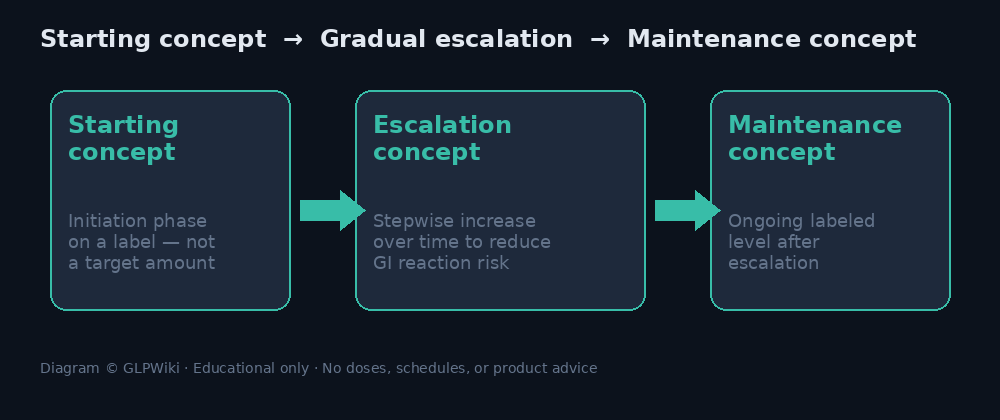
- Initiation / starting concept — how labeled use begins, frequently described as an introductory step rather than a long-term target.
- Escalation concept — a planned stepwise change over time, described within the label's own tolerability and monitoring framing.
- Maintenance concept — the ongoing labeled level after escalation for the labeled indication.
- Product-specific — another brand, salt, formulation, or compounded vial does not inherit another product's titration language.
Why labels escalate slowly
FDA-approved GLP-1 and incretin labels generally connect their initiation and escalation structure to gastrointestinal tolerability. Adverse-reaction sections for this class report nausea, vomiting, diarrhea, and constipation among the most common findings, and clinical-trial narratives describe these reactions as clustering around periods when the amount is being increased rather than being evenly distributed across treatment.
"Go slow" in this context is regulatory benefit-risk framing, not a lifestyle tip or a piece of community folklore. The escalation structure exists because it was studied, reviewed, and written into a label that a manufacturer is legally bound by. It reflects a considered trade-off between reaching the labeled maintenance concept and limiting adverse reactions along the way.
Some labels also include language about how escalation may be handled when a step is not tolerated. That language is written for prescribers making clinical judgments about a patient in front of them. It is not a self-management instruction, and it does not translate into a general rule that a reader can apply to an unlabeled or compounded preparation. If a reader wants the mechanism behind the gastrointestinal side of this, our GLP-1 GI effects guide covers the physiology without offering symptom protocols.
What titration language does — and does not — authorize
A label's titration section authorizes a description of that finished product's labeled plan and nothing beyond it. It is not a statement about every product that shares a molecule name, it is not a statement about research-use-only material, and it is not a statement about a compounded preparation made outside the approval pathway. Those categories were not reviewed under the same application and do not carry the same reviewed language.
Titration language also does not authorize combining products, and it does not silently supply unit conversions. A frequent literacy hazard appears when a labeled amount in milligrams is read against a nonstandard concentration in milligrams per millilitre and then converted into syringe units. Each of those three quantities means something different, and errors compound quickly when a reader treats them as interchangeable. Our dosing-math and syringe-unit guides explain the arithmetic conceptually, without prefilled amounts.
Semaglutide and tirzepatide product families each contain several distinct approved products with separate labels and separate indications. The practical habit is to identify the exact product, then read its current label through Drugs@FDA rather than assuming a family-level rule exists.
- Applies to the specific finished approved product only — not to every item bearing the same molecule name.
- Compounded, research-use-only, and investigational preparations are separate categories without reviewed titration language.
- Milligrams, milligrams per millilitre, and syringe units are distinct quantities; conflating them is a common and serious error.
- Product problems and adverse events can be reported to MedWatch; personal clinical questions go to a licensed clinician.
Approved labels vs investigational and compounded contexts
Reviewed titration language is a feature of approved finished drug products. That is what makes it a durable reference point: it was submitted, examined, and published as part of an approval, and it is updated when the evidence base changes.
Protocols registered on ClinicalTrials.gov are a different kind of document. A study protocol describes what investigators planned to do under study conditions with monitoring, eligibility criteria, and oversight. It is a window into study design, not a marketed label, and an investigational compound may never receive one.
Compounded preparations likewise do not inherit the titration language of an approved pen or auto-injector. They sit in a distinct regulatory category with different oversight and different labeling obligations. The most useful habit a reader can build is status-first: before interpreting any number, establish whether the thing being discussed is an approved product, an investigational compound, or a compounded or research-use-only preparation. Our compounded-versus-approved and approved-versus-investigational guides go through that classification in detail.
How to read titration claims you see online
Treat any sentence of the form "titrate to X" as a claim that needs a primary source. The first question is not whether the number sounds plausible but which product it belongs to and where it was published. A claim without a named product and a citable label is not yet information.
The authoritative place to check is the Dosage and Administration section of the current prescribing information, retrievable through Drugs@FDA. Labels are revised, so the date on the copy matters as much as its content — a PDF from a search result may be several revisions behind.
ClinicalTrials.gov is the right source for study design questions, but it is not a substitute for a label. MedWatch is the route for reporting suspected product problems or adverse events. And any question that begins "should I…" is a clinical question for a licensed clinician who knows the person's history — not something a reference site can or should answer.
What this page deliberately does not do
This guide contains no milligram amounts presented as advice, no week-by-week calendars, no escalation timelines, and no side-effect management protocols. It does not describe what to do after an interruption, and it does not convert between pen, vial, and syringe measurements for personal use.
It also names no pharmacy, supplier, telehealth service, or product as recommended. GLPWiki has no commercial relationships with sellers of any compound described anywhere on this site, and our editorial standards page documents that position.
Readers who want the underlying arithmetic can use the dosing-math guide and the calculators, both of which teach the formulas without prefilling a personal amount. Readers who want the physiology can use the GI-effects guide, and readers who want regulatory status can use the status guides.
Where to read next
This guide pairs most directly with the GLP-1 gastrointestinal effects explainer, which covers the mechanism behind the tolerability framing, and with the peptide dosing-math guide, which teaches concentration arithmetic in the abstract.
For measurement literacy, the U-100 syringe guide and the IU-versus-micrograms-versus-units guide address the unit confusions most likely to turn a misread label into a real error. For regulatory status, the approved-versus-investigational and compounded-versus-approved guides classify what a reader is actually looking at.
Individual compound entries on GLPWiki describe mechanism, receptor targets, and regulatory status rather than dosing. Our editorial standards and medical disclaimer pages set out how this material is sourced and the limits of its use.
Frequently asked questions
- What does titration mean on a drug label?
- It describes a planned, stepwise change in the labeled amount over time for that specific product, as set out in its FDA prescribing information. It is a regulatory description of how an approved product is intended to be started and adjusted — not a do-it-yourself method.
- Why do GLP-1 labels escalate slowly?
- Approved incretin labels tie their escalation structure to gastrointestinal tolerability. Nausea, vomiting, and diarrhea are among the most commonly reported adverse reactions in this class, and trial data describe them concentrating around periods when the amount is increased.
- Is the starting amount the same as the maintenance amount?
- Often no. Labels frequently describe the starting phase as an initiation step rather than the long-term target. The only reliable answer for any particular product is its own current prescribing information, read with a prescriber.
- Can I apply an approved product's schedule to a compounded or research vial?
- No. Compounded preparations and research-use-only material are separate regulatory categories and do not carry the reviewed labeling of an approved finished product. A label's titration language applies only to the product it was written for.
- Does GLPWiki recommend a schedule or dose?
- No. We publish no doses, no schedules, no stacks, and no protocols, and we recommend no product, pharmacy, or supplier. This site is educational reference material only.
- Where should clinical questions go?
- To a licensed clinician who knows your medical history and is working from the current official label. Suspected product problems and adverse events can also be reported to the FDA through MedWatch.
SOURCES
- 01Ozempic (semaglutide) prescribing information— U.S. Food and Drug Administration
- 02Wegovy (semaglutide) prescribing information— U.S. Food and Drug Administration
- 03Mounjaro (tirzepatide) prescribing information— U.S. Food and Drug Administration
- 04Trulicity (dulaglutide) prescribing information— U.S. Food and Drug Administration
- 05Drugs@FDA: approved drug products and current labels— U.S. Food and Drug Administration
- 06MedWatch: safety information and adverse event reporting— U.S. Food and Drug Administration
- 07Glucagon-Like Peptide-1 Receptor Agonists (StatPearls)— NCBI Bookshelf
- 08Review of practical issues with GLP-1 receptor agonists— PubMed Central
- 09ClinicalTrials.gov study registry— U.S. National Library of Medicine
EDUCATIONAL REFERENCE ONLY · Not medical advice. Nothing here diagnoses, treats, cures or prevents any disease, and nothing here is a dosing recommendation. Consult a licensed clinician before any treatment decision.