Why GLP-1 medicines cause nausea and other GI effects (mechanism explainer)
Nausea and related GI effects are among the most common labeled adverse reactions for GLP-1 receptor agonists. This guide explains the mechanisms discussed in labels and research — delayed gastric emptying and central aversion pathways — without recommending any dose, schedule, or home remedy.
UPDATED 12 SEPT 2026 · 14 MIN READ
KEY TAKEAWAYS
- Official labels for approved GLP-1 receptor agonists list gastrointestinal adverse reactions such as nausea, vomiting, diarrhea, abdominal pain, and constipation among common events.
- Many GI reports occur during dose escalation periods described in prescribing information; that is a label observation, not a DIY schedule.
- Delayed gastric emptying is a known pharmacologic effect and can affect absorption timing of some oral medicines — see the product label.
- Recent research distinguishes hindbrain pathways linked more to satiety from pathways linked more to aversion and nausea (area postrema versus NTS framing); this is mostly preclinical circuit work and should not be read as clinical advice.
- Severe GI reactions and existing severe gastroparesis are addressed in warnings; patients should use official labeling and a clinician — GLPWiki does not manage care.
- This page is educational only: no doses, no stacks, no anti-nausea protocols.
Why GI effects show up so often in labels
Anyone reading about GLP-1 receptor agonists quickly runs into the same cluster of reported effects: nausea, vomiting, diarrhea, abdominal pain, and constipation. These are not incidental footnotes buried in a document nobody reads. They appear in the adverse reactions section of official prescribing information precisely because they were among the most frequently reported events in the controlled trials that supported approval.
There is a mechanistic reason the pattern is so consistent across this drug class. The GLP-1 receptor is not confined to the pancreas. It is expressed in tissues involved in gastric motility and in regions of the brainstem that participate in appetite, satiety, and nausea signaling. A medicine designed to engage that receptor systemically will therefore act on more than glucose handling — it will engage a gut–brain axis that also influences how full, how uninterested in food, and sometimes how queasy a person feels.
Understanding that connection is useful reference literacy. It explains why GI effects are described as expected, common, and dose-related rather than as signs that something rare has gone wrong. It also explains why they cannot simply be engineered away without also weakening the appetite effects people take these medicines for — the pathways overlap, even if, as research increasingly suggests, they are not identical.
GLPWiki is an educational reference. This page explains published mechanisms and label observations. It does not tell anyone what to take, how much to take, how fast to change anything, or how to treat a symptom. Those are clinical decisions that belong to a licensed clinician working from the official label for the specific product involved.
What FDA prescribing information actually lists
The clearest way to ground this topic is to read an approved product's own label rather than a summary of one. The U.S. prescribing information for Ozempic (semaglutide) is a concrete, citable example of how a regulator-reviewed document describes the GI profile of a GLP-1 receptor agonist.
That label identifies the most common adverse reactions reported in at least 5% of patients as nausea, vomiting, diarrhea, abdominal pain, and constipation. In placebo-controlled trial tables, nausea was reported by roughly 6.1% of placebo patients compared with about 15.8% at the 0.5 mg strength and about 20.3% at the 1 mg strength. Vomiting followed a similar shape at roughly 2.3% on placebo versus about 5.0% and 9.2%. Diarrhea was about 1.9% on placebo versus roughly 8.5% and 8.8%. Abdominal pain was about 4.6% on placebo versus roughly 7.3% and 5.7%, and constipation about 1.5% on placebo versus roughly 5.0% and 3.1%.
Two further label observations matter more than any single percentage. First, gastrointestinal adverse reactions occurred more frequently on drug than on placebo, and the majority of nausea, vomiting, and diarrhea reports occurred during the dose escalation period described in the prescribing information. Second, discontinuations attributed to gastrointestinal adverse events were higher on drug than on placebo — meaning these effects were, for some participants, significant enough to end treatment.
Those figures belong to that product and those trials. They should not be copied onto other molecules. Tirzepatide, retatrutide, and other agents in and around this space have their own trial programs, their own populations, and their own documents. The class shares a broadly similar gastrointestinal profile — GI effects are prominent across GLP-1 receptor agonism generally — but the specific numbers are product-specific. For any other product, read that product's official label. GLPWiki's compound entries for semaglutide and tirzepatide summarize mechanism and evidence context and point toward those primary records; they are not substitutes for the label.
- Most common adverse reactions at 5% or greater in the cited label: nausea, vomiting, diarrhea, abdominal pain, constipation.
- GI reactions were more frequent on drug than placebo across the placebo-controlled trials summarized in the label.
- Most nausea, vomiting, and diarrhea reports occurred during the dose escalation period described in the prescribing information.
- Discontinuation for gastrointestinal adverse events was higher on drug than on placebo.
- Percentages are product-specific and must not be transferred to other molecules or brands.
Delayed gastric emptying as a peripheral mechanism
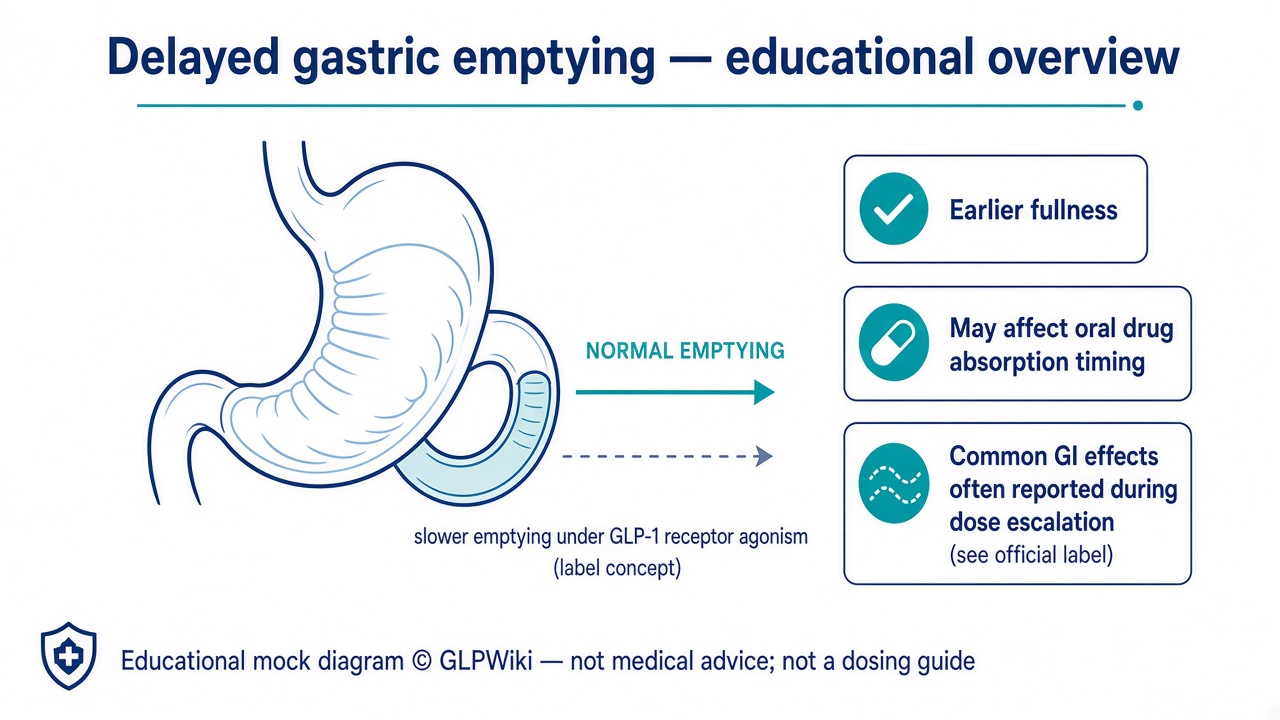
The most intuitive mechanism behind GLP-1 GI effects is peripheral: these medicines slow the rate at which the stomach empties its contents into the small intestine. This is not an unexpected side finding; it is a recognized pharmacologic action described in official labeling, and it is one reason a meal produces a sense of fullness earlier and for longer.
Slower gastric emptying has a straightforward relationship with the symptoms people describe. Food and liquid remain in the stomach longer, distension persists, and the sensation of fullness arrives sooner in a meal and outlasts it. When the effect is pronounced, that same physiology can present as nausea, early satiety that feels uncomfortable rather than convenient, or upper abdominal discomfort.
There is a second, less obvious consequence that the label addresses directly as a drug interaction consideration: because these medicines delay gastric emptying, they may impact the absorption of concomitantly administered oral medications. Timing and absorption of some oral drugs can shift. This is precisely the kind of question a clinician and pharmacist evaluate against a patient's full medication list and the official label — it is not something to work out from an encyclopedia page.
Labeling for approved products also addresses severe gastrointestinal adverse reactions in its warnings, and recent label language indicates these products are not recommended in patients with severe gastroparesis. That is a clinically meaningful boundary condition, and it exists because the drug's mechanism acts on the same motility that is already impaired in that condition.
Gut–brain signaling and why CNS pathways matter for aversion
Peripheral slowing explains part of the picture, but not all of it. GLP-1 signaling is better understood as operating along a gut–brain axis. Native GLP-1 is released from intestinal enteroendocrine cells after a meal and acts both locally, including on vagal afferent fibers, and centrally in brain regions that express the GLP-1 receptor. Pharmacologic agonists engage that same architecture, with the added characteristic that long-acting analogues sustain receptor engagement far beyond the brief window of endogenous hormone release.
Reviews of GLP-1 physiology and pharmacology along the gut–brain axis describe how the signal reaches the brainstem both through neural afferents and, for regions with permissive access, directly from circulation. This matters for nausea specifically, because several of the brain structures involved in food intake regulation sit close to — and in some cases overlap with — structures involved in detecting potentially harmful substances.
That anatomical proximity is the reason appetite suppression and nausea have historically been difficult to separate in this drug class. A compound that reaches hindbrain regions to reduce food intake is operating in a neighborhood where nausea and aversion signals are also generated. Understanding this makes the class-wide symptom pattern legible rather than mysterious, and it frames why so much current research is aimed at asking whether those two outputs can be pulled apart.
Dissociable satiety and aversion pathways
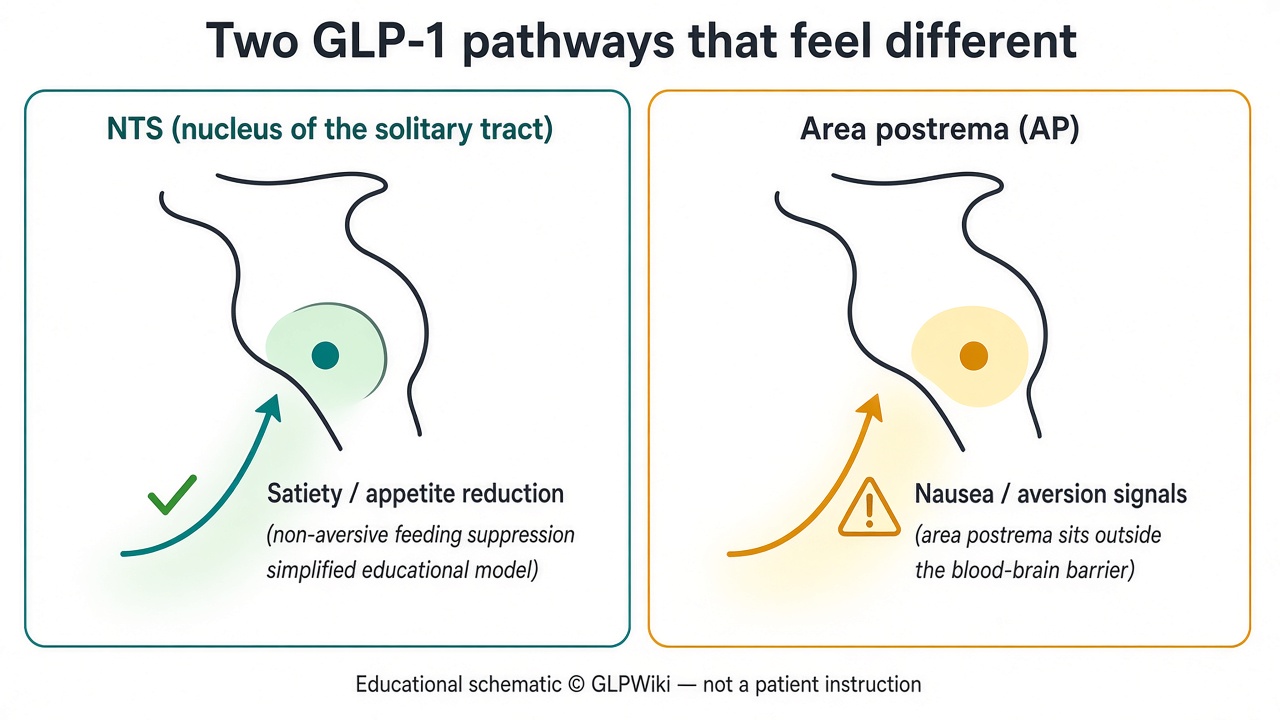
One of the more consequential recent research directions concerns whether the hindbrain circuits producing reduced food intake are the same circuits producing nausea and aversion. Work published in Nature in 2024 by Huang and colleagues examined GLP-1 receptor-expressing neurons in the hindbrain and reported that distinct populations can be associated with different behavioral outcomes — with signaling routed through the nucleus of the solitary tract linked more closely to non-aversive feeding suppression, and signaling involving the area postrema linked more closely to aversive responses.
The area postrema is anatomically notable because it is a circumventricular organ: it lies outside the standard blood-brain barrier and can sample circulating substances directly. That property has long made it central to accounts of chemically triggered nausea, and it is one reason a systemically circulating receptor agonist can engage nausea machinery even without crossing the barrier elsewhere.
Two cautions are essential when reading this literature. First, this is largely preclinical circuit neuroscience conducted in rodent models using experimental tools that do not exist in clinical practice. It describes mechanism in animals; it does not report clinical outcomes in people, and it does not establish that any marketed medicine produces one effect without the other. Second, the research interest in these findings is forward-looking — the hope that dissociable pathways might eventually inform compounds with a better tolerability profile. That is a hypothesis about future development, not a claim about currently available products.
Related reviews of neural nausea pathways and their role in energy balance reinforce both the promise and the complexity: nausea circuitry is intertwined with intake regulation in ways that are still being mapped. The honest summary is that the field has strong animal-model evidence for separable pathways and an open clinical question about how far that separation can be exploited.
Why labels describe escalation windows
Prescribing information for approved GLP-1 receptor agonists describes a period during which the amount administered increases from a starting level toward a maintenance level. The label for the semaglutide example explicitly notes that the majority of nausea, vomiting, and diarrhea reports occurred during that escalation period rather than being distributed evenly across treatment.
The conceptual reason is tolerability. Receptor engagement that produces appetite and motility effects also produces the GI effects described above, and the trial evidence indicated that reaching a target level gradually was associated with a different symptom experience than arriving there immediately. Labels encode that finding as a structured plan reviewed by a regulator alongside the efficacy and safety data.
It is equally important to state what this section is not. GLPWiki does not publish escalation schedules, starting amounts, target amounts, intervals, or any instruction about changing what someone is taking. Those specifics exist in the official label for each product and are applied by a prescribing clinician to an individual patient. Describing why a concept exists is reference work; specifying a plan is medical practice, and this site does not do it.
For readers whose interest in this topic is arithmetic rather than clinical — understanding how concentration, volume, and syringe graduations relate to one another as mathematics — GLPWiki's calculators and the peptide dosing math guide cover that ground explicitly as educational arithmetic with no recommended values.
Scope limits and when to involve a clinician
This guide explains mechanisms and summarizes what official labeling reports. It is not a symptom-management resource. It does not describe how to reduce nausea, what to eat, what to take alongside a medicine, when to adjust anything, or how to decide whether an effect is acceptable. Those are clinical judgments requiring knowledge of an individual's history, other medicines, and current condition.
Labels describe severe gastrointestinal adverse reactions in their warnings sections and identify conditions in which a product is not recommended, including severe gastroparesis in recent label language. Persistent, severe, or worsening symptoms are reasons to contact a clinician promptly rather than to search for an explanation online. Dehydration risk associated with sustained vomiting or diarrhea is specifically the kind of concern that belongs in a clinical conversation.
There is also a product-integrity dimension. FDA has published concerns about unapproved GLP-1 drugs used for weight loss, including compounded and non-approved sources where identity, purity, and labeling are not subject to the controls that apply to an approved product. Reasoning about adverse effects from an approved product's label does not transfer to material of unknown provenance. GLPWiki's guide on approved versus investigational peptides explains how those categories differ and how to verify status.
Patients and clinicians in the United States can report suspected adverse events through FDA's MedWatch program. Reporting contributes to the post-marketing safety record that informs future label updates, and it is the appropriate channel for a suspected adverse reaction — not a forum post or a reference page.
Related tools and next reading
For background on the hormone itself — what GLP-1 is, where it is released, and what its receptor does — the GLP-1 wiki entry is the starting point. Compound entries for semaglutide and tirzepatide record mechanism, receptor targets, and evidence context for those specific molecules, along with pointers to the primary regulatory and trial records.
For comparative reading across the incretin class, the semaglutide versus tirzepatide versus retatrutide comparison frames the evidence differences between single, dual, and triple receptor agonism, and the dual agonists guide goes deeper on what adding GIP activity changes mechanistically. For regulatory literacy — distinguishing an approved medicine from investigational material or research-use catalog product — the approved versus investigational guide covers verification.
For the arithmetic side of peptide literacy, the calculators hub provides concentration, volume, and syringe-unit mathematics as educational tools only, with no recommended values and no dosing guidance of any kind.
Frequently asked questions
- Why do GLP-1 medicines cause nausea?
- Two mechanisms are typically described. Peripherally, these medicines delay gastric emptying, so food stays in the stomach longer and produces prolonged fullness that can present as nausea. Centrally, GLP-1 receptors are expressed in hindbrain regions involved in both satiety and nausea signaling, including the area postrema, which sits outside the blood-brain barrier and can sample circulating substances directly.
- Is nausea required for the medicine to work?
- No. Trial data summarized in official labels show that many participants did not report nausea, and appetite and glycemic effects are not contingent on experiencing it. Recent preclinical research also suggests satiety and aversion may be driven by partly separable hindbrain pathways, though that work is in animal models and does not establish clinical claims about any marketed product.
- What is delayed gastric emptying?
- It describes the stomach releasing its contents into the small intestine more slowly than usual. For GLP-1 receptor agonists this is a recognized pharmacologic effect noted in labeling, and it is relevant beyond symptoms: labels state that delayed gastric emptying may impact the absorption of concomitantly administered oral medications.
- Do these effects mean something is wrong with my stomach permanently?
- That is a clinical question this reference cannot answer for any individual. Labels list gastrointestinal reactions as common adverse reactions and also address severe gastrointestinal adverse reactions in their warnings, with recent label language indicating products are not recommended in patients with severe gastroparesis. Persistent or severe symptoms should be discussed with a clinician rather than self-assessed.
- Where should I look for official adverse-reaction information?
- The FDA-approved prescribing information for the specific product. Each approved product has its own label with its own adverse reaction tables from its own trials; figures from one product should never be applied to another. Verify the current label rather than relying on secondary summaries, including this one.
- Does GLPWiki tell me how to manage nausea or what dose to use?
- No. GLPWiki publishes no doses, no schedules, no escalation plans, no stacks, and no symptom-management advice. This guide explains published mechanisms and label observations for educational purposes only. Treatment decisions belong to a licensed clinician working from the official label.
SOURCES
- 01Ozempic (semaglutide) prescribing information— U.S. Food and Drug Administration
- 02GLP-1 physiology and pharmacology along the gut–brain axis (Beutler, 2026)— Journal of Clinical Investigation
- 03Dissociable hindbrain GLP1R circuits for satiety and aversion (Huang et al., 2024)— Nature
- 04Neural pathways of nausea and roles in energy balance— PubMed Central
- 05FDA's Concerns with Unapproved GLP-1 Drugs Used for Weight Loss— U.S. Food and Drug Administration
- 06MedWatch: FDA Safety Information and Adverse Event Reporting Program— U.S. Food and Drug Administration
EDUCATIONAL REFERENCE ONLY · Not medical advice. Nothing here diagnoses, treats, cures or prevents any disease, and nothing here is a dosing recommendation. Consult a licensed clinician before any treatment decision.