Approved vs investigational peptides: how to tell the difference
The same amino-acid sequence name can appear as an FDA-approved medicine, as an investigational trial drug under an IND, or as research-use catalog material. This literacy guide explains what each status actually means, how to verify it, and which paperwork answers which question.
UPDATED 11 SEPT 2026 · 13 MIN READ
KEY TAKEAWAYS
- Regulatory status is not the same as chemical identity: a shared sequence name does not make two products interchangeable.
- FDA-approved peptide drugs have an approved NDA or BLA, official prescribing information, and a labeled indication you can verify on Drugs@FDA.
- Investigational peptides administered to humans in U.S. clinical research generally require an IND under 21 CFR Part 312, with IRB review and informed consent — they are not consumer products.
- Research-use-only (RUO) / not-for-human-use catalog labels are vendor intended-use statements. They are not FDA approval and do not turn a COA into a drug label.
- A Certificate of Analysis describes batch analytics (purity, identity). It does not confer approval status.
- When the question is “is this an approved medicine?”, verify on Drugs@FDA and the official label — not on a seller blog or a research COA.
- This page is educational only. It is not medical advice, not legal advice, not a dosing guide, and not an endorsement of any seller.
Why regulatory status is a separate question from chemistry
Readers often encounter the same peptide name in very different places: an FDA-approved pharmacy product, a clinical-trial announcement, a scientific paper, or a research catalog. Those appearances can look related because they use the same nonproprietary name or refer to the same amino-acid sequence. But a name is not a regulatory category, and sequence identity does not establish that two finished products were made, tested, reviewed, labeled, or distributed under the same controls.
Chemistry asks what molecule or sequence is claimed and whether analytical evidence supports that identity. Regulatory status asks a different question: under what legal and oversight framework does this particular material exist? An approved drug, an investigational drug supplied within a clinical study, and a catalog vial marked for research use can each mention a familiar peptide while carrying very different evidence, manufacturing obligations, labels, and permitted uses.
GLPWiki keeps those questions separate. Compound pages record whether a molecule has an approved use, remains investigational, or is commonly encountered only in research contexts. That status can change as regulators review new applications, so authoritative records and current official labels take priority over marketing language. GLPWiki is an educational reference and never publishes dosing protocols, schedules, stacks, or seller recommendations.
Three frames: approved, investigational, research-use
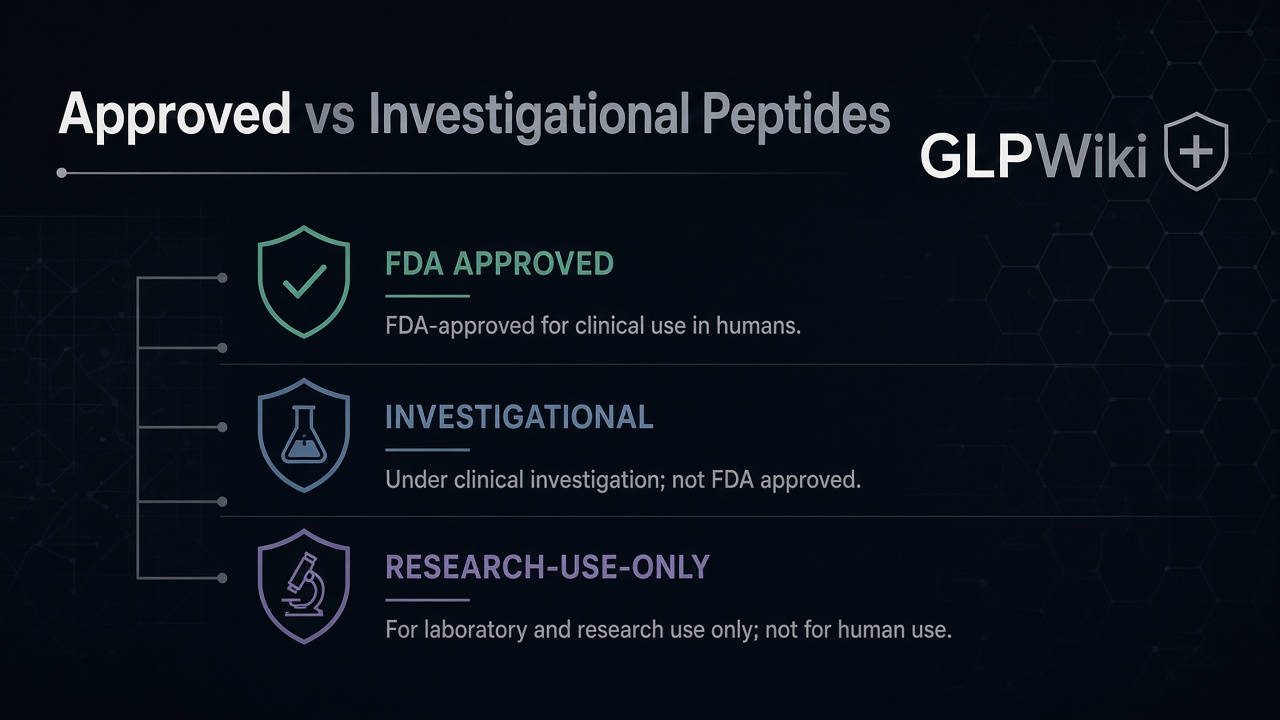
The three-tier ladder below is a U.S.-focused reading aid, not a universal legal classification and not legal advice. It helps identify which evidence should exist for each frame. The tiers are not quality grades that a catalog product can climb through persuasive wording: each represents a different regulatory pathway and set of records.
Approved status belongs to a specific drug application and labeled product, not merely to a molecule name. Investigational status belongs to clinical development conducted under applicable oversight. Research-use wording describes a seller’s stated intended use; it does not create an approved medicine or authorize therapeutic claims.

- FDA-approved drug — tied to an approved NDA or BLA, official prescribing information, a labeled indication, and regulated manufacturing and distribution.
- Investigational drug — studied under an IND framework with protocols, investigator information, ethics review, informed consent, and FDA safety oversight; it is not an ordinary marketed consumer product.
- Research-use or catalog material — sold with vendor intended-use language such as RUO or not for human use; that wording is not FDA approval, and a COA is not an approved label.
What “FDA-approved” means for peptide medicines
In the United States, approval means FDA has reviewed a New Drug Application (NDA) or Biologics License Application (BLA) for a specific product and determined that the submitted evidence supports marketing under defined conditions. The resulting prescribing information identifies the labeled indication, patient population, warnings, contraindications, administration information, and other reviewed particulars. Approval also sits within a current good manufacturing practice framework covering how the marketed drug is consistently produced and controlled.
Semaglutide provides a concrete example. FDA’s approval letter for Ozempic records NDA 209637 and an approval date of 5 December 2017. The approved indication at that time was as an adjunct to diet and exercise to improve glycemic control in adults with type 2 diabetes mellitus. The semaglutide compound entry explains the molecule; Drugs@FDA and the current official product label remain the authorities for the product’s present indications and labeling.
Tirzepatide provides another. FDA approved Mounjaro under NDA 215866 in 2022 as an adjunct to diet and exercise to improve glycemic control in adults with type 2 diabetes mellitus. The FDA approval letter documents that regulatory action, while the tirzepatide compound entry supplies a broader evidence-oriented overview. Brand portfolios and labeled indications can expand over time, including products marketed under different brands, so readers should check the current label for the exact product rather than transferring claims from one brand or indication to another.
An approval associated with one product does not automatically attach to every material carrying the same peptide name. Formulation, manufacturer, application holder, manufacturing controls, packaging, labeling, and distribution chain matter. That is why an unbranded research vial does not become interchangeable with an approved prescription product simply because both labels name semaglutide or another familiar sequence.
What “investigational” means (IND path)
An Investigational New Drug application, or IND, is the U.S. pathway that generally permits an unapproved drug to be shipped across state lines for clinical investigation. The IND framework is designed to support controlled research in humans while FDA and institutional reviewers evaluate whether participants are adequately protected. It is not a marketing authorization and does not make the investigational material available as an ordinary consumer product.
At a high level, an IND submission includes animal pharmacology and toxicology information, manufacturing information, clinical protocols, and information about investigators. FDA ordinarily has a 30-day period to review safety before a proposed clinical investigation may begin, unless the agency places the study on clinical hold. An Institutional Review Board reviews the research at the local level, and informed consent is required from participants except in narrowly defined circumstances governed by regulation.
Retatrutide illustrates the distinction. It is widely discussed and remains investigational; it is not an FDA-approved medicine. References to development progress, study results, or public enthusiasm do not substitute for an approval action and official prescribing information. GLPWiki’s GLP-3 explainer clarifies why “GLP-3” is an internet nickname associated with retatrutide rather than the name of a hormone or receptor, and the retatrutide compound page records its investigational status without presenting trial material as a retail option.
Research-use labeling is not approval
Research-use-only and not-for-human-use statements are vendor descriptions of intended use. They commonly appear on catalog listings and vial stickers for laboratory reagents. Such language is not an FDA approval, an approved prescription label, a clinical safety finding, or proof that the material is suitable for use in a person. It also does not transform a vendor’s analytical paperwork into the documentation required for an approved drug.
The comparison below uses fictional labels to make that paperwork difference visible. The prescription mock includes features associated with a dispensed product and points readers toward official labeling. The RUO mock carries a catalog identity claim, lot information, storage language, and a research-use disclaimer. Even if both used the same sequence name, those documents would not place the products in the same regulatory frame.
FDA has also warned about unapproved GLP-1 products used for weight loss. Research-use wording does not override other evidence that a product is intended for human use when its promotion, instructions, or surrounding claims indicate otherwise. GLPWiki does not make a legal determination about any seller. The narrow literacy point is that a disclaimer printed on a vial is not a substitute for an approved application, and readers should not treat it as one.

A COA answers analytics, not approval
A Certificate of Analysis answers batch-level analytical questions. HPLC may describe chromatographic purity, mass spectrometry may support molecular identity, and a net peptide content result may estimate how much of the material’s mass is peptide rather than water, salts, or counter-ions. None of those fields is an NDA, a BLA, or an FDA approval decision.
The COA guide explains purity, identity, and content as separate measurements. The vial-label guide explains how to match the product name, mass, and lot across a vial, COA, and listing. Those checks can reveal whether research paperwork is internally consistent, but even excellent paperwork does not convert research material into an approved medicine.
How to verify status (checklist)
- Search the exact product name on Drugs@FDA and review the current official labeling when checking an approved product.
- For trial drugs, consult ClinicalTrials.gov and sponsor disclosures, while remembering that an IND permits clinical investigation rather than retail sale.
- Read the physical label: prescription pharmacy labeling and RUO or not-for-human-use disclaimers belong to different regulatory frames.
- If reviewing research paperwork, match the lot identifier on the COA to the lot on the vial; a mismatch means the report describes another batch.
- Check GLPWiki compound pages to see how status is recorded, then review the editorial standards for the evidence and correction rules behind that classification.
Common confusions
Most status errors come from collapsing unlike questions into one. Keep the molecule, the particular finished product, the evidence setting, and the regulatory authorization separate.
- The same international nonproprietary name or amino-acid sequence can appear across approved, investigational, compounded, and research contexts without making the resulting products equivalent.
- A drug described as being in phase 3 is still investigational until a regulator approves a specific application; trial stage is not approval.
- A compounded preparation is not automatically interchangeable with an FDA-approved product. FDA notes that compounded drugs are not FDA-approved and are not reviewed for safety, effectiveness, or quality before marketing.
- Animal or cell-culture literature can support a research hypothesis, but it does not establish approval for human use or prove a clinical outcome.
- A high COA purity percentage describes a laboratory result under stated test conditions. It is not regulatory clearance, a sterility finding, or evidence of clinical safety or effectiveness.
Related tools and next reading
Continue with the guides on reading a peptide COA and reading a peptide vial label, then use the reconstitution and peptide dosing-math guides to understand unit conversions without turning arithmetic into treatment advice. The calculators hub performs transparent calculations from values the user supplies; its calculators never recommend a dose.
For molecule-specific context, see the semaglutide, tirzepatide, and retatrutide compound entries. The glossary defines regulatory and laboratory terms, the editorial standards explain how GLPWiki grades evidence and handles corrections, and the medical disclaimer defines the limits of this educational reference. None of these pages provides purchasing advice, supplier endorsements, or instructions for personal treatment.
Frequently asked questions
- Does a research COA mean FDA approval?
- No. A research COA reports analytical results for a batch, such as purity or identity. FDA approval requires review and approval of a specific NDA or BLA and is verified through Drugs@FDA and official labeling.
- Is an investigational peptide the same as an approved drug with the same name?
- No. A shared sequence name does not make materials interchangeable. Investigational drugs are studied under a clinical-research framework; approved drugs are tied to a reviewed application, official label, manufacturing controls, and labeled indication.
- How do I check if a peptide medicine is FDA-approved?
- Search the exact product name in Drugs@FDA and read the current official prescribing information. A seller page, trial announcement, vial sticker, or COA is not proof of approval.
- Does “for research use only” make something legal to sell as a drug?
- No. RUO wording is a vendor intended-use statement, not drug approval or legal authorization to market a product for human treatment. FDA can consider the product’s promotion and surrounding evidence of intended use.
- Does phase 3 status mean a peptide is approved?
- No. A clinical development phase describes a stage of investigation. Approval requires a separate regulatory review and formal action on a specific application.
- Does GLPWiki recommend doses or suppliers?
- No. GLPWiki is an independent educational reference. It publishes no dosing protocols, schedules, stacks, purchasing advice, or supplier endorsements, and its calculators perform arithmetic only from user-supplied values.
SOURCES
- 01Investigational New Drug (IND) Application— U.S. Food and Drug Administration
- 02Ozempic (semaglutide) NDA 209637 approval letter— U.S. Food and Drug Administration
- 03Mounjaro (tirzepatide) NDA 215866 approval letter— U.S. Food and Drug Administration
- 04FDA’s Concerns with Unapproved GLP-1 Drugs Used for Weight Loss— U.S. Food and Drug Administration
- 05Understanding the Risks of Compounded Drugs— U.S. Food and Drug Administration
- 0621 CFR Part 312 — Investigational New Drug Application— Electronic Code of Federal Regulations
EDUCATIONAL REFERENCE ONLY · Not medical advice. Nothing here diagnoses, treats, cures or prevents any disease, and nothing here is a dosing recommendation. Consult a licensed clinician before any treatment decision.