How to Read a Peptide Vial Label
A vial sticker is not a Certificate of Analysis. This checklist covers the fields that matter on a peptide vial label—name, mass, lot, storage, and research-use statements—and how to check them against the COA and the listing before you treat the paperwork as describing the vial in your hand.
UPDATED 10 SEPT 2026 · 12 MIN READ
KEY TAKEAWAYS
- Match lot number and product name across vial label, COA/ADS, and order/listing before trusting any purity claim.
- Labels state identity claims and handling notes; they do not replace HPLC purity or mass-spectrometry identity on a lot-specific COA.
- Research-use-only (RUO) statements are regulatory/status language, not a dosing or safety clearance.
- Approved drug labels (for example FDA-approved semaglutide products) live in official prescribing information — not on a research-chemical sticker.
- Mass on the label feeds reconstitution math only as user-supplied input; GLPWiki never recommends a dose.
- Educational only — see the medical disclaimer and editorial standards.
What a vial label is (and is not)
A vial label is a summary claim printed by whoever filled or packaged the vial. At best it tells you which material the filler believes is inside, how much of it there should be, which batch it came from, how it should be stored, and what regulatory status the seller is asserting. It is a pointer to documentation — not the documentation itself.
A Certificate of Analysis (COA) or Analytical Data Sheet is different in kind. It reports measurements performed on one specific batch: chromatographic purity, mass-spectrometry identity, and sometimes net peptide content. A label says “Example Peptide A, 5 mg.” A COA is what tries to demonstrate that the batch actually is that peptide, at that purity, in that quantity.
So the practical rule is simple: the label is where you get identifiers, and the COA is where those identifiers get tested. If the two do not line up, you have paperwork for something other than the vial in your hand. The companion guide on how to read a peptide Certificate of Analysis walks through the analytical half of that pair field by field.
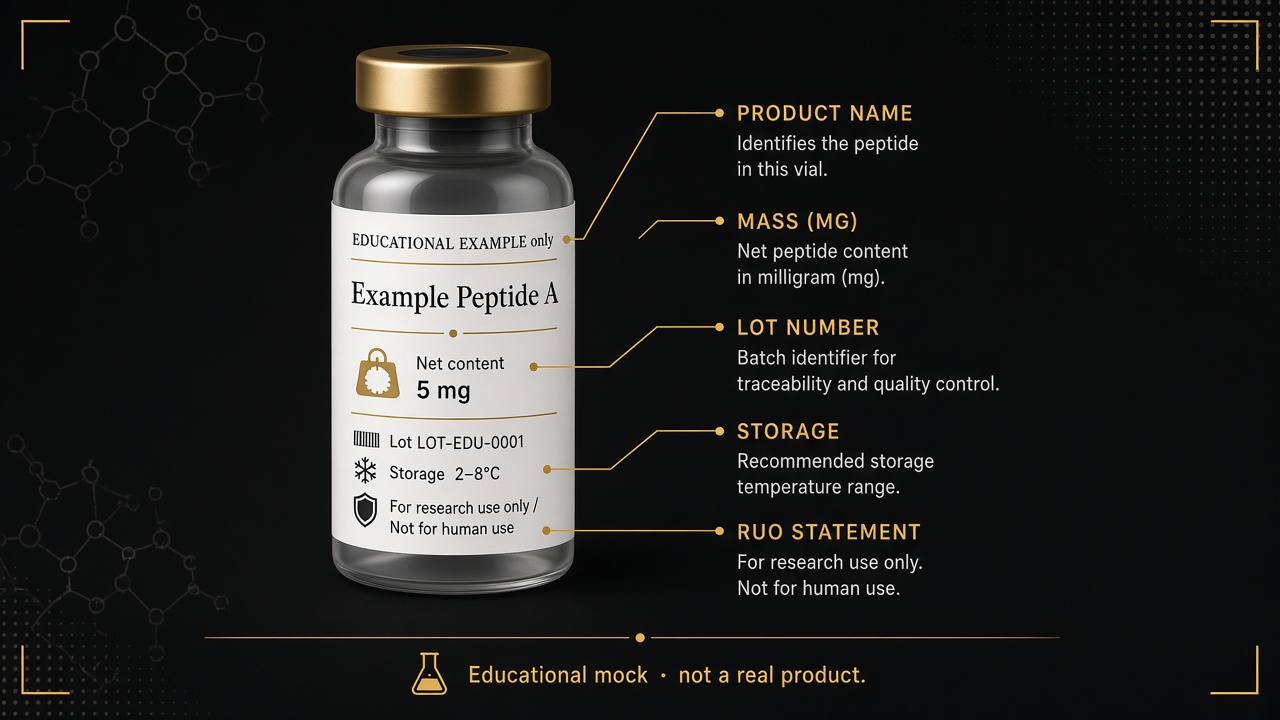
Fields that matter: name, mass, lot, storage, RUO
Most peptide vial labels are small, so nearly everything printed on one is there for a reason. Five fields carry the weight, and each answers a different question.
- Product name — which peptide the filler claims is inside. It should be a specific compound name (and ideally a sequence or CAS reference), not a marketing nickname. This is the string that must match your order and your COA.
- Mass — the amount of material in the vial, almost always in milligrams for lyophilised peptide. Note whether the label distinguishes total lyophilate mass from net peptide content; those are different numbers once salts, counter-ions, and residual water are counted.
- Lot or batch number — the traceability key. Quality is a property of a batch, so the lot is what connects this vial to a set of measurements. A label with no lot number cannot be tied to any COA at all.
- Storage — the temperature range the filler recommends, commonly refrigerated for reconstituted material and cooler or frozen for long-term lyophilised storage. Storage text is a handling instruction, not a stability guarantee; see the storage and handling guide.
- Research-use-only (RUO) statement — regulatory-status language such as “for research use only / not for human use.” It describes how the material is being sold and labelled. It is not a safety clearance and it is not a dosing instruction.
Match these three: label ↔ COA ↔ listing
Before you read a single purity percentage, do the identifier check across three documents: the physical vial label, the COA or Analytical Data Sheet, and the order confirmation or product listing you bought from.
The lot number is the hinge. Bachem’s public guidance on Analytical Data Sheets, for example, has customers retrieve the lot-specific sheet using the product number and lot number printed on the label — the sheet is issued for that batch and no other. If the COA carries a different lot, it is describing a different batch of material.
The product name and claimed mass are the second and third comparisons. A listing advertising 5 mg per vial, a label reading 10 mg, and a COA for a third figure is not a rounding discrepancy — it means at least one of the three documents does not describe this product. Only after all three agree does it make sense to evaluate HPLC purity and mass-spectrometry identity, which the COA guide covers in detail.
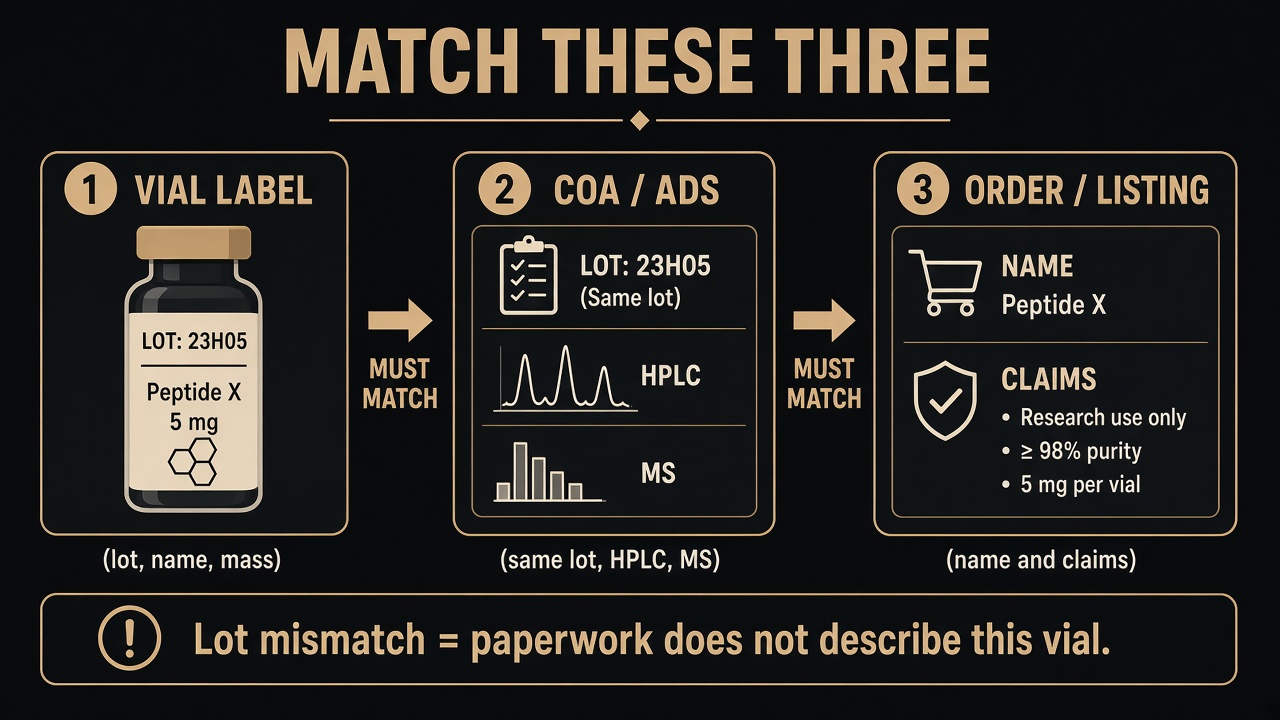
- Lot / batch number identical on label and COA.
- Product name identical across label, COA, and listing.
- Claimed mass per vial consistent across all three.
- COA is dated and issued by a named laboratory or manufacturer.
Mismatch scenarios (educational)
These are reading exercises, not clinical guidance. Each describes what a discrepancy means about the paperwork — nothing more.
- Lot mismatch — the COA lot does not appear on the vial. The analytical results belong to some other batch, so purity and identity claims are unsupported for this vial regardless of how strong the numbers look.
- Name mismatch — the label, listing, and COA disagree about which peptide this is. Identity is the first thing a COA is supposed to establish; a naming conflict undermines everything downstream of it.
- Missing RUO statement — a research-labelled material sold without regulatory-status language, or with language implying therapeutic use. FDA has warned about unapproved and compounded GLP-1 products carrying labelling and quality problems; status language that quietly disappears is a labelling problem.
- Missing storage information — no temperature guidance at all. You cannot infer handling conditions from the compound name, and stability behaviour varies by peptide and by whether the material is lyophilised or reconstituted.
- Recycled COA — the same PDF, same date, same chromatogram supplied for every lot. That is marketing collateral wearing a COA’s clothes; batch-specific measurement is the whole point of the document.
Approved drug labels vs research vial stickers
There are two very different documents that both get called a “label,” and conflating them is the most consequential error on this page.
An approved medicine carries an approved label: FDA-reviewed prescribing information covering indication, contraindications, warnings, and administration, tied to a specific approved application. Semaglutide products sit in that category, and the GLPWiki entry for semaglutide records that approved status. The authoritative source for such a product is Drugs@FDA and the official prescribing information — never a vendor page or a printed sticker.
A research vial sticker is not that. For a compound such as BPC-157, which GLPWiki lists with research status, no approved human label exists to consult; the sticker is a supplier’s claim about contents, batch, and handling. FDA has published concerns specifically about unapproved GLP-1 drugs marketed for weight loss, including quality, labelling, and dosing-error risks in some compounded and fraudulent products. A research-use statement documents that a material sits outside the approved-drug framework — it does not tell you anything about safety, and it is never a dosing instruction.
If you use the labeled mass in calculators
Reconstitution arithmetic is deliberately narrow: concentration = peptide mass ÷ diluent volume. Every term is a number you supply. The labelled mass is one of those inputs, which is why the ambiguity between total lyophilate mass and net peptide content matters — feed in a different mass and you get a different concentration out, with no warning from the arithmetic itself.
The reconstitution calculator on this site performs that conversion and nothing else. It does not suggest an amount to draw, it has no recommended-dose prefill, and it does not know anything about you. If you want the underlying arithmetic explained step by step first, the guide on how to reconstitute peptides covers the same math in prose.
Illustrative only: a vial labelled 5 mg, reconstituted with 2 mL of diluent, yields 2.5 mg/mL. That is a unit conversion, presented as an example of the formula — not a recommendation to prepare anything.
Field checklist + glossary terms
Use this as a reading checklist for the label in front of you. It is not a purchasing recommendation and not a safety clearance.
Several terms above are defined in the GLPWiki glossary — lot, lyophilized, RUO, and HPLC among them. The sourcing rules behind this page are set out in the editorial standards, and the scope limits are in the medical disclaimer.
- Product name present, specific, and matching the order.
- Mass stated, with net peptide content distinguished where relevant.
- Lot or batch number present and matching the COA.
- Storage conditions printed for the form supplied (lyophilised or reconstituted).
- Research-use / regulatory-status statement present and unambiguous.
- A lot-specific COA is actually available for that lot number.
- Nothing on the label implies therapeutic use, approval, or a dose.
Frequently asked questions
- Why does the lot number have to match between the vial and the COA?
- Because quality is measured per batch. A Certificate of Analysis reports tests run on one specific lot, so if the lot printed on the vial does not appear on the COA, the results describe different material and cannot support any claim about your vial.
- What does “research use only” mean on a peptide vial?
- It is regulatory-status language indicating the material is labelled and sold outside the approved-drug framework and not for human use. It is not a safety assessment, not a quality guarantee, and not a dosing instruction.
- Is a vial label the same as a Certificate of Analysis?
- No. The label is a claim about identity, mass, batch, storage, and status. The COA is the batch-specific analytical report — HPLC purity, mass-spectrometry identity, sometimes net peptide content — that tests whether that claim holds.
- How is an approved drug label different from a research vial sticker?
- An approved medicine carries FDA-reviewed prescribing information tied to an approved application, verifiable through Drugs@FDA. A research vial sticker is a supplier's own claim about contents and handling, with no approved human labelling behind it.
- Can I use the mass printed on the label in a reconstitution calculator?
- You can use it as an input to the arithmetic — concentration equals mass divided by diluent volume. Check whether the figure is total lyophilate mass or net peptide content, since they give different concentrations. The calculator converts numbers you supply and does not recommend a dose.
- What should I make of a vial with no storage information?
- Treat it as an incomplete label. Handling requirements vary by peptide and by whether the material is lyophilised or reconstituted, and they cannot be inferred from the compound name alone.
SOURCES
- 01Analytical Data Sheet (ADS) — retrieved by product and lot number from the label— Bachem Knowledge Center
- 02Quality Control of Amino Acids & Peptides: A Guide (HPLC purity; MS identity; batch documentation)— Bachem Knowledge Center
- 03FDA’s Concerns with Unapproved GLP-1 Drugs Used for Weight Loss— U.S. Food and Drug Administration
- 04Understanding the Risks of Compounded Drugs— U.S. Food and Drug Administration
EDUCATIONAL REFERENCE ONLY · Not medical advice. Nothing here diagnoses, treats, cures or prevents any disease, and nothing here is a dosing recommendation. Consult a licensed clinician before any treatment decision.