Storage, stability and research handling basics
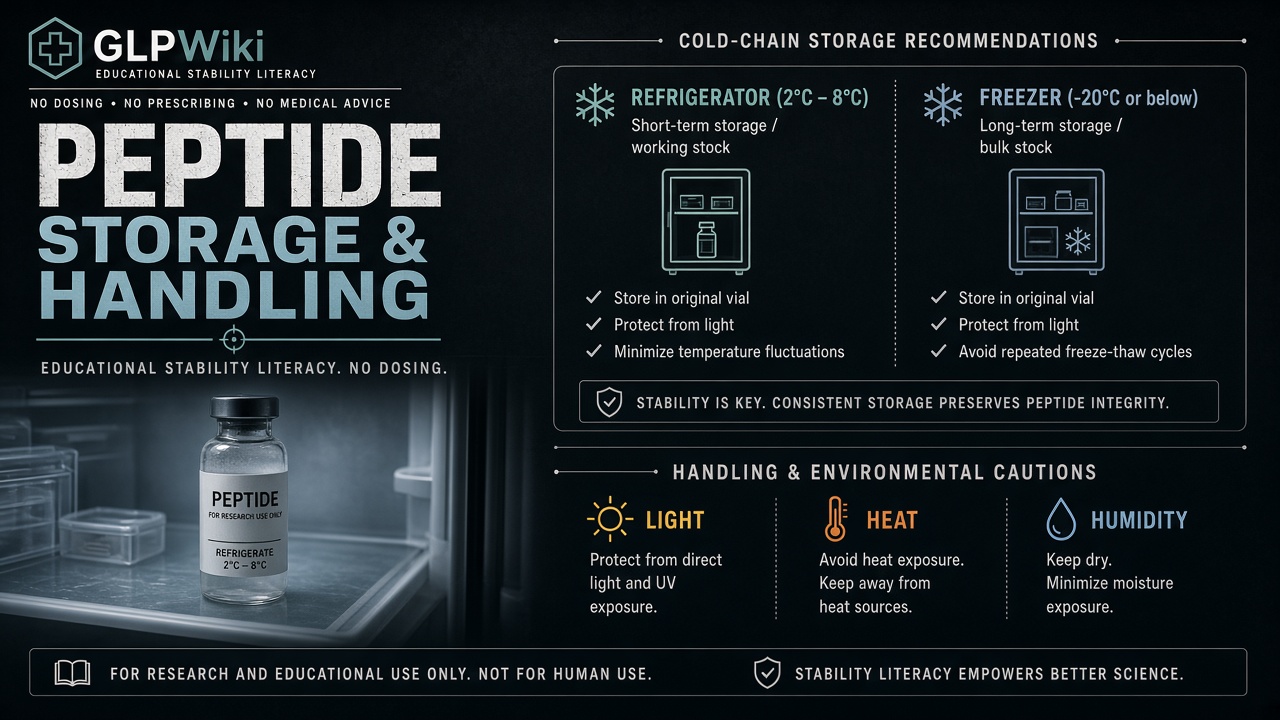
Peptides are chemically fragile molecules. Understanding temperature, light, agitation, and container-material effects is central to keeping a research sample interpretable and consistent.
UPDATED 09 SEPT 2026 · 11 MIN READ
KEY TAKEAWAYS
- Lyophilised (freeze-dried) peptide is generally more stable than reconstituted peptide in solution, which is why most products ship and store as a dry powder.
- Cold-chain storage — often refrigeration (2–8°C) or freezing, depending on the specific peptide — slows chemical degradation pathways such as hydrolysis, oxidation, and aggregation.
- Repeated freeze-thaw cycles can damage peptide structure and are generally discouraged once a solution has been reconstituted.
- Light exposure and vigorous agitation (shaking) can both accelerate degradation or promote aggregation in peptide solutions.
- Peptides can adsorb (stick) to glass or plastic container surfaces, which is a separate phenomenon from chemical degradation but can still reduce the recoverable amount.
- A beyond-use date for a reconstituted solution is an estimate of how long it remains suitable for its intended purpose under specified storage conditions — it is not a universal fixed number across all peptides.
- Clear documentation and labelling (peptide, concentration, reconstitution date, storage condition) is a basic laboratory practice that reduces downstream errors.
Lyophilised vs. reconstituted stability
Peptides are chains of amino acids linked by bonds that are chemically vulnerable to hydrolysis (breakdown in the presence of water), oxidation, and other degradation reactions. In the dry, lyophilised state, the near-absence of water dramatically slows these reactions, which is a major reason pharmaceutical peptides are commonly freeze-dried for storage and shipping rather than distributed as ready-made solutions.
Once a peptide is reconstituted into a liquid diluent, it becomes considerably more chemically active and more vulnerable to the degradation pathways that lyophilisation had been suppressing. Peer-reviewed pharmaceutical stability literature consistently finds that reconstituted peptide and protein solutions have materially shorter usable stability windows than the same material in lyophilised form, and that the appropriate handling conditions (temperature, time, and light exposure) differ substantially between the two states.
This is why manufacturers typically specify separate storage instructions for the unopened lyophilised vial versus the reconstituted solution — the two states are simply not comparable in terms of how forgiving they are of storage lapses.
Cold chain and temperature
'Cold chain' refers to maintaining a continuous, controlled low-temperature environment for a product from manufacture through storage and, ideally, until use. For many peptides, manufacturer documentation specifies refrigeration (commonly in the 2–8°C / 36–46°F range) for both the unopened lyophilised vial and, separately, for a reconstituted solution, sometimes with a shorter allowable window once dissolved.
Some peptides' lyophilised forms are specified for freezer storage rather than simple refrigeration, particularly for long-term storage prior to use, while others are stable at refrigerator temperatures. The specific temperature requirement is peptide- and formulation-dependent, and a product's own certificate of analysis or manufacturer documentation is the primary reference — general rules of thumb should not override product-specific guidance.
Temperature excursions — brief periods outside the specified range, such as during shipping in hot weather — do not necessarily ruin a product outright, but repeated or prolonged excursions increase cumulative degradation risk, which is one reason cold-chain packaging (insulated containers, cold packs) is used during peptide shipping.
Freeze-thaw cycles and agitation
Repeatedly freezing and thawing a reconstituted peptide solution is generally discouraged in laboratory practice because each freeze-thaw cycle can promote physical changes such as aggregation (peptide molecules clumping together) or partial unfolding, in addition to any chemical degradation occurring over the same timeframe. Many laboratory protocols for peptide and protein handling recommend aliquoting a solution into single-use portions specifically to avoid subjecting the entire stock to repeated freeze-thaw cycles.
Vigorous physical agitation — vigorous shaking, rather than gentle swirling or inversion — can also promote aggregation in peptide and protein solutions, partly through mechanisms related to interfacial stress at air-liquid interfaces. General laboratory guidance for reconstituting lyophilised biologics typically favors gentle swirling over shaking for this reason.
- Avoid repeated freeze-thaw cycles once a solution is reconstituted; consider aliquoting instead.
- Prefer gentle swirling over vigorous shaking when dissolving a lyophilised cake.
- Minimize the number of times a vial is opened and re-sealed once in solution.
Light exposure and surface adsorption
Some peptides contain amino acid residues (such as tryptophan, tyrosine, methionine, or cysteine) that are susceptible to light-driven oxidative degradation. For this reason, many peptide products are packaged in amber glass vials or are stored wrapped in foil or kept in a dark environment, and manufacturer instructions frequently specify 'protect from light' for both the lyophilised and reconstituted states.
A separate phenomenon from chemical degradation is adsorption — the tendency of some peptides to stick to the interior surface of glass or plastic containers, syringes, or IV tubing, particularly at low concentrations. Adsorption does not necessarily mean the peptide has chemically degraded, but it does mean that some of the nominal mass in a vial or syringe may not actually be recoverable in solution, which is one reason very dilute peptide solutions can behave less predictably than more concentrated ones in laboratory contexts.
Understanding beyond-use dates
A beyond-use date (BUD) is the date after which a compounded or reconstituted preparation should no longer be considered suitable for its intended purpose, based on stability data, storage conditions, and container characteristics. USP General Chapter <795> and <797> set out general frameworks compounding pharmacies use to assign BUDs to non-sterile and sterile preparations respectively, in the absence of product-specific stability data.
For peptide products specifically, appropriate reconstituted stability windows vary considerably by molecule, diluent, concentration, and storage temperature — some manufacturer documentation specifies windows measured in days at refrigerator temperature, others longer under frozen storage. There is no single universal number that applies to all peptides, which is why manufacturer documentation and, where relevant, a supervising pharmacist's guidance take precedence over generic assumptions.
Shipping considerations and documentation practices
Peptide shipments are commonly packed with cold packs and insulated packaging to limit temperature excursions in transit, and lyophilised (rather than reconstituted) form is generally preferred for shipping specifically because the dry state tolerates temperature variation far better than a liquid solution would.
Basic laboratory documentation practices — labelling each reconstituted vial with the peptide identity, the concentration achieved, the date of reconstitution, and the storage condition used — reduce the risk of downstream confusion, particularly in any setting where more than one reconstituted vial may be in circulation at a time. This kind of labelling discipline mirrors long-standing practice in clinical and compounding pharmacy settings.
- Label each reconstituted vial with peptide identity, concentration, and reconstitution date.
- Store lyophilised material per its specific certificate of analysis.
- Use cold-chain packaging during shipping to limit temperature excursions.
- Track a working beyond-use date for any reconstituted solution rather than assuming indefinite stability.
Signs that may indicate degradation
Visible cloudiness, discoloration, or particulate matter appearing in a solution that was previously clear are commonly cited indicators that a peptide preparation may have degraded or aggregated and should not be considered representative of a fresh preparation for research purposes. Any change of this kind is generally treated as a signal to discard the preparation rather than continue using it, consistent with general good laboratory and pharmacy practice for parenteral solutions.
Because visual inspection alone cannot detect all forms of chemical degradation, adherence to documented storage windows and conditions remains the primary safeguard, rather than relying solely on appearance.
Scope of this guide
This guide summarizes general stability and handling concepts relevant to lyophilised and reconstituted peptides for research and educational purposes. It is not a substitute for a specific product's manufacturer documentation, certificate of analysis, or the guidance of a licensed pharmacist or clinician, all of which should take precedence in any real-world laboratory or research setting.
Frequently asked questions
- Why is lyophilised peptide more stable than reconstituted peptide?
- The near-absence of water in a freeze-dried powder greatly slows chemical degradation pathways such as hydrolysis and oxidation, which occur more readily once the peptide is dissolved in solution.
- Is it safe to freeze and thaw a reconstituted peptide solution repeatedly?
- Laboratory practice generally discourages repeated freeze-thaw cycles because each cycle can promote aggregation or structural changes; aliquoting a solution into single-use portions is a common way to avoid this.
- Why do some peptide vials need to be protected from light?
- Certain amino acid residues in some peptides are susceptible to light-driven oxidative degradation, so manufacturers often specify amber packaging or dark storage to limit this exposure.
- What is adsorption and why does it matter?
- Adsorption is when peptide molecules stick to the interior surface of a container, syringe, or tubing, which can reduce the amount actually recoverable in solution even though the peptide has not necessarily chemically degraded.
- What is a beyond-use date?
- It is the date after which a reconstituted or compounded preparation is no longer considered suitable for its intended purpose, based on stability data and storage conditions; it varies by peptide and is not a single universal figure.
- How can I tell if a peptide solution has degraded?
- Visible cloudiness, discoloration, or particulate matter in a previously clear solution are commonly cited signs of possible degradation or aggregation, though not all degradation is visually detectable.
- Should I always refrigerate peptide vials?
- Storage requirements are peptide- and formulation-specific; some require refrigeration, others freezing, for both lyophilised and reconstituted states. Manufacturer documentation or a certificate of analysis is the primary reference rather than a general rule.
SOURCES
- 01General Chapter <797> Pharmaceutical Compounding — Sterile Preparations— United States Pharmacopeia (USP)
- 02General Chapter <795> Pharmaceutical Compounding — Nonsterile Preparations— United States Pharmacopeia (USP)
- 03Peptide and protein stability: chemical and physical degradation pathways— PubMed (Journal of Pharmaceutical Sciences)
- 04Effects of freeze-thaw cycles on protein aggregation— PubMed
- 05Photostability testing of pharmaceuticals— PubMed
- 06Protein adsorption to container surfaces in parenteral formulations— PubMed
EDUCATIONAL REFERENCE ONLY · Not medical advice. Nothing here diagnoses, treats, cures or prevents any disease, and nothing here is a dosing recommendation. Consult a licensed clinician before any treatment decision.