Peptide classes overview: incretins, amylin, secretagogues, repair, melanocortin and more
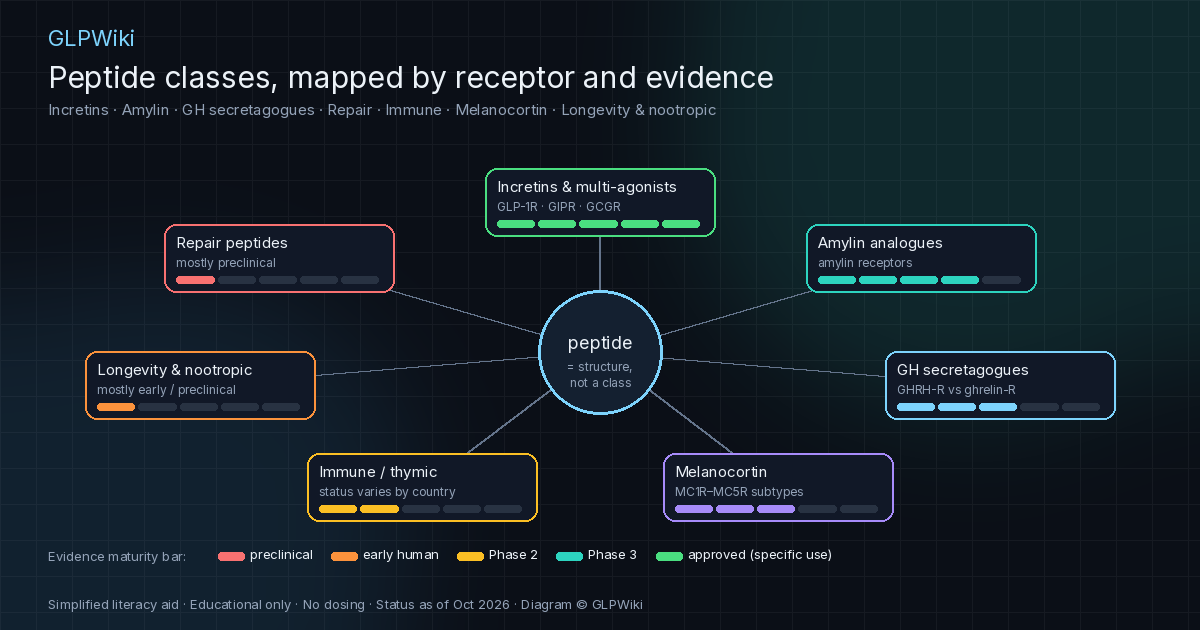
"Peptide" describes a chemical structure, not what a molecule does. This refreshed reference organizes the peptides discussed across GLPWiki by receptor target and physiological system, adds a receptor map for the incretin family (GLP-1, GIP, glucagon, amylin), and places each class on an evidence-maturity ladder so approved medicines are never confused with preclinical research compounds. Educational only: no doses, protocols, or sourcing.
UPDATED 06 OCT 2026 · 17 MIN READ
KEY TAKEAWAYS
- Peptides referenced across GLPWiki fall into functional classes based on receptor target and physiological system, not chemical similarity: incretins and multi-agonists, amylin analogues, growth-hormone secretagogues, repair peptides, immune and thymic peptides, melanocortins, and longevity and nootropic peptides.
- The incretin family is now best read as a receptor map. Semaglutide and other GLP-1 receptor agonists hit one receptor; tirzepatide adds GIP; mazdutide and survodutide add glucagon; retatrutide hits GLP-1, GIP and glucagon; CagriSema pairs a GLP-1 agonist with an amylin analogue.
- Evidence maturity varies enormously within and across classes. Semaglutide and tirzepatide have large Phase 3 programmes and FDA approval, while many repair, longevity and nootropic peptides rest mainly on preclinical animal data or small early-phase human studies.
- Status changes fast, so read it as of a date. As of October 2026: orforglipron (Foundayo) is FDA-approved but is a small molecule, not a peptide; CagriSema has an NDA under FDA review and is not approved; retatrutide has positive Phase 3 TRIUMPH results but remains investigational; mazdutide is approved in China, not in the U.S.
- Approval is indication-specific and country-specific. Tesamorelin's FDA approval for HIV-associated lipodystrophy or bremelanotide's approval for a specific sexual desire disorder does not extend to other uses, and approval in one country does not mean approval everywhere.
- Growth-hormone secretagogues split into two receptor families: GHRH analogues (tesamorelin, sermorelin, CJC-1295) and ghrelin-receptor agonists, also called GHRPs (ipamorelin, hexarelin).
- GLP-1 and GLP-2 share a name but not a receptor or a use: GLP-2 analogues such as teduglutide are used for short bowel syndrome, not metabolic disease.
- Knowing a peptide's class calibrates expectations: treating a preclinical repair peptide and a Phase 3-grade incretin as equivalent in evidentiary weight is a common and avoidable error.
What changed in this October 2026 refresh
This guide was first published in September 2026. The October refresh keeps the same URL and structure but updates regulatory status for fast-moving incretin-family molecules, adds an incretin receptor map and an evidence-maturity ladder (both original GLPWiki diagrams), and links each class to the newer GLPWiki literacy guides that go deeper on approval status, study reading, and ClinicalTrials.gov records.
- Orforglipron moved from "Phase 3" to FDA-approved (Foundayo, April 1, 2026), and is labeled clearly as a non-peptide small molecule.
- CagriSema: NDA submitted to FDA in December 2025 and still under review; not approved.
- Retatrutide: Phase 3 TRIUMPH trials reported positive results in 2026; still investigational, with a U.S. submission planned by the sponsor.
- Mazdutide: approved in China in 2025 (weight management, then type 2 diabetes); not FDA-approved.
Why classify peptides by function
The word 'peptide' describes a chemical structure — a chain of amino acids — not a category of biological effect. A peptide hormone that regulates blood glucose (like GLP-1) has essentially nothing pharmacologically in common with a peptide fragment studied for tissue repair (like BPC-157) beyond the fact that both are peptides. Grouping peptides by their receptor target and physiological system, rather than by chemistry alone, is far more useful for understanding what a given molecule plausibly does and how strong the supporting evidence is.
This guide organizes peptides referenced across GLPWiki into functional classes. For each class, it names the receptor or mechanism involved, gives examples with links to their dedicated pages, and states plainly where evidence is mature (large randomized trials, regulatory approval) versus where it is early or preclinical.
One boundary note: not every molecule discussed alongside peptides is a peptide. Orforglipron is a small-molecule GLP-1 receptor agonist; it appears here because readers constantly compare it with peptide incretins, not because it belongs to the peptide family chemically.
Incretins and related metabolic hormone mimetics
This is the most clinically mature class covered here. Incretin hormones are gut-derived signals released after eating that regulate insulin secretion, appetite, and gastric emptying. Synthetic and engineered analogues of these hormones now form the backbone of modern obesity and type 2 diabetes pharmacotherapy.
- GLP-1 receptor agonists: the original class, including semaglutide, liraglutide, dulaglutide, and exenatide. Multiple agents are FDA-approved for type 2 diabetes and/or chronic weight management (labeled uses differ by brand), backed by large Phase 3 programmes such as STEP, SUSTAIN, LEAD, and AWARD.
- GLP-1 + GIP: tirzepatide is FDA-approved (Mounjaro for type 2 diabetes; Zepbound for chronic weight management and other labeled uses), supported by the SURPASS and SURMOUNT Phase 3 programmes.
- GLP-1 + glucagon: mazdutide was approved in China in June 2025 for weight management and later for type 2 diabetes, but is not FDA-approved. Survodutide is investigational, in Phase 3 (SYNCHRONIZE and other programmes). Efinopegdutide remains in clinical development.
- GLP-1 + GIP + glucagon: retatrutide reported positive Phase 3 TRIUMPH results in 2026 (published in NEJM and The Lancet), but remains investigational and is not FDA-approved.
- GIP as a standalone target: GIP receptor biology is mostly studied in combination with GLP-1 rather than alone; understanding of its independent contribution to weight and glycemic effects is still evolving.
- Oral non-peptide alternative: orforglipron (Foundayo) is a small-molecule GLP-1 receptor agonist that FDA approved on April 1, 2026 for chronic weight management. It is not a peptide; see GLPWiki's dedicated orforglipron guide for its approved-versus-investigational details.
- Oxyntomodulin: a naturally occurring dual GLP-1/glucagon receptor agonist that served as an early proof-of-concept for the multi-agonist approach later engineered into synthetic molecules like survodutide and mazdutide.
Incretin-family receptor map
Most confusion in incretin conversations comes from mixing up which receptors a molecule engages and what regulatory status it has. The map below separates the two: the dots show receptor targets, and the right-hand column shows U.S. status as of October 2026.
Two reading rules help. First, adding a receptor target is a pharmacology fact, not a promise of a better outcome for any individual; comparisons across separate trials are not head-to-head evidence. Second, status is indication-specific, so always confirm the exact label on Drugs@FDA for the product in front of you.
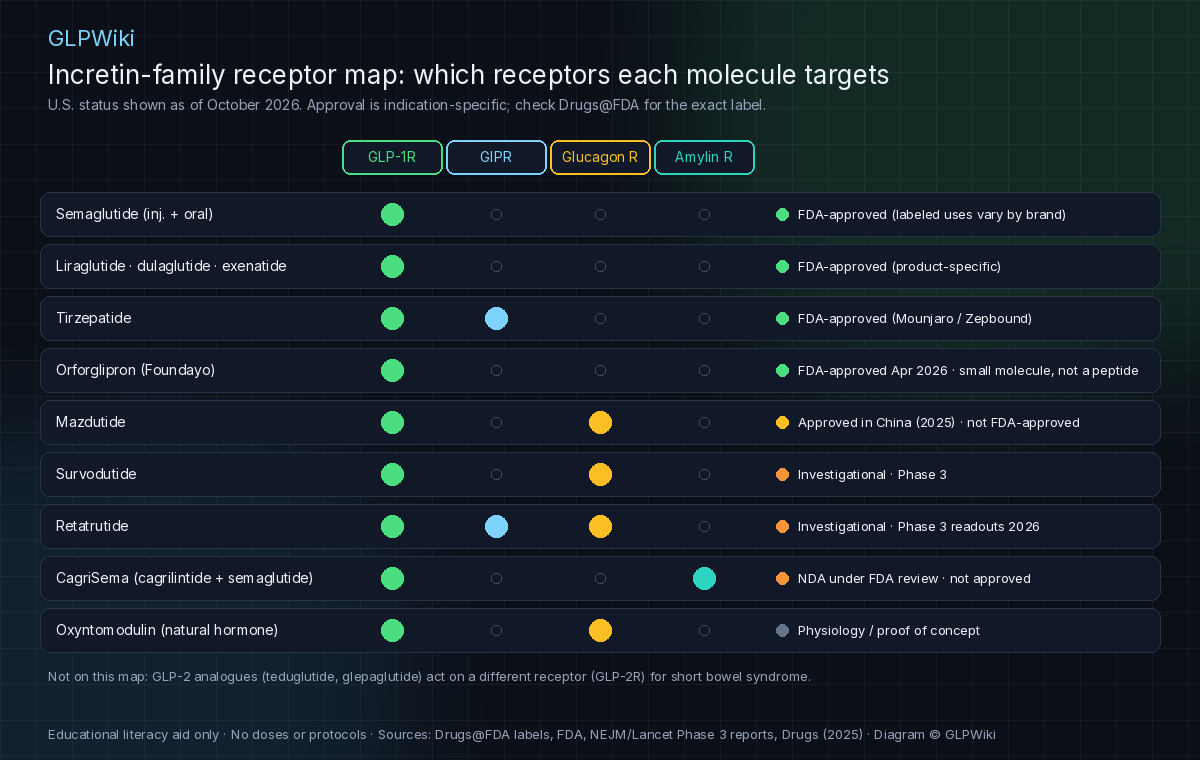
- One receptor (GLP-1R): semaglutide, liraglutide, dulaglutide, exenatide, and the small molecule orforglipron.
- Two receptors: tirzepatide (GLP-1R + GIPR); mazdutide and survodutide (GLP-1R + glucagon receptor).
- Three receptors: retatrutide (GLP-1R + GIPR + glucagon receptor).
- Two hormone systems in one product: CagriSema (semaglutide + the amylin analogue cagrilintide).
GLP-2 and gut-trophic analogues (a different class despite the name)
Teduglutide and glepaglutide act on the GLP-2 receptor to promote intestinal adaptation. Teduglutide is FDA-approved for short bowel syndrome, an entirely different clinical use case from GLP-1's metabolic effects. The shared 'GLP' prefix reflects a shared precursor protein (proglucagon), not shared pharmacology.
Amylin analogues
Amylin is a hormone co-secreted with insulin from pancreatic beta cells that independently regulates satiety and gastric emptying through amylin receptors, which are distinct from GLP-1 receptors. Cagrilintide is a long-acting amylin analogue studied both alone and, more prominently, in fixed combination with semaglutide (CagriSema).
The REDEFINE 1 and REDEFINE 2 Phase 3 trials of co-administered cagrilintide and semaglutide were published in the New England Journal of Medicine in 2025. The sponsor submitted a New Drug Application to FDA in December 2025; as of October 2026 FDA has not announced a decision and CagriSema is not approved. A filed application is not an approval, and no online or compounded product is an approved CagriSema.
Growth-hormone secretagogues: two distinct receptor families
Peptides that stimulate growth hormone release are often lumped together, but they act through two pharmacologically distinct receptor systems.
GHRH analogues
These peptides act on the growth-hormone-releasing hormone receptor to stimulate pituitary GH release in a manner that preserves the body's natural pulsatile pattern and feedback regulation. Tesamorelin is FDA-approved specifically for HIV-associated lipodystrophy, giving it more regulatory-grade human evidence than most peptides discussed in this category. Sermorelin and CJC-1295 are GHRH analogues discussed in research and off-label contexts with more limited large-scale trial data than tesamorelin, particularly for indications beyond what tesamorelin is approved for.
Ghrelin-receptor agonists (GHRPs)
These peptides, including ipamorelin and hexarelin, act on the ghrelin receptor (GHS-R1a) rather than the GHRH receptor, stimulating GH release through a separate mechanism and, for some members of this group, additional appetite-related effects via the same receptor pathway ghrelin itself uses. Evidence for this subclass in humans is generally more limited than for the approved GHRH analogue tesamorelin, and much of the mechanistic data comes from smaller studies or preclinical work. Pairing a GHRH analogue with a ghrelin-receptor agonist appears in research designs, but that pairing is a research construct, not an approved regimen.
Repair and regenerative research peptides
This class includes peptides studied, largely in preclinical animal models, for potential roles in tissue healing, angiogenesis, and inflammation modulation. BPC-157 (a synthetic fragment derived from a naturally occurring gastric protective protein) and TB-500 (a synthetic fragment related to the protein thymosin beta-4) are the most frequently discussed members of this class. Honest framing matters here: the large majority of available evidence for both compounds comes from rodent and in vitro studies; robust randomized controlled human trial data establishing efficacy and safety for tissue repair indications is not currently available in the way it is for approved incretin drugs. Claims about human efficacy for these two peptides should be treated as extrapolations from preclinical data, not established clinical fact.
GHK-Cu, a naturally occurring copper-binding tripeptide, is studied for skin and wound-related biology, with more topical/dermatologic human data (including some clinical cosmetic research) than BPC-157 or TB-500, though it still falls well short of the trial density seen in the incretin class.
Immune and thymic peptides
Thymosin alpha-1 is a peptide derived from thymic tissue that has been studied internationally, including in some countries where it holds approval for specific indications such as certain chronic infections and as an immune adjunct, giving it a comparatively longer clinical research history than many peptides in the repair or longevity categories. This does not mean thymosin alpha-1 is universally approved or FDA-approved, or that its evidence base matches that of incretin drugs; regulatory status varies significantly by country and indication, and this variability should be checked rather than assumed.
KPV, a tripeptide fragment derived from alpha-melanocyte-stimulating hormone, is studied preclinically for anti-inflammatory effects, particularly in gut inflammation models. Human clinical trial data for KPV specifically remains limited, and most published evidence is preclinical.
Melanocortin receptor peptides
The melanocortin receptor family (MC1R through MC5R) mediates diverse effects from pigmentation to sexual function to appetite regulation, and different peptides in research and clinical use target different receptor subtypes within this family.
- PT-141 (bremelanotide) is an MC4R-preferential agonist FDA-approved (under the brand Vyleesi) for hypoactive sexual desire disorder in premenopausal women, giving it a genuine regulatory approval within this class.
- Melanotan II is a non-selective melanocortin receptor agonist studied for pigmentation and libido effects; it is not FDA-approved for any indication, and its safety and impurity profile in unregulated preparations is a distinct concern raised in the safety literature independent of receptor pharmacology.
Longevity and mitochondrial peptides
This is among the least clinically mature classes discussed here. Epitalon (a synthetic tetrapeptide related to epithalamin, a pineal gland extract) has been studied, primarily in older Russian-language research literature and some more recent preclinical work, for potential effects on telomerase activity and aging biomarkers; large-scale, peer-reviewed randomized human trials are not currently available. MOTS-c is a mitochondrial-derived peptide studied preclinically for metabolic and exercise-related effects; human trial data is sparse relative to preclinical mechanistic work. Statements about anti-aging or longevity benefits for either peptide should be treated as hypotheses supported by early-stage or preclinical data rather than established outcomes.
Nootropic peptides and additional research categories
Semax and selank are peptides developed and studied predominantly within Russian pharmacological research, proposed to have effects on cognition, mood, and neurotrophic signaling (including modulation of BDNF expression in some preclinical work). Human trial data exists primarily from Russian-language clinical research with methodological standards and regulatory oversight that differ from Western Phase 3 trial norms, and independent replication in large randomized trials meeting typical Western regulatory standards is limited. Both peptides lack FDA approval for any indication.
AOD-9604 is a modified fragment of human growth hormone studied for potential fat-metabolism effects without the broader growth-promoting effects of full-length GH; human trial data specifically supporting meaningful fat-loss efficacy has been mixed to limited, and it is not FDA-approved as a weight-management therapy. IGF-1 LR3 is a long-acting analogue of insulin-like growth factor 1 studied primarily in preclinical and research contexts for muscle and tissue growth signaling; it carries substantial theoretical safety considerations related to unregulated IGF-1 receptor activation that are more thoroughly documented in mechanistic and case-report literature than in controlled human efficacy trials.
How to read evidence maturity across classes
When comparing peptides across these classes, it helps to ask a consistent set of questions: Has this molecule completed a randomized, placebo-controlled human trial? Is there a Phase 3 programme, and has it read out? Has any regulatory agency approved it for a specific indication, and if so, which agency and which indication exactly? Approval for one narrow indication (like tesamorelin for lipodystrophy or PT-141 for a specific sexual dysfunction diagnosis) does not imply efficacy or safety for other uses some communities have extrapolated to.
The incretin class is unusual in how much Phase 3, multi-thousand-participant trial data exists across multiple molecules. Most other classes surveyed here — repair peptides, longevity peptides, nootropic peptides, and several growth-hormone secretagogues — have comparatively thin human trial data, with much of the mechanistic rationale resting on preclinical or small early-phase studies. This is not a criticism of the biology; it is a statement about where each class currently sits on the evidence-maturity spectrum.
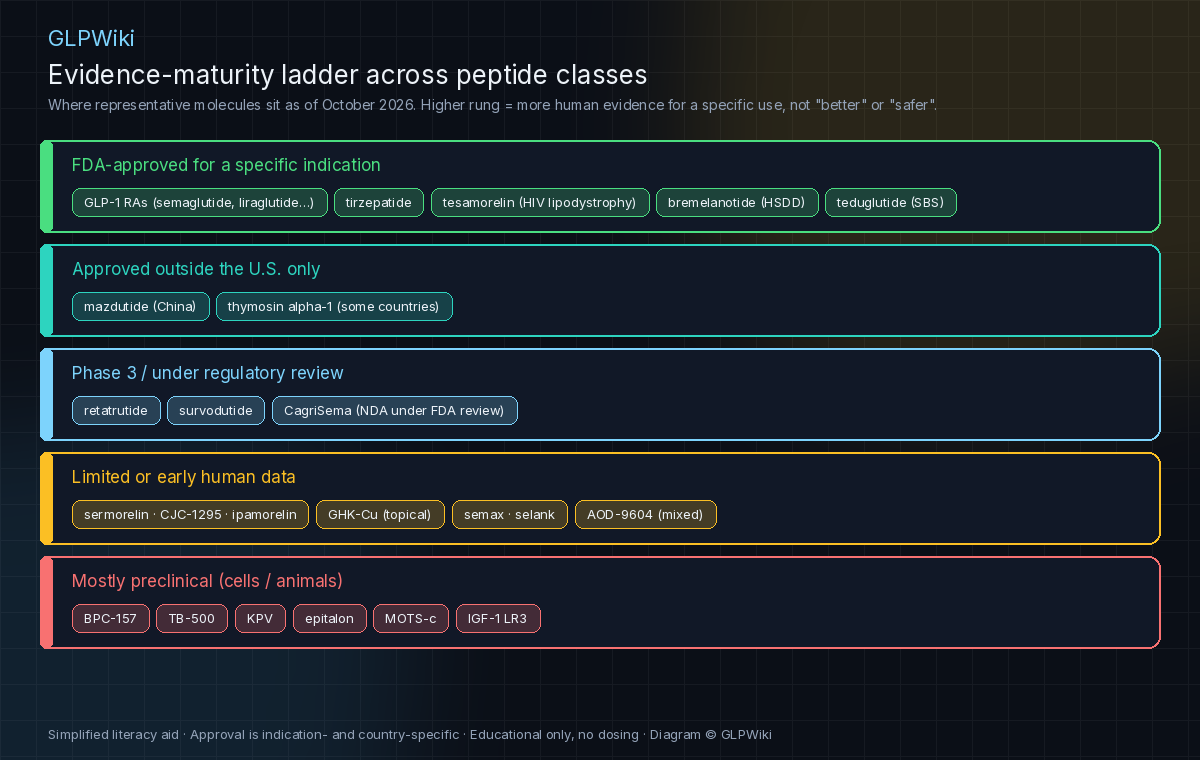
- Registered on ClinicalTrials.gov does not mean approved; a trial record is not a result.
- Approved in one country does not mean approved in the U.S. (or anywhere else).
- Approved for one indication does not mean proven for other uses.
- A filed application (NDA or BLA) is not an approval until FDA acts.
How to use this overview
Use the class to set expectations, then go one level deeper. Open the compound page for receptor and status details, check the exact label on Drugs@FDA for anything described as approved, and use ClinicalTrials.gov to see whether a trial is registered, recruiting, or has posted results. GLPWiki's literacy guides walk through each of those steps. Nothing on this page is medical advice, a dosing reference, or a recommendation to use any compound; decisions about medicines belong with a licensed clinician.
Frequently asked questions
- Are all 'research peptides' backed by similar levels of evidence?
- No. Evidence maturity varies enormously. Incretin-class drugs like semaglutide and tirzepatide have large, multi-thousand-participant Phase 3 trials and FDA approval. Many repair, longevity, and nootropic peptides rest primarily on preclinical animal studies or small early-phase human studies. Treating all peptides as equivalently supported is a common but inaccurate assumption.
- Which receptors do semaglutide, tirzepatide, and retatrutide target?
- Semaglutide targets the GLP-1 receptor. Tirzepatide targets GLP-1 and GIP receptors. Retatrutide targets GLP-1, GIP, and glucagon receptors. Semaglutide and tirzepatide are FDA-approved for specific labeled uses; retatrutide remains investigational as of October 2026.
- Is orforglipron (Foundayo) a peptide?
- No. Orforglipron is a small-molecule GLP-1 receptor agonist. FDA approved it as Foundayo on April 1, 2026 for chronic weight management. It is grouped near the incretins for comparison only.
- Is CagriSema FDA-approved?
- No, not as of October 2026. Novo Nordisk submitted a New Drug Application to FDA in December 2025 and FDA has not announced a decision. A filed application is not an approval.
- Is mazdutide approved?
- Mazdutide was approved in China in 2025 (weight management, then type 2 diabetes). It is not FDA-approved in the United States.
- What is the difference between a GHRH analogue and a ghrelin-receptor agonist?
- Both stimulate growth hormone release but through different receptors. GHRH analogues (tesamorelin, sermorelin, CJC-1295) act on the growth-hormone-releasing hormone receptor and tend to preserve natural pulsatile GH regulation. Ghrelin-receptor agonists, also called GHRPs (ipamorelin, hexarelin), act on the ghrelin receptor (GHS-R1a) and can also influence appetite through the same pathway.
- Is BPC-157 proven to work in humans?
- The large majority of available evidence for BPC-157 comes from rodent and in vitro studies. Robust randomized controlled human trial data supporting efficacy for tissue repair or other proposed uses is not currently available, and claims of human efficacy should be understood as extrapolations from preclinical research rather than established clinical fact.
- Why are GLP-1 and GLP-2 receptor agonists grouped separately despite similar names?
- GLP-1 and GLP-2 act on distinct receptors with different physiological roles. GLP-1 receptor agonists (like semaglutide) primarily affect glucose regulation, satiety, and gastric emptying. GLP-2 receptor agonists (like teduglutide and glepaglutide) promote intestinal adaptation and are used for conditions like short bowel syndrome.
- Does approval for one indication mean a peptide is broadly effective?
- No. Regulatory approval is indication-specific and country-specific. Tesamorelin is approved for HIV-associated lipodystrophy, and PT-141 (bremelanotide) is approved for a specific sexual desire disorder in premenopausal women. Neither approval implies efficacy or safety for other uses sometimes discussed in enthusiast contexts.
- What is the evidence status of longevity peptides like epitalon and MOTS-c?
- Both are studied primarily in preclinical or early-stage research. Neither has large-scale, peer-reviewed randomized controlled human trials establishing longevity benefits.
- How mature is the evidence for nootropic peptides like semax and selank?
- They have been studied predominantly within Russian pharmacological research traditions, with methodological standards that differ from Western Phase 3 trial norms. Independent replication is limited, and neither has FDA approval for any indication.
SOURCES
- 01Once-Weekly Semaglutide in Adults with Overweight or Obesity (STEP 1)— New England Journal of Medicine
- 02Tirzepatide Once Weekly for the Treatment of Obesity (SURMOUNT-1)— New England Journal of Medicine
- 03Triple Hormone Receptor Agonist Retatrutide for Obesity — A Phase 2 Trial— New England Journal of Medicine
- 04Retatrutide, a Triple Hormone Receptor Agonist, for Treatment of Obesity (TRIUMPH-1, Phase 3)— New England Journal of Medicine
- 05Retatrutide in adults with obesity and type 2 diabetes (TRIUMPH-2): a phase 3 trial (2026)— The Lancet
- 06Lilly: detailed TRIUMPH-2 retatrutide results — investigational, not approved (Sept 29, 2026)— Eli Lilly and Company
- 07Garvey WT, et al. Coadministered Cagrilintide and Semaglutide in Adults with Overweight or Obesity (REDEFINE 1). N Engl J Med 2025. PMID 40544433— PubMed
- 08Cagrilintide-Semaglutide in Adults with Overweight or Obesity and Type 2 Diabetes (REDEFINE 2). N Engl J Med 2025. PMID 40544432— PubMed
- 09Mazdutide: First Approval. Drugs 2025. PMID 41028652— PubMed
- 10FDA Approves First New Molecular Entity Under National Priority Voucher Program (Foundayo / orforglipron, April 1, 2026)— U.S. Food and Drug Administration
- 11Drugs@FDA: FDA-Approved Drugs database— U.S. Food and Drug Administration
- 12Egrifta (tesamorelin) Prescribing Information— U.S. Food and Drug Administration
- 13Vyleesi (bremelanotide) Prescribing Information— U.S. Food and Drug Administration
- 14Gattex/Revestive (teduglutide) Prescribing Information— U.S. Food and Drug Administration
- 15Stable Gastric Pentadecapeptide BPC 157: Novel Therapy in Gastrointestinal Tract— Current Pharmaceutical Design (PubMed)
- 16Thymosin alpha 1: An Immunomodulatory Peptide with Broad Clinical Applications— Expert Opinion on Biological Therapy (PubMed)
- 17MOTS-c: A Mitochondrial-Derived Peptide Regulating Metabolic Homeostasis— Free Radical Biology and Medicine (PubMed)
- 18Cagrilintide, a Long-Acting Amylin Analogue, for Weight Management— The Lancet
- 19ClinicalTrials.gov— U.S. National Library of Medicine
EDUCATIONAL REFERENCE ONLY · Not medical advice. Nothing here diagnoses, treats, cures or prevents any disease, and nothing here is a dosing recommendation. Consult a licensed clinician before any treatment decision.