Semaglutide vs tirzepatide vs retatrutide: what the evidence shows
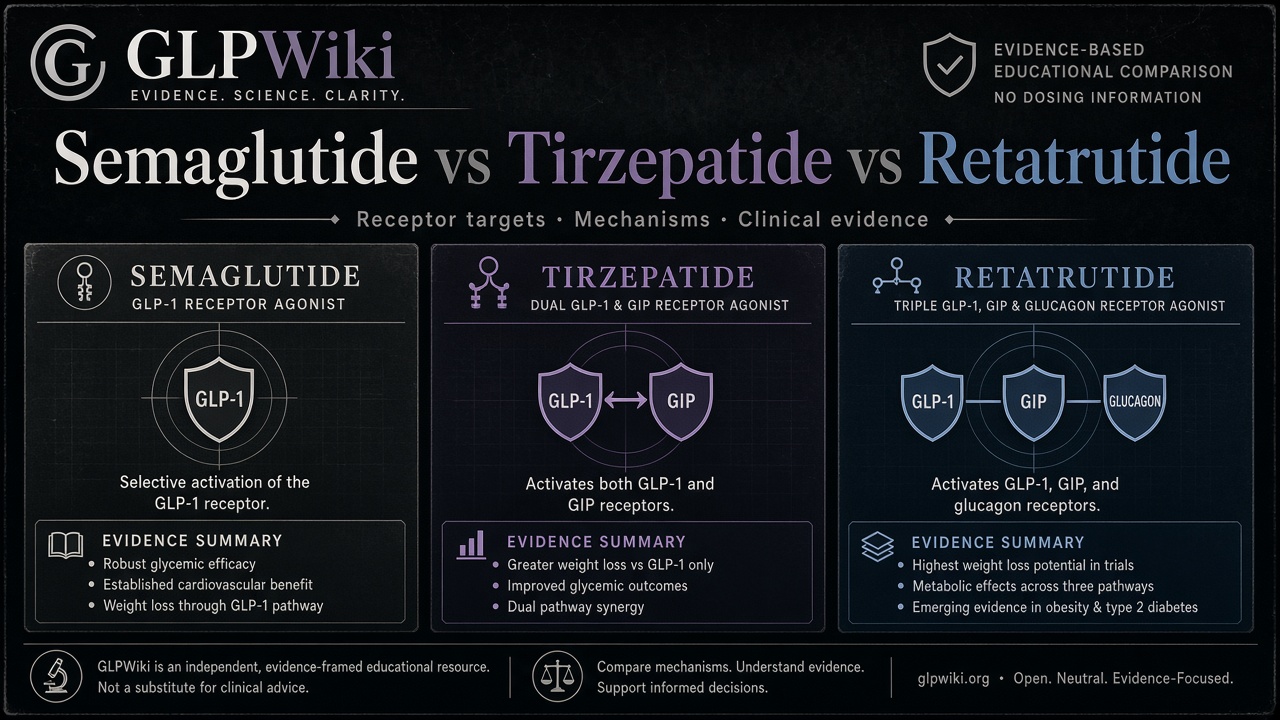
Three incretin-based molecules dominate current obesity and diabetes research and practice. Here is what their trial programmes actually show — and where cross-trial comparisons break down.
UPDATED 09 SEPT 2026 · 14 MIN READ
KEY TAKEAWAYS
- Semaglutide is a single GLP-1 receptor agonist; tirzepatide is a dual GLP-1/GIP receptor agonist; retatrutide is a triple GLP-1/GIP/glucagon receptor agonist — different mechanisms, not just different doses of the same idea.
- In their respective placebo-controlled Phase 3 programmes, mean weight loss trended higher moving from semaglutide (STEP) to tirzepatide (SURMOUNT) to retatrutide (Phase 2), but these are separate trials in different populations, not equivalent head-to-head evidence.
- The direct head-to-head trial SURMOUNT-5 found tirzepatide produced significantly greater mean weight loss than semaglutide in adults with obesity, the strongest real comparative data available between two of the three molecules.
- Semaglutide (SELECT) is the only one of the three with a completed cardiovascular outcomes trial demonstrating reduced major adverse cardiovascular events in people with established cardiovascular disease and overweight or obesity.
- Tirzepatide is FDA-approved for type 2 diabetes (Mounjaro) and chronic weight management (Zepbound); semaglutide is approved for type 2 diabetes (Ozempic, Rybelsus) and chronic weight management (Wegovy); retatrutide remains investigational, with Phase 3 (TRIUMPH) trials ongoing.
- All three drug classes share a common tolerability profile dominated by gastrointestinal effects (nausea, vomiting, diarrhea, constipation), generally most pronounced during dose escalation.
- Reported effects on liver fat and metabolic dysfunction-associated steatotic liver disease appear across all three mechanisms in substudies and dedicated trials, though study designs differ enough that magnitude comparisons should be treated cautiously.
- Cross-trial comparison of percentages is inherently limited by differences in baseline body weight, trial duration, dose selection, population (diabetes vs. no diabetes), and estimand (treatment-policy vs. on-treatment).
Mechanism: one, two, or three receptors
The core distinction between these three molecules is not potency but pharmacology. Semaglutide is a selective agonist at the GLP-1 receptor. Tirzepatide is a single peptide engineered to activate both the GLP-1 receptor and the GIP (glucose-dependent insulinotropic polypeptide) receptor. Retatrutide extends this further, acting as an agonist at GLP-1, GIP, and glucagon receptors simultaneously.
Each added receptor target is thought to contribute a distinct physiological effect. GLP-1 receptor activation slows gastric emptying, promotes satiety signalling in the hypothalamus and brainstem, and enhances glucose-dependent insulin secretion. GIP receptor activation appears to improve insulin sensitivity and may modulate adipose tissue metabolism, though its net contribution to weight loss when combined with GLP-1 agonism is still debated mechanistically even though the clinical effect is well documented. Glucagon receptor agonism increases energy expenditure and hepatic fat oxidation, a property unique to retatrutide among the three.
Why receptor count is not a simple hierarchy
It is tempting to assume that more receptor targets automatically means a stronger drug, but this is an oversimplification. Glucagon receptor agonism, for instance, is counterbalanced in retatrutide's design by concurrent GLP-1 agonism to offset the hyperglycemic tendency of unopposed glucagon signaling. The net clinical effect depends on the balance and relative potency at each receptor, not merely how many receptors are engaged.
The trial programmes at a glance
Each molecule has (or is building) its own dedicated clinical trial programme, generally structured to first establish glycemic efficacy in type 2 diabetes and then chronic weight management in people with or without diabetes.
- Semaglutide: STEP trials (chronic weight management, various populations including adolescents and people with knee osteoarthritis), SUSTAIN trials (type 2 diabetes), SELECT (cardiovascular outcomes).
- Tirzepatide: SURPASS trials (type 2 diabetes), SURMOUNT trials (chronic weight management, including SURMOUNT-5, the head-to-head trial against semaglutide), SUMMIT (heart failure with preserved ejection fraction).
- Retatrutide: a Phase 2 obesity trial (Jastreboff et al., NEJM 2023) and a Phase 2 type 2 diabetes trial, with the Phase 3 TRIUMPH programme underway to evaluate weight management, cardiometabolic risk reduction, and other indications.
Weight-loss outcomes reported in each programme
In STEP 1, adults without diabetes who received semaglutide 2.4 mg weekly for 68 weeks lost a mean of roughly 15% of baseline body weight versus about 2.4% with placebo, on a treatment-policy estimand basis. In SURMOUNT-1, tirzepatide at the highest evaluated dose (15 mg) produced mean weight loss of roughly 21% over 72 weeks, versus about 3% with placebo, in adults with obesity or overweight without diabetes. In the Phase 2 retatrutide obesity trial, the highest dose (12 mg) was associated with mean weight loss of roughly 24% at 48 weeks, the largest mean effect reported for an incretin-based therapy in a randomized trial to date.
These are protocol-condition group means from separate trials with different populations, durations, and dose-escalation schemes — they are not a validated ranking of what any individual would experience, and they must not be read as a three-way head-to-head. The one genuine head-to-head data point is SURMOUNT-5, which compared tirzepatide directly against semagludide within a single randomized trial.
SURMOUNT-5: the actual head-to-head
SURMOUNT-5 randomized adults with obesity or overweight (without diabetes) to tirzepatide (up to 15 mg) or semaglutide (up to 2.4 mg) for 72 weeks. Tirzepatide produced significantly greater mean percentage weight loss than semaglutide in this trial. Because it is a genuine head-to-head, randomized comparison, SURMOUNT-5 carries more weight for a semaglutide-vs-tirzepatide efficacy comparison than juxtaposing STEP 1 and SURMOUNT-1 topline numbers, which is a common but methodologically weak comparison seen in secondary sources.
Glycemic (HbA1c) outcomes in type 2 diabetes
In SUSTAIN trials, semaglutide 1.0–2.0 mg weekly reduced HbA1c by roughly 1.5–1.8 percentage points depending on trial and comparator. In SURPASS trials, tirzepatide reduced HbA1c by roughly 2.0–2.4 percentage points across doses, generally outperforming both placebo and active comparators including semaglutide 1 mg in SURPASS-2, a direct head-to-head within the diabetes programme. Retatrutide's Phase 2 diabetes trial reported HbA1c reductions in a broadly similar range to tirzepatide at higher doses, though this remains a smaller, earlier-stage dataset pending Phase 3 confirmation.
SURPASS-2 is worth flagging separately from SURMOUNT-5: it was conducted in people with type 2 diabetes and used semaglutide 1 mg (not the 2.4 mg weight-management dose), so it answers a different clinical question than SURMOUNT-5's obesity-population comparison at semaglutide 2.4 mg.
Cardiovascular and hepatic data
Semaglutide has the most mature cardiovascular outcomes evidence of the three. SELECT, a dedicated cardiovascular outcomes trial in adults with established cardiovascular disease and overweight or obesity but without diabetes, found that semaglutide 2.4 mg reduced the incidence of a composite endpoint of major adverse cardiovascular events versus placebo. This trial was a major factor in expanding semaglutide's approved indications to include cardiovascular risk reduction in appropriate patients.
Tirzepatide does not yet have a completed general-population cardiovascular outcomes trial of the same design as SELECT, though the SUMMIT trial demonstrated benefit in a specific population with heart failure with preserved ejection fraction and obesity. Dedicated tirzepatide cardiovascular outcomes trials in broader populations are ongoing. Retatrutide's cardiovascular outcomes data is the least mature of the three; cardiometabolic endpoints are being evaluated within the TRIUMPH Phase 3 programme but long-term hard-outcome data is not yet available.
All three mechanisms have shown reductions in liver fat content in substudies or dedicated trials, and interest in these molecules for metabolic dysfunction-associated steatotic liver disease (MASLD) and steatohepatitis (MASH) is active across the class. Semaglutide has been studied in dedicated MASH trials; tirzepatide and retatrutide have shown favorable liver-fat signals in substudies of their broader weight and diabetes trials. Cross-mechanism magnitude comparisons here are especially premature given differing trial designs, imaging methods, and populations.
Tolerability and discontinuation
Across all three molecules, the dominant adverse events are gastrointestinal: nausea, vomiting, diarrhea, and constipation, generally most frequent during dose escalation and decreasing with continued treatment at a stable dose. Discontinuation rates due to adverse events are generally in a broadly similar range across the three trial programmes, though retatrutide's Phase 2 data, being an earlier and smaller dataset, warrants more caution before drawing firm tolerability conclusions relative to the larger, more mature semaglutide and tirzepatide Phase 3 safety databases.
Gallbladder-related events, injection-site reactions, and, less commonly, pancreatitis have been reported across the class in postmarketing and trial data; product labeling for approved agents details specific warnings and contraindications that are beyond the scope of a comparative efficacy summary.
Regulatory and approval status
As of this writing, semaglutide is FDA-approved under multiple brand names for type 2 diabetes (Ozempic, injectable; Rybelsus, oral) and for chronic weight management (Wegovy), and carries an approved cardiovascular risk-reduction indication in eligible adults. Tirzepatide is FDA-approved for type 2 diabetes (Mounjaro) and chronic weight management (Zepbound). Retatrutide has not received regulatory approval for any indication and remains an investigational compound studied under the TRIUMPH Phase 3 programme; timelines for potential approval are not yet public and should not be assumed.
Why cross-trial comparison is not the same as head-to-head evidence
It is common to see tables online stacking STEP, SURMOUNT, and retatrutide Phase 2 topline percentages side by side as though they were arms of a single trial. They were not. Differences in trial duration, dose-escalation schedule, baseline body weight and demographics, background lifestyle intervention intensity, region, and statistical estimand (treatment-policy including people who discontinued, versus on-treatment/per-protocol) can all shift topline numbers independent of the drug's biological effect.
Where a genuine head-to-head randomized trial exists — SURMOUNT-5 for tirzepatide versus semaglutide in obesity, or SURPASS-2 for tirzepatide versus semaglutide in type 2 diabetes — that evidence should be weighted far more heavily than juxtaposed placebo-controlled trial toplines. No completed head-to-head trial yet directly compares retatrutide against either semaglutide or tirzepatide; until TRIUMPH or another dedicated comparative trial reports, any claim about retatrutide being definitively 'stronger' than the other two rests on cross-trial inference, not direct comparative evidence.
Frequently asked questions
- Is retatrutide proven to work better than tirzepatide or semaglutide?
- Not on the basis of head-to-head evidence. Retatrutide's Phase 2 results are numerically larger than semaglutide's and tirzepatide's Phase 3 toplines, but these come from separate trials with different designs. No completed head-to-head trial has directly compared retatrutide against either drug; the ongoing TRIUMPH Phase 3 programme has not yet reported the kind of direct comparison SURMOUNT-5 provided for tirzepatide versus semaglutide.
- What did SURMOUNT-5 actually show?
- SURMOUNT-5 was a randomized, head-to-head trial comparing tirzepatide and semaglutide directly in adults with obesity or overweight without diabetes over 72 weeks. It found tirzepatide produced significantly greater mean percentage weight loss than semaglutide within that single trial population.
- Do all three drugs cause the same side effects?
- The side-effect profiles overlap substantially, with gastrointestinal effects (nausea, vomiting, diarrhea, constipation) being the most commonly reported across all three mechanisms, typically more pronounced during dose escalation. Retatrutide's added glucagon receptor activity is mechanistically distinct, but its Phase 2 tolerability profile has not shown a fundamentally different adverse-event pattern from the other two in what has been published so far.
- Which of the three has cardiovascular outcomes data?
- Semaglutide is the only one of the three with a completed dedicated cardiovascular outcomes trial (SELECT) in a broad population with established cardiovascular disease and overweight or obesity without diabetes. Tirzepatide has shown benefit in the SUMMIT trial in a specific heart failure population, with broader cardiovascular outcomes trials ongoing. Retatrutide's cardiovascular outcomes data is the least mature.
- Are these three approved for the same uses?
- No. Semaglutide and tirzepatide are each approved for type 2 diabetes and chronic weight management, under different brand names and dosing regimens. Retatrutide is investigational and not currently approved for any indication.
- Why can't I just compare STEP 1 and SURMOUNT-1 percentages directly?
- Because they are separate trials with different populations, dose-escalation schedules, trial durations, and statistical estimands. Differences in topline weight-loss percentages between separately conducted trials can reflect trial design differences as much as, or more than, true differences in drug effect. Genuine head-to-head trials like SURMOUNT-5 are needed to make a reliable direct comparison.
- Does GIP or glucagon receptor agonism explain why tirzepatide and retatrutide outperform semaglutide?
- It is a leading hypothesis, but the precise mechanistic contribution of GIP co-agonism to tirzepatide's effect, and of glucagon co-agonism to retatrutide's effect, is still an active area of research. The clinical effect sizes are well documented; the complete mechanistic explanation for why they occur is not yet fully settled.
- Is retatrutide available for people to use now?
- Retatrutide remains an investigational compound under clinical study and is not FDA-approved for any medical indication as of this writing. This guide reports trial data for informational purposes only and does not constitute guidance on obtaining or using investigational compounds.
SOURCES
- 01Once-Weekly Semaglutide in Adults with Overweight or Obesity (STEP 1)— New England Journal of Medicine
- 02Tirzepatide Once Weekly for the Treatment of Obesity (SURMOUNT-1)— New England Journal of Medicine
- 03Tirzepatide versus Semaglutide Once Weekly in Patients with Type 2 Diabetes (SURPASS-2)— New England Journal of Medicine
- 04Tirzepatide versus Semaglutide for Weight Loss in Adults with Obesity (SURMOUNT-5)— JAMA / New England Journal of Medicine
- 05Semaglutide and Cardiovascular Outcomes in Obesity without Diabetes (SELECT)— New England Journal of Medicine
- 06Triple Hormone Receptor Agonist Retatrutide for Obesity — A Phase 2 Trial— New England Journal of Medicine
- 07Efficacy and Safety of Retatrutide in Type 2 Diabetes (Phase 2)— The Lancet
- 08Tirzepatide in Heart Failure with Preserved Ejection Fraction and Obesity (SUMMIT)— New England Journal of Medicine
- 09Mounjaro (tirzepatide) Prescribing Information— U.S. Food and Drug Administration
- 10Wegovy (semaglutide) Prescribing Information— U.S. Food and Drug Administration
EDUCATIONAL REFERENCE ONLY · Not medical advice. Nothing here diagnoses, treats, cures or prevents any disease, and nothing here is a dosing recommendation. Consult a licensed clinician before any treatment decision.