How to read a U-100 insulin syringe
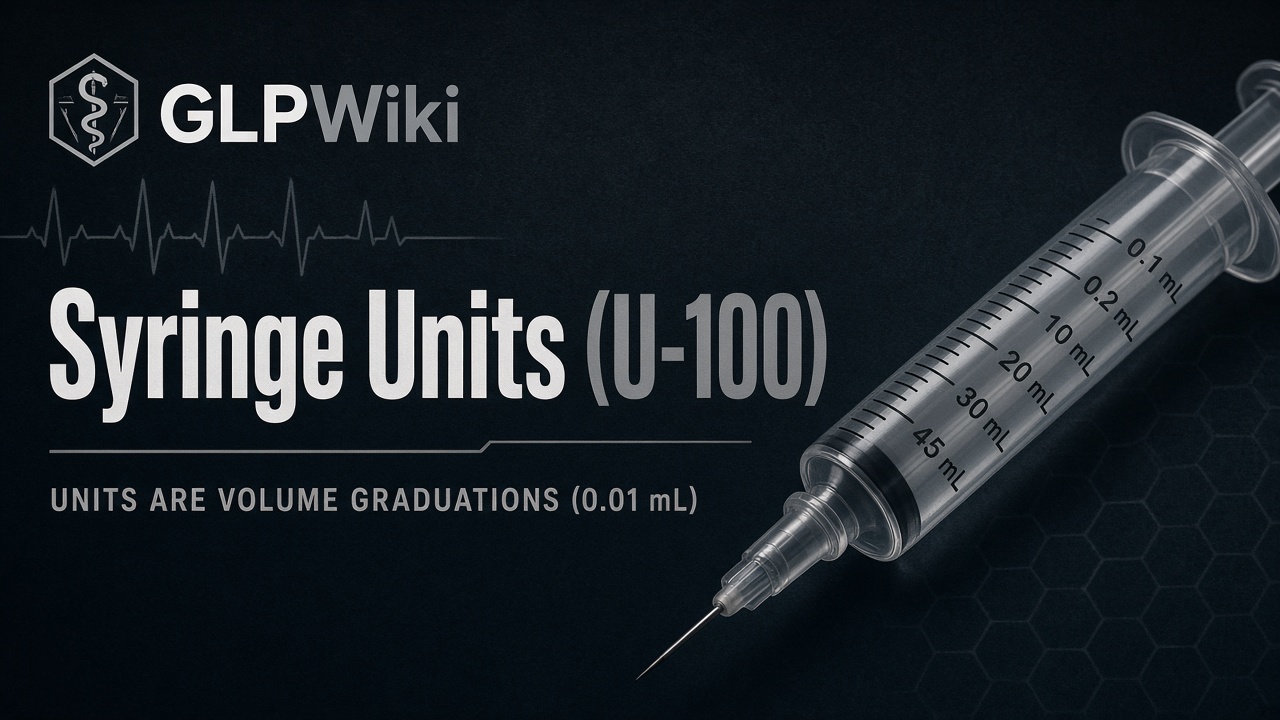
Insulin syringes are graduated in 'units,' not milligrams or millilitres, and mixing those concepts up is one of the most common sources of confusion in research settings. Here is how the markings actually work.
UPDATED 09 SEPT 2026 · 10 MIN READ
KEY TAKEAWAYS
- 'U-100' describes a syringe's calibration scale, not the total volume it holds; U-100 means 100 units are equivalent to 1 mL.
- On a U-100 syringe, 1 unit = 0.01 mL, so a 0.5 mL syringe holds 50 units and a 1 mL syringe holds 100 units.
- U-40 and U-50 syringes use different unit-to-volume ratios and are not interchangeable with U-100 without recalculating.
- The single biggest reading error is confusing 'units' (a volume-based syringe marking) with 'mg' or 'mcg' (a mass-based dose descriptor) — they are not the same kind of quantity.
- Half-unit syringes exist and allow finer-resolution volume measurement, which matters at very small volumes.
- Needle gauge (thickness) and length are separate specifications from the barrel's unit graduations and serve a different purpose.
- This guide is for laboratory and research literacy; it does not instruct anyone to draw up or administer a dose.
What 'U-100' actually means
Syringes designed for insulin are labelled with a scale such as U-100, U-50, or U-40. This number describes the concentration convention the syringe's markings assume, not the syringe's physical capacity. Specifically, 'U-100' means the scale is calibrated so that 100 units equals 1 millilitre of solution — a convention that originated with U-100 insulin, the standard concentration of most modern insulin products in the United States and many other countries.
Because the U-100 scale is built around 100 units per mL, the arithmetic simplifies neatly: 1 unit = 1/100 mL = 0.01 mL. This is true regardless of the syringe's total barrel capacity — a 0.3 mL U-100 syringe, a 0.5 mL U-100 syringe, and a 1 mL U-100 syringe all share the same conversion factor of 0.01 mL per unit; they simply differ in how many total units fit in the barrel (30, 50, and 100 units respectively).
The U-40 and U-50 scales use different conversion factors: on a U-40 syringe, 40 units equals 1 mL (so 1 unit = 0.025 mL), and on a U-50 syringe, 50 units equals 1 mL (so 1 unit = 0.02 mL). These are legacy or region-specific scales and are far less common today than U-100 in most contexts, but they still appear, particularly for veterinary insulin products, which is why checking the printed scale on any given syringe is essential before interpreting its markings.
Reading the barrel graduations
A syringe barrel has a series of printed line markings running along its length. On a standard U-100 1 mL syringe, these lines are typically marked in increments of 2 units for the labelled numbers, with smaller unmarked tick lines in between representing single units. Reading the plunger's position against these lines — at eye level, using the top ring of the plunger's rubber stopper as the reference point in most conventions — is how a volume is determined.
Smaller-capacity syringes (such as 0.3 mL or 0.5 mL U-100 syringes) are often used specifically because their overall barrel is shorter, meaning each unit occupies a larger physical distance along the barrel and is therefore easier to read precisely than the same unit distance on a longer 1 mL barrel. This is a matter of measurement resolution, not a difference in what a 'unit' means.
Half-unit syringes
Some syringes are manufactured with half-unit graduations, marking every 0.5 units rather than every full unit. These are used when finer volume resolution is needed than a whole-unit syringe can provide, since a whole-unit syringe cannot precisely indicate a volume that falls between two adjacent unit lines.
Units are a volume convention, not a mass
The most consequential misreading is treating 'units' on a syringe as though they were milligrams or micrograms. A unit, in the U-100/U-50/U-40 sense, is purely a marking of volume tied to a specific concentration convention — it says nothing on its own about how much peptide mass is in that volume unless the concentration of the solution in the syringe is also known.
This means the same syringe reading (say, 20 units) corresponds to different mg or mcg amounts depending entirely on the concentration of whatever solution has been drawn into it. Two vials reconstituted to different concentrations will require different unit readings to deliver the same mass-based amount, and confusing 'units on the barrel' with 'mg of substance' is a category error that can lead to significant miscalculation.
For this reason, anyone converting between a syringe's unit markings and a mass-based figure needs to know the actual concentration (mg/mL or mcg/mL) of the solution being measured, and should perform the unit ⇄ mL ⇄ mg conversion explicitly rather than assuming a direct correspondence.
- Units describe volume on a defined scale (U-100, U-50, U-40), not mass.
- 1 unit on a U-100 syringe = 0.01 mL, always, regardless of what solution is in it.
- Converting units to a mass-based amount requires knowing the solution's concentration.
- Never assume 'units' and 'mg' or 'mcg' are interchangeable terms.
Needle gauge and length basics
Needle gauge refers to the diameter of the needle and is expressed as a number that runs inversely to actual thickness — a higher gauge number (for example, 29G or 31G) indicates a thinner needle, while a lower gauge number (for example, 25G) indicates a thicker one. Needle length is typically specified in millimetres or fractions of an inch (for example, 4 mm, 6 mm, 8 mm, or 12.7 mm/half-inch).
Gauge and length are independent of the barrel's unit graduations — a syringe's needle specification says nothing about the volume scale printed on its barrel, and the two pieces of information need to be read separately from the packaging or the syringe body itself.
A units-to-millilitres reference discussion
Because U-100 syringes are calibrated at 0.01 mL per unit, a short mental reference table can help build intuition: 10 units = 0.1 mL, 25 units = 0.25 mL, 50 units = 0.5 mL, and 100 units = 1.0 mL. These are pure volume conversions and hold regardless of what is in the syringe.
GLPWiki's syringe draw calculator, available at /calculators#syringe, is built to perform the fuller version of this conversion — taking a target amount (in mg or mcg), a known solution concentration, and the syringe's unit scale, and returning the corresponding unit-mark reading. Using a calculator to check arithmetic, rather than relying purely on memorized reference points, reduces the risk of a units/mass mix-up.
Scope of this guide
This guide explains how syringe markings work as a measurement convention, for laboratory and research literacy. It does not instruct anyone to draw up, measure, or administer a dose, and it is not medical advice. Any real-world handling of syringes or needles should be supervised by a licensed clinician or qualified professional and should follow all applicable local regulations regarding sharps handling and disposal.
Frequently asked questions
- What does U-100 mean on a syringe?
- It means the syringe's printed scale assumes 100 units are equivalent to 1 millilitre, so 1 unit equals 0.01 mL on that scale.
- Are units the same as milligrams?
- No. Units are a volume-based marking tied to a defined scale (U-100, U-50, U-40); milligrams are a mass measurement. Converting between the two requires knowing the solution's concentration.
- How many mL is 50 units on a U-100 syringe?
- 50 units on a U-100 syringe equals 0.5 mL, since the U-100 scale is fixed at 0.01 mL per unit.
- What is the difference between U-100 and U-40 syringes?
- On a U-100 syringe, 100 units equal 1 mL (0.01 mL per unit); on a U-40 syringe, 40 units equal 1 mL (0.025 mL per unit). They are calibrated to different conventions and are not directly interchangeable.
- What is a half-unit syringe used for?
- A half-unit syringe has graduations at every 0.5 units instead of every whole unit, allowing finer volume resolution when smaller increments need to be distinguished.
- Does needle gauge affect the syringe's unit markings?
- No. Needle gauge and length are separate specifications describing the needle itself; they do not change or relate to the barrel's printed unit scale.
- Where can I check a units-to-mL or units-to-mg conversion?
- GLPWiki's syringe draw calculator at /calculators#syringe is designed to perform these conversions for educational reference.
SOURCES
- 01Insulin syringes and needles: how to use them— MedlinePlus (U.S. National Library of Medicine)
- 02How to Give an Insulin Injection— American Diabetes Association
- 03Selecting insulin syringes and needles— U.S. Food and Drug Administration
- 04Needle gauge and length reference— PubMed (Journal of Diabetes Science and Technology)
- 05Insulin concentration standardization (U-100)— PubMed
EDUCATIONAL REFERENCE ONLY · Not medical advice. Nothing here diagnoses, treats, cures or prevents any disease, and nothing here is a dosing recommendation. Consult a licensed clinician before any treatment decision.