Syringe and sharps safety: single use, never sharing, and how disposal works
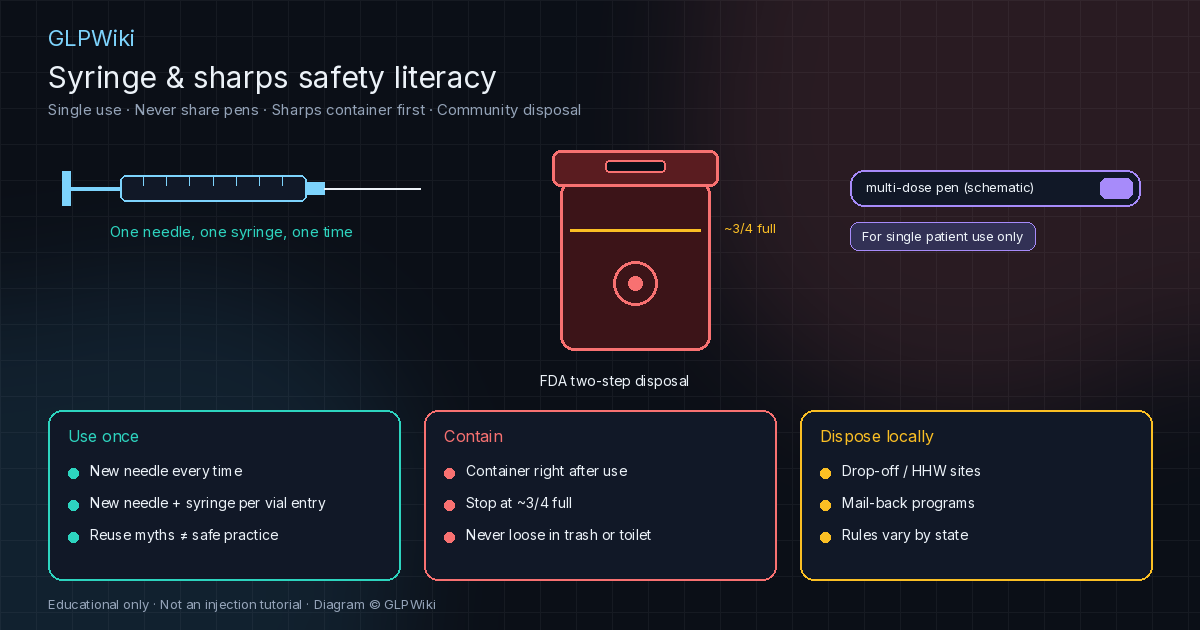
GLPWiki already explains syringe scales (insulin vs tuberculin, U-100 units) and aseptic vial handling. This companion covers what happens around the sharp itself: why needles and syringes are single use, why multi-dose pens are labeled for a single patient even when the needle is changed, what the evidence says about needle reuse, and how FDA's two-step consumer disposal flow works. Educational and YMYL-safe only — not an injection-technique tutorial, not a dosing guide, and local disposal rules vary.
UPDATED 05 OCT 2026 · 11 MIN READ
KEY TAKEAWAYS
- FDA defines sharps as devices with points or edges that can puncture or cut skin — needles, syringes, lancets, auto-injectors and pens, infusion sets, and connection needles.
- CDC injection-safety guidance treats needles and syringes as single use: use once, then discard. Reuse can contaminate medicine and spread infections such as hepatitis B, hepatitis C, and possibly HIV.
- Every entry into a multi-dose vial uses a new needle and a new syringe; reused equipment can contaminate the vial for every later draw.
- In 2015 FDA required multi-dose diabetes pen devices (insulin and other injectable diabetes medicines, including some GLP-1 receptor agonist pens) to carry “For single patient use only.” Pens are never shared, even if the needle is changed.
- Needle reuse is not a harmless shortcut: a 2013 clinical study linked needle reuse with lipohypertrophy risk, and product Instructions for Use warn a reused needle can block.
- FDA's consumer disposal flow has two steps: put used sharps in a sharps disposal container immediately, then dispose of the container by your community's guidelines when it is about three-quarters full.
- Never put loose sharps in household trash or recycling, and never flush them. If someone else's used sharp sticks you, wash the area and seek medical care right away.
Why this companion exists (and what it is not)
Peptide and incretin conversations online spend a lot of time on numbers — units, milliliters, concentrations — and very little on the sharp object that delivers them. Yet the most common practical safety questions are about the device: Can I reuse a needle? Is it okay to share a pen if I change the needle? Where does a used syringe go?
GLPWiki's insulin-vs-tuberculin and U-100 syringe guides cover measurement scales, and the aseptic-technique guide covers vial contamination and beyond-use dating. This page fills the remaining gap: single-use and single-patient rules, the reuse evidence, and FDA's consumer sharps disposal flow.
Nothing here teaches injection technique, injection sites, needle selection for a person, or how much of anything to draw. Those belong with a licensed clinician and the specific product's Instructions for Use.
What counts as a “sharp”
FDA's consumer sharps page defines sharps as a medical term for devices with sharp points or edges that can puncture or cut skin. Its examples include hollow needles, syringes, lancets (fingerstick devices), auto-injectors including insulin and epinephrine pens, infusion sets, and connection needles used for home hemodialysis.
That list matters for GLP-1 readers because pen injectors count. A prefilled pen with an attached or screw-on pen needle is a sharp, and its used needle belongs in a sharps container — not in a drawer, a bag, or the kitchen trash.
- Needles and syringes are sharps.
- Pens and auto-injectors are sharps.
- Lancets and infusion sets are sharps.
- Pet-medication needles follow the same disposal rules (FDA).
Single use vs single patient: two different rules
“Single use” and “single patient” sound alike but govern different things. CDC's injection-safety guidance says a needle and a syringe should each be used only once and then discarded. It also says a new needle and syringe should be used every time a multi-dose vial is accessed, because reused equipment can contaminate the medicine with germs that can then spread to others.
“Single patient” is the rule for multi-dose pens. On February 25, 2015, FDA announced it was requiring multi-dose diabetes pen devices and their packaging to display “For single patient use only,” with matching warnings in prescribing information, Medication Guides, and Instructions for Use. The reason: blood can be present in a pen after use, so sharing a pen between people can transmit bloodborne pathogens even when the needle is changed. Product labeling approved that year, such as the Lantus label, states plainly that pens must never be shared between patients, even if the needle is changed.
Reporting on the 2015 action listed affected products that included GLP-1 receptor agonist pens of that era (for example, Victoza and Byetta) alongside insulins. The literacy point for today's readers is general: if a pen holds more than one dose, treat it as belonging to one person only, and read the current label for the exact product in front of you.
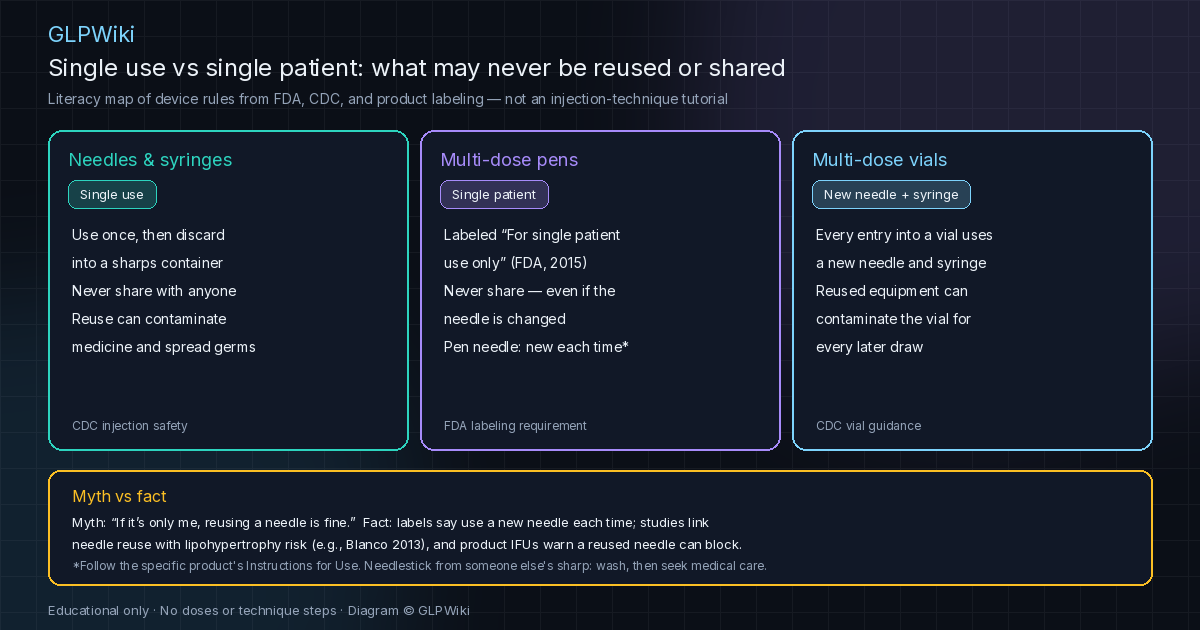
- Needle or syringe: use once, then discard.
- Multi-dose vial: new needle and new syringe for every entry.
- Multi-dose pen: one person only, even with a new needle.
- Current product labeling beats any forum rule of thumb.
Needle reuse myths, and what the evidence says
The most common myth is “If it's only me, reusing my own needle is fine.” Sharing is the infection-transmission problem, but reuse by one person is not risk-free either. Product Instructions for Use for pen-injected medicines tell users not to reuse needles; one 2015 insulin pen IFU, for example, warns that a reused needle could block and affect the dose delivered.
Clinical literature points the same way. In a 2013 study of 430 insulin-injecting outpatients in Spain, Blanco and colleagues found lipohypertrophy (thickened, lumpy fatty tissue at injection sites) in nearly two-thirds of patients, strongly tied to not rotating sites and also related to needle reuse, with risk rising significantly when needles were used more than five times. That study was in insulin users, so it is a caution about device habits, not a measured result for any peptide product.
The 2016 FITTER expert recommendations on insulin delivery (Frid and colleagues, Mayo Clinic Proceedings) also flagged that inappropriate disposal of used sharps poses a risk of infection with bloodborne pathogens, and that proper training, disposal strategies, and safety devices can reduce it.
- Myth: reuse is fine if it's only you. Labels say use a new needle each time.
- Myth: changing the needle makes a pen shareable. FDA says never share pens.
- Myth: a used needle is safe once it's capped. Disposal still means a sharps container.
- Evidence on reuse comes mostly from insulin users; don't overgeneralize numbers.
FDA's two-step sharps disposal flow
FDA recommends a two-step process for consumers using sharps at home, at work, and while traveling. Step 1: place all needles and other sharps in a sharps disposal container immediately after use. This reduces needlesticks, cuts, and punctures from loose sharps. Keep the container out of reach of children and pets.
FDA-cleared sharps containers are generally available from pharmacies, medical supply companies, health care providers, and online. They are made of puncture-resistant plastic with leak-resistant sides and bottom and a tight-fitting, puncture-resistant lid. If an FDA-cleared container is not available, FDA notes a heavy-duty plastic household container, such as a laundry detergent container, can be used as an alternative.
Do not overfill: FDA says overfilling increases needlestick risk, so when the container is about three-quarters full, move to Step 2. Do not reuse sharps disposal containers. When leaving home, FDA suggests carrying a small travel-size sharps container in case other options are not available.
Step 2: dispose of the full container according to community guidelines. Depending on where you live, options can include drop boxes or supervised collection sites (doctors' offices, hospitals, pharmacies, health departments, medical waste facilities, police or fire stations), household hazardous waste collection sites, mail-back programs for certain FDA-cleared containers, and residential special-waste pickup services.
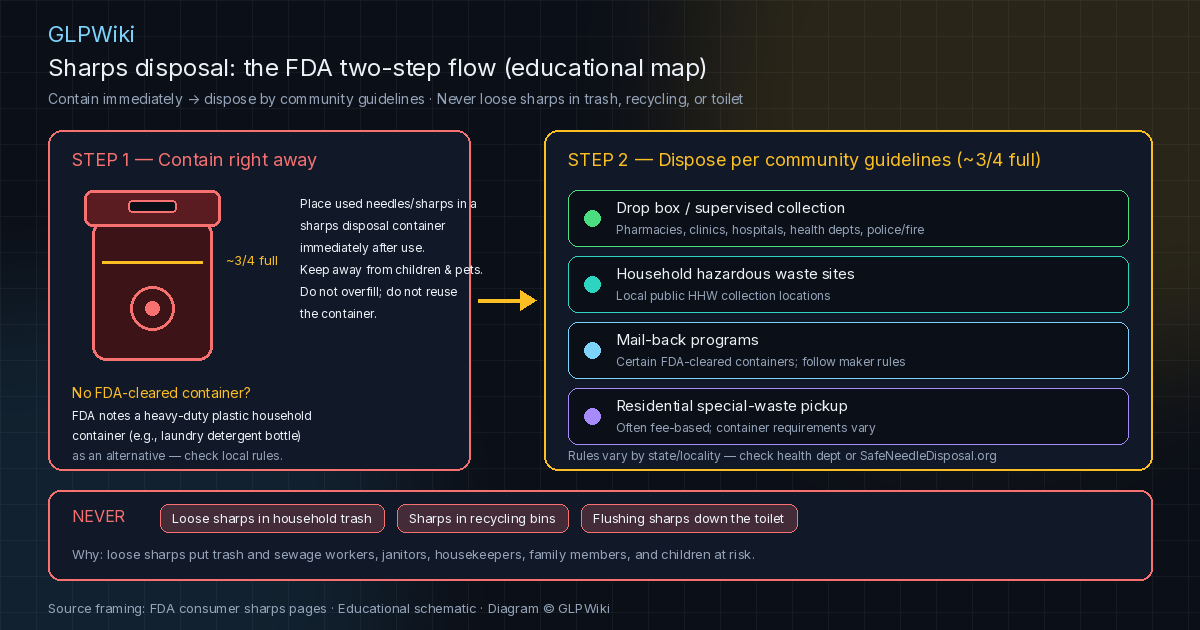
- Container immediately after use.
- Stop at about three-quarters full.
- Don't reuse the container.
- Then follow local disposal options.
What never to do with a used sharp
FDA is explicit: never place loose needles and other sharps in household or public trash cans or recycling bins, and never flush them down the toilet. Loose sharps put trash and sewage workers, janitors, housekeepers, household members, and children at risk of injury and infection.
Sharps rules are local. EPA notes that medical waste is primarily regulated by state environmental and health departments, so whether a sealed container can go out with household trash, how it must be labeled, and which drop-off programs exist depends on your state and town. The nonprofit Safe Needle Disposal (SafeNeedleDisposal.org, 1-800-643-1643, the contact FDA lists) offers state-by-state information.
If you're stuck by someone else's used needle
FDA's consumer guidance for an accidental stick from another person's used needle or sharp has two steps: wash the exposed area right away with water and soap or use a skin disinfectant such as rubbing alcohol or hand sanitizer, then seek immediate medical attention by calling your physician or local hospital.
FDA says to follow the same steps if blood or other body fluids get in your eyes, nose, or mouth, or on your skin. Time matters for medical evaluation, so don't wait to see whether symptoms appear.
Traveling with syringes and sharps (U.S. air travel)
TSA's What Can I Bring pages say unused syringes are allowed in carry-on bags when accompanied by injectable medication and must be declared at the checkpoint, and that used syringes are allowed when transported in a sharps disposal container or similar hard-surface container. The final decision rests with the TSA officer.
FDA adds that labeled medicines (with the medicine type and manufacturer, or a pharmacy label) and a letter from your doctor can make screening easier. Check TSA's current pages before each trip, since rules change. Temperature and storage questions are covered separately in the peptide travel and cold-chain guide.
Approved, compounded, and research-labeled contexts
Sharps safety rules don't change based on what is in the syringe. Whether a reader is using an FDA-approved prefilled pen, a compounded product dispensed by a pharmacy, or is reading about research-labeled vials, the same physical facts apply: needles and syringes are single use, pens are single patient, and used sharps go into a container and then a local disposal channel.
What does change is the documentation. Approved pens come with Instructions for Use and labeling that spell out device handling. Compounded and research-labeled materials often lack that layer, which is one more reason GLPWiki separates approved and investigational status in every guide. Nothing here endorses any product or source.
What this page deliberately does not do
No injection technique, injection sites, site rotation schedules, needle length or gauge recommendations for a person, or drawing instructions.
No doses, schedules, stacks, compounding recipes, or reconstitution instructions for any product.
No supplier, pharmacy, telehealth, or disposal-vendor recommendations.
For questions about a specific medicine or device, use its current official labeling and ask a licensed clinician or pharmacist. Device problems and adverse events for marketed products can be reported through FDA MedWatch.
Where to read next
For syringe scales and the tenfold-error problem, read insulin-vs-tuberculin-syringes and syringe-units-u100. For vial contamination, beyond-use dates, and single-dose vs multi-dose vial labels, read aseptic-technique-peptide-vials.
For temperature excursions and travel storage, see peptide-travel-cold-chain and peptide-storage-and-handling. For why approved labeling is the source of truth, see how-to-read-fda-peptide-labeling.
Frequently asked questions
- Can I reuse my own needle or syringe?
- Safety guidance says no. CDC treats needles and syringes as single use, and product Instructions for Use tell users to attach a new needle each time. A 2013 study in insulin users linked needle reuse with lipohypertrophy risk. Follow your product's labeling and ask a clinician or pharmacist about your device.
- Can two people share a GLP-1 or insulin pen if they change the needle?
- No. In 2015 FDA required multi-dose diabetes pen devices to be labeled “For single patient use only” because blood can be present in a pen after use. Labeling for those products says pens must never be shared, even if the needle is changed.
- What should I use if I don't have an FDA-cleared sharps container?
- FDA notes that a heavy-duty plastic household container, such as a laundry detergent container, can be used as an alternative. Check your state or local guidelines for labeling and disposal rules.
- When is a sharps container full?
- FDA says to follow your community's disposal guidelines when the container is about three-quarters full, because overfilling increases needlestick risk. Do not reuse sharps disposal containers.
- Can I throw used needles in the trash or flush them?
- Never as loose sharps. FDA says loose needles and other sharps should never go in household or public trash or recycling, and should never be flushed. Whether a sealed container can go in household trash depends on your state and local rules.
- Where can I drop off a full sharps container?
- Options vary by location and can include pharmacies, doctors' offices, hospitals, health departments, police or fire stations, household hazardous waste sites, mail-back programs, and special-waste pickup. Your local health department or SafeNeedleDisposal.org can tell you what's available.
- What should I do if I'm stuck by someone else's used needle?
- FDA says to wash the area right away with soap and water or a skin disinfectant such as rubbing alcohol or hand sanitizer, and then seek immediate medical attention by calling your physician or local hospital.
- Does this page teach how to inject peptides?
- No. This page covers single-use rules, reuse evidence, and disposal literacy only. It does not provide injection technique, sites, doses, or product recommendations. Those belong with a licensed clinician and the product's official labeling.
SOURCES
- 01Safely Using Sharps (Needles and Syringes) at Home, at Work and on Travel— U.S. Food and Drug Administration
- 02Best Way to Get Rid of Used Needles and Other Sharps— U.S. Food and Drug Administration
- 03Safe Injection Practices and Your Health— Centers for Disease Control and Prevention
- 04FDA requires label warnings to prohibit sharing of multi-dose diabetes pen devices among patients (FDA Safety Communication, Feb 25, 2015), PSNet record— Agency for Healthcare Research and Quality (AHRQ) PSNet
- 05Citing Disease Transmission Risk, FDA to Require Stronger Labels on Some Diabetes Injectors (2015 report listing affected products)— Regulatory Affairs Professionals Society (RAPS)
- 06Lantus (insulin glargine) supplemental approval and labeling, 2015: pens must never be shared between patients, even if the needle is changed— U.S. Food and Drug Administration (Drugs@FDA)
- 07Toujeo (insulin glargine) 2015 labeling and Instructions for Use: do not share pens; do not re-use needles— U.S. Food and Drug Administration (Drugs@FDA)
- 08Blanco M, et al. Prevalence and risk factors of lipohypertrophy in insulin-injecting patients with diabetes. Diabetes Metab. 2013;39(5):445-53. PMID 23886784— PubMed
- 09Frid AH, et al. New Insulin Delivery Recommendations. Mayo Clin Proc. 2016;91(9):1231-55. PMID 27594187— PubMed
- 10Medical Waste: who regulates medical waste— U.S. Environmental Protection Agency
- 11Safe Needle Disposal: state-by-state home sharps disposal information— Safe Needle Disposal (nonprofit)
- 12Used Syringes — What Can I Bring?— Transportation Security Administration
- 13Unused Syringes — What Can I Bring?— Transportation Security Administration
EDUCATIONAL REFERENCE ONLY · Not medical advice. Nothing here diagnoses, treats, cures or prevents any disease, and nothing here is a dosing recommendation. Consult a licensed clinician before any treatment decision.