Insulin vs tuberculin syringes: markings, mix-up risks, and scale literacy
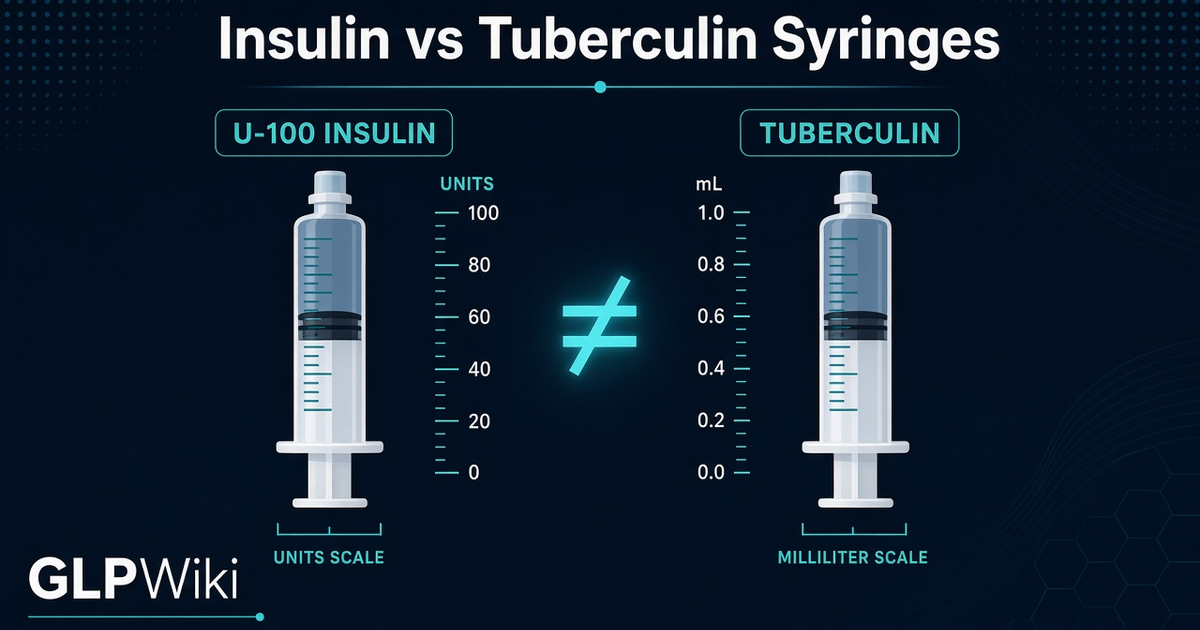
Insulin syringes and tuberculin syringes can look alike but speak different measurement languages — units versus milliliters. This literacy guide explains how to identify each scale, why misreads appear in patient-safety advisories, and how that framing relates to peptide calculator assumptions — without doses, product picks, or administration instructions.
UPDATED 23 SEPT 2026 · 12 MIN READ
KEY TAKEAWAYS
- Insulin syringes labeled for U-100 use are graduated in insulin units; tuberculin syringes are graduated in milliliters (mL).
- The same physical volume can be read as different numbers depending on which scale you are looking at — identify the scale before interpreting any mark.
- Pennsylvania Patient Safety Authority advisories document tenfold-class insulin overdoses when TB syringes were mistaken for insulin syringes, including misreading a 0.5 mL mark as "5 units."
- FDA labeling expectations for insulin syringes include barrel graduations in units and language such as "For use with U-100 insulin only."
- FDA alerts on compounded injectable semaglutide cite confusion among milliliters, milligrams, and "units," plus wrong-size syringes, as contributors to dosing errors — literacy about scales matters.
- GLPWiki's live syringe-units-u100 guide and syringe-draw calculator teach U-100 unit arithmetic; this page is the companion that prevents wrong-syringe scale mix-ups.
- This page is educational only: no dosing recommendations, no product picks, no DIY self-injection instructions, and no conversion tables meant as medical orders.
Why syringe-type literacy matters for peptide readers
Peptide discussions constantly invoke small volumes. A reader moving from a concentration formula to a physical syringe has to translate an abstract number — milliliters — into a mark on a barrel. That translation is only safe when the scale on the barrel is the scale the arithmetic assumed. Two common small syringes, the insulin syringe and the tuberculin syringe, look similar at a glance but are graduated in different measurement languages.
GLPWiki's calculator pages already stress one boundary: the tools compute what you type and never suggest an amount. This page protects a different boundary — the identity of the measuring device itself. Unit arithmetic done perfectly against the wrong scale is still wrong. Scale literacy is the step that comes before any arithmetic.
This is not a niche concern. Published patient-safety advisories and a federal alert about compounded injectable semaglutide both describe real-world confusion between syringe scales, and between units, milliliters, and milligrams. Understanding how these errors arise is a reading skill, not a clinical skill — and it requires no dosing knowledge whatsoever.
Two scales, two languages: units vs milliliters
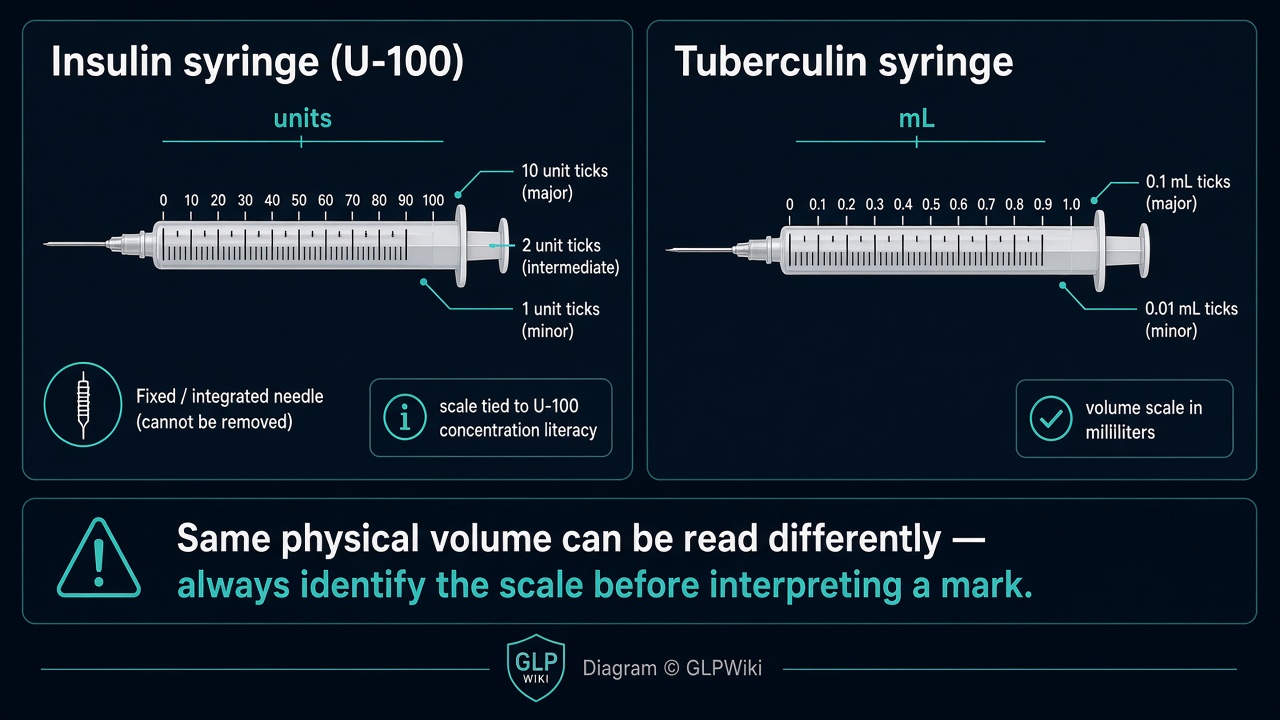
A U-100 insulin syringe is graduated in insulin units. On a standard 1 mL U-100 barrel, the full scale runs from 0 to 100 units, with major ticks typically every 10 units, intermediate ticks every 2 units, and minor ticks every 1 unit on finer versions. The word "unit" here is tied to the U-100 insulin concentration convention — 100 units of insulin activity per milliliter — which is why the scale is meaningful only in that context. Many insulin syringes also have a fixed, integrated needle that cannot be removed, a design feature that distinguishes them physically as well as numerically.
A tuberculin syringe is graduated in milliliters. A typical 1 mL tuberculin barrel shows major ticks every 0.1 mL and minor ticks every 0.01 mL. Nothing on the barrel references insulin units at all; it is a plain volume scale, the same language used by pipettes and oral syringes.
The critical point is that the two scales describe the same physical barrel volume with different numbers. Half a milliliter is 0.5 on the tuberculin scale and 50 on the U-100 insulin scale. Neither marking is wrong — but interpreting one scale's number as if it belonged to the other is a category of error with a documented history. The comparison below shows both scales side by side.
How mix-ups create tenfold-class measurement errors
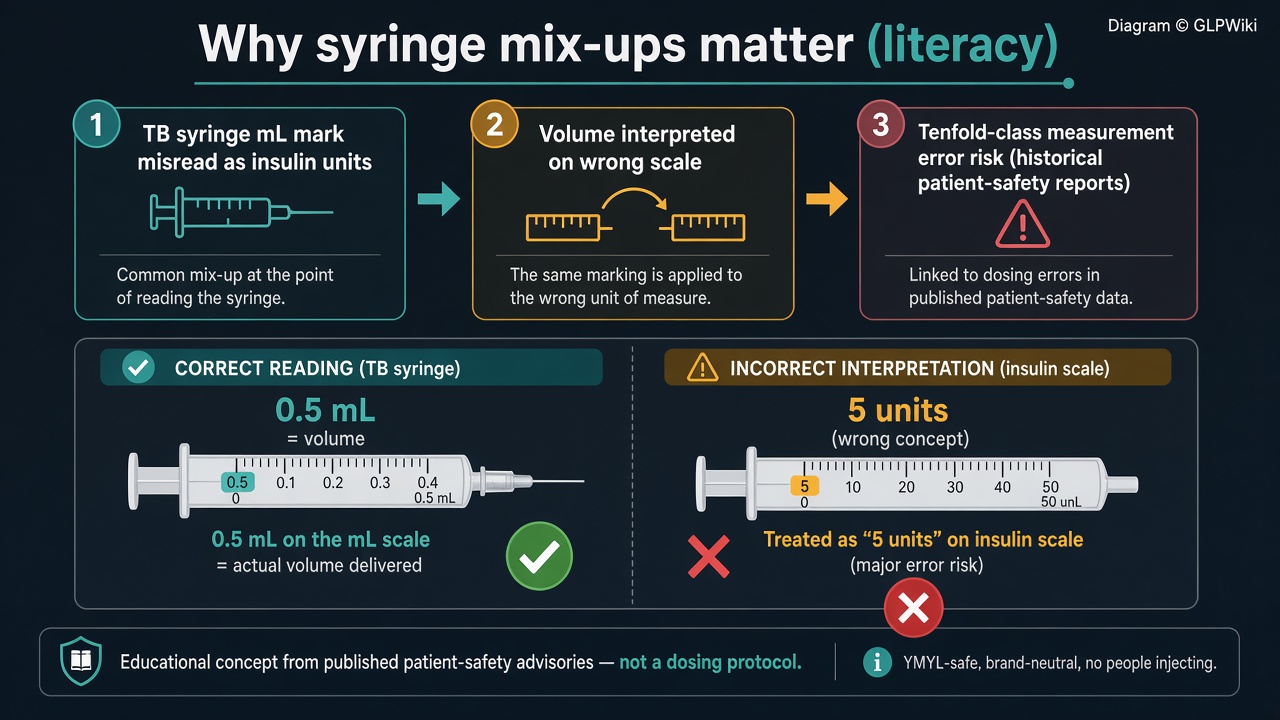
The Pennsylvania Patient Safety Authority has published advisories describing exactly this failure mode. In one analysis, a tuberculin syringe was mistaken for an insulin syringe and the 0.5 mL marking was read as "5 units," contributing to a tenfold-class insulin overdose. A follow-up advisory — pointedly titled around the confusion being "spotted again" — documented the error recurring even after awareness efforts, underscoring that visual similarity between devices defeats good intentions.
The pathway is mechanically simple. A person picks up the wrong syringe, reads a number that is genuinely printed on the barrel, and interprets that number in the wrong measurement language. Because 0.1 mL corresponds to 10 units on a U-100 scale, the magnitude of the misinterpretation is not a rounding error — it is an order of magnitude. That is why patient-safety literature treats syringe identity, not just arithmetic, as a checkpoint.
The diagram below traces the sequence: a tuberculin mL mark is misread as insulin units, the volume is interpreted on the wrong scale, and the result is a tenfold-class measurement error of the kind described in historical patient-safety reports. It is an educational reconstruction of a published error pathway, not a depiction of any administration procedure.
FDA alerts: milliliters, milligrams, and units confusion
FDA has alerted health care providers, compounders, and patients about dosing errors associated with compounded injectable semaglutide products. The alert describes patients and providers drawing incorrect volumes, and explicitly cites confusion among different units of measurement — milliliters, milligrams, and "units" — as a contributing factor, alongside use of inappropriate syringe sizes. Some reported errors involved patients taking many times the intended amount, with resulting hospitalizations.
Two features of that alert matter for literacy. First, the confusion is not hypothetical or historical — it appears in adverse-event reports about products people are using now. Second, the alert separates concepts this site also keeps separate: mass (milligrams), volume (milliliters), and concentration-dependent readings (units on a U-100 scale) are three different quantities, and no mark on a syringe converts between them by itself.
FDA's device-side expectations reinforce the same point. The agency's premarket notification guidance for piston syringes describes labeling expectations for insulin syringes — including barrel graduations in units and limiting statements such as "For use with U-100 insulin only" — precisely so that the intended measurement language is unambiguous. A syringe's printed scale and label statements are part of its safety design, and reading them is the first verification step.
What GLPWiki's U-100 calculator assumption means
GLPWiki's syringe-draw calculator converts a draw volume in milliliters into syringe units using a stated multiplier: 100 for a U-100 syringe, 50 for U-50, and 40 for U-40. That multiplier is not a property of medicine in general — it is a property of the graduation scale printed on a particular device. If the syringe in hand is a tuberculin syringe, none of those unit multipliers apply, because the barrel is already in milliliters.
This is why the calculators print their assumptions and never prefill a desired dose. The arithmetic is only meaningful once the device's scale is identified, and identifying the scale is a reading task this page exists to support. A "50" produced by the calculator means the 50 mark on a U-100 barrel — it does not mean 0.5 on a tuberculin barrel, 50 mg, or 50 IU.
It also bears repeating, because the words collide in casual writing: insulin "units" on a U-100 syringe are volume graduations tied to a specific concentration convention, and International Units (IU) are a measure of biological activity defined per substance. Neither converts into the other by a fixed factor, and neither converts into milligrams without concentration information. GLPWiki's iu-vs-mcg-vs-units guide covers that boundary in full.
Approved vs research-labeled vs compounded
Syringe literacy sits downstream of a more fundamental question: what is the product, and under what oversight was it made? An FDA-approved medicine arrives with approved labeling — a package insert and, where relevant, Instructions for Use — that specifies the presentation, the delivery device where one is supplied, and the measurement language of its dosing. Drugs@FDA is the public index for verifying that a named product is actually approved and for locating its official documents.
Compounded products occupy a different category. They are not FDA-approved, their labeling is not standardized in the same way, and — as the FDA semaglutide alert illustrates — the measurement instructions accompanying them have been implicated in unit-confusion errors. Research-use-only materials are a third category: they are not medicines at all, are not labeled for human use, and no patient-facing measurement framework applies to them.
The literacy rule that survives every category is the same: read the scale on the actual device, read the label of the actual product, and never let a number travel from one measurement language into another unexamined. Where anything is unclear, the authoritative references are the product's official labeling and a qualified healthcare professional or pharmacist — not a forum post, a seller listing, or a calculator output.
How this page fits with other GLPWiki guides
This guide is the device-identity companion to several existing pages. The syringe-units-u100 guide teaches what a U-100 graduation measures; this page teaches how to confirm the syringe in front of you actually has that graduation. The peptide dosing math and BAC water guides cover concentration and dilution arithmetic; this page covers why that arithmetic is only valid once the measurement scale is verified. The aseptic technique guide addresses contamination pathways; this one addresses measurement-language pathways.
Together these pages share a single editorial stance: GLPWiki explains the concepts and the published safety record so readers can interpret labels, devices, and official documents accurately. It does not provide doses, protocols, reconstitution recipes, or product recommendations, and nothing on this page should be read as instruction to acquire or use any device or product.
Scope and disclaimer
This page summarizes published patient-safety advisories, FDA device-labeling guidance, and an FDA alert about compounded products for educational purposes. It is not medical advice, not a training program in injection technique, and not a substitute for the labeling of a specific approved product or for guidance from a licensed healthcare professional.
GLPWiki sells nothing, links to no suppliers, and recommends no products, doses, schedules, or devices. If a question concerns a real medicine and a real person, the correct sources are the current official labeling — reachable through Drugs@FDA for approved medicines — and the prescribing clinician or dispensing pharmacist.
Frequently asked questions
- What is the main difference between an insulin syringe and a tuberculin syringe?
- The scale. A U-100 insulin syringe is graduated in insulin units (typically 0–100 on a 1 mL barrel), while a tuberculin syringe is graduated in milliliters (typically 0–1.0 mL with 0.01 mL minor ticks). Insulin syringes also commonly have a fixed, integrated needle. The barrels can hold the same physical volume while speaking different measurement languages.
- Can the same volume show different numbers on the two syringes?
- Yes. Half a milliliter reads as 0.5 on a tuberculin scale and as 50 on a U-100 insulin scale. Both readings describe the same physical volume, which is exactly why the scale must be identified before any mark is interpreted — a correct number read in the wrong language is still a wrong interpretation.
- Why do patient-safety reports focus on this mix-up?
- Because the Pennsylvania Patient Safety Authority documented real tenfold-class insulin overdoses from exactly this error — including a 0.5 mL tuberculin marking being read as "5 units" — and later reported the confusion recurring. The magnitude of the error is an order of magnitude, not a rounding slip, which is why syringe identity is treated as a safety checkpoint.
- What did FDA say about units confusion with compounded semaglutide?
- FDA alerted providers, compounders, and patients to dosing errors with compounded injectable semaglutide, citing confusion among milliliters, milligrams, and "units," as well as inappropriate syringe sizes, as contributing factors. Some reported errors involved many times the intended amount and led to hospitalizations. The alert is a reminder that mass, volume, and unit-scale readings are three distinct quantities.
- What does the U-100 assumption in GLPWiki's calculator mean?
- The syringe-draw calculator multiplies a draw volume in mL by 100 (U-100), 50 (U-50), or 40 (U-40) to produce syringe units. That multiplier describes the graduation scale of a specific device — it only applies if the syringe in hand actually carries that scale. On a tuberculin syringe graduated in mL, no unit multiplier applies at all.
- Are insulin "units" the same as International Units (IU)?
- No. Insulin units on a U-100 syringe are volume graduations tied to the U-100 concentration convention (100 units per mL). International Units are a measure of biological activity defined separately for each substance. The two do not convert into each other by any fixed factor, and neither converts into milligrams without concentration information.
- Does this guide tell me which syringe to buy or how to inject?
- No. This page is educational literacy only: it explains scales, published error reports, and regulatory framing. It contains no dosing, no product recommendations, no purchasing advice, and no administration instructions. Questions about a real medicine belong with its official labeling and a licensed healthcare professional or pharmacist.
SOURCES
- 01Overdoses Caused by Confusion Between Insulin and Tuberculin Syringes— Pennsylvania Patient Safety Authority — Patient Safety Advisory (2004)
- 02Spotted Again: Confusion Between Insulin and Tuberculin Syringes— Pennsylvania Patient Safety Authority — Patient Safety Advisory (2005)
- 03Guidance on the Content of Premarket Notification [510(k)] Submissions for Piston Syringes— U.S. Food and Drug Administration
- 04FDA Alerts Health Care Providers, Compounders and Patients of Dosing Errors Associated with Compounded Injectable Semaglutide Products— U.S. Food and Drug Administration
- 05ISMP Guidelines for Safe Subcutaneous Insulin Use in Adults (2017)— Institute for Safe Medication Practices
- 06Drugs@FDA: FDA-Approved Drugs— U.S. Food and Drug Administration
- 07PubMed — biomedical literature search— U.S. National Library of Medicine
EDUCATIONAL REFERENCE ONLY · Not medical advice. Nothing here diagnoses, treats, cures or prevents any disease, and nothing here is a dosing recommendation. Consult a licensed clinician before any treatment decision.