Aseptic technique for peptide vials: multi-dose literacy, contamination pathways, and beyond-use concepts
Multi-dose vials are designed for more than one withdrawal — which also means contamination risk can travel back into the remaining contents. This literacy guide explains aseptic technique concepts, single-dose vs multi-dose labeling, and beyond-use framing from CDC injection-safety education — without doses, reconstitution recipes, or administration protocols.
UPDATED 22 SEPT 2026 · 13 MIN READ
KEY TAKEAWAYS
- Aseptic technique is a contamination-prevention mindset used within trained practice; it is not a do-it-yourself injection lesson.
- CDC describes single-dose vials as intended for one patient during one procedure, while multi-dose vials are labeled for repeated withdrawals under controlled conditions.
- A multi-dose preservative may limit growth of some bacteria, but it does not make a vial contamination-proof and does not protect against viruses.
- CDC injection-safety guidance uses a 28-day beyond-use date after first puncture for a multi-dose vial unless the manufacturer states another opened-vial date; the labeled expiration date is never extended.
- Contamination can enter through a reused needle or syringe, an inadequately disinfected septum, hands or surfaces, or use near an immediate patient-treatment area.
- Approved, investigational, compounded, and research-use materials have different labeling, evidence, and oversight; a multi-dose-looking vial does not erase those distinctions.
- This guide is educational only and provides no dose, reconstitution recipe, injection procedure, product recommendation, or individualized instruction.
Why aseptic vial literacy matters
A vial can look closed and orderly while still depending on a chain of contamination controls. Once a stopper is punctured, the remaining contents can be affected by what contacts the stopper, needle, syringe, hands, work surface, or nearby care environment. Multi-dose vial literacy therefore begins with understanding pathways: contamination can move toward the vial as well as away from it.
This topic complements GLPWiki's explanations of bacteriostatic water, reconstitution vocabulary, storage, and syringe-unit arithmetic, but it answers a different question. Arithmetic describes relationships among mass, volume, and concentration. Aseptic technique addresses microbial contamination risk. Correct math cannot establish sterility, and a visually clean vial cannot establish that safe handling controls were followed.
CDC injection-safety materials are written primarily for healthcare settings and trained personnel. GLPWiki summarizes those concepts so readers can understand labels and professional guidance. It does not convert them into a home injection procedure or imply that reading an article substitutes for licensed clinical training.
What aseptic technique means — and what this guide does not teach
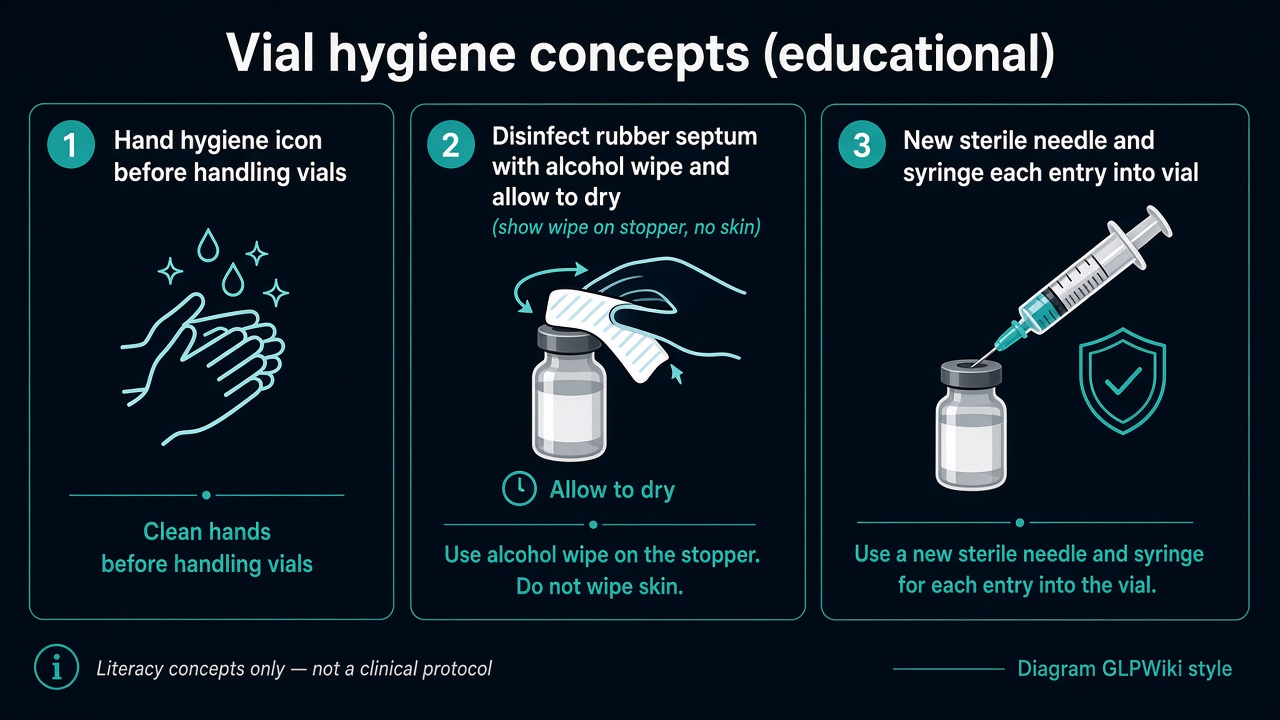
Aseptic technique is the collection of practices intended to prevent microorganisms from entering sterile products, critical device parts, or vulnerable sites. In vial handling, the principle includes clean hands, protection of sterile items, disinfection of the vial septum, use of a new sterile needle and syringe for every entry, and separation from contaminated surfaces or activities. The objective is risk reduction across the whole handling chain, not reliance on one isolated gesture.
Aseptic does not mean that an ordinary room, package exterior, hand, or work surface is sterile. It also does not mean that an alcohol wipe repairs earlier contamination or that a preservative neutralizes every organism. A visible sequence can appear careful while an unnoticed contact has compromised a critical surface, which is why professional standards treat asepsis as a system.
The illustration below names broad hygiene concepts only. It does not show injection, prescribe an administration sequence, or provide a substitute for the exact Instructions for Use of an approved medicine and instruction from a qualified healthcare professional.
Single-dose and multi-dose labels are not interchangeable
A single-dose or single-use vial is intended for use in one patient during one procedure. It generally lacks an antimicrobial preservative intended to support repeated entries. Remaining contents are not converted into a multi-dose supply merely because liquid remains visible, because a stopper can be punctured again, or because the container has been refrigerated.
A multi-dose vial is labeled to contain more than one dose and commonly includes an antimicrobial preservative. That designation permits repeated withdrawals only within the product's labeling and applicable infection-control practices. It does not mean unlimited punctures, indefinite storage, sharing without controls, or immunity from contamination.
The package label and current official product information are therefore evidence, not decoration. Readers should verify the exact finished product rather than inferring container type from vial size, cap color, a seller description, or a photograph. For an FDA-approved medicine, Drugs@FDA helps confirm approval and locate official documents for the named product.
How contamination can travel into a multi-dose vial
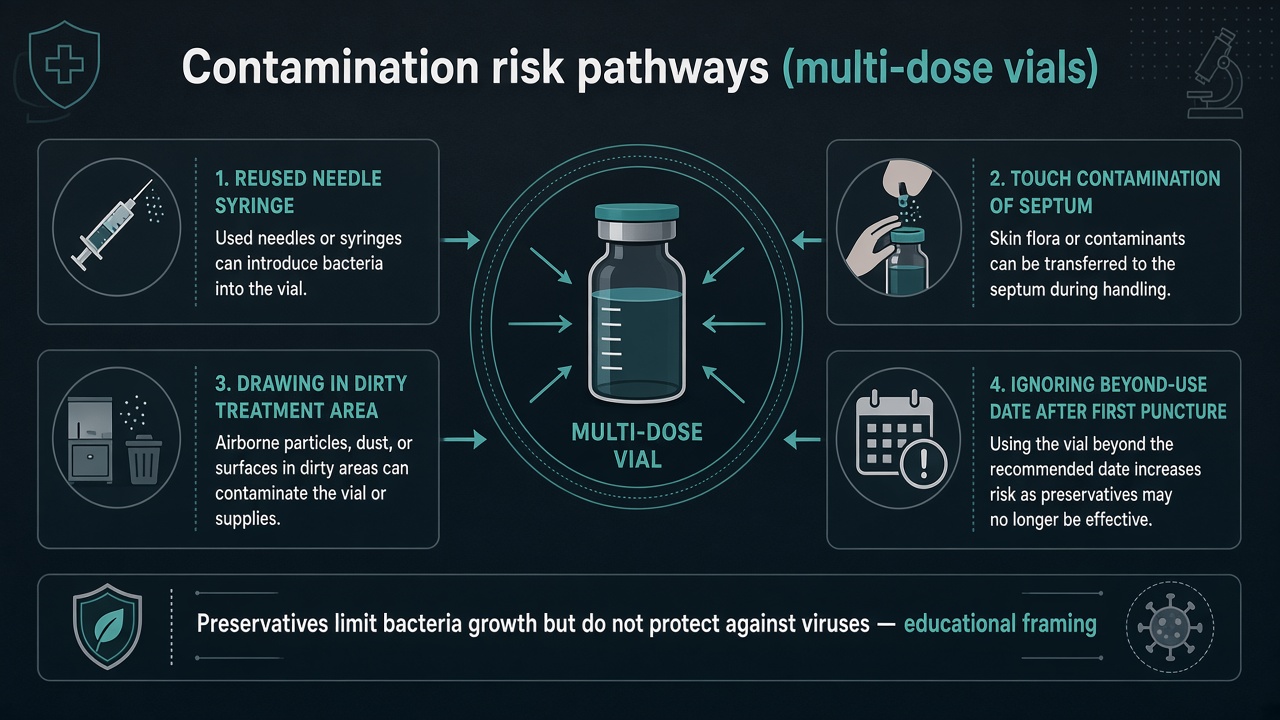
A reused needle or syringe can carry blood, microorganisms, or other material back into a vial. CDC's core injection-safety rule is that needles and syringes are single-use devices: changing only the needle does not make a used syringe safe for another entry. Outbreak investigations have connected unsafe injection practices with transmission of bloodborne pathogens and bacterial infections.
The rubber septum is another critical interface. Touching it after disinfection, failing to disinfect it, or allowing it to contact a contaminated item can create a route into the vial. Hands, preparation surfaces, nearby waste, splashes, and airborne particles in an immediate treatment area can also contribute risk. The fact that contamination is microscopic is precisely why appearance alone is not a reliable check.
Healthcare guidance generally favors preparing medication in a clean area separated from sinks, used equipment, and immediate patient-care activity. This is a systems concept, not a recipe for creating a sterile home workspace. Facility policy, professional standards, product labeling, and trained judgment remain controlling in clinical settings.
Beyond-use dates, first puncture, and labeled expiration
CDC injection-safety education states that a multi-dose vial should generally be dated and discarded within 28 days after first puncture unless the manufacturer specifies a different opened-vial date. That 28-day framework is not a chemical-stability promise and does not override shorter manufacturer instructions, evidence of contamination, storage excursions, damaged packaging, or facility policy.
The printed expiration date and an opened-vial beyond-use date answer different questions. The expiration date applies to the unopened product under labeled conditions. A beyond-use date limits use after a particular event such as first puncture. Opening a vial never extends the manufacturer's expiration date, so whichever applicable limit arrives first governs.
Compounded preparations may carry pharmacy-assigned beyond-use information under a different legal and quality framework. Research-use material may not have patient-use labeling at all. Do not transfer CDC's general multi-dose-vial framing into proof that an unapproved or research-use vial is suitable for administration.
What preservatives and bacteriostatic water can — and cannot — mean
An antimicrobial preservative is included in some multi-dose presentations to inhibit the growth of certain bacteria after repeated entries. It is a risk-control feature, not sterilization after the fact. CDC materials emphasize that preservatives do not provide complete protection, do not reliably protect against viruses, and cannot justify reuse of a needle or syringe.
Bacteriostatic water is a labeled diluent containing a preservative. The word bacteriostatic means that the preservative can inhibit growth of susceptible bacteria under defined conditions; it does not mean that the container kills every microorganism or makes an unknown preparation sterile. Compatibility, diluent choice, storage, and any reconstitution instructions are product-specific questions.
GLPWiki's BAC-water and reconstitution pages explain terminology and arithmetic without recommending a ratio or procedure. This page adds the contamination-control context: neither correct concentration math nor the presence of a preservative establishes identity, sterility, approval, or suitability for human use.
Approved, investigational, compounded, and research-use contexts
An FDA-approved finished medicine has a reviewed application, approved labeling, manufacturing controls, and product-specific instructions. Readers can use Drugs@FDA to verify the exact product and obtain current FDA-posted documents. General vial literacy must yield to those exact instructions when they differ.
An investigational product is being studied and has not become approved merely because a trial, clinic, or article discusses it. A compounded preparation is not an FDA-approved finished drug and does not inherit an approved product's labeling or evidence. FDA has separately warned about risks associated with unapproved GLP-1 products, including quality, labeling, and dosing concerns.
A research-use-only vial belongs to laboratory context and does not carry approved human-use instructions. Similar packaging, a sterile claim, a certificate, or the phrase multi-dose does not bridge these categories. Status should be verified before interpreting any storage, handling, or quality statement.
- FDA-approved medicine: verify the exact application and current official labeling.
- Investigational product: interpret only within its authorized study and evidence context.
- Compounded preparation: not an FDA-approved finished product; rely on lawful, preparation-specific labeling and qualified professional guidance.
- Research-use-only material: laboratory context, not approved patient-use labeling.
How this guide fits the GLPWiki reference system
Use the vial-label guide to identify fields such as product name, lot, concentration, storage language, and single-dose or multi-dose designation. Use the approved-versus-investigational guide to classify regulatory status, and the COA guide to understand why an analytical document does not by itself establish sterility or lawful patient use.
The lyophilization guide explains the dry cake and why appearance cannot prove quality. The storage guide separates general stability concepts from product-specific labeled conditions. The reconstitution and syringe-unit pages cover terminology and arithmetic without suggested inputs. Together, these pages keep identity, status, math, storage, and contamination control separate rather than allowing one claim to stand in for all the others.
That separation is especially important when online discussions collapse a vial photograph, concentration calculation, and assumption of sterility into one conclusion. Each claim needs its own evidence path and its own limits.
Scope and limits of this guide
This page explains infection-control vocabulary, label categories, contamination pathways, and general CDC beyond-use framing. It does not teach injection, reconstitution, compounding, medication preparation, needle handling, or self-administration. It provides no dose, concentration, volume, schedule, equipment selection, product pick, or individualized advice.
For an approved medicine, follow its current official labeling and Instructions for Use and seek instruction from a licensed clinician or pharmacist. Healthcare professionals should follow applicable law, facility policy, infection-control standards, and product-specific requirements. Suspected unsafe injection practices, quality defects, or adverse events should be directed to the appropriate healthcare and public-health channels.
Frequently asked questions
- What does aseptic technique mean for a vial?
- It means using a coordinated set of contamination-prevention practices around sterile supplies, critical surfaces, and medication preparation. It is a professional safety framework, not proof that a vial is sterile and not a do-it-yourself injection lesson.
- What is the difference between a single-dose and multi-dose vial?
- A single-dose vial is intended for one patient during one procedure. A multi-dose vial is labeled for repeated withdrawals and commonly contains a preservative, but it still requires strict handling controls and has an opened-vial time limit.
- Does every multi-dose vial have a 28-day beyond-use date?
- CDC uses 28 days after first puncture as the general framework unless the manufacturer states another opened-vial date. Product-specific labeling, shorter limits, the printed expiration date, storage conditions, and signs of compromise can require earlier disposal.
- Does a preservative protect a vial from viruses?
- No. Preservatives may limit growth of some bacteria but do not make a vial contamination-proof and do not provide reliable protection against viruses or bloodborne pathogen transmission.
- Is it safe to reuse a syringe if the needle is changed?
- No. CDC states that both the needle and syringe are single-use. A used syringe can be contaminated even when its needle is replaced, and it must not re-enter a vial.
- Does this guide explain how to inject or prepare a peptide vial?
- No. It gives no self-injection steps, reconstitution procedure, dose, volume, schedule, or equipment recommendation. Use current official instructions and qualified clinical guidance for an approved medicine.
- How does bacteriostatic water relate to aseptic technique?
- Bacteriostatic water contains a preservative that inhibits growth of some bacteria. It does not sterilize contaminated material or replace aseptic controls, and whether it is an appropriate diluent is product-specific.
SOURCES
- 01Clinical Safety: Preventing Unsafe Injection Practices— Centers for Disease Control and Prevention
- 02Injection Safety for Healthcare Providers— Centers for Disease Control and Prevention
- 03Safe Injection Practices Checklist— Centers for Disease Control and Prevention
- 04Questions and Answers on Current Good Manufacturing Practice Regulations: Production and Process Controls— U.S. Food and Drug Administration
- 05FDA's Concerns with Unapproved GLP-1 Drugs Used for Weight Loss— U.S. Food and Drug Administration
- 06Drugs@FDA— U.S. Food and Drug Administration
- 07Unsafe injection practices and disease transmission— PubMed
- 08Acute hepatitis C virus infections attributed to unsafe injection practices— Centers for Disease Control and Prevention
- 09PubMed— U.S. National Library of Medicine
EDUCATIONAL REFERENCE ONLY · Not medical advice. Nothing here diagnoses, treats, cures or prevents any disease, and nothing here is a dosing recommendation. Consult a licensed clinician before any treatment decision.