Bacteriostatic water ratios explained
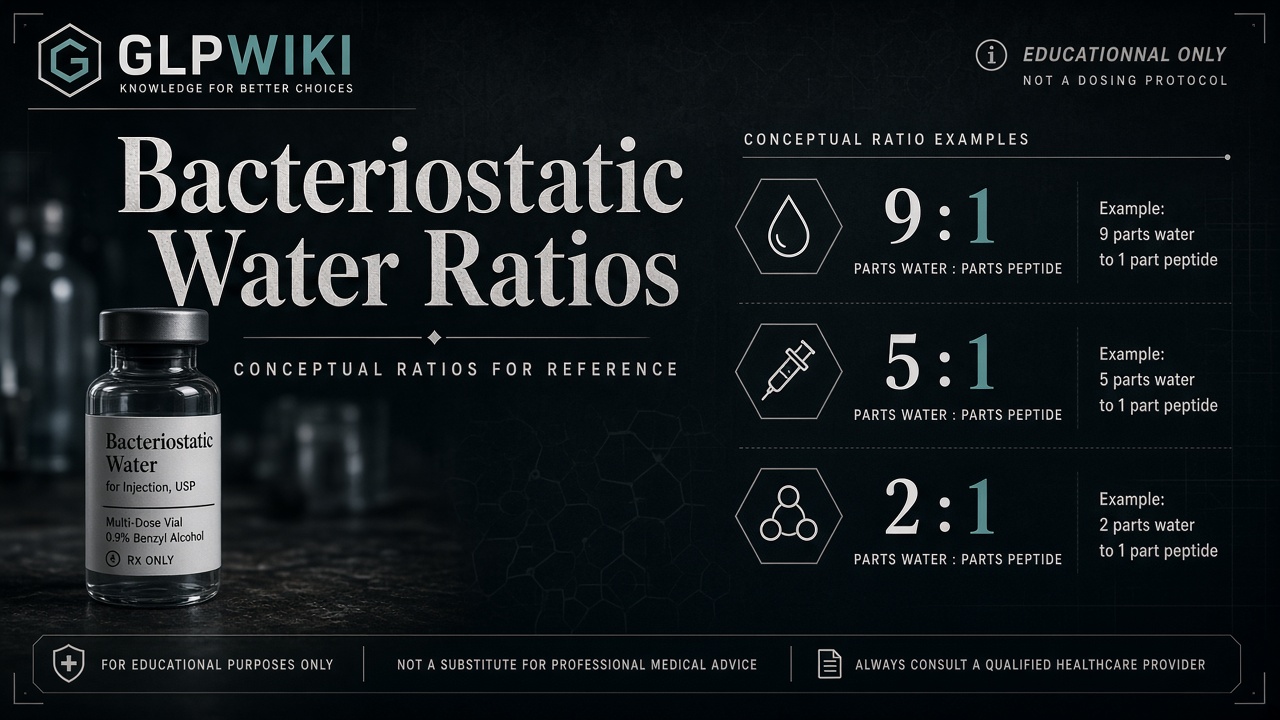
Choosing how much bacteriostatic water to add to a vial does not change the total amount of peptide it contains — it changes the concentration, and with it, how readable the resulting draw volumes are. Here is the reasoning behind common ratio choices.
UPDATED 09 SEPT 2026 · 11 MIN READ
KEY TAKEAWAYS
- Bacteriostatic Water for Injection, USP contains 0.9% benzyl alcohol as a preservative, distinguishing it from preservative-free sterile water for injection.
- The diluent volume added to a vial determines the resulting concentration (mg/mL); it does not change the total peptide mass present in the vial.
- A 'ratio' in this context describes diluent volume relative to a fixed vial mass (e.g., a 5 mg vial with 1 mL, 2 mL, or 3 mL of diluent), each producing a different concentration.
- Choosing a ratio that produces a concentration where hypothetical draw volumes fall in an easily read part of a syringe's barrel can reduce proportional measurement error.
- Benzyl alcohol is contraindicated for use in neonates according to FDA labelling, reflecting a documented, substance-specific safety consideration rather than a general contraindication for all uses.
- Reconstituted solutions have documented stability and storage considerations described on manufacturers' certificates of analysis, and these are separate from the dilution-ratio arithmetic itself.
- This article explains ratio arithmetic and general handling concepts only; it does not recommend a dose, ratio, or protocol for any individual.
What bacteriostatic water is
Bacteriostatic Water for Injection, USP is a pharmaceutical-grade water product that includes 0.9% benzyl alcohol as an added preservative. According to its FDA-approved prescribing information, this preservative is included specifically to inhibit the growth of bacteria once a multi-dose vial has been punctured, which is why bacteriostatic water is commonly selected as a diluent when a reconstituted solution is intended to be drawn from more than once over a period of time.
This distinguishes it from Sterile Water for Injection, USP, which contains no preservative at all. The FDA label for sterile water for injection specifies that, once its container is entered, it is generally intended for single use, because nothing in the solution itself suppresses microbial growth if the vial is reused across multiple sessions.
Both products are otherwise water for injection meeting United States Pharmacopeia purity standards — free of pyrogens and particulate matter to the degree specified by USP monographs — and the choice between them for any specific peptide is a product- and protocol-specific decision that should follow the relevant manufacturer's documentation and a qualified professional's guidance, not a generic assumption that one is always preferable to the other.
Diluent volume sets concentration, not total drug amount
A point that is easy to state but sometimes misunderstood in practice: the amount of diluent added to a vial does not change how much peptide is in the vial. A vial labelled 5 mg contains 5 mg of peptide whether 1 mL, 2 mL, or 10 mL of bacteriostatic water is added to it. What changes is the concentration — how much of that fixed 5 mg is present in each millilitre of the resulting solution.
This follows directly from the concentration equation: concentration (mg/mL) = total vial mass (mg) ÷ diluent volume (mL). Adding more diluent to the same vial mass produces a lower (more dilute) concentration; adding less diluent produces a higher (more concentrated) one. Neither choice increases or decreases the underlying quantity of peptide available from that vial — it only redistributes that fixed quantity across a larger or smaller total liquid volume.
Framed as a 'ratio,' this is simply describing the relationship between a fixed vial mass and a chosen diluent volume. A '1 mL ratio' for a 5 mg vial means 1 mL of diluent was added to that 5 mg of peptide, yielding 5 mg/mL; a '2 mL ratio' for the same vial means 2 mL was added, yielding 2.5 mg/mL, and so on. The word 'ratio' here is doing the same work as it would in a recipe — it describes proportions, not absolute amounts.
Illustrative ratio tables
The following tables show, purely as arithmetic illustrations, how different diluent volumes change the resulting concentration for vials of a few common labelled masses. These are examples of the underlying math, not recommendations about which ratio to select for any specific situation.
5 mg vial
With 1 mL of diluent: concentration = 5 mg ÷ 1 mL = 5 mg/mL.
With 2 mL of diluent: concentration = 5 mg ÷ 2 mL = 2.5 mg/mL.
With 3 mL of diluent: concentration = 5 mg ÷ 3 mL ≈ 1.67 mg/mL.
10 mg vial
With 1 mL of diluent: concentration = 10 mg ÷ 1 mL = 10 mg/mL.
With 2 mL of diluent: concentration = 10 mg ÷ 2 mL = 5 mg/mL.
With 5 mL of diluent: concentration = 10 mg ÷ 5 mL = 2 mg/mL.
2 mg vial
With 1 mL of diluent: concentration = 2 mg ÷ 1 mL = 2 mg/mL.
With 2 mL of diluent: concentration = 2 mg ÷ 2 mL = 1 mg/mL.
Why some ratios are chosen for readability
One practical consideration that appears repeatedly in reconstitution literature and calculator tools is choosing a diluent volume so that hypothetical draw volumes land on a part of a syringe barrel that is easy to read accurately, rather than requiring an estimate between very fine markings. Standard U-100 syringes are typically graduated in single-unit (0.01 mL) increments, and reading a volume near that resolution limit carries proportionally larger measurement error than reading a volume that falls well within the marked range.
For instance, using the earlier 5 mg vial example, if a hypothetical protocol description called for a small mass relative to the vial's total content, reconstituting with a smaller diluent volume (producing a higher concentration) would correspond to an even smaller — and therefore harder to read precisely — draw volume. Reconstituting with a larger diluent volume (producing a lower concentration) would correspond to a larger, more easily read draw volume for that same hypothetical mass. This is a matter of arithmetic and measurement practice, not a recommendation about what mass or ratio to use.
This is also why reconstitution calculators, including the one hosted at GLPWiki's /calculators, commonly allow a user to enter a target draw volume and a vial's labelled mass and solve backward for the diluent volume that would make the two align. This reverse calculation is standard algebra — dividing the total vial mass by the desired concentration — rather than a novel technique, but doing it by hand for several hypothetical scenarios is where a calculator saves time and reduces the chance of arithmetic slips.
Benzyl alcohol considerations
Benzyl alcohol, the preservative in bacteriostatic water, has a well-documented safety profile in adults and older children when used as a preservative in injectable products at the concentrations found in bacteriostatic water for injection. However, the FDA-approved label for bacteriostatic water for injection specifically states that it is contraindicated for use in newborns, reflecting historical case reports and pharmacological data associating benzyl alcohol exposure in neonates with a serious adverse syndrome sometimes referred to in the literature as 'gasping syndrome,' related to neonates' immature capacity to metabolize benzyl alcohol.
This is an example of a safety consideration that is specific to a particular population (neonates) and a particular route/context, rather than a general statement that benzyl alcohol is unsafe in all uses — the same FDA label describes standard use in adult and pediatric (non-neonatal) contexts under appropriate clinical supervision. It illustrates why generic diluent choices should always be checked against the specific product's labelling and a qualified professional's input rather than treated as interchangeable defaults.
Separately from the neonatal contraindication, some peptide manufacturers' technical literature notes that benzyl alcohol may not be appropriate as a diluent for certain specific peptides, independent of the neonatal issue, due to potential effects on that peptide's stability in solution. This is another reason product-specific reconstitution instructions — rather than a one-size-fits-all convention — should guide diluent selection in any real-world laboratory or clinical setting.
Stability and storage implications
Once a lyophilised peptide has been reconstituted into a liquid solution, its stability window is generally documented as shorter than that of the sealed, dry powder — reconstituted peptide solutions are typically described in manufacturers' certificates of analysis as needing refrigerated storage and use within a defined number of days to weeks, though the specific figures vary substantially by peptide and formulation and should always be checked against that product's own documentation rather than assumed from a general rule.
The choice of diluent ratio does not, by itself, change how long a reconstituted solution remains stable — stability is governed primarily by the peptide's own chemical properties, temperature, light exposure, and the presence or absence of a preservative, rather than by the specific concentration chosen. However, documenting the concentration clearly on the vial label at the time of reconstitution (along with the date) is a widely recommended practice, since a mislabeled or undocumented vial can lead to confusion or miscalculation weeks later when the original ratio has been forgotten.
Because bacteriostatic water's preservative supports safer use of a vial across multiple entries over its labelled stability window, a diluent ratio decision is often made alongside a storage plan — for example, considering how many entries into the vial are anticipated over its usable life, and returning it to appropriate refrigerated storage between uses, consistent with the relevant certificate of analysis.
Legal and sterility constraints
Bacteriostatic water and sterile water for injection are regulated pharmaceutical products in most jurisdictions, and their manufacture, sale, and use are subject to relevant national drug regulations — in the United States, for example, both are FDA-approved products with defined prescribing information. Sourcing, storage, and use of any injectable diluent should comply with applicable local laws and be undertaken only under appropriate professional or licensed supervision.
From a sterility standpoint, once a vial's rubber septum is punctured, its contents are exposed to a theoretical risk of microbial ingress each time a needle passes through it. This is precisely the risk that bacteriostatic water's preservative is designed to mitigate over a vial's labelled multi-dose life, but it does not eliminate the importance of aseptic technique — disinfecting the septum before each entry, using new sterile needles, and avoiding unnecessary vial entries — all of which are described in professional compounding standards such as USP General Chapter <797>.
This article describes these constraints for educational awareness. It does not provide instructions for sourcing, preparing, or administering any substance, and readers should consult licensed professionals and applicable regulations for any real-world handling.
Scope of this guide
This article explains the concept and arithmetic of bacteriostatic water dilution ratios, along with general safety and regulatory context, for educational and laboratory-literacy purposes. It does not recommend any specific ratio, dose, or protocol, and does not endorse or link to any supplier.
Reconstitution, storage, and handling of peptides and diluents should be performed only under the guidance of a licensed clinician, pharmacist, or qualified laboratory professional, in accordance with the specific product's documentation and all applicable regulations.
Frequently asked questions
- What is bacteriostatic water made of?
- Bacteriostatic Water for Injection, USP is sterile water with 0.9% benzyl alcohol added as a preservative, according to its FDA-approved prescribing information.
- Does changing the diluent ratio change how much peptide is in the vial?
- No. The total peptide mass in a vial is fixed once manufactured. Changing the diluent volume changes the concentration (mg per mL), not the total amount of peptide present.
- Why might someone choose a larger diluent volume?
- A larger diluent volume produces a lower concentration, which for a given hypothetical mass corresponds to a larger draw volume — often easier to read accurately on a syringe's graduated markings, reducing proportional measurement error.
- Is bacteriostatic water safe for everyone?
- Its FDA label specifically contraindicates use in newborns due to benzyl alcohol's documented association with a serious adverse syndrome in neonates. It is otherwise widely used in adult and pediatric (non-neonatal) clinical contexts under professional supervision, but product-specific and population-specific guidance should always be followed.
- How is bacteriostatic water different from sterile water for injection?
- Bacteriostatic water contains a preservative (benzyl alcohol) and is generally used for multi-dose vials; sterile water for injection contains no preservative and is generally limited to single use once its container is entered, per their respective FDA labels.
- Does the diluent ratio affect how long a reconstituted solution remains stable?
- Stability is governed primarily by the peptide's chemical properties, temperature, and light exposure rather than the specific ratio chosen, though manufacturers' certificates of analysis should always be consulted for product-specific storage guidance.
- Does this article tell me what ratio to use?
- No. This article explains the arithmetic and general considerations behind diluent ratios for educational purposes; it does not recommend a specific ratio, dose, or protocol.
SOURCES
- 01Bacteriostatic Water for Injection, USP — prescribing information— U.S. Food and Drug Administration
- 02Sterile Water for Injection, USP — prescribing information— U.S. Food and Drug Administration
- 03Benzyl alcohol toxicity in neonates ('gasping syndrome')— PubMed
- 04General Chapter <797> Pharmaceutical Compounding — Sterile Preparations— United States Pharmacopeia (USP)
- 05Stability of reconstituted peptide and protein pharmaceuticals— PubMed
- 06Benzyl alcohol as a pharmaceutical excipient: safety review— PubMed
EDUCATIONAL REFERENCE ONLY · Not medical advice. Nothing here diagnoses, treats, cures or prevents any disease, and nothing here is a dosing recommendation. Consult a licensed clinician before any treatment decision.