Peptide reconstitution and bacteriostatic water: a step-by-step educational guide
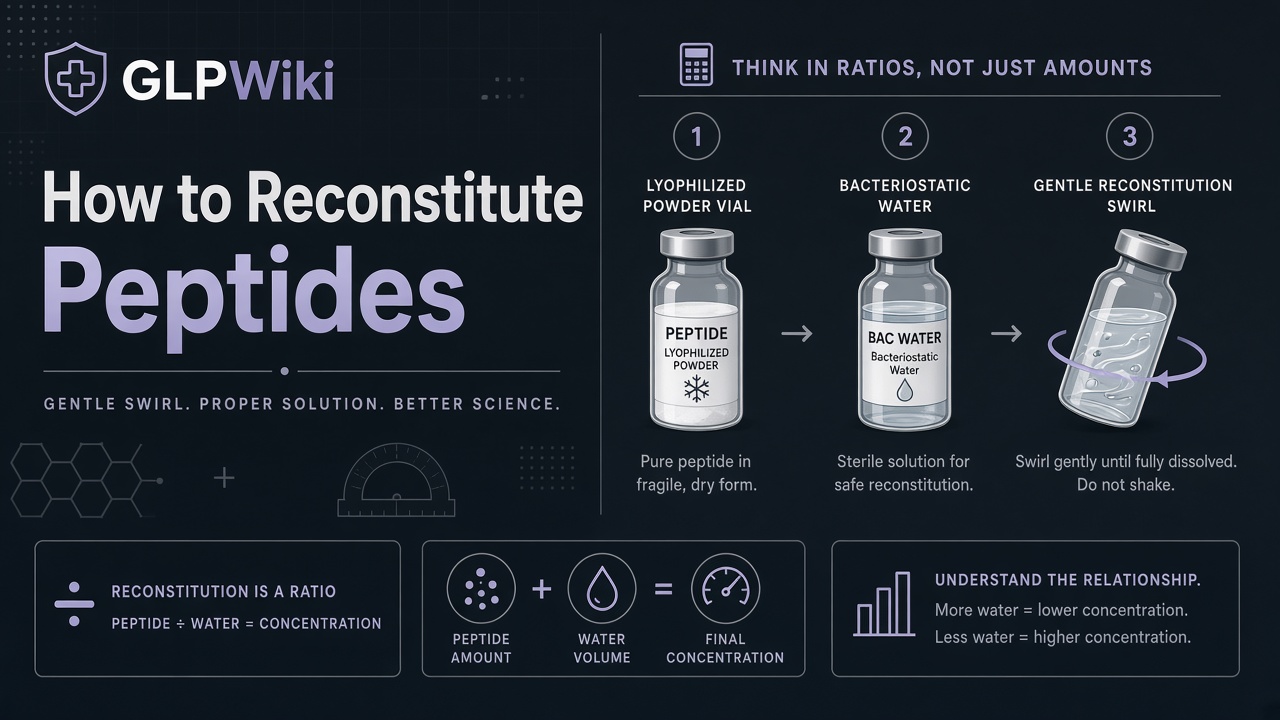
A plain-English walkthrough of how lyophilised peptides are dissolved for research use, including the concentration math, common mistakes, and why the diluent you choose matters.
UPDATED 09 SEPT 2026 · 11 MIN READ
KEY TAKEAWAYS
- Reconstitution simply means dissolving a freeze-dried (lyophilised) peptide powder in a liquid diluent to make a workable solution.
- Bacteriostatic water contains 0.9% benzyl alcohol as a preservative, which distinguishes it from sterile water for injection (no preservative, single-use only).
- The core equation is concentration (mg/mL) = total peptide mass in the vial (mg) ÷ volume of diluent added (mL).
- Dose volume = desired dose (mg or mcg, converted to mg) ÷ concentration (mg/mL).
- Micrograms and milligrams are frequently confused; 1,000 mcg = 1 mg, and mixing these units up is one of the most common arithmetic errors in research settings.
- Aseptic technique — clean vial tops, single-use needles, and minimizing air exposure — matters for solution integrity in any laboratory context.
- This article is educational only; it does not recommend a dose or instruct anyone to self-administer anything, and any hands-on laboratory work should be supervised by a licensed professional.
What is a lyophilised peptide?
Many research peptides are supplied as a lyophilised (freeze-dried) powder inside a sealed glass vial. Lyophilisation removes water from a peptide solution under vacuum at low temperature, leaving behind a stable powder or cake. This process is widely used in pharmaceutical manufacturing because dried peptides are generally far more stable during storage and shipping than peptides already dissolved in liquid.
Because the powder is not in a usable liquid form, it must be reconstituted — dissolved in a diluent — before it can be measured or used in a research protocol. The lyophilised cake itself is usually a specific mass of peptide (for example, 5 mg per vial) plus, in some formulations, bulking agents such as mannitol that help the cake retain its structure.
Handling a lyophilised vial correctly starts before the diluent is even added: vials should be stored per the manufacturer's certificate of analysis (typically refrigerated or frozen and protected from light) and allowed to reach room temperature before reconstitution, since condensation forming on a cold vial can affect subsequent weighing or documentation.
Bacteriostatic water vs. sterile water for injection
Both bacteriostatic water and sterile water for injection are pharmaceutical-grade water products, but they are not interchangeable in practice. Bacteriostatic Water for Injection, USP, contains 0.9% benzyl alcohol as an added preservative. According to the FDA-approved drug label for Bacteriostatic Water for Injection, this preservative is intended to inhibit the growth of bacteria in a multi-dose vial once it has been punctured, which is why bacteriostatic water is commonly used when a reconstituted solution needs to be drawn from repeatedly over a period of time.
Sterile Water for Injection, USP, by contrast, contains no preservative. Its FDA label specifies it is intended for single use only once a container is entered, because there is nothing in the solution to suppress microbial growth after the seal is broken.
The choice of diluent is not arbitrary — some peptide manufacturers explicitly advise against benzyl alcohol for particular peptides or particular routes of research use, because benzyl alcohol can affect certain peptides' stability or is unsuitable in some experimental contexts. This is a key reason product-specific instructions and a qualified professional's guidance take precedence over generic rules of thumb.
Why the preservative matters
A preservative-containing diluent is what allows a multi-dose vial to be used across several sessions rather than needing to be discarded after a single draw. Without a preservative, contamination risk rises each time a vial is entered, which is why sterile (non-bacteriostatic) water is typically limited to single-use scenarios in clinical and research settings alike.
The core arithmetic of reconstitution
Reconstitution math has two steps: figuring out the resulting concentration, and then figuring out what volume corresponds to a given amount of peptide. Both are simple ratio calculations once the units are consistent.
Step 1 — Concentration: concentration (mg/mL) = total peptide in the vial (mg) ÷ volume of diluent added (mL). For example, a vial labelled 5 mg, reconstituted with 2 mL of bacteriostatic water, yields a concentration of 5 mg ÷ 2 mL = 2.5 mg/mL.
Step 2 — Volume for a given amount: volume (mL) = desired amount (mg) ÷ concentration (mg/mL). If a research protocol calls for 0.25 mg from that same 2.5 mg/mL solution, the corresponding volume is 0.25 mg ÷ 2.5 mg/mL = 0.1 mL.
Because many protocols and syringes express amounts in micrograms (mcg) rather than milligrams, converting between the two is essential: 1 mg = 1,000 mcg. So a 250 mcg amount is equivalent to 0.25 mg, and the calculation above proceeds identically.
- Concentration (mg/mL) = vial content (mg) ÷ diluent volume added (mL)
- Volume (mL) = target amount (mg) ÷ concentration (mg/mL)
- mcg to mg: divide by 1,000. mg to mcg: multiply by 1,000.
- Always double-check the vial's labelled peptide mass — it is not always a round number, and some vials include slight manufacturing overfill noted on the certificate of analysis.
Worked examples
Example A: A vial contains 10 mg of peptide. A researcher adds 5 mL of bacteriostatic water. Concentration = 10 ÷ 5 = 2 mg/mL. To identify the volume containing 0.5 mg, divide: 0.5 ÷ 2 = 0.25 mL.
Example B: A vial contains 2 mg of peptide reconstituted with 1 mL of diluent, giving 2 mg/mL, which is the same as 2,000 mcg/mL. To find the volume containing 100 mcg, first convert 100 mcg to mg (0.1 mg), then divide: 0.1 ÷ 2 = 0.05 mL.
Example C: A vial is 5 mg and a researcher wants each 0.1 mL drawn to equal exactly 100 mcg (0.1 mg). Concentration required = 0.1 mg ÷ 0.1 mL = 1 mg/mL. Diluent volume needed = 5 mg ÷ 1 mg/mL = 5 mL of bacteriostatic water. This kind of 'reverse' calculation — solving for the diluent volume that makes the arithmetic land on convenient syringe markings — is one reason many people use a reconstitution calculator rather than doing the algebra by hand each time.
GLPWiki hosts a reconstitution calculator and a bacteriostatic water calculator at /calculators, which perform exactly this arithmetic and let you cross-check figures. These tools are educational aids, not a substitute for professional guidance.
Common arithmetic and handling errors
The most frequent error researchers report is confusing milligrams and micrograms, since the two units differ by a factor of 1,000 and both commonly appear on labels, calculators, and syringe barrels. A misplaced decimal point or unit mix-up can produce a tenfold or thousandfold discrepancy between an intended figure and an actual one.
A second common error is assuming a vial's stated mass is the same as the total content actually available; manufacturing overfill, residual moisture, or adsorption to the vial's glass wall can all cause the real recoverable mass to differ slightly from the label.
A third error is inconsistent diluent volumes — adding an approximate rather than precisely measured amount of water, which throws off every subsequent concentration calculation derived from that vial.
- Mixing up mg and mcg (a 1,000-fold error)
- Misreading which syringe barrel markings correspond to the solution's actual concentration
- Not accounting for a syringe's dead space when precision matters
- Failing to label the reconstituted vial with the date and concentration, leading to confusion later
Aseptic technique concepts
Aseptic technique refers to practices designed to minimize the introduction of microorganisms into a sterile solution or onto a sterile surface. In a laboratory or clinical pharmacy context, this includes disinfecting a vial's rubber septum with an alcohol swab before inserting a needle, using a new sterile needle and syringe for each draw, and avoiding touching the needle tip or the inside of a plunger.
The United States Pharmacopeia's General Chapter <797> on pharmaceutical compounding — sterile preparations lays out detailed standards that professional compounding pharmacies follow for exactly this reason: even trace contamination introduced during reconstitution or drawing can compromise a preparation's safety and validity.
For anyone working with these materials in a research or educational setting, the practical takeaway is that clean technique is not optional busywork — it materially affects whether a solution remains usable and interpretable for the intended research purpose.
Scope of this guide
This article explains the mathematics and general handling concepts associated with reconstituting lyophilised peptides. It is intended for research, laboratory-literacy, and educational purposes. It does not recommend any dose, does not instruct anyone to administer any substance to themselves or others, and does not endorse or link to any supplier.
Anyone working with peptides, diluents, needles, or syringes in a real-world setting should do so under the guidance of a licensed clinician, pharmacist, or qualified laboratory supervisor, and in compliance with all applicable regulations in their jurisdiction.
Frequently asked questions
- What is the difference between bacteriostatic water and sterile water?
- Bacteriostatic water contains 0.9% benzyl alcohol as a preservative and is labelled for multi-dose use, while sterile water for injection contains no preservative and is generally limited to single-use once its container is entered, per their respective FDA drug labels.
- How do I calculate the concentration after reconstitution?
- Divide the total peptide mass in the vial (in mg) by the volume of diluent you add (in mL). For example, 5 mg dissolved in 2 mL gives a concentration of 2.5 mg/mL.
- How do micrograms and milligrams relate to each other?
- There are 1,000 micrograms (mcg) in 1 milligram (mg). Converting correctly between the two is essential because mixing them up produces a thousandfold arithmetic error.
- Why do some sources advise against benzyl alcohol-containing diluent?
- Benzyl alcohol, the preservative in bacteriostatic water, can be unsuitable for certain compounds or certain intended uses according to some manufacturer literature, which is why product-specific instructions and professional guidance should be followed rather than a one-size-fits-all rule.
- Does GLPWiki tell me what dose to use?
- No. GLPWiki's calculators and guides explain the underlying arithmetic and lab concepts for educational purposes; they are not medical advice and do not recommend doses.
- Where can I check this math myself?
- GLPWiki provides a reconstitution calculator and a bacteriostatic water calculator at /calculators that perform this arithmetic and can be used to cross-check figures.
- Why does aseptic technique matter for a research solution?
- Introducing microorganisms into a solution can compromise its stability and validity for its intended purpose. Standards such as USP General Chapter <797> describe the practices professional compounders use to minimize this risk.
SOURCES
- 01Bacteriostatic Water for Injection, USP — prescribing information— U.S. Food and Drug Administration
- 02Sterile Water for Injection, USP — prescribing information— U.S. Food and Drug Administration
- 03General Chapter <797> Pharmaceutical Compounding — Sterile Preparations— United States Pharmacopeia (USP)
- 04Lyophilization of Pharmaceuticals— PubMed (Journal of Pharmaceutical Sciences)
- 05Benzyl alcohol and preservative use in parenteral products— PubMed
EDUCATIONAL REFERENCE ONLY · Not medical advice. Nothing here diagnoses, treats, cures or prevents any disease, and nothing here is a dosing recommendation. Consult a licensed clinician before any treatment decision.