Peptide dosing math: concentration, volume and units
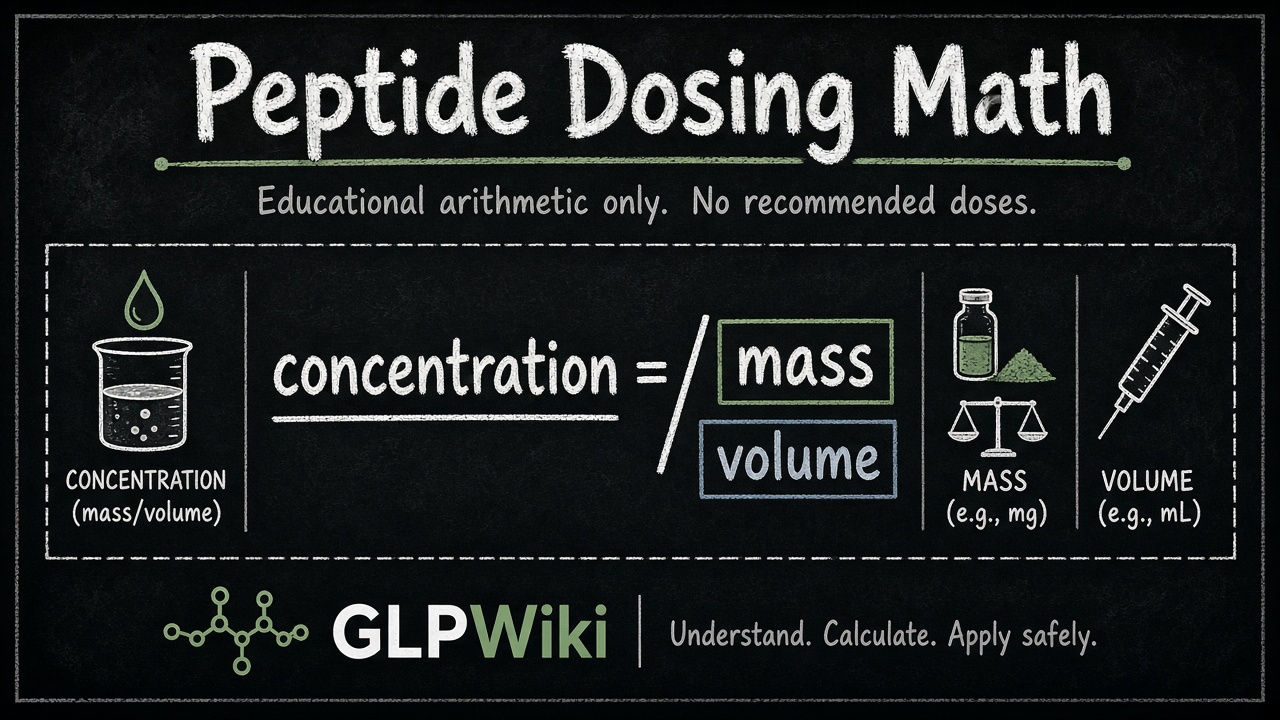
Concentration, volume, and syringe unit markings are three different quantities that are easy to conflate. Here is the arithmetic that connects them, explained through worked examples rather than any recommended amount.
UPDATED 09 SEPT 2026 · 12 MIN READ
KEY TAKEAWAYS
- Milligrams (mg) and micrograms (mcg) differ by a factor of 1,000: 1 mg = 1,000 mcg, and confusing them is the single most common arithmetic error in this space.
- Concentration (mg/mL) = total peptide mass in a vial (mg) ÷ volume of diluent added (mL).
- Volume to draw (mL) = amount of interest (mg) ÷ concentration (mg/mL) — this is pure ratio arithmetic, not a recommendation.
- Syringe 'units' are a volume marking tied to a specific scale (U-100, U-50, U-40), not a universal quantity — the same number of units means a different volume on each scale.
- The number of doses obtainable from a vial is a function of total peptide mass, diluent volume, and the amount used per draw — changing any one of these changes the others.
- Measurement error is proportionally larger at very small draw volumes, which is why rounding and syringe resolution matter more than they might first appear to.
- This article presents arithmetic examples only, phrased hypothetically; it does not recommend or imply any dose, schedule, or protocol.
Mass units: milligrams vs. micrograms
Almost every calculation involving a peptide begins with a mass — the amount of active peptide, expressed in milligrams (mg) or micrograms (mcg). These are both units of mass on the metric scale, related by a fixed factor: 1 milligram equals 1,000 micrograms. Put differently, a microgram is one-thousandth the size of a milligram, in the same way a millimetre is one-thousandth of a metre.
Vial labels, certificates of analysis, and calculators can express the same physical amount in either unit, and different sources in the same conversation sometimes use different units without saying so explicitly. A vial labelled '5 mg' contains 5,000 mcg of peptide; a quantity described as '250 mcg' is the same as 0.25 mg. Converting between the two is a matter of moving the decimal point three places, but doing this reliably under time pressure, in poor lighting, or on a small label is where a large share of documented arithmetic mistakes in peptide handling originate.
Because the conversion factor is exactly 1,000, an error of forgetting to convert — treating a mcg figure as though it were mg, or vice versa — does not produce a small rounding discrepancy; it produces a thousandfold difference between the intended figure and the actual one. This scale of error is why many laboratory and clinical protocols insist on writing out units explicitly at every step of a calculation, rather than assuming the reader will infer them from context, and why professional pharmacy compounding standards emphasize double-checking unit consistency before any solution is finalized.
- 1 mg = 1,000 mcg (multiply mg by 1,000 to get mcg; divide mcg by 1,000 to get mg)
- Always write the unit next to every number in a calculation, not just at the end
- A misplaced decimal point when converting mg/mcg produces a 10x, 100x, or 1,000x error, not a small one
- Vial labels and calculators do not always use the same unit — check both before comparing figures
Concentration: relating mass to volume
Once a lyophilised (freeze-dried) peptide is dissolved in a liquid diluent — typically bacteriostatic water or sterile water for injection — the resulting solution has a concentration, meaning a certain mass of peptide is distributed through each unit of volume. Concentration is expressed as mass per volume, most often mg/mL (milligrams per millilitre) or occasionally mcg/mL.
The governing equation is straightforward: concentration (mg/mL) equals the total peptide mass in the vial (mg) divided by the total volume of diluent added (mL). This is a ratio, and like any ratio, it depends entirely on both numbers involved. Adding more diluent to the same vial mass produces a more dilute (lower mg/mL) solution; adding less diluent to the same vial mass produces a more concentrated one. The total mass of peptide in the vial itself does not change when diluent is added — reconstitution changes the peptide's concentration and workable form, not the total quantity present.
This distinction — that dilution changes concentration, not total content — is one of the more frequently misunderstood points in this subject. A vial labelled 5 mg contains 5 mg of peptide whether it is reconstituted with 1 mL, 2 mL, or 5 mL of diluent; what changes across those three scenarios is how much peptide corresponds to any given draw volume from that vial.
From concentration to draw volume
The second step in most dosing arithmetic is converting a target mass into a corresponding volume, given a known concentration. The equation is: volume (mL) = amount of interest (mg) ÷ concentration (mg/mL). This is again simple ratio arithmetic — the same relationship used to figure out, for instance, how much of a 2 mg/mL solution corresponds to a hypothetical 0.5 mg figure (0.5 ÷ 2 = 0.25 mL).
To be explicit about the framing here: performing this arithmetic is not the same as recommending any particular mass or volume. A protocol, study, or product label may specify a figure, and the reader's task at that point is purely mathematical — determining what volume of a known-concentration solution corresponds to that stated figure. This article works through such conversions purely as arithmetic exercises, using hypothetical numbers, and does not suggest what any figure should be.
It is also worth noting that this arithmetic assumes the concentration figure being used is accurate and that the solution is well-mixed and homogeneous — an uneven or incompletely dissolved solution can mean that the assumed concentration does not hold uniformly throughout the vial, which is one of several reasons gentle swirling rather than vigorous shaking is typically recommended for reconstituting peptide powders, and why documentation of concentration on a vial's label matters for anyone using it later.
Syringe units: a volume marking, not a mass
Insulin-style syringes are commonly marked in 'units' rather than millilitres, and this is a frequent source of confusion because the word 'unit' means something different here than it does in the phrase 'international unit' (a biological potency measure, discussed in a companion guide). On a syringe, a printed unit scale is simply a volume marking calibrated to a specific convention.
The most common convention in the United States and many other countries is U-100, meaning the scale is built so that 100 units equals 1 mL of solution. Under this convention, 1 unit = 0.01 mL, and this holds regardless of the syringe's total barrel size — a 0.3 mL U-100 syringe and a 1 mL U-100 syringe both use the same 0.01 mL-per-unit conversion; they simply hold different maximum numbers of units (30 versus 100).
Other scales exist and are not interchangeable without recalculating: on a U-50 syringe, 50 units equals 1 mL, so 1 unit = 0.02 mL; on a U-40 syringe (more common in some veterinary insulin contexts), 40 units equals 1 mL, so 1 unit = 0.025 mL. Reading '20 units' off a U-40 syringe corresponds to a different physical volume than reading '20 units' off a U-100 syringe — 0.5 mL versus 0.2 mL respectively. Checking which scale a given syringe uses, printed on its barrel or packaging, is a necessary first step before any unit-to-volume conversion.
To convert a volume in mL to a units reading, the formula is: syringe units = volume (mL) × units-per-mL of that syringe's scale (100 for U-100, 50 for U-50, 40 for U-40). So a hypothetical 0.25 mL volume corresponds to 25 units on a U-100 syringe, 12.5 units on a U-50 syringe, and 10 units on a U-40 syringe — three different unit readings for the identical physical volume, which illustrates why the scale must always be specified alongside any units figure.
- U-100: 100 units = 1 mL, so 1 unit = 0.01 mL
- U-50: 50 units = 1 mL, so 1 unit = 0.02 mL
- U-40: 40 units = 1 mL, so 1 unit = 0.025 mL
- Syringe units = volume (mL) × units-per-mL for that scale
- The same unit count means different volumes on different scales — always check the printed scale
How many draws a vial can provide
A related calculation that appears often is estimating how many individual draws a reconstituted vial could theoretically provide, given a hypothetical amount used per draw. This is derived from the same building blocks: total peptide mass in the vial, diluent volume added (which sets concentration), and the mass used per draw.
Algebraically, number of draws = total vial mass (mg) ÷ mass per draw (mg). For example, a vial containing a hypothetical 10 mg of peptide, where each draw uses a hypothetical 0.5 mg, would arithmetically support up to 20 draws — again presented purely as a ratio calculation, not as a recommended schedule or count.
In practice, the number of usable draws from a real vial can be slightly lower than this pure arithmetic suggests, because of factors like residual solution that cannot be fully withdrawn from the vial or syringe (dead space), minor manufacturing overfill or underfill relative to the labelled mass, and any solution lost to evaporation or degradation if a vial is used across an extended period. These practical factors are why documented, professional handling — including correct storage per a product's certificate of analysis — matters for anyone working with a reconstituted solution over time.
Rounding, resolution, and measurement error
Every measurement device has a resolution limit — the smallest increment it can reliably distinguish. A standard U-100 1 mL syringe is typically marked in single-unit increments (0.01 mL each), while some finer-resolution 'half-unit' syringes mark increments of 0.5 units (0.005 mL). At very small draw volumes, the proportional impact of a rounding error becomes much larger, even though the absolute error in mL might look small.
Consider two hypothetical scenarios using the same absolute measurement imprecision of ±0.01 mL. If a calculated draw volume is 0.50 mL, a ±0.01 mL imprecision represents about a 2% deviation. If a calculated draw volume is 0.05 mL, the same ±0.01 mL imprecision represents about a 20% deviation — ten times larger in proportional terms, purely because the target volume is smaller. This is a general principle of measurement, not specific to any one substance: precision at small volumes is disproportionately sensitive to the resolution of the measuring device.
One practical implication discussed in reconstitution literature and calculator tools is that choosing a diluent volume that produces a concentration where hypothetical draw volumes fall in a more easily read, larger portion of a syringe's barrel can reduce the proportional impact of reading error, compared with concentrations that would require reading extremely small volumes near the syringe's minimum resolution. This is a matter of measurement practice, not a recommendation about what amount to use.
Worked arithmetic examples
The following are presented strictly as arithmetic exercises using hypothetical figures. They illustrate how the equations above are applied together; they are not recommendations, and no figure below should be read as a suggested amount for any person.
Example 1: If a vial is labelled 5 mg and is reconstituted with 2 mL of diluent, the concentration is 5 mg ÷ 2 mL = 2.5 mg/mL. If a hypothetical protocol description specified an amount of 0.25 mg, the corresponding volume would be 0.25 mg ÷ 2.5 mg/mL = 0.1 mL. Converted to U-100 syringe units, that is 0.1 mL × 100 = 10 units.
Example 2: If a vial is labelled 10 mg and reconstituted with 5 mL of diluent, the concentration is 10 ÷ 5 = 2 mg/mL, equivalent to 2,000 mcg/mL. If a hypothetical figure of 100 mcg were specified, converting to mg first gives 0.1 mg, and the volume is 0.1 mg ÷ 2 mg/mL = 0.05 mL, or 5 units on a U-100 syringe.
Example 3 (reverse calculation): If a researcher wanted a hypothetical concentration such that a 0.2 mL draw would correspond to 0.1 mg, the required concentration is 0.1 mg ÷ 0.2 mL = 0.5 mg/mL. For a vial labelled 5 mg, the diluent volume that produces this concentration is 5 mg ÷ 0.5 mg/mL = 10 mL. This kind of reverse arithmetic — solving for the diluent volume that makes a calculation land on a convenient number — is one reason reconstitution calculators are widely used rather than working the algebra by hand every time.
GLPWiki's calculators at /calculators perform this class of arithmetic and allow cross-checking of figures; they are educational aids and do not generate or suggest a dose.
Common mistakes in this arithmetic
Beyond the mg/mcg confusion already discussed, several other recurring errors appear in discussions of this arithmetic. Recognizing them is useful regardless of the specific numbers involved in any given calculation.
- Confusing syringe 'units' (a volume marking specific to a syringe's scale) with 'IU' (international units, a measure of biological activity) — these are unrelated quantities that happen to share the word 'unit'
- Using the wrong syringe scale conversion (e.g., treating a U-40 reading as though it were U-100)
- Assuming a vial's labelled mass and the actual recoverable mass are identical, without accounting for manufacturing overfill/underfill noted on a certificate of analysis
- Not re-deriving concentration after adding an approximate, rather than precisely measured, diluent volume
- Failing to label a reconstituted vial with its date and concentration, leading to guesswork later
- Treating small-volume draws as equally precise as larger-volume draws, without accounting for proportional measurement error
Scope of this guide
This article explains the arithmetic relationships between mass, concentration, volume, and syringe unit markings for educational and laboratory-literacy purposes. It does not state or imply a recommended dose, schedule, or protocol for any substance, and none of the worked figures above should be interpreted as guidance for personal use.
Anyone handling peptides, diluents, needles, or syringes in a real-world setting should do so under the supervision of a licensed clinician, pharmacist, or qualified laboratory professional, and in compliance with applicable regulations in their jurisdiction.
Frequently asked questions
- What is the difference between mg and mcg?
- Milligrams (mg) and micrograms (mcg) are both units of mass; 1 mg equals 1,000 mcg. Mixing the two up produces a thousandfold arithmetic error, which is the most commonly reported mistake in this subject.
- How is concentration calculated after reconstitution?
- Concentration (mg/mL) equals the total peptide mass in the vial (mg) divided by the volume of diluent added (mL). For example, 5 mg dissolved in 2 mL yields 2.5 mg/mL.
- Are syringe 'units' the same as international units (IU)?
- No. Syringe units are a volume marking specific to a syringe's printed scale (U-100, U-50, or U-40), while international units are a measure of biological activity defined by WHO reference standards. They are unrelated quantities that happen to share a word.
- Why does the same 'units' number mean different volumes on different syringes?
- Because U-100, U-50, and U-40 describe different unit-to-volume conversions (100, 50, and 40 units per mL respectively). The printed scale on the syringe barrel must be checked before interpreting any units reading.
- Does reconstituting a vial with more diluent change the total amount of peptide in it?
- No. Adding diluent changes the concentration (how much peptide is present per mL), not the total mass of peptide in the vial, which stays fixed once the powder was manufactured.
- Why does measurement error matter more at small volumes?
- A fixed absolute measurement imprecision (for example, ±0.01 mL) represents a much larger proportional error at a small target volume than at a larger one, which is a general principle of measurement resolution.
- Does this article recommend a dose?
- No. This article explains arithmetic relationships using hypothetical figures for educational purposes only; it does not state or imply a recommended dose, schedule, or protocol.
SOURCES
- 01Bacteriostatic Water for Injection, USP — prescribing information— U.S. Food and Drug Administration
- 02Sterile Water for Injection, USP — prescribing information— U.S. Food and Drug Administration
- 03General Chapter <797> Pharmaceutical Compounding — Sterile Preparations— United States Pharmacopeia (USP)
- 04Insulin syringes and pen needles: patient education materials— U.S. Food and Drug Administration
- 05Medication errors related to drug concentration and unit confusion— PubMed
- 06Look-alike, sound-alike and unit-of-measure errors in dosing— PubMed
EDUCATIONAL REFERENCE ONLY · Not medical advice. Nothing here diagnoses, treats, cures or prevents any disease, and nothing here is a dosing recommendation. Consult a licensed clinician before any treatment decision.