IU vs mcg vs syringe units: what each means
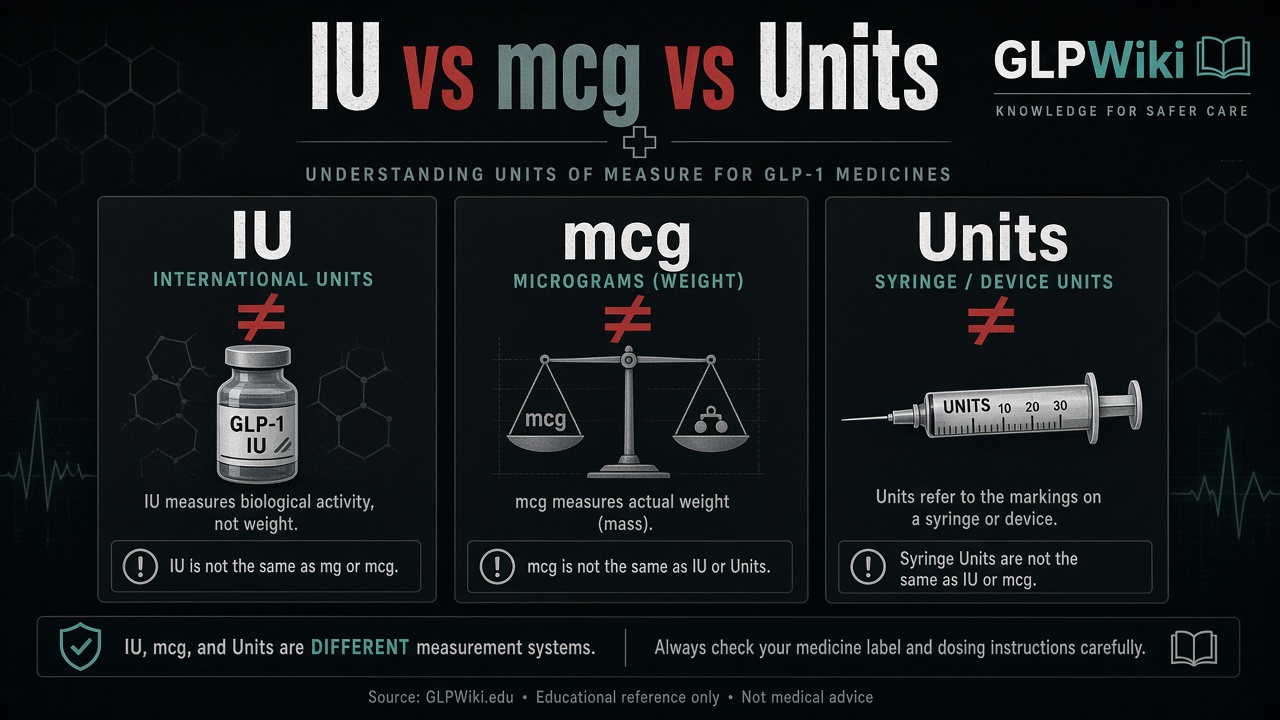
The word 'unit' shows up in at least three unrelated contexts — international units of biological activity, syringe volume markings, and colloquial shorthand — and conflating them is a well-documented source of confusion. Here is how each is actually defined.
UPDATED 09 SEPT 2026 · 11 MIN READ
KEY TAKEAWAYS
- International units (IU) measure biological activity, defined per substance against a WHO international reference standard — they are not a measure of mass.
- Micrograms (mcg) and milligrams (mg) are mass units; they measure how much material is present, independent of its biological potency.
- 'Units' printed on an insulin-style syringe barrel are a volume marking tied to a specific scale (U-100 = 100 units per mL), unrelated to IU.
- A syringe's 'units' and a substance's 'IU' sound alike but describe different kinds of quantities entirely, and treating them as interchangeable is a well-documented, potentially serious point of confusion.
- IU-to-mg conversion factors are specific to each labelled product and its WHO or pharmacopeial reference standard — there is no single universal IU-to-mg conversion that applies across all peptides.
- Somatropin (recombinant human growth hormone) product labels have historically cited approximate IU-to-mg relationships (commonly around 3 IU per mg), but this figure is product-label-specific and should never be assumed to apply to a different substance.
- When in doubt, treat IU, mg/mcg, and syringe units as three separate systems that require explicit, product-specific conversion — never assume one directly substitutes for another.
What an international unit (IU) actually is
An international unit (IU) is a unit of measurement for the biological activity of a substance, not a measure of its physical mass. IUs are defined and maintained by the World Health Organization through its system of international biological reference standards and reference preparations — physical reference materials against which a given batch of a biologic can be compared in a standardized bioassay to establish its potency.
The reason IU exists as a concept at all is that, historically, many biologic substances (hormones, vitamins, vaccines, blood products) could not be reliably standardized purely by mass, because a given mass of material could vary in actual biological potency depending on its purity, structure, or manufacturing process. Defining potency by a standardized biological effect — calibrated against an international reference material — allowed different manufacturers' products to be compared on a consistent activity basis, even before analytical chemistry could fully characterize a molecule's structure.
A critical consequence of this history is that the IU-to-mass relationship is defined separately for each substance, by its own WHO reference standard, and is not a fixed universal conversion factor. One IU of insulin, one IU of a vitamin, and one IU of a growth hormone preparation each correspond to different masses of different substances, established independently through each substance's own reference standard and bioassay. There is no single number that converts 'IU' to 'mg' across biologics in general.
Micrograms and milligrams measure mass, not activity
By contrast, micrograms (mcg) and milligrams (mg) are units of mass on the standard metric scale, related by a fixed factor: 1 mg = 1,000 mcg. A milligram of any substance always represents the same amount of physical matter, regardless of that substance's biological potency — a milligram is a milligram whether it describes a highly potent hormone or an inert filler.
This is the fundamental distinction between mass-based units (mg, mcg) and activity-based units (IU): mass units describe how much material is physically present, while IU describes a standardized biological effect that material is expected to produce, benchmarked against a reference preparation. Two products with the same mass of active substance can, in principle, have different IU potency if their biological activity per unit mass differs — which is precisely the scenario IU was designed to standardize against.
For substances that are regulated and labelled using mass units — including many peptides sold with a stated mg content per vial — mcg and mg remain the relevant units for the dosing-math arithmetic covered in companion guides on this site (concentration, draw volume, and syringe unit markings). The complication arises specifically with substances whose labelling or historical convention uses IU, such as certain growth-hormone products, some hormone preparations, and vaccines.
Syringe 'units' are a volume marking, not IU
A separate and unrelated use of the word 'unit' appears on insulin-style syringe barrels, where graduated markings are labelled simply 'units.' These markings describe a fixed conversion to volume, calibrated to a specific syringe scale — most commonly U-100, meaning the scale is built so that 100 units equals 1 mL of solution (so 1 unit = 0.01 mL). Other scales, such as U-50 and U-40, use different unit-to-volume conversions.
This syringe-unit convention originated historically alongside U-100 insulin as the standard insulin concentration in many countries, and the scale was designed so that insulin, itself dosed and labelled in international units of biological activity, could be drawn up directly in a syringe whose markings corresponded numerically to the insulin product's own IU labelling — for U-100 insulin specifically, 1 unit on a U-100 syringe corresponds to 1 IU of that particular insulin formulation, because the product and the syringe scale were designed together around that correspondence.
This historical alignment — where, for U-100 insulin specifically, syringe units and the insulin's own IU happen to numerically coincide — is very likely the origin of a broader and more general confusion: assuming that 'units' on any syringe always equal 'IU' of whatever substance is being measured. This assumption does not hold for substances that are not U-100 insulin. For a peptide labelled and dosed in mg or mcg, a syringe's 'unit' markings are purely a volume readout (via that syringe's specific mL-per-unit conversion) and have no direct numerical relationship to IU at all, because IU is not the unit that substance's mass-based labelling uses in the first place.
- For U-100 insulin only: 1 syringe unit happens to correspond to 1 IU of that specific product, by historical design
- For any mg/mcg-labelled substance drawn into a U-100 syringe: 'units' on the barrel are purely a volume marking (1 unit = 0.01 mL) and do not equal IU of anything
- Never assume a syringe's 'units' reading translates directly to 'IU' for a substance that is not itself IU-labelled U-100 insulin
The classic units-vs-IU confusion
Because 'units' appears in both the syringe-marking context and the IU-labelling context, and because the two happen to coincide numerically for the single well-known case of U-100 insulin, a recurring point of confusion in broader public and even some clinical discussions is treating 'units' as a generic, universally interchangeable term. Pharmacy and patient-safety literature has repeatedly flagged unit-of-measure ambiguity — including confusion between 'units,' 'IU,' and mass units — as a documented category of medication error, serious enough that some clinical and regulatory bodies have specifically recommended writing 'units' out in full rather than using ambiguous abbreviations on prescriptions and labels, precisely because abbreviations for 'unit' and 'international unit' have historically been mistaken for one another or for other symbols.
This confusion is compounded for substances where a manufacturer's labelling uses IU (as some growth-hormone and hormone products historically have, alongside or instead of mg/mcg), because a syringe's printed 'unit' markings do not, in that case, automatically equal that product's IU count. Establishing the actual relationship requires consulting that specific product's own labelling, which will state its manufacturer-defined mass-to-IU relationship (see below) and any specific instructions for how a given syringe or delivery device should be read for that product.
IU-to-mg conversions are product-label-specific: the somatropin example
Recombinant human growth hormone (somatropin) products are frequently labelled and discussed using IU alongside mg, and this is one of the more commonly cited examples of IU-to-mass conversion in the peptide and hormone literature. Various somatropin manufacturers' labelling and pharmacology references have historically cited an approximate relationship in the range of roughly 3 IU per 1 mg of somatropin, though the precise figure has varied somewhat across product formulations, reference standards, and historical revisions to the WHO international standard for growth hormone over time.
The critical caveat is that this approximate 3 IU-per-mg figure is specific to somatropin as labelled by particular manufacturers against the applicable growth-hormone reference standard — it is not a universal constant that applies to other peptides, other hormones, or even necessarily to every somatropin product formulation without checking that specific product's current labelling. Presenting it here is for illustrative and educational purposes to show what a real-world, product-specific IU-to-mass relationship looks like; it should not be applied to any other substance, or assumed current for any specific commercial somatropin product without checking that product's own label.
This product-specific variability is precisely why general dosing-math guides — including this one — cannot responsibly provide a universal IU-to-mg (or mg-to-IU) conversion table applicable across peptides. Where IU appears on a specific product's labelling, the manufacturer's own documentation and a qualified professional are the appropriate sources for that product's defined conversion, not a generalized reference figure from an unrelated substance.
Worked conversion examples
The following are presented strictly as arithmetic illustrations using the previously stated, product-specific somatropin example, to show the mechanics of an IU-to-mg conversion when a valid, labelled conversion factor is available. They are not universal figures and do not apply to any substance other than the specific labelled product they are drawn from.
Illustration 1: If a specific somatropin product's labelling states approximately 3 IU per 1 mg, then a hypothetical labelled amount of '6 IU' of that specific product would correspond to approximately 6 ÷ 3 = 2 mg, using that product's own stated conversion factor.
Illustration 2: Using the same product-specific factor, a hypothetical amount of '1.5 mg' would correspond to approximately 1.5 × 3 = 4.5 IU of that same specific product.
Illustration 3 — contrast with syringe units: if that same 2 mg (6 IU, per the illustration above) quantity of a reconstituted solution were present in, say, a 0.5 mL volume of solution (implying a concentration of 4 mg/mL for that solution), reading that 0.5 mL volume on a U-100 syringe would show '50 units' — a number that has no direct numerical relationship to either the 2 mg mass figure or the 6 IU activity figure for that product; it is simply 0.5 mL expressed via the U-100 scale's own 100-units-per-mL convention.
This three-way contrast — mg/mcg (mass), IU (biological activity, product-specific), and syringe units (volume, scale-specific) — illustrates why all three numbers can appear together on materials related to the same vial, yet none of them can be assumed to convert directly into another without an explicit, sourced conversion factor for that exact product and that exact syringe scale.
A clear 'never assume' summary
Given how often these three kinds of units appear side by side on labels, calculators, and informal discussions, a short set of explicit rules is more reliable than intuition.
- Never assume 'units' on a syringe equal 'IU' of a substance — they coincide only for the specific historical case of U-100 insulin measured on a U-100 syringe.
- Never assume an IU-to-mg conversion factor from one substance (e.g., somatropin) applies to a different substance — each substance's IU is defined by its own WHO or pharmacopeial reference standard.
- Never assume a single 'IU-to-mg' number is fixed forever for a given substance — reference standards and product formulations can be revised, so always check the specific, current product labelling.
- Always identify which of the three systems (mass, activity, or syringe-scale volume) a given number belongs to before performing any conversion or comparison.
- When a product's labelling uses IU, treat the manufacturer's own documentation as the authoritative source for any IU-to-mass relationship, rather than a generic reference figure.
Scope of this guide
This article explains the conceptual and definitional differences between international units, mass units (mg/mcg), and syringe volume markings, for educational purposes. It does not recommend a dose, IU amount, or protocol for any substance, and any product-specific conversion factors mentioned are illustrative examples, not current clinical guidance.
For any real-world use involving IU-labelled products, syringes, or peptides, consult the specific product's current labelling and a licensed clinician, pharmacist, or qualified laboratory professional.
Frequently asked questions
- Is an international unit (IU) a measure of mass?
- No. An IU measures biological activity, defined per substance against a WHO international reference standard. It is not interchangeable with mg or mcg, which measure physical mass.
- Are syringe 'units' the same as IU?
- Generally no. Syringe unit markings are a volume convention (e.g., U-100 means 100 units = 1 mL). They coincide numerically with IU only in the specific historical case of U-100 insulin measured on a U-100 syringe.
- How many IU are in a milligram of a peptide?
- There is no universal answer — the IU-to-mg relationship is defined separately for each substance by its own reference standard. It must be looked up on that specific product's labelling, not assumed from another substance.
- Is the '3 IU per mg' figure for somatropin universal?
- No. That approximate figure has appeared in some somatropin product labelling and pharmacology references, but it is specific to somatropin and to particular formulations/reference standards — it should not be applied to any other substance.
- Why does this confusion happen so often?
- Because the word 'unit' is used in at least three unrelated contexts — international units of biological activity, syringe volume markings, and general shorthand — and for the one well-known case of U-100 insulin, two of those meanings happen to coincide numerically, which encourages an inaccurate generalization to other substances.
- What should I do if a product label uses IU?
- Refer to that specific product's current manufacturer labelling and consult a licensed clinician or pharmacist for the applicable conversion; do not apply an IU-to-mg figure taken from an unrelated substance.
- Does this guide provide a general IU-to-mg conversion table?
- No. Because IU is defined per substance by its own reference standard, no single, general-purpose conversion table can be responsibly provided; product-specific labelling is the correct source.
SOURCES
- 01International Unit (IU) and biological reference preparations— World Health Organization
- 02Insulin syringes and pen needles: patient education materials— U.S. Food and Drug Administration
- 03ISMP List of Error-Prone Abbreviations, Symbols, and Dose Designations— Institute for Safe Medication Practices (ISMP)
- 04Somatropin (recombinant human growth hormone) — prescribing information— U.S. Food and Drug Administration
- 05WHO International Standard for somatropin: potency and reference standards— PubMed
- 06Unit-of-measure and abbreviation errors in medication dosing— PubMed
EDUCATIONAL REFERENCE ONLY · Not medical advice. Nothing here diagnoses, treats, cures or prevents any disease, and nothing here is a dosing recommendation. Consult a licensed clinician before any treatment decision.