Peptide travel and cold chain: what labels and standards actually say
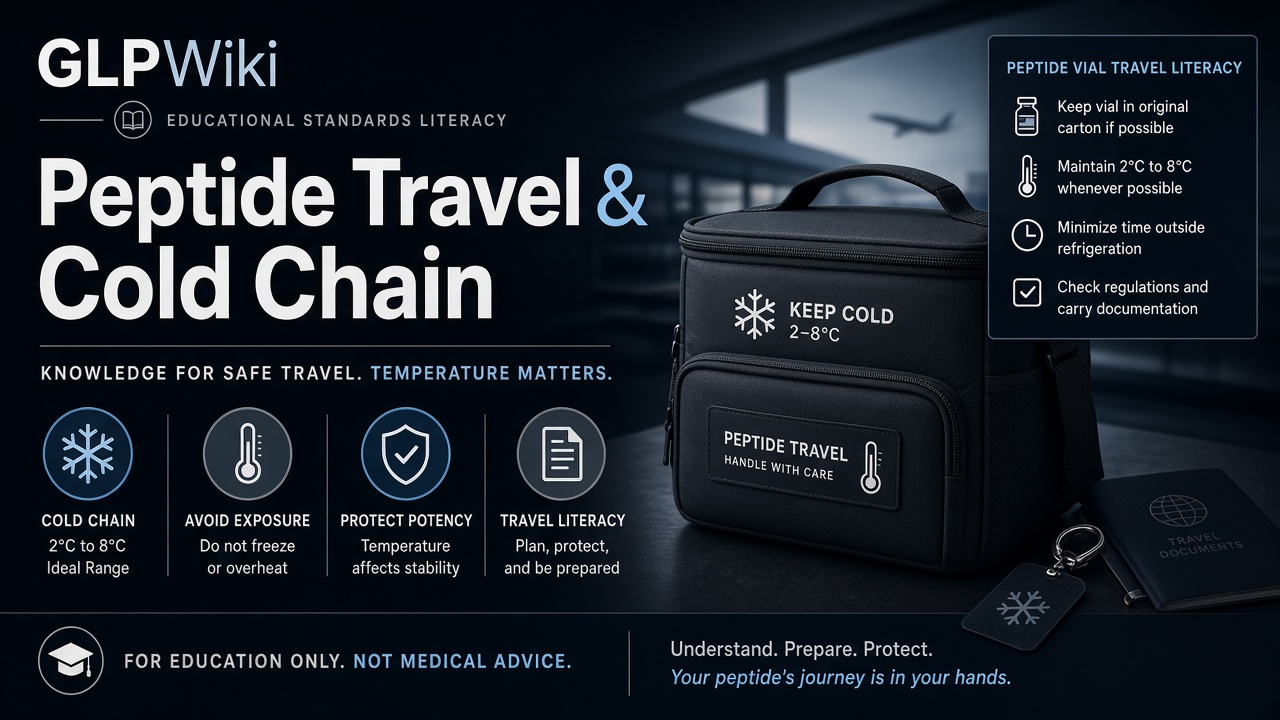
Cold chain is a temperature-controlled path from manufacture through storage and use. For FDA-approved peptide injectables, the product label — not a forum tip — defines refrigeration, room-temperature windows, and freeze rules. This literacy guide explains the concepts and where to verify them.
UPDATED 15 SEPT 2026 · 13 MIN READ
KEY TAKEAWAYS
- Cold chain means a temperature-controlled supply path; for a patient holding an approved product, the binding source is the current FDA label for that exact finished product.
- USP <659> defines refrigerator and controlled cold storage (typically 2–8°C) as packaging and storage vocabulary for articles — it is not a personal travel checklist.
- Approved GLP-1 and incretin pens carry product-specific pre-use and in-use storage language; the windows are not interchangeable between products.
- Freezing is commonly prohibited on these labels, and product that has been frozen is generally not to be used — follow the specific label.
- Compounded, research-use-only, and investigational preparations do not inherit an approved pen's reviewed travel or storage language.
- This page publishes no packing protocols, no doses, and no product recommendations.
What cold chain actually means
"Cold chain" is supply-chain vocabulary, not a consumer product feature. It describes an unbroken, temperature-controlled path that a temperature-sensitive article travels from the point of manufacture, through distribution and wholesale storage, into a pharmacy or clinic refrigerator, and finally to the point of use. Each handoff in that path is a place where temperature can drift, and the discipline of cold chain is mostly about monitoring, documenting, and correcting those drifts rather than about any single container or ice pack.
Professional cold-chain systems are built out of qualified equipment and written procedures: calibrated temperature monitoring devices, validated shipping containers with tested packouts, documented excursion response plans, and staff trained to act when a reading falls outside range. The CDC's Vaccine Storage and Handling Toolkit is the most widely read public example of that model. It is an excellent literacy analogy for understanding how professionals think about temperature-sensitive biologics — and it is explicitly written for vaccine providers running clinic refrigerators, not as instructions for an individual carrying a personal medicine on a trip.
That distinction matters for peptide readers. Most of the cold-chain material circulating online borrows professional vocabulary — "validated packout", "mean kinetic temperature", "excursion" — and reapplies it to personal travel, where none of the underlying qualification, monitoring, or documentation exists. Knowing what the words mean makes you a better reader of your own product's label. It does not turn a suitcase into a qualified shipper.
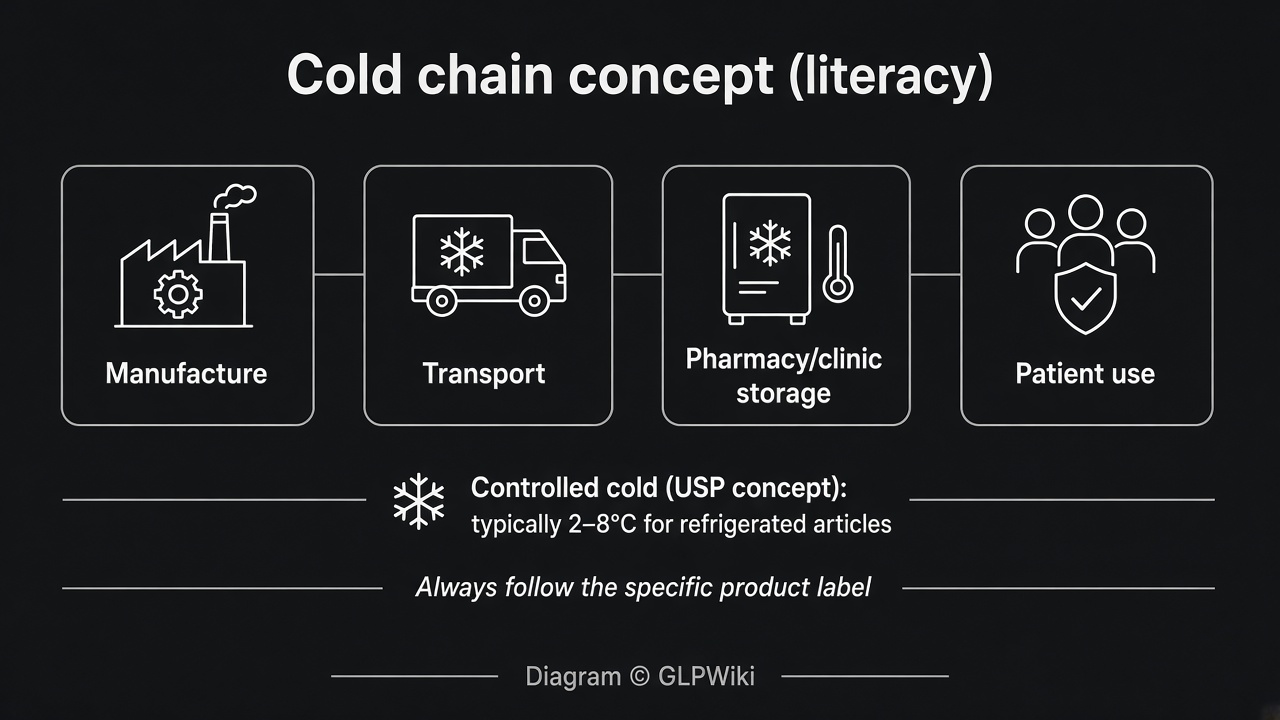
- Cold chain is a path, not a product: manufacture → transport → pharmacy or clinic storage → point of use.
- Professional systems rely on qualified equipment, monitoring devices, and written excursion procedures.
- USP general chapters define the storage vocabulary; refrigerated or controlled cold storage is commonly described as approximately 2–8°C.
- Professional cold-chain models are literacy analogies for patients, not personal logistics instructions.
For an approved product, the label is the source of truth
For any FDA-approved finished product, the storage answer lives in that product's current prescribing information, generally in the section headed How Supplied/Storage and Handling, and in the patient-facing Instructions for Use that accompanies a pen or autoinjector. Those documents state the refrigerated range before first use, whether and for how long room-temperature storage is permitted, whether the product may be frozen, whether it must be protected from light, and what to do with product stored outside those conditions. Nothing on a forum, in a marketing email, or on this page supersedes that text.
Labels are living documents. FDA-approved labeling is revised as new data, new presentations, and new indications are reviewed, and storage language has changed for several incretin products over the past several years. That means the date of the label you are reading matters as much as its content. The reliable habit is to look the product up on Drugs@FDA and read the most recent label revision, rather than trusting a PDF someone saved or screenshotted at an unknown point in the past.
It also means you must identify the exact product, not just the molecule. Semaglutide and tirzepatide each appear in multiple approved products with different presentations, different indications, and separately written labels. A room-temperature window described for one presentation is a statement about that presentation only. Our guide on reading a peptide vial label covers how to match the item in your hand to the document that governs it.
Example labeled storage windows (literacy comparison only)
The examples below are quoted from published labeling to show how differently two products in the same broad class can be written. They are illustrations of label structure, not advice, not a recommendation, and not a substitute for reading the current document for the product you actually have.
Ozempic (semaglutide) prescribing information describes refrigerated storage at 36°F to 46°F (2°C to 8°C) prior to first use. After first use, the labeling describes storage for 56 days either at controlled room temperature of 59°F to 86°F (15°C to 30°C) or refrigerated. The label states that the product should not be frozen, should be protected from excessive heat and sunlight, and should be stored with the pen cap on and without a needle attached.
Tirzepatide single-dose pens (Mounjaro and Zepbound) are written differently. The Instructions for Use describe refrigerated storage at 36°F to 46°F (2°C to 8°C), with the option to store at room temperature up to 86°F (30°C) for up to a total of 21 days, after which the pen is to be discarded. The labeling states not to freeze the product and to keep it in the original carton to protect it from light.
Put side by side, those two products differ in the length of the permitted unrefrigerated period, in whether that period is framed as post-first-use or as a cumulative total, and in the disposal language that follows it. That is precisely why a window from one product cannot be borrowed for another. The numbers above are examples drawn from published labels at the time of writing; verify the current label for your specific product before relying on anything.
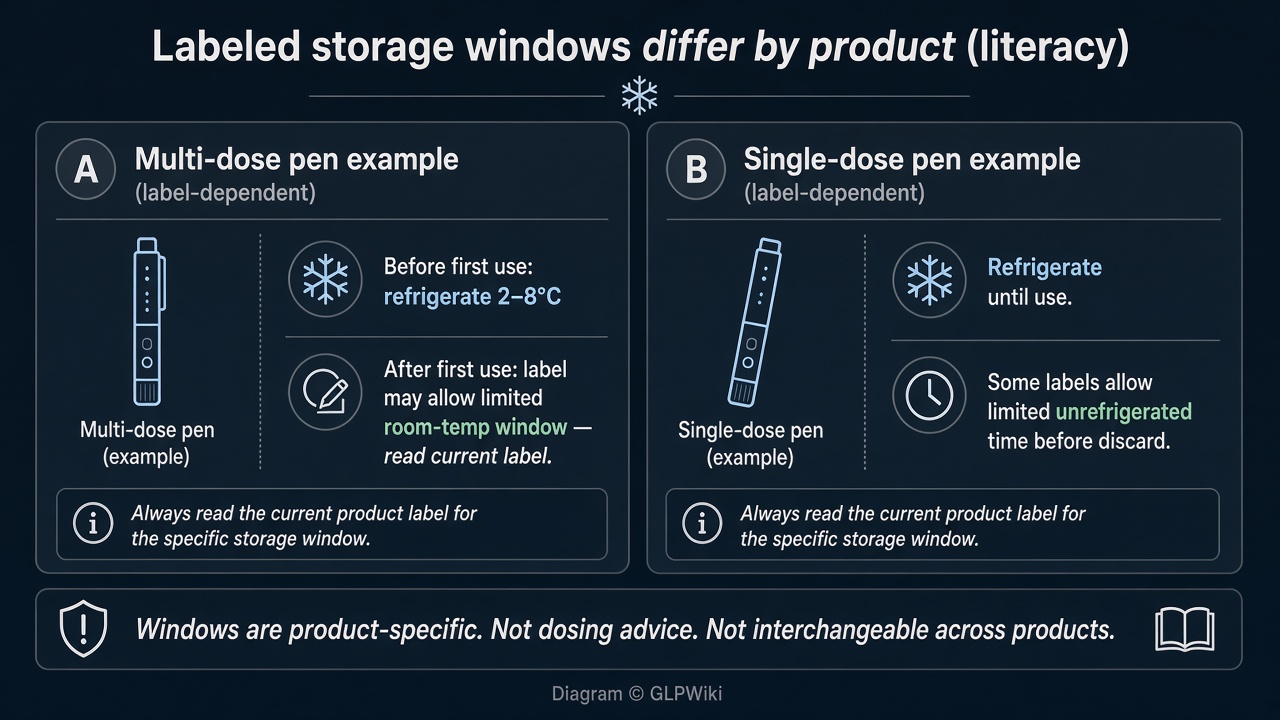
- Refrigerated ranges are commonly stated as 36–46°F (2–8°C) before first use.
- Permitted unrefrigerated periods differ by product in both length and framing.
- "Do not freeze" and light-protection statements are routine, but their exact wording is product-specific.
- Always verify on the current label via Drugs@FDA; example numbers age.
Travel literacy, not a travel protocol
Temperature-sensitive medicines are generally discussed in professional literature as being at greater risk in uncontrolled environments than in controlled ones. Aircraft cargo holds, parked vehicles, and checked baggage are all environments whose temperature the traveller does not control and cannot monitor, and general medicines guidance has long treated them as less suitable for temperature-sensitive products than cabin baggage that stays with the traveller. That is a framing of where risk sits, not an instruction about what to pack.
Screening and airline rules are a separate question from storage, and they change. GLPWiki does not restate security rules, quantity allowances, documentation requirements, or accommodation procedures, because a stale summary of those is actively harmful. Check current TSA guidance on travelling with medications and your airline's own medical-items policy close to your travel date, and confirm anything that affects your treatment with your prescriber or pharmacist.
We deliberately publish no packing recipe: no cooler recommendations, no ice-pack counts, no duration estimates, no improvised monitoring schemes. A packing method that has not been qualified against the specific product's labeled conditions is an untested assumption, and an ice pack in direct contact with a pen introduces a freezing hazard that most of these labels explicitly prohibit. If you need a travel plan for a temperature-sensitive medicine, that conversation belongs with the pharmacist or clinician who knows your product and your itinerary, and in many cases with the manufacturer's own patient support materials.
- Uncontrolled environments — holds, parked cars, unattended baggage — are where temperature risk concentrates.
- Screening and airline medical-item rules change; verify them at their current official source, not here.
- GLPWiki publishes no packing recipes, cooler recommendations, or ice-pack counts.
- Freezing hazards can be introduced by improvised cooling, which most labels prohibit.
Excursions and mean kinetic temperature, explained
An excursion is a period during which a stored or shipped article sits outside its labeled or specified temperature range. In professional quality systems, excursions are detected by monitoring devices, recorded, and evaluated against the product's stability data before a disposition decision is made. The evaluation is a documented process performed by people with access to that stability data — not a judgement call made by eye.
Mean kinetic temperature, described in USP <1079.2>, is one tool used in that professional evaluation. MKT is a single derived temperature that expresses the cumulative thermal effect of a varying temperature profile over time, weighted so that higher temperatures count for more than a simple average would suggest. The chapter is clear that MKT is an evaluation aid for storage and distribution systems, and that it must not be used to justify or excuse a system that repeatedly runs outside its specified range. Repeated excursions indicate a system that needs fixing, not arithmetic that needs adjusting.
For a patient, none of this translates into a personal calculation. If a pen may have frozen, may have been left in heat, or may have sat outside its labeled conditions for an unknown period, the correct action is to contact the pharmacist or prescriber, and where relevant the manufacturer's patient support line, and to follow the product's own labeled instructions on product stored outside labeled conditions. Do not attempt to reason your way to a disposition with MKT math, and do not rely on a stranger's rule of thumb.
- Excursion = time spent outside the labeled or specified range, detected by monitoring.
- MKT is a professional evaluation tool for systems, not a patient decision aid.
- USP <1079.2> states MKT must not justify a system with repeated excursions.
- Suspected freeze or heat exposure → pharmacist, prescriber, or manufacturer guidance, plus the product label.
Approved products versus compounded, RUO, and investigational material
Everything above about labeled storage windows applies to FDA-approved finished products, because those windows exist as a result of a review process in which stability data were submitted and assessed. A labeled 21-day room-temperature total or a labeled 56-day in-use period is a regulatory conclusion about a specific formulation in a specific container closure system, manufactured under specific controls.
Compounded preparations are made outside that approval pathway. They may use different formulations, different concentrations, different excipients, and different containers, and their beyond-use dating is assigned on a different basis than an approved product's labeled shelf life and in-use window. Research-use-only material is not intended for human use at all and carries no patient storage guidance of any kind. Investigational compounds studied in trials are handled under protocol-specific instructions given to trial sites, which are not public consumer guidance.
The practical consequence is simple: none of these categories inherits an approved pen's travel or storage language. Reading an approved product's label and applying it to a compounded vial or an RUO powder is a category error, and it is one of the most common ways people end up confidently wrong. Our guides on approved versus investigational status and on compounded versus FDA-approved GLP-1 products cover the distinction in more depth.
How to verify any of this yourself
Start at Drugs@FDA, search for the exact product name, and open the most recent label revision. Read the How Supplied/Storage and Handling section, then read the patient-facing Instructions for Use or Medication Guide that ships with the presentation you have. Those two documents together are the authoritative storage statement for an approved product, and both carry revision dates you can check.
For the standards vocabulary behind those statements, USP <659> Packaging and Storage Requirements defines the storage condition terms, and USP <1079.2> covers mean kinetic temperature in storage and distribution. The CDC Vaccine Storage and Handling Toolkit shows how a professional cold-chain program is actually operated, which is useful background even though it is written for a different product class and a different audience.
If a product appears damaged, appears to have been frozen, or does not match its labeling, FDA's MedWatch program is the route for reporting problems. Anything that touches your own treatment — whether a particular pen is still usable, what to do about a missed or disrupted plan, whether a trip changes anything — is a clinical question for a licensed clinician or pharmacist, not a question this page can answer.
- Drugs@FDA → exact product → current label → How Supplied/Storage and Handling.
- Instructions for Use and Medication Guide for the presentation in your hand.
- USP <659> for storage vocabulary; USP <1079.2> for MKT concepts.
- MedWatch for suspected product problems; a clinician for anything clinical.
What this page does not do
This guide is educational reference material published by an independent site that sells nothing, carries no sponsored or affiliate content, and links to no suppliers, pharmacies, or telehealth services. It does not state a dose, a schedule, a titration plan, or a stack for any compound, and nothing here should be read as endorsing any product or vendor.
It also does not give travel logistics instructions. There is no packing method, no container recommendation, no cooling duration, no ice-pack count, and no advice on whether a specific pen remains usable after a specific exposure. Those determinations depend on product-specific stability data and on facts about your situation that only your pharmacist, prescriber, or the manufacturer can properly weigh.
- No doses, schedules, titration plans, or stacks.
- No packing protocols, cooler or ice-pack guidance, or duration estimates.
- No supplier, pharmacy, telehealth, or brand endorsements.
- No case-specific judgement on whether a given product is still usable.
Next reading
General storage principles — refrigeration, light protection, lyophilised versus reconstituted material — are covered in our peptide storage and handling guide, which this page deliberately does not duplicate. For the regulatory categories referenced throughout, see the guides on approved versus investigational peptides and on compounded versus FDA-approved GLP-1 products.
To connect a physical item to the document that governs it, the vial label literacy guide walks through name, mass, lot, and storage fields and how to match them against a certificate of analysis. And for the labeling vocabulary around starting and maintenance concepts, the titration concepts guide explains what those words mean on an approved label without publishing any schedule.
Frequently asked questions
- What is cold chain?
- Cold chain is an unbroken, temperature-controlled path that a temperature-sensitive article follows from manufacture through transport and pharmacy or clinic storage to the point of use. In professional systems it is maintained with qualified equipment, monitoring devices, and written procedures for handling temperature excursions.
- Where do I find the storage rules for my pen?
- In the current FDA-approved labeling for that exact product: the How Supplied/Storage and Handling section of the prescribing information, plus the Instructions for Use or Medication Guide supplied with your presentation. Look the product up on Drugs@FDA so you are reading the latest revision rather than an older saved copy.
- Can I use another product's room-temperature window?
- No. Labeled windows are conclusions about a specific formulation in a specific container, and they differ between products in both length and framing — one label may describe a post-first-use period while another describes a cumulative total. A window from one product says nothing about another.
- What if my pen froze?
- Most of these labels prohibit freezing and state that product which has been frozen should not be used. Follow your product's own labeled instruction and contact your pharmacist, prescriber, or the manufacturer's patient support for guidance. GLPWiki cannot assess a specific pen.
- Does any of this apply to compounded vials?
- Not directly. Compounded preparations are made outside the FDA approval pathway and may differ in formulation, concentration, excipients, and container, with beyond-use dating assigned on a different basis. Research-use-only material is not intended for human use at all and carries no patient storage guidance.
- Does GLPWiki give travel packing instructions?
- No. We publish no packing recipes, cooler recommendations, ice-pack counts, or duration estimates. We explain the cold-chain concepts and point to the current label, current TSA and airline medical-items guidance, and your pharmacist or clinician for anything specific to you.
- What is mean kinetic temperature and do I need it?
- MKT, described in USP <1079.2>, is a derived single temperature expressing the cumulative thermal effect of a varying profile over time. It is a professional tool for evaluating storage and distribution systems, and the chapter states it must not justify a system with repeated excursions. Patients should not use it to make decisions about a pen.
SOURCES
- 01Ozempic (semaglutide) prescribing information — How Supplied/Storage and Handling— U.S. Food and Drug Administration
- 02Mounjaro (tirzepatide) single-dose pen Instructions for Use— Eli Lilly and Company
- 03Zepbound (tirzepatide) pen Instructions for Use— Eli Lilly and Company
- 04USP <1079.2> Mean Kinetic Temperature in the Evaluation of Temperature Excursions— United States Pharmacopeia
- 05Vaccine Storage and Handling Toolkit (cold-chain literacy reference)— U.S. Centers for Disease Control and Prevention
- 06Drugs@FDA: approved drug products and current labels— U.S. Food and Drug Administration
- 07MedWatch: safety information and adverse event reporting— U.S. Food and Drug Administration
- 08Traveling with medications (current screening guidance)— U.S. Transportation Security Administration
EDUCATIONAL REFERENCE ONLY · Not medical advice. Nothing here diagnoses, treats, cures or prevents any disease, and nothing here is a dosing recommendation. Consult a licensed clinician before any treatment decision.