Compounded vs FDA-approved GLP-1 medicines: what's the difference?
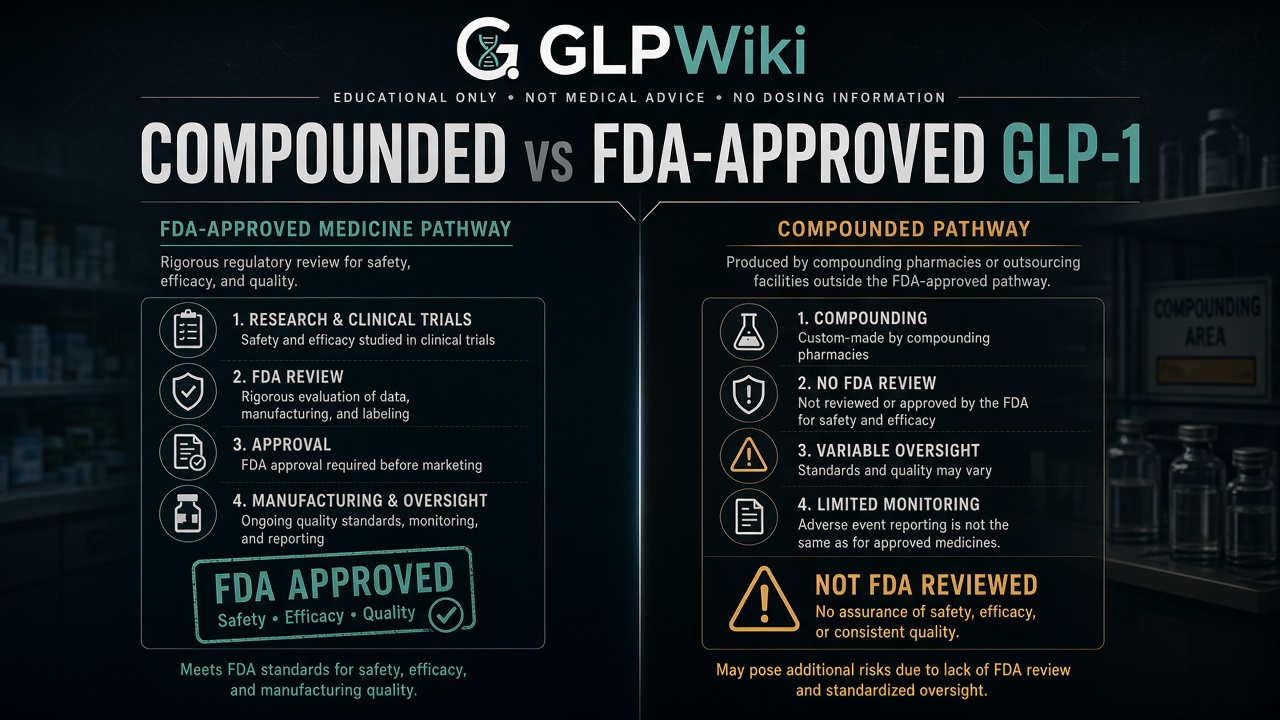
FDA-approved GLP-1 receptor agonists are reviewed finished drugs with official labels. Compounded preparations are not FDA-approved as finished products. This literacy guide explains the distinction, the questions FDA has raised about unapproved versions, and how to verify status — without recommending any product, dose, or seller.
UPDATED 13 SEPT 2026 · 14 MIN READ
KEY TAKEAWAYS
- An FDA-approved GLP-1 medicine is tied to a specific NDA or BLA, official prescribing information, and manufacturing oversight; a shared molecule name is not enough.
- Compounded drugs are not FDA-approved. FDA does not review compounded preparations for safety, effectiveness, or quality before they are marketed.
- Compounding may be appropriate in limited circumstances when an approved product cannot meet a documented patient-specific medical need — that determination belongs to a licensed clinician and applicable law, not this page.
- FDA has warned about unapproved GLP-1 products used for weight loss, including concerns about salt forms, added ingredients, false labels, and dosing errors with multidose vials.
- Confusion among milligrams, millilitres, and syringe “units,” plus nonstandard concentrations, is repeatedly cited in adverse-event reporting associated with compounded injectables.
- This page is educational only: no doses, no schedules, no stacks, no purchasing advice, and no legal advice.
Why “same name” is not the same product
Search for semaglutide or tirzepatide and you will find two very different kinds of product sharing a single word. One is a finished medicine sold in a prefilled pen under a brand name, accompanied by an official prescribing information document that a regulator reviewed before the product could be marketed. The other is a preparation compounded by a pharmacy, often supplied in a multidose vial with a syringe, described online as containing the same active molecule.
The molecule name is a chemistry question. Whether a product is FDA-approved is a regulatory question about a specific finished product: its formulation, its strength, its container, its manufacturing controls, its labeling, and the evidence submitted for it. Two products can name the same peptide and still sit in entirely different regulatory categories, because approval attaches to the product, not to the molecule in the abstract.
That distinction is the whole subject of this guide. It is the same literacy problem GLPWiki covers elsewhere in a different costume: a certificate of analysis tells you about a tested lot, not about approval; a vial label tells you what a supplier printed, not what a regulator concluded; and an investigational compound with published trial data is still not an approved medicine. Here the confusion runs in the other direction — a compounded preparation can carry the name of an approved drug while sitting outside the approval that name evokes.
GLPWiki takes no position on whether any reader should use any product. We do not sell anything, we do not link to suppliers or pharmacies, and we publish no doses, schedules, or protocols. What follows is an explanation of what the regulatory categories mean and where the official records live, so the words on a page or a label can be read accurately. It is not medical advice and it is not legal advice.
What “FDA-approved” actually means
An FDA-approved drug in the United States is one for which a sponsor submitted an application — a New Drug Application (NDA) for most small molecules and peptides, or a Biologics License Application (BLA) for biologics — and FDA reviewed the submitted evidence and concluded that the product's benefits outweigh its risks for the labeled use in the labeled population. Approval is granted to that application: that formulation, that strength, that presentation, that manufacturer.
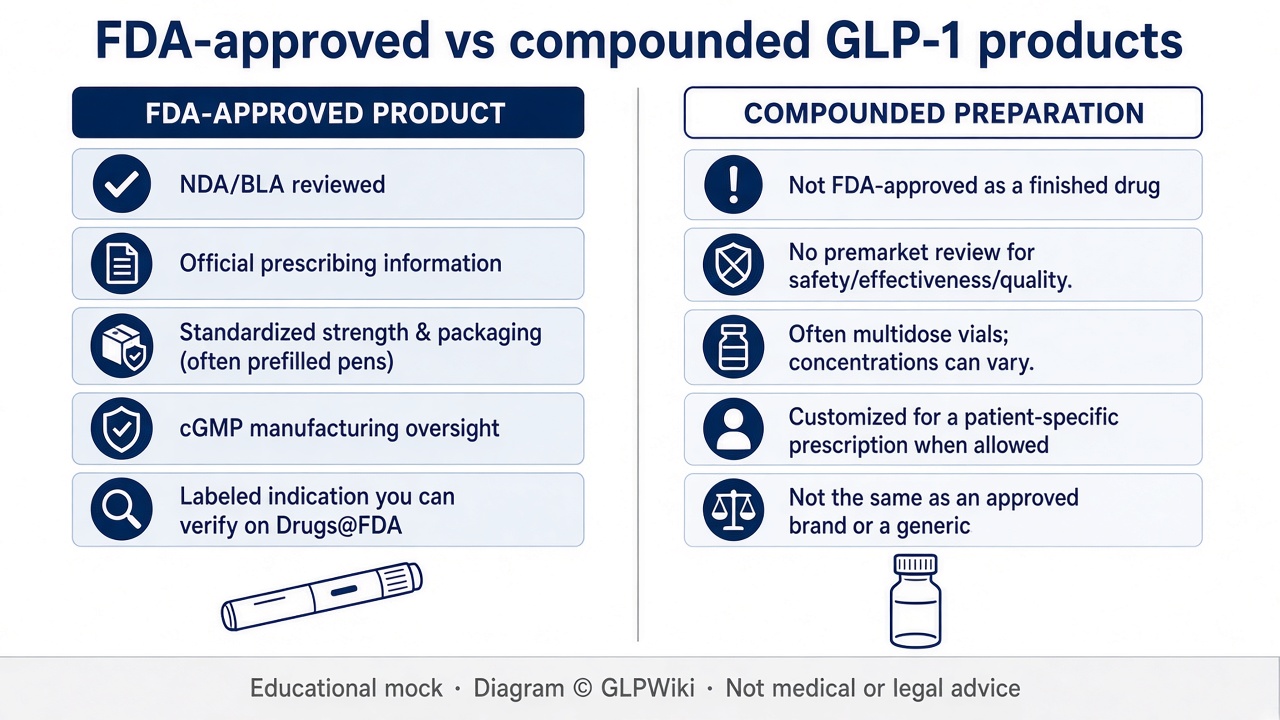
Three practical consequences follow. First, an approved product has official prescribing information — the label — that FDA reviewed. It states the indication, the population, the warnings, the adverse reactions observed in trials, and how the product is supplied. Second, the product is manufactured under current good manufacturing practice requirements, with the oversight regime that implies for identity, strength, quality, and purity. Third, the approval is a public record you can look up, which means a claim of approval is checkable rather than a matter of trust.
In the GLP-1 space, the semaglutide product family includes Ozempic and Rybelsus, approved with type 2 diabetes indications, and Wegovy, approved in the weight-management setting; the tirzepatide family includes Mounjaro and Zepbound with their own respective indications. Those groupings are illustrative, not a current regulatory summary — indications, populations, and labeling change over time as new submissions are reviewed. Always check the current official label for the specific product rather than relying on a description of it, including this one.
Note also what approval does not mean. It does not mean a product is right for a given person, it does not mean it is free of adverse effects, and it does not travel between jurisdictions — approval is granted by a specific regulator for a specific market. Our companion guide on approved versus investigational compounds works through that ladder of status in more detail.
What pharmacy compounding is — and is not
Compounding, as FDA describes it, is the practice of combining, mixing, or altering ingredients to create a medication tailored to the needs of an individual patient. The classic examples are familiar and uncontroversial: a patient who cannot swallow a tablet and needs a liquid, or a patient with a documented allergy to a dye or preservative present in the approved product. Compounding exists to serve medical needs that an approved finished product cannot meet.
The essential fact for this guide is what FDA states plainly: compounded drugs are not FDA-approved. FDA does not verify the safety, effectiveness, or quality of compounded preparations before they are marketed. There is no premarket review of the specific finished preparation, and no FDA-reviewed prescribing information accompanies it. A compounded product is therefore not a generic, and it is not an equivalent of the brand whose molecule it names. Generic drugs are themselves approved products, demonstrated to be bioequivalent to a reference listed drug; compounded preparations undergo no such demonstration.
United States law distinguishes, at a high level, between traditional compounding pharmacies operating under section 503A of the Federal Food, Drug, and Cosmetic Act and outsourcing facilities registered under section 503B, which are subject to different requirements including cGMP and FDA inspection. Those two regimes differ substantially in oversight, permitted activities, and record-keeping. Describing the boundary in any operative detail would be legal analysis, which this page does not provide; readers who need it should consult FDA's compounding resources and appropriate professional advice.
None of this makes compounding inherently improper. It makes it a different category with a different evidentiary basis. When an approved product exists and can meet a patient's documented need, that determination — and any decision to depart from it — sits with a licensed clinician operating within applicable law, not with a website, a supplier's marketing copy, or a reader's own reading of a regulation.
What FDA has publicly raised about unapproved GLP-1 products
FDA has issued public communications specifically about unapproved GLP-1 drugs used for weight loss. Those communications are the best primary source on this topic, and they are worth reading directly rather than through summaries. The agency's stated concerns fall into a few recognizable groups.
The first is structural: because these products are not FDA-approved, no regulator evaluated them for safety, effectiveness, or quality before they reached patients. Every downstream concern follows from that gap, because the ordinary mechanism that would catch a formulation or labeling problem before marketing was never applied.
The second concerns identity and formulation. FDA has described products using salt forms of semaglutide — semaglutide sodium and semaglutide acetate — rather than the base form present in approved products. Salt forms are different active ingredients, and their behaviour in a body is not established to be the same. The agency has also described products combining GLP-1 molecules with additional ingredients, such as vitamins, where no bioequivalence to an approved product has been shown. In several instances FDA has also referred to false or mismatched labeling, meaning the printed contents and the actual contents may not agree.
The third concerns measurement. Approved GLP-1 products are commonly supplied in prefilled pens that deliver a defined amount. Compounded preparations are frequently supplied in multidose vials that require a user to draw a volume with a syringe. That shifts an arithmetic step onto whoever is doing the measuring, and FDA has described dosing errors arising from confusion among milligrams, millilitres, and syringe “units.” Nonstandard and varying concentrations between preparations compound the problem: the same printed number does not correspond to the same volume across products.
The fourth is outcome-level. FDA has stated it has received adverse event reports associated with these unapproved products, including reports involving hospitalization. We summarize that qualitatively and deliberately do not reproduce counts here, because report totals change and are best read from the agency's own current page. Adverse events can be reported through MedWatch, and anyone experiencing a concerning effect should contact a clinician rather than a reference site.
On the measurement point specifically, GLPWiki's own position is worth stating: our calculators perform arithmetic on numbers a user types and deliberately suggest no amount, and our dosing-math guide exists precisely because unit confusion is a documented hazard rather than an abstract one. Understanding that milligrams, millilitres, and syringe graduations are three different kinds of quantity is basic literacy, not a workaround for the absence of a reviewed label.
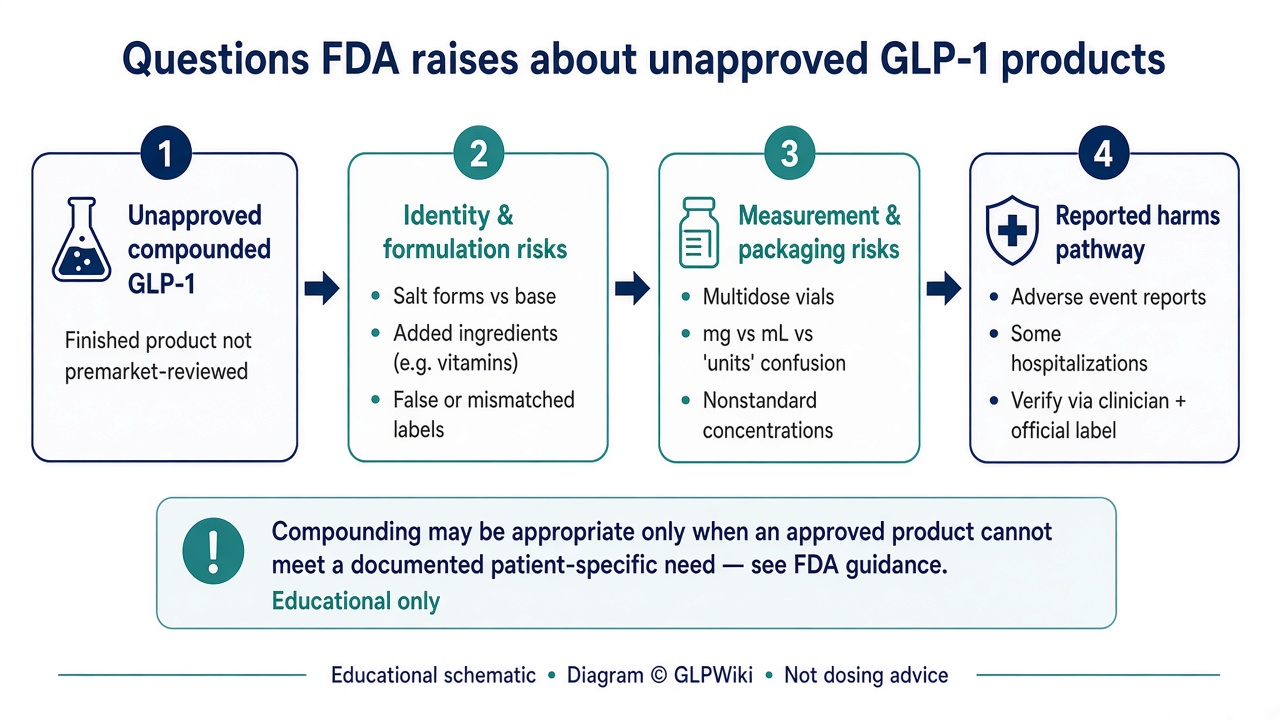
- Premarket review gap: unapproved products were not evaluated by FDA for safety, effectiveness, or quality before marketing.
- Identity and formulation: salt forms such as semaglutide sodium or acetate are not the base form used in approved products; added ingredients have no demonstrated bioequivalence.
- Labeling integrity: FDA has described false or mismatched labels on products in this space.
- Measurement errors: mg, mL, and syringe “units” are distinct quantities, and confusion among them has been described in dosing errors.
- Nonstandard concentrations: multidose vials vary between preparations, unlike the fixed delivery of an approved prefilled pen.
Shortages, copies, and why the picture keeps moving
A recurring question is why compounded versions of well-known GLP-1 medicines appeared widely at all, given that approved products exist. The short answer is that United States law restricts compounding drugs that are essentially copies of commercially available approved drugs, but that restriction interacts with drug shortage status. When an approved product is listed as being in shortage, the practical landscape changes; when the shortage is resolved, it changes back.
That interaction is why this topic resists a stable summary. Shortage listings are updated by FDA on an ongoing basis, and the agency's positions on compounding specific substances — including decisions about bulk drug substance lists and related enforcement policy — have evolved and continue to evolve. Any sentence claiming a fixed present-tense status would be wrong within months.
The correct habit is therefore procedural rather than factual: check FDA's current communications and current shortage listings rather than relying on an article, a forum post, or a seller's claim about what is permitted today. A statement that was accurate during one shortage period is not evidence about the present.
GLPWiki does not offer a conclusion about the legality of any particular arrangement, product, or pharmacy. Those are legal questions with jurisdiction-specific answers, and they are not ours to answer. What we can say is that the absence of FDA approval for a compounded finished product is not contingent on shortage status — that remains true in every period.
How to verify what you are actually looking at
Verification here is a small number of concrete checks, all of which use public records rather than the seller's own material. The goal is not to evaluate a product's merits, which is a clinical task, but to establish which regulatory category it occupies — because that determines what every other claim about it can reasonably mean.
Start with the primary record. Drugs@FDA lists approved products and their labeling; if a product is presented as approved, its application and official prescribing information should be findable there. If it is not, the claim is not supported, whatever a website says. Then read the physical packaging on its own terms: an approved product carries its official labeling, while a compounded preparation carries a pharmacy's own labeling, and research-use-only material carries statements disclaiming human use entirely.
Be clear about what does not constitute approval. A certificate of analysis from a testing laboratory documents what was found in a submitted sample of a lot — that is a purity and identity record, not a regulatory status. A seller's blog post, a comparison chart, a social media thread, or a screenshot of a lab report are not regulatory records at all. Our COA and vial-label guides walk through exactly what those documents do and do not establish.
- Look up the product in Drugs@FDA and read the official prescribing information rather than a description of it.
- Distinguish four categories deliberately: approved, compounded, investigational, and research-use-only — see the approved-vs-investigational guide.
- Read the physical packaging and compare it against any certificate of analysis, using the COA guide and the vial-label guide.
- Do not treat a seller's blog post, comparison chart, COA, or social media claim as evidence of approval.
- Report suspected problems through MedWatch and take clinical questions, including GI symptoms covered in the GLP-1 GI effects guide, to a licensed clinician.
- If arithmetic is involved, understand mg, mL, and syringe units first via the dosing-math guide and the /calculators hub, which compute only what you type and suggest nothing.
What this page deliberately does not do
This guide publishes no dose, no schedule, no escalation plan, and no stack for any compound, approved or otherwise. That is a standing editorial rule across GLPWiki and it is not relaxed for topics where readers would like a number. If a page like this one offered a figure, that figure would be acting as advice regardless of the disclaimer attached to it.
It also offers no guidance on where to obtain anything. GLPWiki does not sell products, does not accept affiliate or sponsored placement, and does not link to pharmacies, suppliers, or marketplaces. We are not in a position to vouch for any seller, and we do not attempt to.
For symptoms, adverse effects, interactions with other medicines, or any question about whether a particular product is appropriate for a particular person, the answer is a licensed clinician working from the official label for the specific product involved. For legal questions about compounding in a given jurisdiction, the answer is qualified professional advice, not an encyclopedia entry.
What this guide does offer is the vocabulary and the record locations needed to read claims about GLP-1 products accurately — which is the same thing every literacy guide on this site is for.
Where to read next
For the molecules themselves, our compound entries for semaglutide and tirzepatide cover mechanism, receptor targets, and the evidence context around each, with human trial data kept separate from preclinical work.
For the surrounding literacy cluster, the approved-vs-investigational guide sets out the full status ladder, the COA guide explains what a certificate of analysis does and does not establish, and the vial-label guide covers reading packaging and matching it against a COA and a listing.
For the arithmetic that FDA's measurement concerns point at, the peptide dosing math guide explains why milligrams, millilitres, and syringe units are three different quantities, and the calculators hub applies those formulas to numbers you supply — with nothing prefilled and nothing recommended.
For the clinical effect profile most commonly asked about, the GLP-1 GI effects explainer covers nausea and gastrointestinal effects at the mechanism level. And for how any of this is sourced and corrected, see our editorial standards and medical disclaimer pages.
Frequently asked questions
- Is compounded semaglutide the same as Ozempic, Wegovy, Mounjaro, or Zepbound?
- No. Those brand names refer to specific FDA-approved finished products with reviewed prescribing information and manufacturing oversight. A compounded preparation is not FDA-approved as a finished product, even when it names the same molecule, and it is not a generic or an equivalent of the brand.
- Are compounded drugs illegal?
- Not categorically. Compounding has a recognized, lawful role in United States pharmacy practice under defined rules, including provisions for individualized patient needs. At the same time, compounding drugs that are essentially copies of commercially available approved drugs is restricted, and the rules are situation- and jurisdiction-specific. This is not legal advice; consult FDA's compounding resources and qualified professional advice.
- Why does FDA warn about unapproved GLP-1 drugs used for weight loss?
- Because those products did not undergo premarket review for safety, effectiveness, or quality, and because the agency has described reports of labeling, formulation, and dosing problems associated with them — including salt forms rather than the base molecule, added ingredients, false labels, and measurement errors with multidose vials. FDA has stated it has received adverse event reports, including some involving hospitalization.
- Does adding B12 or another vitamin make a compounded product better or safer?
- No. Adding an ingredient creates a different formulation whose behaviour has not been demonstrated to match an approved product. FDA has specifically noted combinations with additional ingredients as a concern precisely because no bioequivalence has been shown.
- How can I check a claim that something is “the same as the approved drug”?
- Look the product up in Drugs@FDA and read the official prescribing information. If the specific finished product is not there, it is not approved. A shared international nonproprietary name tells you about the molecule, not about the product's regulatory status, formulation, strength, or quality controls.
- Does GLPWiki recommend a dose, a product, or a pharmacy?
- No. GLPWiki publishes no doses, schedules, or protocols, sells nothing, carries no affiliate or sponsored content, and links to no suppliers or pharmacies. This page is an educational explanation of regulatory categories only.
SOURCES
- 01FDA's Concerns with Unapproved GLP-1 Drugs Used for Weight Loss— U.S. Food and Drug Administration
- 02Understanding the Risks of Compounded Drugs— U.S. Food and Drug Administration
- 03Human Drug Compounding— U.S. Food and Drug Administration
- 04Drugs@FDA: FDA-Approved Drugs database— U.S. Food and Drug Administration
- 05MedWatch: FDA Safety Information and Adverse Event Reporting Program— U.S. Food and Drug Administration
- 06Compounded GLP-1 receptor agonists and dual agonists: statement— American Diabetes Association (Diabetes Care)
EDUCATIONAL REFERENCE ONLY · Not medical advice. Nothing here diagnoses, treats, cures or prevents any disease, and nothing here is a dosing recommendation. Consult a licensed clinician before any treatment decision.