How to read a peptide Certificate of Analysis
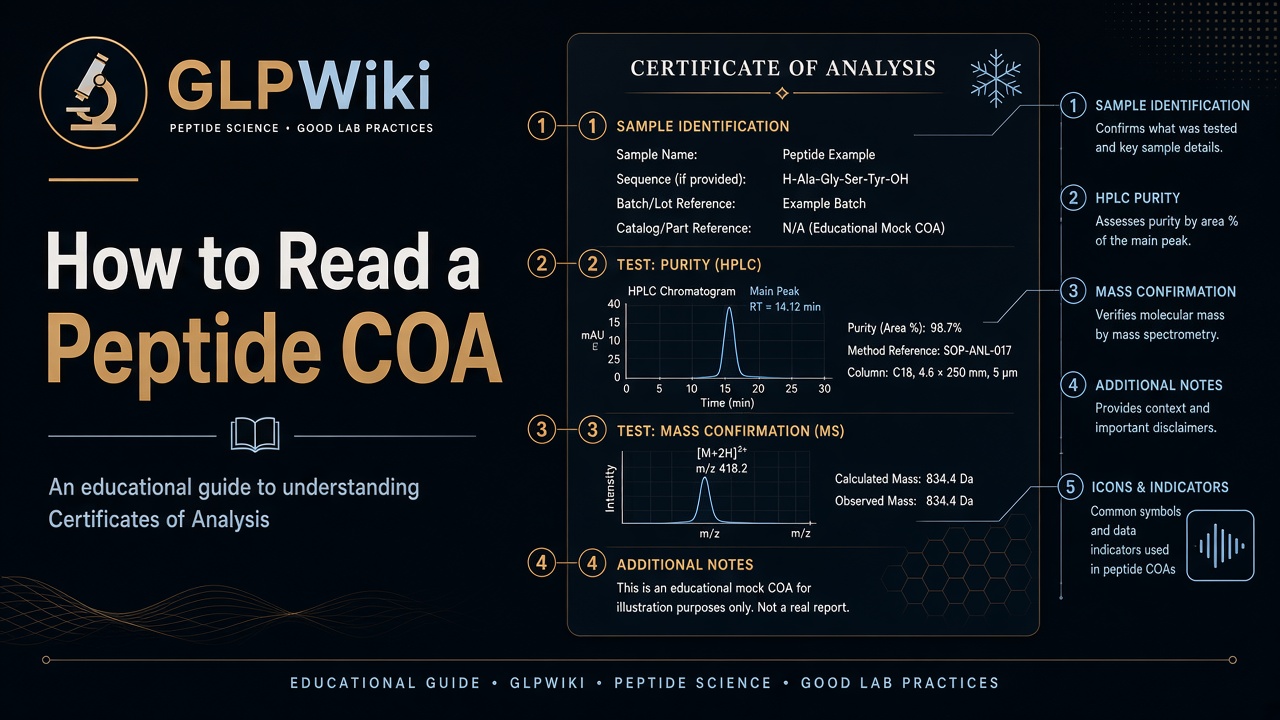
A Certificate of Analysis is only useful if it is lot-specific, method-documented, and matched to the vial in your hand. This guide is a field-by-field checklist: what a COA is, what HPLC and mass spectrometry each answer, why purity is not content, and which red flags mean the paperwork is not doing its job.
UPDATED 10 SEPT 2026 · 14 MIN READ
KEY TAKEAWAYS
- A COA is a batch-specific analytical report — not marketing copy and not a safety or efficacy statement.
- Match the lot/batch number on the COA to the lot on the physical vial and listing. Unmatched paperwork is close to useless.
- HPLC purity answers ‘how much of the detected peptidic signal is the main peak?’ — it does not prove identity by itself.
- Mass spectrometry answers ‘does the measured mass match the intended sequence?’ — purity and identity are separate checks.
- Net peptide content (when reported) is not the same as HPLC purity: salts, water, and counter-ions change how much peptide mass is actually in the vial.
- Method detail matters: a purity percentage without wavelength, method, and preferably a chromatogram is hard to interpret.
- This page is educational only. It is not medical advice, not a dosing guide, and not an endorsement of any seller.
What a Certificate of Analysis is — and is not
A Certificate of Analysis (COA), sometimes called an Analytical Data Sheet, is a document that reports measurements performed on a specific batch of material. For peptides, the usual core is purity by analytical HPLC and identity by mass spectrometry, plus identifiers that tie the report to one lot.
A COA is not a guarantee of clinical safety or efficacy. It is not a prescribing document. It does not, by itself, make a research-labeled material into an FDA-approved drug. Treat it as laboratory paperwork that either does or does not support the claim that this lot matches the intended structure and purity profile.
FDA has separately warned that unapproved and compounded GLP-1 products can carry quality and labeling risks that no marketing page substitutes for. A strong COA is still only one quality signal — and for approved medicines, the regulatory path is Drugs@FDA and the approved label, not a vendor PDF.

Step 1 — Match the lot before you read any numbers
Start with the identifiers, not the purity percentage. Confirm that the product name (and sequence if shown) matches what you ordered, and that the lot or batch number on the COA matches the lot on the vial label and on the packing list or invoice.
If the COA is generic, undated, reused across lots, or missing a lot number, it cannot speak for the vial in your hand. Reputable manufacturers treat the lot as the unit of quality; Bachem’s public guidance on Analytical Data Sheets, for example, ties ADS retrieval to product number and lot number found on the label.
- Product / peptide name matches the order and the vial.
- Lot or batch number matches COA ↔ vial ↔ packing documents.
- Test or issue date is present and plausible for the lot.
- Issuing laboratory or manufacturer is named.
Step 2 — HPLC purity: what the percentage actually means
Analytical reverse-phase HPLC with UV detection (commonly around 210–220 nm, where the peptide bond absorbs) is the standard purity assay for peptides. The purity figure is typically the area of the main peak as a percentage of the total area of peaks detected under those conditions.
That definition has built-in limits. Impurities that do not absorb at the detection wavelength do not reduce the purity number. Closely related substances can co-elute under the main peak. Counter-ions such as trifluoroacetate, residual water, and many salts are largely invisible to that UV purity calculation — which is why purity and peptide content are different fields.
Ask for method context whenever you can: detection wavelength, column/gradient notes, and preferably the chromatogram or integration table. A bare ‘99%’ without method is weakly interpretable.
Step 3 — Mass spectrometry: identity is a separate question
Mass spectrometry measures mass-to-charge and is used to confirm that the observed mass matches the theoretical mass expected for the intended sequence (within a stated tolerance). HPLC can tell you that one main peak dominates; MS is what ties that peak to the molecule you think you bought.
A high HPLC purity with the wrong mass is a failure of identity. A correct mass with poor chromatographic purity is a different problem. Orthogonal checks exist for a reason: manufacturers such as Bachem describe HPLC purity and MS molecular weight as complementary QC elements summarized on the ADS/CofA.

- Theoretical mass for the stated sequence is shown.
- Observed / measured mass is shown (not only ‘conforms’).
- Tolerance or accuracy statement is present.
- Ionization / method notes are a plus (ESI, MALDI, etc.).
Step 4 — Net peptide content vs HPLC purity
Net peptide content (NPC) estimates how much of the vial’s mass is actual peptide versus water, counter-ions, and other non-peptidic material. It is often determined by elemental nitrogen analysis or amino acid analysis — not by reading the HPLC purity percentage as if it were a mass fraction.
If you later use reconstitution math, remember that concentration = peptide mass ÷ diluent volume. An ambiguous vial mass (total lyophilate vs net peptide) changes the concentration you calculate. See GLPWiki’s dosing-math and reconstitution guides, and use the calculators only with inputs you understand — never as a dosing recommendation.
Field-by-field checklist
Use this as a reading checklist. It is not a purchasing recommendation and not a pass/fail medical clearance.
- Lot number present and matches the vial.
- Product name / sequence consistent across COA, label, and listing.
- HPLC purity % with method context (wavelength / conditions) and ideally a chromatogram.
- Mass spectrometry: observed vs theoretical mass within stated tolerance.
- Net peptide content reported when quantitative work depends on true peptide mass.
- Issuing lab named; date present; no obvious copy-paste or lot mismatch.
- Clear about what was NOT tested (sterility, endotoxin, residual solvents, etc., if absent).
Red flags
Treat these as reasons to distrust the paperwork — not as clinical advice.
- COA without a lot number, or lot that does not match the vial.
- Purity claim with no method, no chromatogram, and no MS identity.
- ‘Conforms’ identity with no measured mass shown.
- Stock photos or the same PDF recycled for every lot.
- Claims that a research COA makes a product FDA-approved or interchangeable with an approved drug.
Approved medicines vs research paperwork
For FDA-approved peptide and incretin medicines, quality and labeling live in the approved application and prescribing information — not in a third-party research COA. FDA has published concerns about unapproved GLP-1 drugs used for weight loss, including quality, labeling, and dosing-error issues with some compounded and fraudulent products.
GLPWiki records regulatory status on compound pages. When the question is ‘is this an approved drug?’, verify on Drugs@FDA and the official label — not on a seller blog.
Related tools and next reading
After you understand the lot’s analytical story, reconstitution and syringe math are separate skills: they convert masses and volumes you supply into concentration and draw volume. They never recommend a dose.
Continue with how to reconstitute peptides, peptide dosing math, bacteriostatic water ratios, and the reconstitution / syringe-draw calculators. Unfamiliar terms — net peptide content, counter-ion, lyophilate — are defined in the glossary, and the sourcing rules behind this page are set out in the editorial standards and medical disclaimer.
Frequently asked questions
- Is HPLC purity the same as peptide content?
- No. HPLC purity is usually an area percentage among UV-detected peaks. Net peptide content estimates how much of the solid mass is peptide versus water, salts, and counter-ions. Both can appear on a thorough COA.
- Can a peptide be ‘99% pure’ and still be the wrong molecule?
- Yes. Purity describes the dominance of a main peak; identity requires a separate check, typically mass spectrometry against the theoretical mass for the intended sequence.
- What if the COA lot number does not match my vial?
- Then the COA does not describe that vial. Lot matching is the first check; without it, the purity and identity numbers are not evidence for your material.
- Does a good COA mean a product is FDA-approved?
- No. A COA is analytical paperwork for a batch. FDA approval is a separate regulatory status. Check Drugs@FDA and official labeling for approved products.
- Should I use COA purity numbers to choose a dose?
- No. GLPWiki does not provide dosing recommendations. Calculators on this site perform arithmetic on user-supplied inputs only and are for educational reconstitution math.
SOURCES
- 01Quality Control of Amino Acids & Peptides: A Guide (HPLC purity; MS molecular weight; ADS/CofA)— Bachem Knowledge Center
- 02Analytical Data Sheet (ADS) — lot-specific documentation— Bachem Knowledge Center
- 03FDA’s Concerns with Unapproved GLP-1 Drugs Used for Weight Loss— U.S. Food and Drug Administration
- 04Understanding the Risks of Compounded Drugs— U.S. Food and Drug Administration
EDUCATIONAL REFERENCE ONLY · Not medical advice. Nothing here diagnoses, treats, cures or prevents any disease, and nothing here is a dosing recommendation. Consult a licensed clinician before any treatment decision.