How to read a peptide clinical study: trial design literacy for endpoints, phases, and evidence
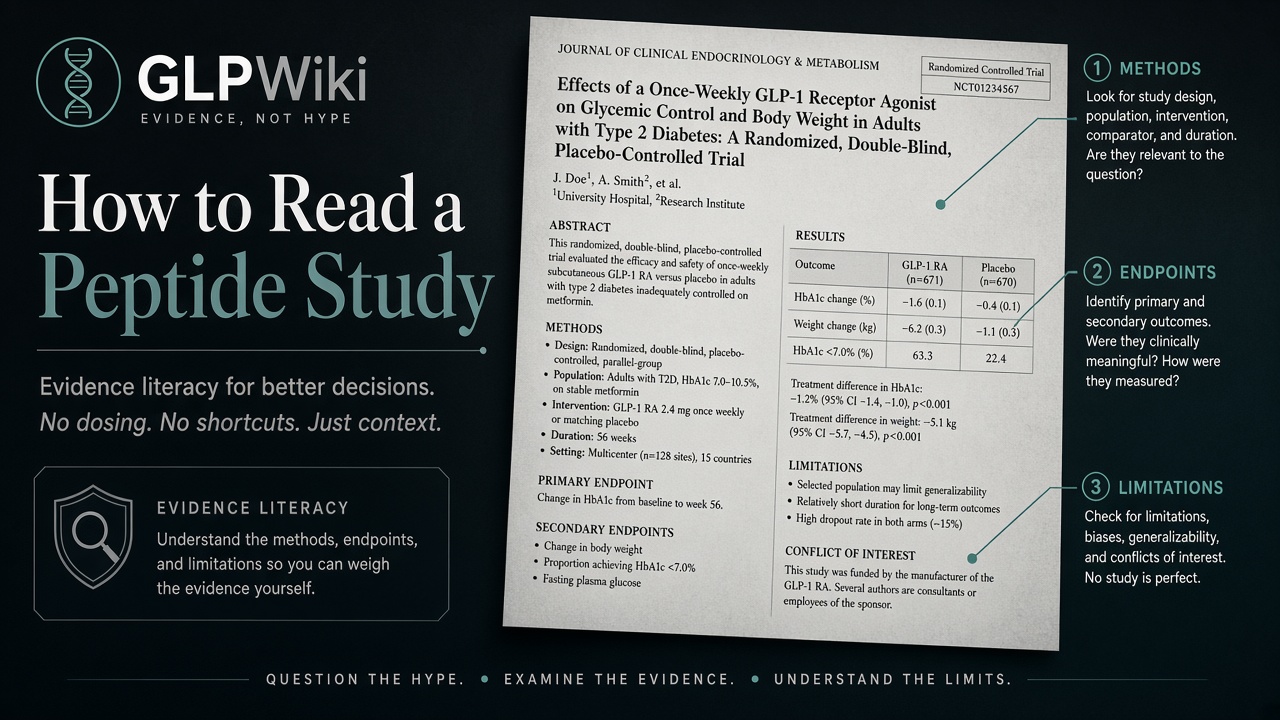
Peptide claims online often collapse press releases, preprints, Phase 2 signals, and FDA-approved labeling into one confident sentence. This literacy guide explains how to read a clinical study's structure — methods before headlines, primary before secondary, absolute before relative — and how to verify status on ClinicalTrials.gov, PubMed, and Drugs@FDA. Educational only: no dosing, no protocols, no product picks.
UPDATED 18 SEPT 2026 · 16 MIN READ
KEY TAKEAWAYS
- Start with registration and Methods, not the Abstract headline or a press release.
- Primary endpoints are the outcomes the trial was designed and powered to test; secondary and exploratory findings usually need more caution, especially after many analyses.
- Relative change can look large while absolute difference is small — ask for both, plus baseline rates.
- CONSORT-style reporting and ClinicalTrials.gov registration improve transparency; they do not equal FDA approval.
- Press releases and investor decks are awareness tools, not substitutes for peer-reviewed methods and results.
- Approved labeling evidence for a finished product is a different evidence bar from investigational trial claims about a molecule or formulation.
- Verify with Drugs@FDA, ClinicalTrials.gov, and PubMed/PMC — never invent citations or trust a screenshot alone.
- This page publishes no doses, schedules, stacks, compounding recipes, or product recommendations.
Why study literacy matters for peptide claims
Peptide conversations online move fast. A Phase 1 safety study can be described as proven. A secondary endpoint can be presented as the main result. A preprint can be treated as settled science. An investor deck can be quoted as if it were FDA labeling. The molecule name stays the same across those documents; the evidence bar does not.
Study literacy is the habit of asking which document supports a claim, what the trial was designed to show, and what it cannot show. That habit matters especially for peptides and incretin medicines because the same chemical name may appear in approved finished drugs, investigational programs, compounded preparations, and research-use-only listings. Category confusion is common; careful reading reduces it.
This guide is educational reference material for readers who want to evaluate claims about clinical studies. It is not medical advice, not a protocol, and not a recommendation to use, buy, or compound any product. Clinical decisions belong with licensed clinicians working from current official labeling for approved products, or from trial protocols for investigational use.
Anatomy of a clinical paper
Most clinical papers follow a recognizable structure: Title and Abstract, Introduction, Methods, Results, Discussion, and Limitations, often with a trial registration identifier. The Abstract is a compressed snapshot. It can be useful for triage, but it is a poor place to stop — especially when marketing language echoes only the Abstract's most favorable sentence.
Methods is where design lives: who was enrolled, what interventions were compared, how outcomes were defined, which analysis set was primary, and whether multiplicity (many tests) was controlled. Results should lead with the primary endpoint. Discussion interprets; Limitations should disclose bias, power, missing data, and generalizability problems. Registration (for example an NCT number on ClinicalTrials.gov) lets you compare what was promised to what was reported.
A practical reading order for literacy is: registration → Methods (outcomes and statistics) → primary Results → Limitations → only then Abstract marketing language or press coverage. That order makes it harder for selective reporting to hide.
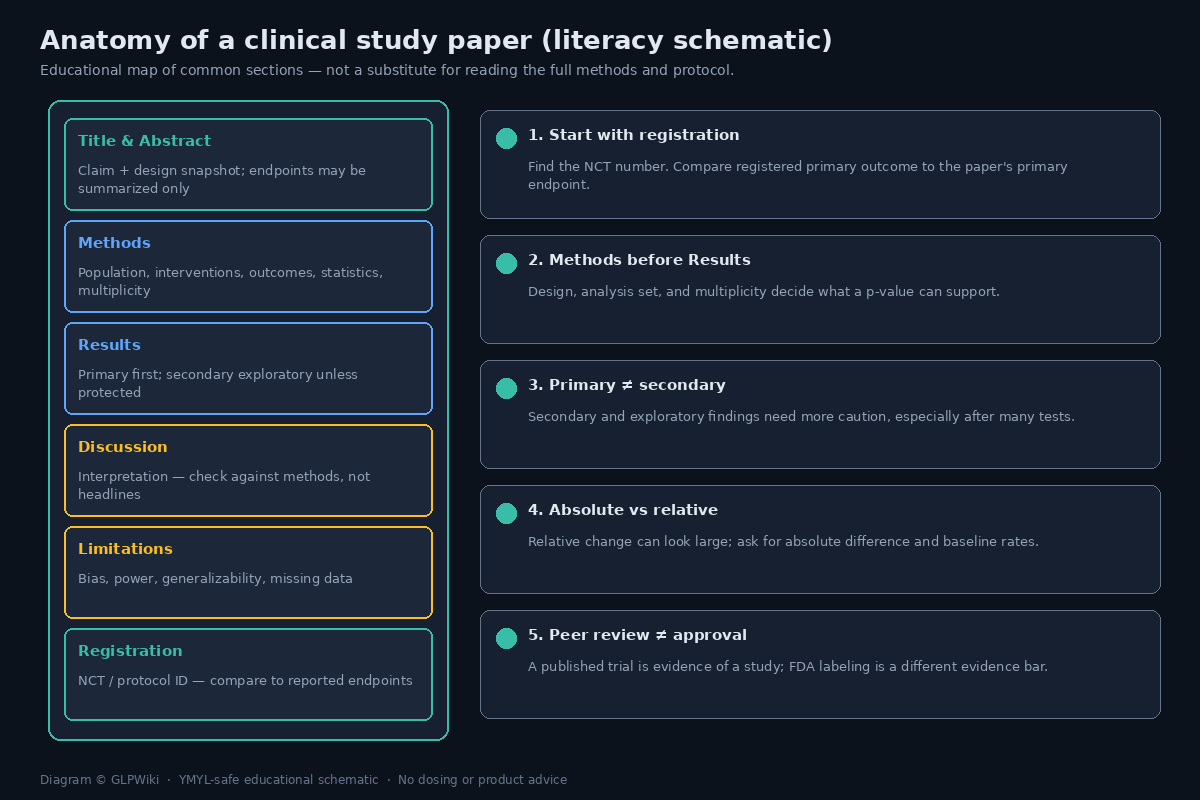
- Abstract: triage only — verify claims in Methods and Results.
- Methods: population, interventions, endpoints, statistics, multiplicity.
- Results: primary endpoint first; secondary needs extra caution.
- Registration: compare NCT/protocol outcomes to published outcomes.
Trial phases and what each can (and cannot) show
Clinical development is often described in phases. Phase 1 studies typically focus on safety, pharmacokinetics, and tolerability in small groups. They are not designed to prove clinical benefit for a labeled indication. Phase 2 studies often explore dose ranges and look for signals on efficacy or biomarkers; many endpoints remain exploratory.
Phase 3 (and related pivotal) trials are usually larger confirmatory studies intended to test whether an intervention works for predefined clinical outcomes in a defined population. Even a well-run Phase 3 paper is still a study report — not the same thing as an approved product label. Preclinical work (cells, animals) can inform mechanism; it is not human evidence of benefit.
When a peptide claim cites clinical evidence, ask which phase, which population, which endpoint, and whether the claim concerns an approved finished product or an investigational program. Phase language is a map of intent, not a stamp of approval.
- Phase 1: safety / PK — not clinical benefit proof.
- Phase 2: signal-seeking / dose-finding — often hypothesis-generating.
- Phase 3 / pivotal: confirmatory intent — still not automatically a label.
- Preclinical: mechanism clues — not human outcome evidence.
Primary vs secondary endpoints and multiplicity
The primary endpoint is the outcome the trial was principally designed and statistically powered to evaluate. Secondary endpoints may be important, but they are usually not the sole basis for the trial's confirmatory claim unless the protocol and analysis plan protect them (for example with a hierarchical testing strategy).
Multiplicity means many statistical tests. The more outcomes you test, the more likely some significant findings appear by chance. Transparent papers and CONSORT-oriented reporting encourage authors to state which outcomes were primary, which were secondary, and how Type I error was controlled. When a social post elevates a secondary or post-hoc finding while ignoring the primary result, treat that as a red flag.
Also check the analysis population: intention-to-treat, modified intention-to-treat, per-protocol, and completer analyses answer related but different questions. A dramatic per-protocol result can look stronger than the primary analysis set the trial committed to in advance.
Absolute vs relative change and risk literacy
Relative change answers by what percentage did something move? Absolute change answers by how many percentage points or units did it move from baseline? Both can be true at once. A relative risk reduction of 50% sounds large; if the baseline event rate moved from 2% to 1%, the absolute difference is 1 percentage point.
For continuous outcomes (weight, HbA1c, lab values), ask for the absolute difference between groups, the baseline values, the confidence interval or uncertainty, and the time point. For binary events, ask for absolute risk difference when reported responsibly — remembering that those metrics are context-specific and not personal prescriptions.
Marketing and headlines often prefer relative framing because it sounds bigger. Literacy prefers both frames plus the baseline. If a claim refuses to state absolute differences, that is information about the claim's quality.
- Prefer absolute difference + baseline alongside any relative percentage.
- Check time point, population, and uncertainty (CI), not only a point estimate.
- Headline-friendly relative figures are not automatically the primary endpoint.
Registration, CONSORT-style reporting, preprint vs peer review
ClinicalTrials.gov study records summarize protocol information such as recruitment status, eligibility, interventions, and outcome measures, and may later include posted summary results. NLM quality-control review checks for apparent errors and inconsistencies; it does not verify scientific validity. Use registry history of changes to see whether outcome definitions shifted over time.
CONSORT is a reporting guideline for randomized trials (now updated as CONSORT 2025 on the EQUATOR Network and CONSORT-SPIRIT sites). CONSORT-oriented papers are easier to appraise because they encourage clear flow diagrams, outcome definitions, and harms reporting. Good reporting is not the same as FDA approval, and poor reporting does not automatically mean a study is false — but opaque reporting should lower your confidence.
Preprints share manuscripts before peer review. They can be valuable for speed and transparency, but they have not passed journal peer review. Peer-reviewed publication improves scrutiny; it still does not convert a trial into approved labeling. Read Methods and registered outcomes either way.
Press releases and investor decks vs Methods sections
Press releases and investor presentations are written to communicate selectively. They may emphasize favorable endpoints, omit failed co-primaries, under-specify harms, or blur investigational status. They are useful as pointers to a study — not as the study.
When a peptide claim arrives via a screenshot of a deck, ask for the NCT number, the peer-reviewed paper or preprint, the primary endpoint result, and the regulatory status of any finished product named. If those cannot be produced, you do not yet have evidence literacy — you have marketing awareness.
Company blogs and key-opinion threads sit in the same bucket until they link to primary documents you can verify. GLPWiki's standard is citation-first: prefer Drugs@FDA, ClinicalTrials.gov, PubMed/PMC, and official reporting guidelines over secondary summaries.
Approved labeling evidence vs investigational trial claims
An FDA-approved finished drug has reviewed labeling (Prescribing Information) for specific indications, populations, and conditions of use. That label is a regulatory document about a finished product — manufacturing, clinical pharmacology, warnings, and efficacy claims as the Agency allowed them to be stated. It is not a scrapbook of every study ever run on a related molecule.
Investigational claims concern programs still under study. A strong Phase 3 publication can be important evidence about a trial population and endpoint, yet the compound may remain unapproved. Conversely, approved labeling may emphasize a narrower set of evidence than every exploratory analysis circulating online.
Compounded and research-use materials do not inherit approved labeling simply because they share a peptide name. Keep three questions separate: (1) What did this trial show under its design? (2) Is there an approved finished product with current labeling? (3) Is the item being discussed that finished product, an investigational agent, or something else?
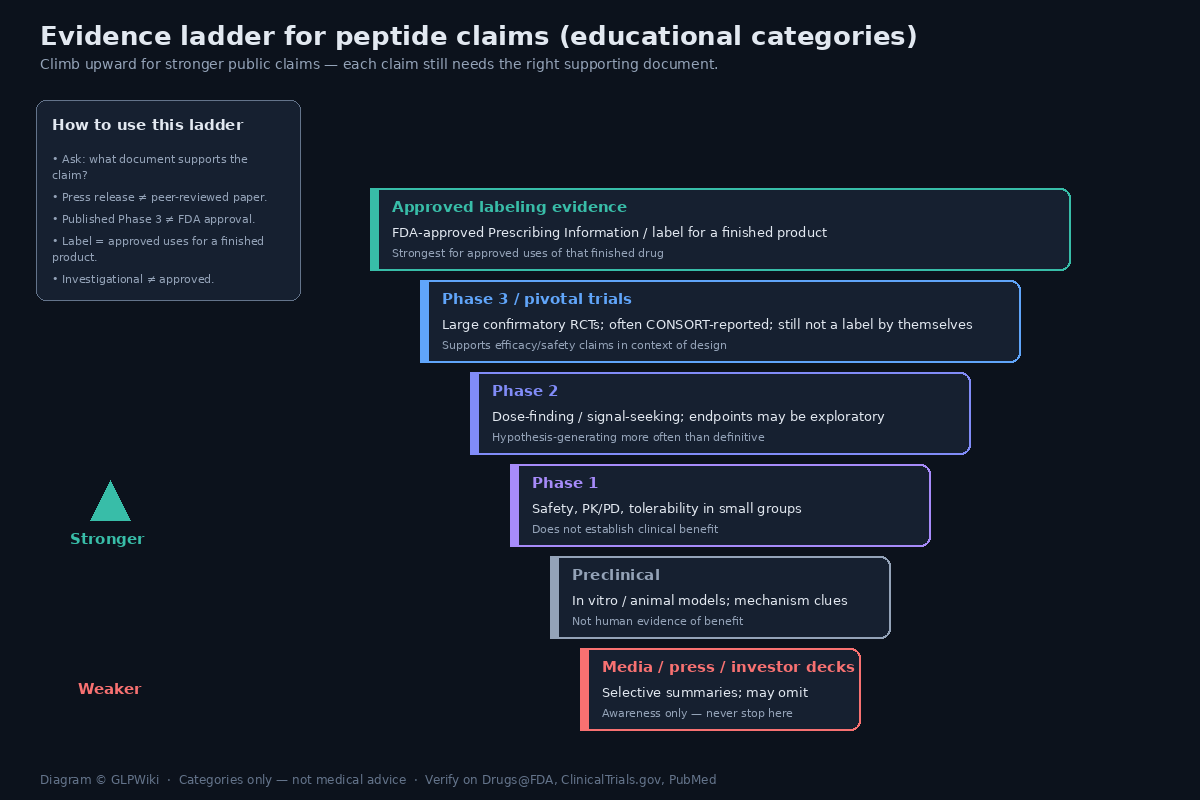
- Approved label: finished product + reviewed claims for labeled uses.
- Investigational trial: evidence about a study — not automatic approval.
- Press / decks: awareness layer — verify before repeating claims.
How to verify (Drugs@FDA, ClinicalTrials.gov, PubMed)
For approved U.S. products, start at Drugs@FDA. Open the current label and, when available, clinical and statistical review documents from the approval package. Labels and reviews answer different questions: the label states approved use; reviews often discuss trial details, sensitivity analyses, and reviewer concerns more fully.
For trials and investigational programs, use ClinicalTrials.gov. Read the study record's outcomes, status, and — if posted — results modules. Cross-check the NCT number cited in a paper. For literature, use PubMed or PMC and prefer full methods over abstract-only claims.
A reliable peptide claim names the molecule or product, the document type (label, review, registry record, peer-reviewed paper, preprint), the primary endpoint, and the regulatory status. If any of those are missing, the claim is incomplete.
- Drugs@FDA: labels and approval/review packages for finished products.
- ClinicalTrials.gov: registration, outcome definitions, posted results.
- PubMed/PMC: peer-reviewed methods and results.
- EQUATOR / CONSORT-SPIRIT: reporting standards for appraising trial papers.
What this page does not do
This page does not recommend medicines, doses, schedules, stacks, suppliers, pharmacies, telehealth services, or compounding recipes. It does not interpret a study for a personal clinical decision, and it does not declare whether any product is appropriate for a reader.
Appraising evidence literacy is not the same as practicing medicine. If you use an approved medicine, follow the current official label and your licensed clinician's guidance. If you are considering research participation, that belongs under a protocol and informed consent process — not under a wiki explainer.
- No doses, protocols, stacks, or product picks.
- No compounding or reconstitution instructions.
- No personal risk–benefit judgements.
- No invented citations or fabricated DOIs.
Next reading
Pair this page with the approved versus investigational peptides guide and the compounded versus FDA-approved GLP-1 guide — those pages police category boundaries that study literacy depends on. For document literacy at the vial and certificate level, read how to read a peptide COA.
For related concept literacy without schedules, the titration concepts guide explains how labels talk about initiation and maintenance. Together, these pages aim to make peptide claims checkable instead of merely shareable.
Frequently asked questions
- What is a primary endpoint?
- The primary endpoint is the main outcome a trial was designed and powered to evaluate. It should be defined in the protocol and registration. Secondary and exploratory outcomes may still be informative, but they usually carry more risk of chance findings, especially when many are tested.
- Does a peer-reviewed Phase 3 paper mean FDA approval?
- No. Peer-reviewed publication means a journal reviewed a manuscript. FDA approval of a finished product is a separate regulatory decision reflected in labeling and Drugs@FDA records. Strong trials often support approvals, but the documents are not interchangeable.
- Why do press releases feel more confident than papers?
- Press materials are written to highlight selected messages. Methods sections constrain claims with populations, endpoints, statistics, and limitations. Literacy prefers the constrained document over the promotional summary.
- What is CONSORT?
- CONSORT is a reporting guideline for randomized trials, maintained with updates catalogued by the EQUATOR Network and the CONSORT-SPIRIT website. It helps authors report trials more completely so readers can appraise design, outcomes, and harms. It is a reporting standard, not an approval.
- How do I use ClinicalTrials.gov when reading a peptide study?
- Find the NCT number, open the study record, and compare registered primary outcomes with the paper's primary endpoint. Check status, eligibility, interventions, and — when available — posted results. QC review on ClinicalTrials.gov does not prove scientific validity.
- What is the difference between absolute and relative results?
- Relative results describe proportional change; absolute results describe the actual difference from baseline or between groups. Both can be true. Claims that only show relative percentages without baselines or absolute differences are incomplete for literacy purposes.
- Where do I verify an approved peptide or incretin medicine?
- Use Drugs@FDA for the current U.S. label and related review documents for the exact finished product. Do not assume a compounded or research-use item inherits that label because it shares a molecule name.
- Does this page tell me how to dose a peptide?
- No. This page is study-design literacy only. It does not provide doses, schedules, stacking advice, compounding recipes, or product recommendations. Clinical use of approved medicines belongs with licensed clinicians and current official labeling.
SOURCES
- 01How to read a ClinicalTrials.gov study record— ClinicalTrials.gov / U.S. National Library of Medicine
- 02ClinicalTrials.gov— U.S. National Library of Medicine
- 03CONSORT 2025 reporting guideline (EQUATOR Network record)— EQUATOR Network
- 04CONSORT-SPIRIT official site— CONSORT-SPIRIT
- 05CONSORT 2025 statement (BMJ)— BMJ
- 06Drugs@FDA: approved drug products and labels— U.S. Food and Drug Administration
- 07How to use FDA drug approval documents for evidence syntheses— BMJ
- 08ICMJE Recommendations (manuscript & trial reporting norms)— International Committee of Medical Journal Editors
- 09PubMed— U.S. National Library of Medicine
- 10About the Results Database (ClinicalTrials.gov)— ClinicalTrials.gov / U.S. National Library of Medicine
EDUCATIONAL REFERENCE ONLY · Not medical advice. Nothing here diagnoses, treats, cures or prevents any disease, and nothing here is a dosing recommendation. Consult a licensed clinician before any treatment decision.