Oral peptides and absorption: why tablets are hard, and what SNAC vs non-peptide agonists change
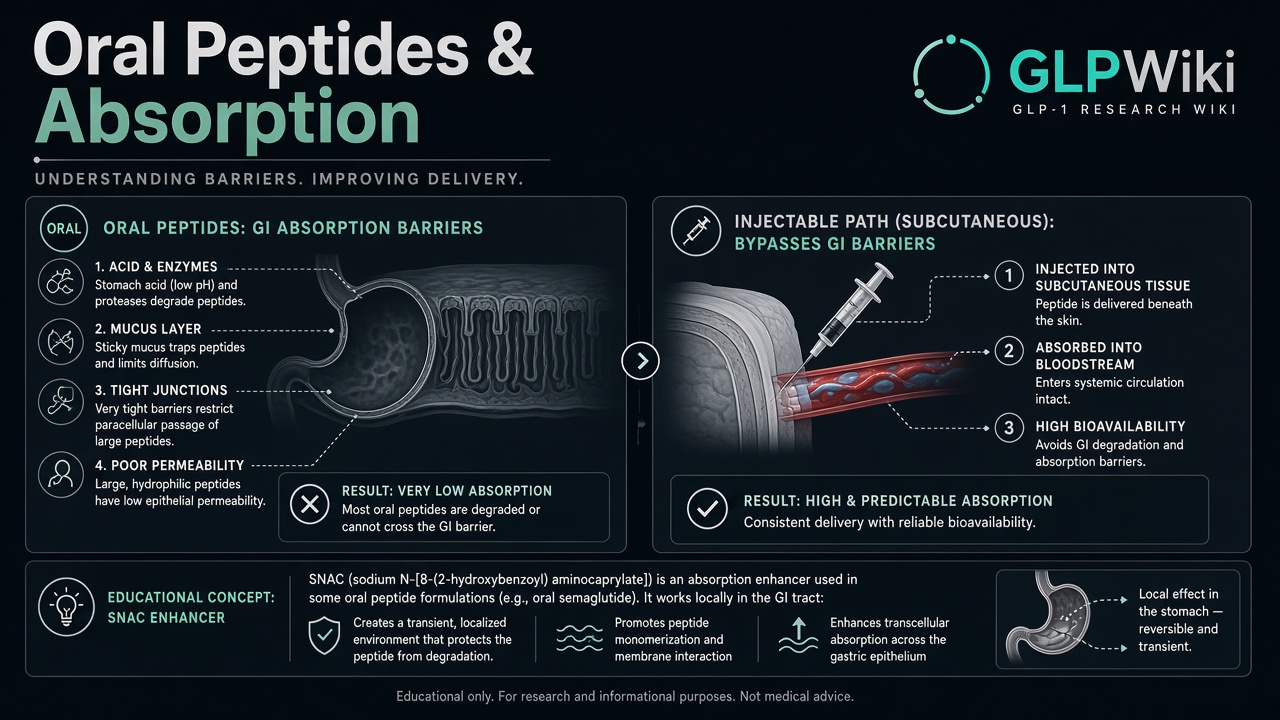
Most therapeutic peptides degrade in the gut and absorb poorly as tablets. Oral semaglutide uses an absorption enhancer (SNAC) with strict labeled dosing conditions and low absolute bioavailability. Non-peptide oral GLP-1 receptor agonists are a different chemical class with different absorption pharmacokinetics. This literacy guide explains the concepts and where to verify status — without recommending any product, dose, or schedule.
UPDATED 17 SEPT 2026 · 14 MIN READ
KEY TAKEAWAYS
- Native and therapeutic peptides face acid, proteases, mucus, and low membrane permeability — so oral bioavailability is usually very low without formulation help.
- Oral semaglutide, an FDA-approved tablet, co-formulates the peptide with SNAC to support stomach-localized absorption; absolute bioavailability is on the order of 0.4–1% under studied conditions and depends strongly on fasting and water-volume conditions described in labeling.
- Non-peptide oral GLP-1 receptor agonists, including investigational orforglipron, are small molecules rather than peptides; they do not use SNAC and show substantially higher oral bioavailability in published pharmacokinetic studies.
- "Oral GLP-1" in marketing language can mean either an approved peptide tablet or an investigational small molecule — verify chemical class and regulatory status separately.
- Compounded or research-use oral peptide products do not inherit Rybelsus labeling, SNAC formulation science, or approved manufacturing controls.
- This page publishes no doses, fasting protocols as advice, schedules, or product recommendations.
Why most peptides absorb poorly as tablets
A peptide is a chain of amino acids. That chemistry is useful for receptor selectivity, but it creates a problem for tablets: the gastrointestinal tract is built to dismantle proteins and peptides before their building blocks are absorbed. Stomach acid and pepsin can begin fragmenting peptide bonds, and intestinal enzymes such as trypsin, chymotrypsin, and carboxypeptidases continue that work farther down the lumen.
Even if a peptide survives those enzymes, it still has to cross physical barriers. Mucus can trap large, water-soluble molecules before they reach the epithelial surface. Tight junctions restrict paracellular movement between cells, and the lipid membranes of intestinal cells are poorly suited to passive diffusion by large hydrophilic molecules. The result is that most intact peptides have extremely low oral absorption unless formulation technology changes the local environment or the molecule is redesigned.
This is why injectable routes have historically dominated peptide therapeutics. Injection bypasses the digestive lumen and delivers the molecule into a compartment where it can reach circulation without first surviving acid, proteases, mucus, and epithelial permeability limits. Oral peptide tablets are therefore not ordinary tablets with a peptide inside; when they work, they usually depend on specific formulation and clinical pharmacology evidence for that exact finished product.
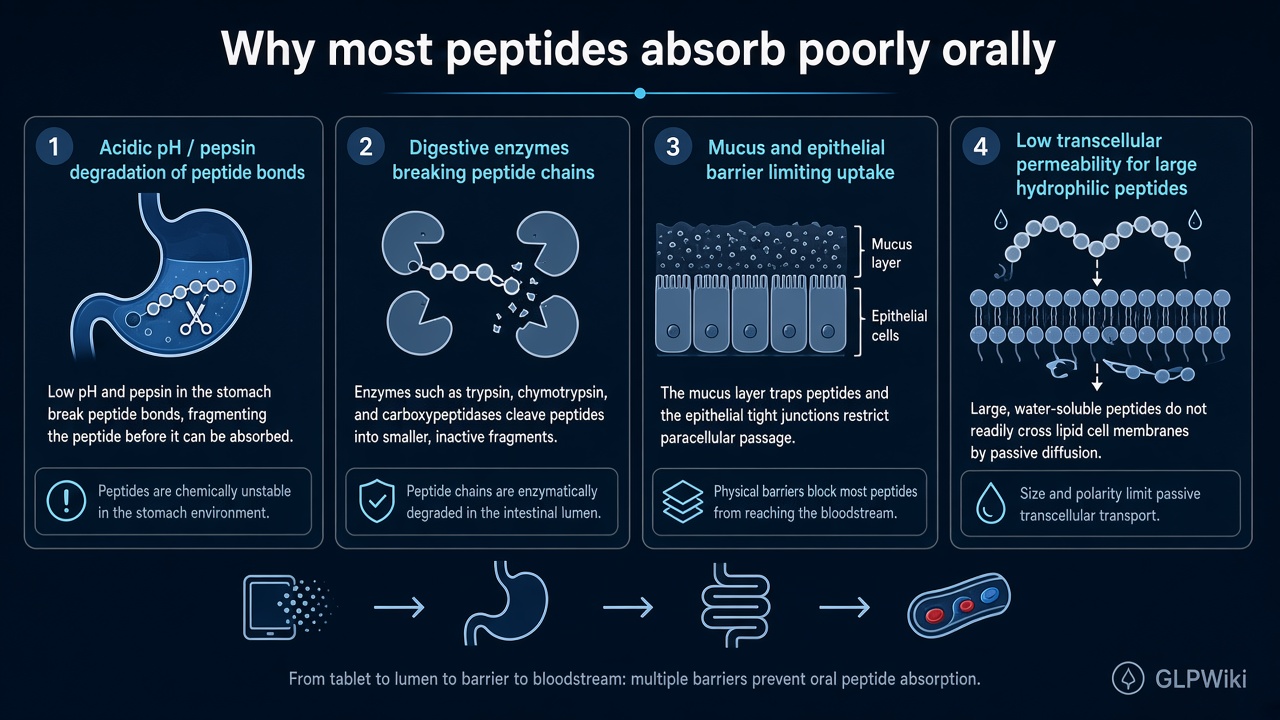
- Acid and pepsin can fragment peptide bonds in the stomach.
- Digestive proteases can further cleave peptide chains in the intestinal lumen.
- Mucus, epithelial tight junctions, and hydrophilic size limit intact uptake.
- Injectable delivery historically avoided these gut barriers for many peptide drugs.
What oral bioavailability means (literacy)
Absolute bioavailability is the fraction of an administered dose that reaches systemic circulation intact compared with an intravenous reference, which by definition enters circulation directly. For oral products, the number reflects everything that happens before the molecule reaches the blood: dissolution, chemical stability, enzymatic degradation, membrane crossing, and first-pass handling by the body.
A low percentage is not automatically the same thing as clinical failure. A potent molecule can still be useful if exposure is reproducible enough under the conditions tested and reviewed for that finished product. That conclusion belongs to clinical pharmacology and regulatory review, not to home arithmetic. A reader cannot take a bioavailability percentage, multiply it by a tablet strength, and infer a personal plan.
Oral peptides can also show substantial variability within the same person from day to day. Food, water volume, gastric contents, timing, and formulation details may shift exposure. The useful literacy point is not to memorize one number; it is to understand why labels for oral peptide products can contain unusually specific administration language and why that language cannot be casually transferred to another product.
SNAC and oral semaglutide: approved peptide tablet
In 2019, the FDA announced approval of the first oral GLP-1 treatment for type 2 diabetes: oral semaglutide, marketed as Rybelsus. Semaglutide is still a peptide. The tablet works by combining that peptide with an absorption enhancer, SNAC, also called salcaprozate sodium or sodium N-(8-[2-hydroxybenzoyl] amino) caprylate.
Mechanistic literature describes SNAC as acting locally in the stomach. It can raise the local pH around the tablet, helping protect semaglutide from acid-mediated degradation; it can reduce semaglutide oligomerization; and it can transiently increase gastric epithelial permeability so that a limited amount of intact peptide crosses into circulation. That is very different from saying the gut simply absorbs peptides well. The formulation creates a narrow, product-specific absorption opportunity.
Clinical pharmacokinetic analyses of oral semaglutide report mean absolute bioavailability around 0.8% under recommended administration conditions, with the broader literature describing values on the order of about 0.4–1% depending on study conditions. Exposure is sensitive to food and water conditions described in the FDA-reviewed labeling. GLPWiki does not restate those conditions as instructions; readers using an approved product should read the current FDA label and Medication Guide for the product itself, and clinical questions belong with a licensed clinician or pharmacist.
The key category distinction is that oral semaglutide is an approved finished drug with reviewed labeling and manufacturing controls. That does not make every oral peptide claim equivalent to it, and it does not make SNAC a generic shortcut that can be assumed to validate compounded, research-use, or investigational products.
Peptide + enhancer vs non-peptide oral agonists
Two very different strategies can sit under the casual phrase "oral GLP-1". The first is a peptide plus an absorption enhancer: oral semaglutide remains a peptide GLP-1 receptor agonist, and SNAC helps a small fraction absorb through the stomach under labeled conditions. The second is a non-peptide small molecule designed to activate the GLP-1 receptor after conventional oral absorption pathways.
Orforglipron (LY3502970) is an example of the second strategy. It is described in the literature as a non-peptide oral GLP-1 receptor agonist, not as an oral peptide. As of this writing, it remains investigational rather than FDA-approved as a finished marketed medicine; status should be verified through Drugs@FDA and ClinicalTrials.gov rather than through headlines or investor summaries.
Published disposition work has reported mean absolute oral bioavailability for orforglipron of about 79% in healthy participants. That large difference from oral semaglutide is a chemical-class and formulation distinction, not a consumer tip and not a claim that one product should be preferred. A small molecule that survives the GI tract and crosses membranes through conventional pathways is solving a different problem than a peptide tablet that needs a local absorption enhancer.
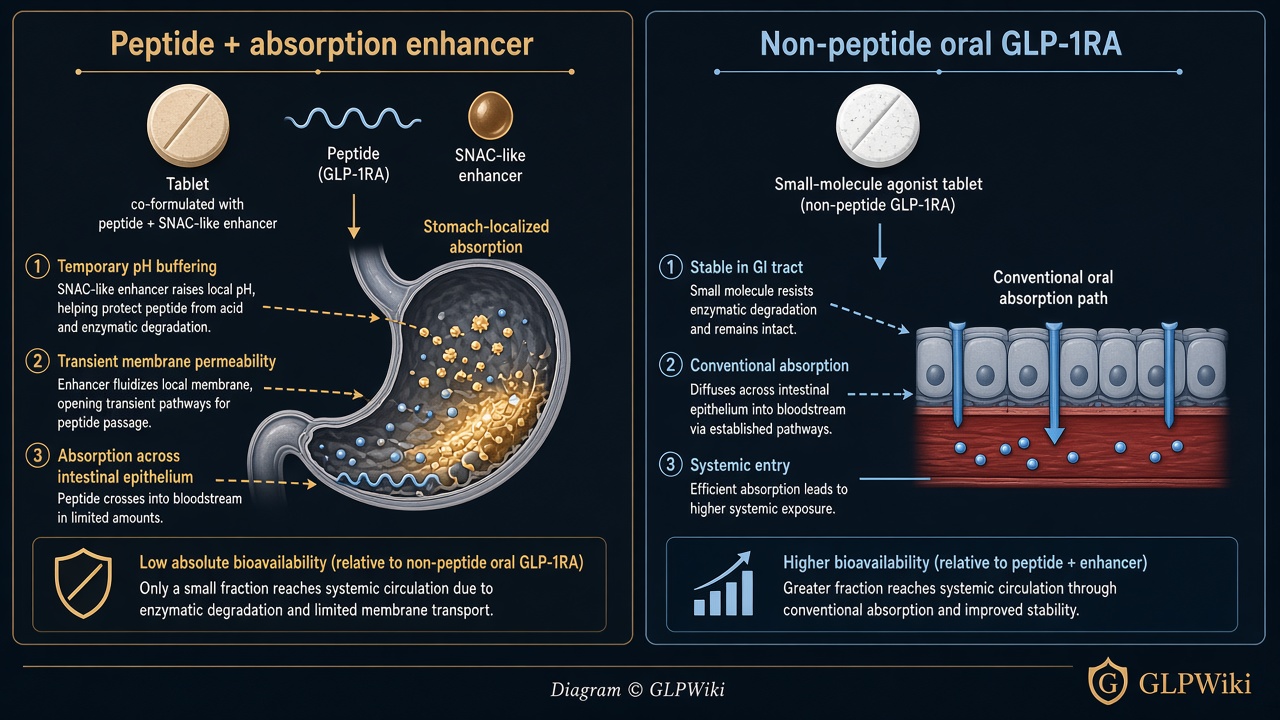
- Peptide + enhancer: a peptide remains chemically vulnerable and depends on formulation-assisted absorption.
- Non-peptide agonist: a small molecule is designed for oral exposure by different pharmacokinetic rules.
- Investigational status is separate from mechanism; verify current approval status independently.
Food, water, and why labels matter
For oral peptide-plus-SNAC products, labeled administration conditions exist because exposure depends on them. Food, gastric contents, water volume, and timing can all change how much intact peptide reaches circulation. Those variables are studied during development and then translated into product-specific labeling when a finished drug is reviewed.
Non-peptide agonists may have different food-effect profiles because they are different chemical entities. The safe literacy statement is only that food-effect studies are product-specific. It is not sound to assume that a small molecule's conditions apply to a peptide tablet, or that one peptide tablet's instructions can be copied to a compounded oral powder.
This is also where forum advice becomes risky. A "hack" that claims to improve exposure is usually an uncontrolled change to a reviewed product's administration conditions. For an approved medicine, the current label is the governing document. For an investigational compound, the trial protocol controls study use. For compounded or research-use material, there is no FDA-approved patient label to inherit.
Approved tablets vs investigational and other oral claims
An approved finished drug is a product with reviewed manufacturing, labeling, pharmacology, safety, and efficacy information for specific indications. Oral semaglutide tablets fall into that category for their approved uses. The label does not merely describe a molecule; it describes a finished product with a particular formulation, excipient system, manufacturing process, packaging, and tested administration conditions.
Investigational material is different. It may be studied under an Investigational New Drug application and clinical-trial protocol, but it is not an approved marketed product unless and until the relevant regulator approves it. Orforglipron is important to watch because it is a non-peptide oral GLP-1 receptor agonist in late-stage development, but investigational status must be kept distinct from approved patient labeling.
Compounded oral peptides and research-use-only oral powders are different again. A compounded product is not the same as Rybelsus because it shares a molecule name, a route claim, or an excipient buzzword. Research-use-only material is not for human use. These categories do not inherit the SNAC literature, the Rybelsus label, or the manufacturing controls of an approved finished drug. Our guides on approved versus investigational peptides and compounded versus FDA-approved GLP-1 products explain those boundaries in more detail.
How to verify status and PK claims
Start with Drugs@FDA when the claim concerns an approved U.S. product. Search the exact product name, open the current label, and read the clinical pharmacology and administration sections in context. For a medicine you personally use, the Medication Guide or Instructions for Use that comes with the product matters too, and any clinical question belongs with your prescriber or pharmacist.
Use ClinicalTrials.gov when the claim concerns an investigational compound or a trial phase. Trial records can show study status, intervention names, sponsors, populations, and endpoints, but they are not the same thing as an approval. For pharmacokinetic numbers such as absolute bioavailability, prefer peer-reviewed articles, FDA clinical pharmacology reviews, and full-text sources over short summaries.
Be especially careful with posts that collapse chemical class, route, and approval status into one phrase. "Oral GLP-1" could mean an approved peptide tablet, an investigational non-peptide small molecule, a trial formulation, or an unreviewed commercial claim. A reliable source names the molecule, the dosage form, the regulatory status, and the primary evidence behind the statement.
- Drugs@FDA: approved products, current labels, and review documents.
- ClinicalTrials.gov: trial status for investigational compounds.
- PubMed and PMC: peer-reviewed pharmacokinetic and formulation literature.
- Primary sources first; influencer summaries last, if at all.
What this page does not do
This page is educational reference material. It does not recommend a medicine, compare products for personal selection, state a dose, restate fasting or water instructions as advice, publish a schedule, describe a stack, or link to suppliers. It also does not provide compounding recipes or instructions for making an oral peptide product.
The reason is simple: administration conditions and exposure data are product-specific. A clinical pharmacology review can explain why a label says what it says, but it does not turn a reader into the reviewer for a different product. Use labels, trial records, and peer-reviewed pharmacology to understand claims; use licensed clinicians and pharmacists for decisions that affect care.
- No doses, schedules, fasting recipes as advice, or stacking guidance.
- No supplier, pharmacy, telehealth, or product endorsements.
- No extrapolating Rybelsus labeling to compounded or research-use products.
- No case-specific judgement about whether a product is appropriate for a person.
Next reading
For the regulatory boundaries behind this page, start with the approved versus investigational peptides guide, then read the guide on compounded versus FDA-approved GLP-1 products. Those two pages explain why chemical similarity, route claims, and online marketing language are not substitutes for a reviewed label.
For mechanism context, read the GLP-1 gastrointestinal effects explainer and the semaglutide compound page. The titration concepts guide explains how labels use starting and maintenance language without publishing schedules, and the semaglutide-versus-tirzepatide-versus-retatrutide comparison helps separate receptor biology from approval status.
Frequently asked questions
- What is SNAC?
- SNAC, or salcaprozate sodium, is an absorption enhancer co-formulated with oral semaglutide. Mechanistic literature describes local gastric pH buffering, reduced semaglutide oligomerization, and transient effects on gastric epithelial permeability that support limited stomach absorption.
- Why is oral peptide bioavailability so low?
- Peptides are vulnerable to stomach acid, digestive proteases, mucus barriers, epithelial tight junctions, and low passive membrane permeability. Those barriers mean only a small fraction of an intact peptide may reach systemic circulation unless a specific formulation changes the local absorption conditions.
- Is orforglipron an oral peptide?
- No. Orforglipron is described in the literature as a non-peptide small-molecule GLP-1 receptor agonist. It is included in oral GLP-1 discussions because it targets the GLP-1 receptor, but its chemistry and absorption are different from peptide tablets such as oral semaglutide.
- Are compounded oral peptides the same as Rybelsus?
- No. Rybelsus is an FDA-approved finished oral semaglutide tablet with a reviewed formulation, label, manufacturing controls, and clinical pharmacology package. Compounded oral peptides do not inherit that approval, that label, or the SNAC formulation evidence for that finished product.
- Where should I read the current oral semaglutide label?
- Use Drugs@FDA to find the current FDA-approved labeling and related review documents for the exact product. If you use a prescribed product, also read the Medication Guide or Instructions for Use supplied with it and ask your prescriber or pharmacist about clinical questions.
- Does this page give dosing or fasting instructions?
- No. This page explains why administration conditions appear in labels and why exposure can depend on them, but it does not state doses, fasting protocols as advice, water-volume instructions, schedules, or product recommendations. Follow the current product label and a licensed clinician's guidance.
- Does low bioavailability mean an oral product cannot work?
- Not necessarily. A low percentage can still be clinically useful when a potent molecule produces reproducible exposure under reviewed product-specific conditions. That is a conclusion from clinical pharmacology and regulatory review, not something to infer for unreviewed products.
SOURCES
- 01Clinical Pharmacokinetics of Oral Semaglutide— Clinical Pharmacokinetics / PMC
- 02Current Understanding of SNAC as an Absorption Enhancer— PubMed
- 03FDA Clinical Pharmacology Review NDA 213051 (oral semaglutide)— U.S. Food and Drug Administration
- 04FDA approves first oral GLP-1 treatment for type 2 diabetes— U.S. Food and Drug Administration
- 05Disposition and Absolute Bioavailability of Orally Administered Orforglipron— Clinical Pharmacology in Drug Development
- 06Orforglipron Phase 1a study— Diabetes Obesity and Metabolism
- 07Drugs@FDA: approved drug products and current labels— U.S. Food and Drug Administration
- 08ClinicalTrials.gov— U.S. National Library of Medicine
EDUCATIONAL REFERENCE ONLY · Not medical advice. Nothing here diagnoses, treats, cures or prevents any disease, and nothing here is a dosing recommendation. Consult a licensed clinician before any treatment decision.