Oral semaglutide vs injectable: Rybelsus, Wegovy tablets, and injection literacy
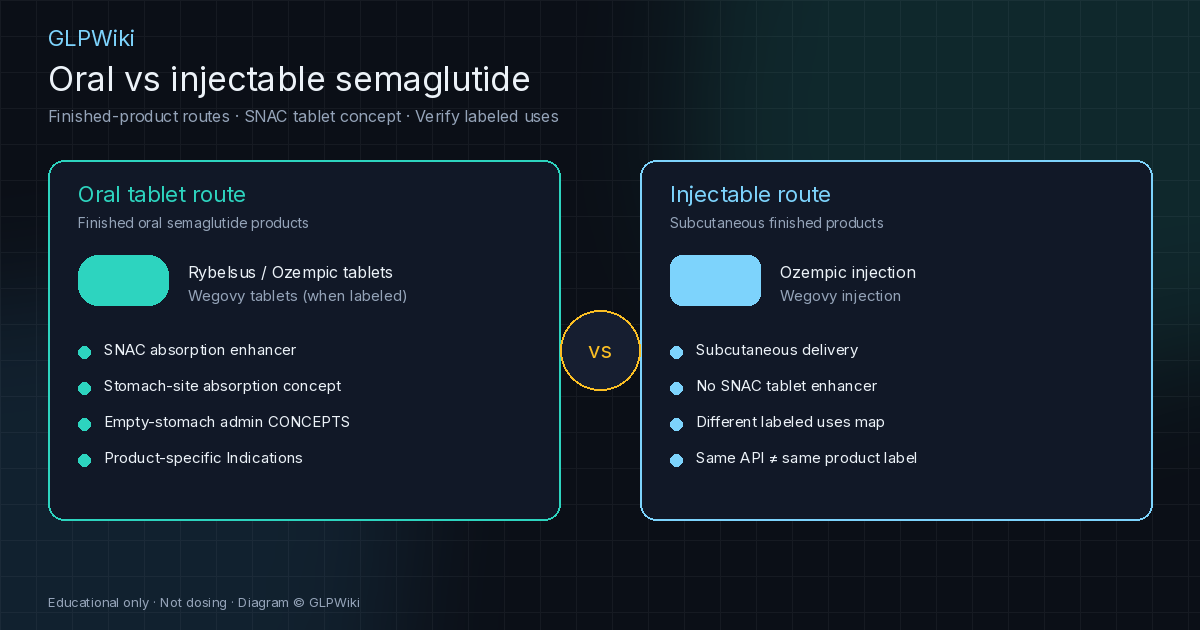
Semaglutide is one active ingredient that appears in multiple FDA-approved finished products with different routes — oral tablets co-formulated with the absorption enhancer SNAC, and subcutaneous injections without that tablet technology. This literacy guide is distinct from the general oral-peptides-absorption explainer: it maps finished-product route differences, SNAC versus injection framing, product-specific labeled uses (including oral Wegovy tablets when labeled), fasting/admin CONCEPT literacy without doses, and how approved oral peptide-formulated products differ from research "oral peptide" marketing claims.
UPDATED 30 SEPT 2026 · 14 MIN READ
KEY TAKEAWAYS
- Route is a finished-product attribute: oral tablet semaglutide products and injectable semaglutide products have separate Prescribing Information, even when they share the same active ingredient.
- Oral semaglutide tablets are co-formulated with SNAC (salcaprozate sodium), an absorption enhancer that helps absorption predominantly in the stomach — a different exposure path than subcutaneous injection.
- Labeled uses (type 2 diabetes, weight management, cardiovascular risk-reduction language, and other expansions) attach to specific brands and presentations — not to the molecule name alone.
- Oral Wegovy (semaglutide) tablets received FDA approval under NDA 218316 (approval letter dated December 22, 2025) for defined adult weight-management and CV risk-reduction uses — always re-verify the current label on Drugs@FDA.
- Administration CONCEPT literacy for oral tablets (empty stomach, plain water volume concepts, wait before food/other oral medicines) lives in Dosage and Administration on the label — this page does not prescribe doses or schedules.
- Approved oral peptide-formulated finished drugs are not the same as research-marketed "oral peptide" powders or capsules without FDA-approved finished-drug labeling.
- This page is educational literacy only: not medical advice, no doses, no schedules, no pharmacy or product recommendations.
Why oral-versus-injectable route literacy matters
Headlines often say "oral semaglutide" or "the semaglutide pill" as if one tablet equals every injectable pen that shares the molecule name. Regulatory reality is product-by-product. Semaglutide appears in distinct finished drugs: historically Rybelsus tablets for type 2 diabetes; injectable Ozempic and Wegovy with their own indication maps; and, as of late-2025 labeling, Wegovy tablets for defined adult weight-management and cardiovascular risk-reduction uses. Naming updates on diabetes tablets (Rybelsus / Ozempic tablets under shared labeling) further show that brand presentation and route must be read on the current Prescribing Information — not inferred from molecule shorthand.
The already-live guide on oral peptides and absorption explains why most peptides struggle as tablets and how SNAC and non-peptide oral agonists change the picture conceptually. This companion zooms into finished-product route literacy for semaglutide specifically: tablet versus injection, SNAC co-formulation versus subcutaneous delivery, and how labeled uses and administration concepts travel with each product.
None of the examples below is a recommendation to start, switch, or stop any medicine. Open Drugs@FDA and read the current label before treating any detail as current for a named product.
Finished-product route map: tablet vs injection
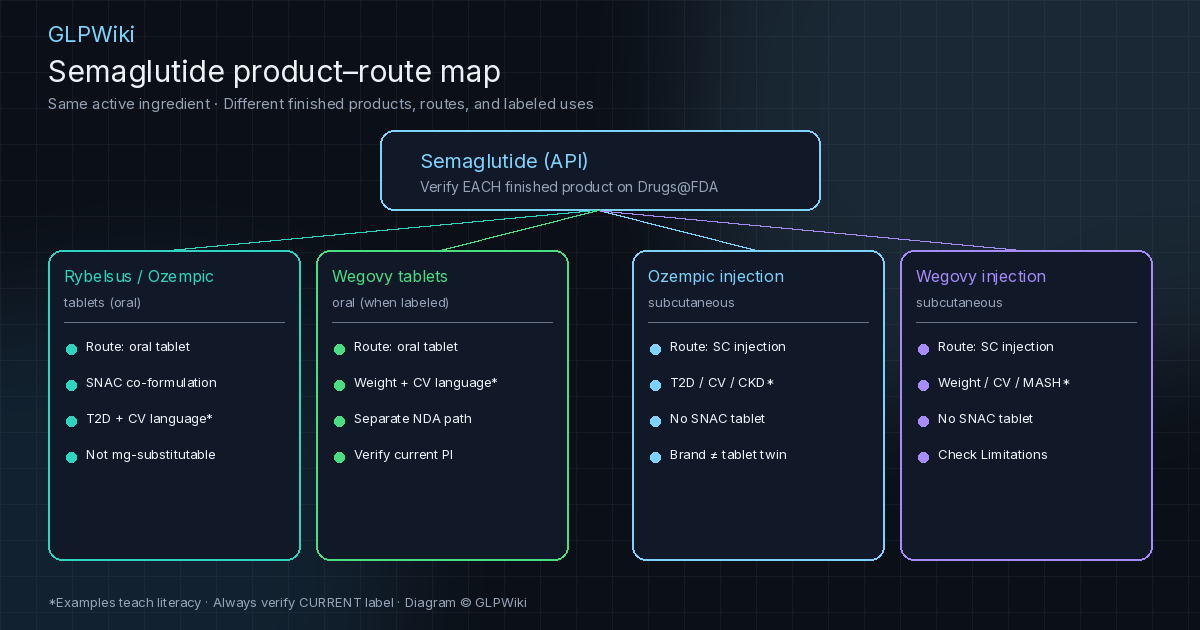
Think in finished products, not molecule nicknames. Useful literacy pairs (always re-verify current labels): oral Rybelsus and Ozempic tablets (semaglutide tablets for oral use; shared labeling under NDA 213051 describes type 2 diabetes glycemic-control language and MACE risk-reduction language in adults with type 2 diabetes at high risk for those events); oral Wegovy tablets (NDA 218316 approval letter December 22, 2025) for adult weight-management and MACE risk-reduction language in adults with established cardiovascular disease and either obesity or overweight, used with reduced-calorie diet and increased physical activity; injectable Ozempic for type 2 diabetes–related labeled uses including glycemic control, MACE risk reduction in adults with type 2 diabetes and established cardiovascular disease, and chronic kidney disease–related risk-reduction language when present on the current PI; injectable Wegovy for weight-management, cardiovascular risk-reduction, and other expansions such as MASH accelerated-approval language when present on the current PI.
Sharing an active ingredient does not copy Brand A's route or indication onto Brand B. Oral and injectable presentations are not interchangeable on a milligram-to-milligram basis — labels for oral tablets explicitly state that certain tablet presentations are not substitutable on a mg-to-mg basis with each other, and switching concepts between oral and injectable products belong in the official Dosage and Administration / switching language on the PI, not in encyclopedia shorthand.
Treat "oral Wegovy" and "injectable Wegovy" as separate finished presentations with their own dosage forms and labeled sections, even when they share a brand family name.
SNAC absorption enhancer vs subcutaneous injection
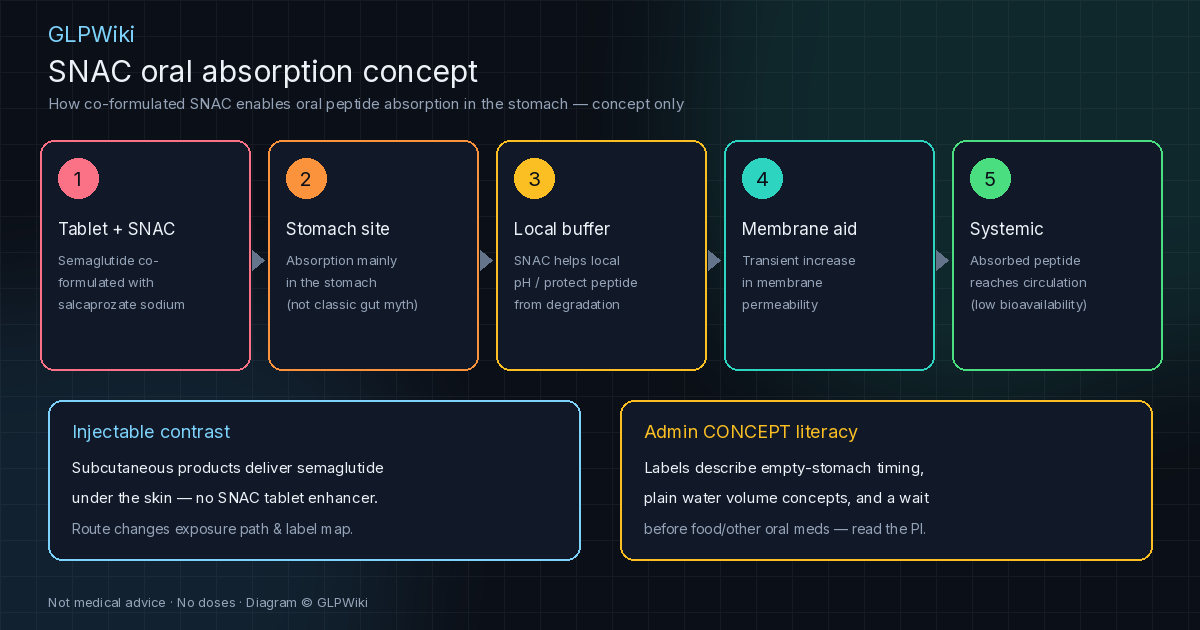
Therapeutic peptides usually degrade in the gastrointestinal tract and absorb poorly as ordinary tablets. Oral semaglutide finished tablets are co-formulated with salcaprozate sodium (SNAC), an absorption enhancer. Labeling and mechanistic literature describe SNAC as facilitating absorption of semaglutide after oral administration, with absorption predominantly occurring in the stomach. Reviews summarize local buffering, protection from enzymatic degradation, reduced oligomerization, and transient increases in gastric epithelial membrane permeability as conceptual mechanisms — not as DIY formulation recipes.
Subcutaneous injectable finished products deliver semaglutide under the skin. They do not rely on the SNAC tablet co-formulation pathway. That difference in exposure path helps explain why oral and injectable products have separate Dosage and Administration instructions, bioavailability characteristics discussed in Clinical Pharmacology, and product-specific labeled uses — even though the circulating active moiety after absorption is still semaglutide.
Literacy takeaway: "oral peptide" in an FDA-approved finished tablet with SNAC is a regulated pharmaceutical technology. It is not proof that any research-marketed peptide powder in a capsule will absorb the same way.
Administration CONCEPT literacy (no doses)
Oral semaglutide tablet labels describe administration conditions that matter for absorption because food, other liquids, and other oral medicines can change how much drug is absorbed. Conceptually — without prescribing any milligram schedule — current labeling for Rybelsus / Ozempic tablets and Wegovy tablets describes taking the tablet orally once daily on an empty stomach in the morning with water (up to about 4 ounces / 120 mL of plain water), not with other liquids besides water; swallowing tablets whole (not splitting, crushing, chewing, or dissolving); and waiting at least 30 minutes after the tablet before eating food, drinking beverages, or taking other oral medications.
Those are labeled administration CONCEPTS, not DIY tips invented here. Exact wording, exceptions, missed-dose language, and any switching instructions live in Dosage and Administration on the current Prescribing Information. This encyclopedia page does not list starting, escalation, or maintenance milligram amounts and does not recommend any schedule.
Injectable products have their own administration instructions (subcutaneous sites, weekly or product-specific cadence concepts, storage, and device instructions). Do not assume oral fasting-window concepts apply to pens, or that pen instructions apply to tablets.
Product-specific labeled uses — route does not copy indications
Day 19 and Day 20 companions taught that Indications & Usage and Limitations of Use live on the finished-product label. Route literacy adds one more filter: an oral tablet and an injectable pen that share a brand family or API can still carry different indication sets, population qualifiers, and Limitations of Use.
Literacy anchors verified for this guide (always re-open the live label): Rybelsus historically as the first FDA-approved oral GLP-1 receptor agonist for type 2 diabetes (FDA press announcement September 20, 2019); subsequent labeling for Rybelsus / Ozempic tablets describing glycemic-control and MACE risk-reduction language in adults with type 2 diabetes at high risk for those events; Wegovy tablets approved December 22, 2025 (NDA 218316) for adult weight-management and MACE risk-reduction language in adults with established CV disease and either obesity or overweight; injectable Ozempic and Wegovy labels for their respective diabetes, weight, CV, CKD, and MASH-related expansions as currently worded on Drugs@FDA.
Do not assume that a use on injectable Wegovy automatically appears on Wegovy tablets, or that Rybelsus / Ozempic tablets inherit every injectable Ozempic expansion. Read section 1 and Limitations of Use for the exact presentation under discussion.
Approved oral peptide products vs research "oral peptide" marketing
FDA-approved oral semaglutide tablets are finished drugs with Drugs@FDA entries, Prescribing Information, and manufacturing/quality controls as approved finished pharmaceuticals. Research-use catalogs, compounded oral preparations, or social-media "oral peptide" capsules that name a research peptide are not the same regulatory category — even if they use the word oral.
Secondary literacy contrast: oral non-peptide small-molecule GLP-1 receptor agonists (for example, orforglipron / Foundayo when labeled as an approved finished tablet) are a different chemical class from peptide-plus-SNAC tablets. They may have different absorption and administration concepts on their own labels. Mentioning them here is only to keep chemical-class literacy clear — not to recommend any product.
When a listing says "oral peptide," ask: Is there an FDA-approved finished-drug Prescribing Information for that exact product? Or is it research-labeled / investigational / compounded / marketing shorthand? Use Drugs@FDA, DailyMed, ClinicalTrials.gov, and the approved-versus-investigational companion guide to categorize honestly.
How to verify an oral-versus-injectable claim
Step 1 — Capture the claim: brand name, dosage form (tablet vs injection), and the use or admin rule someone asserted.
Step 2 — Open Drugs@FDA for that finished product (not only the API name). Confirm whether an oral tablet presentation exists and is approved.
Step 3 — Open the current Prescribing Information / label PDF. Prefer the latest labeled document for that presentation.
Step 4 — Read Indications & Usage, Limitations of Use, Dosage and Administration (for admin CONCEPTS), and Clinical Pharmacology notes on absorption when relevant.
Step 5 — Categorize: labeled oral finished product; labeled injectable finished product; oral non-peptide agonist (different class); investigational / trial-only; or unsupported research-marketing claim.
What this page deliberately does not do
No doses, schedules, titration plans, reconstitution recipes, stacks, or switching protocols — for any product.
No pharmacy, telehealth, clinic, or supplier recommendations; no purchasing advice; no affiliate links.
No claim that oral and injectable products are interchangeable, or that SNAC technology transfers to unrelated research peptides.
No exhaustive catalog of every worldwide oral incretin candidate. Drugs@FDA and the /medications hub are the living indexes.
For whether any product is appropriate for a person, consult a licensed clinician using the official label. Adverse events and quality concerns can be reported through MedWatch.
Where to read next
Continue with oral-peptides-absorption for general SNAC and oral-barrier literacy, GLP-1 medicines by indication and labeled indication expansions for brand-versus-API indication maps, and how-to-read-FDA-peptide-labeling for Prescribing Information structure.
For status ladders, see approved-versus-investigational peptides and compounded-versus-FDA-approved GLP-1. Return to the /medications hub and compound pages such as semaglutide for molecule-level context.
Editorial standards and the medical disclaimer explain sourcing limits and what GLPWiki never publishes.
Frequently asked questions
- Is oral Wegovy the same as injectable Wegovy?
- No. They are different finished presentations (tablets for oral use versus injection for subcutaneous use) with separate Dosage and Administration and potentially different indication details. Verify each current label on Drugs@FDA.
- What is SNAC?
- SNAC (salcaprozate sodium) is an absorption enhancer co-formulated in FDA-approved oral semaglutide tablets. Labeling states that it facilitates absorption of semaglutide after oral administration, with absorption predominantly in the stomach. It is not a reason to assume other research peptides will absorb orally.
- Can I convert an injectable milligram amount to a tablet milligram amount myself?
- Do not. Labels state that certain oral tablet presentations are not substitutable on a mg-to-mg basis, and oral versus injectable products are separate labeled medicines. Any switching concepts belong in official labeling discussed with a clinician — not in encyclopedia arithmetic.
- Does every "oral peptide" online use SNAC like Rybelsus?
- No. Approved oral semaglutide tablets are specific finished drugs with SNAC co-formulation and Drugs@FDA labeling. Research-marketed oral peptide claims are a different category unless they have their own approved finished-drug Prescribing Information.
- How is orforglipron different from oral semaglutide?
- Orforglipron (Foundayo, when labeled) is described as an oral small-molecule (non-peptide) GLP-1 receptor agonist — a different chemical class from peptide-plus-SNAC tablets. Compare current labels separately; do not treat them as interchangeable.
- Does GLPWiki recommend oral or injectable semaglutide?
- No. GLPWiki publishes no doses or protocols, sells nothing, and links to no pharmacies or suppliers. This guide is educational literacy only — not medical advice.
SOURCES
- 01Drugs@FDA: FDA-Approved Drugs database— U.S. FDA
- 02FDA Approves First Oral GLP-1 Treatment for Type 2 Diabetes (Rybelsus, Sep 20, 2019)— U.S. FDA
- 03Rybelsus / Ozempic (semaglutide) tablets Prescribing Information (label PDF via Drugs@FDA, NDA 213051)— U.S. FDA / Drugs@FDA
- 04Ozempic (semaglutide) tablets and Rybelsus (semaglutide) tablets — Supplement Approval Letter NDA 213051/S-030— U.S. FDA / Drugs@FDA
- 05Wegovy (semaglutide) tablets — NDA 218316 Approval Letter (Dec 22, 2025)— U.S. FDA / Drugs@FDA
- 06DailyMed — WEGOVY (semaglutide) injection and tablets labeling— U.S. NLM / DailyMed
- 07Ozempic (semaglutide) injection Prescribing Information (label PDF via Drugs@FDA)— U.S. FDA / Drugs@FDA
- 08Wegovy (semaglutide) Prescribing Information (label PDF via Drugs@FDA)— U.S. FDA / Drugs@FDA
- 09Current Understanding of SNAC as an Absorption Enhancer: The Oral Semaglutide Experience (PMC10788673)— Clinical Diabetes / PMC
- 10FDA Approves First New Molecular Entity Under National Priority Voucher Program (Foundayo / orforglipron)— U.S. FDA
- 11ClinicalTrials.gov— U.S. National Library of Medicine
- 12MedWatch: FDA Safety Information and Adverse Event Reporting Program— U.S. FDA
EDUCATIONAL REFERENCE ONLY · Not medical advice. Nothing here diagnoses, treats, cures or prevents any disease, and nothing here is a dosing recommendation. Consult a licensed clinician before any treatment decision.