GLP-1 labeled indication expansions: CV, CKD, MASH, and OSA literacy
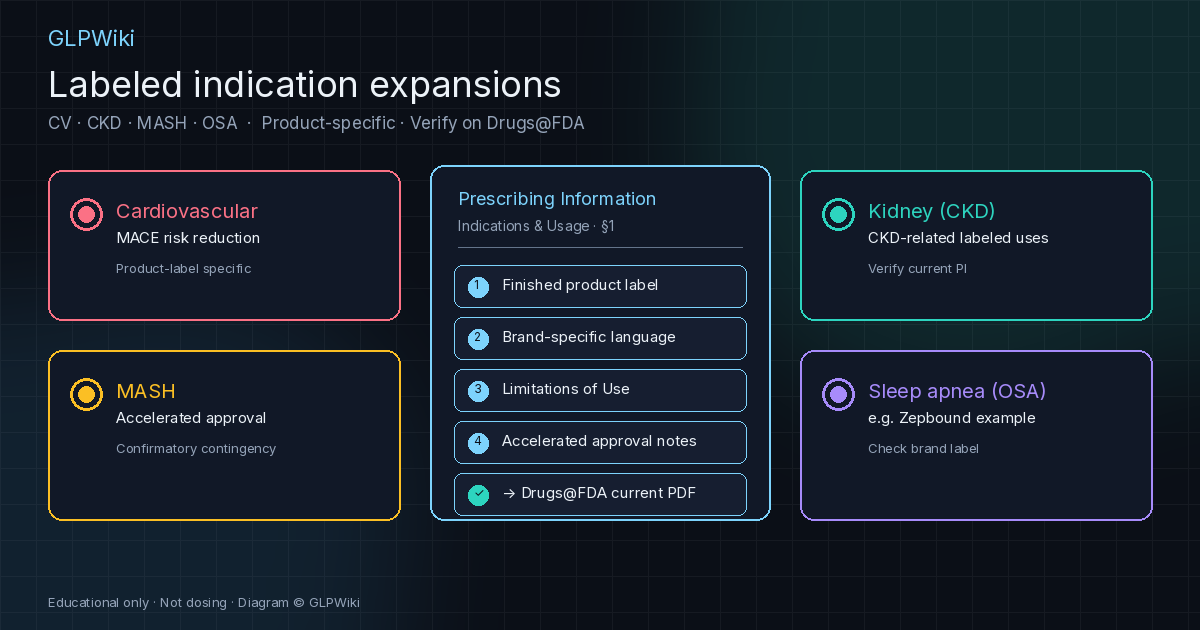
Beyond classic glycemic-control and weight-management shorthand, some FDA-approved GLP-1 and related incretin products carry additional labeled uses — cardiovascular risk reduction, chronic kidney disease–related language, MASH under accelerated approval, and obstructive sleep apnea. This literacy companion to Day 19's medications-by-indication guide teaches that those expansions attach to specific finished-product labels, may use accelerated-approval language, change over time, and must be verified on Drugs@FDA — never assumed from molecule name, another brand, or headlines.
UPDATED 29 SEPT 2026 · 14 MIN READ
KEY TAKEAWAYS
- Labeled-use expansions (CV/MACE risk reduction, CKD-related uses, MASH, OSA) are product-specific: they live in Indications & Usage on a finished product's Prescribing Information, not on the molecule name alone.
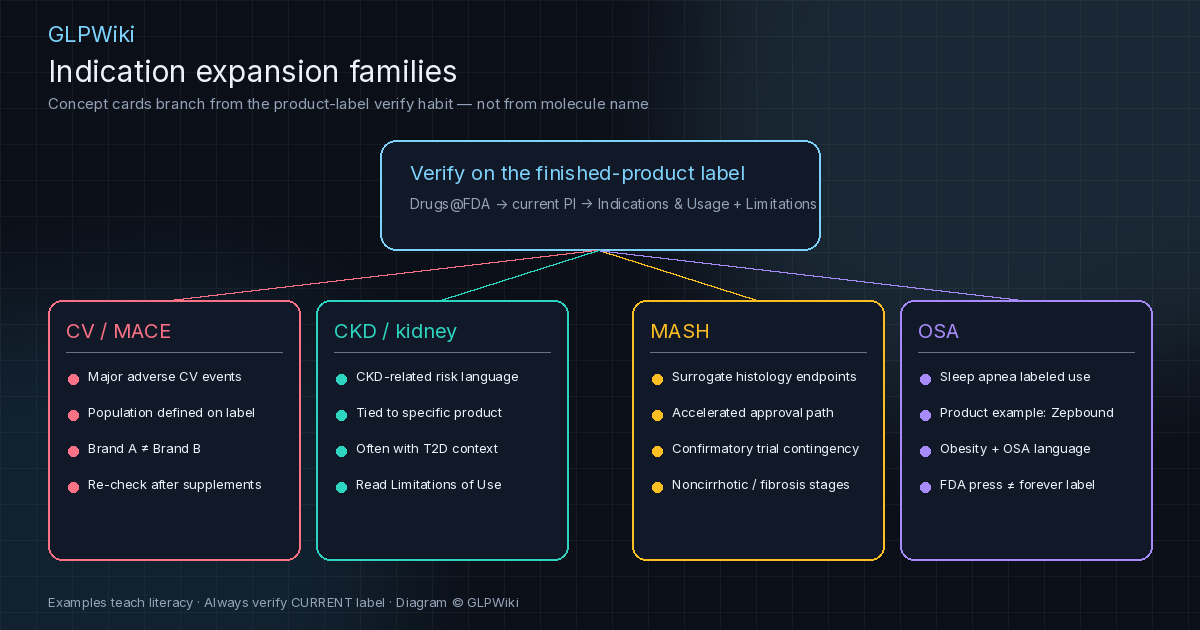
- Sharing an active ingredient does not copy Brand A's expansion onto Brand B. Always ask which product's current label states the use.
- Accelerated approval (for example, MASH language on a given product) may rest on surrogate endpoints with confirmatory-trial contingencies — read that language on the label, not only in news summaries.
- FDA press announcements are useful anchors for when a use was added, but the living source of truth is the current label PDF linked from Drugs@FDA.
- ClinicalTrials.gov and publications describe research; they are not a substitute for labeled Indications & Usage on the finished product under discussion.
- This page is educational literacy only: not medical advice, no doses, no schedules, no pharmacy or product recommendations.
Why expansion literacy matters beyond diabetes and weight shorthand
Search results and social posts often flatten GLP-1 medicines into two buckets: "diabetes drug" and "weight-loss drug." Regulatory labels are more granular. Over recent years, some finished products' Indications & Usage sections have grown to include cardiovascular (MACE) risk-reduction language, chronic kidney disease–related risk-reduction language, metabolic dysfunction-associated steatohepatitis (MASH) treatment language under accelerated approval, and obstructive sleep apnea (OSA) treatment language — each tied to a specific brand product and population wording.
Day 19's guide on GLP-1 medicines by indication taught the foundational habit: brand product ≠ active ingredient, and Indications & Usage live on the Prescribing Information. This companion zooms into the expansion families that sit beyond classic glycemic and weight language — and into the verify habit that keeps summaries from drifting into outdated or brand-swapped claims.
None of the examples below is a recommendation to use any medicine. They are literacy illustrations. Open Drugs@FDA and read the current label before treating any detail as current for a named product.
Product-specific, not molecule-wide: API ≠ brand indication map
An active pharmaceutical ingredient (API) can appear in more than one FDA-approved finished drug. Each product has its own application path, brand name, and Prescribing Information. When a headline says "semaglutide is now approved for X" or "tirzepatide treats Y," the accurate literacy question is: which finished product's current label states that indication?
Classic pairs remain useful teaching tools: semaglutide as Ozempic versus Wegovy versus Rybelsus; tirzepatide as Mounjaro versus Zepbound. An expansion on one product's label does not automatically appear on another product that shares the API. Limitations of Use, accelerated-approval contingencies, and population qualifiers travel with the specific document you open.
Treat molecule-level shorthand as a pointer to look up brands — not as proof that every brand in the family carries every expansion.
Cardiovascular (MACE) risk-reduction language — product by product
"MACE" is shorthand for major adverse cardiovascular events — typically a composite that can include cardiovascular death, non-fatal myocardial infarction, and non-fatal stroke, as defined in the specific trial and then reflected in labeled wording. Some GLP-1 receptor agonist products carry labeled language to reduce the risk of such events in defined adult populations; the exact population (for example, type 2 diabetes with established cardiovascular disease versus established cardiovascular disease with obesity or overweight) is product-specific.
Literacy anchors verified for this guide (always re-open the live label): the FDA announced a new Wegovy (semaglutide) injection indication to reduce cardiovascular death, heart attack, and stroke in adults with cardiovascular disease and either obesity or overweight (March 2024 press announcement; SELECT-related labeling). Ozempic (semaglutide) labeling has long included MACE risk-reduction language in adults with type 2 diabetes and established cardiovascular disease — confirm the current Indications & Usage on Drugs@FDA. Rybelsus (semaglutide) tablets received a supplemental approval adding MACE risk-reduction language in adults with type 2 diabetes mellitus at high risk for these events (FDA supplement approval letter dated October 17, 2025, NDA 213051/S-024) — again, confirm the current PI rather than relying on this encyclopedia summary alone.
Do not assume that a CV claim on one semaglutide product applies to every other semaglutide product, or that a dual agonist brand inherits another brand's CV language. Read section 1 and Limitations of Use for the product under discussion.
Chronic kidney disease–related labeled uses
Some products' labels include kidney-related risk-reduction language — for example, language about reducing the risk of sustained eGFR decline, end-stage kidney disease, and cardiovascular death in adults with type 2 diabetes mellitus and chronic kidney disease. That wording, when present, is an Indications & Usage statement on a specific finished product, not a class-wide property of "GLP-1 medicines."
Literacy example commonly discussed after early-2025 labeling updates: Ozempic (semaglutide) Indications & Usage language addressing kidney outcomes in adults with type 2 diabetes and chronic kidney disease (FLOW trial–related expansion; confirm on the current Drugs@FDA label PDF and DailyMed SPL). The presence of that language on Ozempic does not automatically place the same indication on Wegovy, Rybelsus, or any tirzepatide brand.
When reading kidney-related claims online, capture the brand name, open the current PI, and check whether section 1 actually states the claimed use for that product — including any population qualifiers and Limitations of Use.
MASH and accelerated-approval literacy
Metabolic dysfunction-associated steatohepatitis (MASH), formerly often discussed as NASH, is a serious liver disease with fat-related inflammation and scarring. FDA has described Wegovy (semaglutide) injection approval to treat MASH in adults with moderate-to-advanced fibrosis, granted under the accelerated approval pathway based on histologic (biopsy) surrogate endpoints, with the pivotal trial continuing to assess longer-term clinical outcomes. Continued approval for such an indication may be contingent upon verification of clinical benefit in a confirmatory trial — language that belongs on the product label and in FDA communications, not only in secondary news write-ups.
Accelerated approval literacy matters: a surrogate endpoint can support earlier access for a serious condition while confirmatory evidence is still accruing. That is not the same as a traditional approval based solely on established clinical outcomes, and it is not a blank check to assume the same MASH language exists on every semaglutide or dual-agonist brand.
Verify on Drugs@FDA: open the current Wegovy Prescribing Information, read Indications & Usage for MASH wording (including noncirrhotic / fibrosis-stage framing if present), and note any accelerated-approval and confirmatory-trial contingencies. Do not invent trial DOIs; prefer FDA pages, Drugs@FDA label PDFs, and ClinicalTrials.gov registry records for primary verification.
Obstructive sleep apnea (OSA) literacy — Zepbound example
On December 20, 2024, FDA announced approval of Zepbound (tirzepatide) for the treatment of moderate to severe obstructive sleep apnea in adults with obesity, to be used with a reduced-calorie diet and increased physical activity — described as the first medication approved for that OSA use in that setting. The press announcement is a useful historical anchor; the living source of truth for labeled wording is the current Zepbound Prescribing Information on Drugs@FDA.
Literacy points: the OSA indication attaches to Zepbound as a finished product, not automatically to Mounjaro or to every tirzepatide presentation; population language (moderate to severe OSA in adults with obesity) and adjunct diet/activity language matter; Fast Track, Priority Review, or Breakthrough Therapy designations described in FDA communications are regulatory path descriptors, not a substitute for reading Indications & Usage.
If a headline says "tirzepatide treats sleep apnea," rewrite it as a product-label question: does the current Zepbound (or other named brand) label state that use today? Then verify.
How to verify an expansion claim on Drugs@FDA
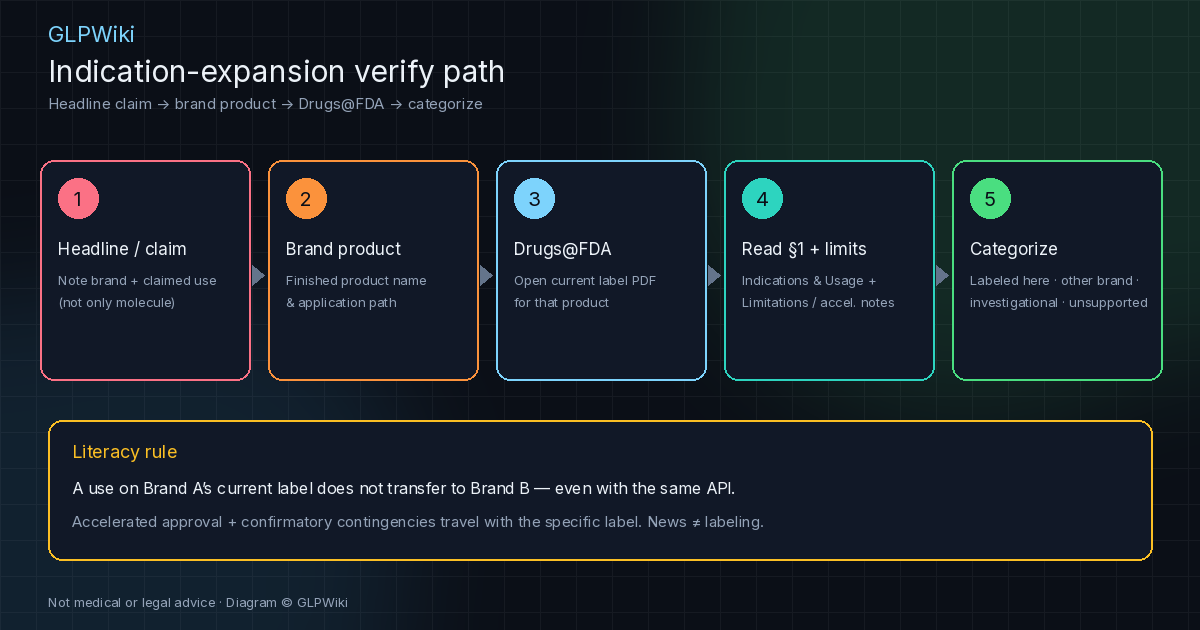
Step 1 — Capture the claim: brand name (not only the API) and the expansion someone asserted (CV, CKD, MASH, OSA, or other).
Step 2 — Identify the finished product and open Drugs@FDA (accessdata.fda.gov Drugs@FDA database). Select the matching brand/application.
Step 3 — Open the current Prescribing Information / label PDF linked for that product. Prefer the latest labeled document.
Step 4 — Read Indications & Usage (section 1) and Limitations of Use. For accelerated-approval expansions, note confirmatory-trial contingency language if present. Compare exact labeled wording to the claim.
Step 5 — Categorize honestly: labeled for that use on this product; labeled on a different brand sharing the API; investigational / trial-only (see ClinicalTrials.gov); or unsupported marketing shorthand. Cross-check approved-versus-investigational literacy and the Day 19 medications-by-indication companion when helpful.
What this page deliberately does not do
No doses, schedules, titration plans, reconstitution recipes, or stacks — for any product.
No pharmacy, telehealth, clinic, or supplier recommendations; no purchasing advice; no affiliate links.
No claim that an expansion on one brand applies to another brand with the same API, or that a press announcement forever freezes the label.
No exhaustive worldwide catalog of every incretin product or every supplement approval. Drugs@FDA and the /medications hub are the living indexes.
For whether any product is appropriate for a person, consult a licensed clinician using the official label. Adverse events and quality concerns can be reported through MedWatch.
Where to read next
Continue with GLP-1 medicines by indication for the brand-versus-API map, how-to-read-FDA-peptide-labeling for the full Prescribing Information structure, and approved-versus-investigational peptides for the status ladder.
For compounded versus approved finished drugs, see compounded-versus-FDA-approved GLP-1 and the 503A versus 503B sibling guide. Return to the /medications hub and compound pages such as semaglutide and tirzepatide for molecule-level context.
Editorial standards and the medical disclaimer explain sourcing limits and what GLPWiki never publishes.
Frequently asked questions
- If Wegovy has a CV or MASH indication, does Ozempic automatically have the same?
- No. Ozempic and Wegovy are distinct finished products with their own Prescribing Information. Some uses may appear on one label and not the other. Always verify the current Indications & Usage for the specific brand on Drugs@FDA.
- Does Zepbound's OSA approval mean Mounjaro is labeled for OSA?
- Not automatically. OSA labeled use discussed in FDA's December 20, 2024 announcement attached to Zepbound. Mounjaro is a different tirzepatide finished product — check its current label separately.
- What does accelerated approval mean for MASH language?
- Accelerated approval can allow earlier marketing authorization based on a surrogate endpoint for a serious condition, with continued approval often contingent on confirmatory evidence of clinical benefit. Read the product's Indications & Usage and FDA communications for the exact contingency language.
- Is a ClinicalTrials.gov listing the same as a labeled indication?
- No. Trials and publications describe research. A labeled indication appears in the approved Prescribing Information for that finished product. Use ClinicalTrials.gov to understand studies; use Drugs@FDA to verify labeled uses.
- Where do I verify Rybelsus cardiovascular language?
- Open Drugs@FDA for Rybelsus (semaglutide tablets), open the current Prescribing Information, and read Indications & Usage. FDA's October 17, 2025 supplement approval letter for NDA 213051/S-024 describes addition of MACE risk-reduction language — confirm it still appears on the live label.
- Does GLPWiki recommend a brand for CV, kidney, liver, or sleep apnea use?
- No. GLPWiki publishes no doses or protocols, sells nothing, and links to no pharmacies or suppliers. This guide is educational literacy only — not medical advice.
SOURCES
- 01Drugs@FDA: FDA-Approved Drugs database— U.S. FDA
- 02FDA Approves First Medication for Obstructive Sleep Apnea (Zepbound, Dec 20, 2024)— U.S. FDA
- 03Zepbound (tirzepatide) Prescribing Information (label PDF via Drugs@FDA)— U.S. FDA / Drugs@FDA
- 04FDA Approves First Treatment to Reduce Risk of Serious Heart Problems Specifically in Adults with Obesity or Overweight (Wegovy CV, March 2024)— U.S. FDA
- 05FDA Approves Treatment for Serious Liver Disease Known as ‘MASH’ (Wegovy)— U.S. FDA
- 06Wegovy (semaglutide) Prescribing Information (label PDF via Drugs@FDA)— U.S. FDA / Drugs@FDA
- 07Ozempic (semaglutide) Prescribing Information (label PDF via Drugs@FDA)— U.S. FDA / Drugs@FDA
- 08Rybelsus (semaglutide) tablets — Supplement Approval Letter NDA 213051/S-024, S-028, S-029 (Oct 17, 2025)— U.S. FDA / Drugs@FDA
- 09DailyMed — OZEMPIC (semaglutide) labeling— U.S. NLM / DailyMed
- 10DailyMed — WEGOVY (semaglutide) labeling— U.S. NLM / DailyMed
- 11ClinicalTrials.gov— U.S. National Library of Medicine
- 12MedWatch: FDA Safety Information and Adverse Event Reporting Program— U.S. FDA
EDUCATIONAL REFERENCE ONLY · Not medical advice. Nothing here diagnoses, treats, cures or prevents any disease, and nothing here is a dosing recommendation. Consult a licensed clinician before any treatment decision.