FDA-approved GLP-1 medicines by indication: diabetes, weight, and beyond
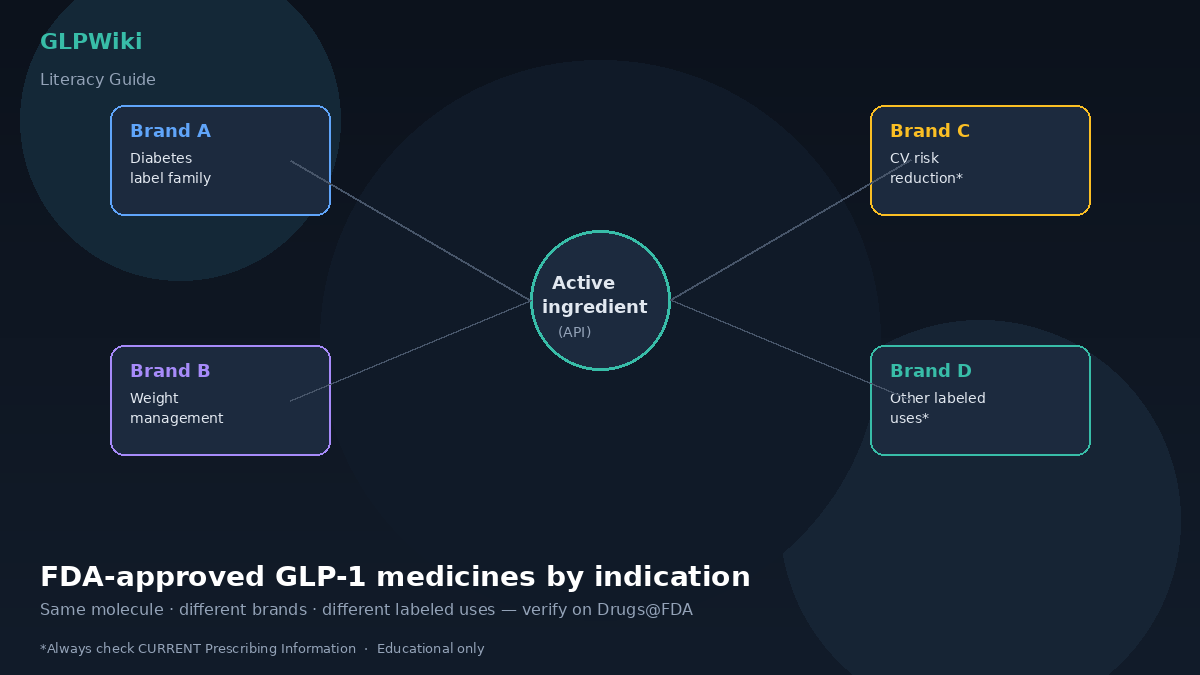
The same active ingredient can appear under different brand names with different labeled indications. This literacy companion to the /medications hub explains how to read Indications & Usage and Limitations of Use on Prescribing Information via Drugs@FDA — without doses, schedules, or product recommendations.
UPDATED 28 SEPT 2026 · 13 MIN READ
KEY TAKEAWAYS
- Brand name and active ingredient are not interchangeable: each FDA-approved finished product has its own Prescribing Information, including Indications & Usage and Limitations of Use.
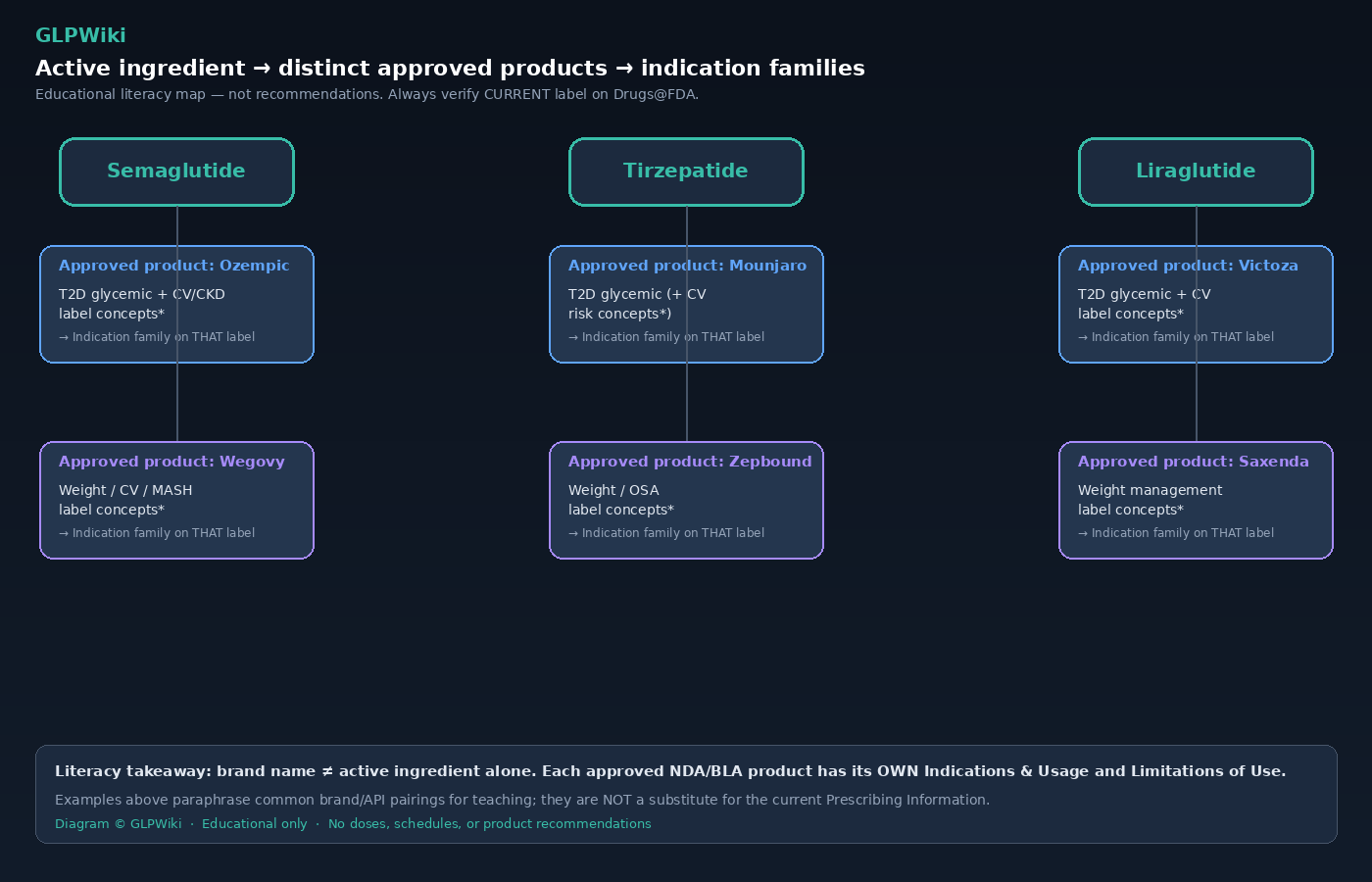
- Classic literacy pairs: semaglutide as Ozempic vs Wegovy; tirzepatide as Mounjaro vs Zepbound; liraglutide as Victoza vs Saxenda — same API family, different labeled-use maps on each product label.
- Indication expansions (cardiovascular risk reduction, chronic kidney disease, MASH, obstructive sleep apnea, and others) are product-label-specific and can change; always verify the CURRENT label on Drugs@FDA.
- Section 1 of the Prescribing Information states what the product is indicated for; Limitations of Use narrow or exclude uses. Marketing shorthand is not a substitute for that text.
- Approved labeled use is not the same as investigational research or off-label discussion. ClinicalTrials.gov and news headlines are not Drugs@FDA labeling.
- This page is educational literacy only: not medical advice, no doses, no schedules, no pharmacy or purchase recommendations.
Why indication literacy matters for the /medications hub
GLPWiki's /medications hub lists FDA-approved-oriented entries from the compound library. Readers often arrive asking a simpler question in plain language: "What is this brand for?" The accurate answer is never just the molecule name. Approval and labeling attach to a specific finished product — brand, application, formulation, and the Indications & Usage section of that product's Prescribing Information.
Search and social posts frequently collapse brand names into a shared active ingredient ("semaglutide," "tirzepatide," "liraglutide") as if every use traveled with the molecule. Regulatory literacy goes the other direction: start from the finished product, open its current label, and read what that label says.
This guide is a companion to /medications and to how-to-read-FDA-peptide-labeling. It teaches the habit of separating active ingredient, brand product, and labeled indication — then verifying claims on Drugs@FDA. It does not recommend any medicine, dose, or purchase path.
One molecule, multiple approved products (brand vs active ingredient)
An active pharmaceutical ingredient (API) can be the active ingredient in more than one FDA-approved finished drug product. Each product has its own New Drug Application (or related application path), brand name, and Prescribing Information. Sharing an API does not copy another product's Indications & Usage onto a different brand.
Well-documented literacy examples (always re-check the live label): semaglutide appears in Ozempic and Wegovy as distinct approved products; tirzepatide appears in Mounjaro and Zepbound; liraglutide appears in Victoza and Saxenda. Dulaglutide (Trulicity) is another GLP-1 receptor agonist product with its own labeling. The /medications hub may list additional approved-oriented entries over time — this page is not an exhaustive catalog.
When someone says a molecule "is approved for" a use, ask: which finished product's label states that indication today? If the answer points only to a blog, a clinic ad, or another brand's label, the claim is not verified for the product under discussion.
How Indications & Usage and Limitations of Use work on a label
Under FDA's Physician Labeling Rule structure, section 1 of the Prescribing Information is Indications and Usage. That section states the conditions, populations, and settings for which the product is indicated, often with adjunct language such as diet and exercise where applicable. It is the primary place to answer "what is this approved product labeled for?"
Many labels also include Limitations of Use in or near that section. Limitations may state that coadministration with other products containing the same API or other GLP-1 receptor agonists is not recommended, that safety and effectiveness have not been established in a particular population, or other narrowing language. Skipping Limitations of Use is a common literacy error.
Other label sections (Warnings and Precautions, Clinical Studies, Clinical Pharmacology) support understanding but do not replace section 1 as the statement of labeled indications. Our how-to-read-FDA-peptide-labeling guide walks the broader PI structure; this page focuses on indication mapping across brands.
Diabetes-oriented vs weight-management-oriented products (literacy map)
A useful first cut for readers — not a recommendation — is to notice that some products' primary labeled uses center on improving glycemic control in type 2 diabetes mellitus (often with additional CV or kidney-related labeled uses on that same product), while other products' primary labeled uses center on chronic weight management in combination with a reduced-calorie diet and increased physical activity.
Literacy pairs that illustrate the pattern (verify each on Drugs@FDA before relying on any detail): Ozempic (semaglutide) versus Wegovy (semaglutide); Mounjaro (tirzepatide) versus Zepbound (tirzepatide); Victoza (liraglutide) versus Saxenda (liraglutide). In each pair, the API is shared; the finished-product labels are different documents with different Indications & Usage text.
Do not treat this map as clinical guidance about which product is "better," interchangeable, or appropriate for any person. Product selection, if any, belongs with a licensed clinician and the official label. GLPWiki never publishes doses, titration schedules, or stacks.
Additional labeled uses (CV, kidney, and beyond) — always check the CURRENT label
Beyond glycemic control and weight-management language, some products' labels include additional indication statements — for example, reduction of major adverse cardiovascular events in defined adult populations, kidney-related risk reduction language in type 2 diabetes with chronic kidney disease, treatment of noncirrhotic metabolic dysfunction-associated steatohepatitis (MASH) with specified fibrosis under accelerated approval conditions on a given product, or treatment of moderate to severe obstructive sleep apnea in adults with obesity on a given product.
These expansions are product-specific. A use that appears on Brand A's current label does not automatically appear on Brand B's label, even when both share an API. Accelerated-approval language, confirmatory-trial contingencies, and Limitations of Use also travel with the specific label.
Labels change. Supplement approvals, safety updates, and indication additions can revise section 1. Treat any encyclopedia summary — including this one — as a pointer to Drugs@FDA, not as a forever-true substitute for the PDF you open today.
How to verify on Drugs@FDA (step path)
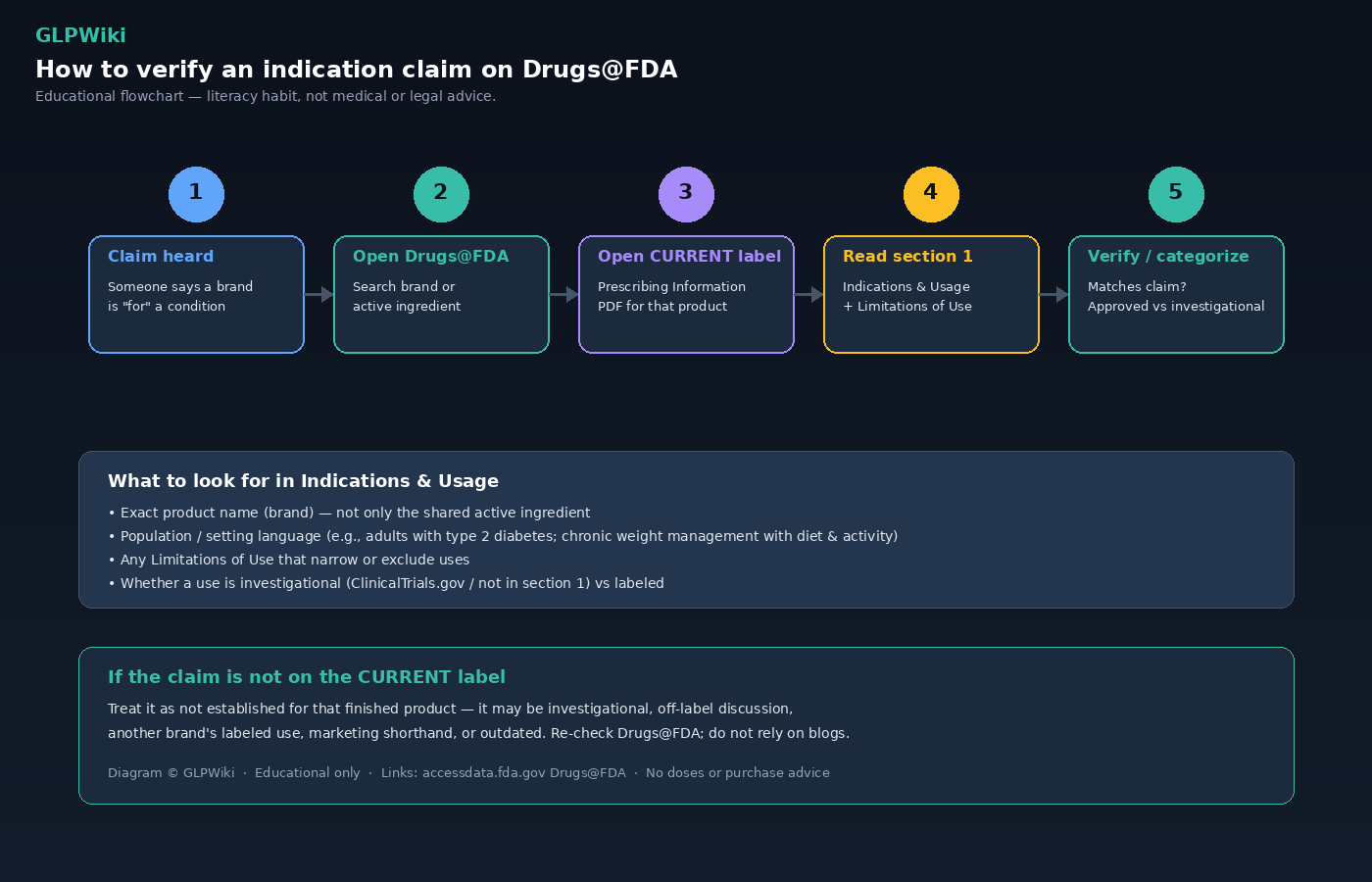
Step 1 — Capture the claim: note the brand name (not only the API) and the condition someone said it is "for."
Step 2 — Open Drugs@FDA (accessdata.fda.gov Drugs@FDA database) and search the brand or active ingredient. Select the finished product that matches the brand under discussion.
Step 3 — Open the current Prescribing Information / label PDF for that product. Prefer the latest labeled document linked from Drugs@FDA for that application.
Step 4 — Read Indications & Usage (section 1) and any Limitations of Use. Compare the exact labeled language to the claim.
Step 5 — Categorize honestly: labeled for that use on this product; labeled on a different brand sharing the API; investigational / trial-only; or unsupported marketing shorthand. For investigational status literacy, see approved-versus-investigational peptides. For compounded versus approved finished drugs, see compounded-versus-FDA-approved GLP-1 and the 503A/503B sibling guide.
What this page deliberately does not do
No doses, schedules, titration plans, reconstitution recipes, or stacks — for any product.
No pharmacy, telehealth, clinic, or supplier recommendations; no purchasing advice; no affiliate links.
No claim that sharing an API makes two brands clinically interchangeable or that an indication on one brand applies to another.
No exhaustive list of every GLP-1 or dual agonist product worldwide. The /medications hub and Drugs@FDA are the living indexes.
For whether any product is appropriate for a person, consult a licensed clinician using the official label. Adverse events and quality concerns can be reported through MedWatch.
Where to read next
Continue with how-to-read-FDA-peptide-labeling for the full Prescribing Information map, approved-versus-investigational peptides for the status ladder, and compounded-versus-FDA-approved GLP-1 (plus the 503A vs 503B sibling) for unapproved and compounded pathways.
Return to the /medications hub for the approved-oriented product index, and to compound pages such as semaglutide, tirzepatide, and liraglutide for molecule-level context.
Editorial standards and the medical disclaimer explain sourcing limits and what GLPWiki never publishes.
Frequently asked questions
- Are Ozempic and Wegovy the same medicine?
- They share the active ingredient semaglutide but are distinct FDA-approved finished products with their own Prescribing Information and Indications & Usage. Always compare the current labels on Drugs@FDA rather than assuming uses transfer between brands.
- Are Mounjaro and Zepbound the same?
- They share the active ingredient tirzepatide but are distinct approved products with different labeled-use maps. Verify each product's current Indications & Usage and Limitations of Use on Drugs@FDA.
- If a use is on one brand's label, does it apply to another brand with the same API?
- No. Labeled indications attach to the specific finished product. A use on Brand A's label does not automatically appear on Brand B's label.
- Where do I verify a current indication?
- Drugs@FDA → select the product → open the current Prescribing Information → read Indications & Usage (section 1) and Limitations of Use. Do not rely on blogs, ads, or social posts as substitutes.
- What is the difference between a labeled indication and an investigational use?
- A labeled indication appears in the approved Prescribing Information for that product. Investigational uses are studied in trials (see ClinicalTrials.gov and publications) but are not established as labeled indications for that finished product until they appear on the current label.
- Does GLPWiki recommend a brand, dose, or pharmacy?
- No. GLPWiki publishes no doses or protocols, sells nothing, and links to no pharmacies or suppliers. This guide is educational literacy only — not medical advice.
SOURCES
- 01Drugs@FDA: FDA-Approved Drugs database— U.S. FDA
- 02Ozempic (semaglutide) Prescribing Information (label PDF via Drugs@FDA)— U.S. FDA / Drugs@FDA
- 03Wegovy (semaglutide) Prescribing Information (label PDF via Drugs@FDA)— U.S. FDA / Drugs@FDA
- 04Mounjaro (tirzepatide) Prescribing Information (label PDF via Drugs@FDA)— U.S. FDA / Drugs@FDA
- 05Zepbound (tirzepatide) Prescribing Information (label PDF via Drugs@FDA)— U.S. FDA / Drugs@FDA
- 06Victoza (liraglutide) Prescribing Information (label PDF via Drugs@FDA)— U.S. FDA / Drugs@FDA
- 07Saxenda (liraglutide) Prescribing Information (label PDF via Drugs@FDA)— U.S. FDA / Drugs@FDA
- 08FDA approves Zepbound (tirzepatide) for chronic weight management (press announcement)— U.S. FDA
- 09MedWatch: FDA Safety Information and Adverse Event Reporting Program— U.S. FDA
- 10ClinicalTrials.gov— U.S. National Library of Medicine
EDUCATIONAL REFERENCE ONLY · Not medical advice. Nothing here diagnoses, treats, cures or prevents any disease, and nothing here is a dosing recommendation. Consult a licensed clinician before any treatment decision.