SNAC and oral peptide absorption: formulation science primer
Most therapeutic peptides degrade in the gut and absorb poorly as tablets. SNAC (salcaprozate sodium) is the absorption enhancer co-formulated in FDA-approved oral semaglutide tablets. This primer goes deeper than GLPWiki's oral-peptides and oral-vs-injectable companions: what SNAC is chemically, the Buckley et al. Sci Transl Med 2018 stomach mechanism (local pH buffering, monomerization, transient transcellular permeability), why absolute bioavailability stays on the order of ~1% or less and is highly sensitive to food and water conditions as label literacy, how C10/sodium caprate and enteric designs differ, and why small-molecule oral GLP-1 receptor agonists such as orforglipron are a different strategy. Educational only: no doses, schedules, or product recommendations.
UPDATED 12 OCT 2026 · 15 MIN READ
KEY TAKEAWAYS
- SNAC (salcaprozate sodium; sodium N-[8-(2-hydroxybenzoyl)amino]caprylate) is an absorption enhancer co-formulated with oral semaglutide in FDA-approved finished tablets — not a generic proof that any peptide powder will absorb orally.
- Buckley et al. (Sci Transl Med 2018, PMID 30429357) describe stomach-localized absorption: SNAC locally buffers pH, supports monomerization, and transiently enhances transcellular gastric epithelial permeability without evidence of tight-junction opening.
- Labeled absolute bioavailability for oral semaglutide remains low — approximately 0.4–1% for R1 tablet strengths on cited Prescribing Information, with formulation-specific ranges on later labels — and exposure is highly sensitive to fasting, water volume, and timing concepts on the label.
- Other oral strategies differ mechanistically: sodium caprate (C10) is often framed as an intestinal permeation enhancer with additional tight-junction effects in vitro; enteric coatings protect against acid then release regionally; non-peptide small-molecule GLP-1 RAs (e.g., orforglipron / Foundayo when labeled) change chemistry rather than relying on SNAC.
- Approved oral peptide finished drugs, investigational oral formulations, compounded oral claims, and research-use capsules are separate regulatory categories — verify on Drugs@FDA, DailyMed, and ClinicalTrials.gov.
- This page publishes no doses, fasting recipes as advice, administration schedules, compounding recipes, or vendor recommendations.
What this guide covers (and how it differs from sister pages)
GLPWiki already publishes oral-peptides-absorption (why tablets are hard; SNAC vs non-peptide at a literacy overview level) and oral-semaglutide-vs-injectable (finished-product route and indication literacy for tablet versus injection semaglutide). Those pages stay in place. This Day 33 guide is the P2-4 formulation-science primer: chemical identity of SNAC, the primary mechanistic paper, bioavailability and food/water sensitivity as Clinical Pharmacology literacy, and a map of competing oral strategies.
- Primary sources: Buckley et al. Sci Transl Med 2018; Rybelsus / oral semaglutide Prescribing Information Clinical Pharmacology; Solis-Herrera SNAC review (PMC10788673); Twarog et al. SNAC vs C10 Caco-2 comparison (PMID 32387703); Drugs@FDA / DailyMed for finished products; ClinicalTrials.gov for investigational status.
- Two original GLPWiki diagrams: SNAC-in-the-stomach mechanism concept map, and oral-peptide strategies map (permeation enhancer vs enteric design vs non-peptide small molecule).
- Out of scope: doses, titration schedules, fasting or water-volume instructions as advice, compounding recipes, and product or pharmacy recommendations.
What SNAC is (chemical and regulatory identity)
SNAC is the common short name for salcaprozate sodium — chemically sodium N-[8-(2-hydroxybenzoyl)amino]caprylate (also written sodium N-(8-[2-hydroxybenzoyl] amino) caprylate). It belongs to a family of absorption-enhancing carriers historically explored for oral delivery of poorly absorbed molecules (including heparin, vitamin B12, and others in earlier programs).
In FDA-approved oral semaglutide tablets, SNAC is an inactive ingredient / absorption enhancer co-formulated with the peptide active ingredient. Labeling states that semaglutide is co-formulated with salcaprozate sodium, which facilitates absorption after oral administration, and that absorption predominantly occurs in the stomach. That is finished-product labeling language for a reviewed tablet — not a free-standing approval of SNAC as a medicine, and not a transferable certificate that any other peptide will behave the same way when mixed with SNAC in an informal capsule.
Literacy distinction: Eligen / SNAC technology describes a formulation approach. A Drugs@FDA entry describes a specific finished drug with strength, manufacturing controls, Clinical Pharmacology, and Indications & Usage. Confusing the technology name with an approved product is a common online category error.
Why oral peptide bioavailability is typically ~1% or less
Therapeutic peptides face stacked gastrointestinal barriers: acidic gastric fluid, pepsin and other proteases that cleave peptide bonds, mucus that can trap large hydrophilic molecules, epithelial tight junctions that limit paracellular passage, and lipid membranes poorly suited to passive diffusion of large polar peptides. Absolute oral bioavailability — the fraction of an administered amount that reaches systemic circulation intact relative to an intravenous reference — therefore often sits well under one percent without formulation help.
A low percentage is not automatically clinical failure for a potent molecule under reviewed product-specific conditions. It does mean that small changes in the absorption microenvironment can produce large relative swings in exposure. That is why oral peptide finished-drug labels often carry unusually specific administration CONCEPT language about fasting, plain water volume, and waiting before food or other oral medicines — and why those CONCEPTS cannot be casually copied to a different product or a research capsule.
GLPWiki does not restate labeled milligram amounts or personal fasting recipes as advice. Readers using an approved product should open the current Prescribing Information and Medication Guide and discuss clinical questions with a licensed clinician or pharmacist.
Buckley 2018: SNAC mechanism in the stomach
The primary mechanistic paper for oral semaglutide with SNAC is Buckley ST and colleagues, “Transcellular stomach absorption of a derivatized glucagon-like peptide-1 receptor agonist,” Science Translational Medicine (2018);10(467):eaar7047 (PMID 30429357; DOI 10.1126/scitranslmed.aar7047).
Key literacy points from that work and consistent secondary summaries: absorption takes place in the stomach rather than following the usual small-intestinal path of many small molecules; absorption is confined to an area close to the tablet surface and requires co-formulation with SNAC; SNAC protects against enzymatic degradation via local buffering actions; the absorption-enhancing effect is transient; and the mechanism is described as compound-specific and transcellular, without evidence of an effect on tight junctions.
Secondary clinical reviews (for example Solis-Herrera et al., Clinical Diabetes / PMC10788673) summarize the same triad for readers: (1) local pH buffering that stabilizes semaglutide against gastric enzymes; (2) reduced oligomerization / support for monomerization; and (3) transient membrane fluidization that enhances transcellular passage. Effects are described as reversible, and coadministered (rather than coformulated) molecules are not claimed to inherit the same boost.
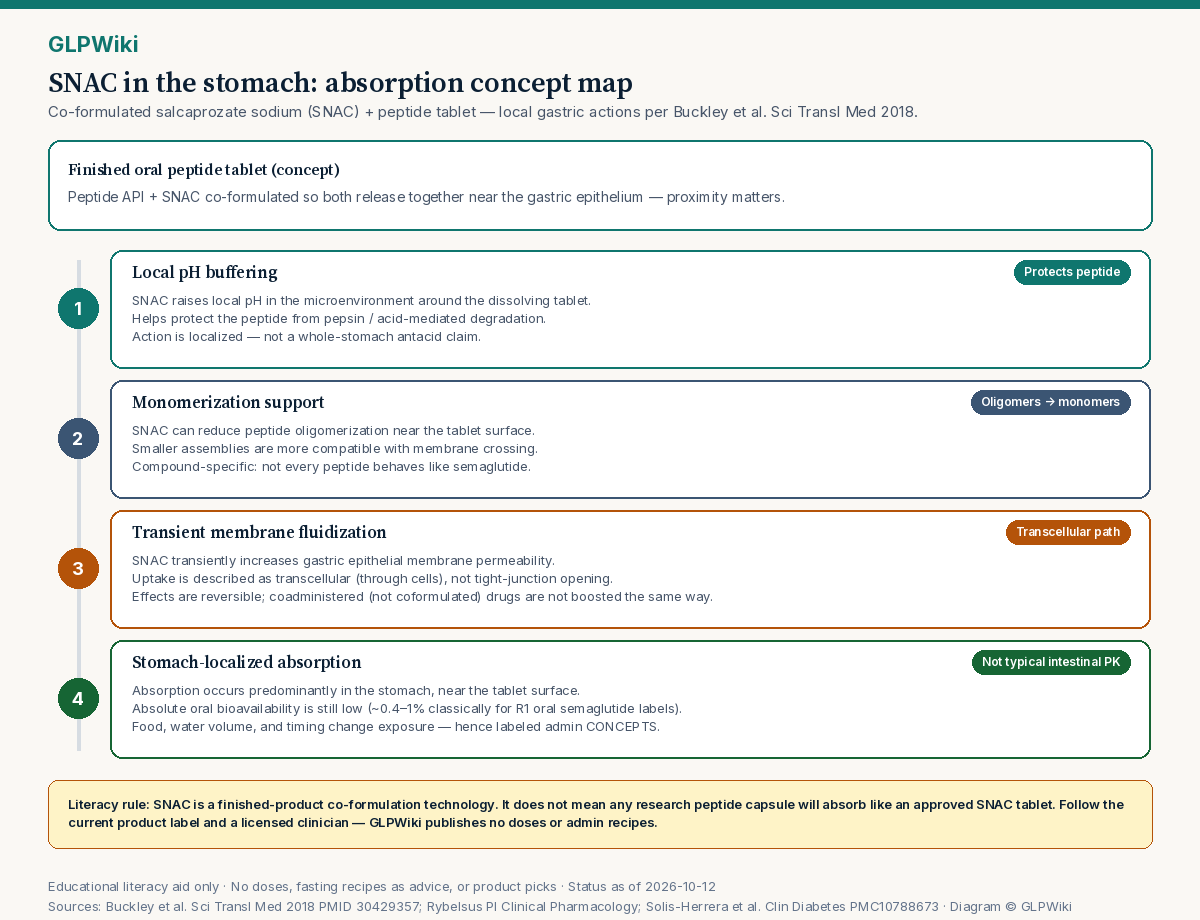
- Site: stomach-localized, near the dissolving tablet surface.
- Protection: local buffering against acid / pepsin degradation.
- Assembly: reduced oligomerization supporting absorption-compatible monomers.
- Path: transient transcellular permeability increase; not tight-junction opening in the Buckley framing.
- Specificity: compound- and coformulation-specific — not a universal oral-peptide hack.
Bioavailability numbers and food/water sensitivity (label literacy)
Cited U.S. Prescribing Information for oral semaglutide tablets states that absorption predominantly occurs in the stomach and reports estimated absolute bioavailability of approximately 0.4% to 1% after oral administration of the original (R1) tablet strengths. Later labeled formulations may report different estimated ranges (for example approximately 1% to 2% for certain R2 strengths on cited labels) — always re-open the current label PDF on Drugs@FDA rather than treating one encyclopedia sentence as permanent.
Clinical pharmacology and labeling also document that exposure depends on administration conditions. Food in the stomach can sharply reduce measurable exposure; water volume and the post-dose waiting window before food, beverages other than plain water, or other oral medicines change how much intact peptide is absorbed. Those facts explain why labels specify fasting and water CONCEPTS — they are Clinical Pharmacology consequences of a narrow gastric absorption window, not lifestyle tips invented by blogs.
Literacy only: exact volumes, wait times, missed-dose rules, and any switching language live in Dosage and Administration on the current Prescribing Information. This encyclopedia page does not publish those instructions as advice and does not recommend any schedule.
Other permeation enhancers and enteric approaches
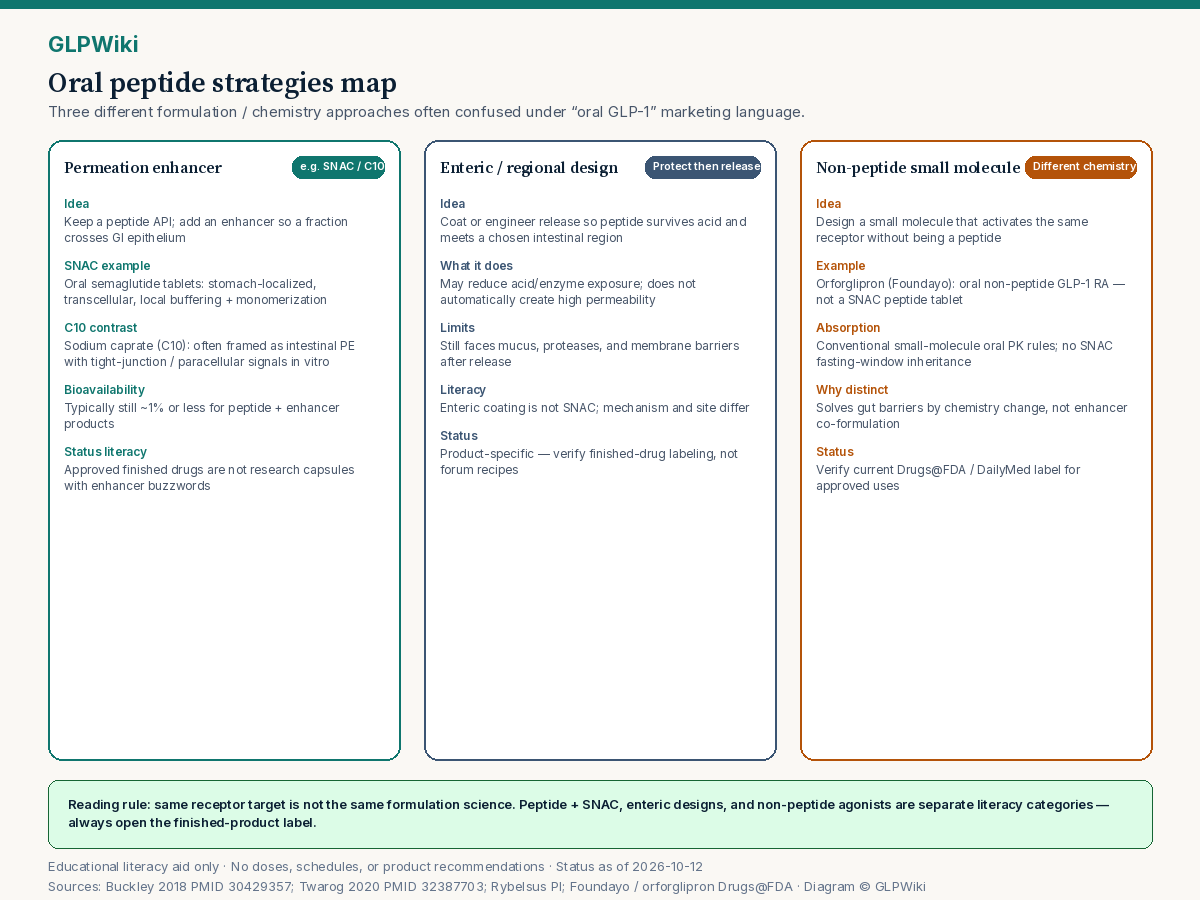
SNAC is not the only permeation enhancer studied for oral macromolecules. Sodium caprate (C10), a medium-chain fatty-acid salt, has been a leading clinical candidate in other oral peptide programs (historically associated with GIPET-type formulations). Head-to-head Caco-2 work by Twarog and colleagues (Eur J Pharm Biopharm 2020; PMID 32387703; DOI 10.1016/j.ejpb.2020.04.014) found that C10 reversibly reduced transepithelial resistance and increased paracellular marker flux with tight-junction protein reorganization, whereas SNAC did not increase paracellular flux except at cytotoxic concentrations — supporting the literacy contrast that C10 often shows additional tight-junction / paracellular signals in vitro while SNAC's clinically successful oral-semaglutide path is framed as gastric and transcellular.
Enteric coatings and regional-release designs are a different strategy again: they aim to protect a peptide from acid and release it in a chosen intestinal region. Protection against acid does not automatically create high membrane permeability. After release, the peptide still faces mucus, proteases, and epithelial barriers. Enteric coating is therefore not interchangeable with SNAC co-formulation literacy.
None of these approaches turn “oral peptide” into a casual category. Each finished product — if it exists as an approved medicine — carries its own Clinical Pharmacology, manufacturing controls, and labeled uses.
Why small-molecule oral GLP-1 RAs are a different strategy
A non-peptide oral GLP-1 receptor agonist is a small molecule designed to activate the GLP-1 receptor after conventional oral absorption pathways. It is not a peptide tablet that needs SNAC. That chemistry change is the point of the strategy: gut barriers that shred peptides are a different problem for a stable small molecule.
Orforglipron (brand Foundayo when labeled as an approved finished tablet) is the clearest current literacy example of this class in U.S. labeling discussions. FDA announced approval of Foundayo (orforglipron) tablets in 2026 for defined adult weight-management uses alongside diet and physical activity — always re-verify the current Drugs@FDA / DailyMed label for Indications & Usage, Limitations of Use, and administration CONCEPTS. Food-effect and water rules on a non-peptide label do not inherit from SNAC tablet labeling, and SNAC fasting-window CONCEPTS do not apply to a chemically different finished product.
Mentioning orforglipron here is chemical-class and formulation literacy only — not a recommendation to start, switch, or prefer any product.
Approved vs investigational vs research “oral peptide” claims
Approved finished oral peptide drugs (for example oral semaglutide tablets with SNAC) have Drugs@FDA entries, Prescribing Information, and manufacturing/quality controls as finished pharmaceuticals. Investigational oral formulations may appear on ClinicalTrials.gov under an IND and trial protocol without being approved medicines. Compounded oral preparations and research-use-only capsules that name a peptide are different regulatory categories again — even if they use the words “oral,” “SNAC,” or “absorption enhancer.”
Verification habit: capture the brand or molecule name, dosage form, and claimed use; open Drugs@FDA for finished-product status; open DailyMed for current structured labeling when available; open ClinicalTrials.gov for investigational NCT records; prefer PubMed / PMC primary papers for mechanism and PK numbers. For regulatory-status literacy more broadly, see approved-versus-investigational peptides and compounded-versus-FDA-approved GLP-1.
- Approved finished tablet with SNAC ≠ research capsule with SNAC buzzword.
- Non-peptide oral agonist ≠ peptide + enhancer tablet.
- Trial registry entry ≠ FDA approval.
- Molecule nickname ≠ finished-product Prescribing Information.
Scope, disclaimer and review date
This guide is educational. It maps SNAC chemical identity, Buckley 2018 mechanism literacy, labeled bioavailability and food/water sensitivity CONCEPTS, contrasts with C10 and enteric designs, and the separate strategy of non-peptide oral GLP-1 receptor agonists. It does not provide doses, titration schedules, fasting or water-volume instructions as advice, compounding recipes, injection or tablet administration tutorials, sourcing advice, or individual medical advice, and nothing here recommends starting, stopping, or combining any medicine or research chemical. Decisions about health care belong with a licensed clinician and, for approved medicines, the official label.
Last reviewed: October 12, 2026. Labeling, approval status, and literature may have changed since; verify with Drugs@FDA, DailyMed, ClinicalTrials.gov, PubMed, and your clinician or pharmacist.
Frequently asked questions
- What is SNAC?
- SNAC (salcaprozate sodium) is an absorption enhancer co-formulated in FDA-approved oral semaglutide tablets. Mechanistic literature describes local gastric pH buffering, reduced peptide oligomerization, and transient transcellular permeability increases that support limited stomach absorption.
- Where is oral semaglutide absorbed?
- Labeling and Buckley et al. (Sci Transl Med 2018) describe absorption predominantly in the stomach, near the tablet surface, requiring co-formulation with SNAC — unlike many small molecules absorbed mainly in the intestine.
- Why is oral peptide bioavailability around 1% or less?
- Peptides face acid, proteases, mucus, tight junctions, and low passive membrane permeability. Even with SNAC, labeled absolute bioavailability for oral semaglutide remains on the order of about 0.4–1% for classic R1 strengths (verify current label ranges). Low percent exposure can still be clinically useful for a potent molecule under reviewed conditions — that is a regulatory and clinical-pharmacology conclusion, not DIY math.
- Why do oral semaglutide labels talk about fasting and water?
- Because exposure is highly sensitive to food, water volume, and timing in the narrow gastric absorption window created by SNAC co-formulation. Those are labeled administration CONCEPTS grounded in Clinical Pharmacology — follow the current product label and a clinician; this page does not restate them as advice.
- How is C10 (sodium caprate) different from SNAC?
- Both are permeation enhancers studied for oral macromolecules. In vitro head-to-head work (Twarog et al. 2020) found C10 more clearly increased paracellular flux with tight-junction reorganization, while SNAC's successful oral-semaglutide path is framed as gastric and transcellular. They are not interchangeable literacy labels.
- Is an enteric-coated peptide the same as a SNAC tablet?
- No. Enteric coatings aim to protect against acid and release regionally; SNAC co-formulation creates a local gastric absorption microenvironment. Mechanism, site, and product evidence differ.
- Is orforglipron (Foundayo) a SNAC peptide tablet?
- No. Orforglipron is a non-peptide small-molecule GLP-1 receptor agonist. When labeled as Foundayo, it is a different chemical class and formulation strategy from peptide-plus-SNAC tablets. Compare current labels separately.
- Does SNAC make any research peptide oral?
- No. SNAC's clinical success story is tied to specific finished-drug co-formulations (notably oral semaglutide) with reviewed manufacturing and labeling. Research-use or compounded oral claims do not inherit that evidence package.
- Where should I verify current labels and trial status?
- Use Drugs@FDA and DailyMed for approved finished products, ClinicalTrials.gov for investigational NCT records, and PubMed/PMC for primary mechanism and PK papers. Prefer primary sources over social-media summaries.
- Does this page give doses or administration instructions?
- No. GLPWiki publishes educational formulation and label literacy only. Doses, schedules, fasting recipes as advice, compounding instructions, and product sourcing are out of scope.
SOURCES
- 01Buckley ST, et al. Transcellular stomach absorption of a derivatized glucagon-like peptide-1 receptor agonist. Sci Transl Med. 2018;10(467):eaar7047. PMID 30429357. DOI 10.1126/scitranslmed.aar7047— Science Translational Medicine / PubMed
- 02Solis-Herrera C, Kane MP, Triplitt C. Current Understanding of SNAC as an Absorption Enhancer: The Oral Semaglutide Experience. Clin Diabetes. PMID 38230324 / PMC10788673— Clinical Diabetes / PMC
- 03Twarog C, et al. A head-to-head Caco-2 assay comparison of the mechanisms of action of the intestinal permeation enhancers: SNAC and sodium caprate (C10). Eur J Pharm Biopharm. 2020;152:95-107. PMID 32387703. DOI 10.1016/j.ejpb.2020.04.014— European Journal of Pharmaceutics and Biopharmaceutics / PubMed
- 04Twarog C, et al. Intestinal permeation enhancers for oral delivery of macromolecules: a comparison between SNAC and sodium caprate (C10). Pharmaceutics. 2019;11(2):78. PMID 30759801 / PMC6409749— Pharmaceutics / PMC
- 05Rybelsus (semaglutide) tablets Prescribing Information — Clinical Pharmacology absorption / absolute bioavailability (label PDF via Drugs@FDA, NDA 213051)— U.S. FDA / Drugs@FDA
- 06FDA Clinical Pharmacology Review NDA 213051 (oral semaglutide)— U.S. Food and Drug Administration
- 07FDA Approves First Oral GLP-1 Treatment for Type 2 Diabetes (Rybelsus, Sep 20, 2019)— U.S. Food and Drug Administration
- 08FDA Approves First New Molecular Entity Under National Priority Voucher Program (Foundayo / orforglipron, Apr 1, 2026)— U.S. Food and Drug Administration
- 09Foundayo (orforglipron) tablets — Drugs@FDA / label documents (NDA 220934)— U.S. FDA / Drugs@FDA
- 10Overgaard RV, et al. Clinical Pharmacokinetics of Oral Semaglutide. Clin Pharmacokinet. PMC8505367— Clinical Pharmacokinetics / PMC
- 11ClinicalTrials.gov— U.S. National Library of Medicine
- 12MedWatch: FDA Safety Information and Adverse Event Reporting Program— U.S. Food and Drug Administration
EDUCATIONAL REFERENCE ONLY · Not medical advice. Nothing here diagnoses, treats, cures or prevents any disease, and nothing here is a dosing recommendation. Consult a licensed clinician before any treatment decision.