How to read Drug Interactions on peptide labels (Section 7)
GLPWiki's how-to-read-fda-peptide-labeling hub already maps PLR sections. This companion goes deeper on Section 7 Drug Interactions: how it differs from Contraindications / Warnings and Precautions and from Clinical Pharmacology 12.3 PK tables; what "clinically significant" and "predicted" mean in labeling rules; food and laboratory-test interference; delayed gastric emptying oral-medication caution as CONCEPT literacy only; and a product-specific verify path on Drugs@FDA and DailyMed. Educational only: no doses, schedules, or medical recommendations.
UPDATED 15 OCT 2026 · 15 MIN READ
KEY TAKEAWAYS
- On modern PLR Prescribing Information, Section 7 Drug Interactions must describe clinically significant interactions — observed or predicted — with other drugs, drug classes, or foods, plus specific practical instructions for preventing or managing them (21 CFR 201.57(c)(8)).
- Section 7 is not interchangeable with Section 4 Contraindications, Section 5 Warnings and Precautions, or Section 12.3 Clinical Pharmacology Drug Interaction Studies: each answers a different question.
- Interactions that appear in Contraindications or Warnings and Precautions must be discussed in more detail in Section 7; Clinical Pharmacology should carry study/PK detail without prevention/management instructions.
- Highlights of Prescribing Information includes a concise Drug Interactions summary that points into Full PI Section 7 — a gateway, not a substitute.
- Some GLP-1 finished-product labels discuss delayed gastric emptying and potential impact on orally administered medications as a Section 7 CONCEPT; wording is product-specific — always open the current PI.
- Never invent interaction advice from a molecule nickname. Quote the finished product's current Agency-posted label.
- This page publishes no doses, titration schedules, product recommendations, or personal medical advice.
What this guide covers (and how it differs from sister pages)
How to read FDA peptide labeling already explains PLR Highlights vs Full PI, Drugs@FDA vs DailyMed, and why a trial paper is not an approved label. That hub briefly notes that safety and pharmacology sections answer different questions — but it does not walk through Drug Interactions (Section 7) in depth. This Day 36 guide is that deep companion.
It is also distinct from Clinical Pharmacology label literacy (Day 34 — Section 12 mechanism / PK, including how 12.3 tables work) and from Warnings, Precautions, and Adverse Reactions literacy (Day 35 — Boxed Warning / 4 / 5 / 6). Today stays on interaction-section document literacy: clinically significant vs predicted, placement across sections, food and lab-test interference, GLP-1 delayed gastric emptying oral-med CONCEPT language, and verification habits.
- Primary sources: 21 CFR 201.57(c)(8); FDA FAQs about labeling for prescription medicines; FDA Prescribing Information Resources; FDA draft guidance Drug Interaction Information in Human Prescription Drug and Biological Product Labeling (Oct 2024); FDA Clinical Pharmacology Section of Labeling guidance; Drugs@FDA / DailyMed finished-product PIs for literacy examples.
- Two original GLPWiki diagrams: a Section 7 vs 4/5 vs 12.3 vs Highlights map, and a five-step Section 7 verification ladder.
- Out of scope: doses, titration schedules, compounding recipes, product or pharmacy recommendations, personal interaction checkers, and medical advice.
What Section 7 Drug Interactions must contain
Under 21 CFR 201.57(c)(8), the Drug Interactions section of Full Prescribing Information must describe clinically significant interactions — either observed or predicted — with other prescription or over-the-counter drugs, classes of drugs, or foods (for example dietary supplements or grapefruit juice), and must give specific practical instructions for preventing or managing them. The mechanism of the interaction, if known, must be briefly described.
FDA's October 2024 draft guidance on Drug Interaction Information in labeling explains that Section 7 content should generally prioritize actionable instructions first, then mechanisms, then clinical effects — so healthcare professionals can find what to do before diving into study detail. Cross-references reduce redundancy when the same DI theme appears in more than one section.
The same regulation requires practical guidance on known interference of the drug with laboratory tests. FDA's draft DI labeling guidance distinguishes a true test interference (an inaccurate result that can mislead clinical decisions) from an accurate pharmacodynamic change that simply reflects the drug's effect — the latter is not lab-test interference for Section 7 purposes.
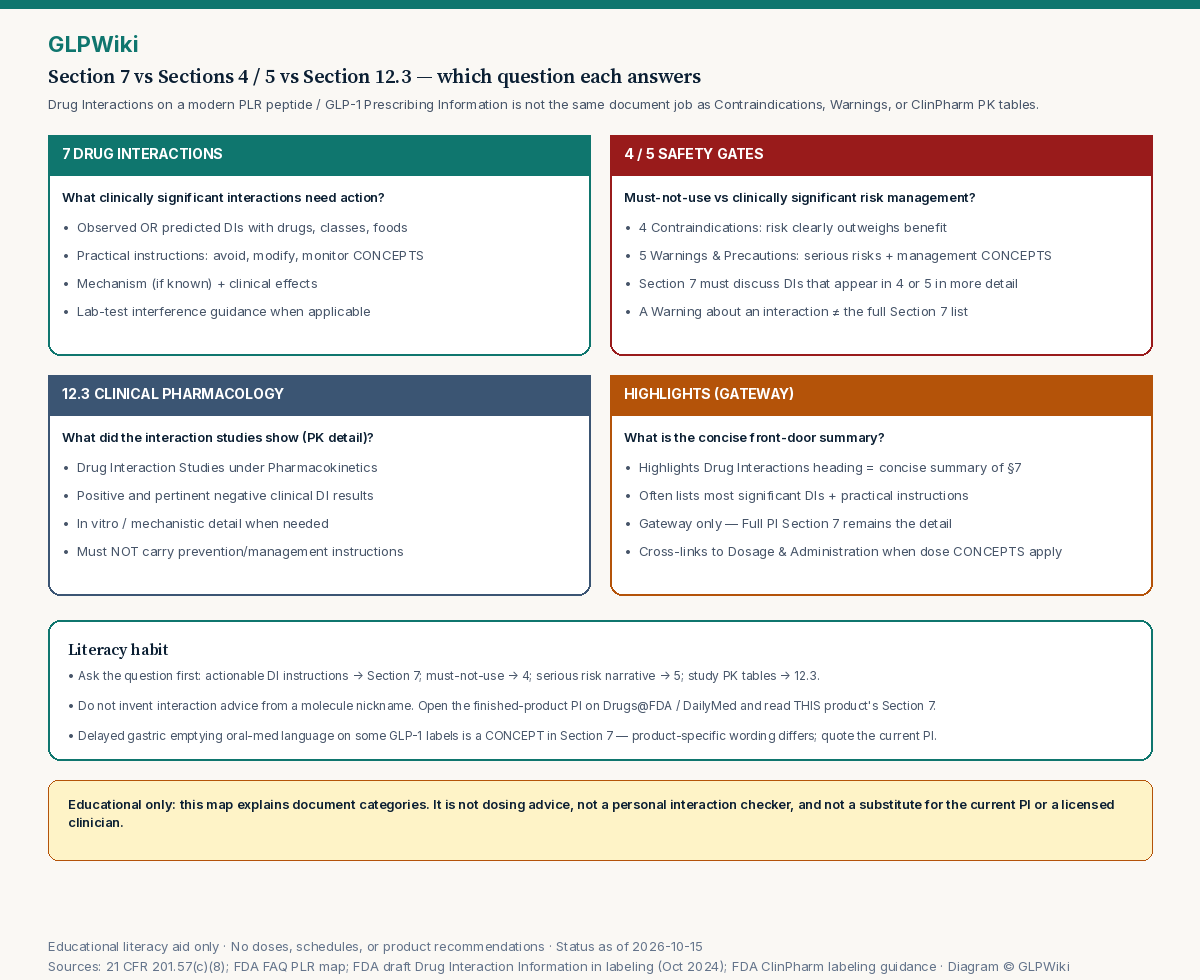
Section 7 vs Sections 4 / 5 vs Section 12.3 vs Highlights
FDA's labeling FAQs map Full Prescribing Information into numbered jobs. Section 4 Contraindications lists situations when the risk from use clearly outweighs any possible therapeutic benefit and the medicine must not be used. Section 5 Warnings and Precautions describes clinically significant risks with implications for prescribing decisions and management CONCEPTS. Section 7 is where clinically significant drug–drug, drug–class, and drug–food interactions — including those also flagged in 4 or 5 — get more detailed, actionable discussion.
Section 12 Clinical Pharmacology, and in particular the Pharmacokinetics Drug Interaction Studies discussion under 12.3, is where positive and pertinent negative clinical DI study results (and sometimes in vitro detail) live. FDA's Clinical Pharmacology labeling guidance and the October 2024 draft DI labeling guidance both emphasize that Clinical Pharmacology should not carry the prevention/management instructions that belong in Section 7 (and, when dosage CONCEPTS change, in Dosage and Administration with cross-links).
Highlights of Prescribing Information must include a concise Drug Interactions summary of the information required under Full PI Section 7. Treat Highlights as a gateway: orient there, then read Full PI Section 7 for context, mechanisms, clinical effects, and qualifications.
Clinically significant vs predicted — and what Section 7 usually omits
"Clinically significant" in this labeling context means an interaction that matters for safe and effective use — typically because it needs a practical instruction such as avoid concomitant use, modify dosage or administration CONCEPTS, increase monitoring, or contraindicate use. "Predicted" means the interaction may be inferred from mechanism or class properties even when a dedicated clinical study for every member of a drug interacting class was not run; FDA's draft guidance discusses identifying drug interacting classes (for example strong CYP3A inhibitors) rather than endlessly listing every individual agent.
The draft guidance generally recommends against putting interactions that are not clinically significant into Section 7, unless it is important to communicate the absence of a clinically significant interaction. In vitro and/or animal data alone are generally insufficient to justify a clinically significant DI claim in Section 7 — those details, when relevant, belong under Clinical Pharmacology study discussion with clear statements about clinical significance when known or unknown.
Literacy habit: if a social-media post says "this peptide interacts with everything," ask which finished product, which Section 7 language, and whether the claim is actually a Highlights bullet, a 12.3 PK table row, or an invented molecule-name rumor.
Delayed gastric emptying and oral medications — CONCEPT literacy only
Several FDA-approved GLP-1 and dual-agonist finished-product labels discuss, in Section 7, that the medicine delays gastric emptying and thereby has the potential to impact absorption of concomitantly administered oral medications. Related subsections may address concomitant use with insulin or an insulin secretagogue, with cross-links to Warnings and Precautions. These are product-specific labeled CONCEPTS — not a universal rule you can paste across every molecule nickname.
Wording differs across finished products. Some injectable semaglutide labels note that clinical pharmacology trials did not show clinically relevant effects on absorption of certain oral medications and still advise caution; some tirzepatide labels add monitoring CONCEPTS for narrow-therapeutic-index oral drugs and product-specific language about oral hormonal contraceptives around initiation and dose-escalation CONCEPT windows; oral semaglutide labeling discusses other oral drugs with different study detail (including a documented levothyroxine exposure change in a drug-interaction study) and monitoring CONCEPTS. None of those sentences are dosing advice from GLPWiki — they are reasons to open the current PI for the exact finished product.
This encyclopedia page intentionally does not reproduce amounts, schedules, or personal management algorithms. For individual questions about concomitant medicines, contact a licensed clinician and use the Agency-posted label.
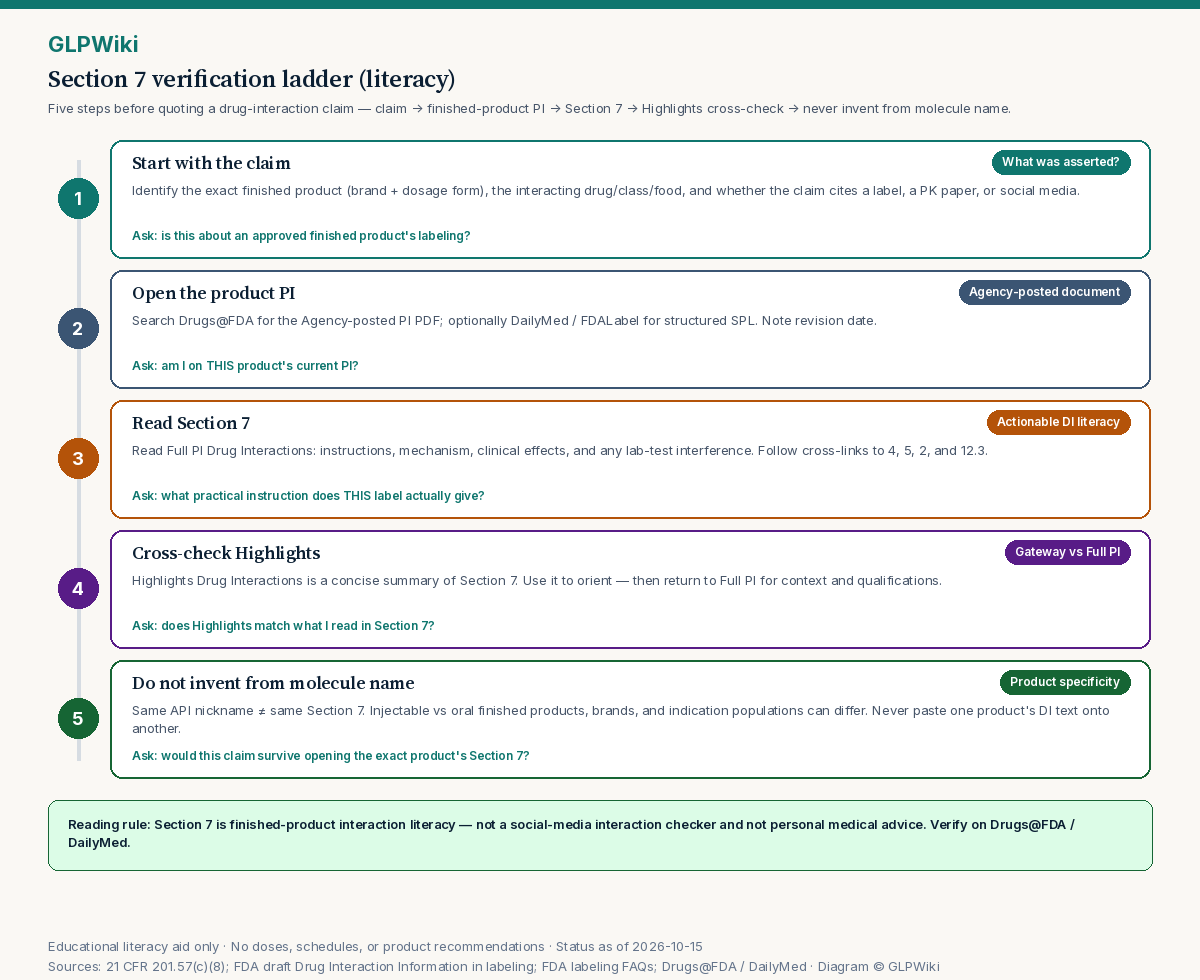
A practical Section 7 verification path
Start with the claim: exact finished product name and dosage form, the interacting drug or class or food, and the document type being cited. Open Drugs@FDA for the Agency-posted PI PDF, then optionally DailyMed or FDALabel for structured SPL text. Read Full PI Section 7 in order — instructions, mechanism, clinical effects, lab-test interference — and follow cross-links to Sections 4, 5, 2, and 12.3 before quoting a single bullet.
Cross-check the Highlights Drug Interactions heading so the gateway summary matches what you read in Full PI. Record product, section, subsection, revision date, and whether the claim is an instruction, a mechanism, a clinical-effect statement, or a PK study result from 12.3.
For investigational compounds without an approved PI, use ClinicalTrials.gov and PubMed — and do not treat an NCT record or paper as substitute Section 7 labeling.
- Approved finished-product Section 7: Drugs@FDA label PDF.
- Structured SPL search: DailyMed / FDALabel — still verify against the Agency-posted PI when precision matters.
- CYP / transporter class examples resource: FDA's examples of drugs that interact with CYP enzymes and transporter systems (for class literacy, not product advice).
- Investigational only: ClinicalTrials.gov / PubMed — not approved labeling.
Product specificity: never invent from a molecule nickname
Prescribing Information is finished-product labeling. Two brands that share an active moiety can differ in formulation, route, approved indication populations, titration CONCEPTS, study programs, and therefore in how Section 7 is written. Copying Product A's interaction paragraph into a claim about Product B is a document-type error.
The same rule applies when comparing an approved finished medicine with a compounded preparation or a research-use listing that happens to use a familiar molecule name. Those other items do not inherit Section 7 of an approved PI. For category boundaries, see approved versus investigational peptides and compounded versus FDA-approved GLP-1 medicines.
Scope, disclaimer and review date
This guide is educational. It maps how to read Drug Interactions (Section 7) on FDA peptide and GLP-1 Prescribing Information — including how Section 7 differs from Sections 4/5 and 12.3, clinically significant vs predicted interactions, food and lab-test interference CONCEPTS, delayed gastric emptying oral-med caution as label CONCEPT literacy, and a Drugs@FDA / DailyMed verify path. It does not provide doses, titration schedules, compounding recipes, administration tutorials, sourcing advice, personal interaction triage, or individual medical advice, and nothing here recommends starting, stopping, or combining any medicine or research chemical. Decisions about health care belong with a licensed clinician and, for approved medicines, the official label.
Last reviewed: October 15, 2026. Labeling, approval status, and literature may have changed since; verify with Drugs@FDA, DailyMed, FDALabel, ClinicalTrials.gov, PubMed, and your clinician or pharmacist.
Frequently asked questions
- What is Section 7 Drug Interactions for?
- It must describe clinically significant drug interactions — observed or predicted — with other drugs, drug classes, or foods, give specific practical instructions for preventing or managing them, briefly describe known mechanisms, and include practical guidance on known laboratory-test interference (21 CFR 201.57(c)(8)).
- How is Section 7 different from Section 12.3?
- Section 12.3 Clinical Pharmacology Drug Interaction Studies carry PK and study detail (positive and pertinent negative results). Section 7 carries the actionable clinically significant interaction discussion. Clinical Pharmacology should not include the prevention/management instructions that belong in Section 7.
- How is Section 7 different from Warnings and Precautions?
- Warnings and Precautions (Section 5) describe clinically significant risks with management CONCEPTS. When an interaction is serious enough to appear in Contraindications or Warnings and Precautions, Section 7 must discuss it in more detail. A Warning about an interaction is not a substitute for reading the full Section 7 list for that finished product.
- What does "predicted" interaction mean on a label?
- It means the clinically significant interaction may be inferred from mechanism or class properties (for example a CYP inhibitor class) even when every individual drug in the class was not separately studied with the subject drug. Always read the product's current wording rather than inventing class membership yourself.
- Why do some GLP-1 labels mention delayed gastric emptying and oral medications?
- Because those finished-product labels describe delayed gastric emptying as having the potential to impact absorption of concomitantly administered oral medications, with product-specific caution or monitoring CONCEPT language in Section 7. Wording differs by product — open the current PI rather than generalizing from a molecule nickname.
- Are food interactions and lab-test interference part of Section 7?
- Yes when clinically significant. Foods (including dietary supplements and examples such as grapefruit juice in some class contexts) can appear among clinically significant interactions. Known laboratory-test interference that can produce inaccurate results must also be addressed with practical guidance.
- Can I use Highlights alone for drug-interaction decisions?
- No. Highlights Drug Interactions is a concise summary required to reflect Full PI Section 7. Use it to orient, then read the Full Prescribing Information for context and qualifications. Individual decisions belong with a licensed clinician and the current official label.
- Does this page give doses or tell me which drugs I can combine?
- No. Doses, schedules, compounding instructions, product sourcing, and personal combination advice are out of scope. GLPWiki publishes educational label literacy only.
SOURCES
- 0121 CFR 201.57 — Specific requirements on content and format of labeling (PLR), including (c)(8) Drug interactions— U.S. Government Publishing Office / eCFR
- 02Drug Interaction Information in Human Prescription Drug and Biological Product Labeling (FDA draft guidance, Oct 2024)— U.S. Food and Drug Administration
- 03Drug Interaction Information in Human Prescription Drug and Biological Product Labeling — PDF (FDA, Oct 2024)— U.S. Food and Drug Administration
- 04Clinical Pharmacology Section of Labeling for Human Prescription Drug and Biological Products — Content and Format (FDA guidance)— U.S. Food and Drug Administration
- 05Frequently Asked Questions about Labeling for Prescription Medicines— U.S. Food and Drug Administration
- 06Prescribing Information Resources (PLR section map; Section 7 resources)— U.S. Food and Drug Administration
- 07M12 Drug Interaction Studies (FDA guidance)— U.S. Food and Drug Administration
- 08Healthcare Professionals: FDA's Examples of Drugs that Interact with CYP Enzymes and Transporter Systems— U.S. Food and Drug Administration
- 09Ozempic (semaglutide) injection Prescribing Information — Drug Interactions (DailyMed)— U.S. FDA / DailyMed
- 10Wegovy (semaglutide) injection Prescribing Information — Drug Interactions (DailyMed)— U.S. FDA / DailyMed
- 11Rybelsus / Ozempic tablets (oral semaglutide) Prescribing Information — Drug Interactions (DailyMed)— U.S. FDA / DailyMed
- 12Mounjaro (tirzepatide) injection Prescribing Information — Drug Interactions (DailyMed)— U.S. FDA / DailyMed
- 13Zepbound (tirzepatide) injection Prescribing Information — Drug Interactions (DailyMed)— U.S. FDA / DailyMed
- 14Drugs@FDA— U.S. Food and Drug Administration
- 15DailyMed— U.S. National Library of Medicine
- 16FDALabel: Full-Text Search of Drug Product Labeling— U.S. Food and Drug Administration
- 17ClinicalTrials.gov— U.S. National Library of Medicine
EDUCATIONAL REFERENCE ONLY · Not medical advice. Nothing here diagnoses, treats, cures or prevents any disease, and nothing here is a dosing recommendation. Consult a licensed clinician before any treatment decision.