How to read Warnings, Precautions, and Adverse Reactions on peptide labels

GLPWiki's how-to-read-fda-peptide-labeling hub already teases that Boxed Warning, Warnings and Precautions, and Adverse Reactions answer different safety questions. This companion goes deeper: how Contraindications (Section 4), Warnings and Precautions (Section 5), Adverse Reactions (Section 6), and a Boxed Warning (when present) differ; how to read incidence tables and denominators; why rates never transfer across brands sharing an API nickname; and how MedWatch reporting relates to — but is not the same as — approved labeling. Educational only: no doses, schedules, or medical recommendations.
UPDATED 14 OCT 2026 · 15 MIN READ
KEY TAKEAWAYS
- On modern PLR Prescribing Information, a Boxed Warning (when present), Contraindications (4), Warnings and Precautions (5), and Adverse Reactions (6) are related but not interchangeable safety categories.
- Contraindications identify situations in which the finished product must not be used because risk clearly outweighs benefit; the section may state None if none apply.
- Warnings and Precautions describe clinically significant risks with implications for prescribing decisions and management CONCEPTS (risk factors, monitoring, interactions) — not a casual side-effect list.
- Adverse Reactions summarizes the observed reaction profile from clinical trials and postmarketing spontaneous reports, typically with tables, denominators, and cross-links to Sections that discuss serious risks in more detail.
- Literacy habit for AR tables: identify the study pool, the N (denominator), drug % versus placebo/comparator, seriousness or discontinuation signals, and the exact finished product — never paste rates across brands.
- MedWatch is FDA's adverse-event reporting program; reports can help surface safety signals but are not the same document as Section 6 of an approved PI.
- This page publishes no doses, titration schedules, product recommendations, or personal medical advice.
What this guide covers (and how it differs from sister pages)
How to read FDA peptide labeling already explains PLR Highlights vs Full PI, Drugs@FDA vs DailyMed, Indications, and why a trial paper is not an approved label. That hub briefly notes that Boxed Warning, Warnings and Precautions, and Adverse Reactions answer different safety questions — but it does not walk through how to read those sections in depth. This Day 35 guide is that deep companion.
It is also distinct from Clinical Pharmacology label literacy (Section 12 mechanism / PK) and from the GLP-1 GI effects mechanism explainer (why nausea pathways exist). Today stays on safety-section document literacy: categories, tables, denominators, product specificity, and MedWatch versus label.
- Primary sources: FDA guidance on Warnings and Precautions, Contraindications, and Boxed Warning sections; FDA Adverse Reactions Section of Labeling guidance; FDA FAQs about labeling for prescription medicines; Drugs@FDA / DailyMed finished-product PIs for literacy examples; MedWatch program pages.
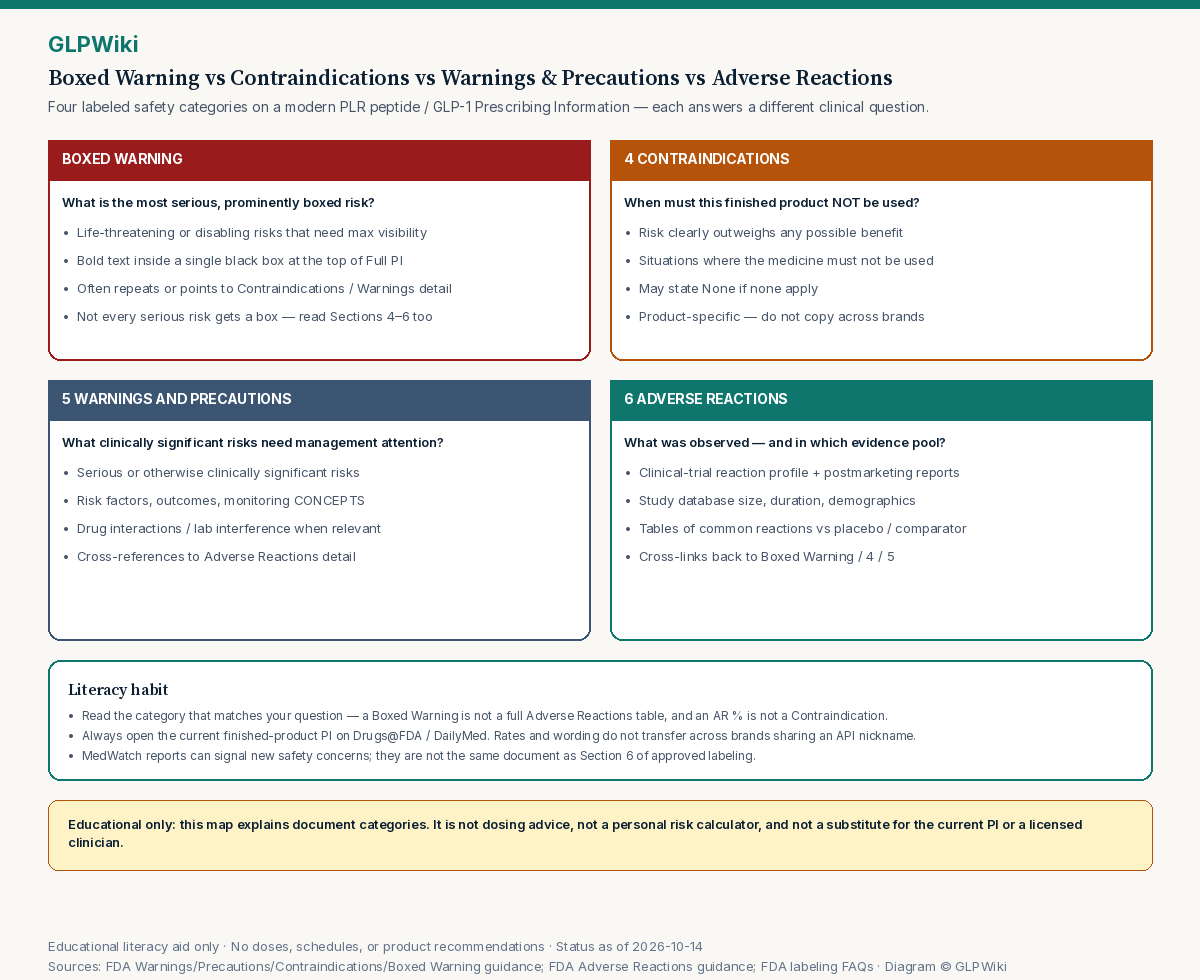
- Two original GLPWiki diagrams: a four-category safety map (Boxed Warning / 4 / 5 / 6) and an Adverse Reactions table literacy ladder (study pool → denominator → % vs placebo → seriousness → do-not-cross-products).
- Out of scope: doses, titration schedules, compounding recipes, product or pharmacy recommendations, and personal symptom management advice.
Four categories, four questions
FDA's labeling resources describe how Full Prescribing Information organizes safety information into numbered sections with distinct jobs. A Boxed Warning, when present, sits at the beginning of the Full PI in bold text surrounded by a single black line (box) and highlights certain serious adverse reactions that may lead to death or serious injury. It is a prominence device — not a substitute for reading Contraindications, Warnings and Precautions, and Adverse Reactions.
Section 4 Contraindications lists situations when the risk from use clearly outweighs any possible therapeutic benefit and the medicine must not be used. FDA guidance also notes that if there are no contraindications, the section should state None.
Section 5 Warnings and Precautions describes clinically significant adverse reactions or risks — including numerical estimates when known, outcomes, known risk factors, and information on how to prevent, mitigate, or monitor those risks. Inclusion generally requires reason to believe there is a causal association, even if causality is not definitively established.
Section 6 Adverse Reactions presents the overall adverse-reaction profile from clinical studies and spontaneous postmarketing reports. It typically describes the clinical-trial database (designs, number of patients, dosage, duration, demographics) and lists common reactions in tables, with cross-references to more detailed discussion in Boxed Warning or Warnings and Precautions when applicable.
Boxed Warning and Contraindications literacy
A Boxed Warning is used when FDA determines that certain serious risks need maximum visual prominence. FDA guidance on Boxed Warnings describes contexts such as serious, life-threatening, or disabling adverse reactions; preventable adverse reactions; or safe-use restrictions. The boxed text is meant to be concise and accessible — it often points readers into Sections 4 or 5 for fuller detail rather than replacing those sections.
Literacy habit: if a social-media summary says a peptide has a black-box warning, verify which finished product, which exact boxed language, and which revision of the PI. Some related products share theme language (for example thyroid C-cell tumor boxed language on several GLP-1 receptor agonist labels), but wording, populations, and cross-references remain product-specific — always open the current Agency-posted label.
Contraindications are not a softer version of Warnings. They are the label's statement of when the finished product must not be used. Mixing a contraindication with a common Adverse Reactions table entry is a category error: one answers must-not-use, the other answers what was observed under stated study conditions.
How to read Warnings and Precautions
Section 5 is where many of the clinician-facing risk-management CONCEPTS live: pancreatitis discussion, gallbladder disease, hypoglycemia risk when combined with certain other glucose-lowering medicines, diabetic retinopathy complications in specific populations, acute kidney injury in the setting of severe gastrointestinal losses, hypersensitivity, and perioperative residual gastric contents — depending on the finished product. This encyclopedia page does not reproduce management algorithms or amounts; it teaches you where those CONCEPTS sit and how they differ from Section 6 tables.
FDA guidance emphasizes discrete, clinically significant risks with implications for prescribing decisions. Expect subsections, cross-references to Adverse Reactions, and sometimes numerical rate estimates. Read risk factors and monitoring CONCEPTS as labeled communication to healthcare professionals — not as a DIY checklist published by GLPWiki.
Highlights of Prescribing Information often summarize selected Warnings and Precautions. Highlights is a gateway; the Full PI Section 5 remains the place for context, definitions, and qualifications.
How to read Adverse Reactions tables
Section 6 typically opens by identifying the most clinically important reactions and directing readers to Boxed Warning or Warnings and Precautions for deeper discussion, then describes the clinical-trial safety database, then presents common adverse reactions — often as tables comparing the investigational product arm with placebo or an active comparator at or above a stated incidence threshold.
FDA's Adverse Reactions labeling guidance stresses making the most clinically important information accessible: cross-reference serious reactions discussed elsewhere, identify the most commonly occurring reactions, and identify reactions that led to discontinuation or other clinical intervention in trials. Postmarketing spontaneous reports appear separately and generally without incidence rates, because voluntary reporting lacks a reliable denominator.
For peptide and GLP-1 finished-product labels, gastrointestinal events such as nausea, vomiting, diarrhea, and constipation frequently appear among the most common trial-observed reactions — with rates that differ by product, indication population, and study program. Quote the current PI for the exact finished product; do not average social-media lists across brands.
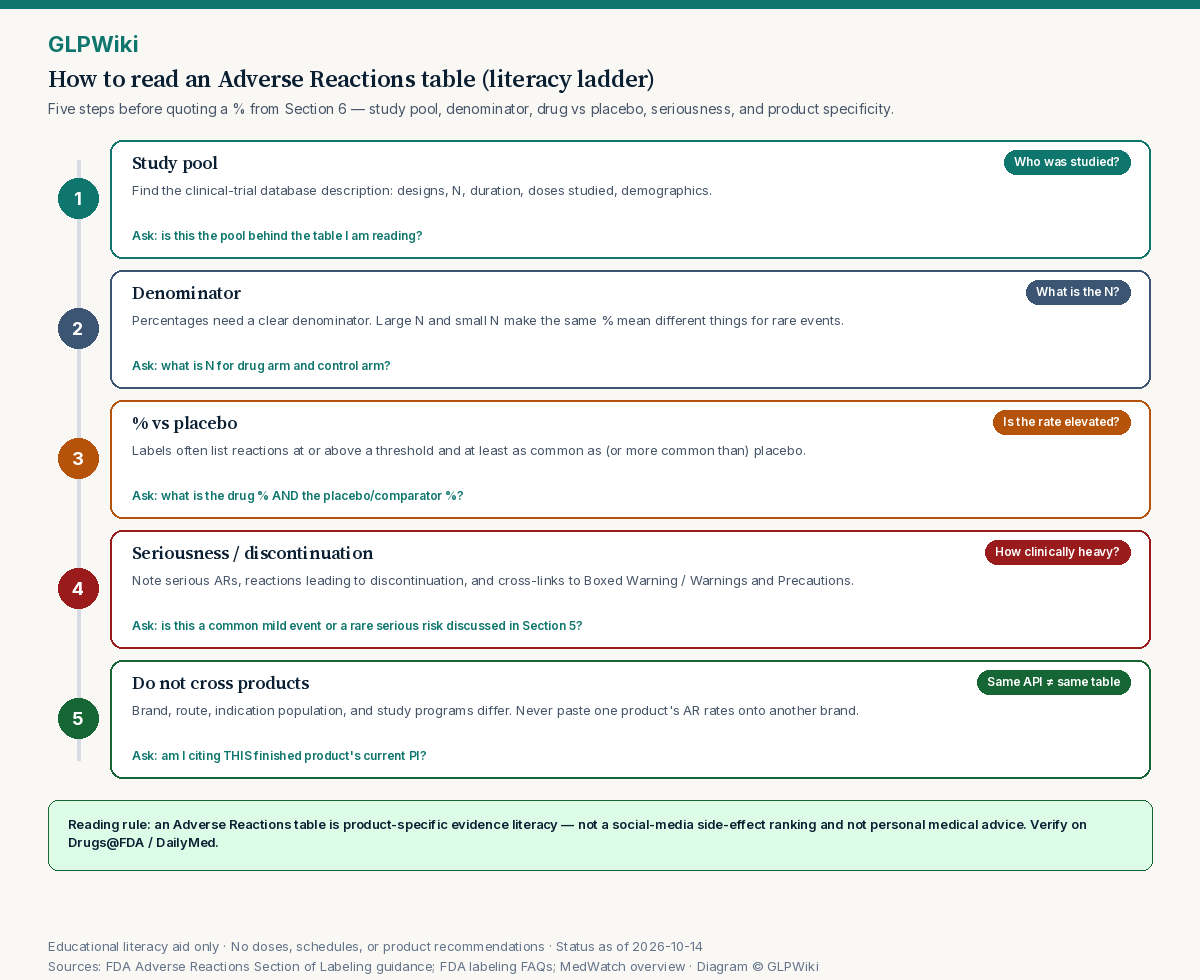
- Study pool: designs, N, duration, demographics behind the table.
- Denominator: know N for drug and control arms before quoting a %.
- Drug vs placebo: read both columns, not a lone drug percentage.
- Seriousness: connect common mild events to Section 5 / Boxed Warning when the label does.
- Product specificity: same API nickname ≠ same Adverse Reactions table.
Product specificity: never transfer rates across brands
Prescribing Information is finished-product labeling. Two brands that share an active moiety can differ in formulation, route, approved indication populations, titration CONCEPTS, study programs, and therefore in how Adverse Reactions tables and Warnings subsections are written. A rate copied from Product A into a claim about Product B is not label literacy — it is a document-type error.
The same rule applies when comparing an approved finished medicine with a compounded preparation or a research-use listing that happens to use a familiar molecule name. Those other items do not inherit Section 6 of an approved PI. For category boundaries, see approved versus investigational peptides and compounded versus FDA-approved GLP-1 medicines.
MedWatch versus the approved label
FDA MedWatch is the Agency's safety information and adverse-event reporting program. Healthcare professionals and consumers can report serious problems they believe may be associated with medical products. FDA notes that MedWatch reports alone rarely confirm a causal relationship; formal epidemiologic study or controlled trials may be needed to establish causation. Still, reports provide rapid signals that problems may be occurring — especially for serious events not listed in labeling.
Approved labeling (including Section 6) is a different document type: it is the Agency-approved (or Agency-posted) professional labeling for a finished product, updated through labeling supplements and safety labeling changes when required. MedWatch reports can contribute to the evidence that eventually changes a label, Medication Guide, or other regulatory action — but a spontaneous report is not itself Section 6.
Highlights of Prescribing Information typically include an Adverse Reactions contact reporting statement with manufacturer and FDA MedWatch contact information. That statement encourages reporting of suspected adverse events; it does not turn an encyclopedia page into a reporting tutorial or medical advice.
A practical safety-section verification path
Start with the exact finished product name and dosage form. Open Drugs@FDA for the Agency-posted PI PDF, then optionally DailyMed for structured SPL text. Read Boxed Warning (if present) → Section 4 → Section 5 → Section 6 in order before mining a single percentage.
For each rate you want to cite, record: product, section, table or subsection, reaction term, drug %, placebo/comparator %, N or database description, and document revision date. If the event is also discussed in Warnings and Precautions, read that subsection so the table is not separated from risk-management CONCEPTS.
For investigational compounds without an approved PI, use ClinicalTrials.gov and PubMed — and do not treat an NCT record or paper as substitute labeling.
- Approved finished-product safety sections: Drugs@FDA label PDF.
- Structured SPL search: DailyMed / FDALabel — still verify against the Agency-posted PI when precision matters.
- Suspected serious product problems: MedWatch official channels.
- Investigational only: ClinicalTrials.gov / PubMed — not approved labeling.
Scope, disclaimer and review date
This guide is educational. It maps how to read Boxed Warning, Contraindications (4), Warnings and Precautions (5), and Adverse Reactions (6) on FDA peptide and GLP-1 Prescribing Information — including incidence-table literacy, product specificity, and MedWatch versus label. It does not provide doses, titration schedules, compounding recipes, administration tutorials, sourcing advice, symptom triage, or individual medical advice, and nothing here recommends starting, stopping, or combining any medicine or research chemical. Decisions about health care belong with a licensed clinician and, for approved medicines, the official label.
Last reviewed: October 14, 2026. Labeling, approval status, and literature may have changed since; verify with Drugs@FDA, DailyMed, MedWatch, ClinicalTrials.gov, PubMed, and your clinician or pharmacist.
Frequently asked questions
- What is the difference between Warnings and Precautions and Adverse Reactions?
- Warnings and Precautions (Section 5) describe clinically significant risks with implications for prescribing decisions and management CONCEPTS. Adverse Reactions (Section 6) summarizes the observed reaction profile from clinical trials and postmarketing reports, often in tables with denominators. Serious reactions discussed in Section 5 are usually cross-referenced from Section 6.
- What is a Boxed Warning?
- A Boxed Warning (sometimes called a black-box warning in lay terms) highlights certain serious risks in bold text inside a black box at the beginning of the Full Prescribing Information. It increases prominence; it does not replace reading Sections 4–6 on the current product label.
- What belongs in Contraindications?
- Situations when the risk from use clearly outweighs any possible therapeutic benefit and the medicine must not be used. If there are none, the section may state None. Contraindications are product-specific.
- How should I read an Adverse Reactions percentage?
- Identify the finished product, the study pool behind the table, the denominator (N), the drug rate and the placebo/comparator rate, and whether the event is also discussed as a serious risk in Warnings and Precautions or a Boxed Warning. Do not transfer rates across brands.
- Why can't I compare side-effect rates across GLP-1 brands from memory?
- Because Prescribing Information is finished-product labeling. Indication populations, study programs, formulations, and table thresholds differ. Quote each product's current PI separately.
- Is MedWatch the same as Section 6?
- No. MedWatch is FDA's adverse-event reporting and safety-information program. Section 6 is part of approved (or Agency-posted) professional labeling. Reports can help surface signals that later change labeling, but a spontaneous report is not itself the Adverse Reactions section.
- Do postmarketing adverse reaction lists include percentages?
- Often not. Spontaneous reporting generally lacks a reliable denominator, so postmarketing lists are typically presented without incidence rates. Clinical-trial tables are where labeled percentages usually appear.
- Does this page tell me what to do if I have a side effect?
- No. GLPWiki publishes educational label literacy only. Individual symptoms and risk questions belong with a licensed clinician. Suspected serious product problems can be reported through official MedWatch channels.
- Does this page give doses or product recommendations?
- No. Doses, schedules, compounding instructions, and product sourcing are out of scope.
SOURCES
- 01Warnings and Precautions, Contraindications, and Boxed Warning Sections of Labeling for Human Prescription Drug and Biological Products — Content and Format (FDA guidance, Oct 2011)— U.S. Food and Drug Administration
- 02Adverse Reactions Section of Labeling for Human Prescription Drug and Biological Products — Content and Format (FDA guidance, Jan 2006)— U.S. Food and Drug Administration
- 03Frequently Asked Questions about Labeling for Prescription Medicines— U.S. Food and Drug Administration
- 04Prescribing Information Resources (PLR section map)— U.S. Food and Drug Administration
- 05MedWatch: The FDA Safety Information and Adverse Event Reporting Program— U.S. Food and Drug Administration
- 06Information About Reporting Adverse Events to FDA's MedWatch Program— U.S. Food and Drug Administration
- 07Ozempic (semaglutide) injection Prescribing Information — Warnings / Adverse Reactions (Drugs@FDA / DailyMed)— U.S. FDA / DailyMed
- 08Wegovy (semaglutide) injection Prescribing Information — Warnings / Adverse Reactions (Drugs@FDA / DailyMed)— U.S. FDA / DailyMed
- 09Mounjaro (tirzepatide) injection Prescribing Information — Warnings / Adverse Reactions (DailyMed)— U.S. FDA / DailyMed
- 10Zepbound (tirzepatide) injection Prescribing Information — Warnings / Adverse Reactions (DailyMed / Drugs@FDA)— U.S. FDA / DailyMed
- 11Drugs@FDA— U.S. Food and Drug Administration
- 12DailyMed— U.S. National Library of Medicine
- 13ClinicalTrials.gov— U.S. National Library of Medicine
EDUCATIONAL REFERENCE ONLY · Not medical advice. Nothing here diagnoses, treats, cures or prevents any disease, and nothing here is a dosing recommendation. Consult a licensed clinician before any treatment decision.