BPC-157 evidence check: claims, animal literature and the thin human record
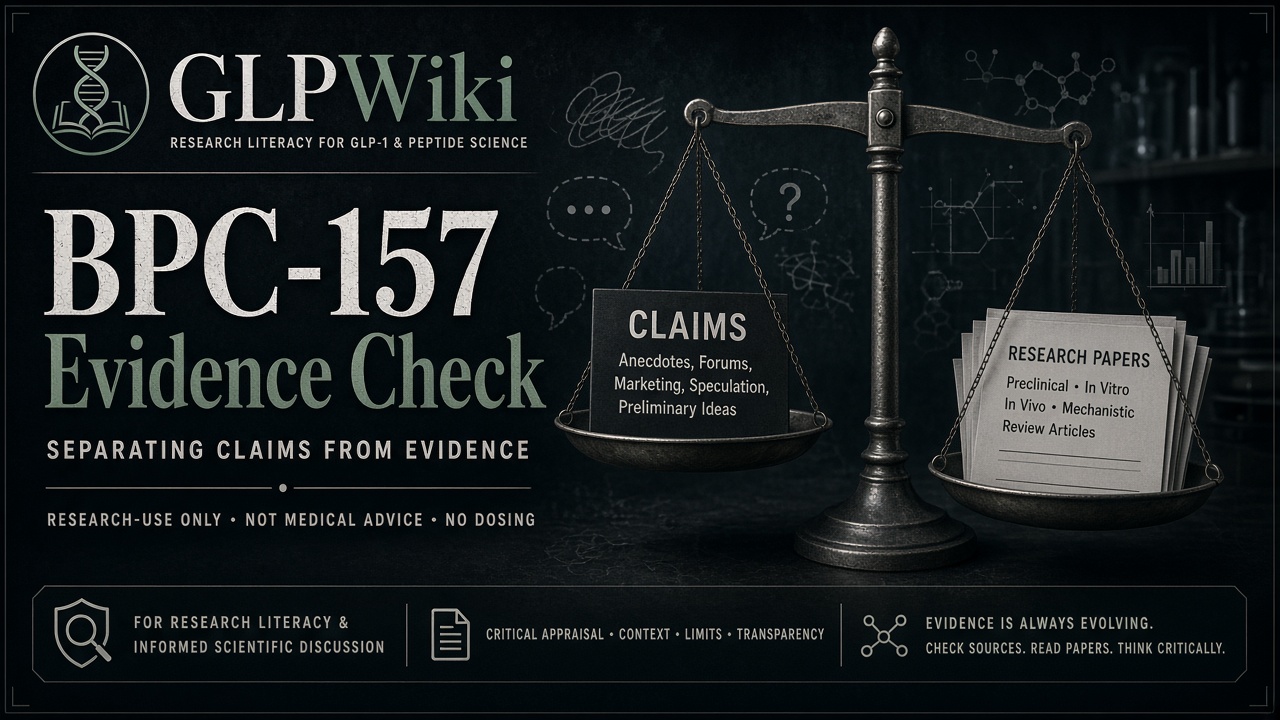
Body Protection Compound-157 is a synthetic gastric pentadecapeptide with a large rodent literature and almost no rigorous human efficacy trials. This guide maps claim domains against evidence type, lists verified ClinicalTrials.gov records, summarises FDA compounding safety communications, and separates animal findings from medicine status. Educational only: no doses, protocols or product recommendations.
UPDATED 10 OCT 2026 · 14 MIN READ
KEY TAKEAWAYS
- BPC-157 (also called PL 14736 / Bepecin in older literature) is a synthetic 15–amino-acid peptide associated with gastric cytoprotection research; it is not an FDA-approved medicine.
- Most repair claims (tendon, ligament, muscle, gut, nerve, vascular) rest on rodent and other preclinical models. A prolific originating research network accounts for much of the positive musculoskeletal literature; independent replication is comparatively thin.
- Published human reports identified as of this review are small and uncontrolled (e.g. retrospective knee injections n=16; interstitial-cystitis pilot n=12; intravenous safety pilot n=2). No completed randomised efficacy trial with posted results was identified.
- Registry literacy: NCT02637284 (oral Phase 1) has status unknown and no results posted; NCT07437547 (hamstring Phase 2) is recruiting; NCT07803250 (rotator-cuff Phase 1) is not yet recruiting. A registry entry is never an approval.
- FDA communications describe significant safety concerns for compounding use of BPC-157 (immunogenicity risk for some routes, peptide-related impurities / API characterisation complexity, and insufficient human safety information). It is not within the Category 1 interim compounding policy scope.
- WADA lists BPC-157 among prohibited / unapproved substances for sport — anti-doping policy, not FDA approval status.
- COA purity (if genuine) addresses lot identity/purity questions; it does not prove clinical efficacy. Animal ≠ human; preprint ≠ peer-review; marketing ≠ evidence.
What this guide adds to the August 2026 blog post
GLPWiki's August 2026 deep dive, 'BPC-157: separating the claims from the evidence', summarised the imbalance between animal enthusiasm and missing human trials. This guide rebuilds that check as a full reference: chemistry/identity literacy, claim-domain map, verified NCT numbers, FDA compounding safety language, related TB-500 context, and an evidence-maturity ladder. The original post stays online with a link to this guide.
- Primary sources: ClinicalTrials.gov records, FDA bulk-substance compounding/safety pages, PubMed-indexed human pilots and narrative/systematic reviews.
- Status check as of October 10, 2026: still no FDA-approved BPC-157 finished drug; human RCT efficacy results still absent from the public record.
- Two original GLPWiki diagrams: evidence ladder and claim-vs-evidence map.
What BPC-157 is (identity literacy only)
BPC-157 stands for Body Protection Compound-157. In the scientific literature it is described as a synthetic gastric pentadecapeptide — a 15–amino-acid fragment associated with research on a larger body-protection protein / gastric juice–related cytoprotection concept pioneered in work linked to Predrag Sikiric and colleagues beginning in the early 1990s. Older development names include PL 14736, PL-10 / PLD-116 and Bepecin (sometimes spelled Bepectin).
Common sequence listings for the free peptide give Gly-Glu-Pro-Pro-Pro-Gly-Lys-Pro-Ala-Asp-Asp-Ala-Gly-Leu-Val (CAS often cited as 137525-51-0 for the free base). That chemistry identity does not imply approved drug status. Online 'research-use' vials are not the same as trial materials or approved medicines: lot identity, purity, sterility and counter-ion content are separate questions from any animal paper.
This page deliberately stops at literacy. It does not describe how to obtain, reconstitute, inject or schedule BPC-157.
Claim landscape vs evidence type
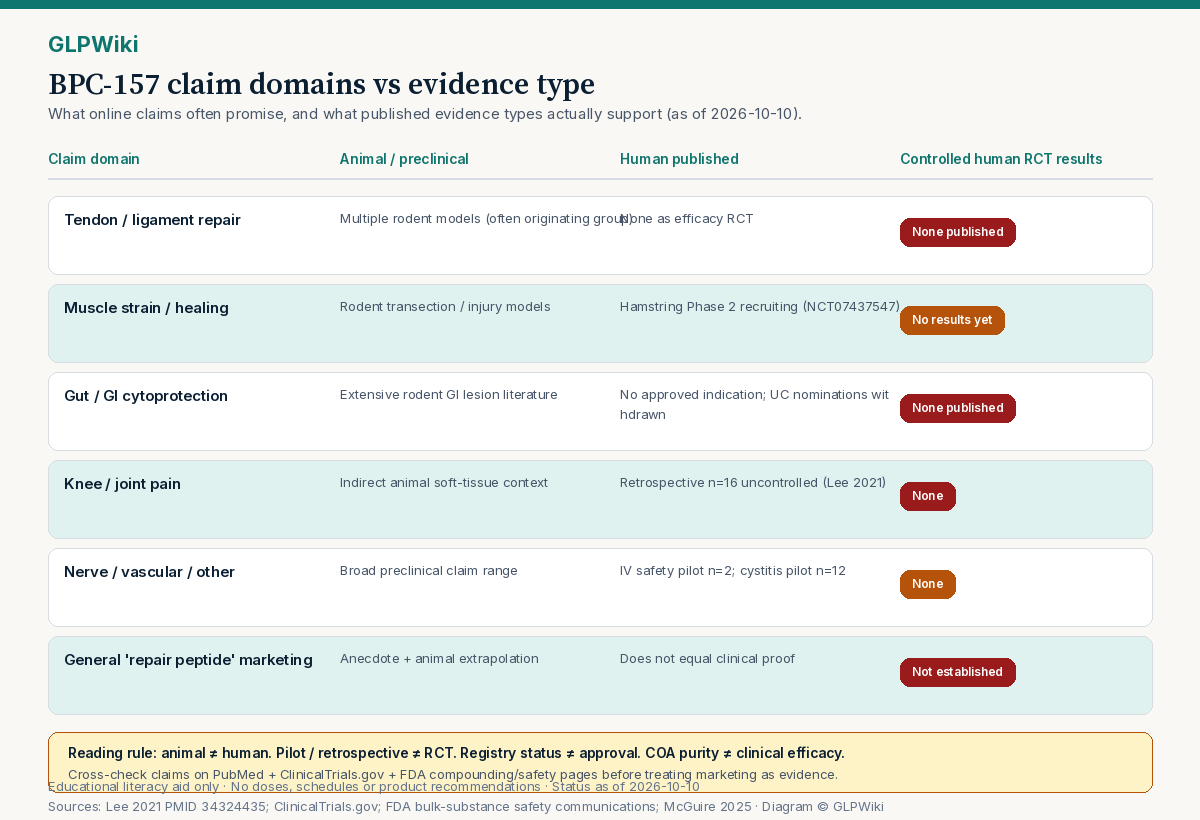
Internet marketing often presents BPC-157 as a general 'repair peptide' for tendons, ligaments, muscles, gut lining, nerves and blood vessels. Those claim domains are not equal in evidence strength.
Preclinically, rodent models report effects across soft-tissue injury, gastrointestinal lesions, angiogenesis-related endpoints and other systems. Narrative reviews (for example Gwyer and colleagues, 2019; Seiwerth and colleagues, 2021; McGuire and colleagues, 2025) summarise proposed pathways such as VEGFR2 / nitric-oxide signalling and fibroblast responses. Methodologists note that much of the positive musculoskeletal animal work comes from a prolific originating network, with thinner independent replication outside that network.
Human clinical evidence remains sparse. A 2025 narrative review in Current Reviews in Musculoskeletal Medicine identified only three published human studies at the time of its search, all small and methodologically limited. A 2026 systematic review of human orthopaedic/regenerative use likewise found very low certainty of evidence and advised against clinical use outside regulated trials.
Human evidence map (verified records)
Honesty about the human record is the point of this guide. As of October 10, 2026, GLPWiki did not identify a completed randomised, placebo-controlled BPC-157 efficacy trial with published results.
- Lee and Padgett, 2021 (PMID 34324435): retrospective contact of 16 patients after intra-articular knee injections containing BPC-157 alone or with thymosin beta-4; 14 of 16 reported significant pain relief. No control group; heterogeneous diagnoses; not an RCT.
- Lee and colleagues, 2024: pilot of intravesical BPC-157 in 12 people with interstitial cystitis refractory to pentosan polysulfate; patient-reported improvement without a randomised control arm.
- Lee and Burgess, 2025 (PMID 40131143): intravenous infusion safety/pharmacokinetics pilot in two healthy adults; authors reported tolerability without establishing efficacy for any indication.
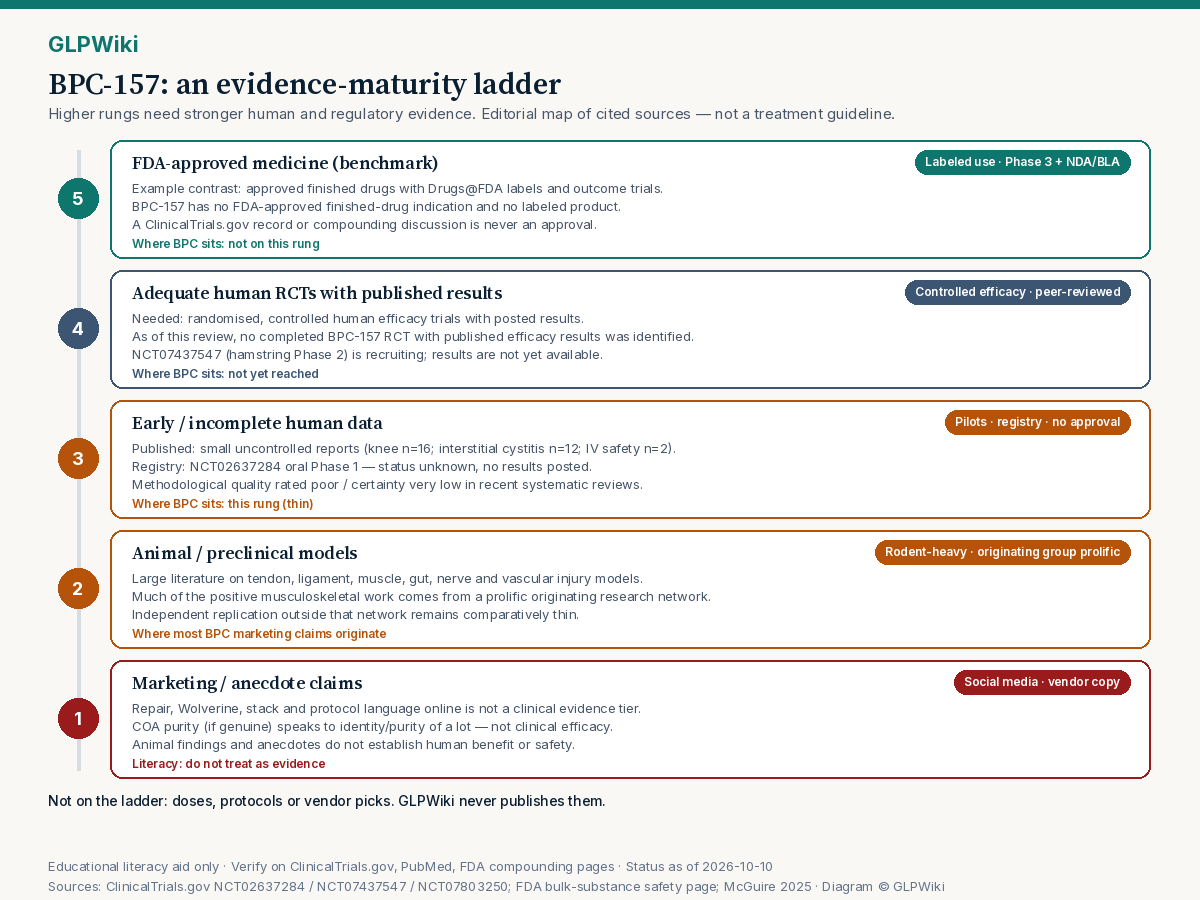
- NCT02637284 — PCO-02 oral Phase 1 safety/PK in an estimated 42 healthy volunteers (PharmaCotherapia; Hospital Ángeles Tijuana). Status: unknown; primary completion listed 2016; no results posted on ClinicalTrials.gov at fetch time.
- NCT07437547 — randomised, double-blind Phase 2 of BPC-157 versus placebo for MRI-confirmed acute grade II hamstring strain (estimated n=120; recruiting as of registry fetch; primary completion estimate 2027). Registry status is not a result.
- NCT07803250 — Phase 1 rotator-cuff repair recovery pilot (University of Arkansas; not yet recruiting at fetch time; estimated start 2027). Registry status is not a result.
Regulatory status: not approved; compounding safety communications
BPC-157 is not an FDA-approved finished drug. There is no labeled indication on Drugs@FDA for a BPC-157 medicine comparable to approved peptides such as tesamorelin for its specific labeled use.
Under FDA's interim policies on bulk drug substances for compounding, Category 2 covers nominated substances for which FDA has identified significant safety risks and therefore does not apply the more permissive Category 1 interim approach. Industry and compounding-association summaries document that BPC-157 was added to the 503A Category 2 framing in September 2023 alongside other peptides. On FDA's public page listing bulk substances that may present significant safety risks, BPC-157 appears among substances whose nominations were withdrawn, with this risk language: compounded products may pose immunogenicity risk for certain routes; peptide-related impurities and API characterisation may be complex; and FDA has no, or only limited, safety-related information for proposed routes — so the agency lacks sufficient information to know whether the drug would cause harm when administered to humans.
In July 2026, FDA's Pharmacy Compounding Advisory Committee agenda included BPC-157 free base and acetate (uses evaluated included ulcerative colitis). Nominations had been withdrawn; FDA noted it may evaluate substances at its discretion. Committee discussion of a bulks-list nomination is not an approval to market a medicine.
Separately, sport anti-doping authorities (WADA / USADA communications) treat BPC-157 as a prohibited / unapproved substance for athletes. That is anti-doping policy, not a substitute for reading FDA labels or trial results.
Evidence-maturity ladder
The diagram ranks marketing claims, animal models, thin human pilots, missing RCT results, and FDA-approved medicines as separate rungs. BPC-157 sits on the early/incomplete human rung at best, with most marketing claims resting on animal work.
- Ask whether a claim cites a peer-reviewed human controlled trial, a small uncontrolled pilot, an animal paper, or vendor copy.
- Ask whether an NCT number has posted results — or only a registry description.
- Ask whether 'FDA' language refers to an approved label, a compounding Category 2 / safety communication, or a PCAC agenda item.
- Ask whether a COA is being used as a proxy for clinical proof (it should not be).
How to read marketing claims
Three literacy errors appear constantly around BPC-157.
- Animal ≠ human. Positive rodent tendon or gut models generate hypotheses; they do not establish human efficacy or safety.
- Preprint / blog / anecdote ≠ peer-reviewed controlled evidence. Retrospective pilots without controls cannot replace randomised trials.
- COA purity ≠ clinical efficacy. A certificate of analysis (when genuine and matching the lot) informs identity/purity questions only. See GLPWiki's COA and study-reading guides.
- ClinicalTrials.gov Study Status ≠ FDA approval. Recruiting or completed registry rows are research documentation, not marketing authorisation.
How to verify BPC-157 claims
Use primary sources rather than social media summaries.
- PubMed / PMC: search BPC-157, PL 14736, Bepecin; separate reviews from primary animal papers from human reports.
- ClinicalTrials.gov: look up NCT02637284, NCT07437547, NCT07803250 and any new BPC-157 rows; read status, results tabs and eligibility — do not invent outcomes.
- FDA compounding pages: 'Certain Bulk Drug Substances… Significant Safety Risks' and 503A bulks interim policy pages for current Category 2 / withdrawn-nomination language.
- Drugs@FDA / DailyMed: confirm there is still no approved BPC-157 finished drug before trusting 'FDA-approved peptide' marketing.
- WADA prohibited list / USADA athlete advisories: for sport eligibility only.
Scope, disclaimer and review date
This guide is educational. It maps chemistry identity, claim domains, published human reports, registry records and regulatory communications for BPC-157. It does not provide doses, reconstitution or titration schedules, sourcing advice, stacking protocols or individual medical advice, and nothing here recommends starting, stopping or combining any medicine or research chemical. Decisions about health care belong with a licensed clinician and, for approved medicines, the official label.
Last reviewed: October 10, 2026. Trial results and regulatory status may have changed since; verify with ClinicalTrials.gov, PubMed, Drugs@FDA and FDA compounding pages.
Frequently asked questions
- Is BPC-157 FDA-approved?
- No. As of this review there is no FDA-approved finished drug with a BPC-157 labeled indication. FDA compounding communications describe significant safety concerns for BPC-157 as a bulk substance; that is not the same as approving a medicine.
- Are there human clinical trials of BPC-157?
- A small number of published human reports exist (retrospective knee injections, an interstitial-cystitis pilot, a two-person IV safety pilot). A 2015–2016 oral Phase 1 registry study (NCT02637284) has unknown status and no posted results. Newer registry trials (e.g. NCT07437547 hamstring Phase 2; NCT07803250 rotator-cuff Phase 1) do not yet report published efficacy results.
- Does animal research prove BPC-157 repairs human tendons?
- No. Rodent tendon, ligament and muscle models generate hypotheses. They do not establish human efficacy, dosing, or long-term safety.
- What does FDA Category 2 mean for BPC-157?
- Under FDA's interim 503A bulks policy, Category 2 covers nominated bulk substances for which FDA has identified significant safety risks and therefore does not apply the Category 1 interim approach. FDA's public safety-risk page states concerns including immunogenicity for some routes, peptide impurity / API characterisation complexity, and insufficient human safety information for proposed routes.
- Is a COA enough to know a research vial works?
- No. A certificate of analysis, when genuine and lot-matched, may support identity and purity literacy. It does not demonstrate clinical benefit, sterility for injection, or equivalence to trial material.
- What about TB-500 with BPC-157?
- TB-500 usually refers to a thymosin beta-4 fragment marketed alongside BPC-157 online. Pairing is a marketing pattern, not proof of a studied combination. TB-500 / thymosin beta-4 fragment also appears in FDA bulk-substance safety communications. This page does not endorse stacks.
- Is BPC-157 allowed in sport?
- WADA / athlete advisories treat BPC-157 as a prohibited or unapproved substance. Athletes subject to anti-doping rules should follow those authorities. Anti-doping status is separate from FDA approval.
- Why do so many animal papers look positive?
- A prolific originating research network has published extensively across injury models. Positive preclinical signals can be real in those models and still fail to translate, and independent replication outside that network remains thinner than the claim volume online.
- Does a ClinicalTrials.gov listing mean it works?
- No. Registry records document planned or ongoing research. Study Status, enrollment estimates and eligibility text are not efficacy results and are not FDA approvals.
- Does this page recommend doses or protocols?
- No. GLPWiki publishes educational evidence maps and status literacy only. Doses, schedules, reconstitution and product sourcing are out of scope.
SOURCES
- 01Lee E, Padgett B. Intra-Articular Injection of BPC 157 for Multiple Types of Knee Pain. Altern Ther Health Med. 2021;27(4):8-13. PMID 34324435— PubMed / Europe PMC
- 02Lee E, Burgess K. Safety of Intravenous Infusion of BPC157 in Humans: A Pilot Study. Altern Ther Health Med. 2025. PMID 40131143— PubMed
- 03McGuire FP, et al. Regeneration or Risk? A Narrative Review of BPC-157 for Musculoskeletal Healing. Curr Rev Musculoskelet Med. 2025. PMC12446177— PMC
- 04Gwyer D, Wragg NM, Wilson SL. Gastric pentadecapeptide body protection compound BPC 157 and its role in accelerating musculoskeletal soft tissue healing. Cell Tissue Res. 2019;377:153-159— Springer
- 05Seiwerth S, et al. Stable gastric pentadecapeptide BPC 157 and wound healing. Front Pharmacol. 2021;12:627533. PMCID PMC8275095— PMC
- 06PCO-02 oral BPC-157 Phase 1 safety/PK (NCT02637284)— ClinicalTrials.gov
- 07BPC 157 for Acute Hamstring Muscle Strain Repair — Phase 2 (NCT07437547)— ClinicalTrials.gov
- 08Impact of BPC-157 on Recovery Following Rotator Cuff Repair Surgery — Phase 1 (NCT07803250)— ClinicalTrials.gov
- 09Certain Bulk Drug Substances for Use in Compounding that May Present Significant Safety Risks (includes BPC-157 risk language)— U.S. Food and Drug Administration
- 10Bulk Drug Substances Used in Compounding Under Section 503A of the FD&C Act (Category 1/2/3 interim policy framing)— U.S. Food and Drug Administration
- 11July 23-24, 2026 Pharmacy Compounding Advisory Committee meeting (agenda includes BPC-157-related bulk substances)— U.S. Food and Drug Administration
- 12World Anti-Doping Agency Prohibited List— World Anti-Doping Agency
- 13USADA: BPC-157 experimental peptide creates risk for athletes— U.S. Anti-Doping Agency
- 14ClinicalTrials.gov registry home— U.S. National Library of Medicine
- 15Drugs@FDA: FDA-Approved Drugs database— U.S. Food and Drug Administration
EDUCATIONAL REFERENCE ONLY · Not medical advice. Nothing here diagnoses, treats, cures or prevents any disease, and nothing here is a dosing recommendation. Consult a licensed clinician before any treatment decision.