How to use ClinicalTrials.gov for peptides: search, NCT records, and status literacy
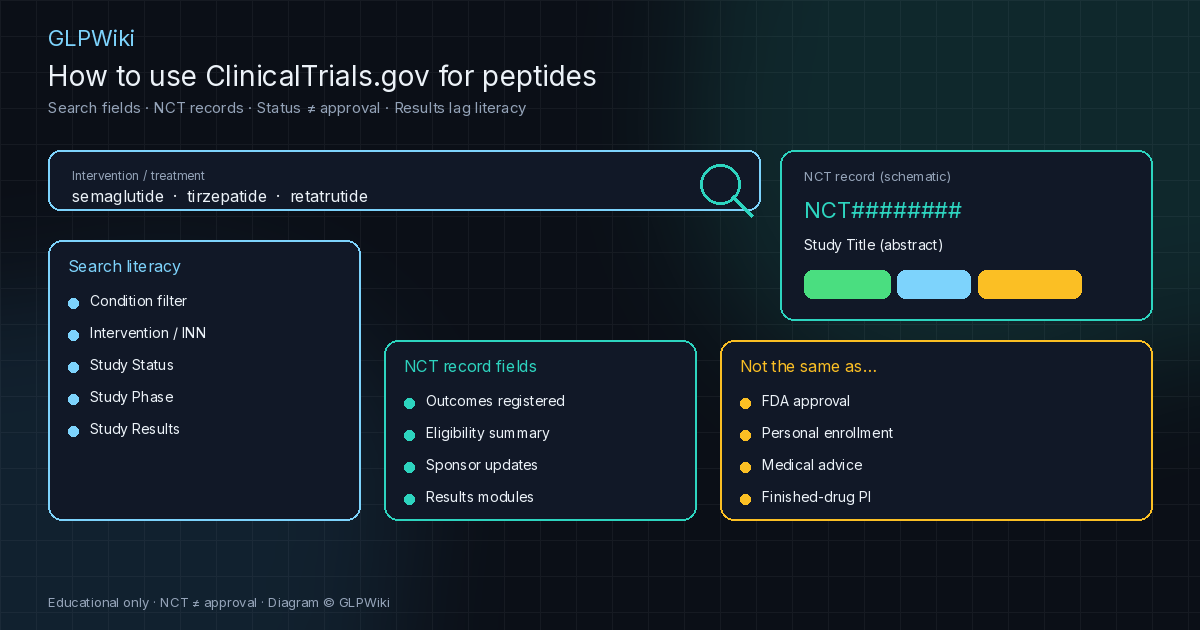
The already-live how-to-read-a-peptide-study guide teaches paper and evidence literacy: endpoints, phases, absolute vs relative change, CONSORT, and registration as a transparency habit. This companion teaches the registry tool itself — how to search ClinicalTrials.gov for peptide and incretin interventions, read an NCT study record, interpret Study Status / Phase / Results fields, and avoid collapsing a registry entry into FDA approval, self-enrollment, or medical advice. Educational and YMYL-safe only — always open the live ClinicalTrials.gov page; sponsors update records; results modules can lag.
UPDATED 04 OCT 2026 · 13 MIN READ
KEY TAKEAWAYS
- ClinicalTrials.gov is a U.S. National Library of Medicine (NIH/NLM) registry of clinical study records — not an FDA approval database and not medical advice.
- An NCT number is NCT followed by exactly eight digits; paste it into Other terms / Study IDs (or the study URL) when you already have an identifier from a paper or press claim.
- For peptide/incretin searches, start with Intervention/treatment using the INN (and try brand names), then narrow with Condition, Study Status, Study Phase, and Study Results filters.
- Study Status (Recruiting, Completed, Terminated, and related values) describes the study record — it is not FDA approval, labeled use, or a personal invitation to enroll without screening and consent.
- Posted Results modules summarize participant flow, baselines, outcomes, and adverse events when available; they can lag, and NLM quality-control review does not prove scientific validity.
- Compare registered primary outcomes on the NCT record with what a paper or press release emphasizes — outcome drift is a literacy red flag.
- For finished-product claims, verify Drugs@FDA / DailyMed labeling separately from any NCT record that mentions the same molecule name.
Why this companion exists (and what it is not)
Peptide and incretin claims online often cite an NCT number, a "recruiting trial," or a screenshot of ClinicalTrials.gov as if the registry entry itself proved safety, efficacy, or product approval. That collapse mixes three different documents: a study registration record, a peer-reviewed (or preprint) study report, and — when it exists — FDA-approved finished-product labeling.
The already-live guide on how to read a peptide clinical study remains the paper/evidence companion: Methods before headlines, primary endpoints before secondary, absolute before relative, CONSORT-style reporting, and registration as a transparency check. This page does not rewrite that study-reading walkthrough. It zooms into the registry tool: search fields, NCT anatomy, Study Status and Phase literacy, Results modules, and the hard rule that registration is not approval.
Nothing here is enrollment advice, medical advice, a protocol, or a product recommendation. If you are considering research participation, that belongs under a protocol, screening, and informed consent process with the study team — not under a wiki explainer. For approved medicines, open current official labeling on Drugs@FDA or DailyMed.
What ClinicalTrials.gov is (and is not)
ClinicalTrials.gov is a public registry and results database operated by the U.S. National Library of Medicine (NLM), part of the National Institutes of Health (NIH). Study records summarize protocol-facing information such as recruitment status, eligibility, interventions, outcome measures, contacts, and — when posted — structured summary results. Sponsors and investigators are responsible for submitting and updating many of those fields.
NLM quality-control review checks registration and results submissions for apparent errors, omissions, and inconsistencies. It does not verify scientific validity, clinical benefit, or regulatory approval. A clean-looking NCT page is not a peer-reviewed paper and not an FDA label.
Keep the institutions straight: ClinicalTrials.gov (NIH/NLM registry) answers "what is registered about this study?" Drugs@FDA / DailyMed answer "what does the Agency allow a finished product's labeling to say?" Confusing those lanes is how molecule-name claims become status literacy failures.
- Registry record ≠ peer-reviewed paper ≠ FDA-approved PI.
- Sponsors update records — always refresh the live NCT page.
- QC review ≠ scientific validity proof.
Search anatomy for peptide and incretin queries
The modern ClinicalTrials.gov find-studies interface organizes free-text boxes and optional filters. Official How to Search guidance covers Condition/disease, Intervention/treatment, Other terms, and Additional filters such as Study Status, Study Phase, and Study Results. Treat any third-party screenshot as stale — open the live site.
Peptide-specific literacy starts in Intervention/treatment. Prefer the International Nonproprietary Name (INN) when you know it (for example, semaglutide, tirzepatide, retatrutide) and also try brand names used in finished products when those appear in records. Condition/disease narrows the indication context (for example, type 2 diabetes or obesity) so you are not drowning in every study that mentions a related pathway word.
Other terms is useful for keywords, acronyms, or a known NCT ID. Study Status filters (Recruiting, Completed, and related values) describe recruitment/progress of the study. Study Phase filters map Early Phase 1 through Phase 4 and Not Applicable. Study Results filters separate records with posted summary results from those without. Expert / complex query operators exist for systematic work — start with the basic boxes plus filters unless you already need AREA-style precision.
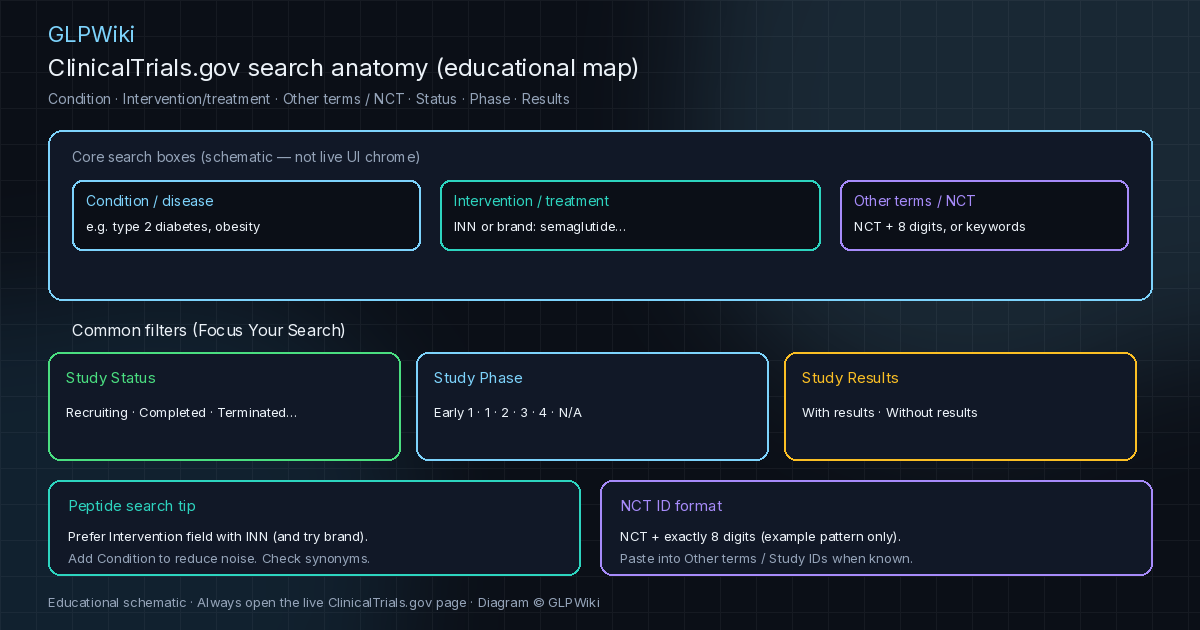
- Intervention: INN first; try brand synonyms.
- Condition: reduce noise to the disease/context you mean.
- NCT########: paste when you already have an ID.
- Filters: Status, Phase, Results — optional but powerful.
How to read an NCT study record
An NCT number (ClinicalTrials.gov identifier) is the unique code assigned when a study is registered: the letters NCT followed by eight digits. Official study-basics pages define the identifier and walk through record sections. Open the live study page rather than trusting a forwarded PDF or social screenshot.
Literacy reading order for a record: (1) Study Status and last-update timing, (2) Interventions and Conditions, (3) Primary and secondary outcome measures as registered, (4) Eligibility summary, (5) Study design / phase / type, (6) Contacts and locations if you are evaluating participation pathways for yourself or a patient in a clinical setting, (7) Results tab/modules if posted. Compare registered outcomes with any paper or press claim that cites the same NCT.
History of changes (when available on the record) can show whether outcome definitions or status shifted over time. Outcome drift between registration and publication is a classic transparency red flag in evidence literacy — pair this habit with the how-to-read-a-peptide-study guide.
Study Status is not FDA approval
Study Status values such as Recruiting, Active not recruiting, Completed, Terminated, Withdrawn, and related terms describe where the study sits in its operational life cycle on the registry. They do not mean a finished drug is approved, that a labeled indication exists, or that a reader can skip screening and enroll themselves.
"Recruiting" means sites may be enrolling participants under a protocol — not that you are pre-approved, not that the intervention is safe for you, and not that the product is marketed. "Completed" means the study finished its registered course as reported — not that results are published, not that results are favorable, and not that FDA approved a product.
FDA approval and labeled use live in a different document lane: Drugs@FDA records and current Prescribing Information for a finished product. An investigational peptide can have many NCT entries and still lack approved labeling. An approved medicine can appear in post-marketing Phase 4 studies while already having a label. Keep the ladders separate.
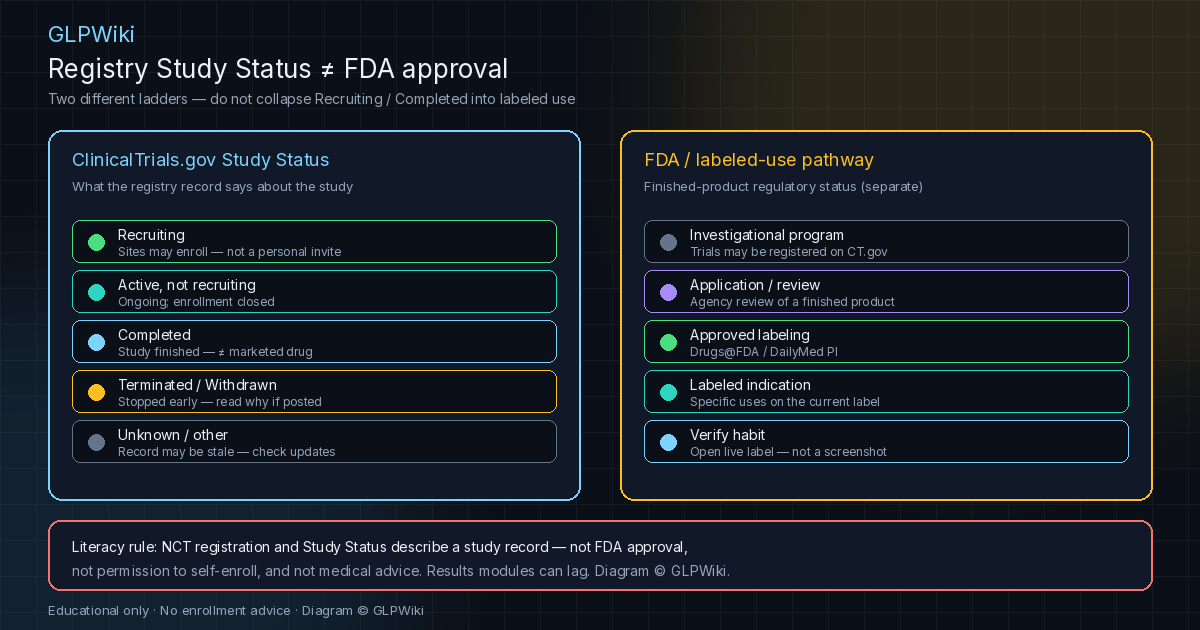
- Recruiting ≠ personal invite without screening/consent.
- Completed ≠ marketed / labeled product.
- Many NCT records can exist for one investigational program.
- Finished-product claims → verify Drugs@FDA / DailyMed.
Results modules, lag, and what they are not
When summary results are posted, ClinicalTrials.gov results modules typically cover participant flow, baseline characteristics, outcome measures, and adverse events (including serious adverse events). A study described as having results "posted" means structured summary results appear on the registry — not that a peer-reviewed paper exists, and not that every outcome you care about was analyzed.
Results can lag. Legal and policy timelines for results reporting, sponsor workflows, and QC processes mean a Completed status can appear long before (or without) posted results you expected. Always check the live Results section rather than assuming a social post is current.
Posted results are still a structured summary of what was submitted. They are useful for transparency and for comparing against a paper's primary endpoint. They are not a substitute for clinical judgment, not a dosing guide, and not FDA labeling. Pair registry results with peer-reviewed Methods when appraising claims.
Why trials are registered (high-level norms)
Prospective trial registration is a transparency norm endorsed by groups such as the International Committee of Medical Journal Editors (ICMJE) and reflected in the World Health Organization's International Clinical Trials Registry Platform (ICTRP) network framing. The educational point for readers is simple: registration before outcome shopping improves the chance that primary endpoints were declared in advance.
Registration norms do not convert every NCT entry into high-quality evidence. A registered Phase 1 safety study remains a Phase 1 safety study. A registered exploratory endpoint remains exploratory unless the protocol and statistics protect it. Use registration to check promises — not to inflate phase language into approval language.
When a peptide claim refuses to name an NCT (or a peer-reviewed paper / label), that absence is information about claim quality. Ask for the identifier, open the live record, and compare outcomes.
Verify-path checklist: peptide registry claims
Step 1 — Capture the claim: molecule or product name, NCT ID if given, what is asserted (recruiting, "proven," "FDA path," efficacy), and whether the claim concerns an approved finished product or an investigational program.
Step 2 — Open the live NCT page on ClinicalTrials.gov. Confirm Study Status, interventions, conditions, registered primary outcomes, and last update. Do not rely on screenshots alone.
Step 3 — Search literacy: if you lack an NCT, search Intervention (INN ± brand) + Condition, then apply Status / Phase / Results filters. Skim several records — one hit is not a landscape.
Step 4 — Cross-check publications: PubMed/PMC for papers or preprints that cite the NCT; compare registered primary outcomes to published primaries.
Step 5 — Separate approval: for finished-product claims, open Drugs@FDA / DailyMed for the exact product. Keep investigational NCT evidence distinct from labeled use. Categorize unsupported social tips honestly.
- No NCT + no paper + no label → claim is incomplete.
- Status Recruiting → still not personal medical advice.
- Posted results lag or missing → do not invent them.
- Same INN ≠ same regulatory status across products.
What this page deliberately does not do
No doses, schedules, stacks, compounding recipes, reconstitution instructions, or syringe-draw guidance for any product.
No pharmacy, telehealth, clinic, supplier, or trial-site recommendations; no "how to get into this trial" shortcuts that bypass screening and consent.
No claim that every peptide study must be registered on ClinicalTrials.gov, or that registration proves benefit.
No personal risk–benefit judgements about participating in research or using any medicine.
For whether any medicine is appropriate for a person, consult a licensed clinician using current official labeling. Adverse events and quality concerns for marketed products can be reported through MedWatch.
Where to read next
Continue with how-to-read-a-peptide-study for paper anatomy, endpoints, absolute vs relative literacy, and CONSORT/preprint framing. Pair with how-to-read-fda-peptide-labeling and approved-vs-investigational-peptides to keep finished-product labels separate from investigational NCT records.
For indication literacy on approved incretin medicines, see glp1-medications-by-indication. For oral non-peptide GLP-1 chemical-class literacy (distinct from peptide registry searches), see orforglipron-foundayo-literacy.
Editorial standards and the medical disclaimer explain sourcing limits and what GLPWiki never publishes.
Frequently asked questions
- Does an NCT number mean a peptide is FDA-approved?
- No. An NCT number identifies a registered study record on ClinicalTrials.gov. FDA approval of a finished product is a separate regulatory status verified on Drugs@FDA and current labeling — not assumed from registry presence.
- What does Recruiting mean on ClinicalTrials.gov?
- Recruiting usually means the study may be enrolling participants at listed sites under a protocol. It is not a personal invitation, not medical advice, and not proof that you qualify. Enrollment decisions involve screening, eligibility, and informed consent with the study team.
- How should I search for peptide or incretin trials?
- Start with the Intervention/treatment field using the INN (and try brand names), add a Condition/disease filter for the context you mean, then optionally filter by Study Status, Study Phase, and Study Results. If you already have an NCT ID, paste NCT plus eight digits into Other terms / Study IDs.
- What is the NCT ID format?
- ClinicalTrials.gov identifiers use the letters NCT followed by exactly eight digits. Always open the live study page for that ID rather than trusting a forwarded screenshot.
- Why might a Completed study have no posted results?
- Results modules can lag behind Study Status updates because of reporting timelines, sponsor workflows, and quality-control processes. Check the live Results section and last-update information; do not invent results from a social post.
- Is ClinicalTrials.gov the same as Drugs@FDA?
- No. ClinicalTrials.gov (NIH/NLM) registers study information and may post summary results. Drugs@FDA provides approved drug product records and labeling for finished medicines. Use both when a claim mixes trial registration with approval language.
- Does NLM review prove a trial is scientifically valid?
- No. NLM quality-control review checks submitted registration and results information for apparent errors and inconsistencies. It does not validate scientific design quality, clinical benefit, or regulatory approval.
- Does this page tell me how to join a peptide trial or how to dose a peptide?
- No. This page is registry-tool literacy only. It does not provide enrollment shortcuts, doses, schedules, stacks, compounding recipes, or product recommendations. Clinical care and research participation belong with licensed clinicians and formal study processes.
SOURCES
- 01ClinicalTrials.gov home— U.S. National Library of Medicine (NIH/NLM)
- 02How to Search for Clinical Studies— ClinicalTrials.gov / U.S. National Library of Medicine
- 03How to read a ClinicalTrials.gov study record— ClinicalTrials.gov / U.S. National Library of Medicine
- 04ClinicalTrials.gov glossary (NCT number and study terms)— ClinicalTrials.gov / U.S. National Library of Medicine
- 05About the Results Database— ClinicalTrials.gov / U.S. National Library of Medicine
- 06Protocol Registration and Results System (PRS) Data Element Definitions— ClinicalTrials.gov / U.S. National Library of Medicine
- 07Constructing complex search queries (Expert Search)— ClinicalTrials.gov / U.S. National Library of Medicine
- 08ICMJE Recommendations — Clinical Trial Registration— International Committee of Medical Journal Editors
- 09WHO International Clinical Trials Registry Platform (ICTRP)— World Health Organization
- 10Drugs@FDA: FDA-Approved Drugs database (finished-product label verification)— U.S. Food and Drug Administration
EDUCATIONAL REFERENCE ONLY · Not medical advice. Nothing here diagnoses, treats, cures or prevents any disease, and nothing here is a dosing recommendation. Consult a licensed clinician before any treatment decision.