Retatrutide explained: the GIP, GLP-1 and glucagon triple agonist, its trials and its status
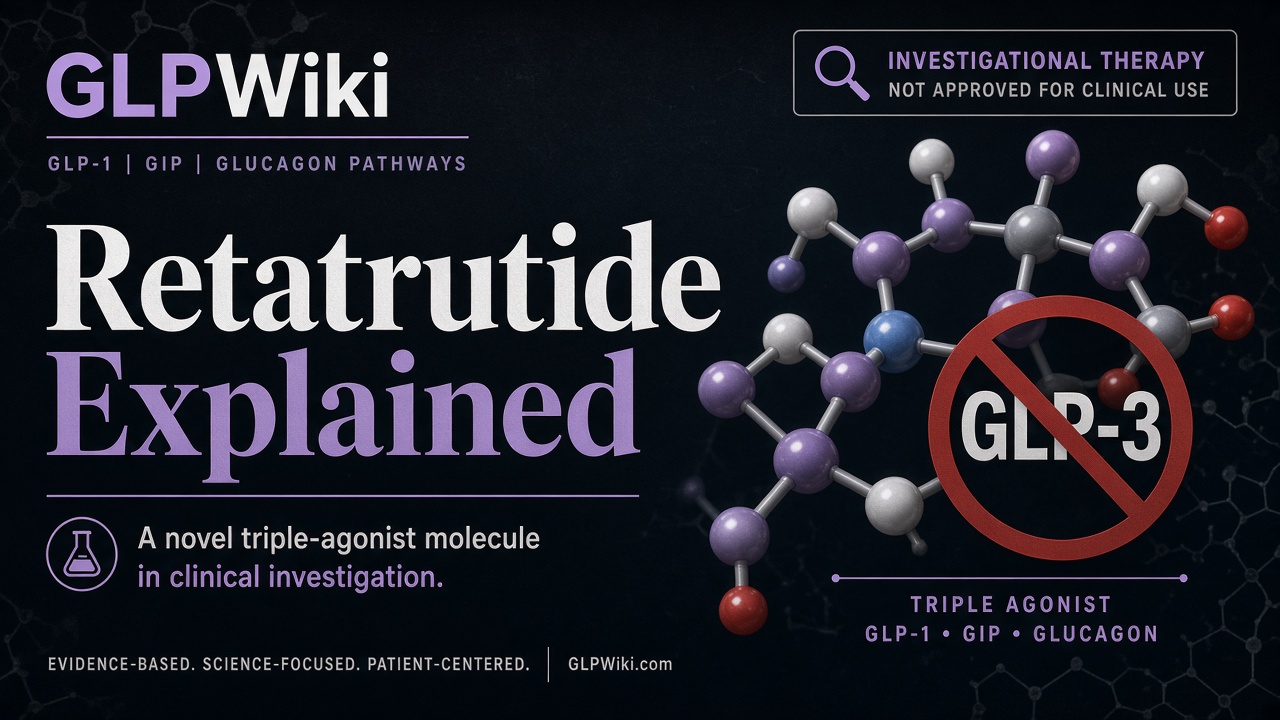
Retatrutide (LY3437943) is an investigational Eli Lilly peptide engineered to activate three hormone receptors at once: GIP, GLP-1 and glucagon. This rebuilt guide explains the mechanism at concept level, walks through the published Phase 2 and Phase 3 TRIUMPH evidence with trial names and registry numbers, lists the safety signals trials have reported, and shows how to check its regulatory status yourself. As of October 7, 2026 it is not FDA-approved. Educational only: no doses, schedules or sourcing.
UPDATED 07 OCT 2026 · 18 MIN READ
KEY TAKEAWAYS
- Retatrutide (LY3437943) is a single investigational peptide from Eli Lilly that activates the GIP, GLP-1 and glucagon receptors. It is often called a 'triple agonist'; the internet nickname 'GLP-3' does not refer to a real hormone or receptor.
- Receptor level is the key difference: semaglutide activates the GLP-1 receptor, tirzepatide activates GIP and GLP-1 receptors, and retatrutide adds the glucagon receptor on top of both.
- Glucagon receptor activity is the new ingredient. At concept level, glucagon acts mainly on the liver; in animal studies, adding it increased energy expenditure on top of the appetite effects of GIP and GLP-1. Human trials measure outcomes, not that mechanism directly.
- Phase 2 trials (NEJM 2023 in obesity; The Lancet 2023 in type 2 diabetes) and a Nature Medicine 2024 liver-fat substudy reported large, dose-dependent effects on body weight, HbA1c and liver fat versus placebo.
- The Phase 3 programme has reported positive results: TRIUMPH-1 (NEJM) and TRIUMPH-2 (The Lancet) were published on September 29, 2026, TRANSCEND-T2D-1 appeared in The Lancet in June 2026, and TRIUMPH-3 and TRIUMPH-4 were announced by the sponsor.
- Trial safety reports most often list gastrointestinal effects (nausea, diarrhoea, constipation, vomiting). Dysesthesia (abnormal skin sensation), a dose-dependent heart-rate rise in Phase 2, and more frequent hypotension in TRIUMPH-2 were also reported. Long-term and cardiovascular outcome data are still being collected.
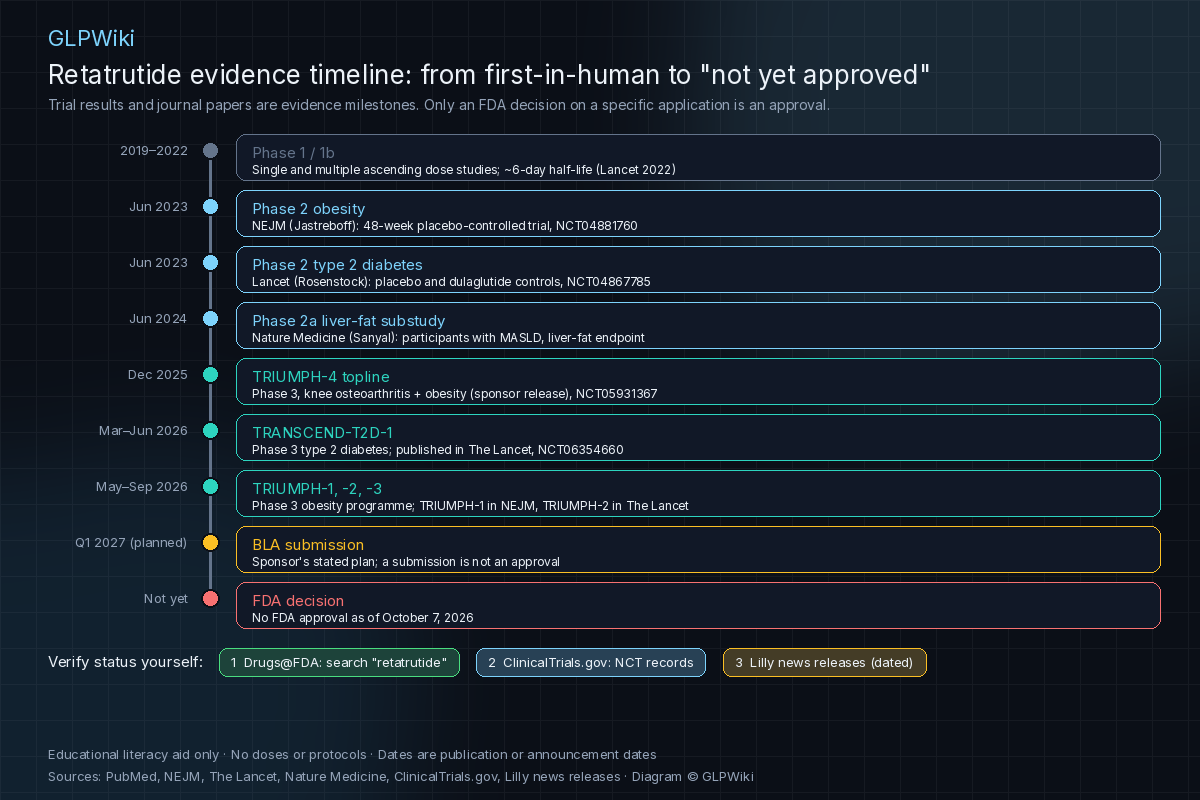
- Retatrutide is not FDA-approved. Lilly says it plans to submit a Biologics License Application in Q1 2027; a planned submission is not a submission, and a submission is not an approval.
- FDA says retatrutide cannot be used in compounding under federal law and has warned sellers of products falsely labeled 'for research purposes'. Anything sold online as retatrutide is not the trial drug.
What changed in this October 2026 rebuild
GLPWiki's earlier retatrutide primer was written while only Phase 2 data existed and Phase 3 results were still pending. This rebuild replaces it with a full reference that reflects the Phase 3 readouts published or announced between December 2025 and September 2026, adds a receptor map and an evidence timeline (both original GLPWiki diagrams), and links to the regulatory-status, ClinicalTrials.gov and study-reading guides that help readers check claims themselves.
- TRIUMPH-1 (obesity without diabetes) published in the New England Journal of Medicine on September 29, 2026.
- TRIUMPH-2 (obesity with type 2 diabetes) published in The Lancet on September 29, 2026.
- TRANSCEND-T2D-1 (type 2 diabetes) published in The Lancet in June 2026.
- TRIUMPH-3 (severe obesity with established cardiovascular disease) and TRIUMPH-4 (obesity with knee osteoarthritis) reported as sponsor topline results; full peer-reviewed papers were not yet available when this guide was reviewed.
- Status: still investigational and not FDA-approved; the sponsor plans a U.S. Biologics License Application (BLA) in Q1 2027.
What is retatrutide?
Retatrutide, code name LY3437943, is an investigational peptide developed by Eli Lilly and Company. It is a single molecule engineered to activate three receptors: the glucose-dependent insulinotropic polypeptide receptor (GIPR), the glucagon-like peptide-1 receptor (GLP-1R) and the glucagon receptor (GCGR). In the published trials it was given as a once-weekly injection under the skin.
Early human pharmacology work reported a half-life of roughly six days, which is what made once-weekly use in trials possible. Lilly's discovery paper described the molecule's in-vitro profile as having more activity at the GIP receptor, with balanced activity at the glucagon and GLP-1 receptors. That balance was a design choice, and it is one reason results for retatrutide cannot be assumed for any other multi-agonist.
Online, retatrutide is often called 'GLP-3'. That nickname is informal. There is no GLP-3 hormone and no GLP-3 receptor; GLPWiki's GLP-3 concept page explains where the name came from. In journals, registries and regulatory documents the molecule is called retatrutide or LY3437943.
How a triple agonist works: three receptors at concept level
GLP-1 and GIP are incretin hormones released from the gut after eating. Their receptors support glucose-dependent insulin release, and GLP-1 receptor activity also slows gastric emptying and acts on brain appetite pathways. Approved medicines already use these two receptors: semaglutide activates GLP-1R, and tirzepatide activates both GIPR and GLP-1R.
Glucagon is different. It is made mainly by pancreatic alpha cells, and its best-known job is to tell the liver to release glucose. Taken alone, that sounds like the opposite of what a metabolic medicine should do. The design idea behind adding controlled glucagon receptor activity is that its other effects (on energy expenditure and on how the liver handles fat) may add to the appetite and glucose effects of GLP-1 and GIP activity, while those incretin signals help offset glucagon's glucose-raising action.
Evidence for that idea comes in layers. In obese mice, Lilly scientists reported that glucagon receptor activity added an increase in energy expenditure to the reduced food intake driven by GIP and GLP-1 receptor activity. In people, trials measure outcomes such as body weight, HbA1c and liver fat; they do not show by themselves how much of any result came from each receptor. GLPWiki's glucagon receptor agonism concept page covers the physiology in more depth.
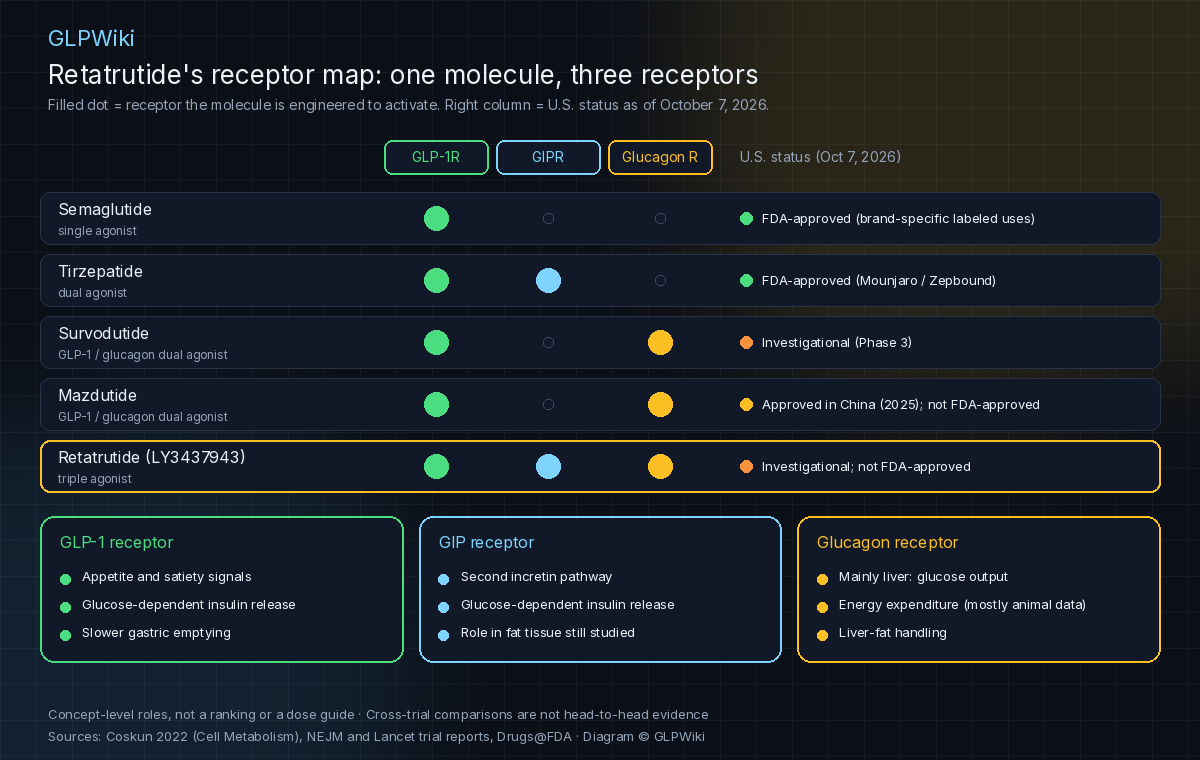
- GLP-1 receptor: appetite and satiety signalling, glucose-dependent insulin release, slower gastric emptying.
- GIP receptor: the second incretin pathway, also glucose-dependent; its role in fat tissue and appetite is still being studied.
- Glucagon receptor: mainly the liver (glucose output and fat handling); energy-expenditure effects are best documented in animal studies.
How retatrutide differs from semaglutide, tirzepatide and GLP-1/glucagon dual agonists
The cleanest way to compare these molecules is by receptor, not by headline weight-loss figures. Semaglutide is a GLP-1 receptor agonist. Tirzepatide is a GIP and GLP-1 receptor dual agonist. Survodutide and mazdutide are GLP-1 and glucagon receptor dual agonists. Retatrutide combines all three targets in one peptide.
Regulatory status differs just as much. Semaglutide and tirzepatide are FDA-approved, with labeled uses that vary by brand. Mazdutide has been approved in China but not by FDA. Survodutide is in Phase 3 and investigational. Retatrutide is investigational and not approved by FDA or, according to its developer, by any regulator worldwide.
Comparing percentages across separate trials is not head-to-head evidence, because trial populations, durations and analysis methods differ. A direct randomized comparison is under way: TRIUMPH-5 (NCT06662383) compares retatrutide with tirzepatide in adults with obesity, with primary completion estimated for November 2026 on ClinicalTrials.gov. Until results like these are published, statements that one molecule is 'stronger' than another are cross-trial inferences.
Early evidence: Phase 1 and Phase 2 trials
Phase 1 studies tested single and multiple ascending doses for safety and pharmacology. A 12-week Phase 1b trial in 72 people with type 2 diabetes (NCT04143802), published in The Lancet in 2022, reported gastrointestinal events as the most common adverse events, the roughly six-day half-life, and reductions in glucose and body weight that supported Phase 2 development.
The Phase 2 obesity trial (NCT04881760), published in the New England Journal of Medicine in 2023, randomized 338 adults with obesity, or overweight plus a weight-related condition, to several retatrutide dose groups or placebo for 48 weeks. Mean body-weight change at 48 weeks reached -24.2% in the highest-dose group versus -2.1% with placebo. Gastrointestinal events were the most common adverse events, were dose-related and mostly mild to moderate, and the authors reported dose-dependent increases in heart rate that peaked at 24 weeks and declined thereafter.
The Phase 2 type 2 diabetes trial (NCT04867785), published in The Lancet in 2023, randomized 281 adults to retatrutide, placebo or the approved GLP-1 receptor agonist dulaglutide. At 24 weeks, HbA1c fell by up to 2.02 percentage points with retatrutide, versus 0.01 with placebo and 1.41 with dulaglutide; body weight fell by up to 16.94% at 36 weeks. No severe hypoglycaemia was reported. The authors noted that these data informed dose selection for Phase 3.
Liver fat: the MASLD substudy
Because glucagon acts mainly on the liver, liver fat was an early focus. A Phase 2a substudy of the obesity trial, published in Nature Medicine in 2024 (Sanyal and colleagues), enrolled 98 participants with metabolic dysfunction-associated steatotic liver disease (MASLD) and at least 10% liver fat at baseline.
At 24 weeks, mean relative change in liver fat ranged from -42.9% in the lowest-dose group to -82.4% in the highest-dose group, versus +0.3% with placebo. Liver fat fell below the 5% threshold usually treated as normal in up to 86% of participants in the higher-dose groups, versus none on placebo. The authors reported that liver-fat reductions tracked changes in body weight, abdominal fat and markers of insulin sensitivity and lipid metabolism.
Liver-fat content is a surrogate marker. It is not the same as showing improvement in liver inflammation or fibrosis on biopsy, or in clinical liver outcomes. A Phase 3 master protocol that includes retatrutide in MASLD (NCT07165028) was recruiting when this guide was reviewed.
The Phase 3 programme: TRIUMPH and TRANSCEND-T2D
Lilly's Phase 3 work runs in two main programmes: TRIUMPH, focused on obesity and its complications, and TRANSCEND-T2D, focused on type 2 diabetes. All of the trials below are randomized, double-blind and placebo-controlled. Results are listed with the analysis the source used, because sponsor releases and journal papers often report different estimands (see the next section).
TRIUMPH-1: obesity without diabetes (NCT05929066)
TRIUMPH-1 randomized 2,339 adults with obesity or overweight and without diabetes to one of three retatrutide doses or placebo for 80 weeks. In the NEJM paper's treatment-regimen (intention-to-treat) analysis, mean body-weight change was -17.6%, -23.7% and -25.0% across the three dose groups versus -3.9% with placebo. The trial included two nested 'basket' studies: in 574 participants with knee osteoarthritis, retatrutide reduced WOMAC knee-pain scores more than placebo, and in 243 participants with obstructive sleep apnea it reduced the apnea-hypopnea index more than placebo. Lilly's May 2026 release, using the efficacy estimand, reported up to -28.3% at 80 weeks in the highest-dose group.
TRIUMPH-2: obesity with type 2 diabetes (NCT05929079)
TRIUMPH-2 randomized 1,152 adults with type 2 diabetes and a BMI of 27 or higher for 80 weeks. In The Lancet paper's treatment-regimen analysis, mean body-weight change was -11.9%, -16.8% and -18.8% across the three dose groups versus -5.1% with placebo. Lilly reported average HbA1c reductions of up to 1.6 percentage points from a baseline of 7.7% (efficacy estimand). Weight loss in people with type 2 diabetes is typically smaller than in people without diabetes across the incretin class, which is one reason TRIUMPH-1 and TRIUMPH-2 figures should not be compared directly.
TRIUMPH-3: severe obesity with established cardiovascular disease (NCT05882045)
TRIUMPH-3 randomized 1,949 adults with a BMI of 35 or higher and established cardiovascular disease to two retatrutide doses or placebo for 80 weeks. Lilly's July 2026 topline release reported mean weight change of up to -22.6% versus -3.2% with placebo (efficacy estimand). Major adverse cardiovascular events occurred less often than anticipated in both arms; the pre-specified hazard ratio was 0.82 (95% CI 0.55 to 1.22) for a five-component MACE outcome and 1.12 (95% CI 0.64 to 1.96) for three-component MACE. Wide confidence intervals that cross 1 mean these figures neither show cardiovascular benefit nor rule out harm. The trial was not a dedicated cardiovascular outcomes trial; that question is being tested separately (NCT06383390).
TRIUMPH-4: obesity with knee osteoarthritis (NCT05931367)
TRIUMPH-4 enrolled 445 adults with obesity or overweight and knee osteoarthritis, without diabetes, and tested the two highest doses against placebo for 68 weeks. Lilly's December 2025 topline release reported weight change of up to -28.7% versus -2.1% with placebo and WOMAC pain-score reductions of up to 4.5 points versus 2.4 points with placebo (efficacy estimand). It was the first Phase 3 retatrutide trial to report.
TRANSCEND-T2D-1: type 2 diabetes (NCT06354660)
TRANSCEND-T2D-1 randomized 537 adults with type 2 diabetes inadequately controlled by diet and exercise alone for 40 weeks. In The Lancet paper's treatment-regimen analysis, HbA1c fell by 1.69 to 1.94 percentage points across the three dose groups versus 0.81 with placebo, and body weight fell by 11.5% to 15.3% versus 2.6%. No severe hypoglycaemia was reported.
Still running
Registered Phase 3 trials still in progress include TRIUMPH-5 versus tirzepatide (NCT06662383), a cardiovascular and kidney outcomes trial planned for about 10,000 participants (NCT06383390, primary completion estimated February 2029), TRIUMPH-6 on maintenance of weight reduction (NCT06859268), TRIUMPH-7 in chronic low back pain (NCT07035093), a type 2 diabetes trial versus semaglutide (NCT06260722) and a trial in type 2 diabetes with renal impairment (NCT06297603). 'Active, not recruiting' on ClinicalTrials.gov means a trial is ongoing, not that it has results.
How to read the headline numbers: two estimands
Retatrutide coverage often quotes two different numbers for the same trial. That is usually not an error; it reflects two pre-specified ways of handling people who stop treatment or start other therapies.
The treatment-regimen estimand (close to intention-to-treat) estimates the average effect in everyone randomized, whether or not they stayed on the drug. The efficacy estimand estimates the effect had everyone stayed on treatment as assigned. Efficacy-estimand figures are typically larger. For TRIUMPH-1, the highest-dose group's 80-week weight change was -25.0% under the treatment-regimen estimand in NEJM and -28.3% under the efficacy estimand in Lilly's release.
Either way, these are group averages under trial conditions, with monitoring and lifestyle counselling. They are not predictions for any individual. GLPWiki's study-reading guide explains estimands, absolute versus relative effects, and why topline releases are not peer-reviewed papers.
Safety signals reported in trials
Everything below is what trial reports and sponsor releases have described. Retatrutide has no FDA label yet, so there is no official list of warnings, contraindications or interactions; those would only be set if FDA reviews and approves an application.
- Gastrointestinal effects were the most common adverse events across trials. In TRIUMPH-1, nausea was reported in up to 42.4% of retatrutide-treated participants versus 14.8% with placebo, alongside diarrhoea, constipation and vomiting. Phase 2 reported these events as dose-related and mostly mild to moderate.
- Dysesthesia, an abnormal or unpleasant skin sensation, was reported more often with retatrutide (up to 12.5% versus 0.9% with placebo in TRIUMPH-1). Lilly described these events as generally mild to moderate, with most resolving during treatment.
- Heart rate: the Phase 2 obesity trial reported dose-dependent increases in heart rate that peaked at 24 weeks and then declined. Heart rate is a recognised area to watch with GLP-1 and glucagon receptor activity.
- Blood pressure: hypotension was reported more often with retatrutide than placebo in TRIUMPH-2 (1% to 6% across dose groups versus under 1%), in a population where blood pressure also fell with weight loss.
- Urinary tract infections were reported more often with retatrutide in TRIUMPH-1 (7.5% to 8.8% across dose groups versus 5.3% with placebo); in TRIUMPH-2, rates were similar to placebo at lower doses and higher at the highest dose.
- Discontinuation because of adverse events was higher at higher doses in several trials, for example up to 11.3% versus 4.9% with placebo in TRIUMPH-1 and up to 13.5% versus 4.8% in TRIUMPH-3.
- Unknowns: long-term safety beyond about two years, cardiovascular and kidney outcomes (being tested in NCT06383390), and how results apply outside trial populations.
Why 'research peptide' retatrutide sold online is not the trial drug
The evidence in this guide comes from retatrutide manufactured by its developer under controlled conditions and given to trial participants under protocols with monitoring. Material sold online under the same name has no connection to that evidence. A name on a vial does not establish identity, purity, sterility, strength or equivalence to trial material, and a certificate of analysis supplied by a seller is not an FDA review.
FDA states that retatrutide cannot be used in compounding under federal law, that it is not a component of any FDA-approved drug, and that it has not been found safe and effective for any condition. The agency says it has warned telehealth companies for marketing retatrutide, ingredient distributors for selling it to compounders, and outsourcing facilities for repackaging it. It has also warned companies selling unapproved GLP-1-class drugs, including retatrutide, that were falsely labeled 'for research purposes' or 'not for human consumption' while being sold to consumers with dosing instructions, and it urges consumers not to buy them. In a September 2025 warning letter, FDA described compounded retatrutide products as unapproved new drugs that do not qualify for the compounding exemptions.
In August 2026 Lilly said that no medicine containing retatrutide had been approved for human use by any regulatory agency in the world, and announced lawsuits against sellers including compounding pharmacies, medical spas and online 'research-use only' sellers. Separately, Lilly posted a pre-approval expanded access record on ClinicalTrials.gov (NCT07629401) for single patients with severe obesity and serious complications who cannot join a trial. Expanded access is a physician-requested pathway overseen by FDA; it is not a way to buy the drug.
How to verify retatrutide's status yourself
Status claims about retatrutide change quickly and are often wrong online. Three free, primary sources settle most questions.
- Drugs@FDA: search 'retatrutide'. An approved product would appear with an application number, brand name, approval date and label. When GLPWiki queried FDA's Drugs@FDA dataset (via openFDA) on October 7, 2026, it returned no retatrutide products.
- ClinicalTrials.gov: search the intervention 'retatrutide' or an NCT number. A record shows whether a trial is recruiting, active or completed, and whether results are posted; a trial record is never an approval.
- Sponsor news releases: read the date and the exact verb. 'Plans to submit' is not 'submitted', and 'submitted' or 'accepted for review' is not 'approved'. An FDA approval would also be visible on Drugs@FDA and usually in an FDA announcement.
- If a website, clinic or seller claims retatrutide is approved, available by prescription or 'pharmacy grade' today, treat that as a red flag and check the sources above.
Scope, disclaimer and review date
This guide is educational. It explains pharmacology, published trial evidence and regulatory status. It does not provide doses, dose-escalation schedules, administration instructions, sourcing information or individual medical advice, and nothing here recommends using retatrutide or any other compound. Trial figures are group averages under protocol conditions. Decisions about medicines belong with a licensed clinician; report suspected adverse events from approved medicines to FDA MedWatch.
Last reviewed: October 7, 2026. Regulatory status and trial results may have changed since; verify with Drugs@FDA, ClinicalTrials.gov and dated sponsor releases.
Frequently asked questions
- What is retatrutide?
- Retatrutide (LY3437943) is an investigational peptide developed by Eli Lilly that activates three hormone receptors: GIP, GLP-1 and glucagon. It is often described as a triple agonist and is sometimes nicknamed 'GLP-3' online, although there is no GLP-3 hormone.
- Is retatrutide FDA-approved?
- No. As of October 7, 2026, retatrutide is investigational and not FDA-approved for any use. Lilly has said it plans to submit a Biologics License Application to FDA in Q1 2027. Check Drugs@FDA for current status.
- When will retatrutide be approved?
- No one can say. A planned submission in Q1 2027 would be followed by FDA review, which can end in approval, a request for more information or rejection. Any specific approval date quoted online is speculation.
- How is retatrutide different from tirzepatide and semaglutide?
- At receptor level, semaglutide activates the GLP-1 receptor, tirzepatide activates GIP and GLP-1 receptors, and retatrutide activates GIP, GLP-1 and glucagon receptors. Semaglutide and tirzepatide are FDA-approved for specific labeled uses; retatrutide is not. A head-to-head trial against tirzepatide (TRIUMPH-5) is ongoing.
- Why add glucagon to a weight-loss molecule?
- Glucagon mainly acts on the liver and raises glucose output, but its receptor is also linked to energy expenditure and liver-fat handling. The design idea is that controlled glucagon receptor activity adds to the appetite and glucose effects of GLP-1 and GIP activity. The energy-expenditure effect is best documented in animal studies.
- What did the TRIUMPH-1 trial show?
- In 2,339 adults with obesity or overweight without diabetes, mean body-weight change at 80 weeks was -17.6%, -23.7% and -25.0% across three retatrutide dose groups versus -3.9% with placebo (treatment-regimen estimand, NEJM 2026). Knee-pain and sleep-apnea substudies also met their primary endpoints.
- What side effects were reported in retatrutide trials?
- Gastrointestinal effects (nausea, diarrhoea, constipation, vomiting) were most common. Trials also reported dysesthesia (abnormal skin sensation), a dose-dependent heart-rate increase in Phase 2, more frequent hypotension in TRIUMPH-2 and, in some trials, more urinary tract infections. Long-term and cardiovascular outcome data are still being collected.
- Is 'research grade' retatrutide sold online the same as the trial drug?
- No. FDA says retatrutide cannot be compounded under federal law, and it has warned sellers of products falsely labeled 'for research purposes' or 'not for human consumption'. Such products are of unknown identity, purity and sterility, and trial results do not apply to them.
- Can a pharmacy compound retatrutide?
- No. FDA states that retatrutide cannot be used in compounding under federal law because it is not a component of an FDA-approved drug and has not been found safe and effective for any condition.
- Is 'GLP-3' the same thing as retatrutide?
- 'GLP-3' is an informal internet nickname that usually refers to retatrutide. It is not a hormone, a receptor or a drug class, and it is not used in journals or FDA documents.
- How can I check retatrutide's status myself?
- Search 'retatrutide' on Drugs@FDA for approvals, on ClinicalTrials.gov for trial records and status, and read dated Eli Lilly news releases for sponsor plans. A trial record or a planned submission is never an approval.
SOURCES
- 01Coskun T, et al. LY3437943, a novel triple glucagon, GIP, and GLP-1 receptor agonist for glycemic control and weight loss: from discovery to clinical proof of concept. Cell Metab 2022. PMID 35985340— PubMed
- 02Urva S, et al. LY3437943, a novel triple GIP, GLP-1, and glucagon receptor agonist in people with type 2 diabetes: a phase 1b trial. Lancet 2022. PMID 36354040— PubMed
- 03Jastreboff AM, et al. Triple-Hormone-Receptor Agonist Retatrutide for Obesity — A Phase 2 Trial. N Engl J Med 2023;389:514-526. doi:10.1056/NEJMoa2301972— New England Journal of Medicine
- 04Jastreboff AM, et al. Retatrutide Phase 2 obesity trial. PMID 37366315— PubMed
- 05Rosenstock J, et al. Retatrutide, a GIP, GLP-1 and glucagon receptor agonist, for people with type 2 diabetes: a phase 2 trial. Lancet 2023;402:529-544. doi:10.1016/S0140-6736(23)01053-X. PMID 37385280— PubMed
- 06Sanyal AJ, et al. Triple hormone receptor agonist retatrutide for metabolic dysfunction-associated steatotic liver disease: a randomized phase 2a trial. Nat Med 2024;30:2037-2048. doi:10.1038/s41591-024-03018-2. PMID 38858523— PubMed
- 07Jastreboff AM, et al. Retatrutide, a Triple Hormone Receptor Agonist, for Treatment of Obesity (TRIUMPH-1). N Engl J Med 2026. doi:10.1056/NEJMoa2604169. PMID 42814954— New England Journal of Medicine
- 08Bellido V, et al. Retatrutide in adults with obesity and type 2 diabetes (TRIUMPH-2): a phase 3 trial. Lancet 2026. doi:10.1016/S0140-6736(26)01861-1. PMID 42810372— PubMed
- 09Bajaj HS, et al. Efficacy and safety of retatrutide in people with type 2 diabetes and inadequate glycaemic control with diet and exercise (TRANSCEND-T2D-1). Lancet 2026. doi:10.1016/S0140-6736(26)00967-0. PMID 42250575— PubMed
- 10Lilly: TRIUMPH-4 topline results in obesity and knee osteoarthritis (Dec 11, 2025)— Eli Lilly and Company / PR Newswire
- 11Lilly: TRIUMPH-1 topline results (May 21, 2026)— Eli Lilly and Company / PR Newswire
- 12Lilly: TRIUMPH-2 and TRIUMPH-3 topline results; BLA planned Q1 2027 (July 23, 2026)— Eli Lilly and Company / PR Newswire
- 13Lilly: detailed TRIUMPH-2 results at EASD; investigational, BLA planned Q1 2027 (Sept 29, 2026)— Eli Lilly and Company / PR Newswire
- 14Lilly: action against the illegal retatrutide black market; no retatrutide medicine approved anywhere (Aug 12, 2026)— Eli Lilly and Company / PR Newswire
- 15FDA's Concerns with Unapproved GLP-1 Drugs Used for Weight Loss (retatrutide cannot be used in compounding)— U.S. Food and Drug Administration
- 16Warning letter: GLP-1 Solution (retatrutide products), Sept 9, 2025— U.S. Food and Drug Administration
- 17TRIUMPH-1 (NCT05929066)— ClinicalTrials.gov
- 18TRIUMPH-2 (NCT05929079)— ClinicalTrials.gov
- 19TRIUMPH-3 (NCT05882045)— ClinicalTrials.gov
- 20TRIUMPH-4 (NCT05931367)— ClinicalTrials.gov
- 21TRIUMPH-5, retatrutide vs tirzepatide (NCT06662383)— ClinicalTrials.gov
- 22Retatrutide cardiovascular and kidney outcomes trial (NCT06383390)— ClinicalTrials.gov
- 23Pre-approval expanded access of retatrutide (NCT07629401)— ClinicalTrials.gov
- 24All registered retatrutide studies— ClinicalTrials.gov
- 25Mazdutide: First Approval (China). Drugs 2025. PMID 41028652— PubMed
- 26Survodutide Phase 3 SYNCHRONIZE-1 (NCT06066515)— ClinicalTrials.gov
- 27Drugs@FDA: FDA-Approved Drugs database— U.S. Food and Drug Administration
EDUCATIONAL REFERENCE ONLY · Not medical advice. Nothing here diagnoses, treats, cures or prevents any disease, and nothing here is a dosing recommendation. Consult a licensed clinician before any treatment decision.