Glucagon receptor agonism in metabolic peptides
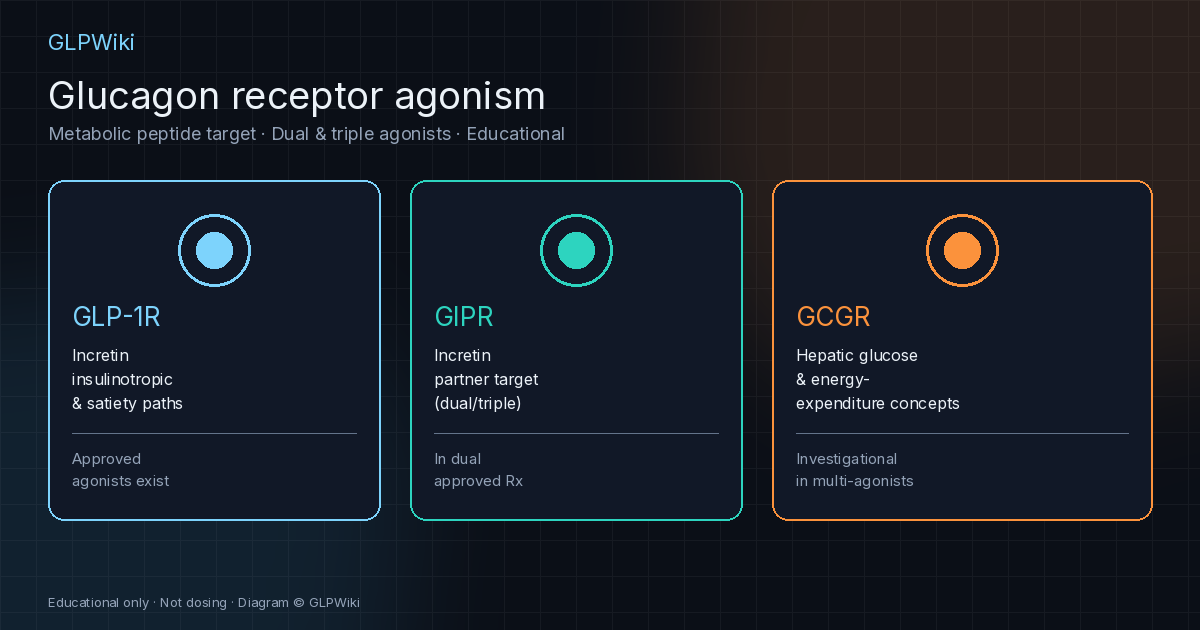
Native glucagon raises blood glucose mainly through hepatic pathways and acts on the glucagon receptor (GCGR). Engineered dual and triple agonists deliberately include controlled GCGR activity for metabolic and energy-expenditure effects — but that pharmacology is not the same as an approved ‘glucagon obesity drug.’ This page separates physiology, multi-agonist design, and investigational status.
UPDATED 26 SEPT 2026 · 12 MIN READ
KEY TAKEAWAYS
- Native glucagon is a proglucagon-derived peptide that raises blood glucose mainly via hepatic glycogenolysis and gluconeogenesis; it acts on the glucagon receptor (GCGR), a class B GPCR.
- GCGR agonism is mechanistically distinct from GLP-1R and GIPR; multi-agonist drugs engineer controlled GCGR activity into one molecule rather than ‘adding free glucagon.’
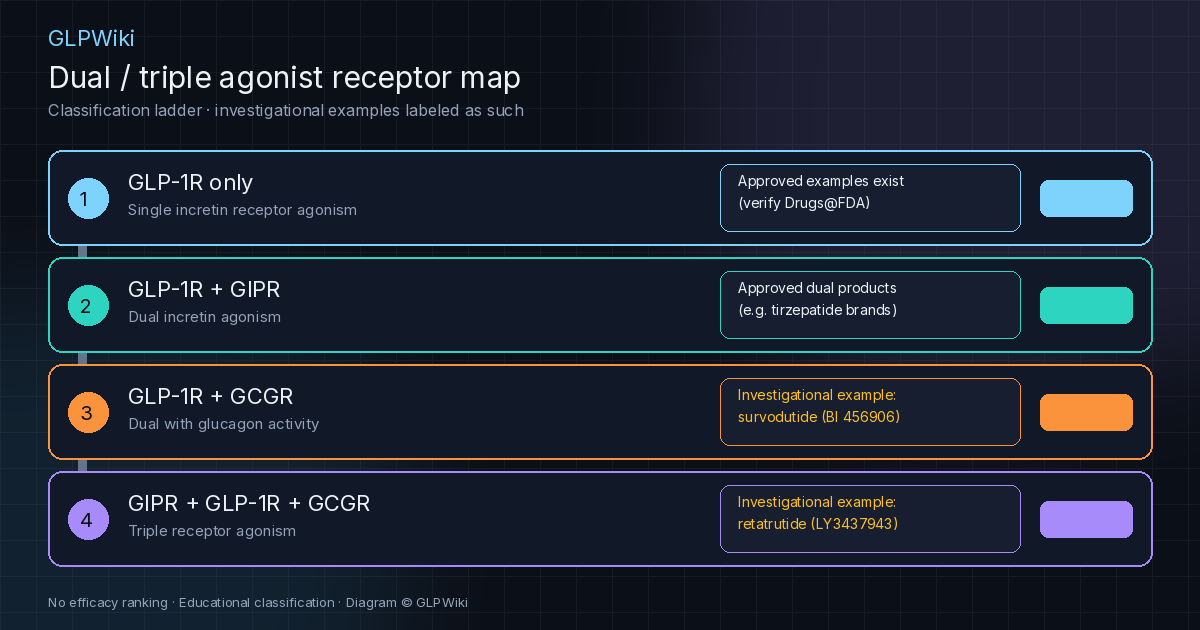
- Dual agonists such as survodutide (GLP-1R + GCGR) and triple agonists such as retatrutide (GIPR + GLP-1R + GCGR) are investigational for obesity and metabolic disease unless and until a regulator approves a specific product — verify status on Drugs@FDA and official labeling.
- Phase 2 data for retatrutide (NEJM) and survodutide (The Lancet Diabetes & Endocrinology) show substantial weight-loss signals in separate trials; cross-trial ranking is not valid.
- FDA-approved glucagon products for hypoglycemia rescue or diagnostic uses are not obesity dual or triple agonists; those labels must not be conflated with investigational multi-agonists.
- ‘GLP-3’ is an informal nickname for retatrutide-class triples, not a natural hormone.
- This page is educational only — no doses, schedules, stacks, or product picks.
What glucagon is
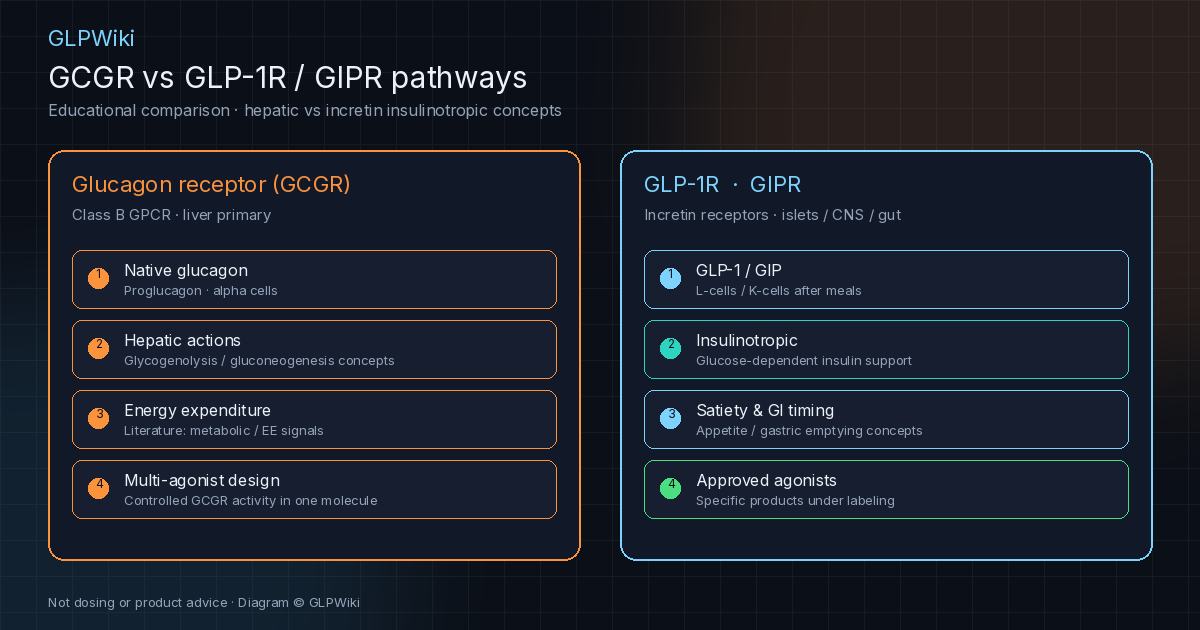
Glucagon is a peptide hormone produced mainly by pancreatic alpha cells. It comes from proglucagon, a larger precursor that is processed differently depending on the tissue. Pancreatic processing produces glucagon, while intestinal processing of the same precursor produces peptides that include GLP-1 and GLP-2. A shared precursor explains the family relationship, but it does not make the resulting hormones interchangeable.
When circulating glucose is low or metabolic demand changes, glucagon helps the liver release glucose. It does this principally by supporting glycogenolysis, the breakdown of stored glycogen, and gluconeogenesis, the production of glucose from non-carbohydrate substrates. This counter-regulatory role is distinct from the glucose-dependent insulin-supporting actions usually emphasized for GLP-1 and GIP.
The pathway comparison below is a simplified map for literacy. It distinguishes native glucagon and its hepatic receptor pathway from incretin signals originating in intestinal cells. It does not rank efficacy and should not be read as treatment advice.
The glucagon receptor
The glucagon receptor, abbreviated GCGR, is a class B G-protein-coupled receptor. It belongs to the same broad structural receptor family as GLP-1R and GIPR, yet each receptor recognizes different ligands and initiates a different balance of downstream effects. Structural kinship is not pharmacologic equivalence.
GCGR is expressed most prominently in the liver, which fits glucagon's established role in controlling hepatic glucose output. Receptor expression and glucagon-related signaling have also been studied in other tissues, but a signal observed in a cell or animal model is not automatically a demonstrated clinical outcome in people. Human trial evidence must remain separate from mechanistic hypotheses.
Engineered peptides can be designed to activate GCGR together with one or more incretin receptors. The activity profile depends on the specific molecule: receptor potency, balance, exposure and molecular design all matter. A receptor checklist alone cannot predict the full clinical effect or safety profile.
Physiology: hepatic glucose output and energy balance
Native glucagon's clearest physiological action is to defend circulating glucose by increasing output from the liver. In isolation, that action may appear to conflict with the glucose-lowering aims of diabetes treatment. Multi-agonist research therefore does not treat GCGR activation as a simple extension of GLP-1 action; it studies whether a deliberately balanced signal can combine complementary effects while the incretin component helps offset unwanted glycemic consequences.
Experimental literature also links glucagon signaling with energy expenditure, lipid handling and amino-acid metabolism. These observations help explain why researchers consider GCGR a metabolic target. They do not establish that every GCGR-active molecule produces the same magnitude of effect in humans, nor that a laboratory mechanism guarantees a favorable clinical outcome.
Clinical interpretation should therefore move in layers: established native physiology first, receptor pharmacology second, and outcomes from controlled trials of the exact engineered molecule third. Claims should not jump directly from a pathway diagram to a conclusion about weight, liver disease or long-term benefit.
Why researchers engineer glucagon agonism into one molecule
Pure glucagon is not an approved obesity medicine. Its native role includes raising hepatic glucose output, and approved glucagon products have historically served other specific purposes, such as rescue treatment for severe hypoglycemia or certain diagnostic uses. Those products and indications are categorically different from investigational multi-receptor metabolic peptides.
The drug-design hypothesis behind a GLP-1R/GCGR dual agonist is balance. GLP-1R activity contributes established incretin, appetite and gastric pathways, while calibrated GCGR activity may contribute energy-expenditure and metabolic effects. A triple agonist adds GIPR activity to that design. The molecule is engineered with a defined receptor-activity profile rather than created by mixing separate hormones.
‘Balanced’ is a development concept, not proof that an ideal balance has been found. Too little activity at one receptor may add little; too much may change tolerability or metabolic effects. Only trials can characterize a candidate's net behavior, and approval requires review of a specific finished product, indication, manufacturing process and benefit-risk package.
Dual agonists: survodutide
Survodutide, also identified as BI 456906, is an investigational peptide designed to activate GLP-1R and GCGR. Its Phase 2 obesity study, reported in The Lancet Diabetes & Endocrinology and indexed in PubMed, provides human trial evidence for this specific candidate under protocol conditions. The ClinicalTrials.gov record NCT04667377 provides the registered study context.
A Phase 2 result is not regulatory approval. As of 2026-09-26, survodutide remains investigational. Trial participants, eligibility criteria, endpoints, follow-up and investigational product controls define what the study can support; results should not be transferred to research-labeled materials or used as a self-directed protocol.
Survodutide and retatrutide should not be ranked by placing headline percentages side by side. They were evaluated as different molecules in separate trials, with different protocols and populations. A valid comparative claim would require appropriate head-to-head evidence rather than an informal cross-trial comparison.
Triple agonists: retatrutide
Retatrutide, also identified as LY3437943, is an investigational peptide designed to activate GIPR, GLP-1R and GCGR. A Phase 2 obesity trial was published in the New England Journal of Medicine and is indexed in PubMed; the associated development program can be followed through ClinicalTrials.gov, including NCT04881760.
As of 2026-09-26, retatrutide is not FDA-approved. Publication in a major journal and continued clinical development are evidence milestones, not substitutes for regulatory review. Drugs@FDA is the appropriate source for checking whether a specific finished product and indication have received FDA approval.
The internet nickname ‘GLP-3’ can obscure this pharmacology. Retatrutide is not a third GLP hormone and there is no GLP-3 receptor. It is one engineered molecule with activity at three named receptors. The GLP-3 concept page explains the naming issue, while the GIP page covers the second incretin component in more depth.
GCGR versus GLP-1, GIP and amylin
These pathways are often grouped because they appear in metabolic-drug research, but they begin with different native hormones and receptors. Overlapping clinical goals do not make the biology interchangeable.
- Glucagon / GCGR: pancreatic alpha-cell hormone with a primary hepatic role in glucose output; controlled GCGR activity is being studied in investigational dual and triple agonists.
- GLP-1 / GLP-1R: intestinal incretin pathway involved in glucose-dependent insulin secretion, gastric emptying and appetite; approved GLP-1R agonists exist for labeled indications.
- GIP / GIPR: intestinal incretin pathway with glucose-dependent insulinotropic activity; it is a partner target in approved dual agonism and investigational triple agonism.
- Amylin / amylin-receptor complexes: pancreatic beta-cell partner hormone involved in post-meal glucagon, gastric-emptying and satiety pathways; it is not an incretin or a GCGR agonist.
Common misconceptions
‘A dual or triple agonist is free glucagon added to a GLP-1 drug.’ It is not. The investigational candidate is a single engineered peptide with measurable activity at specified receptors. Its pharmacology cannot be recreated by combining unrelated products.
‘A Phase 2 paper means the drug is approved.’ It does not. A clinical publication reports a study; approval follows a separate regulatory review of a specific product and indication. Both survodutide and retatrutide remain investigational as of this page's update.
‘A research peptide with the same name is the trial drug.’ A name does not establish identity, formulation, purity, sterility, manufacturing controls or equivalence to regulated clinical-trial material. Trial evidence cannot be transferred to an unverified material.
‘GLP-3 is the natural hormone after GLP-2.’ There is no recognized GLP-3 hormone or receptor. The term is an informal nickname associated with triple-agonist pharmacology.
Scope and disclaimer
This page is an educational explanation of physiology, receptor pharmacology, human evidence and regulatory status. It does not provide doses, schedules, stacks, sourcing advice, administration instructions or individualized medical guidance.
FDA-approved glucagon products have existed for hypoglycemia rescue or diagnostic uses, but they are not obesity dual or triple agonists. Their labels do not confer approval on GCGR-active pipeline agents. Verify current product approvals and official labeling through Drugs@FDA, and discuss treatment questions with a licensed clinician.
Frequently asked questions
- What does the glucagon receptor do?
- The glucagon receptor (GCGR) is a class B GPCR expressed prominently in the liver. Native glucagon activates it to support hepatic glucose output through pathways including glycogenolysis and gluconeogenesis.
- Is glucagon the same as GLP-1?
- No. Both are proglucagon-derived peptides, but glucagon acts on GCGR and primarily supports hepatic glucose output, while GLP-1 acts on GLP-1R and has incretin, gastric and appetite-related actions.
- Why add glucagon activity to a GLP-1 drug?
- Researchers are testing whether calibrated GCGR activity can add energy-expenditure and metabolic effects to GLP-1R activity. That is a molecule-specific hypothesis that must be evaluated in controlled trials, not a recommendation to combine products.
- Is retatrutide approved?
- No. As of 2026-09-26, retatrutide is investigational. Check Drugs@FDA for current approval status and official labeling.
- Is survodutide approved?
- No. As of 2026-09-26, survodutide is investigational. Check Drugs@FDA for current approval status and official labeling.
- Is GLP-3 a hormone?
- No. There is no recognized GLP-3 hormone or GLP-3 receptor. The term is an informal nickname often used for retatrutide-class triple agonism.
- Does this page recommend doses?
- No. GLPWiki does not provide doses, schedules, stacks, protocols or product recommendations.
SOURCES
- 01Proglucagon-derived peptides review— Physiological Reviews / PubMed
- 02Retatrutide for obesity: Phase 2 trial— New England Journal of Medicine
- 03Retatrutide Phase 2 record— PubMed
- 04Retatrutide clinical study NCT04881760— ClinicalTrials.gov
- 05Survodutide for obesity: Phase 2 trial— The Lancet Diabetes & Endocrinology
- 06Survodutide Phase 2 record— PubMed
- 07Survodutide clinical study NCT04667377— ClinicalTrials.gov
- 08Drugs@FDA— U.S. Food and Drug Administration
EDUCATIONAL REFERENCE ONLY · Not medical advice. Nothing here diagnoses, treats, cures or prevents any disease, and nothing here is a dosing recommendation. Consult a licensed clinician before any treatment decision.