GIP: the other incretin hormone
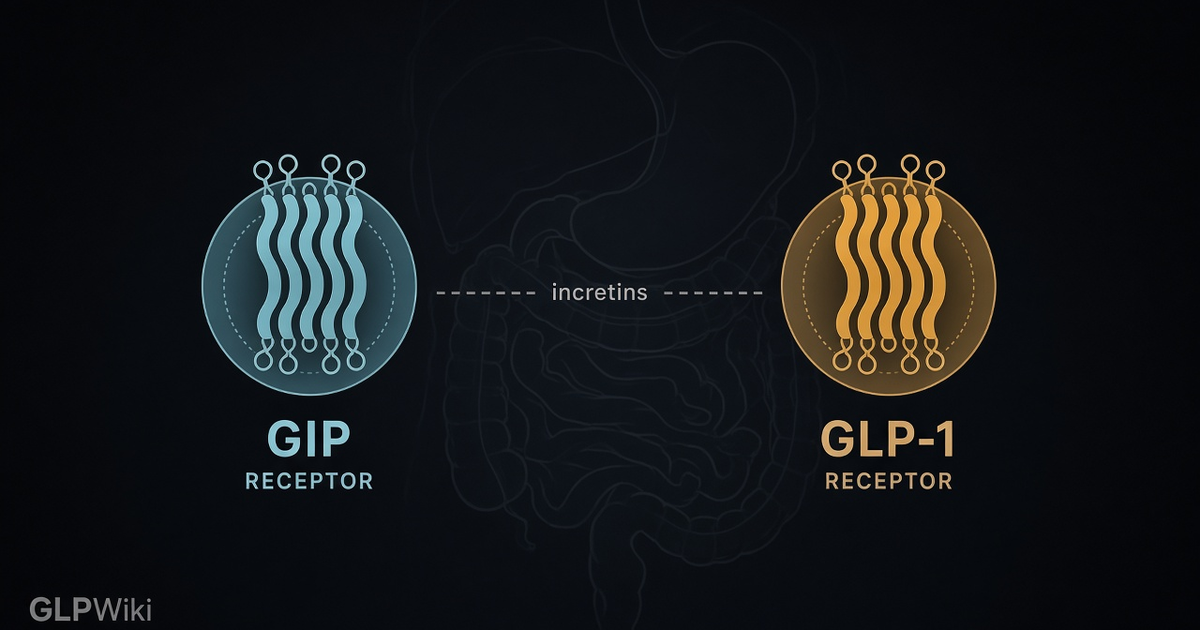
GIP is secreted from intestinal K-cells after nutrient intake and acts on its own receptor — distinct from GLP-1. For years it looked like a dead end as a medicine; dual and triple agonists revived it as a partner target. Here is the physiology, the history, and what human trials actually show.
UPDATED 24 SEPT 2026 · 11 MIN READ
KEY TAKEAWAYS
- GIP (glucose-dependent insulinotropic polypeptide; historically also called gastric inhibitory polypeptide) is one of two major incretin hormones released after eating; the other is GLP-1.
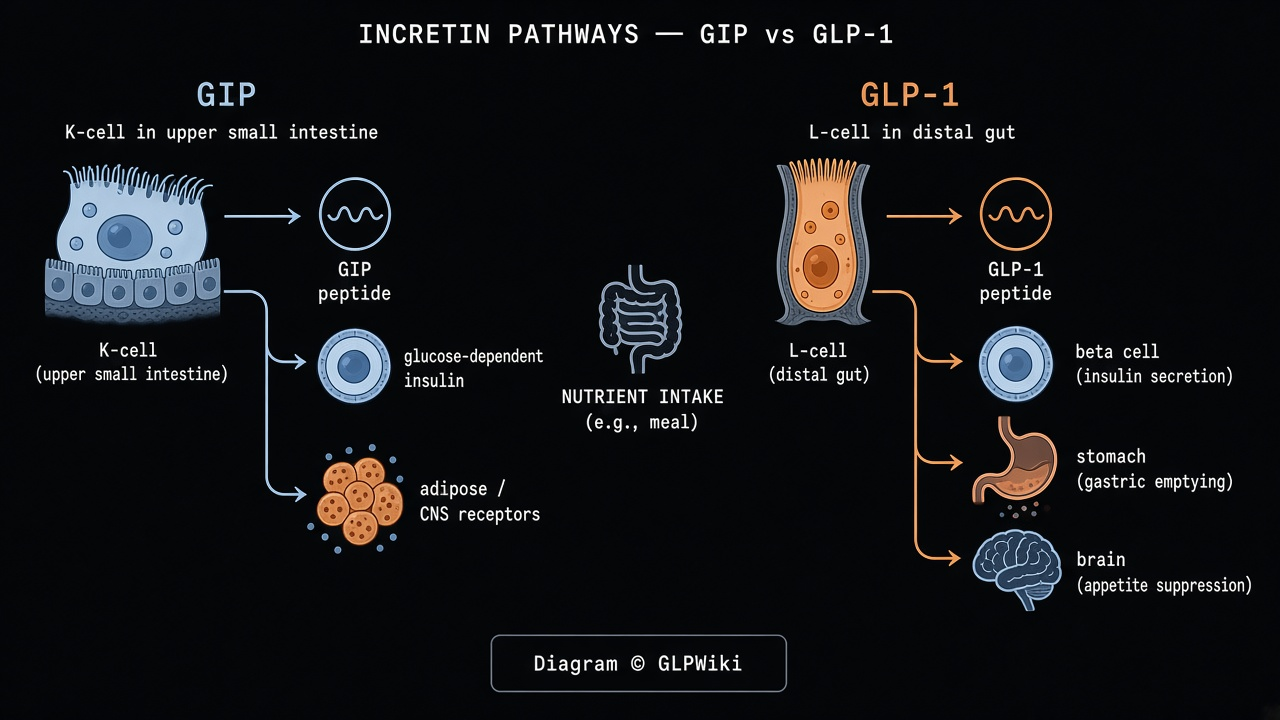
- GIP is secreted mainly by K-cells in the upper small intestine and acts on the GIP receptor (GIPR), a class B GPCR distinct from the GLP-1 receptor.
- Like GLP-1, native GIP stimulates glucose-dependent insulin secretion and is rapidly inactivated by DPP-4, so unmodified GIP is not a practical medicine.
- In type 2 diabetes the insulinotropic effect of GIP is substantially blunted, which historically led developers to deprioritise GIP-only drugs.
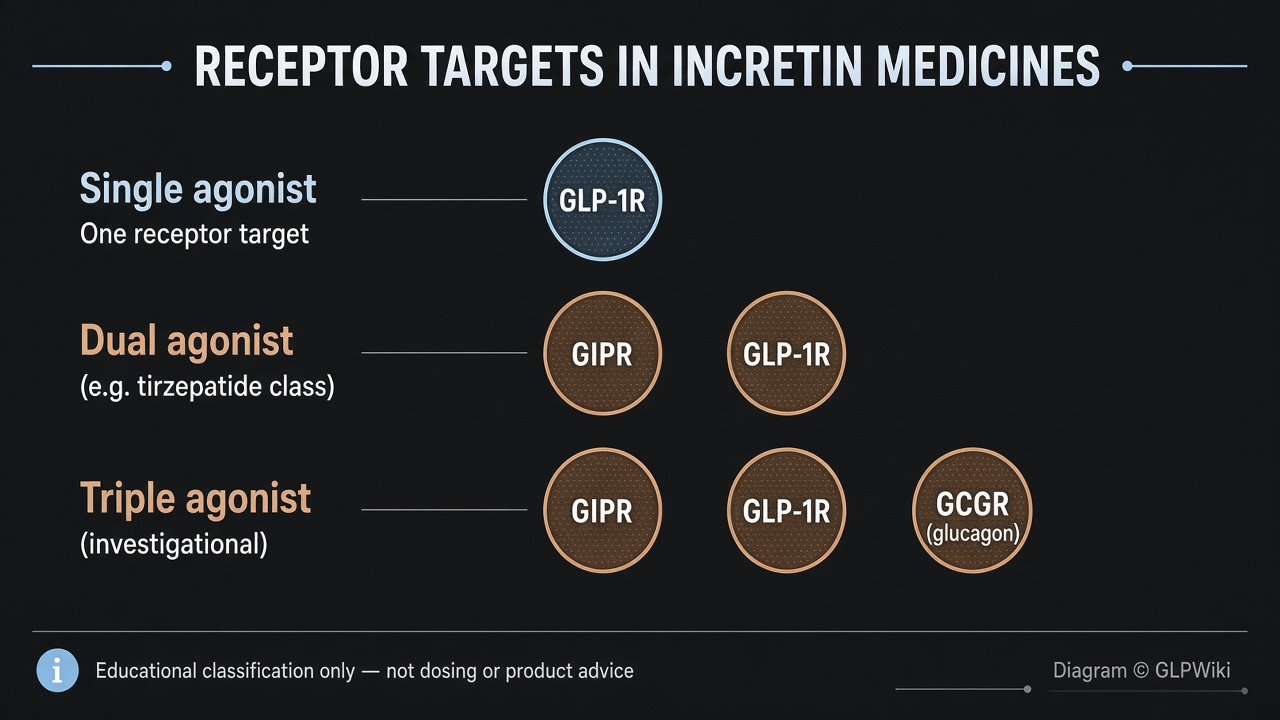
- Concurrent GLP-1 receptor activation appears to restore meaningful benefit from GIP receptor agonism — the rationale behind dual agonists such as tirzepatide (FDA-approved as Mounjaro for type 2 diabetes and Zepbound for chronic weight management).
- Triple agonists add glucagon receptor activity on top of GIPR + GLP-1R; retatrutide is investigational and is not a natural GIP hormone upgrade.
- GIP is not GLP-2 and not GLP-3. GLP-2 is a separate proglucagon product for intestinal growth; GLP-3 is an informal nickname for retatrutide, not a hormone.
What GIP is
Glucose-dependent insulinotropic polypeptide is a 42-amino-acid hormone released primarily by K-cells in the duodenum and jejunum after nutrients enter the upper small intestine. It is one of the two principal incretins; GLP-1 is the other. The incretin effect describes the stronger insulin response seen when glucose is taken through the gut rather than delivered directly into the circulation, because intestinal hormones add a signal that circulating glucose alone does not provide.
Older literature calls the molecule gastric inhibitory polypeptide. That name came from early experiments suggesting an effect on gastric acid secretion. As its glucose-dependent insulinotropic action became the physiologically important feature, the modern name changed while the acronym GIP stayed. Both names refer to the same hormone, not two related peptides.
GIP and GLP-1 are released from different intestinal cell populations and are encoded by different precursor systems. They converge on some metabolic outcomes, especially meal-linked insulin secretion, but they are not interchangeable signals.
The GIP receptor
GIP acts through GIPR, a class B G-protein-coupled receptor. The receptor is expressed in pancreatic islet cells and is also found in adipose tissue, parts of the central nervous system, bone and other tissues. Distribution alone does not establish a therapeutic effect: receptor expression, local signaling, exposure and the physiological state of the person all affect what follows activation.
GIPR is distinct from the GLP-1 receptor. Native GIP does not simply stand in for GLP-1, and GLP-1 does not meaningfully substitute for GIP at its receptor. Medicines described as dual agonists are engineered to activate both targets; they are not mixtures of the two natural hormones.
What native GIP does
The best-established action of native GIP is amplification of insulin secretion when glucose is elevated. The glucose dependence matters: an incretin signal interacts with the nutrient state rather than acting as an unconditional insulin switch. GIP biology extends beyond the pancreatic beta cell, but findings from cells or animals should not automatically be presented as demonstrated clinical outcomes in humans.
Native GIP is short-lived. Dipeptidyl peptidase-4 cleaves it rapidly after release, limiting how long the intact hormone circulates. That fleeting signal suits meal-to-meal physiology but makes unmodified GIP unsuitable as a practical long-acting medicine.
- Pancreatic islets: glucose-dependent amplification of insulin secretion is the core incretin action.
- Adipose tissue: GIPR signaling participates in nutrient storage and lipid biology, with effects that depend on metabolic context.
- Central nervous system: receptor expression and experimental findings support brain-related actions, but the clinical contribution of each pathway remains under study.
- Circulation: DPP-4 rapidly inactivates native GIP, producing a short physiological signal.
Why GIP-only medicines stalled
In people with type 2 diabetes, the insulinotropic response to GIP is substantially blunted even though some GLP-1 responsiveness remains. That observation shaped drug development for years: if the most obvious pancreatic effect was impaired in the population of interest, a GIP-only agonist looked less promising than a GLP-1 receptor agonist.
There was also an apparent biological tension. Because GIP participates in nutrient storage and adipose signaling, some researchers investigated whether blocking rather than activating GIPR might be useful. Agonism and antagonism can both produce interesting preclinical findings in complex systems, but those findings do not make the strategies equivalent or establish human benefit. The relevant question is what a defined molecule does in controlled human trials.
The later success of dual agonism did not prove that the earlier concern was imaginary. It showed that GIPR activation can behave differently when engineered into a molecule that also activates GLP-1R and is given at sustained pharmacologic exposure. Combination pharmacology is not a simple replay of native GIP physiology.
GIP in dual agonists (approved)
Tirzepatide is a single engineered peptide with activity at both GIPR and GLP-1R. It is FDA-approved as Mounjaro for type 2 diabetes and as Zepbound for chronic weight management under the conditions and populations defined in each current prescribing information. Calling it a dual agonist identifies receptor pharmacology; it does not mean that every effect can be assigned neatly to one receptor.
The SURPASS-2 trial compared tirzepatide with semaglutide in adults with type 2 diabetes, while SURMOUNT-1 studied tirzepatide in adults with obesity or overweight and a weight-related complication without diabetes. These trials helped establish clinical effects of the finished medicine. They do not show that native GIP, an unapproved GIP-only product or another research peptide produces the same outcomes.
Approval belongs to the specific medicine, indication, formulation and labeling reviewed by the regulator. Readers can continue with the dual-agonist guide for a fuller comparison of mechanism, evidence and status without turning trial results into personal treatment instructions.
Triple agonists and investigational status
Triple agonists extend the multi-receptor idea by adding glucagon receptor activity to GIPR and GLP-1R activity. Retatrutide is the prominent example. A phase 2 trial reported clinical outcomes in adults with obesity, but the molecule remains investigational and is not FDA-approved. Phase 2 evidence is a development milestone, not a substitute for completed confirmatory trials and regulatory review.
The online label “GLP-3” can obscure this distinction. Retatrutide is not a third naturally occurring GLP hormone and there is no GLP-3 receptor. The phrase is an informal nickname for triple receptor agonism. The dedicated GLP-3 concept page explains why receptor count, hormone nomenclature and approval status should be kept separate.
GIP versus GLP-1, GLP-2, and GLP-3
These names are often placed in one sequence even though they describe different kinds of things. A direct comparison prevents a numbered-name shortcut from becoming a biological claim.
- GIP: a natural incretin from upper-intestinal K-cells acting at GIPR; it is not a proglucagon-derived GLP peptide.
- GLP-1: a natural proglucagon-derived incretin from intestinal L-cells acting at GLP-1R, with pancreatic, gastric and central effects.
- GLP-2: a separate proglucagon-derived hormone acting at GLP-2R to support intestinal growth and absorption; it is not an incretin weight-management target.
- “GLP-3”: not a recognized natural hormone or receptor; an informal nickname commonly applied to investigational retatrutide.
- Dual and triple agonists: engineered medicines or candidates classified by the receptors they activate, not new natural incretin hormones.
Common misconceptions
GIP is sometimes described as simply the weaker version of GLP-1. That is inaccurate: it has its own receptor, cellular origin and physiology. The blunted insulin response observed in type 2 diabetes is an important context, not proof that the hormone has no function or that every therapeutic use must fail.
The approval of tirzepatide does not validate every substance advertised as a GIP agonist, dual agonist or research peptide. Evidence belongs to the studied molecule and finished product. Identity, purity, sterility, exposure and receptor profile cannot be inferred from a marketing label.
This page also does not provide a route to self-experimentation. Receptor diagrams cannot establish a safe dose, schedule, combination or administration method, and results from approved dual agonists cannot be transferred to investigational triple agonists or unrelated peptides.
Scope and disclaimer
This is an educational concept page, not medical advice, prescribing guidance or a recommendation to use any product. It contains no doses or treatment protocols. Decisions about an approved medicine belong with a qualified clinician using the current prescribing information and the person's medical context.
Approval status changes only through regulatory action. Drugs@FDA is the primary U.S. reference for approved applications and current labeling. A compound described in a paper, registry or vendor listing should not be called FDA-approved unless the relevant application appears there for the claimed use.
Frequently asked questions
- What does GIP stand for?
- GIP stands for glucose-dependent insulinotropic polypeptide. Older sources may call the same hormone gastric inhibitory polypeptide; the acronym was retained when its principal incretin action became clearer.
- Is GIP the same as GLP-1?
- No. Both are meal-responsive incretin hormones, but GIP comes mainly from upper-intestinal K-cells and activates GIPR, while GLP-1 comes from L-cells and activates GLP-1R.
- Why did GIP drugs fail alone?
- The insulinotropic response to GIP is substantially blunted in type 2 diabetes, which made GIP-only agonism look unattractive historically. Later dual agonists showed that GIPR activity can contribute differently alongside GLP-1R activity.
- Is tirzepatide a GIP drug?
- Tirzepatide is a dual GIPR and GLP-1R agonist, not native GIP and not a GIP-only medicine. FDA has approved specific tirzepatide products for defined indications.
- Is there a natural GLP-3?
- No. “GLP-3” is an informal nickname often used for retatrutide, an investigational GIPR/GLP-1R/glucagon-receptor triple agonist. It is not a natural hormone or receptor.
- Does this page recommend doses?
- No. This page explains physiology, receptor classes, evidence and regulatory status only. It does not provide doses, schedules, combinations or individualized treatment advice.
SOURCES
- 01Glucose-dependent insulinotropic polypeptide physiology— Endocrine Reviews / PubMed
- 02SURPASS-2— New England Journal of Medicine
- 03SURMOUNT-1— New England Journal of Medicine
- 04Mounjaro prescribing information— U.S. Food and Drug Administration
- 05Zepbound prescribing information— U.S. Food and Drug Administration
- 06Retatrutide phase 2 trial— New England Journal of Medicine
- 07Proglucagon-derived peptides— Physiological Reviews / PubMed
- 08Drugs@FDA— U.S. Food and Drug Administration
EDUCATIONAL REFERENCE ONLY · Not medical advice. Nothing here diagnoses, treats, cures or prevents any disease, and nothing here is a dosing recommendation. Consult a licensed clinician before any treatment decision.