How to read the Drug Abuse and Dependence section on peptide labels (Section 9): controlled-substance status, abuse vs misuse vs addiction, and why GLP-1 labels skip it
GLPWiki's how-to-read-fda-peptide-labeling hub maps the whole Prescribing Information, and our Day 44 guide covered Section 10 Overdosage. This companion explains the section that sits just before it: Section 9 Drug Abuse and Dependence. What 21 CFR 201.57(c)(10) requires in 9.1 Controlled Substance, 9.2 Abuse and 9.3 Dependence; how the DEA schedule symbol shows up on the Highlights title line; the precise label meanings of abuse, misuse, addiction, physical dependence and tolerance; and why current GLP-1 and most peptide labels have no Section 9 at all. Label-reading literacy only: no doses, no treatment recommendations, no medical advice.
UPDATED 25 OCT 2026 · 12 MIN READ
KEY TAKEAWAYS
- Section 9 Drug Abuse and Dependence is governed by 21 CFR 201.57(c)(10). It has three possible subsections: 9.1 Controlled Substance (the DEA schedule, if any), 9.2 Abuse, and 9.3 Dependence. The rule says "as appropriate," so a label includes only what applies.
- If a drug is controlled under the Controlled Substances Act, 9.1 must name the schedule, and the Highlights title line must carry the schedule symbol (for example "CIV") next to the drug name and route under 201.57(a)(2) and DEA's 21 CFR 1302.03–1302.04.
- 9.2 Abuse must describe the types of abuse that can occur, the related adverse reactions, and particularly susceptible populations, based primarily on human data. 9.3 Dependence must describe psychological and physical dependence, tolerance, the effects of abrupt withdrawal, and the principles for managing it.
- FDA's 2019 draft guidance gives labels standard one-sentence definitions. Abuse is intentional non-therapeutic use, even once, for desirable psychological or physiological effects. Misuse is intentional therapeutic use other than as prescribed. Addiction is a behavioral, cognitive and physiological cluster. Physical dependence and tolerance are expected biological adaptations and, by themselves, are not addiction.
- "Not a controlled substance" is not automatically printed. The draft guidance says a 9.1 not-controlled statement belongs only when 9.2 or 9.3 contains information; otherwise the section is simply absent.
- The current DailyMed labels we checked for Ozempic, Rybelsus, Wegovy, Mounjaro, Zepbound, Victoza, Saxenda and Trulicity, plus the peptide products Imcivree, Vyleesi, Egrifta WR, Korsuva and Zegalogue, have no Section 9. By contrast, the weight-management combination Qsymia has 9.1–9.3 (phentermine is Schedule IV) and Contrave has a 9.2 Abuse subsection.
- A missing Section 9 means FDA's labeling contains no abuse or dependence information for that product. It is not a statement that a product is safe to use without a prescription, and it says nothing about compounded or "research" products, which have no FDA-approved label at all.
What this guide covers (and how it differs from sister pages)
How to read FDA peptide labeling explains the PLR layout and where each numbered section sits. Our Day 44 Overdosage guide covers Section 10, and Warnings and Precautions literacy covers Section 5. This Day 46 guide is the deep companion for Section 9 as regulated text: what the regulation requires, how FDA's draft guidance recommends it be worded, what the controlled-substance symbol means, and how to read the precise vocabulary of abuse and dependence.
It quotes labels only to show structure and wording patterns. It reproduces no doses or strengths and does not suggest who should or should not use any medicine. Where we use a non-peptide label (Qsymia, Contrave) it is because the GLP-1 labels have no Section 9 to show, and those two are FDA-approved weight-management products many GLP-1 readers will also encounter.
Where Section 9 sits and what the regulation requires
Under the Physician Labeling Rule, the Full Prescribing Information has 17 numbered sections. Section 9 sits between Section 8 Use in Specific Populations and Section 10 Overdosage. 21 CFR 201.57(c)(10) says Section 9 "must contain the following information, as appropriate":
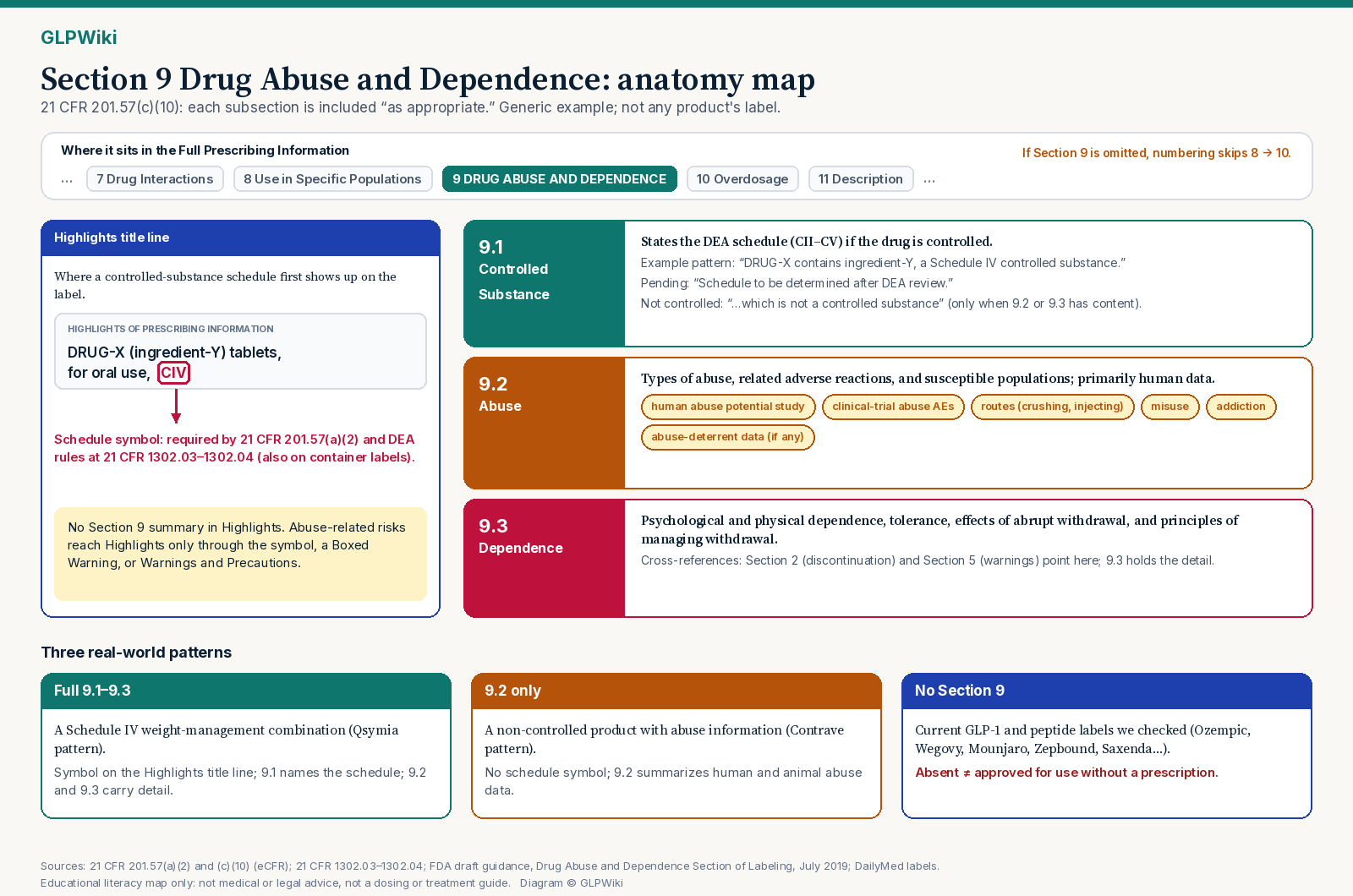
- 9.1 Controlled Substance: "If the drug is controlled by the Drug Enforcement Administration, the schedule in which it is controlled must be stated."
- 9.2 Abuse: must state the types of abuse that can occur and the adverse reactions pertinent to them, and must identify particularly susceptible patient populations. It must be based primarily on human data and experience; pertinent animal data may also be used.
- 9.3 Dependence: must describe the characteristic effects of psychological and physical dependence, identify the quantity of drug over time that may lead to tolerance or dependence, give details on the adverse effects of chronic abuse and of abrupt withdrawal, and describe how the dependent state is diagnosed and the principles of treating abrupt-withdrawal effects.
Two reading consequences, and what Highlights shows
First, "as appropriate" means subsections are included only when they apply, which is why a label can have 9.2 without 9.1 or 9.3, or no Section 9 at all. Second, the section numbers are fixed by regulation: when Section 9 is absent, the label jumps from Section 8 to Section 10 rather than renumbering. A missing number in the table of contents is a signal worth noticing, not a typo.
Highlights has no Section 9 summary. The only place abuse-related status reaches Highlights is the controlled-substance symbol on the product-title line, plus any Boxed Warning or Warnings and Precautions entries that the section cross-references.
9.1 Controlled Substance: schedules, symbols and "pending" wording
The Controlled Substances Act (21 U.S.C. 812) places controlled drugs into Schedules I–V. Scheduling decisions are made through the process in 21 U.S.C. 811, which includes an FDA scientific and medical evaluation and a DEA scheduling action; the full list of scheduled substances is in 21 CFR part 1308. FDA's 2017 Assessment of Abuse Potential guidance explains that Schedule I covers substances with no currently accepted medical use, and that drugs in FDA-approved products with abuse potential are placed in Schedules II–V according to relative abuse potential and dependence liability.
How it shows on a label:
- Section 9.1 sentence: the draft guidance pattern is "DRUG-X contains active ingredient-Y, a Schedule [N] controlled substance." The Qsymia label reads: "QSYMIA contains phentermine, a Schedule IV controlled substance, and topiramate, which is not a controlled substance."
- Highlights title line: 21 CFR 201.57(a)(2) requires the controlled-substance symbol designating the schedule to follow the drug names, dosage form and route, as required by DEA's 21 CFR 1302.04. The Qsymia Highlights title line ends "for oral use, CIV."
- Container labels: DEA's 21 CFR 1302.03 requires the schedule symbol (CII or C-II through CV or C-V) on each commercial container and on manufacturer labeling, and 1302.04 requires it to be prominent and legible "without removal from the dispenser's shelf."
- Pending scheduling: if scheduling is still pending at approval, the draft guidance shows wording such as "(Controlled substance schedule to be determined after review by the Drug Enforcement Administration.)" Since a 2015 law, approval of a new drug that FDA recommends for control generally does not take effect until DEA issues an interim final scheduling rule, and the label must then be updated.
- Not controlled, but with 9.2 or 9.3 content: the draft guidance says 9.1 should then carry one sentence, "DRUG-X contains active ingredient-Y, which is not a controlled substance," and that this sentence should not appear when 9.2 and 9.3 are empty. Older labels may not follow this draft pattern; the Contrave label we checked has a 9.2 Abuse subsection with no 9.1 line. A draft guidance is non-binding and labels are updated over time.
Federal scheduling is one layer
States can add their own controls, and some substances are regulated outside the CSA: for example, 21 U.S.C. 333(e) makes it a federal crime to knowingly distribute human growth hormone for uses in humans other than an FDA-authorized use on a physician's order, even though growth hormone is not a CSA-scheduled drug. That restriction lives in statute, not in Section 9.
9.2 Abuse: abuse, misuse and addiction, in the label's own terms
FDA's 2019 draft guidance on the Drug Abuse and Dependence section recommends standard single-sentence definitions so labels read consistently across classes. These are labeling definitions; the guidance notes they are not always the same as clinical diagnostic definitions in DSM-5.
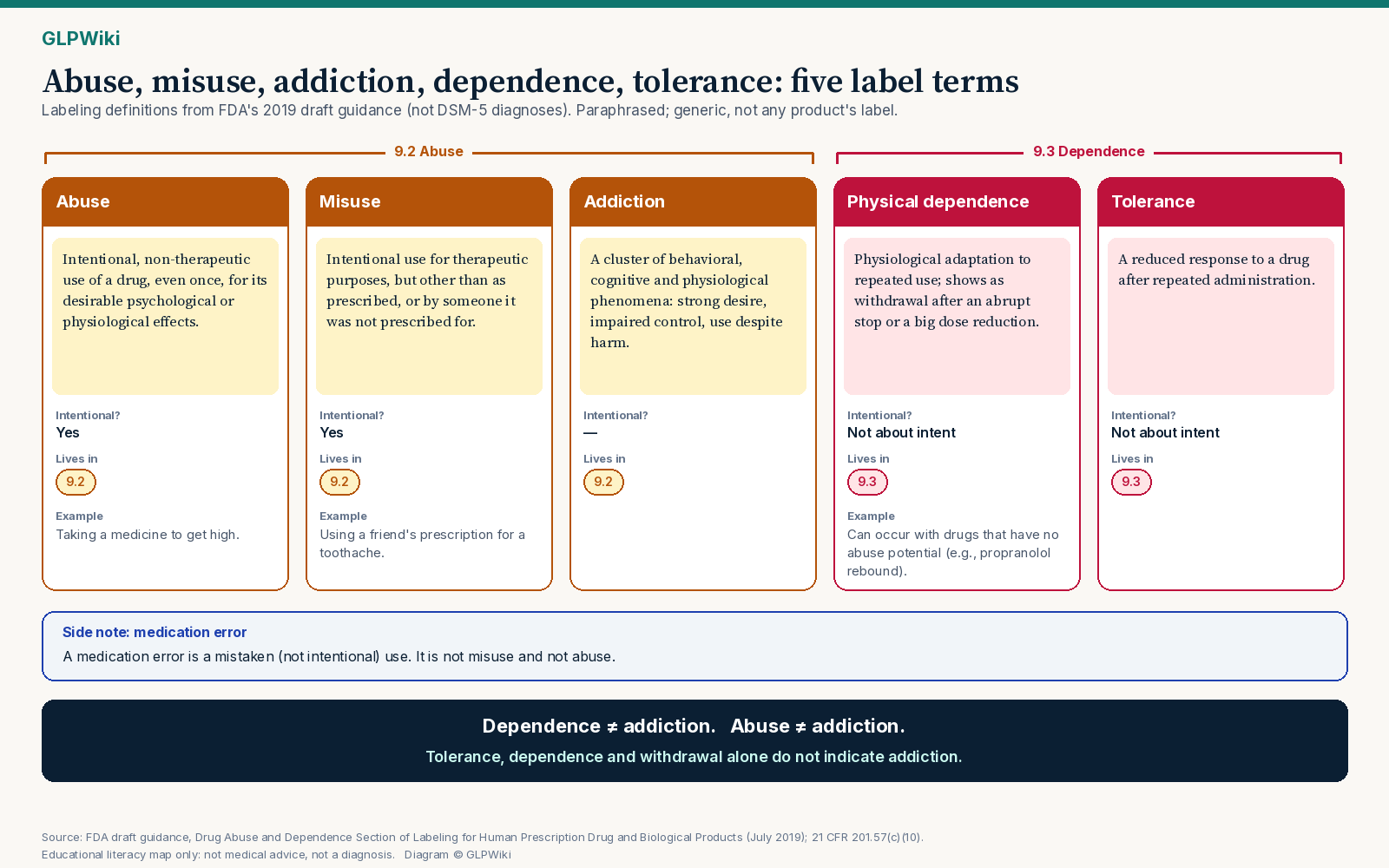
- Abuse: "the intentional, non-therapeutic use of a drug, even once, for its desirable psychological or physiological effects." The guidance says abuse should not describe accidental or inadvertent exposure, because abuse requires intent.
- Misuse: "the intentional use, for therapeutic purposes, of a drug by an individual in a way other than prescribed by a health care provider or for whom it was not prescribed." The guidance's illustration: taking a friend's prescription pain medicine for a toothache is misuse; taking it for euphoria is abuse.
- Medication error: a mistaken (not intentional) use other than prescribed. It is neither misuse nor abuse.
- Addiction: "a cluster of behavioral, cognitive, and physiological phenomena that may include a strong desire to take the drug, difficulties in controlling drug use … and possible tolerance or physical dependence." The guidance places addiction content in 9.2, not 9.3.
What else 9.2 may contain
Results of human abuse potential studies (often comparing "drug liking" against a known comparator), abuse-related adverse events from the clinical program, routes of abuse such as crushing or injecting oral products, susceptible populations, and for some opioid products, data on abuse-deterrent properties. Detailed animal data belong in Section 13.2 Animal Toxicology and/or Pharmacology, with only the clinical implications summarized in 9.2.
Two label examples show the range
Reading lesson: a 9.2 subsection is not automatically a red flag, and an absent 9.2 is not a clean bill of health. Read what kind of evidence is cited (human abuse potential study, clinical-trial observation, postmarketing reports, animal data) and how strongly it is worded.
- Qsymia 9.2 states phentermine "has a known potential for abuse," gives the standard abuse definition, notes that phentermine is chemically and pharmacologically related to amphetamines, and tells prescribers to assess abuse risk before prescribing.
- Contrave 9.2 states the product "has not been systematically studied in humans for its potential for abuse, tolerance, or physical dependence," reports no evidence of euphoric intoxication, physical dependence, diversion or abuse in its outpatient studies, and then summarizes older single-dose human and animal studies of bupropion. It also notes reports of crushed tablets being inhaled or injected and that the tablets are for oral use only. Its own text cautions that such clinical findings "are not known to reliably predict the abuse potential of drugs."
9.3 Dependence: physical dependence, withdrawal and tolerance
The draft guidance stresses two points readers often miss. Physical dependence is not addiction: a person can be physically dependent without being addicted, and tolerance, dependence and withdrawal are expected biological consequences of chronic treatment with certain drugs. And physical dependence is not limited to drugs of abuse: the guidance's own example is withdrawal-type rebound after abruptly stopping propranolol, a blood-pressure medicine with no abuse potential. That is why 9.3 can appear on a non-controlled label when stopping the drug has been shown to cause a withdrawal syndrome.
Qsymia's 9.3 uses the standard physical-dependence sentence and then describes discontinuation effects for each component, cross-referencing Warnings and Precautions and Dosage and Administration. This illustrates the cross-reference pattern the guidance recommends: 9.3 holds the detail, and other sections point to it rather than repeat it. We are not reproducing that label's discontinuation instructions here; any change to a prescribed medicine should be discussed with the prescriber.
- Physical dependence: "a state that develops as a result of physiological adaptation in response to repeated drug use, manifested by withdrawal signs and symptoms after abrupt discontinuation or a significant dose reduction of a drug."
- Tolerance: "a physiological state characterized by a reduced response to a drug after repeated administration (i.e., a higher dose of a drug is required to produce the same effect that was once obtained at a lower dose)." Tolerance can develop to some effects faster than others.
Why current GLP-1 and most peptide labels have no Section 9
On October 25, 2026 we retrieved the current DailyMed SPL files for Ozempic, Rybelsus, Wegovy, Mounjaro, Zepbound, Victoza, Saxenda and Trulicity, and for the peptide products Imcivree (setmelanotide), Vyleesi (bremelanotide), Egrifta WR (tesamorelin), Korsuva (difelikefalin) and Zegalogue (dasiglucagon). None contains a Drug Abuse and Dependence section; their tables of contents go from Section 8 to Section 10. None of these labels' Highlights title lines carries a schedule symbol.
How to read that correctly:
- It means: the FDA-approved labeling does not identify these products as controlled substances and does not contain abuse, misuse, addiction, dependence or tolerance information that FDA and the sponsor judged necessary to convey to prescribers.
- It does not mean: that a product is appropriate without a prescription, that every possible risk of stopping or misusing it is known, or that nothing is said elsewhere. Gastrointestinal, gallbladder, pancreatitis, hypoglycemia and other risks live in Sections 5 and 6, and Section 10 covers overdose. The word "abuse" can still appear elsewhere for other reasons: the Victoza label, for example, mentions alcohol abuse as a pancreatitis risk factor in its trial narrative. That is not a Section 9 statement about liraglutide.
- Research is not label text. GLP-1 receptor agonists are being studied as possible treatments for substance use disorders. A 2022 randomized trial of exenatide in alcohol use disorder (Klausen et al., JCI Insight; NCT03232112) did not meet its primary outcome, and a 2025 phase 2 trial of semaglutide (Hendershot et al., JAMA Psychiatry; NCT05520775) reported reductions in some but not all drinking measures in 48 adults. Neither study adds an indication or a Section 9 entry. Investigational findings do not become label text unless FDA approves them, and Section 9 is about a drug's own abuse and dependence potential, not about treating someone else's.
- Compounded and research products have no Section 9 to read. FDA's statements on unapproved GLP-1 drugs note that compounded versions are not FDA-approved, and "research use only" peptides have no FDA-reviewed label at all. The absence of a Section 9 there means no one has made an FDA-reviewed assessment, not that one was made and came back clean.
How Section 9 connects to the rest of the label
- Boxed Warning and Section 5: for drugs with serious abuse, misuse or addiction risks, the summary and required actions appear here, cross-referencing 9.2. The draft guidance asks that the detail live in Section 9 and not be duplicated.
- Section 2 Dosage and Administration: discontinuation and tapering instructions, cross-referencing 9.3.
- Section 10 Overdosage: what happens at excessive exposure, whether intentional or not. Abuse can lead to overdose, but the two sections answer different questions.
- Section 12 Clinical Pharmacology and Section 13.2: mechanism, pharmacodynamics, and animal abuse-liability data such as self-administration or drug-discrimination studies.
- Sections 16 and 17 / Medication Guide: storage, safe disposal of controlled substances, and what patients are told about keeping medicines secure. The draft guidance says detailed disposal information generally does not belong in Section 9.
- Drugs@FDA review documents: for scheduled drugs, the approval package often contains the abuse-potential review behind the label wording.
A five-question checklist for reading any Section 9
- Is there a Section 9 at all? Check the table of contents for a jump from 8 to 10.
- Is there a schedule symbol (CII–CV) on the Highlights title line, and does 9.1 name the same schedule for the same ingredient?
- In 9.2, what kind of evidence is cited: a human abuse potential study, clinical-trial observations, postmarketing reports, or animal data? Who is named as particularly susceptible?
- In 9.3, is physical dependence or tolerance described, and do Sections 2 and 5 cross-reference it?
- Are you reading the current label for this exact product? Scheduling, labels and draft guidance change; confirm the revision date on DailyMed or Drugs@FDA.
Scope, disclaimer and review date
This guide is educational. It maps how to read Section 9 Drug Abuse and Dependence on FDA Prescribing Information under PLR: what 21 CFR 201.57(c)(10) and (a)(2) require, how the DEA schedule symbol is displayed, how FDA's 2019 draft guidance defines abuse, misuse, addiction, physical dependence and tolerance for labeling, and how current GLP-1 and peptide labels compare. It does not provide doses, strengths, titration or tapering schedules, preparation or injection steps, treatment instructions, legal advice, product or pharmacy recommendations, or individual medical advice, and nothing here recommends starting, stopping, switching or continuing any medicine or research chemical. If you are worried about your own or someone else's substance use, talk to a clinician or call the SAMHSA National Helpline (1-800-662-4357). For a possible overdose or poisoning, call 911 or Poison Help (1-800-222-1222).
Last reviewed: October 25, 2026. Labeling, scheduling and guidance may have changed since; verify with Drugs@FDA, DailyMed, and your pharmacist or clinician.
Frequently asked questions
- What is Section 9 Drug Abuse and Dependence?
- It is the ninth section of the PLR Full Prescribing Information, governed by 21 CFR 201.57(c)(10). It can contain 9.1 Controlled Substance, 9.2 Abuse and 9.3 Dependence, each included only as appropriate.
- Why don't Ozempic, Wegovy, Mounjaro or Zepbound labels have a Section 9?
- The current labels we checked identify no controlled-substance schedule and include no abuse or dependence information, so the section is omitted and the numbering skips from 8 to 10. That reflects what FDA-approved labeling contains; it is not advice about use without a prescription.
- What does "CIV" next to a drug name mean?
- It is the DEA symbol for Schedule IV under the Controlled Substances Act. 21 CFR 201.57(a)(2) and DEA's 21 CFR 1302.03–1302.04 require the schedule symbol on the Highlights title line and on container labels.
- What is the difference between abuse and misuse on a label?
- In FDA's draft labeling definitions, abuse is intentional non-therapeutic use for desirable psychological or physiological effects, even once; misuse is intentional therapeutic use in a way other than prescribed or by someone it was not prescribed for. Accidental mistakes are medication errors, not either one.
- Is physical dependence the same as addiction?
- No. FDA's draft guidance says physical dependence and tolerance are expected biological adaptations to some chronic treatments, can occur with drugs that have no abuse potential, and by themselves do not indicate addiction.
- Can a drug that is not controlled still have a Section 9?
- Yes. A non-controlled drug may have 9.2 or 9.3 content, for example a demonstrated lack of abuse potential or a withdrawal syndrome. The draft guidance then recommends a 9.1 sentence saying the ingredient is not controlled.
- Does research on GLP-1 drugs for alcohol use disorder change their labels?
- No. Trials such as the exenatide and semaglutide alcohol-use-disorder studies are investigational. They add no indication and no Section 9 text unless FDA approves a labeling change.
- Do compounded or research peptides have a Section 9?
- No. They have no FDA-approved Prescribing Information, so there is no FDA-reviewed abuse or dependence assessment to read.
SOURCES
- 0121 CFR 201.57 — Specific requirements on content and format of labeling (PLR), including (a)(2) controlled substance symbol and (c)(10) 9 Drug abuse and dependence— U.S. Government Publishing Office / eCFR
- 02Drug Abuse and Dependence Section of Labeling for Human Prescription Drug and Biological Products — Content and Format (draft guidance for industry, July 2019)— U.S. Food and Drug Administration
- 03Drug Abuse and Dependence Section of Labeling — draft guidance (PDF)— U.S. Food and Drug Administration
- 04Notice of availability: Drug Abuse and Dependence Section of Labeling draft guidance, July 2, 2019 (FDA-2019-D-1917)— Federal Register
- 05Assessment of Abuse Potential of Drugs (guidance for industry, January 2017)— U.S. Food and Drug Administration
- 06Labeling for Human Prescription Drug and Biological Products — Implementing the PLR Content and Format Requirements (guidance, February 2013)— U.S. Food and Drug Administration
- 07Prescribing Information Resources (PLR section map)— U.S. Food and Drug Administration
- 0821 CFR 1302.04 — Location and size of symbol on label and labeling— U.S. Government Publishing Office / eCFR
- 0921 CFR part 1308 — Schedules of controlled substances— U.S. Government Publishing Office / eCFR
- 1021 U.S.C. 812 — Schedules of controlled substances— Legal Information Institute, Cornell Law School
- 1121 U.S.C. 811 — Authority and criteria for classification of substances— Legal Information Institute, Cornell Law School
- 1221 U.S.C. 333(e) — Prohibited distribution of human growth hormone— Legal Information Institute, Cornell Law School
- 1321 CFR 314.50 — Content and format of an NDA, including (d)(5)(vii) abuse potential— U.S. Government Publishing Office / eCFR
- 14Qsymia (phentermine and topiramate extended-release) capsules — Highlights CIV symbol and Section 9 (DailyMed)— U.S. FDA / DailyMed
- 15Contrave (naltrexone HCl and bupropion HCl) extended-release tablets — Section 9.2 Abuse (DailyMed)— U.S. FDA / DailyMed
- 16Wegovy (semaglutide) — current label, no Section 9 (DailyMed)— U.S. FDA / DailyMed
- 17Zepbound (tirzepatide) injection — current label, no Section 9 (DailyMed)— U.S. FDA / DailyMed
- 18Victoza (liraglutide) injection — current label, no Section 9 (DailyMed)— U.S. FDA / DailyMed
- 19Klausen MK, et al. Exenatide once weekly for alcohol use disorder investigated in a randomized, placebo-controlled clinical trial. JCI Insight. 2022;7(19):e159863 (PMID 36066977; NCT03232112)— JCI Insight / PubMed
- 20Hendershot CS, et al. Once-weekly semaglutide in adults with alcohol use disorder: a randomized clinical trial. JAMA Psychiatry. 2025;82(4):395-405 (PMID 39937469; NCT05520775)— JAMA Psychiatry / PubMed
- 21FDA's concerns with unapproved GLP-1 drugs used for weight loss (compounded drugs are not FDA-approved)— U.S. Food and Drug Administration
EDUCATIONAL REFERENCE ONLY · Not medical advice. Nothing here diagnoses, treats, cures or prevents any disease, and nothing here is a dosing recommendation. Consult a licensed clinician before any treatment decision.