How to read Nonclinical Toxicology on peptide labels (Section 13): animal carcinogenicity, genotoxicity and fertility findings

GLPWiki's how-to-read-fda-peptide-labeling hub maps the whole Prescribing Information. This companion goes deep on Section 13 Nonclinical Toxicology: what 21 CFR 201.57(c)(14) requires in 13.1 Carcinogenesis, Mutagenesis, Impairment of Fertility and 13.2 Animal Toxicology and/or Pharmacology, how animal findings are reported relative to human exposure, why a rodent finding is not automatically a human finding, how rodent thyroid C-cell tumor findings for GLP-1 receptor agonists became a Boxed Warning and an MTC / MEN 2 contraindication, how to read a genotoxicity battery, why fertility findings sit in Section 13 while embryo-fetal findings sit in Section 8, and how to cross-check it all on Drugs@FDA and DailyMed. Label-reading literacy only: no doses, animal dose numbers, product picks, or medical advice.
UPDATED 20 OCT 2026 · 15 MIN READ
KEY TAKEAWAYS
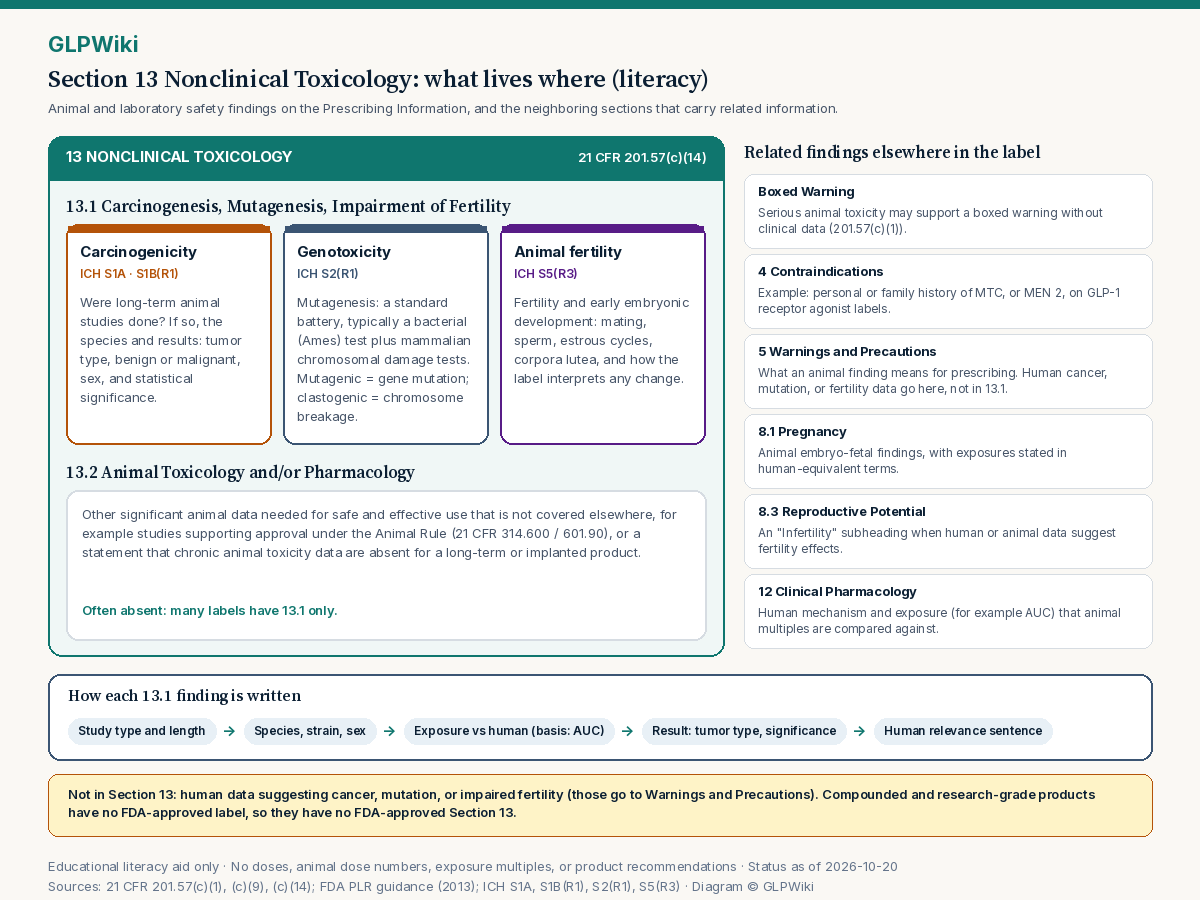
- Under 21 CFR 201.57(c)(14), Section 13 Nonclinical Toxicology contains, as appropriate, 13.1 Carcinogenesis, Mutagenesis, Impairment of Fertility and 13.2 Animal Toxicology and/or Pharmacology. It is where long-term animal cancer studies, genotoxicity tests, and animal fertility findings are summarized.
- 13.1 must state whether long-term animal studies of carcinogenic potential were performed and, if so, the species and results. Any precautionary statement must give the prescriber practical, relevant advice on the significance of the animal findings. Human data suggesting carcinogenicity, mutagenicity, or impaired fertility belong in Warnings and Precautions, not 13.1.
- Labels usually express animal exposure relative to human exposure, for example as a multiple of exposure at the maximum recommended human dose based on AUC. Read that as a comparison of exposure, not as a dose for anyone to use. This page reproduces no animal doses or multiples.
- A rodent finding is a hazard signal, not proof of human risk. Species can differ in receptors, physiology, and background tumor rates, so labels say explicitly when human relevance is unknown or has not been determined.
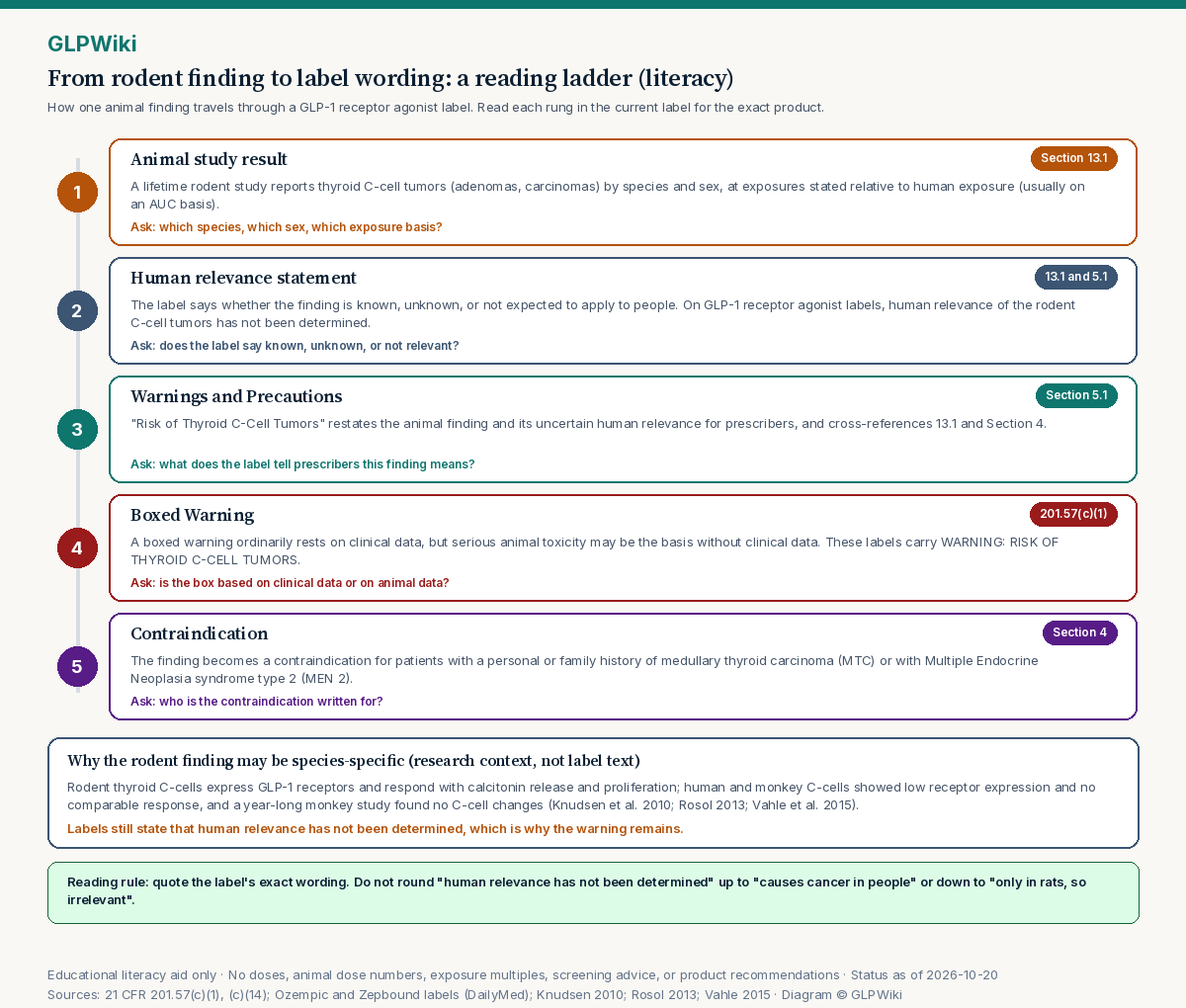
- For GLP-1 receptor agonists, lifetime rodent studies showed thyroid C-cell tumors. Because 21 CFR 201.57(c)(1) allows serious animal toxicity to support a Boxed Warning, that finding flows from 13.1 into Warnings and Precautions 5.1, the Boxed Warning, and the Section 4 contraindication for a personal or family history of MTC or MEN 2.
- Genotoxicity results are reported as a standard battery of tests, typically a bacterial mutation (Ames) test plus mammalian chromosomal damage tests, described in ICH S2(R1). A negative battery tells you the tests did not detect DNA damage; it does not cancel a tumor finding.
- Animal fertility findings appear in 13.1; animal embryo-fetal and developmental findings appear in Section 8.1 Pregnancy. Compounded or research-grade products have no FDA-approved label and therefore no FDA-approved Section 13. This page gives no doses, product picks, or medical advice.
What this guide covers (and how it differs from sister pages)
How to read FDA peptide labeling already explains PLR Highlights vs Full Prescribing Information, Drugs@FDA vs DailyMed, and the overall section map. This Day 41 guide is the deep companion for Section 13 Nonclinical Toxicology, the part of the label that summarizes what animal and laboratory studies showed about cancer, genetic damage, and fertility.
It is a reading guide, not a toxicology textbook and not a risk calculator. It explains where each kind of animal finding lives, how it is worded, and how it connects to other sections. It deliberately does not reproduce animal doses, exposure multiples, or tumor incidences from any label: those numbers belong to the exact product and are meant to be read in the current label. It is distinct from the Section 12, Sections 4–6, Section 7, Section 8, Section 14, Section 16, and Section 17 companions in this series.
- Primary sources: 21 CFR 201.57(c)(1), (c)(9), and (c)(14); FDA's PLR content and format guidance (February 2013); FDA Prescribing Information Resources; ICH S1A, S1B(R1), S2(R1), S5(R3), and S6(R1) as adopted by FDA; peer-reviewed papers on rodent thyroid C-cell findings (Knudsen et al. 2010; Rosol 2013; Vahle et al. 2015); current Ozempic and Zepbound labels on DailyMed (structure only); Drugs@FDA; FDA Compounding Q&A.
- Two original GLPWiki diagrams: a Section 13 anatomy map and a 'rodent finding to label wording' reading ladder.
- Out of scope: doses, schedules, animal dose numbers or exposure multiples, cancer-screening advice, product or pharmacy recommendations, sourcing advice, and medical advice.
What Section 13 is required to contain
In the PLR format, Section 13 is paragraph (c)(14) of 21 CFR 201.57. The regulation says the section must contain two subsections as appropriate. 13.1 Carcinogenesis, Mutagenesis, Impairment of Fertility must state whether long-term studies in animals have been performed to evaluate carcinogenic potential and, if so, the species and results. If reproduction studies or other animal data raise concern about mutagenesis or impairment of fertility in males or females, that must be described. Any precautionary statement on these topics must include practical, relevant advice to the prescriber on the significance of the animal findings.
One boundary is easy to miss: human data suggesting that a drug may be carcinogenic or mutagenic, or that it impairs fertility, must not be placed in 13.1. Those human data belong in Warnings and Precautions. Section 13 is, by design, the animal and laboratory section.
13.2 Animal Toxicology and/or Pharmacology holds significant animal data necessary for safe and effective use in humans that is not incorporated elsewhere in the labeling. The regulation's examples include specifics about studies used to support approval under the Animal Rule (21 CFR 314.600 or 601.90) and the absence of chronic animal toxicity data for a drug that is given over prolonged periods or implanted in the body. Many labels have no 13.2 at all.
Older labels used a different layout. FDA's PLR implementation guidance maps the old Precautions subsection 'Carcinogenesis, Mutagenesis, Impairment of Fertility' and the old optional 'Animal Pharmacology and/or Animal Toxicology' section into the new Section 13, and notes that Nonclinical Toxicology, previously optional, is now required if applicable. If you are reading an old-format label, the same information may sit under those older headings.
How animal findings are written: species, study, exposure, result
A typical 13.1 carcinogenicity paragraph follows a predictable pattern. It names the study length and species (often a lifetime study of about two years in rats and/or mice, sometimes a shorter study in a transgenic mouse model), the strain, and the route of administration. It then lists the dose groups and, in brackets, how those animal exposures compare with human exposure. Finally it states the result: which tissues showed tumors, whether they were benign (adenomas) or malignant (carcinomas), in which sex, and whether the increase was statistically significant or only numerical.
The exposure comparison is the part readers most often misread. Labels usually express it as a multiple of the exposure at the maximum recommended human dose (MRHD), and they state the basis, most commonly AUC (area under the plasma concentration–time curve). Sometimes a label compares body surface area instead. A multiple below one means the animals were exposed to less drug than people are at the MRHD; a multiple above one means more. The phrase 'clinically relevant exposures' means the finding occurred at exposures similar to those reached in people. None of this is a dose instruction, and GLPWiki reproduces none of the numbers.
Three reading habits help. First, note the species and sex for each finding, because a result in male rats is not automatically a result in female mice. Second, separate 'statistically significant increase' from 'numerical increase', which the label uses for changes that did not reach statistical significance. Third, look for the sentence that interprets the finding, such as whether human relevance is known, and for the cross-reference that sends you to Warnings and Precautions or the Boxed Warning.
- Study: lifetime (about two-year) rodent bioassay, or a shorter transgenic mouse study.
- Species, strain, sex: each reported separately.
- Exposure: animal exposure relative to human exposure at the MRHD, with the basis (AUC or body surface area) stated.
- Result: tissue, benign vs malignant, statistically significant vs numerical.
- Interpretation: human relevance statement and cross-references to Sections 5 and the Boxed Warning.
Rodent vs human relevance: a hazard signal is not a human verdict
Animal studies are designed to detect hazards, often at exposures higher than people reach and over most of an animal's lifespan. That makes them sensitive, but it also means some findings reflect biology that differs between species: receptor expression in a tissue, hormone physiology, metabolism, or a high background rate of a particular tumor in a particular strain. A label therefore does not stop at 'tumors were seen'. It adds a statement about whether the finding is known, unknown, or not expected to be relevant to humans, and how that conclusion was reached.
When the human relevance of a serious animal finding cannot be ruled out, the label treats it conservatively. When it has been shown not to apply to humans, the label says so and explains why. When the answer is not known, the label says that too. The wording matters, and the literacy skill is to read it exactly rather than rounding it up to 'causes cancer' or down to 'only in rats, so irrelevant'.
The GLP-1 example: from rodent thyroid C-cell tumors to a Boxed Warning
Thyroid C-cells make calcitonin; medullary thyroid carcinoma (MTC) is a cancer of those cells. In lifetime rodent studies, GLP-1 receptor agonists have produced thyroid C-cell hyperplasia and tumors. On the current Ozempic (semaglutide) label on DailyMed, 13.1 reports statistically significant increases in thyroid C-cell adenomas in both mice and rats, with C-cell carcinomas increased numerically in mice and statistically in male rats, at clinically relevant exposures, followed by the sentence that the human relevance of thyroid C-cell tumors in rats is unknown and could not be determined by clinical or nonclinical studies. The current Zepbound (tirzepatide) label reports thyroid C-cell tumors in a two-year rat study and no tumors in a shorter transgenic mouse study.
Research explains why the finding may be species-specific. Knudsen and colleagues (Endocrinology, 2010) reported that the GLP-1 receptor is present on rodent C-cells, that GLP-1 receptor agonists stimulated calcitonin release and C-cell proliferation in rats and, to a lesser extent, mice, and that human and monkey C-cells showed low GLP-1 receptor expression and no comparable response. They also concluded that the long-term consequences of sustained GLP-1 receptor activation in the human thyroid remain unknown. Rosol's 2013 review in Toxicologic Pathology described the rodent effect as an on-target, species-specific effect that may not be relevant to humans, and a 2015 monkey study of dulaglutide by Vahle and colleagues found no thyroid C-cell or calcitonin changes in male monkeys.
Why, then, is there a Boxed Warning? Because the regulation allows it. 21 CFR 201.57(c)(1) says a boxed warning ordinarily must be based on clinical data, but serious animal toxicity may also be the basis of a boxed warning in the absence of clinical data. GLP-1 receptor agonist labels follow that path: the rodent finding in 13.1 is restated in Warnings and Precautions 5.1 'Risk of Thyroid C-Cell Tumors', summarized in the Boxed Warning 'WARNING: RISK OF THYROID C-CELL TUMORS', and translated into a contraindication in Section 4 for patients with a personal or family history of MTC or with Multiple Endocrine Neoplasia syndrome type 2 (MEN 2). The Ozempic 5.1 text also notes that postmarketing cases of MTC have been reported with liraglutide and that those reports are insufficient to establish or exclude a causal relationship.
Read the chain in both directions. Starting from the Boxed Warning, follow its cross-reference to 13.1 to see the animal evidence. Starting from 13.1, follow its cross-reference to the Boxed Warning and 5.1 to see what the finding means for prescribing. For how to read the Boxed Warning, Contraindications, and Warnings and Precautions themselves, see the Warnings, Precautions, and Adverse Reactions companion. Questions about personal or family thyroid history belong with your clinician, not this page.
Why carcinogenicity studies exist and how they are designed
ICH S1A, adopted by FDA as guidance, explains when long-term rodent carcinogenicity studies are expected: generally for pharmaceuticals whose expected clinical use is continuous for at least six months, or frequent and intermittent over a lifetime, and in other cases where there is cause for concern. Many chronic-use medicines, including GLP-1 receptor agonists, therefore carry carcinogenicity results in 13.1.
ICH S1B describes the basic scheme as one long-term rodent carcinogenicity study plus one other study that adds information, either a short- or medium-term in vivo rodent test (such as a transgenic mouse model) or a long-term study in a second rodent species. In the absence of clear evidence favoring one species, the rat is recommended for the long-term study. The 2022 S1B(R1) addendum adds a weight-of-evidence approach for deciding whether a two-year rat study would add value. That is why one label may describe two-year studies in both mice and rats while another describes a two-year rat study and a six-month rasH2 transgenic mouse study: both are accepted designs.
For biotechnology-derived products, ICH S6(R1) applies instead and standard rodent bioassays are often not appropriate. Whichever framework applies, the label tells you what was actually done; the literacy question is simply which studies, in which species, with what result and what interpretation.
Reading the genotoxicity battery
Genotoxicity tests look for damage to genetic material. ICH S2(R1) describes two equally suitable standard batteries. Option 1 is a bacterial gene mutation test (the Ames test), an in vitro mammalian cytogenetic test for chromosomal damage (or an in vitro mouse lymphoma Tk assay), and an in vivo test, usually for chromosomal damage in rodent blood-forming cells such as a micronucleus test. Option 2 is the bacterial test plus in vivo assessment in two different tissues.
Labels compress this into one or two sentences. The Ozempic label, for example, says semaglutide was not mutagenic or clastogenic in a standard battery and names the Ames test, a human lymphocyte chromosome aberration test, and a rat bone marrow micronucleus test. 'Mutagenic' refers to gene mutations; 'clastogenic' refers to chromosome breakage. The Zepbound label names a rat bone marrow micronucleus assay.
A negative genotoxicity battery means the tests did not detect DNA-damaging potential. It does not cancel a tumor finding in 13.1. When tumors appear in animals but the battery is negative, reviewers look for a non-genotoxic explanation, such as a receptor-mediated effect on a specific cell type, which is exactly the question the GLP-1 C-cell research set out to answer.
Fertility in 13.1 vs embryo-fetal findings in Section 8
ICH S5(R3) describes three classic study types for reproductive and developmental toxicity: a fertility and early embryonic development (FEED) study, embryo-fetal development (EFD) studies usually in two species, and a pre- and postnatal development (PPND) study. On a PLR label, the results are split between sections.
Animal fertility findings, such as effects on mating, sperm, estrous cycles, or corpora lutea, appear in 13.1 under 'impairment of fertility'. Animal embryo-fetal and developmental findings appear in Section 8.1 Pregnancy. Under 21 CFR 201.57(c)(9)(i), the 8.1 Risk Summary must summarize relevant animal findings and express animal doses or exposures in terms of human dose or exposure equivalents, and the Data subsection must describe the types of studies, species, timing, findings, maternal toxicity, and limitations. When human or animal data suggest drug-associated fertility effects, Section 8.3 Females and Males of Reproductive Potential carries an 'Infertility' subheading.
On the GLP-1 labels we reviewed, 13.1 reports no effect on male fertility and describes changes in female estrous cycles and corpora lutea that the label attributes to the drug's pharmacological effects on food intake and body weight, while 8.1 describes the embryo-fetal studies. Reading habit: if you are looking for pregnancy information, start with 8.1 and 8.3; use 13.1 for the animal fertility study behind it. The Section 8 companion explains PLLR in detail.
When there is a 13.2 Animal Toxicology and/or Pharmacology
13.2 is used for significant animal data that do not fit elsewhere: for example, studies that supported approval under the Animal Rule when human efficacy trials were not ethical or feasible, special organ toxicity studies, or a statement that chronic animal toxicity data are absent for a long-term or implanted product. Neither the Ozempic nor the Zepbound label we reviewed includes a 13.2 subsection; their Section 13 consists of 13.1 only. When a 13.2 exists, read it the same way: study, species, exposure, result, interpretation.
Cross-checking Section 13 on Drugs@FDA and DailyMed
Open the current Agency-posted label PDF on Drugs@FDA or the structured label on DailyMed for the exact product, then jump to '13 NONCLINICAL TOXICOLOGY'. Check the revision date, confirm the product name and established name, and read every cross-reference in both directions: 13.1 to the Boxed Warning, Section 4, and Section 5, and 8.1 to the animal data behind it. For many approvals, Drugs@FDA also posts review documents, which can include the pharmacology and toxicology review; those are background reading, while the label remains the controlling summary.
Do not transfer Section 13 findings between products by assumption. Two products can share a theme, such as the thyroid C-cell Boxed Warning across GLP-1 receptor agonists, while the species, studies, results, and wording in 13.1 remain product-specific. Always read the label for the product actually in question.
- Find: Drugs@FDA label PDF or DailyMed SPL for the exact product.
- Read: 13.1 study by study (species, exposure basis, result) and any 13.2.
- Follow: cross-references to the Boxed Warning, Section 4, Section 5, and Sections 8.1 / 8.3.
- Check: the revision date and that you are on an FDA or NIH source, not a copy.
Compounded and research-grade products have no FDA-approved Section 13
Compounded drugs are not FDA-approved, and FDA's compounding Q&A explains that FDA does not verify their safety, effectiveness, or quality before they are marketed. A compounded preparation therefore has no FDA-approved Prescribing Information and no FDA-approved Section 13. Products sold for research use only are not labeled medicines at all. Animal findings in an approved product's label describe the studies behind that approved product; they are not a label for a different product, preparation, or source.
This is a neutral category distinction, not a judgment about any product or pharmacy. See Compounded vs FDA-approved GLP-1 medicines and Approved vs investigational peptides for the framework.
A practical Section 13 reading path
Start with the Boxed Warning and Section 5 to see whether any animal finding was serious enough to be elevated. Then read 13.1 in order: carcinogenicity studies, genotoxicity battery, fertility study. For each finding, note species, sex, exposure basis, result, and the human relevance sentence. Then check 8.1 and 8.3 for developmental and fertility information, and 13.2 if present. Finally, confirm the revision date on Drugs@FDA or DailyMed.
When something is unclear, follow your own product's current labeling and ask your pharmacist or clinician rather than a forum, another product's label, or this page.
- Was an animal finding elevated? Boxed Warning, Section 4, Section 5.
- What did long-term animal studies show? 13.1 carcinogenicity paragraph.
- Was DNA damage detected? 13.1 genotoxicity sentence (standard battery).
- Did animal studies affect fertility? 13.1 fertility paragraph; human or animal fertility effects also in 8.3 'Infertility'.
- What about pregnancy? 8.1 Risk Summary and Animal Data.
- Is it relevant to humans? The label's own human relevance sentence; do not round it up or down.
- Compounded or research products: no FDA-approved Section 13.
Scope, disclaimer and review date
This guide is educational. It maps how to read Section 13 Nonclinical Toxicology on FDA peptide and GLP-1 Prescribing Information under PLR — what 21 CFR 201.57(c)(14) requires in 13.1 and 13.2, how animal findings and exposure comparisons are reported, how to read human relevance statements, how rodent thyroid C-cell findings connect to the Boxed Warning and the MTC / MEN 2 contraindication on GLP-1 receptor agonist labels, how to read a genotoxicity battery, how fertility findings in 13.1 relate to Section 8, and why compounded or research products have no FDA-approved Section 13. It does not provide doses, titration schedules, animal dose numbers or exposure multiples, cancer-risk estimates, screening or monitoring advice, product or pharmacy recommendations, sourcing advice, or individual medical advice, and nothing here recommends starting, stopping, switching, or continuing any medicine or research chemical. Follow your own product's current labeling and ask your pharmacist or clinician.
Last reviewed: October 20, 2026. Labeling, nonclinical study summaries, approval status, ICH guidelines, and FDA rules may have changed since; verify with Drugs@FDA, DailyMed, and your pharmacist or clinician.
Frequently asked questions
- What is Section 13 Nonclinical Toxicology?
- It is the section of the PLR Prescribing Information governed by 21 CFR 201.57(c)(14). It summarizes animal and laboratory safety findings in 13.1 Carcinogenesis, Mutagenesis, Impairment of Fertility and, when needed, 13.2 Animal Toxicology and/or Pharmacology.
- Does a tumor finding in rats mean the medicine causes cancer in people?
- Not by itself. A rodent finding is a hazard signal. The label states whether human relevance is known, unknown, or not expected, and if a serious finding cannot be ruled out it is carried into Warnings and Precautions and sometimes the Boxed Warning. Read the label's exact wording and discuss personal risk with your clinician.
- Why do GLP-1 receptor agonist labels have a thyroid C-cell Boxed Warning?
- Lifetime rodent studies showed thyroid C-cell tumors, and human relevance has not been determined. 21 CFR 201.57(c)(1) allows serious animal toxicity to support a Boxed Warning without clinical data, so the finding appears in 13.1, Section 5.1, the Boxed Warning, and a Section 4 contraindication for a personal or family history of MTC or MEN 2.
- What does 'multiple of the maximum recommended human dose based on AUC' mean?
- It compares how much drug the animals were exposed to with the exposure people reach at the highest labeled dose, measured as area under the plasma concentration–time curve. It is an exposure comparison for interpreting the study, not a dose for anyone to take.
- What does 'not mutagenic or clastogenic' mean?
- Mutagenic refers to gene mutations and clastogenic to chromosome breakage. The phrase means the drug did not cause either in the standard genotoxicity battery described in ICH S2(R1), typically an Ames test plus mammalian chromosomal damage tests. It does not cancel a tumor finding.
- Where do I find animal pregnancy findings: Section 13 or Section 8?
- Animal embryo-fetal and developmental findings are summarized in Section 8.1 Pregnancy. Animal fertility findings are in 13.1, and fertility effects relevant to patients are flagged under the Infertility subheading of Section 8.3.
- Why do two labels describe different animal studies?
- ICH S1B allows more than one accepted design, for example two lifetime rodent studies or one lifetime rat study plus a shorter transgenic mouse study. Each label reports the studies done for that product, so findings and wording are product-specific.
- Do compounded or research-grade peptides have a Section 13?
- No. FDA states compounded drugs are not FDA-approved, so they have no FDA-approved Prescribing Information or Section 13, and research-use products are not labeled medicines. An approved product's animal findings describe that product's studies, not a different preparation.
- Can this page tell me whether a medicine is safe for me?
- No. It teaches how to read and verify Section 13. It gives no doses, exposure numbers, screening advice, or personal medical advice. Read your product's current label and ask your pharmacist or clinician.
SOURCES
- 0121 CFR 201.57 — Specific requirements on content and format of labeling (PLR), including (c)(1) Boxed warning, (c)(9) Use in specific populations, and (c)(14) 13 Nonclinical toxicology— U.S. Government Publishing Office / eCFR
- 02Labeling for Human Prescription Drug and Biological Products — Implementing the PLR Content and Format Requirements (guidance, February 2013)— U.S. Food and Drug Administration
- 03Prescribing Information Resources (PLR section map)— U.S. Food and Drug Administration
- 04S1A The Need for Long-term Rodent Carcinogenicity Studies of Pharmaceuticals (ICH guidance)— U.S. Food and Drug Administration
- 05S1B(R1) Addendum to S1B Testing for Carcinogenicity of Pharmaceuticals (ICH guidance, November 2022)— U.S. Food and Drug Administration
- 06S2(R1) Genotoxicity Testing and Data Interpretation for Pharmaceuticals Intended for Human Use (ICH guidance, June 2012)— U.S. Food and Drug Administration
- 07S5(R3) Detection of Reproductive and Developmental Toxicity for Human Pharmaceuticals (ICH guidance, May 2021)— U.S. Food and Drug Administration
- 08S6(R1) Preclinical Safety Evaluation of Biotechnology-Derived Pharmaceuticals (ICH guidance)— U.S. Food and Drug Administration
- 09Bjerre Knudsen L, et al. Glucagon-like peptide-1 receptor agonists activate rodent thyroid C-cells causing calcitonin release and C-cell proliferation. Endocrinology. 2010;151(4):1473-1486 (PMID 20203154)— Endocrinology / PubMed
- 10Rosol TJ. On-target effects of GLP-1 receptor agonists on thyroid C-cells in rats and mice. Toxicologic Pathology. 2013;41(2):303-309 (PMID 23471186)— Toxicologic Pathology / PubMed
- 11Vahle JL, et al. Effects of dulaglutide on thyroid C cells and serum calcitonin in male monkeys. Endocrinology. 2015;156(7):2409-2416 (PMID 25860028)— Endocrinology / PubMed
- 12Ozempic (semaglutide) injection — Boxed Warning, 5.1, 8.1, and 13.1 Nonclinical Toxicology (DailyMed)— U.S. FDA / DailyMed
- 13Zepbound (tirzepatide) injection — Boxed Warning, 5.1, 8.1, and 13.1 Nonclinical Toxicology (DailyMed)— U.S. FDA / DailyMed
- 14Drugs@FDA— U.S. Food and Drug Administration
- 15DailyMed— U.S. National Library of Medicine
- 16Compounding and the FDA: Questions and Answers— U.S. Food and Drug Administration
EDUCATIONAL REFERENCE ONLY · Not medical advice. Nothing here diagnoses, treats, cures or prevents any disease, and nothing here is a dosing recommendation. Consult a licensed clinician before any treatment decision.