How to read Use in Specific Populations on peptide labels (Section 8)
GLPWiki's how-to-read-fda-peptide-labeling hub already maps PLR sections. This companion goes deeper on Section 8 Use in Specific Populations under the Pregnancy and Lactation Labeling Rule (PLLR): how 8.1 Pregnancy, 8.2 Lactation, and 8.3 Females and Males of Reproductive Potential are structured; what 8.4–8.7 Pediatric / Geriatric / Renal / Hepatic answer as labeled CONCEPTS; why old pregnancy letter categories A–X are removed; and a product-specific verify path on Drugs@FDA and DailyMed. Educational only: no pregnancy advice, lactation advice, doses, or medical recommendations.
UPDATED 16 OCT 2026 · 15 MIN READ
KEY TAKEAWAYS
- On modern PLR Prescribing Information, Section 8 Use in Specific Populations is governed in part by 21 CFR 201.57(c)(9) and the Pregnancy and Lactation Labeling Rule (PLLR) for subsections 8.1–8.3.
- 8.1 Pregnancy uses ordered subheads: Pregnancy Exposure Registry (when available), Risk Summary, Clinical Considerations, and Data. Old pregnancy letter categories A, B, C, D, and X are removed.
- 8.2 Lactation (renamed from Nursing Mothers) and, when applicable, 8.3 Females and Males of Reproductive Potential (testing / contraception / infertility CONCEPTS) answer different document questions than 8.1.
- 8.4 Pediatric, 8.5 Geriatric, and when supported by data 8.6 Renal / 8.7 Hepatic Impairment describe clinically significant population differences as labeled — not a license to invent uses from a molecule nickname.
- Some semaglutide finished-product labels discuss discontinue ≥2 months before a planned pregnancy because of long washout / half-life — product-specific CONCEPT language; open the CURRENT PI, never treat a social-media paraphrase as advice.
- Section 8 is not interchangeable with Section 12 Clinical Pharmacology population PK, Sections 4/5 safety gates, or Highlights alone.
- This page publishes no doses, pregnancy advice, lactation advice, product recommendations, or personal medical advice.
What this guide covers (and how it differs from sister pages)
How to read FDA peptide labeling already explains PLR Highlights vs Full PI, Drugs@FDA vs DailyMed, and why a trial paper is not an approved label. That hub briefly notes that safety and pharmacology sections answer different questions — but it does not walk through Use in Specific Populations (Section 8) or the Pregnancy and Lactation Labeling Rule (PLLR) in depth. This Day 37 guide is that deep companion.
It is also distinct from Clinical Pharmacology label literacy (Day 34 — Section 12 mechanism / PK, including how specific-population PK tables work), Warnings, Precautions, and Adverse Reactions literacy (Day 35 — Boxed Warning / 4 / 5 / 6), and Drug Interactions label literacy (Day 36 — Section 7). Today stays on specific-populations document literacy: PLLR subheads, removed letter categories, pediatric/geriatric/renal/hepatic CONCEPTS, GLP-1 washout language as a reason to open the current PI, and verification habits.
- Primary sources: 21 CFR 201.57(c)(9); FDA Pregnancy and Lactation Labeling Resources; FDA PLLR guidance / Small Entity Compliance Guide; FDA FAQs about labeling for prescription medicines; FDA Prescribing Information Resources; Drugs@FDA / DailyMed finished-product PIs for literacy examples.
- Two original GLPWiki diagrams: a Section 8.1–8.7 populations anatomy map, and a Section 8 / PLLR verification ladder.
- Out of scope: pregnancy advice, lactation advice, doses, titration schedules, compounding recipes, product or pharmacy recommendations, and medical advice.
What Section 8 Use in Specific Populations is for
Under 21 CFR 201.57(c)(9), the Use in Specific Populations section of Full Prescribing Information must contain required subsections for pregnancy, lactation, and — when applicable — females and males of reproductive potential, plus pediatric and geriatric use information, and other specific-population information when clinically significant differences exist (commonly renal and hepatic impairment as 8.6 / 8.7 when the label includes them).
The Pregnancy and Lactation Labeling Rule (PLLR), effective June 30, 2015 for new submissions with a phase-in for older applications, revised how 8.1–8.3 are written so healthcare professionals can assess benefit versus risk with structured narrative data rather than a single letter category. PLLR also requires labeling to be updated when information becomes outdated.
Highlights of Prescribing Information typically includes a concise Use in Specific Populations summary that points into Full PI Section 8. Treat Highlights as a gateway: orient there, then read the Full PI subsections for Risk Summary, Clinical Considerations, Data, and product-specific qualifications.
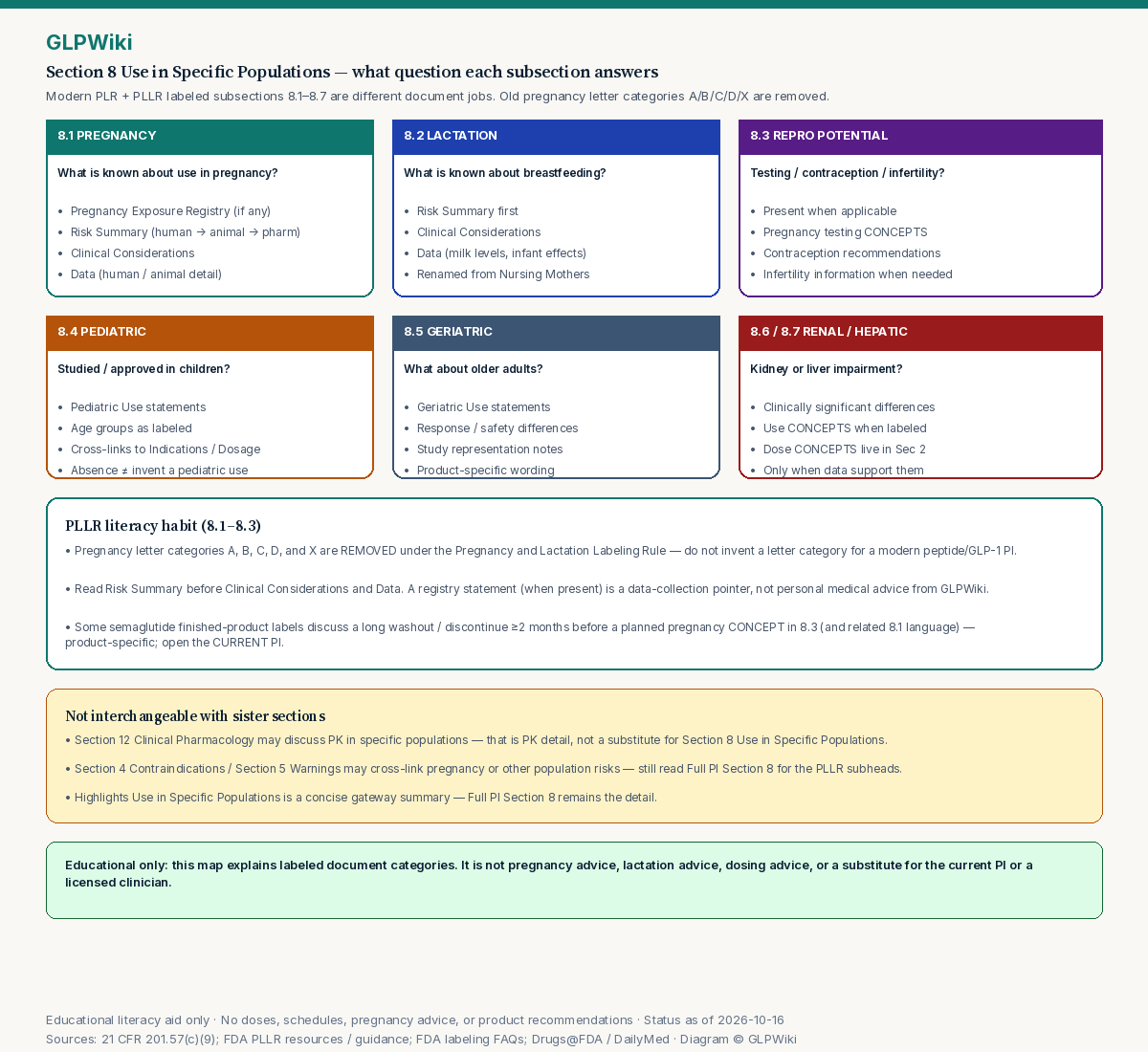
Section 8.1–8.7 map — which question each subsection answers
8.1 Pregnancy answers what is known about use during pregnancy for this finished product, including a pregnancy exposure registry statement when a registry exists, a Risk Summary drawn from human, animal, and/or pharmacologic sources (presented in that order when available), Clinical Considerations, and Data. Information formerly placed under a separate Labor and delivery heading is incorporated into Pregnancy under PLLR.
8.2 Lactation (formerly Nursing Mothers) addresses use while breastfeeding: Risk Summary, Clinical Considerations, and Data such as presence in milk and potential effects on the breastfed infant when information exists. 8.3 Females and Males of Reproductive Potential appears when necessary and may discuss pregnancy testing, contraception recommendations, and infertility information as they relate to the drug.
8.4 Pediatric Use and 8.5 Geriatric Use state what is known about use in those age groups for the labeled product. 8.6 Renal Impairment and 8.7 Hepatic Impairment appear when the label includes clinically significant differences or use CONCEPTS for those populations; dosage CONCEPT changes, when present, typically live in Dosage and Administration with cross-links — Section 8 describes the population finding, not a GLPWiki dosing table.
PLLR structure and why A/B/C/D/X letter categories are gone
FDA's Pregnancy and Lactation Labeling Resources explain that PLLR removes pregnancy letter categories A, B, C, D, and X. Those letters were widely misunderstood as a simple safety ranking. Modern labels replace them with narrative Risk Summary / Clinical Considerations / Data so readers can see the evidence type and its limits.
Literacy habit: if a social-media post says a peptide is "Category B" or "Category X," ask which finished product, which document date, and whether the claim is quoting a pre-PLLR label, a non-U.S. system, or an invented letter. Do not assign a letter category to a current PLLR-format U.S. PI.
When a pregnancy exposure registry is available, 8.1 includes information about it. Registries collect outcome data; a registry mention on a label is not personal counseling from this encyclopedia page.
Long washout / planned pregnancy language on some GLP-1 labels — CONCEPT literacy only
Some FDA-approved semaglutide finished-product labels discuss, in Section 8 (often 8.3 Females and Males of Reproductive Potential, with cross-links to 8.1), that the medicine should be discontinued at least 2 months before a planned pregnancy because of the long washout period / long half-life of semaglutide. Related 8.1 language may address what to do when pregnancy is recognized and may differ by labeled indication population.
Wording is product-specific and indication-context-specific. Injectable diabetes-labeled semaglutide, weight-management / CV-risk semaglutide, oral semaglutide, and dual-agonist finished products do not share identical Section 8 paragraphs. None of those sentences are pregnancy advice, lactation advice, or dosing advice from GLPWiki — they are reasons to open the current Agency-posted PI for the exact finished product and to involve a licensed clinician for personal decisions.
This encyclopedia page intentionally does not reproduce counseling algorithms, amounts, or schedules. For individual questions about pregnancy, lactation, or reproductive planning, contact a licensed clinician and use the Agency-posted label.
Pediatric, geriatric, renal, and hepatic — labeled CONCEPTS only
Pediatric Use (8.4) states whether safety and effectiveness have been established in pediatric patients, and for which age groups when applicable. Absence of a pediatric indication on one finished product is not evidence about another product that shares a molecule nickname, and it is not permission to invent a pediatric use from a trial paper.
Geriatric Use (8.5) describes what is known about older adults, including whether clinical studies included sufficient numbers of subjects aged 65 and over to determine differences, and any labeled response or safety differences.
Renal and hepatic impairment subsections (commonly 8.6 / 8.7 when present) describe clinically significant differences in response, safety, or use CONCEPTS. PK detail about organ impairment may also appear under Clinical Pharmacology; actionable dosage CONCEPTS, when labeled, usually sit in Dosage and Administration with cross-references. Literacy means following those cross-links rather than inventing a renal or hepatic rule from a half-life number on social media.
A practical Section 8 / PLLR verification path
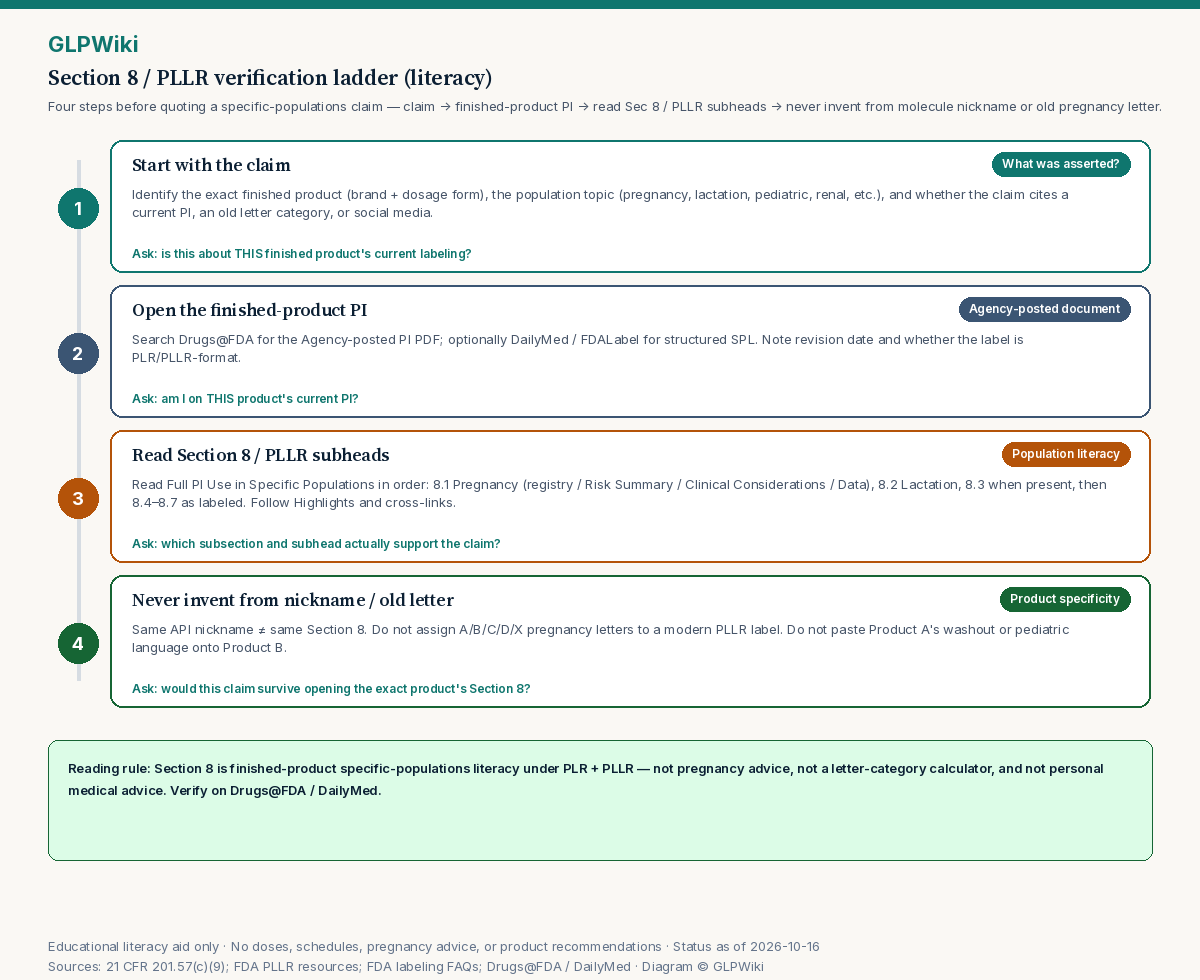
Start with the claim: exact finished product name and dosage form, the population topic, and the document type being cited. Open Drugs@FDA for the Agency-posted PI PDF, then optionally DailyMed or FDALabel for structured SPL text. Read Full PI Section 8 in order — 8.1 PLLR subheads, 8.2, 8.3 when present, then 8.4–8.7 as labeled — and follow cross-links to Highlights, Contraindications, Warnings and Precautions, Dosage and Administration, and Clinical Pharmacology before quoting a single bullet.
Reject letter-category shortcuts and molecule-nickname paraphrases. Record product, subsection, subhead, revision date, and whether the claim is a Risk Summary statement, a Clinical Considerations point, a Data paragraph, or a Highlights gateway line.
For investigational compounds without an approved PI, use ClinicalTrials.gov and PubMed — and do not treat an NCT record or paper as substitute Section 8 labeling.
- Approved finished-product Section 8: Drugs@FDA label PDF.
- Structured SPL search: DailyMed / FDALabel — still verify against the Agency-posted PI when precision matters.
- PLLR outline and resources: FDA Pregnancy and Lactation Labeling Resources.
- Investigational only: ClinicalTrials.gov / PubMed — not approved labeling.
Product specificity: never invent from a molecule nickname
Prescribing Information is finished-product labeling. Two brands that share an active moiety can differ in formulation, route, approved indication populations, study programs, and therefore in how Section 8 is written. Copying Product A's pregnancy or pediatric paragraph into a claim about Product B is a document-type error.
The same rule applies when comparing an approved finished medicine with a compounded preparation or a research-use listing that happens to use a familiar molecule name. Those other items do not inherit Section 8 of an approved PI. For category boundaries, see approved versus investigational peptides and compounded versus FDA-approved GLP-1 medicines.
Scope, disclaimer and review date
This guide is educational. It maps how to read Use in Specific Populations (Section 8) on FDA peptide and GLP-1 Prescribing Information under PLR and PLLR — including 8.1–8.3 structure, removal of pregnancy letter categories, 8.4–8.7 CONCEPTS, product-specific washout language as a reason to open the current PI, and a Drugs@FDA / DailyMed verify path. It does not provide pregnancy advice, lactation advice, reproductive-planning advice, doses, titration schedules, compounding recipes, administration tutorials, sourcing advice, or individual medical advice, and nothing here recommends starting, stopping, or continuing any medicine or research chemical. Decisions about health care belong with a licensed clinician and, for approved medicines, the official label.
Last reviewed: October 16, 2026. Labeling, approval status, and literature may have changed since; verify with Drugs@FDA, DailyMed, FDALabel, ClinicalTrials.gov, PubMed, and your clinician or pharmacist.
Frequently asked questions
- What is Section 8 Use in Specific Populations for?
- It presents labeled information about use in particular populations — including pregnancy, lactation, reproductive potential when applicable, pediatric and geriatric use, and often renal/hepatic impairment when data support those subsections — under 21 CFR 201.57(c)(9) and PLLR for 8.1–8.3.
- What happened to pregnancy categories A, B, C, D, and X?
- The Pregnancy and Lactation Labeling Rule removes those letter categories from prescription labeling in PLR format. Modern labels use Risk Summary, Clinical Considerations, and Data instead. Do not invent a letter category for a current PLLR-format U.S. PI.
- What are the PLLR subheads under 8.1 Pregnancy?
- In order: Pregnancy Exposure Registry (when a registry is available), Risk Summary, Clinical Considerations, and Data. Risk statements draw from human, animal, and/or pharmacologic sources as available.
- How is 8.2 Lactation different from old Nursing Mothers labeling?
- PLLR renamed Nursing Mothers to Lactation and structures the subsection with Risk Summary, Clinical Considerations, and Data focused on breastfeeding, milk levels, and potential effects on the breastfed infant when information exists.
- When does 8.3 Females and Males of Reproductive Potential appear?
- When necessary for the finished product. It may include pregnancy testing, contraception recommendations, and infertility information as they relate to the drug. Not every label needs every 8.3 topic.
- Why do some semaglutide labels mention stopping at least 2 months before a planned pregnancy?
- Because those finished-product labels discuss a long washout / half-life CONCEPT for semaglutide in Section 8 (often 8.3 with links to 8.1). Wording is product- and context-specific — open the current PI rather than generalizing from a molecule nickname. This page does not give pregnancy advice.
- How is Section 8 different from Section 12 Clinical Pharmacology?
- Section 12 may include PK or mechanism detail in specific populations. Section 8 carries the Use in Specific Populations discussion under PLLR/PLR rules. They can cross-link; neither replaces the other.
- Does this page give pregnancy, lactation, or dosing advice?
- No. Pregnancy advice, lactation advice, doses, schedules, compounding instructions, product sourcing, and personal medical advice are out of scope. GLPWiki publishes educational label literacy only.
SOURCES
- 0121 CFR 201.57 — Specific requirements on content and format of labeling (PLR), including (c)(9) Use in specific populations— U.S. Government Publishing Office / eCFR
- 02Pregnancy and Lactation Labeling Resources (PLLR overview; removal of A/B/C/D/X categories)— U.S. Food and Drug Administration
- 03Pregnancy and Lactation Labeling Final Rule— U.S. Food and Drug Administration
- 04Pregnancy, Lactation, and Reproductive Potential: Labeling for Human Prescription Drug and Biological Products — Content and Format (FDA guidance)— U.S. Food and Drug Administration
- 05Pregnancy, Lactation, and Reproductive Potential — Small Entity Compliance Guide (PDF)— U.S. Food and Drug Administration
- 06Frequently Asked Questions about Labeling for Prescription Medicines— U.S. Food and Drug Administration
- 07Prescribing Information Resources (PLR section map; Section 8 resources)— U.S. Food and Drug Administration
- 08Ozempic (semaglutide) injection Prescribing Information — Use in Specific Populations (DailyMed)— U.S. FDA / DailyMed
- 09Wegovy (semaglutide) injection Prescribing Information — Use in Specific Populations (DailyMed)— U.S. FDA / DailyMed
- 10Rybelsus (oral semaglutide) Prescribing Information — Use in Specific Populations (DailyMed)— U.S. FDA / DailyMed
- 11Mounjaro (tirzepatide) injection Prescribing Information — Use in Specific Populations (DailyMed)— U.S. FDA / DailyMed
- 12Zepbound (tirzepatide) injection Prescribing Information — Use in Specific Populations (DailyMed)— U.S. FDA / DailyMed
- 13Drugs@FDA— U.S. Food and Drug Administration
- 14DailyMed— U.S. National Library of Medicine
- 15FDALabel: Full-Text Search of Drug Product Labeling— U.S. Food and Drug Administration
- 16ClinicalTrials.gov— U.S. National Library of Medicine
EDUCATIONAL REFERENCE ONLY · Not medical advice. Nothing here diagnoses, treats, cures or prevents any disease, and nothing here is a dosing recommendation. Consult a licensed clinician before any treatment decision.