How to read the Description section on peptide labels (Section 11): active ingredient, structure, salt forms and inactive ingredients
GLPWiki's how-to-read-fda-peptide-labeling hub maps the whole Prescribing Information. This companion goes deep on Section 11 Description: what 21 CFR 201.57(c)(12) requires, how the proprietary and established names relate, what the chemical description, molecular formula and molecular weight of a peptide tell you, how inactive ingredients are declared, why salt forms matter, why multiple-dose presentations list preservatives, and how a Description section differs from a research-peptide certificate of analysis. Label-reading literacy only: no strengths, doses, product picks, or medical advice.
UPDATED 22 OCT 2026 · 13 MIN READ
KEY TAKEAWAYS
- Under 21 CFR 201.57(c)(12), Section 11 Description must give the proprietary and established names, the dosage form(s) and route(s), the ingredient information required by 21 CFR 201.100(b), a statement if the product is sterile, the pharmacological or therapeutic class, and, for drug products other than biological products, the chemical name and structural formula. Other important chemical or physical information such as pH must be stated if appropriate.
- Section 11 tells you what the product is made of. It is not a dosing section: the recommended dosage lives in Section 2, the list of forms and strengths in Section 3, and how the drug acts in the body in Section 12.
- For products given by injection, 21 CFR 201.100(b)(5) requires the names of all inactive ingredients and their quantity or proportion, with narrow exceptions such as pH adjusters, which may be named with a statement of their effect. That is why GLP-1 injection labels list buffers, tonicity agents and, for multiple-dose presentations, preservatives.
- Current semaglutide and tirzepatide labels describe each peptide's modifications (for example, the fatty diacid side chain that enables albumin binding), its molecular formula and molecular weight. These identify the molecule; they are not a measure of purity, potency or dose.
- FDA's salt naming guidance applies the USP Salt Policy: for new products whose active ingredient is a salt, the name and strength are generally expressed as the active moiety, and the full salt name appears elsewhere in labeling. FDA has said semaglutide sodium and semaglutide acetate are different active ingredients from the one in the approved drugs.
- Multiple-dose presentations of GLP-1 injections list antimicrobial preservatives such as phenol or benzyl alcohol, while some single-dose presentations do not. A 2007 review found phenol and benzyl alcohol are the most common preservatives in peptide and protein products.
- A certificate of analysis is a lot-level test report, not FDA labeling. Compounded and research-use products are not FDA-approved and have no FDA-approved Section 11. This page lists no strengths or doses and gives no medical advice.
What this guide covers (and how it differs from sister pages)
How to read FDA peptide labeling already explains PLR Highlights vs Full Prescribing Information, Drugs@FDA vs DailyMed, and the overall section map. This Day 43 guide is the deep companion for Section 11 Description, the section that says what the medicine is: its names, its molecule, its dosage form and route, and everything else in the formulation.
It is a reading guide, not a chemistry course and not a product catalog. It explains what the section must contain, how to read a peptide's chemical description without overinterpreting it, how inactive ingredients and salt forms are declared, and how Section 11 differs from a certificate of analysis. It deliberately reproduces no strengths from any label. It is distinct from the Dosage Forms and Strengths (Section 3) guide, which covers forms, strength expressions and package type terms, and from the certificate-of-analysis and net peptide content guides, which cover research-vial test reports.
What Section 11 is: 21 CFR 201.57(c)(12)
In the PLR format, Section 11 is paragraph (c)(12) of 21 CFR 201.57. The regulation lists what the section must contain, in this order of ideas:
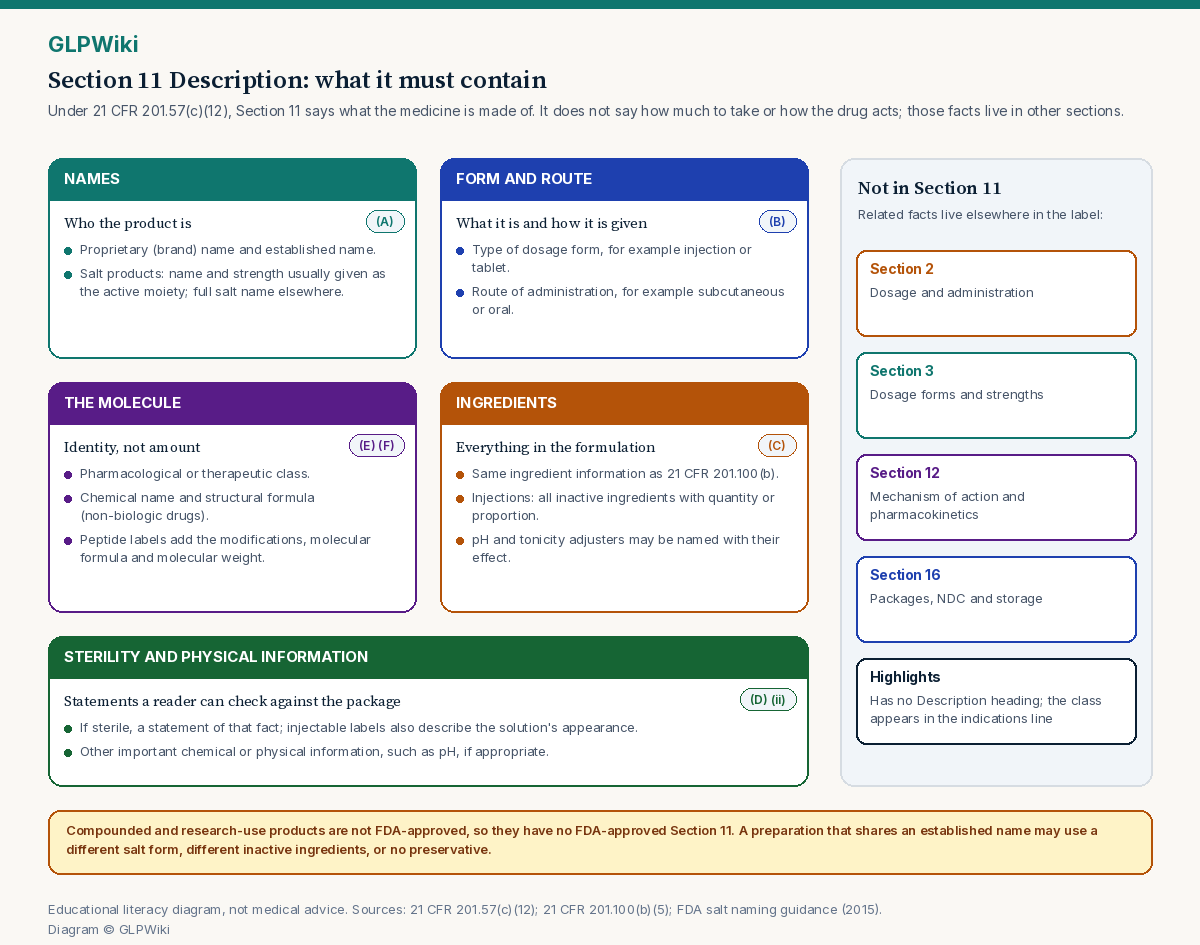
- (A) The proprietary name and the established name, if any, or for biological products the proper name, with any appropriate descriptors.
- (B) The type of dosage form(s) and the route(s) of administration to which the labeling applies.
- (C) The same qualitative and/or quantitative ingredient information required under 21 CFR 201.100(b) for drug labels (or the biologics labeling rules for biological products).
- (D) If the product is sterile, a statement of that fact.
- (E) The pharmacological or therapeutic class of the drug.
- (F) For drug products other than biological products, the chemical name and structural formula of the drug.
- (G) For radioactive products, key nuclear physical characteristics. This does not apply to GLP-1 medicines.
- (ii) If appropriate, other important chemical or physical information, such as physical constants or pH.
Names: proprietary, established, and the active moiety
Section 11 usually opens by naming the product the way the whole label does: a proprietary (brand) name followed by the established name in parentheses and the dosage form and route, for example "BRAND (semaglutide) injection, for subcutaneous use". The established name is the nonproprietary name that stays the same across brands containing the same active ingredient.
That is why one molecule can appear under several brand names. The current DailyMed labels for Ozempic and Wegovy both describe semaglutide in nearly identical chemical terms, and the Zepbound label describes tirzepatide. Reading the established name, not only the brand name, tells you which molecule you are looking at; reading the dosage form and route tells you which presentation the description covers.
FDA's 2015 guidance Naming of Drug Products Containing Salt Drug Substances explains how CDER applies the USP Salt Policy, effective May 1, 2013. For new prescription products whose active ingredient is a salt, the drug product name and strength are generally expressed in terms of the active moiety, the part of the molecule responsible for the pharmacological action, rather than the salt. FDA's Drug Info Rounds explainer adds that when that happens, the full name of the salt must still appear elsewhere in labeling, and gives the Description section as an example of where to find it. Exceptions keep the salt in the name when it conveys clinically vital information.
Reading a peptide's chemical description
For a peptide drug, the chemical description in Section 11 explains how the molecule differs from the natural hormone it is modeled on. The current Ozempic label, for example, says the peptide backbone is produced by yeast fermentation, that position 26 lysine carries a hydrophilic spacer and a C18 fatty diacid whose albumin binding is the main protraction mechanism, that position 8 is modified to resist breakdown by the enzyme DPP-4, and that a minor change at position 34 ensures only one fatty diacid attaches. The original medicinal chemistry paper (Lau and colleagues, J Med Chem, 2015) describes the same design: two amino acid substitutions compared with human GLP-1 (Aib at position 8, Arg at position 34) and derivatization at lysine 26.
The current Zepbound label describes tirzepatide as based on the GIP sequence, with aminoisobutyric acid (Aib) at positions 2 and 13, a C-terminal amide, and a lysine at position 20 attached to a C20 fatty diacid (1,20-eicosanedioic acid) via a linker. Its discovery paper (Coskun and colleagues, Mol Metab, 2018) describes it as a fatty-acid-modified peptide with dual GIP and GLP-1 receptor agonist activity.
These sentences explain why a medicine behaves as it does at the level of design. They do not tell you how the drug acts clinically, which belongs to Section 12, or how much to take, which belongs to Section 2 and your prescriber.
Molecular formula, molecular weight and structural formula
Section 11 of a non-biologic drug label must include the chemical name and structural formula. Peptide labels usually also state the molecular (or empirical) formula and molecular weight. The current Ozempic and Wegovy labels give semaglutide as C187H291N45O59 with a molecular weight of 4113.58 g/mol, and the current Zepbound label gives tirzepatide as C225H348N48O68 with a molecular weight of 4813.53 Da. Those are identity facts, not amounts of drug.
Three reading points follow. First, the formula and weight describe one specific molecule, so a different salt or a different peptide will not match them. Second, a molecular weight is not a purity or potency figure; it cannot tell you how much of the molecule is in any container. Third, the structural formula on DailyMed is usually an image showing the amino acid sequence and side chain, and it is easier to read alongside the text description than on its own.
Inactive ingredients: what 201.100(b)(5) requires
Section 11 carries the same ingredient information that 21 CFR 201.100(b) requires on prescription drug labels. For a product intended for other than oral use, paragraph (b)(5) requires the names of all inactive ingredients, with limited exceptions for flavorings, color additives and trace identification substances. If the product is intended for injection, the quantity or proportion of all inactive ingredients must be stated, except that ingredients added to adjust pH or make the product isotonic may be declared by name with a statement of their effect, and water for injection need not be named.
You can see this structure in current GLP-1 injection labels. They list a buffer (a sodium phosphate salt), ingredients commonly used to adjust tonicity (such as sodium chloride, propylene glycol or glycerin, depending on the presentation), water for injection, and a sentence that hydrochloric acid or sodium hydroxide may be added to adjust pH, followed by the approximate pH or pH range. The oral semaglutide tablets in the Wegovy label list a different set: magnesium stearate and salcaprozate sodium (SNAC), the absorption enhancer explained in GLPWiki's SNAC guide.
FDA's Inactive Ingredient Database lists excipients that have been used in approved drug products and the maximum amounts used for each route and dosage form. It is a formulation reference for developers, not a safety rating for any ingredient in any particular product.
Why multiple-dose presentations list preservatives
Compare the inactive ingredients across presentations of the same molecule and a pattern appears. In the current Zepbound label, the single-dose pen and vial presentations list sodium chloride, a sodium phosphate buffer and water for injection, while the multi-dose vial and single-patient-use KwikPen presentations also list benzyl alcohol, glycerin and phenol. In the current Ozempic and Wegovy labels, the multi-use pen presentations list phenol and propylene glycol, while single-dose syringe or pen presentations list sodium chloride instead and no phenol.
Phenol and benzyl alcohol are antimicrobial preservatives. FDA's package type terms guidance defines a multiple-dose container as one that has met antimicrobial effectiveness testing requirements, or is excluded from them by regulation, and a single-dose container as one that is not required to meet them. A 2007 review of preservatives in licensed parenteral products (Meyer and colleagues, J Pharm Sci) found phenol and benzyl alcohol to be the two most common preservatives in peptide and protein products.
The reading lesson is about labeling, not handling: the ingredient list and the package type term should agree. A product labeled single-dose was not designed to be used more than once, regardless of what you might infer from its ingredients. GLPWiki's bacteriostatic water guide covers benzyl alcohol as a diluent ingredient in more detail.
Sterility, appearance, pH and pharmacological class
If a product is sterile, Section 11 must say so. Injectable GLP-1 labels describe the solution, for example as a sterile, aqueous, clear, colorless solution, or as clear and colorless to slightly yellow. That appearance description is one of the few Section 11 details a patient can compare directly with what is in front of them; any mismatch is a question for a pharmacist, not something to judge alone.
The pH statement falls under the regulation's "other important chemical or physical information". Labels typically give an approximate pH or a range and note which acids or bases may be used to adjust it.
Section 11 also names the pharmacological or therapeutic class. Current labels describe semaglutide as a GLP-1 receptor agonist (or GLP-1 analog) and tirzepatide as a GIP receptor and GLP-1 receptor agonist. Separately, 21 CFR 201.57(a)(6) requires that when a product belongs to an established pharmacologic class, the Highlights indications statement identify that class in the form "(Drug) is a (name of class) indicated for (indication(s))."
Salt forms: why semaglutide sodium is not the same ingredient
The active ingredient named in Section 11 is a specific chemical entity. FDA's page on concerns with unapproved GLP-1 drugs used for weight loss states that some semaglutide products sold by compounders may be salt forms, including semaglutide sodium and semaglutide acetate, that these are different active ingredients from those used in the approved drugs, and that FDA does not have information on whether they have the same chemical and pharmacologic properties. FDA also says it is not aware of any lawful basis for their use in compounding.
The salt naming policy explains why the distinction matters on a label. A salt adds a counterion, which changes the weight of the material without changing the active moiety; for that reason labels that follow the policy express strength as the active moiety and give an equivalence to the salt. GLPWiki's net peptide content guide explains the same counterion idea for research-peptide test reports. A label for one form does not describe another.
Section 11 vs a certificate of analysis
People who have read research-peptide paperwork sometimes expect Section 11 to look like a certificate of analysis. The two documents answer different questions.
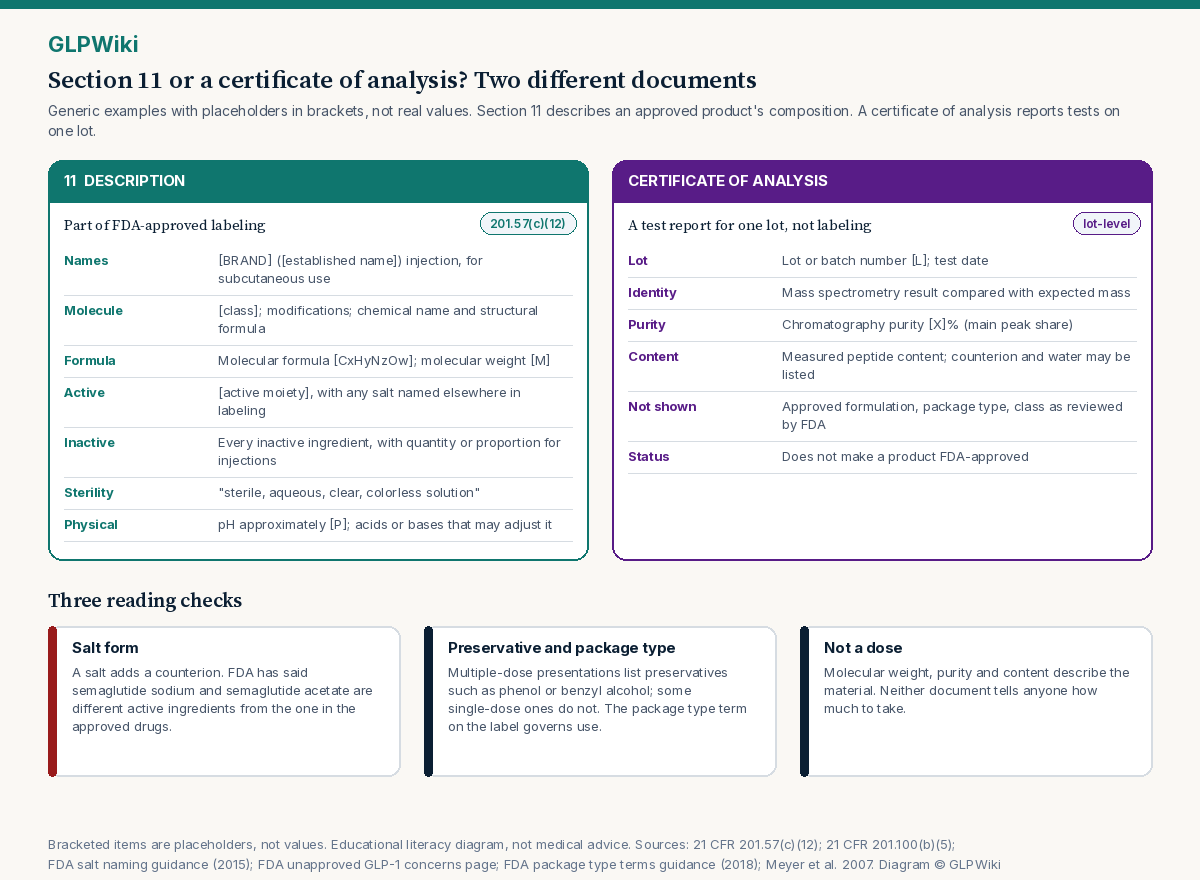
- Section 11 is part of FDA-approved labeling. It describes the approved product as a whole: names, molecule, dosage form, route, every inactive ingredient (with quantity or proportion for injections), sterility, class and physical information. Manufacturing quality is controlled through the application and current good manufacturing practice, not printed in the label.
- A certificate of analysis is a test report for one lot. It typically lists identity tests, purity by chromatography, measured content and sometimes counterion or water content. It is not FDA labeling and does not make a product approved.
- Section 11 will not show a purity percentage or a lot number; a certificate of analysis will not tell you the approved formulation, the package type, or the pharmacological class as FDA reviewed it.
- Neither document is dosing guidance.
Compounded and research-use products have no FDA-approved Section 11
FDA states that compounded drugs are not FDA-approved, which means FDA does not verify their safety, effectiveness or quality before they are marketed. They therefore have no FDA-approved Prescribing Information and no Section 11. Research-use products are not labeled medicines at all.
An approved product's Description describes only that product's formulation. A compounded or research preparation that uses the same established name may contain a different salt form, different inactive ingredients, a different preservative or none, and a different pH. Its composition is whatever its own documentation states, and that documentation has not been reviewed as FDA labeling.
Cross-checking Section 11 on Drugs@FDA and DailyMed
Section 11 changes when a manufacturer adds a presentation or changes a formulation, so check the current version rather than a screenshot or an old package insert.
- Open the product on DailyMed and note the SPL version and effective date at the top of the label.
- Find 11 DESCRIPTION in the Full Prescribing Information; there is no Description heading in Highlights.
- Match the established name, dosage form and route to your package and to Section 3.
- If a label covers several presentations, read which inactive ingredients go with which presentation.
- Use Section 12 for mechanism of action and Section 16 for package sizes, NDC and storage.
- Use Drugs@FDA for the approval history and the FDA-approved labeling on file for the application.
- If anything does not match, ask your pharmacist before using the product.
Common misreadings
These are reading errors, not clinical guidance.
- Treating molecular weight as a purity, potency or dose figure.
- Assuming two products with the same established name have the same inactive ingredients. Presentations of one molecule can differ.
- Assuming a salt form is interchangeable with the active ingredient in an approved label.
- Reading an inactive ingredient list as a safety rating, or the Inactive Ingredient Database as approval of a product.
- Expecting a purity percentage or lot number in Section 11. That is certificate-of-analysis territory.
- Inferring that a product can be used more than once because its ingredients include a preservative, when its package type term says single-dose.
- Applying an approved label's Description to a compounded or research product with the same ingredient name.
Scope, disclaimer and review date
This guide is educational. It maps how to read Section 11 Description on FDA peptide and GLP-1 Prescribing Information under PLR — what 21 CFR 201.57(c)(12) and 201.100(b)(5) require, how names, salt forms and the active moiety are expressed, what chemical descriptions, molecular formulas and weights do and do not mean, how inactive ingredients and preservatives relate to package type, how Section 11 differs from a certificate of analysis, and why compounded or research products have no FDA-approved Section 11. It does not list product strengths and does not provide doses, titration schedules, preparation or injection steps, product or pharmacy recommendations, sourcing advice, or individual medical advice, and nothing here recommends starting, stopping, switching, or continuing any medicine or research chemical. Follow your own product's current labeling and ask your pharmacist or clinician.
Last reviewed: October 22, 2026. Labeling, formulations, approval status, and FDA guidance may have changed since; verify with Drugs@FDA, DailyMed, and your pharmacist or clinician.
Frequently asked questions
- What is Section 11 Description?
- It is the section of the PLR Prescribing Information governed by 21 CFR 201.57(c)(12). It gives the proprietary and established names, dosage form and route, ingredient information, a sterility statement if applicable, the pharmacological class, the chemical name and structural formula for non-biologic drugs, and other important physical information such as pH.
- Does Section 11 tell me how much to take?
- No. Section 11 describes what the product is made of. The recommended dosage is in Section 2 Dosage and Administration, and your own dose comes only from your prescriber.
- Why do injection labels list every inactive ingredient?
- 21 CFR 201.100(b)(5) requires the names of all inactive ingredients for products not taken by mouth, and for injections their quantity or proportion, except that pH and tonicity adjusters may be named with a statement of their effect and water for injection need not be named.
- What does the molecular weight of semaglutide or tirzepatide tell me?
- It identifies the molecule. Current labels give semaglutide as C187H291N45O59 (4113.58 g/mol) and tirzepatide as C225H348N48O68 (4813.53 Da). It is not a purity, potency or dose figure.
- Is semaglutide sodium the same as semaglutide?
- Not for labeling purposes. FDA has said semaglutide sodium and semaglutide acetate are different active ingredients from the one used in the approved drugs, and that it lacks information on whether they share the same chemical and pharmacologic properties.
- Why do some pens list phenol or benzyl alcohol and others do not?
- Those are antimicrobial preservatives. Multiple-dose and single-patient-use presentations designed for more than one injection list them, while some single-dose presentations do not. The package type term on the label is what tells you how the container was designed to be used.
- Is Section 11 the same as a certificate of analysis?
- No. Section 11 is FDA-approved labeling describing the product's composition. A certificate of analysis is a test report for one lot, with results such as identity, purity and measured content. It is not FDA labeling.
- Do compounded or research-grade peptides have a Section 11?
- No. FDA states compounded drugs are not FDA-approved, so they have no FDA-approved Prescribing Information or Section 11, and research-use products are not labeled medicines. An approved label's Description does not describe a different preparation.
- Can this page tell me which product or formulation is right for me?
- No. It teaches how to read and verify Section 11. It lists no strengths or doses and gives no personal medical advice. Read your product's current label and ask your pharmacist or clinician.
SOURCES
- 0121 CFR 201.57 — Specific requirements on content and format of labeling (PLR), including (a)(6) Highlights Indications and usage (established pharmacologic class) and (c)(12) 11 Description— U.S. Government Publishing Office / eCFR
- 0221 CFR 201.100 — Prescription drugs for human use, including (b)(5) inactive ingredient declaration for non-oral and injectable products— U.S. Government Publishing Office / eCFR
- 03Labeling for Human Prescription Drug and Biological Products — Implementing the PLR Content and Format Requirements (guidance, February 2013)— U.S. Food and Drug Administration
- 04Prescribing Information Resources (PLR section map)— U.S. Food and Drug Administration
- 05Naming of Drug Products Containing Salt Drug Substances (guidance for industry, June 2015)— U.S. Food and Drug Administration
- 06FDA Drug Info Rounds: USP Salt Policy (December 2014)— U.S. Food and Drug Administration
- 07FDA's concerns with unapproved GLP-1 drugs used for weight loss (salt forms of semaglutide)— U.S. Food and Drug Administration
- 08Inactive Ingredients Database— U.S. Food and Drug Administration
- 09Selection of the Appropriate Package Type Terms and Recommendations for Labeling Injectable Medical Products Packaged in Multiple-Dose, Single-Dose, and Single-Patient-Use Containers for Human Use (final guidance, October 2018)— U.S. Food and Drug Administration
- 10Meyer BK, Ni A, Hu B, Shi L. Antimicrobial preservative use in parenteral products: past and present. J Pharm Sci. 2007;96(12):3155-3167 (PMID 17722087)— Journal of Pharmaceutical Sciences / PubMed
- 11Lau J, Bloch P, Schäffer L, et al. Discovery of the once-weekly glucagon-like peptide-1 (GLP-1) analogue semaglutide. J Med Chem. 2015;58(18):7370-7380 (PMID 26308095)— Journal of Medicinal Chemistry / PubMed
- 12Coskun T, Sloop KW, Loghin C, et al. LY3298176, a novel dual GIP and GLP-1 receptor agonist for the treatment of type 2 diabetes mellitus: from discovery to clinical proof of concept. Mol Metab. 2018;18:3-14 (PMID 30473097)— Molecular Metabolism / PubMed
- 13Ozempic (semaglutide) injection — Section 11 Description (DailyMed)— U.S. FDA / DailyMed
- 14Wegovy (semaglutide) injection and tablets — Section 11 Description (DailyMed)— U.S. FDA / DailyMed
- 15Zepbound (tirzepatide) injection — Section 11 Description (DailyMed)— U.S. FDA / DailyMed
- 16Drugs@FDA— U.S. Food and Drug Administration
- 17Compounding and the FDA: Questions and Answers— U.S. Food and Drug Administration
EDUCATIONAL REFERENCE ONLY · Not medical advice. Nothing here diagnoses, treats, cures or prevents any disease, and nothing here is a dosing recommendation. Consult a licensed clinician before any treatment decision.