How to read Dosage Forms and Strengths on peptide labels (Section 3): forms, strength expressions and package types
GLPWiki's how-to-read-fda-peptide-labeling hub maps the whole Prescribing Information. This companion goes deep on Section 3 Dosage Forms and Strengths: what 21 CFR 201.57(c)(4) requires, how the Highlights version under 201.57(a)(8) is condensed, how Section 3 differs from Section 2 Dosage and Administration, Section 16 How Supplied and the carton, how injectable strengths are written (total per total volume, then per mL), what single-dose, multiple-dose and single-patient-use mean, and why mixing up milligrams, milliliters and syringe units has caused real errors. Label-reading literacy only: no strengths, doses, product picks, or medical advice.
UPDATED 21 OCT 2026 · 13 MIN READ
KEY TAKEAWAYS
- Under 21 CFR 201.57(c)(4), Section 3 Dosage Forms and Strengths lists every available dosage form the labeling covers, the strength or potency of each in the metric system, and identifying characteristics such as shape, color, coating, scoring and imprinting when applicable. National Drug Code numbers must not appear in Section 3.
- Highlights carries a concise version under 201.57(a)(8). FDA's PLR guidance says it must include all available dosage forms and strengths to help product selection, multiple strengths of one form go on one line, and appearance descriptors stay out of Highlights.
- Section 3 tells you what a unit of the product contains. It is not a dosing instruction: the recommended dosage lives in Section 2 Dosage and Administration, and package sizes, NDCs and storage live in Section 16.
- For small-volume injections, FDA's 2022 container and carton labeling guidance recommends the quantity per total volume as the primary expression, followed by the quantity per mL in parentheses, because people have overdosed after seeing the per-mL concentration and missing the total volume.
- Package type terms have defined meanings in FDA's 2018 guidance: single-dose (one patient, one injection), multiple-dose (more than one dose, meets antimicrobial effectiveness testing or is excluded), and single-patient-use (multiple uses by one patient only, such as certain pens).
- Milligrams (amount of drug), milliliters (volume) and syringe "units" are different measures. FDA's July 2024 alert linked confusion among them to dosing errors with compounded semaglutide vials, and poison-center case series describe similar errors.
- Compounded and research-use products are not FDA-approved, so they have no FDA-approved Section 3. An approved product's strengths describe only that product. This page lists no strengths or doses and gives no medical advice.
What this guide covers (and how it differs from sister pages)
How to read FDA peptide labeling already explains PLR Highlights vs Full Prescribing Information, Drugs@FDA vs DailyMed, and the overall section map. This Day 42 guide is the deep companion for Section 3 Dosage Forms and Strengths, the short section near the front of the label that names each physical form of the product and how much drug each unit contains.
It is a reading guide, not a product catalog. It explains what the section must contain, how it is condensed in Highlights, how it relates to the dosage section, the How Supplied section and the package itself, and how to parse an injectable strength line without confusing a container total, a concentration and a per-injection amount. It deliberately lists no strengths from any label: those values belong to the exact product and change as products are added or withdrawn, so read them in the current label. It is distinct from the How Supplied / Storage and Handling (Section 16) guide, which covers package configurations, NDC numbers and storage, and from the vial-label and syringe-units guides, which cover research-vial labels and syringe markings.
What Section 3 is: 21 CFR 201.57(c)(4)
In the PLR format, Section 3 is paragraph (c)(4) of 21 CFR 201.57. The regulation says the section must contain information on the available dosage forms to which the labeling applies and for which the manufacturer or distributor is responsible, including (i) the strength or potency of the dosage form in the metric system, with any apothecary-system strength in parentheses after the metric designation, and (ii) a description of the identifying characteristics of the dosage forms, including shape, color, coating, scoring and imprinting, when applicable.
The same paragraph ends with a firm boundary: the National Drug Code number(s) for the drug product must not be included in Section 3. NDCs belong in Section 16 How Supplied/Storage and Handling, which repeats the strength and adds package units, identification including the NDC, and storage conditions under 201.57(c)(17).
Older, non-PLR labels have no separate Section 3. FDA's PLR implementation guidance maps the old How Supplied section into two new places, Dosage Forms and Strengths and How Supplied/Storage and Handling. If you are reading an old-format label, the dosage form and strength information is usually in How Supplied near the end.
The Highlights version: 201.57(a)(8)
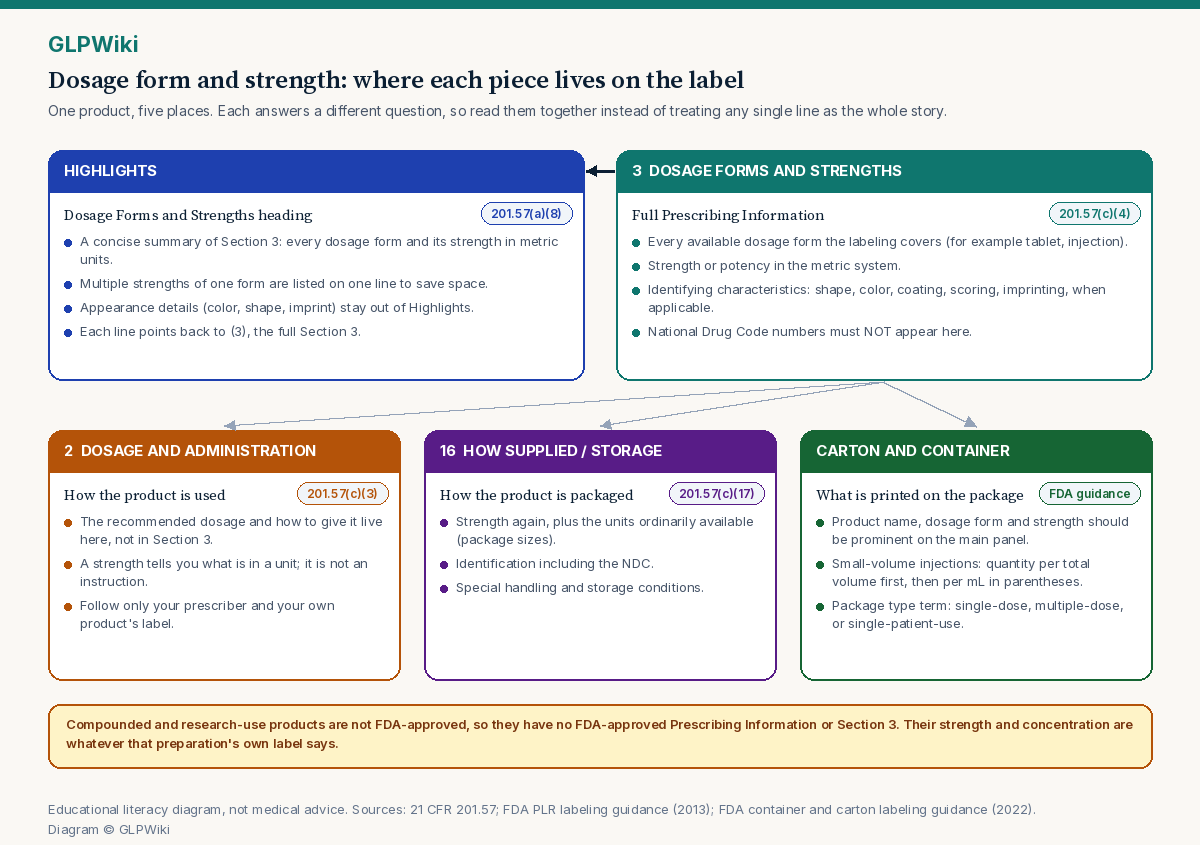
Highlights of Prescribing Information has its own Dosage Forms and Strengths heading. Under 201.57(a)(8) it is a concise summary of the Section 3 information, with any appropriate subheadings (for example tablets, capsules, injectable, suspension), including the strength or potency in the metric system and whether the product is scored.
FDA's PLR content and format guidance adds practical rules. The Highlights entry must include all available dosage forms and strengths to assist the prescriber in product selection. If a product has numerous dosage forms, bulleted subheadings or a table are recommended. Because space is tight, multiple strengths of one dosage form are listed on one line. Descriptors of product appearance such as color, shape or embossing that appear in the full Section 3 should not appear in Highlights. For some products, limited packaging information can be included when it facilitates prescribing.
Each Highlights bullet ends with a reference such as (3) pointing back to the full section. When the two seem to differ, the full Section 3 is the complete version and Highlights is the summary.
Section 3 vs Section 2 vs Section 16 vs the carton
Four places on and around the label mention strength, and each answers a different question. Reading them as interchangeable is the most common Section 3 mistake.
- Section 2 Dosage and Administration (201.57(c)(3)) states the recommended dose and how to give it. It is where dosing lives. A strength in Section 3 is not an instruction.
- Section 3 Dosage Forms and Strengths (201.57(c)(4)) names each form and what one unit contains, with identifying features, so a prescriber or pharmacist can select and recognize the product. No NDCs.
- Section 16 How Supplied/Storage and Handling (201.57(c)(17)) repeats the strength and adds the units ordinarily available for prescribing (package sizes), identification including the NDC, and storage and handling conditions.
- The carton and container labels are printed on the package itself. FDA's container and carton labeling guidance says key information such as the product name, dosage form and strength should be prominent, and warns against placing strength next to a dosing frequency in a way that reads like a complete dosing instruction.
Reading an injectable strength line: total per total volume, then per mL
Peptide and GLP-1 medicines are often liquids in pens, prefilled syringes or vials, and their strength lines carry more than one number. FDA's May 2022 guidance Safety Considerations for Container Labels and Carton Labeling Design to Minimize Medication Errors explains why the format matters. For small-volume injection products, strength should be expressed as the quantity per total volume followed by the quantity per milliliter, as described in USP General Chapter <7> Labeling.
The guidance gives the reason plainly: a number of overdoses have occurred because a health care practitioner or patient saw the quantity per milliliter, the concentration, and missed the net quantity, which often appeared elsewhere on the label. That led to the whole contents being given when only part was needed. So the total per total volume should be primary and prominent, with the per-mL value in parentheses close by. If a container holds less than 1 mL, FDA recommends not labeling it with a mg/mL concentration, because that may suggest the container holds more drug than it does.
Current GLP-1 labels apply this structure in Section 3. The semaglutide injection label on DailyMed lays out its pens in columns for dose per injection, total strength per total volume, and strength per mL, and lists single-dose prefilled syringes separately without a per-mL column. The tirzepatide label for Zepbound covers single-dose pens, single-dose vials, multi-dose vials and single-patient-use pens and uses the same column logic for the multi-dose presentations. This page does not reproduce those values; read them in the current label for the exact product.
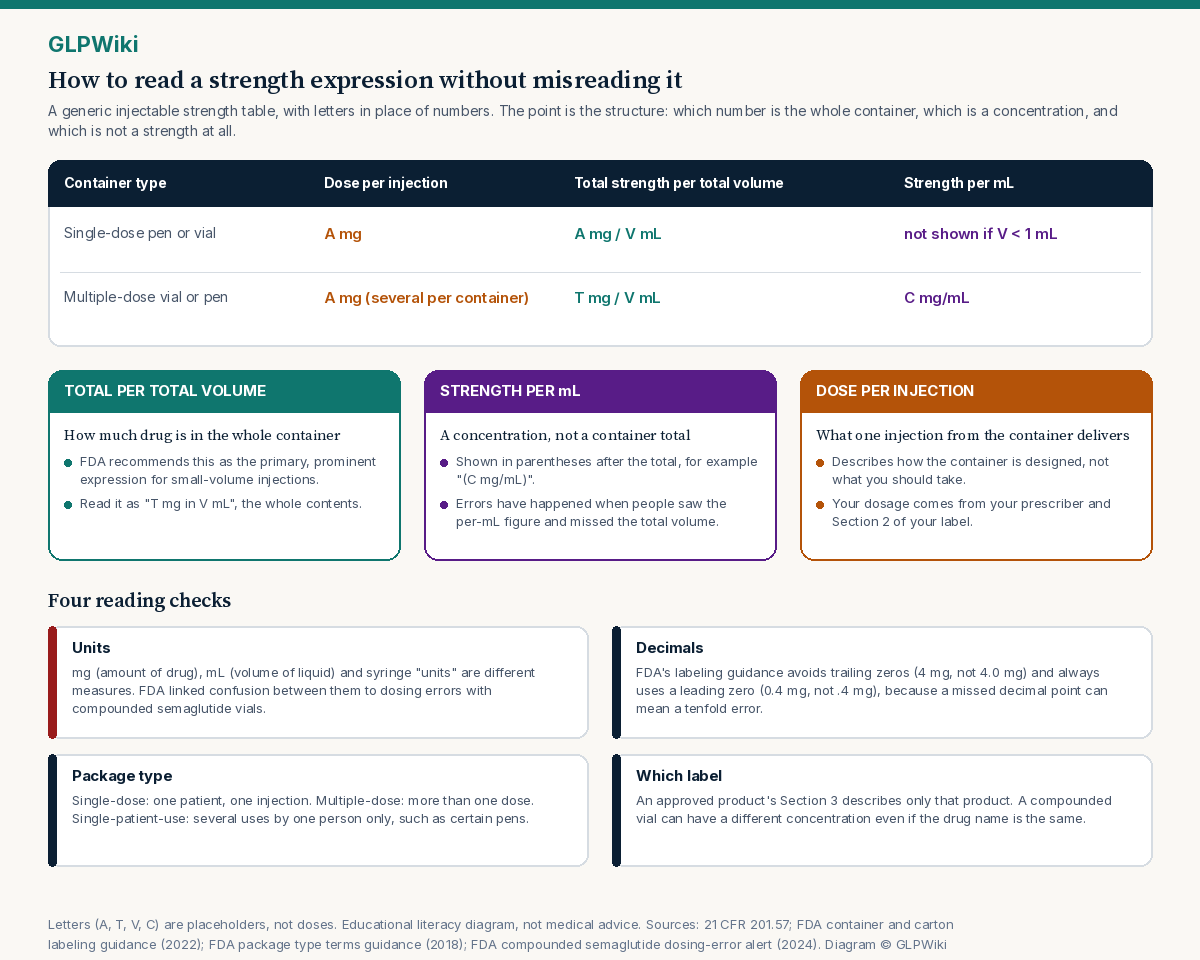
- Total strength per total volume: how much drug is in the whole container, read as "this many mg in this many mL".
- Strength per mL: a concentration. Useful for comparison, but it is not the container total and not a dose.
- Dose per injection: on multi-dose presentations, what one injection from that container is designed to deliver. It describes the product's design. Your own dosage comes only from your prescriber and Section 2 of your label.
Single-dose, multiple-dose and single-patient-use
Injectable Section 3 entries usually name a package type, and those words have defined meanings. FDA's October 2018 guidance Selection of the Appropriate Package Type Terms and Recommendations for Labeling Injectable Medical Products Packaged in Multiple-Dose, Single-Dose, and Single-Patient-Use Containers for Human Use sets them out.
Use the same term consistently across the container, carton, Prescribing Information and patient labeling. If a label says single-dose, it was not designed to be used again; if it says single-patient-use, it was designed for repeated use by one person only.
- Single-dose container: sterile medication for injection or infusion that is not required to meet antimicrobial effectiveness testing, designed for use with a single patient as a single injection or infusion. Examples are vials, ampules and prefilled syringes.
- Multiple-dose container: sterile medication that has met antimicrobial effectiveness testing requirements, or is excluded from them by regulation, and is intended to contain more than one dose. FDA notes the term multi-dose may be used instead.
- Single-patient-use container: sterile medication intended to be used multiple times for a single patient. Examples include patient-controlled analgesia cartridges and certain pens for injection. FDA's guidance recalls its 2009 safety alert that insulin pens are for one patient only and must not be shared.
Tablets and identifying characteristics
For solid oral forms, the identifying-characteristics part of 201.57(c)(4) does the most work: shape, color, coating, scoring and imprinting or debossing let a pharmacist or patient recognize a tablet. Highlights must also say whether a product is scored, and FDA's PLR guidance says functional scoring information must be included.
Oral semaglutide is a useful reading example. The current DailyMed label for oral semaglutide tablets (SPL version 14) covers tablets marketed under two brand names, RYBELSUS and OZEMPIC, and its Section 3 distinguishes each tablet by shape and by the markings debossed on each side as well as by strength. The lesson is general: check the brand name, the dosage form and the identifying description together, because one label can describe more than one presentation.
Dosage form vocabulary: what words like "injection, solution" mean
The dosage form named in Section 3 is drawn from a controlled vocabulary. FDA's Structured Product Labeling resources publish the dosage form terms used in electronic labels, each with a code. Examples relevant to peptides include INJECTION, SOLUTION; INJECTION, POWDER, LYOPHILIZED, FOR SOLUTION; TABLET; and KIT.
These terms tell you the physical state the product is supplied in. A product supplied as a ready-to-use solution and one supplied as a freeze-dried powder that must be reconstituted are different dosage forms even if they contain the same active ingredient. When a Section 3 entry names a powder, the label's Section 2 and Instructions for Use govern any preparation steps; this guide does not describe them.
Units and decimals: where strength reading goes wrong
Milligrams measure the amount of drug, milliliters measure the volume of liquid, and the "units" printed on many syringes are volume markings, not amounts of drug. A strength in mg/mL connects the first two, and nothing about a syringe marking changes the strength of what is in the container.
FDA's July 2024 alert on compounded injectable semaglutide reported adverse events, some requiring hospitalization, that may be related to overdoses from dosing errors: patients measuring and self-administering incorrect doses, and health care providers miscalculating doses. It noted that unfamiliarity with drawing medication from a vial into a syringe, coupled with confusion between milliliters, milligrams and units, may have contributed, and that different compounded concentrations may exist. The same alert contrasts the FDA-approved semaglutide presentations: single-dose prefilled pens, multiple-dose pens for single-patient use, and oral tablets.
Published case series point the same way. Lambson and colleagues (J Am Pharm Assoc, 2023) described three poison-center cases after administration errors with compounded semaglutide, including two self-administered tenfold errors and one patient who measured in milliliters and units rather than milligrams. Wiener and colleagues (Clin Toxicol, 2024) described three unintentional semaglutide overdoses at initiation that they attributed to gaps in patient and prescriber knowledge and evasion of regulated access.
Decimal formatting is a second trap. FDA's container and carton guidance recommends whole numbers without trailing zeros (4 mg, not 4.0 mg) and a leading zero before any decimal smaller than 1 (0.4 mg, not .4 mg), because an unseen decimal point can produce a tenfold error. Those are FDA's formatting examples, not doses for any product.
Compounded and research-use products have no FDA-approved Section 3
FDA states that compounded drugs are not FDA-approved, which means FDA does not verify their safety, effectiveness or quality before they are marketed. They therefore have no FDA-approved Prescribing Information and no Section 3. Research-use products are not labeled medicines at all.
Two practical consequences follow. First, an approved product's Section 3 describes that product only; it says nothing about the concentration of a compounded vial that shares the active ingredient's name. Second, the strength and concentration of any other preparation are whatever its own label states, and they may differ between sources. The GLPWiki vial-label guide explains how to read the label printed on a vial without treating it as FDA labeling.
Cross-checking Section 3 on Drugs@FDA and DailyMed
Section 3 changes when a manufacturer adds or withdraws a presentation, so check the current version rather than a screenshot or an old package insert.
- Open the product on DailyMed and note the SPL version and effective date at the top of the label.
- Read Highlights Dosage Forms and Strengths, then the full Section 3, and confirm they describe the same forms.
- Match the brand name, dosage form, package type term and strength expression on your package to one row in Section 3.
- Use Section 16 for package sizes and the NDC, and the NDC Directory if you need to confirm a specific package.
- Use Drugs@FDA for the approval history and the FDA-approved labeling on file for the application.
- If anything does not match, ask your pharmacist before using the product.
Common misreadings
These are reading errors, not clinical guidance.
- Treating a strength as a dose. Section 3 says what a unit contains; Section 2 and your prescriber say what to take.
- Reading the per-mL concentration as the container total, or the total as the per-injection amount.
- Assuming "units" on a syringe are milligrams of drug.
- Looking for the NDC in Section 3. It is in Section 16 and on the package.
- Assuming Highlights lists everything about appearance. Appearance details are only in the full Section 3.
- Assuming a single-dose or single-patient-use container can be shared or reused in other ways than labeled.
- Applying an approved label's strengths to a compounded or research product with the same ingredient name.
Scope, disclaimer and review date
This guide is educational. It maps how to read Section 3 Dosage Forms and Strengths on FDA peptide and GLP-1 Prescribing Information under PLR — what 21 CFR 201.57(a)(8) and (c)(4) require, how Section 3 differs from Sections 2 and 16 and the carton, how injectable strengths and package type terms are expressed, how dosage form vocabulary works, where unit and decimal confusion causes errors, and why compounded or research products have no FDA-approved Section 3. It does not list product strengths and does not provide doses, titration schedules, preparation or injection steps, product or pharmacy recommendations, sourcing advice, or individual medical advice, and nothing here recommends starting, stopping, switching, or continuing any medicine or research chemical. Follow your own product's current labeling and ask your pharmacist or clinician.
Last reviewed: October 21, 2026. Labeling, available presentations, approval status, and FDA guidance may have changed since; verify with Drugs@FDA, DailyMed, and your pharmacist or clinician.
Frequently asked questions
- What is Section 3 Dosage Forms and Strengths?
- It is the section of the PLR Prescribing Information governed by 21 CFR 201.57(c)(4). It lists each available dosage form the labeling covers, its strength or potency in metric units, and identifying characteristics such as shape, color, coating, scoring and imprinting. NDC numbers are not allowed there.
- Is the strength in Section 3 the dose I should take?
- No. Section 3 describes what a unit of the product contains. The recommended dosage is in Section 2 Dosage and Administration, and your own dose comes only from your prescriber.
- How is Section 3 different from Section 16 How Supplied?
- Section 3 names forms, strengths and identifying features for product selection. Section 16 repeats the strength and adds package sizes, identification including the NDC, and storage and handling conditions.
- Why do injectable labels show both a total and a per-mL strength?
- FDA's 2022 container and carton labeling guidance recommends the quantity per total volume first, then the quantity per mL in parentheses, because overdoses have occurred when people saw only the concentration and missed the total volume.
- What do single-dose, multiple-dose and single-patient-use mean?
- Under FDA's 2018 guidance, a single-dose container is for one patient and one injection; a multiple-dose container holds more than one dose and meets antimicrobial effectiveness testing or is excluded; a single-patient-use container is for repeated use by one patient only, such as certain pens.
- Are syringe "units" the same as milligrams?
- No. Syringe unit markings measure volume, milligrams measure the amount of drug, and the strength in mg/mL links them. FDA has linked confusion among mL, mg and units to dosing errors with compounded semaglutide.
- Why does Highlights leave out tablet color and shape?
- FDA's PLR guidance says appearance descriptors that appear in the full Section 3 should not appear in Highlights, which must stay concise. Highlights still lists all forms and strengths and says whether a product is scored.
- Do compounded or research-grade peptides have a Section 3?
- No. FDA states compounded drugs are not FDA-approved, so they have no FDA-approved Prescribing Information or Section 3, and research-use products are not labeled medicines. An approved label's strengths do not describe a different preparation.
- Can this page tell me which strength or product is right for me?
- No. It teaches how to read and verify Section 3. It lists no strengths or doses and gives no personal medical advice. Read your product's current label and ask your pharmacist or clinician.
SOURCES
- 0121 CFR 201.57 — Specific requirements on content and format of labeling (PLR), including (a)(8) Highlights Dosage forms and strengths, (c)(3) Dosage and administration, (c)(4) 3 Dosage forms and strengths, and (c)(17) 16 How supplied/storage and handling— U.S. Government Publishing Office / eCFR
- 02Labeling for Human Prescription Drug and Biological Products — Implementing the PLR Content and Format Requirements (guidance, February 2013)— U.S. Food and Drug Administration
- 03Prescribing Information Resources (PLR section map)— U.S. Food and Drug Administration
- 04Safety Considerations for Container Labels and Carton Labeling Design to Minimize Medication Errors (final guidance, May 2022)— U.S. Food and Drug Administration
- 05Selection of the Appropriate Package Type Terms and Recommendations for Labeling Injectable Medical Products Packaged in Multiple-Dose, Single-Dose, and Single-Patient-Use Containers for Human Use (final guidance, October 2018)— U.S. Food and Drug Administration
- 06Structured Product Labeling Resources — Dosage Forms (controlled terminology)— U.S. Food and Drug Administration
- 07FDA alerts health care providers, compounders and patients of dosing errors associated with compounded injectable semaglutide products (July 2024)— U.S. Food and Drug Administration
- 08Lambson JE, Flegal SC, Johnson AR. Administration errors of compounded semaglutide reported to a poison control center — case series. J Am Pharm Assoc (2003). 2023;63(5):1643-1645 (PMID 37392810)— Journal of the American Pharmacists Association / PubMed
- 09Wiener BG, Gnirke M, Vassallo S, Smith SW, Su MK. Challenges with glucagon-like peptide-1 (GLP-1) agonist initiation: a case series of semaglutide overdose administration errors. Clin Toxicol (Phila). 2024;62(2):131-133 (PMID 38470137)— Clinical Toxicology / PubMed
- 10Ozempic (semaglutide) injection — Highlights and Section 3 Dosage Forms and Strengths (DailyMed)— U.S. FDA / DailyMed
- 11Zepbound (tirzepatide) injection — Highlights and Section 3 Dosage Forms and Strengths (DailyMed)— U.S. FDA / DailyMed
- 12Rybelsus and Ozempic (semaglutide) tablets — Section 3 Dosage Forms and Strengths (DailyMed)— U.S. FDA / DailyMed
- 13Drugs@FDA— U.S. Food and Drug Administration
- 14DailyMed— U.S. National Library of Medicine
- 15Compounding and the FDA: Questions and Answers— U.S. Food and Drug Administration
EDUCATIONAL REFERENCE ONLY · Not medical advice. Nothing here diagnoses, treats, cures or prevents any disease, and nothing here is a dosing recommendation. Consult a licensed clinician before any treatment decision.