How to read How Supplied / Storage and Handling on peptide labels (Section 16)
GLPWiki's how-to-read-fda-peptide-labeling hub maps the whole Prescribing Information. This companion goes deep on Section 16 How Supplied / Storage and Handling: what 21 CFR 201.57(c)(17) requires it to contain, how to read the presentation and package tables, what the three segments of a National Drug Code (NDC) mean, how to cross-check an NDC in the FDA NDC Directory and on DailyMed, where storage and handling wording appears across the label (Section 16, Section 2, the Medication Guide, Instructions for Use, and the carton), and why compounded or research products have no FDA-approved Section 16. Label-reading literacy only: no doses, schedules, product picks, or storage instructions of our own.
UPDATED 18 OCT 2026 · 14 MIN READ
KEY TAKEAWAYS
- Under 21 CFR 201.57(c)(17), Section 16 How Supplied/Storage and Handling must describe the available dosage forms the labeling applies to and include, as appropriate: strength or potency in metric units, the units in which the dosage form is ordinarily available, information to identify the dosage forms (such as shape, color, coating, scoring, imprinting, and the NDC), and special handling and storage conditions.
- Section 3 Dosage Forms and Strengths also describes strengths and identifying characteristics, but the regulation says NDC numbers must not be included in Section 3 — Section 16 is where a PI lists them.
- An NDC has three segments — labeler, product, and package — and is 10 or 11 digits today in one of five permitted layouts (21 CFR 207.33). FDA's final rule moves to a uniform 12-digit format on March 7, 2033.
- FDA states that assigning an NDC does not in any way denote FDA approval, and inclusion in the NDC Directory does not mean FDA has verified the listing.
- Storage and handling wording can appear in Section 16, in Section 2 (storage of a reconstituted drug when important), in the Medication Guide or Patient Information, in the Instructions for Use, and on the carton — read them together for the exact presentation you have.
- Compounded drugs are not FDA-approved, so they have no FDA-approved Prescribing Information or Section 16; research-use products are not labeled medicines at all.
- This page publishes no doses, schedules, titration numbers, product recommendations, temperature-excursion advice, or personal medical advice. Follow your own product's current label and ask your pharmacist.
What this guide covers (and how it differs from sister pages)
How to read FDA peptide labeling already explains PLR Highlights vs Full PI, Drugs@FDA vs DailyMed, and the overall section map. This Day 39 guide is the deep companion for Section 16 How Supplied / Storage and Handling — the part of the Prescribing Information that tells you which presentations exist, how they are packaged, how to identify them, and which storage and handling conditions the label states.
It is a label-reading guide, not a handling tutorial. Practical storage concepts live in Peptide storage and handling, and freeze-thaw, light, and post-reconstitution labeling mistakes live in Peptide freeze-thaw and light. It is also distinct from How to read a peptide vial label (research-vial label literacy) and from the Section 12, Sections 4–6, Section 7, Section 8, and Section 14 companions in this series.
- Primary sources: 21 CFR 201.57(c)(3)(iv), (c)(4), (c)(17) and (c)(18); 21 CFR 201.2; 21 CFR 207.33 and 207.35; FDA National Drug Code Directory and National Drug Code Format pages; FDA Compounding Q&A; current finished-product PIs on DailyMed.
- Two original GLPWiki diagrams: a Section 16 anatomy map, and an NDC segment and verify ladder (placeholder NDC only).
- Out of scope: doses, titration schedules, temperature-excursion advice, product or pharmacy recommendations, sourcing advice, and medical advice.
What Section 16 is required to contain
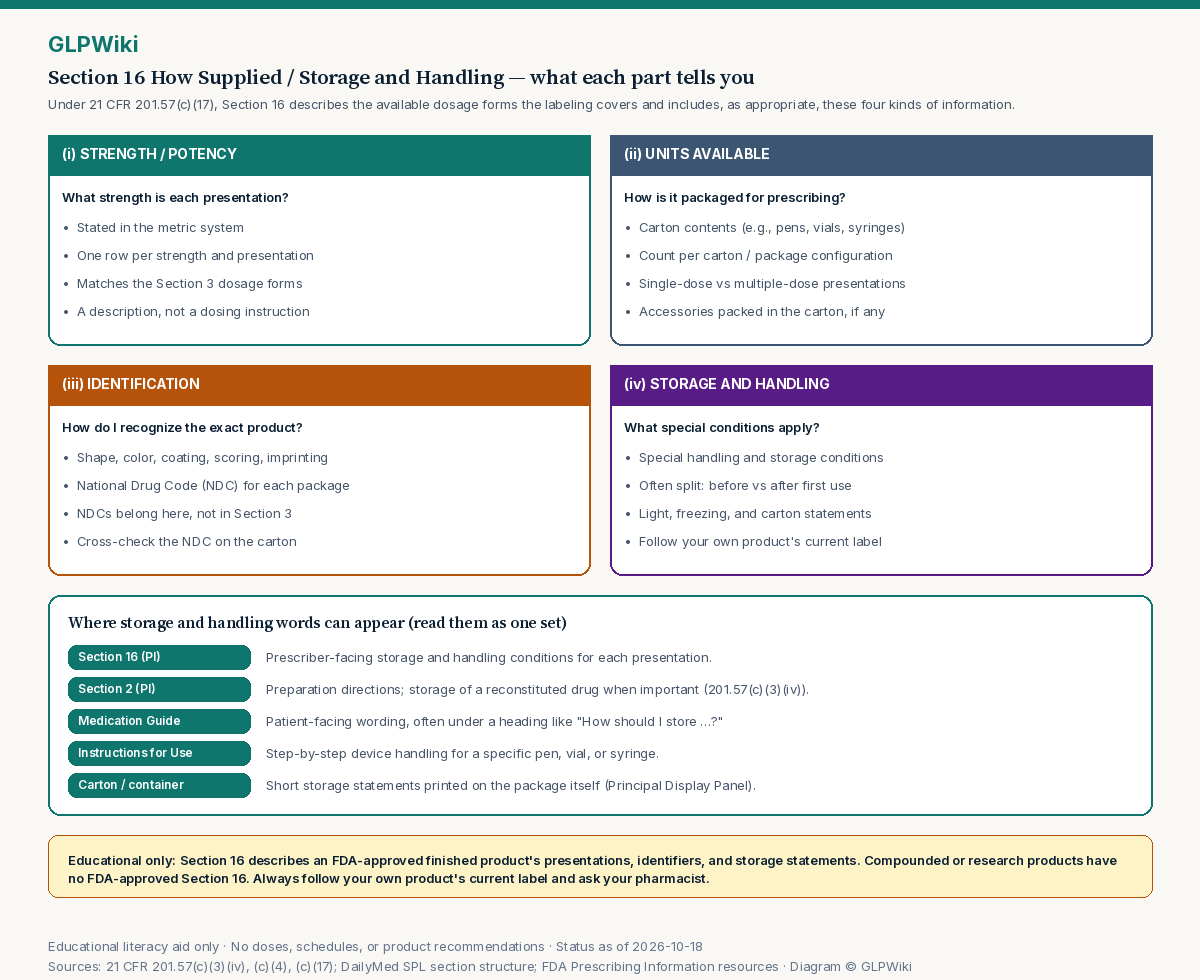
In the PLR format, Section 16 is paragraph (c)(17) of 21 CFR 201.57. The regulation says this section must contain information on the available dosage forms to which the labeling applies and for which the manufacturer or distributor is responsible, and that the information must include, as appropriate: (i) the strength or potency of the dosage form in the metric system; (ii) the units in which the dosage form is ordinarily available for prescribing by practitioners (the regulation's example is bottles of 100); (iii) appropriate information to facilitate identification of the dosage forms, such as shape, color, coating, scoring, imprinting, and National Drug Code number; and (iv) special handling and storage conditions.
Read those four items as four questions: which strengths exist, how each one is packaged, how you would recognize the exact package in your hand, and which special conditions the label states for it. Section 16 answers them for the finished product described by that specific label — not for a molecule in general, and not for any other product that shares the same active ingredient.
Section 16 anatomy — strength, packaging, identification, storage
Strength and presentation. Section 16 usually opens with a short description of the dosage form (for example, a clear solution in a pen, vial, or prefilled syringe) followed by a table or list with one row per strength and presentation. That row is a description of what is manufactured and supplied. It is not a dosing instruction; doses and regimens belong only to Section 2 Dosage and Administration.
Package configuration. The units ordinarily available for prescribing appear as carton contents: how many pens, vials, or syringes are in one carton, whether a presentation is single-dose or multiple-dose, and whether accessories such as needles are packed in the carton. Different package configurations of the same strength usually carry different NDCs.
Identification. For tablets and capsules this is where shape, color, coating, scoring, and imprint codes appear; for injectables it is mostly the description of the solution and the device, plus the NDC for each package. Storage and handling. The final part states special handling and storage conditions — often split by presentation, and by before versus after first use or unopened versus opened.
Section 16 vs Section 3 Dosage Forms and Strengths vs Highlights
Section 3 Dosage Forms and Strengths (21 CFR 201.57(c)(4)) also lists the available dosage forms with their metric strength and identifying characteristics such as shape, color, coating, scoring, and imprinting. The difference is purpose and detail: Section 3 is a concise prescriber-facing list of what forms and strengths exist, while Section 16 adds package configurations, NDCs, and storage and handling. The regulation is explicit that NDC numbers must not be included in Section 3.
The Highlights of Prescribing Information carry a concise Dosage Forms and Strengths summary as well, but not the NDC tables or the full storage statements. If you only read Highlights, you have not read Section 16.
What Section 16 looks like on current GLP-1 labels (structure only)
On the current Ozempic (semaglutide) injection PI posted on DailyMed (SPL effective June 2026), Section 16 HOW SUPPLIED/STORAGE AND HANDLING uses unnumbered subheadings — How Supplied and Recommended Storage Conditions. The How Supplied part groups presentations (single-patient-use pens and single-dose prefilled syringes) in tables with columns for strength per volume, carton contents, and NDC. The storage part is organized by presentation, with a table split into before first use and after first use. It also carries a special-handling statement that each multi-dose pen is for use by a single patient and must never be shared, cross-referenced to Warnings and Precautions (5.4) — an example of Section 16 pointing to another section.
On the current Zepbound (tirzepatide) injection PI on DailyMed (SPL effective August 2026), Section 16 is numbered: 16.1 How Supplied and 16.2 Storage and Handling. 16.1 lists each presentation (single-dose pens, single-dose vials in one- and four-packs, a multi-dose vial, and a single-patient-use KwikPen) by strength and NDC. 16.2 begins with statements that apply to every presentation — including “Do not freeze ZEPBOUND” and “Store ZEPBOUND in the original carton to protect from light” — and then gives separate conditions for single-dose presentations and for unopened versus opened multi-dose presentations.
GLPWiki deliberately does not reproduce the strengths, temperature ranges, or time limits from these tables. They are presentation-specific and labels are revised; read them on the current Agency-posted PI for the exact product and package you have, and ask your pharmacist if anything is unclear.
How to read a National Drug Code (NDC)
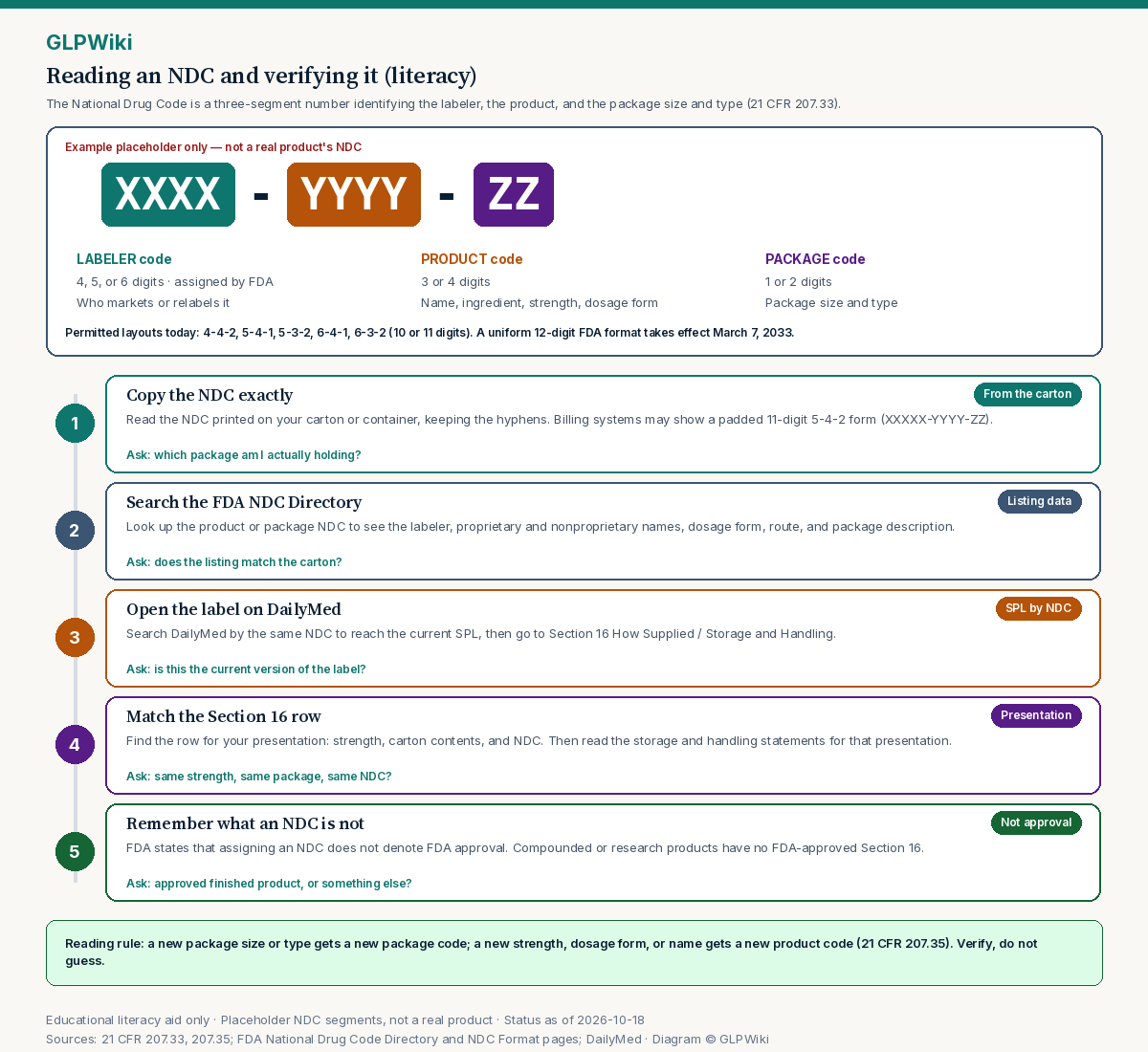
Under 21 CFR 207.33, the NDC is a numeric code that must uniquely identify a drug's labeler, product, and package size and type. It has three segments: the labeler code (4, 5, or 6 digits, assigned by FDA), the product code (3 or 4 digits), and the package code (1 or 2 digits). The permitted layouts are 4-4-2, 5-4-1, 5-3-2, 6-4-1, and 6-3-2, for a total of 10 or 11 digits, and a labeler must use only one product-package configuration across its NDCs. On current GLP-1 labels such as Ozempic and Zepbound, the NDCs are printed in a 4-4-2 layout.
21 CFR 207.35 explains when a new NDC is needed. A change to the drug's name, an active ingredient or its strength, the dosage form, prescription status, or distinguishing characteristics such as size, shape, color, or imprint requires a new product code; a change only to the package size or type requires a new package code. That is why one strength can appear in Section 16 with several NDCs — one per package configuration.
Formats are changing. FDA's final rule Revising the National Drug Code Format and Drug Label Barcode Requirements adopts a uniform 12-digit NDC that takes effect March 7, 2033, with FDA converting existing 10-digit NDCs by adding leading zeros to segments and a three-year label transition through March 6, 2036. FDA notes the rule does not change formats used for other purposes, such as the HIPAA 11-digit format used for reimbursement — which is why a pharmacy or insurance record may show a padded 11-digit version of the same NDC printed on your carton.
One more labeling detail: 21 CFR 201.2 says the NDC is requested but not required to appear on drug labels and labeling. In practice, approved peptide and GLP-1 PIs list NDCs in Section 16 and print them on cartons and containers.
Cross-checking an NDC in the FDA NDC Directory and DailyMed
Copy the NDC exactly as printed on the carton or container, keeping the hyphens. Search it in the FDA National Drug Code Directory, which FDA updates daily from structured product labeling (SPL) listing files submitted by labelers. The listing shows the labeler, proprietary and nonproprietary names, dosage form, route, and package description, which you can compare with the carton.
Then search DailyMed by the same NDC to reach the current SPL for that product, open Section 16, and find the row that matches your strength, package configuration, and NDC. Read the storage and handling statements for that presentation, then the Medication Guide and Instructions for Use for the patient-facing wording. If the NDC Directory, DailyMed, and the carton do not agree, ask the dispensing pharmacist before relying on any of them.
Know the limits. FDA states that inclusion in the NDC Directory does not indicate that FDA has verified the information or that a product is FDA-approved, that the content of each entry is the labeler's responsibility, and that assignment of an NDC number does not in any way denote FDA approval — any representation that an NDC implies FDA approval is misleading. The Directory also does not contain every listed drug. Approval status is checked on Drugs@FDA, not by the presence of an NDC.
Where storage and handling statements live on a label
Section 16 is the prescriber-facing home for special handling and storage conditions. Section 2 Dosage and Administration can also carry storage wording: 21 CFR 201.57(c)(3)(iv) asks Section 2 to give directions on dilution and preparation, including storage conditions for stability of the reconstituted drug when important. For products supplied ready to use, Section 2 may say nothing about storage at all — on the current Ozempic and Zepbound PIs, storage wording sits in Section 16 rather than Section 2.
Patient-facing labeling repeats storage information in plain language. Section 17 Patient Counseling Information (21 CFR 201.57(c)(18)) must reference any FDA-approved patient labeling, such as a Medication Guide or Patient Information, which often has a heading like “How should I store …?” Device Instructions for Use usually add step-level handling for a specific pen, vial, or syringe. Finally, the carton and container labels — shown on DailyMed as Package Label / Principal Display Panel images — carry short storage statements on the package itself.
Reading habit: treat these as one set for one presentation. If they seem to differ, the most specific current text for your exact package wins, and the dispensing pharmacist is the right person to resolve it. For practical handling concepts, see Peptide storage and handling and Peptide freeze-thaw and light rather than inferring rules from a different product's label.
Why compounded and research products have no FDA-approved Section 16
Section 16 exists because an approved finished product has FDA-approved labeling. FDA's compounding Q&A states that compounded drugs are not FDA-approved, which means FDA does not verify their safety, effectiveness, or quality before they are marketed. A compounded preparation therefore has no FDA-approved Prescribing Information and no FDA-approved Section 16; any storage or beyond-use information comes from the compounder and the dispensing pharmacy, not from an approved label.
Some compounded products do carry NDCs: outsourcing facilities that elect to assign NDCs report them to FDA, and the NDC Directory includes compounded products reported in the last two years. That NDC still does not mean approval. Products sold for research use only are not labeled medicines, so there is no Prescribing Information to read at all.
This is a neutral category distinction, not a judgment about any product or pharmacy. For the regulatory framework, see Compounded vs FDA-approved GLP-1 medicines and FDA 503A vs 503B GLP-1 compounding; for research-vial labels, see How to read a peptide vial label.
A practical Section 16 reading path
Start with the package in hand: product name, strength, presentation, and NDC on the carton. Open the current PI on Drugs@FDA (Agency-posted PDF) or DailyMed / FDALabel (structured SPL) and note the revision date. In Section 16, find the row that matches your strength, package configuration, and NDC, then read the storage and handling statements for that presentation and any cross-referenced section.
Read the Medication Guide or Patient Information and the Instructions for Use for the same presentation. Cross-check the NDC in the FDA NDC Directory. When anything is unclear — or when a product has been exposed to conditions the label does not cover — follow your own product's label and ask your pharmacist rather than a forum, a different product's label, or this page.
- Approved finished-product Section 16: Drugs@FDA label PDF.
- Structured SPL and NDC search: DailyMed / FDALabel — still verify against the Agency-posted PI when precision matters.
- Listing data for an NDC: FDA National Drug Code Directory (inclusion is not approval).
- Approval status: Drugs@FDA, not the presence of an NDC.
- Compounded or research products: no FDA-approved Section 16 — ask the dispensing pharmacy what applies.
Scope, disclaimer and review date
This guide is educational. It maps how to read How Supplied / Storage and Handling (Section 16) on FDA peptide and GLP-1 Prescribing Information under PLR — including what 21 CFR 201.57(c)(17) requires, how Section 16 differs from Section 3 and Highlights, how to read presentation and package tables, NDC structure and verification, where storage wording appears across the label, and why compounded or research products have no FDA-approved Section 16. It does not provide doses, titration schedules, administration tutorials, storage or temperature-excursion instructions of its own, product or pharmacy recommendations, sourcing advice, or individual medical advice, and nothing here recommends starting, stopping, switching, or continuing any medicine or research chemical. Follow your own product's current label and ask your pharmacist or clinician.
Last reviewed: October 18, 2026. Labeling, NDC listings, approval status, and NDC format rules may have changed since; verify with Drugs@FDA, DailyMed, FDALabel, the FDA NDC Directory, and your pharmacist.
Frequently asked questions
- What is Section 16 How Supplied / Storage and Handling?
- It is the part of the PLR Prescribing Information governed by 21 CFR 201.57(c)(17). It describes the available dosage forms the labeling covers and includes, as appropriate, strength or potency in metric units, the units ordinarily available for prescribing, identifying information including the NDC, and special handling and storage conditions.
- How is Section 16 different from Section 3 Dosage Forms and Strengths?
- Section 3 is a concise list of the dosage forms and strengths with identifying characteristics. Section 16 adds package configurations, NDCs, and storage and handling. The regulation says NDC numbers must not be included in Section 3.
- What do the three parts of an NDC mean?
- Under 21 CFR 207.33, the first segment is the FDA-assigned labeler code, the second is the product code, and the third is the package code identifying package size and type. Today's NDCs are 10 or 11 digits in a 4-4-2, 5-4-1, 5-3-2, 6-4-1, or 6-3-2 layout; a uniform 12-digit format takes effect March 7, 2033.
- Does having an NDC mean a product is FDA-approved?
- No. FDA states that assignment of an NDC does not in any way denote FDA approval and that inclusion in the NDC Directory does not mean FDA has verified the information. Check approval status on Drugs@FDA.
- How do I check the NDC on my carton?
- Copy it exactly, search it in the FDA NDC Directory, then search DailyMed by the same NDC, open Section 16, and match the row for your strength and package. If the sources and the carton disagree, ask the dispensing pharmacist.
- Where else on a label can storage instructions appear?
- Besides Section 16, Section 2 may give storage conditions for a reconstituted drug when important, the Medication Guide or Patient Information often has a How should I store section, Instructions for Use add device-level handling, and the carton and container labels carry short storage statements. Read them together for your exact presentation.
- Do compounded or research peptides have a Section 16?
- Not an FDA-approved one. FDA states compounded drugs are not FDA-approved, so there is no approved Prescribing Information; research-use products are not labeled medicines. Ask the dispensing pharmacy what storage information applies to a compounded preparation.
- Does this page tell me how to store my medicine or give dosing advice?
- No. It teaches how to read the label. Follow your own product's current label and ask your pharmacist. Doses, schedules, temperature-excursion advice, product picks, and personal medical advice are out of scope.
SOURCES
- 0121 CFR 201.57 — Specific requirements on content and format of labeling (PLR), including (c)(3)(iv), (c)(4), (c)(17) How supplied/storage and handling, and (c)(18) Patient counseling information— U.S. Government Publishing Office / eCFR
- 0221 CFR 201.2 — Drugs and devices; National Drug Code numbers— U.S. Government Publishing Office / eCFR
- 0321 CFR 207.33 — What is the National Drug Code (NDC), how is it assigned, and what are its requirements?— U.S. Government Publishing Office / eCFR
- 0421 CFR 207.35 — What changes require a new NDC?— U.S. Government Publishing Office / eCFR
- 05National Drug Code Directory— U.S. Food and Drug Administration
- 06National Drug Code Format (final rule: uniform 12-digit NDC effective March 7, 2033)— U.S. Food and Drug Administration
- 07NDC Directory search— U.S. Food and Drug Administration
- 08Compounding and the FDA: Questions and Answers— U.S. Food and Drug Administration
- 09Frequently Asked Questions about Labeling for Prescription Medicines— U.S. Food and Drug Administration
- 10Prescribing Information Resources (PLR section map)— U.S. Food and Drug Administration
- 11Ozempic (semaglutide) injection Prescribing Information — Section 16 How Supplied/Storage and Handling (DailyMed)— U.S. FDA / DailyMed
- 12Zepbound (tirzepatide) injection Prescribing Information — Section 16 How Supplied/Storage and Handling (DailyMed)— U.S. FDA / DailyMed
- 13openFDA NDC Directory API— U.S. Food and Drug Administration
- 14Drugs@FDA— U.S. Food and Drug Administration
- 15DailyMed— U.S. National Library of Medicine
- 16FDALabel: Full-Text Search of Drug Product Labeling— U.S. Food and Drug Administration
EDUCATIONAL REFERENCE ONLY · Not medical advice. Nothing here diagnoses, treats, cures or prevents any disease, and nothing here is a dosing recommendation. Consult a licensed clinician before any treatment decision.