Peptide freeze-thaw, light, and post-reconstitution labeling mistakes
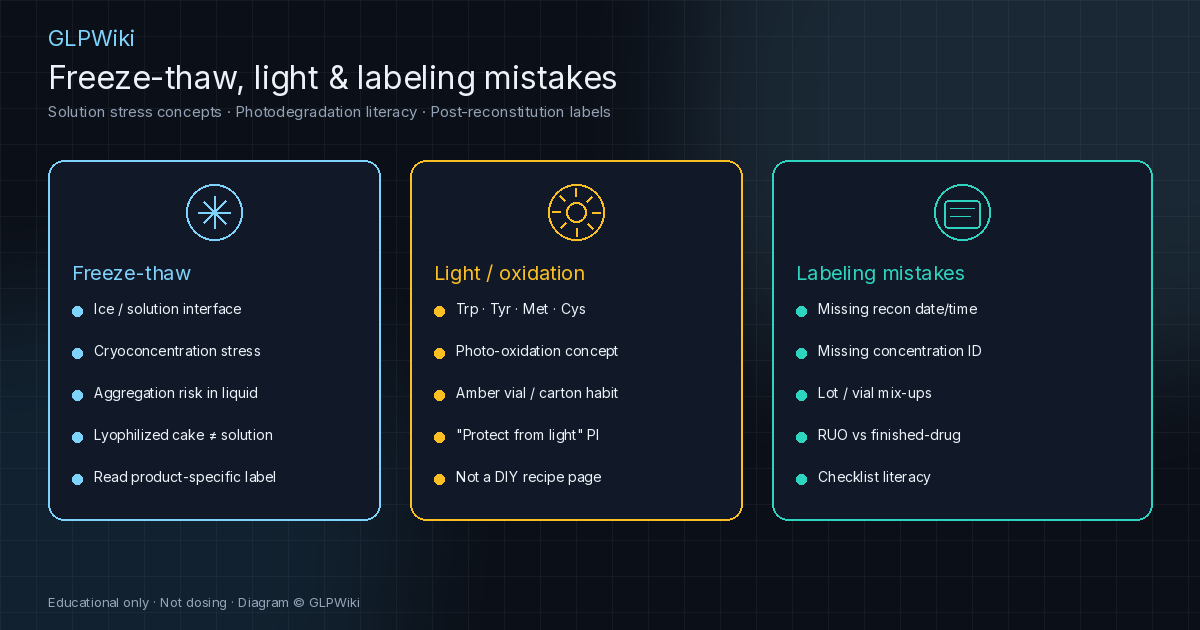
The already-live peptide storage and handling guide covers cold-chain basics. This companion deepens three high-error literacy topics: why freezing a reconstituted vial is not automatically safe, how light and oxidation-sensitive residues (Trp, Tyr, Met, Cys) motivate "protect from light" labeling, and which post-reconstitution labeling mistakes confuse identity, concentration, lots, and research-use versus finished-drug context. Educational and YMYL-safe only — verify DailyMed / Drugs@FDA for approved finished products; no reconstitution recipes or pharmacy advice.
UPDATED 01 OCT 2026 · 13 MIN READ
KEY TAKEAWAYS
- Freeze-thaw stress is mainly a liquid-solution problem: ice/solution interfaces, cryoconcentration, and aggregation risk differ sharply from a dry lyophilized cake.
- "Just freeze the reconstituted vial" is a common literacy mistake — many FDA-approved finished peptide products (for example, GLP-1 pens) explicitly say do not freeze and do not use if frozen.
- Light and oxidation literacy centers on susceptible residues (tryptophan, tyrosine, methionine, cysteine and related sulfur/aromatic chemistry) at a high level — not as a DIY formulation rule.
- Amber vials, original cartons, and labeled "protect from light" language exist because photostability studies can show light-sensitive degradation for specific products.
- Post-reconstitution labeling mistakes — missing date/time, missing concentration identity, mixed vials/lots, and blurring RUO versus finished-drug status — create identity and safety literacy failures even when temperature was "correct."
- Approved finished-product How Supplied/Storage and Handling language on DailyMed / Drugs@FDA is the authority for labeled medicines; research catalogs and compounded preparations are different regulatory contexts.
- This page is educational literacy only: not medical advice, no doses, no reconstitution recipes, no beyond-use date prescriptions, and no pharmacy or supplier recommendations.
Why this companion exists (and what it is not)
Peptide storage pages often stop at "keep at 2–8°C" and "protect from light." Those phrases are useful starting points, but they leave three gaps that show up repeatedly in questions and mislabeled vials: (1) people treat freezing a reconstituted solution as a free upgrade in stability; (2) "protect from light" is treated as folklore rather than product-specific photostability labeling; and (3) after reconstitution, the handwritten label on the vial is incomplete — so nobody can tell what concentration was made, when, or whether the vial is research-labeled versus a finished drug.
The already-live guide on peptide storage and handling remains the basics page for lyophilized-versus-solution stability, cold chain, adsorption, and beyond-use concepts. This companion does not restate those refrigerator-temperature basics. It zooms into freeze-thaw damage concepts, light/oxidation residue literacy, and post-reconstitution labeling mistakes — with diagrams for the visual topics Jerry’s editorial standard requires.
Nothing here is a protocol to freeze, thaw, aliquot, reconstitute, or assign a beyond-use date. For any FDA-approved finished product, open the current Prescribing Information. For research-use materials, follow the manufacturer’s certificate of analysis and institutional laboratory policy — and never treat research labeling as clinical use authorization.
Freeze-thaw damage concepts: solution vs lyophilized cake
When a peptide is still a dry lyophilized cake, there is little free water to form ice crystals. That is a major reason pharmaceutical peptides are often shipped and stored dry: hydrolysis and many liquid-phase aggregation pathways are slowed when water activity is very low. Reviews of peptide and protein instability emphasize that shelf-life in solution is typically much shorter than for lyophilized material stored cold and protected from light — though even dry cakes are not infinitely stable, and product-specific labels still govern.
Once the peptide is reconstituted into an aqueous solution, freezing is a different physical process. As ice forms, solutes (peptide, salts, buffers, preservatives) are excluded into a shrinking liquid phase — cryoconcentration. The ice/solution interface creates interfacial stress. Buffer components can crystallize selectively and shift local pH. Reviews of freezing biologicals describe aggregation, cold denaturation, ice-interface interactions, and related stresses as real risks — not theoretical trivia. Repeated freeze–thaw cycles add cumulative opportunity for those stresses.
Literacy contrast: a dry cake in a freezer and a reconstituted liquid "parked in the freezer because fridge space was tight" are not the same storage story. Laboratory literature often discusses aliquoting strategies to reduce repeated freeze–thaw of protein stocks in development settings — that is manufacturing/lab process literacy, not a permission slip to freeze any finished drug pen or any research vial against its label.
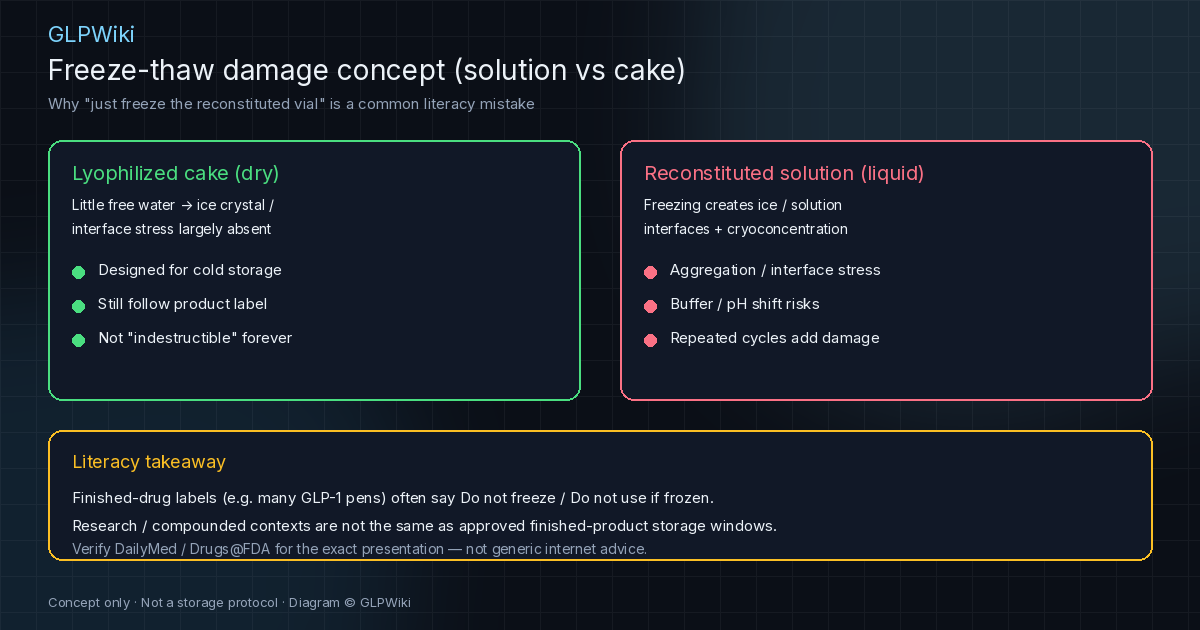
Finished-product "do not freeze" language vs research contexts
Many FDA-approved peptide finished products are aqueous solutions in pens or syringes with explicit How Supplied/Storage and Handling rules. For example, current Ozempic (semaglutide) injection labeling instructs refrigeration before first use, states do not freeze and do not use if frozen, and describes in-use windows and light/heat protection language for pens and prefilled syringes. Wegovy injection labeling similarly includes do-not-freeze and protect-from-light / original-carton concepts for defined presentations. Those statements are product-specific — always re-open DailyMed or the Drugs@FDA label PDF for the exact presentation under discussion.
Research-use-only (RUO) lyophilized peptides and compounded preparations are not the same regulatory category as an approved finished drug. A catalog note that a dry powder may be stored frozen does not authorize freezing a finished multi-dose pen. Conversely, a finished-drug "do not freeze" rule does not automatically describe every research peptide’s dry-cake storage. Keep the categories honest: approved finished-product PI → Drugs@FDA / DailyMed; research materials → COA / datasheet + institutional policy; compounded preparations → pharmacy labeling and applicable compounding standards — each separate.
If someone says "peptides should always be frozen after reconstitution," treat that as a claim to categorize, not a fact. Ask: Which exact product? Dry cake or liquid? What does the current label or COA say? Generic social-media storage tips are not substitutes for labeled storage sections.
Light and oxidation-sensitive residues (high-level literacy)
Certain amino acid side chains are more prone to oxidative and photochemical damage. Educational reviews commonly highlight tryptophan (Trp), tyrosine (Tyr), methionine (Met), and cysteine (Cys) — with related discussion of phenylalanine and histidine in protein photodegradation literature. Photo-oxidation can change primary structure and contribute to aggregation or loss of activity; Kerwin and Remmele’s "Protect from light" review summarizes primary photooxidation pathways for protein biologics and why packaging and handling matter.
Mechanistic literacy (not a recipe): light can excite photosensitizers; type I and type II pathways generate reactive oxygen species that oxidize susceptible residues (for example, methionine sulfoxide/sulfone concepts; tryptophan kynurenine-related products; tyrosine crosslinking concepts; cysteine oxidation/disulfide scrambling concepts). Peptide sequence reviews also note that Cys, Met, and Trp oxidation can be worsened by freeze–thaw and high pH in some contexts — another reason liquid handling history matters.
Regulatory packaging language exists for a reason. ICH Q1B describes photostability testing frameworks used to decide whether special light protection is needed for a drug substance or product. When a label says "protect from light," "keep in the original carton," or specifies amber containers, that language is tied to product-specific evidence and labeling — not superstition. Literacy habit: read How Supplied/Storage and Handling; keep pens/vials in labeled cartons when the PI says so; do not invent homemade light-protection protocols that contradict the label.
Post-reconstitution labeling mistakes (educational checklist)
After a lyophilized research peptide is reconstituted — or after any multi-draw solution is prepared in a laboratory context — the vial’s identity often depends entirely on what someone wrote on the label. Common literacy failures include: no reconstitution date or time; no recorded concentration (or inconsistent mg/mcg units); swapping or pooling vials/lots without documentation; and writing a research peptide name in a way that looks like a finished brand drug (or the reverse).
These mistakes are identity and documentation problems, not "fridge temperature" problems. A perfectly refrigerated vial with the wrong concentration written on it, or with two lots mixed, is still a failed literacy object. Parallel clinical pharmacy practice emphasizes clear labeling of compounded/reconstituted preparations; USP sterile compounding frameworks discuss beyond-use dating and labeling concepts for professionals — cited here only as context for why labeling discipline exists, not as DIY compounding permission.
Use the educational checklist diagram as a memory aid: identity, concentration concept, date/time, lot/vial integrity, storage note copied from the product document, and status context (RUO vs finished drug). Cross-read how-to-read-a-peptide-vial-label, how-to-read-a-peptide-coa, how-to-reconstitute-peptides (arithmetic literacy only), and peptide-storage-and-handling for the basics this page does not repeat.
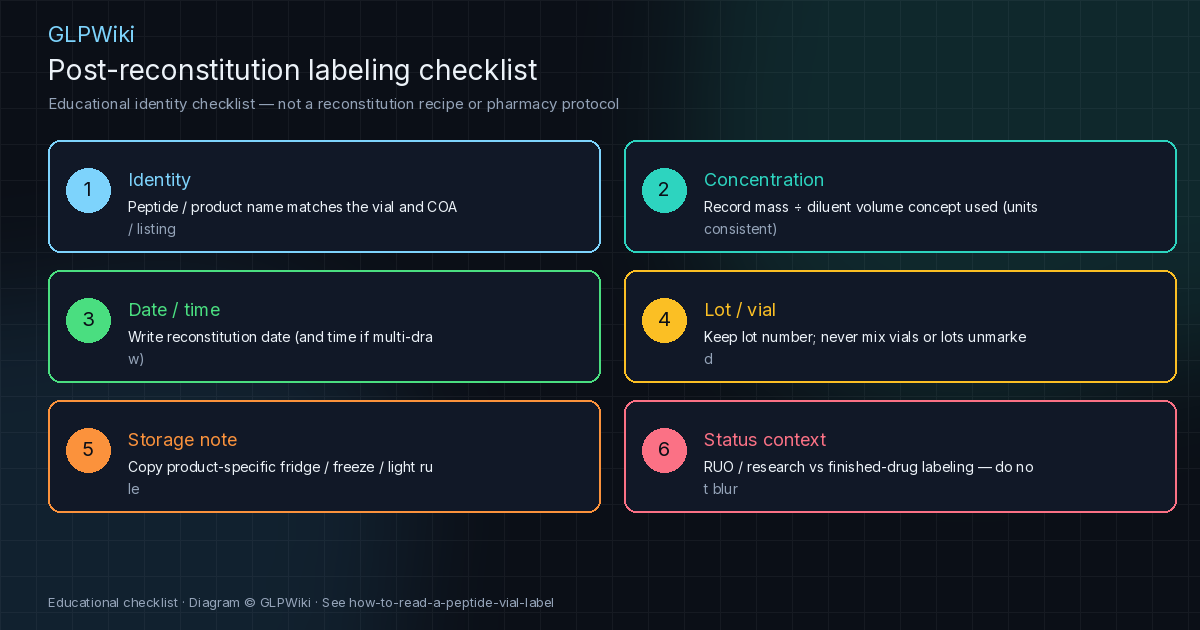
- Missing reconstitution date/time → nobody can apply a documented use window later.
- Missing concentration identity → syringe arithmetic becomes guesswork.
- Mixed vials/lots → COA and impurity history no longer map to the liquid.
- RUO wording erased or "upgraded" in handwriting → regulatory category confusion.
- Storage note omitted → fridge vs freezer vs protect-from-light rules get lost.
How to verify a freeze, light, or labeling claim
Step 1 — Capture the claim: product name, dosage form (pen, syringe, lyophilized vial), and whether the material is an FDA-approved finished drug, compounded preparation, or research-labeled catalog item.
Step 2 — For finished drugs, open Drugs@FDA / DailyMed and read How Supplied/Storage and Handling (and the Medication Guide storage section when present). Note freeze, light, carton, and in-use window language exactly.
Step 3 — For research materials, open the current COA / datasheet storage section. Do not import finished-drug pen rules onto dry research cakes, or vice versa.
Step 4 — Inspect the physical label after any reconstitution: identity, concentration concept, date/time, lot, storage note, status context.
Step 5 — Categorize honestly: labeled finished-drug storage; research COA storage; unsupported social-media tip. Discard tips that conflict with the controlling document.
What this page deliberately does not do
No doses, schedules, reconstitution recipes, diluent volumes, aliquot protocols, or beyond-use date assignments for any product.
No pharmacy, telehealth, clinic, or supplier recommendations; no purchasing advice; no affiliate links.
No claim that freezing always damages every peptide, or that every peptide needs amber glass — susceptibility and labeling are product-specific.
No instruction to use research-use materials in humans. RUO and finished-drug contexts stay separate.
For whether any medicine is appropriate for a person, consult a licensed clinician using the official label. Adverse events and quality concerns can be reported through MedWatch.
Where to read next
Continue with peptide-storage-and-handling for cold-chain basics, peptide-travel-cold-chain for excursion literacy, peptide-lyophilization-explained for cake structure, and how-to-reconstitute-peptides for concentration arithmetic (not recipes).
For label and status literacy, see how-to-read-a-peptide-vial-label, how-to-read-a-peptide-coa, how-to-read-fda-peptide-labeling, and approved-versus-investigational peptides.
Editorial standards and the medical disclaimer explain sourcing limits and what GLPWiki never publishes.
Frequently asked questions
- Is it OK to freeze a reconstituted peptide vial to make it last longer?
- Not as a generic rule. Freeze–thaw can stress peptides in solution via ice interfaces and cryoconcentration. Many finished peptide drugs explicitly say do not freeze. Always read the product-specific label or COA — this page does not assign a freezing protocol.
- Why do some labels say "do not freeze" while research powders are stored frozen?
- A dry lyophilized cake and an aqueous finished solution are different physical states with different labels. Finished-drug pens (for example, certain semaglutide injections) often forbid freezing; research dry powders may list freezer storage on a COA. Do not mix the categories.
- Which amino acids are most often discussed for light or oxidation sensitivity?
- Educational literature commonly discusses tryptophan, tyrosine, methionine, and cysteine (with related aromatic/sulfur chemistry). Susceptibility is sequence- and formulation-dependent — residue lists are literacy, not a DIY stability formula.
- What does "protect from light" mean on a peptide medicine label?
- It is labeled storage/handling language based on product-specific photostability considerations. Practical PI language may include keeping the pen or syringe in the original carton or keeping a cap on. Follow the exact product label.
- What should go on a reconstituted vial label (educationally)?
- At minimum, literacy practice includes identity, concentration concept with consistent units, reconstitution date/time, lot/vial integrity, storage note from the controlling document, and clear RUO versus finished-drug status. This is documentation literacy — not a compounding protocol.
- Does GLPWiki tell me how long a reconstituted peptide is good for?
- No. Beyond-use windows are product- and context-specific. GLPWiki publishes no BUDs, doses, or reconstitution recipes. Use the official label, COA, or a licensed professional’s guidance.
SOURCES
- 01Drugs@FDA: FDA-Approved Drugs database— U.S. FDA
- 02DailyMed — OZEMPIC (semaglutide) injection labeling (How Supplied/Storage and Handling)— U.S. NLM / DailyMed
- 03DailyMed — WEGOVY (semaglutide) injection and tablets labeling— U.S. NLM / DailyMed
- 04Strategies for overcoming protein and peptide instability in biodegradable drug delivery systems (PMC10526705)— Advanced Drug Delivery Reviews / PMC
- 05Freezing of Biologicals Revisited: Scale, Stability, Excipients, and Degradation Stresses (Authelin et al., PubMed 31705975)— Journal of Pharmaceutical Sciences / PubMed
- 06Protect from light: photodegradation and protein biologics (Kerwin & Remmele, PubMed 17230445)— Journal of Pharmaceutical Sciences / PubMed
- 07Photo-Oxidation of Therapeutic Protein Formulations: From Radical Formation to Analytical Techniques (PMC8779573)— Pharmaceutics / PMC
- 08ICH Q1B Photostability Testing of New Drug Substances and Products— ICH / U.S. FDA guidance page
- 09ICH Q1B Guideline PDF (Photostability Testing)— ICH
- 10General Chapter <797> Pharmaceutical Compounding — Sterile Preparations— United States Pharmacopeia (USP)
- 11MedWatch: FDA Safety Information and Adverse Event Reporting Program— U.S. FDA
EDUCATIONAL REFERENCE ONLY · Not medical advice. Nothing here diagnoses, treats, cures or prevents any disease, and nothing here is a dosing recommendation. Consult a licensed clinician before any treatment decision.