Peptide lyophilization explained: freeze-drying, cake structure, and why technique matters
Lyophilization removes water from a frozen peptide formulation under vacuum to create a dry, porous cake. This science-foundation guide explains the process, why manufacturers use it, what cake appearance can and cannot prove, and how handling and storage context change after reconstitution. Educational only: no doses, protocols, recipes, or product recommendations.
UPDATED 21 SEPT 2026 · 13 MIN READ
KEY TAKEAWAYS
- Lyophilization, or freeze-drying, removes water from a frozen formulation under reduced pressure; it is not simply air-drying.
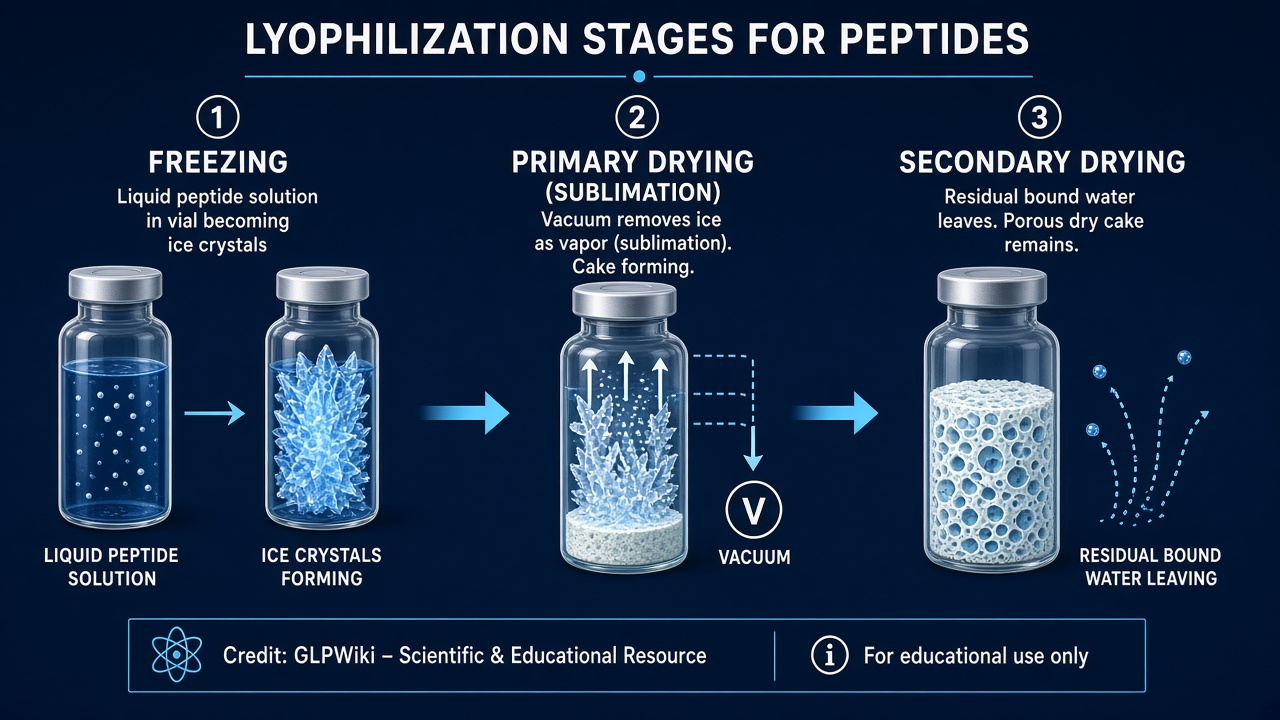
- A typical cycle includes freezing, primary drying by sublimation, and secondary drying that reduces more tightly associated water.
- Manufacturers may use lyophilization when a peptide or biologic is less stable in aqueous solution, but the process must be developed and validated for the specific formulation.
- The visible cake is part of the finished presentation, but appearance alone cannot establish identity, purity, potency, sterility, or proper manufacture.
- Residual moisture can affect stability, yet the appropriate level is product- and formulation-specific and requires validated analytical testing.
- Dry and reconstituted products may have different storage limits; only the current official labeling for an approved finished product defines its conditions.
- Approved, investigational, compounded, and research-use materials belong to different evidence and oversight pathways even when every vial appears lyophilized.
- This guide explains concepts only and does not provide reconstitution instructions, dosing, storage improvisations, or compounding recipes.
Why lyophilization literacy belongs beneath reconstitution and storage
Many peptide pages begin with a dry vial and then jump immediately to reconstitution or storage. That skips the manufacturing concept that produced the dry material. Lyophilization changes a frozen formulation into a porous solid by removing water under controlled vacuum and temperature conditions. Understanding that foundation helps readers interpret words such as cake, sublimation, residual moisture, and reconstituted stability without turning them into instructions.
The topic also prevents a common visual shortcut: assuming that a neat white cake proves a vial is authentic or high quality. Appearance is only one observation. Identity, purity, content, sterility, container-closure integrity, residual moisture, and stability require appropriate specifications, validated methods, records, and — where applicable — regulatory review.
GLPWiki treats lyophilization as science literacy, not as a home-production or handling protocol. This page gives no cycle parameters, compounding method, dosing information, mixing recipe, or product recommendation.
What lyophilization is: freezing, primary drying, and secondary drying
Lyophilization is commonly described in three broad stages. During freezing, water in the filled formulation becomes ice while solutes become concentrated in the remaining unfrozen phase. Ice-crystal formation influences the pore network left behind, so freezing behavior is part of process design rather than a cosmetic preliminary step.
During primary drying, pressure is reduced and heat is carefully managed so ice leaves mainly by sublimation — direct transition from solid ice to water vapor. The vapor is removed from the vial environment, leaving a porous structure. During secondary drying, additional water associated with the dried matrix is reduced through desorption. These stages are controlled manufacturing operations whose conditions depend on formulation and equipment.
The terms primary and secondary drying describe mechanisms and process phases; they do not certify that a particular vial was properly manufactured. FDA inspection materials emphasize cycle development, process controls, validation, equipment performance, and contamination control across parenteral lyophilization.
Why manufacturers freeze-dry some peptide formulations
Peptides and other biologic molecules can undergo chemical or physical changes in water. Depending on the molecule and formulation, relevant pathways may include hydrolysis, oxidation, deamidation, aggregation, adsorption, or changes in higher-order structure. Removing much of the water can slow selected degradation pathways and may support a useful shelf life before reconstitution.
That benefit is not automatic. Freezing and drying can themselves stress a molecule or formulation. Manufacturers may evaluate excipients, fill volume, thermal behavior, ice nucleation, collapse temperature, drying time, residual moisture, reconstitution behavior, container closure, and stability over time. Peer-reviewed reviews describe lyophilization as a formulation-and-process problem that must be optimized rather than a universal preservation switch.
A stable dry presentation for one approved medicine does not establish stability for another product or for an unreviewed material. Product-specific evidence and current labeling remain decisive.
Cake structure and appearance: useful observation, limited conclusion
A lyophilized cake is the porous solid left after ice and additional water are removed. Its shape and texture reflect the formulation, vial fill, freezing history, drying cycle, and movement during shipping. Terms such as intact, shrunken, collapsed, cracked, powdered, or discolored describe appearance; they do not by themselves diagnose the cause or determine whether a material meets specification.
A visually elegant cake is not proof of peptide identity, labeled content, purity, sterility, potency, or stability. Conversely, a crack or shift does not, by appearance alone, quantify chemical degradation. Those questions require appropriate analytical tests and product-specific acceptance criteria. A certificate of analysis can be useful only when its sample identity, lot linkage, methods, and results are credible and relevant.
For an approved finished medicine, use its current official labeling and contact the manufacturer or a licensed pharmacist about a questionable presentation. Suspected quality problems or adverse events can be reported through the appropriate FDA channels. Do not use a generic internet photograph as a release test.
Residual moisture and stability are product-specific
Lyophilization does not remove every water molecule. Residual moisture refers to water remaining in or associated with the dried matrix after the cycle. It can influence molecular mobility, cake structure, and degradation pathways, but lower is not always a universally better target. The appropriate range depends on the peptide, excipients, container, analytical method, and validated stability program.
Moisture can also enter after drying if the container-closure system is inadequate or storage conditions are not maintained. That is why manufacturing controls extend beyond the visible cycle to stopper seating, sealing, leak testing, packaging, transport, and stability monitoring.
A consumer cannot reliably infer residual moisture from color, texture, or how rapidly a cake dissolves. A meaningful claim requires a defined method, specification, lot-linked result, and context. See the COA literacy guide for the difference between a reported test result and a visual assumption.
Gentle-handling literacy without a reconstitution protocol
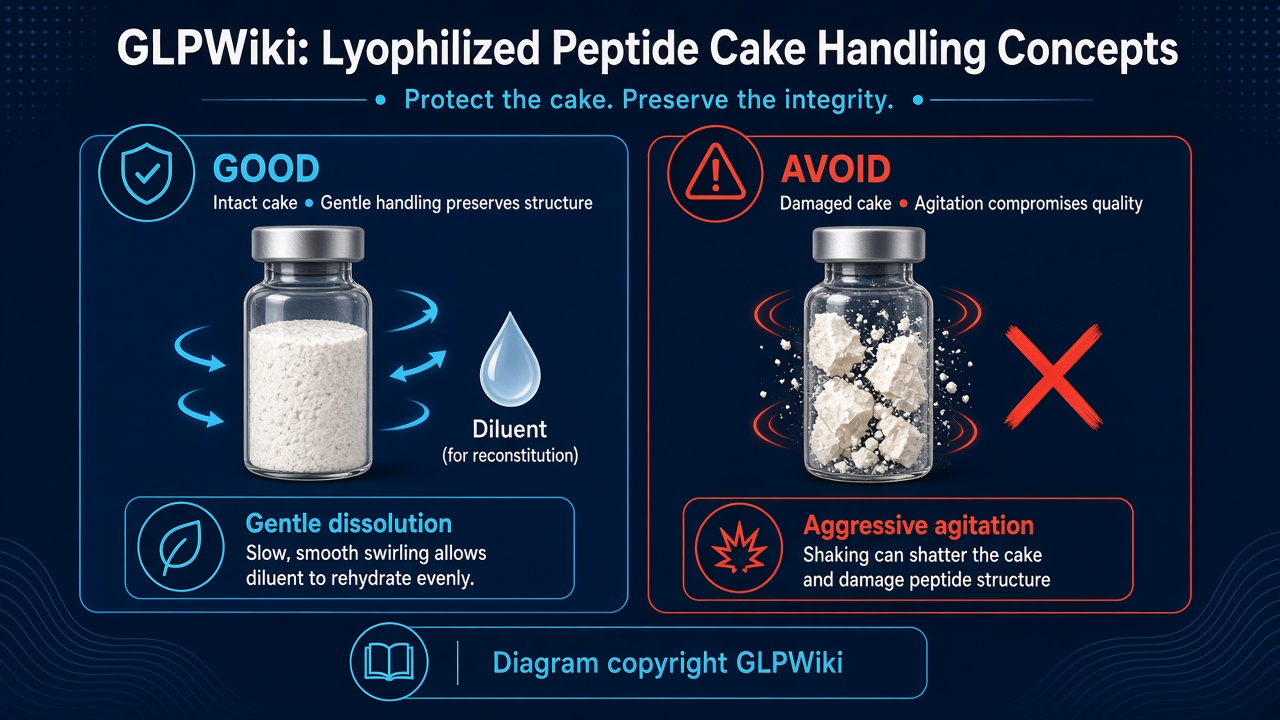
Educational discussions often distinguish gentle dissolution from aggressive agitation because peptides and proteins can be sensitive to interfaces and mechanical stress in ways that depend on formulation. That principle explains why an approved product's Instructions for Use may contain product-specific handling language. It does not create one universal technique for every vial.
The dry cake and the reconstituted liquid are different physical states. Once liquid is present, degradation pathways, adsorption, contamination risk, and storage limits may differ. Readers should not transfer a dry-vial storage claim to a prepared solution or borrow instructions from another medicine, research material, or social-media demonstration.
For approved products, follow the exact current Prescribing Information and Instructions for Use and ask a licensed clinician or pharmacist when anything is unclear. Investigational products follow study controls. Compounded preparations depend on the responsible pharmacy's lawful labeling and beyond-use information. Research-use-only material does not become an approved medicine because it can dissolve.
Approved, investigational, compounded, and research-use contexts
Lyophilized appearance does not erase regulatory categories. An FDA-approved finished medicine has an application record, reviewed manufacturing information, product-specific labeling, and defined quality controls. Drugs@FDA is the appropriate starting point for confirming U.S. approval and finding FDA-posted documents for the exact product.
An investigational product is studied under a development program and is not an approved medicine merely because it is used in a clinical trial. A compounded preparation is not an FDA-approved finished product and does not inherit another product's labeling. A research-use-only vial belongs to laboratory or research context and should not be narrated as though approved human-use instructions apply.
The same broad manufacturing word — lyophilized — can appear across all four contexts. Keep the material, finished product, evidence path, and status explicit before interpreting a claim.
- FDA-approved finished medicine: verify the exact application and current labeling in Drugs@FDA.
- Investigational product: verify trial registration, protocol context, and published evidence without calling it approved.
- Compounded preparation: not an FDA-approved finished product; use its lawful, product-specific labeling and professional guidance.
- Research-use-only material: laboratory context, not approved human labeling.
Scope and limits of this guide
This page explains freeze-drying vocabulary and evidence boundaries. It does not teach readers how to manufacture, compound, freeze-dry, reconstitute, dose, inject, store, or transport a peptide. It gives no equipment settings, temperatures, pressures, timings, volumes, concentrations, recipes, schedules, or product picks.
It cannot determine whether a vial is authentic, sterile, stable, or suitable from a photograph. For an approved medicine, use current official labeling and qualified clinical or pharmacy guidance. For suspected product-quality problems or adverse events involving an FDA-regulated product, consult FDA reporting resources and appropriate healthcare professionals.
Next reading
Continue with how to reconstitute peptides for arithmetic and terminology without suggested amounts, then peptide storage and handling for the distinction between labeled storage and general stability concepts. Peptide travel and cold-chain literacy explains why professional supply-chain frameworks are not personal packing recipes.
How to read a peptide COA and how to read a peptide vial label explain lot linkage, analytical claims, and label fields. Approved versus investigational peptides keeps regulatory categories separate, while BAC water ratios explains concentration relationships without recommending a ratio or dose.
Frequently asked questions
- What does lyophilized mean?
- Lyophilized means freeze-dried. A formulation is frozen, ice is removed mainly by sublimation during primary drying, and additional associated water is reduced during secondary drying under controlled manufacturing conditions.
- What are the stages of peptide lyophilization?
- The broad stages are freezing, primary drying, and secondary drying. Actual cycle conditions are formulation- and equipment-specific manufacturing parameters, not universal instructions.
- Why use a lyophilized cake instead of a liquid?
- Some peptides or biologics are less stable in aqueous solution. A validated dry presentation may slow selected degradation pathways and support shelf life, but freeze-drying can introduce stresses and must be developed for the specific formulation.
- Does a white, intact cake prove quality or purity?
- No. Appearance alone cannot establish identity, purity, labeled content, potency, sterility, residual moisture, or stability. Those require appropriate specifications, validated tests, records, and product-specific context.
- Why do some instructions mention gentle swirling rather than shaking?
- Some peptide and protein formulations can be sensitive to interfaces or mechanical stress. Follow only the current product-specific instructions for an approved medicine; this guide does not provide a universal mixing method.
- Are dry and reconstituted storage conditions the same?
- Not necessarily. The dry cake and prepared liquid are different physical states and may have different labeled storage windows. Verify the exact product's current official labeling rather than transferring conditions between states or products.
- Does freeze-drying automatically protect a peptide from heat, moisture, or time?
- No. Stability remains formulation-, packaging-, and condition-specific. Residual moisture, oxygen, light, temperature, closure integrity, and time can still matter, and only validated stability evidence supports a shelf-life claim.
- Does this guide tell me how much liquid to add or what dose to use?
- No. It provides no dose, concentration, volume, recipe, schedule, or reconstitution protocol. For approved medicines, use current official labeling and guidance from a licensed clinician or pharmacist.
SOURCES
- 01Lyophilization of Parenteral (793)— U.S. Food and Drug Administration
- 02Lyophilization of Parenterals— U.S. Food and Drug Administration
- 03Guidance for Industry: Sterile Drug Products Produced by Aseptic Processing — Current Good Manufacturing Practice— U.S. Food and Drug Administration
- 04Freeze-drying of proteins: some emerging concerns— PubMed
- 05Lyophilization of pharmaceuticals and biologicals: new technologies and approaches— PubMed
- 06Recent advances in lyophilization: excipients and process design— PubMed
- 07Drugs@FDA— U.S. Food and Drug Administration
- 08PubMed— U.S. National Library of Medicine
EDUCATIONAL REFERENCE ONLY · Not medical advice. Nothing here diagnoses, treats, cures or prevents any disease, and nothing here is a dosing recommendation. Consult a licensed clinician before any treatment decision.