How to read Patient Counseling Information, Medication Guides and IFUs on peptide labels (Section 17)

GLPWiki's how-to-read-fda-peptide-labeling hub maps the whole Prescribing Information. This companion goes deep on its last numbered section, Section 17 Patient Counseling Information, and on the FDA-approved patient labeling it points to: what 21 CFR 201.57(c)(18) requires, what a Medication Guide is under 21 CFR Part 208 and when FDA requires one, how a Patient Package Insert and Instructions for Use differ, where each one lives in a label, how to find the current versions on Drugs@FDA, DailyMed, and FDALabel and compare revision dates, and why compounded or research products have no FDA-approved Medication Guide or IFU. Label-reading literacy only: no doses, schedules, injection steps, product picks, or medical advice.
UPDATED 19 OCT 2026 · 14 MIN READ
KEY TAKEAWAYS
- Under 21 CFR 201.57(c)(18), Section 17 Patient Counseling Information must contain information necessary for patients to use the drug safely and effectively, must reference any FDA-approved patient labeling, and that labeling's full text must be reprinted immediately after Section 17 or accompany the Prescribing Information.
- Highlights must carry the verbatim statement "See 17 for Patient Counseling Information" — with "and FDA-approved patient labeling" or "and Medication Guide" added when the product has it (21 CFR 201.57(a)(14)).
- FDA lists three kinds of FDA-approved patient labeling: Medication Guides, Patient Package Inserts (also called "Patient Information"), and Instructions for Use. Not every prescription drug has them.
- A Medication Guide (21 CFR Part 208) is required when FDA determines patient labeling could help prevent serious adverse effects, when patients should know about serious risks that could affect their decision to use or continue a product, or when adherence to directions is crucial to effectiveness. It must be provided each time the product is dispensed.
- Instructions for Use give step-by-step written and visual directions for products with complicated or detailed use, such as pens and other devices. They are usually written per presentation and carry their own revision dates.
- The Prescribing Information, the Medication Guide, and each IFU can carry different "Revised" dates. Check the current versions on Drugs@FDA, DailyMed, or FDALabel against the copy you were handed.
- Compounded drugs are not FDA-approved, so they have no FDA-approved Medication Guide or IFU. This page gives no doses, injection steps, product picks, or personal medical advice.
What this guide covers (and how it differs from sister pages)
How to read FDA peptide labeling already explains PLR Highlights vs Full PI, Drugs@FDA vs DailyMed, and the overall section map, and it notes that patient-facing documents such as a Medication Guide, Patient Package Insert, or Instructions for Use exist alongside the PI. This Day 40 guide is the deep companion for that seam: Section 17 Patient Counseling Information and the FDA-approved patient labeling that follows it.
It is a document-literacy guide, not a how-to-use guide. It does not reproduce injection steps, device handling, preparation, disposal directions, doses, or schedules from any Medication Guide or IFU. For sharps concepts see Syringe and sharps safety; for storage-statement literacy see the Section 16 companion. It is also distinct from the Section 12, Sections 4–6, Section 7, Section 8, and Section 14 companions in this series.
- Primary sources: 21 CFR 201.57(a)(14) and (c)(18); 21 CFR Part 208 (208.1, 208.3, 208.20, 208.24, 208.26); FDA Patient Labeling Resources; FDA Frequently Asked Questions about Labeling for Prescription Medicines; FDA Medication Guides database; FDA Instructions for Use guidance (July 2022); FDA Patient Medication Information page; FDA Compounding Q&A; current Ozempic and Zepbound labels on DailyMed (structure only).
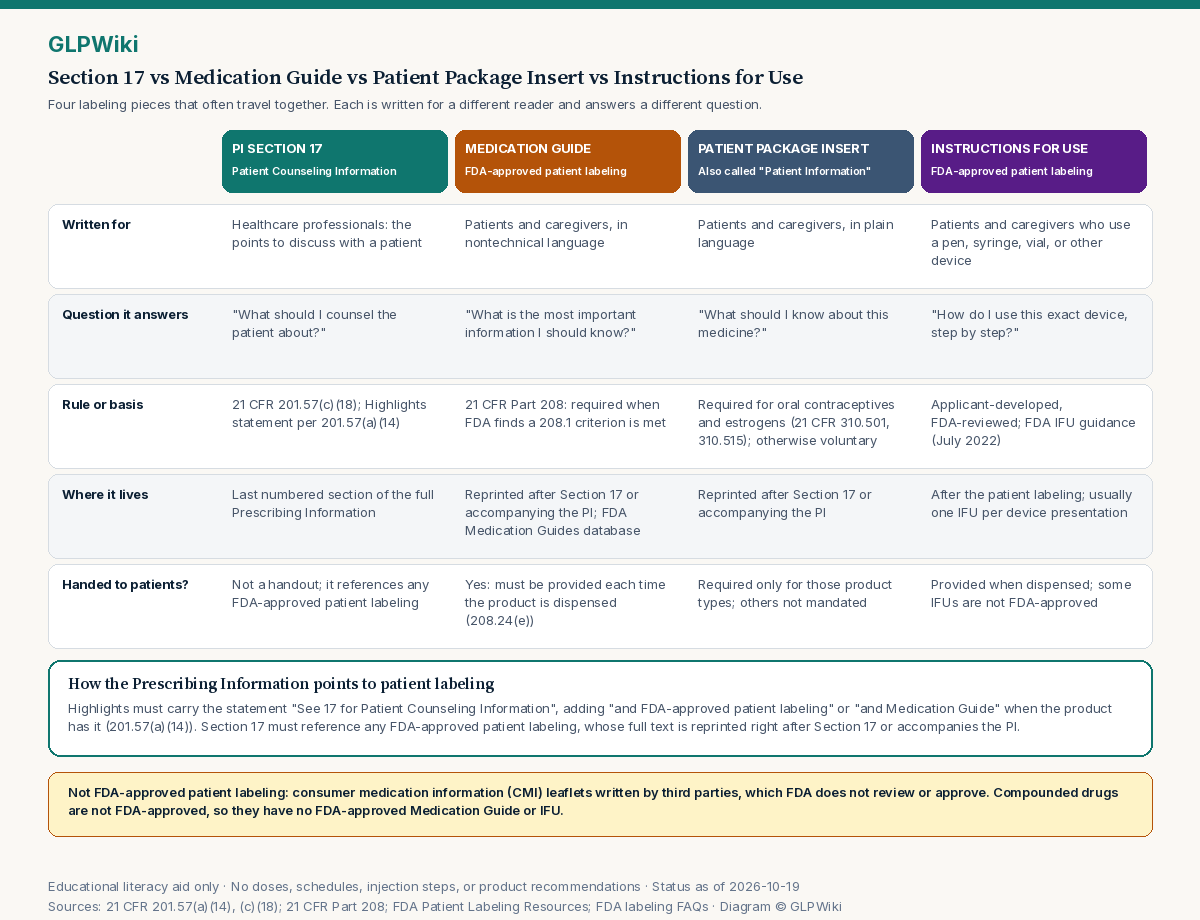
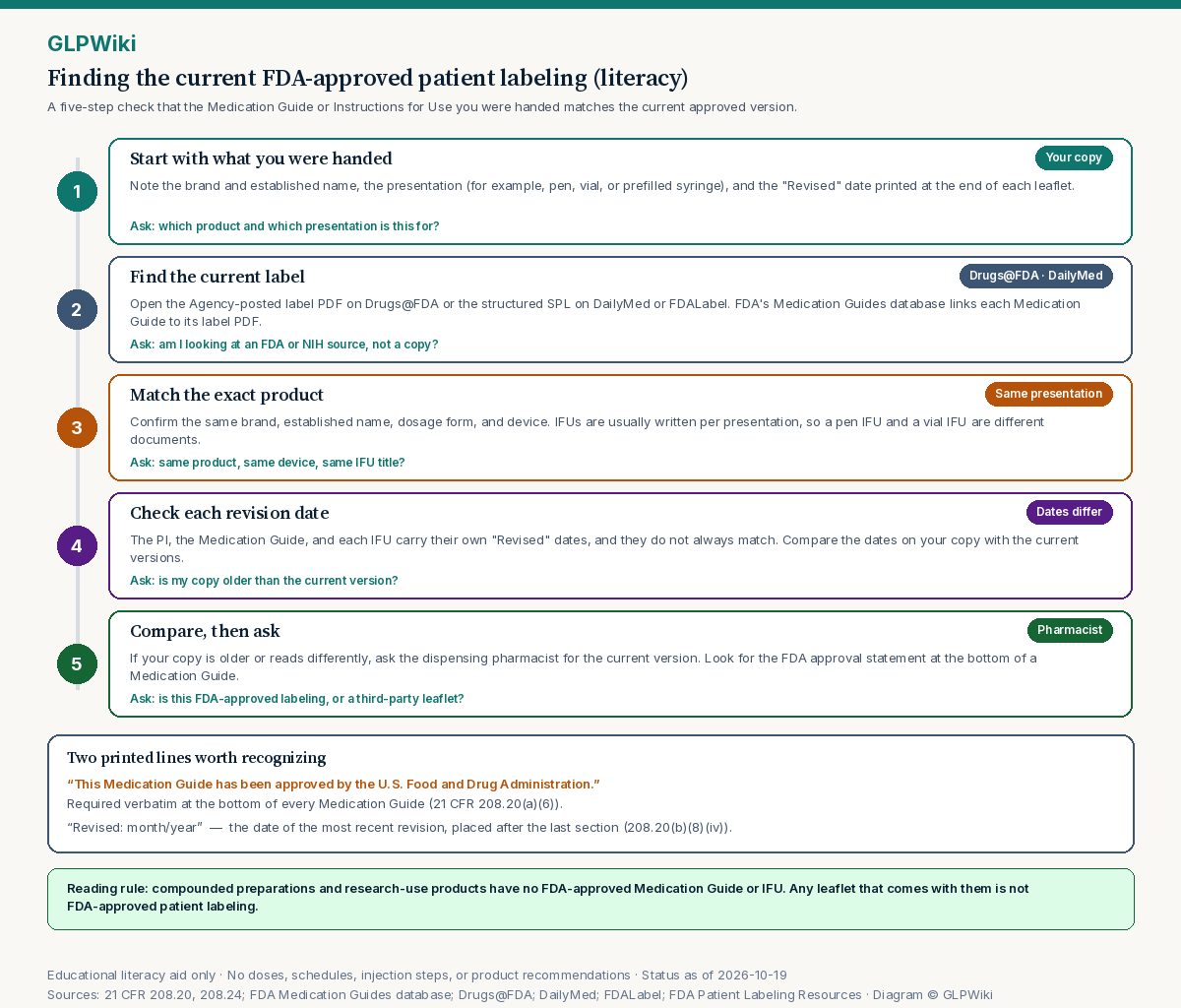
- Two original GLPWiki diagrams: a Section 17 vs Medication Guide vs Patient Package Insert vs IFU map, and a verify ladder for finding the current approved patient labeling.
- Out of scope: doses, titration schedules, injection or device steps, product or pharmacy recommendations, sourcing advice, and medical advice.
What Section 17 Patient Counseling Information is required to contain
In the PLR format, Section 17 is paragraph (c)(18) of 21 CFR 201.57. The regulation says this section must contain information necessary for patients to use the drug safely and effectively, and gives examples such as precautions concerning driving or the concomitant use of other substances that may have harmful additive effects. It also says any FDA-approved patient labeling must be referenced in this section, and the full text of that patient labeling must be reprinted immediately following Section 17 or, alternatively, accompany the prescription drug labeling.
Section 17 is still part of the Prescribing Information, which FDA describes as written primarily for healthcare professionals. Read it as the prescriber's and pharmacist's counseling checklist: the topics a clinician is expected to discuss with a patient. The patient-facing words themselves live in the Medication Guide, Patient Package Insert, or IFU that Section 17 points to.
The pointer starts earlier. Highlights of Prescribing Information must include the verbatim statement "See 17 for Patient Counseling Information" or, if the product has FDA-approved patient labeling, the same statement followed by "and FDA-approved patient labeling" or "and Medication Guide" (21 CFR 201.57(a)(14)). That one line in Highlights tells you whether a Medication Guide or other approved patient labeling exists for the product.
Three kinds of FDA-approved patient labeling
FDA's Patient Labeling Resources page lists three types of FDA-approved patient labeling: Medication Guides, Patient Package Inserts, and Instructions for Use. FDA also states that not all prescription drugs are required to have FDA-approved patient labeling. Each type is written for patients and caregivers, but each answers a different question.
Medication Guide: "What is the most important information I should know?" It is required for certain drugs, approved by FDA, and must be given to the patient when the product is dispensed. Patient Package Insert (also called "Patient Information"): a plain-language overview of the medicine. Instructions for Use: "How do I use this exact product, step by step?" for products with complicated or detailed instructions.
Medication Guides under 21 CFR Part 208
21 CFR 208.3 defines a Medication Guide as FDA-approved patient labeling that conforms to Part 208. Under 208.1, Part 208 covers human prescription drug products, including biological products, that FDA determines pose a serious and significant public health concern requiring distribution of FDA-approved patient information. It applies primarily to products used on an outpatient basis without direct supervision by a health professional, and it applies to new prescriptions and refills.
When is one required? Section 208.1(c) lists three circumstances, any one of which is enough: the product is one for which patient labeling could help prevent serious adverse effects; the product has serious risks (relative to benefits) that patients should know about because the information could affect their decision to use, or to continue to use, the product; or the product is important to health and patient adherence to directions for use is crucial to its effectiveness. FDA makes that determination for a specific product; the presence of a Medication Guide is a regulatory signal, not a ranking of how risky one product is compared with another.
What it must look like. Section 208.20 requires a Medication Guide to be written in English in nontechnical, understandable language, not promotional in tone or content, scientifically accurate, and based on — and not in conflict with — the approved professional labeling, in type no smaller than 10 points. The words "Medication Guide" must appear prominently at the top, and the verbatim statement "This Medication Guide has been approved by the U.S. Food and Drug Administration" must appear at the bottom.
What it covers. Section 208.20(b) sets the headings and their order where relevant: the brand and established names; "What is the most important information I should know about (name of drug)?"; "What is (name of drug)?"; "Who should not take (name of drug)?"; "How should I take (name of drug)?"; "What should I avoid while taking (name of drug)?"; "What are the possible or reasonably likely side effects of (name of drug)?"; general information about safe and effective use; and the date of the most recent revision placed immediately after the last section. Additional headings may be added where appropriate.
Why a Medication Guide must be handed to you
Section 208.24 sets the distribution chain. The manufacturer must obtain FDA approval of the Medication Guide before distributing it and must make enough Medication Guides (or the means to produce them) available so that each patient receiving the product can get one. The container or package label must instruct the authorized dispenser to provide a Medication Guide to each patient and state how it is provided. Each authorized dispenser must then provide a Medication Guide directly to each patient, or the patient's agent, when the product is dispensed, unless an exemption applies.
FDA's Patient Labeling Resources page adds that the Medication Guide shall be dispensed in paper form when the product is dispensed, although the patient may request electronic delivery instead. Under 208.26(b), a prescriber may direct that a Medication Guide not be provided to a particular patient, but the dispenser must still provide one to any patient who requests it.
Reading habit: if a product's Highlights say "and Medication Guide" and you did not receive one, ask the dispensing pharmacist for it. That is a request for a document you are entitled to read, not a question about treatment.
Patient Package Inserts and Instructions for Use
A Patient Package Insert, which FDA notes is also known as "Patient Information," is patient labeling that can be part of the FDA-approved labeling. FDA states that PPIs are required — and must be dispensed with each prescription — for oral contraceptives (21 CFR 310.501) and estrogen-containing products (21 CFR 310.515). PPIs for other prescription drugs are submitted voluntarily and approved by FDA, but their distribution is not mandated.
Instructions for Use are patient labeling developed for prescription drugs with complicated or detailed patient-use instructions. FDA describes the IFU as detailed, action-oriented, step-by-step written and visual instructions on how to use the drug, including preparation, administration, handling, storage, and disposal; its labeling FAQ gives autoinjectors, patches, syringes, and products that need mixing as examples. The IFU is developed by the applicant, reviewed and approved by FDA, and provided to patients or caregivers when the drug is dispensed. FDA also notes that some IFUs are not approved by FDA.
FDA's final guidance Instructions for Use — Patient Labeling for Human Prescription Drug and Biological Products — Content and Format (July 2022) gives FDA's recommendations on IFU content and format for products under an NDA or BLA, including drug-led and biologic-led combination products. GLPWiki deliberately does not restate any product's IFU steps: they belong to the exact device and presentation, and they are the document to read — with your pharmacist or clinician — not a page to paraphrase.
What Section 17 and patient labeling look like on current GLP-1 labels (structure only)
On the current Ozempic (semaglutide) injection label on DailyMed (SPL effective June 2026), Section 17 PATIENT COUNSELING INFORMATION opens with "Advise the patient to read the FDA-approved patient labeling (Medication Guide and Instructions for Use)" and then lists counseling topics under short headings, beginning with the risk of thyroid C-cell tumors. After the PI, the SPL contains a Medication Guide section followed by four separate Instructions for Use — one per pen or prefilled-syringe presentation — and then the carton (Principal Display Panel) images.
On the current Zepbound (tirzepatide) injection label on DailyMed (SPL effective August 2026), Section 17 opens with the same "Advise the patient to read the FDA-approved patient labeling (Medication Guide and Instructions for Use)" sentence. It is followed by a Patient Medication Guide and four IFUs, one each for the single-dose pen, single-dose vial, multiple-dose vial, and multi-dose KwikPen. The Medication Guide headings on both labels follow the Part 208 pattern, including "What is the most important information I should know…", "How should I use…", "What are the possible side effects…", and "How should I store…".
Revision dates are not uniform. In the Ozempic SPL we reviewed, the Medication Guide carried a January 2025 revision date while the pen IFUs carried June 2026; in the Zepbound SPL, the Medication Guide carried August 2026 while the IFUs carried April 2026 or January 2026. That is normal — each document is revised on its own schedule — and it is why GLPWiki recommends checking each date rather than assuming one date covers the whole package. GLPWiki does not reproduce the counseling content, doses, or IFU steps from these labels; read them on the current Agency-posted version for your exact product and presentation.
Finding the current approved Medication Guide or IFU
Start with the copy you were handed: note the brand and established name, the presentation (pen, vial, or prefilled syringe), and the "Revised" date printed at the end of each leaflet. Then open the current label. FDA's labeling FAQ explains that CDER posts the approved Prescribing Information to Drugs@FDA on approval, and that within 14 days the company submits Structured Product Labeling that is then posted to FDA's FDALabel and NIH's DailyMed. FDA's Medication Guides database lists Medication Guides for FDA-approved human prescription drugs and therapeutic biological products and links each one to its label PDF; for vaccines, blood products, and some other biologics it points to FDALabel or DailyMed instead.
Match the exact product and presentation — same brand, same established name, same dosage form and device — because IFUs are usually written per presentation. Compare the revision dates on your copy with the current Medication Guide and IFU. Look for the FDA approval statement at the bottom of a Medication Guide. If your copy is older or reads differently, ask the dispensing pharmacist for the current version.
What is not FDA-approved patient labeling
Consumer medication information (CMI) is written information about a prescription drug developed by someone other than the drug company — for example, a printed leaflet from a third-party publisher handed out with a prescription. FDA states that it does not review or approve CMI, and the drug company does not review it either. It may be useful, but it is not the FDA-approved Medication Guide, and it does not replace one when a Medication Guide is required.
Compounded drugs are not FDA-approved, which FDA's compounding Q&A explains means FDA does not verify their safety, effectiveness, or quality before they are marketed. A compounded preparation therefore has no FDA-approved Prescribing Information, no Section 17, no FDA-approved Medication Guide, and no FDA-approved IFU; any leaflet that comes with it is written by the compounder or pharmacy. Products sold for research use only are not labeled medicines at all. This is a neutral category distinction, not a judgment about any product or pharmacy; see Compounded vs FDA-approved GLP-1 medicines and Approved vs investigational peptides for the framework.
One proposal to watch: in May 2023 FDA published a proposed rule for a new type of Medication Guide called Patient Medication Information (PMI), a one-page FDA-approved document with standardized format and content for outpatient prescription drugs. FDA's PMI page says the comment period closed on November 27, 2023 and that FDA is reviewing comments; as of this review we found no final PMI rule in the Federal Register. Until any final rule takes effect, the current Medication Guide regulations in Part 208 apply.
A practical Section 17 reading path
Read the Patient Counseling statement near the end of Highlights first: does it say "and Medication Guide" or "and FDA-approved patient labeling"? Then read Section 17 as a list of counseling topics and note which other sections it cross-references. Next read the Medication Guide or Patient Information in full, and the IFU for the exact presentation you have. Finally compare every revision date against the current versions on Drugs@FDA, DailyMed, or FDALabel.
When something is unclear, follow your own product's current labeling and ask your pharmacist or clinician rather than a forum, another product's leaflet, or this page.
- Does approved patient labeling exist? The Highlights statement under 201.57(a)(14).
- What should be discussed? Section 17 (prescriber-facing counseling topics).
- What must a patient be told in plain language? The Medication Guide, when one is required.
- How is this exact device used? The IFU for that presentation.
- Is my copy current? Compare revision dates with Drugs@FDA, DailyMed, FDALabel, or FDA's Medication Guides database.
- Compounded or research products: no FDA-approved Medication Guide or IFU — ask the dispensing pharmacy what applies.
Scope, disclaimer and review date
This guide is educational. It maps how to read Section 17 Patient Counseling Information on FDA peptide and GLP-1 Prescribing Information under PLR and the FDA-approved patient labeling it references — what 21 CFR 201.57(a)(14) and (c)(18) require, what Medication Guides are under 21 CFR Part 208 and when they must be dispensed, how Patient Package Inserts and Instructions for Use differ, how to find and date-check current versions, and why compounded or research products have no FDA-approved Medication Guide or IFU. It does not provide doses, titration schedules, injection or device instructions, storage instructions of its own, product or pharmacy recommendations, sourcing advice, or individual medical advice, and nothing here recommends starting, stopping, switching, or continuing any medicine or research chemical. Follow your own product's current labeling and ask your pharmacist or clinician.
Last reviewed: October 19, 2026. Labeling, Medication Guides, IFUs, approval status, and FDA rules may have changed since; verify with Drugs@FDA, DailyMed, FDALabel, FDA's Medication Guides database, and your pharmacist.
Frequently asked questions
- What is Section 17 Patient Counseling Information?
- It is the last numbered section of the PLR Prescribing Information, governed by 21 CFR 201.57(c)(18). It must contain information necessary for patients to use the drug safely and effectively, must reference any FDA-approved patient labeling, and that labeling's full text is reprinted right after Section 17 or accompanies the PI.
- How is a Medication Guide different from the Prescribing Information?
- The Prescribing Information is written primarily for healthcare professionals. A Medication Guide is FDA-approved patient labeling under 21 CFR Part 208, written in nontechnical language, and it must be based on and not conflict with the approved professional labeling.
- When does FDA require a Medication Guide?
- Under 21 CFR 208.1(c), when FDA determines that patient labeling could help prevent serious adverse effects, that patients should know about serious risks that could affect their decision to use or continue a product, or that adherence to directions is crucial to the product's effectiveness.
- Am I supposed to receive a Medication Guide every time?
- For a product that requires one, 21 CFR 208.24(e) says the authorized dispenser must provide a Medication Guide to each patient, or the patient's agent, when the product is dispensed, and Part 208 applies to refills as well as new prescriptions. FDA says it is given in paper form unless the patient requests electronic delivery. If you did not get one, ask your pharmacist.
- What is the difference between a Patient Package Insert and Instructions for Use?
- A Patient Package Insert, also called Patient Information, is a plain-language overview of the medicine; it is required only for certain product types such as oral contraceptives and estrogens. Instructions for Use give step-by-step written and visual directions for products with complicated or detailed use, such as pens and other devices.
- How do I know my Medication Guide or IFU is current?
- Note the Revised date at the end of your copy, then compare it with the current version on Drugs@FDA, DailyMed, FDALabel, or FDA's Medication Guides database for the same product and presentation. The PI, Medication Guide, and each IFU can carry different dates. If yours is older or differs, ask the dispensing pharmacist.
- Is the printed leaflet that came with my prescription a Medication Guide?
- Not necessarily. Consumer medication information written by third parties is not reviewed or approved by FDA. A Medication Guide says Medication Guide at the top and carries the statement that it has been approved by the U.S. Food and Drug Administration at the bottom.
- Do compounded peptides come with an FDA-approved Medication Guide or IFU?
- No. FDA states compounded drugs are not FDA-approved, so they have no FDA-approved Prescribing Information, Section 17, Medication Guide, or IFU. Research-use products are not labeled medicines. Ask the dispensing pharmacy what written information applies.
- Does this page explain how to inject or use my pen?
- No. It teaches how to read and find the labeling. Device steps belong to your product's current FDA-approved IFU; read it and ask your pharmacist or clinician. Doses, schedules, product picks, and personal medical advice are out of scope.
SOURCES
- 0121 CFR 201.57 — Specific requirements on content and format of labeling (PLR), including (a)(14) Patient counseling information statement and (c)(18) 17 Patient counseling information— U.S. Government Publishing Office / eCFR
- 0221 CFR Part 208 — Medication Guides for Prescription Drug Products (208.1 scope, 208.3 definitions, 208.20 content and format, 208.24 distributing and dispensing, 208.26 exemptions)— U.S. Government Publishing Office / eCFR
- 03Patient Labeling Resources (Medication Guides, Patient Package Inserts, Instructions for Use, Patient Medication Information)— U.S. Food and Drug Administration
- 04Frequently Asked Questions about Labeling for Prescription Medicines— U.S. Food and Drug Administration
- 05Medication Guides database— U.S. Food and Drug Administration
- 06Instructions for Use — Patient Labeling for Human Prescription Drug and Biological Products — Content and Format (final guidance, July 2022)— U.S. Food and Drug Administration
- 07Patient Medication Information (proposed rule, May 2023)— U.S. Food and Drug Administration
- 08Prescribing Information Resources (PLR section map)— U.S. Food and Drug Administration
- 09Compounding and the FDA: Questions and Answers— U.S. Food and Drug Administration
- 10Ozempic (semaglutide) injection — Section 17, Medication Guide, and Instructions for Use (DailyMed)— U.S. FDA / DailyMed
- 11Zepbound (tirzepatide) injection — Section 17, Medication Guide, and Instructions for Use (DailyMed)— U.S. FDA / DailyMed
- 12Drugs@FDA— U.S. Food and Drug Administration
- 13DailyMed— U.S. National Library of Medicine
- 14FDALabel: Full-Text Search of Drug Product Labeling— U.S. Food and Drug Administration
EDUCATIONAL REFERENCE ONLY · Not medical advice. Nothing here diagnoses, treats, cures or prevents any disease, and nothing here is a dosing recommendation. Consult a licensed clinician before any treatment decision.