How to read Highlights of Prescribing Information: the half-page front of an FDA label, line by line

Every modern FDA prescription label opens with a box of dense, bold, bulleted text titled "HIGHLIGHTS OF PRESCRIBING INFORMATION." It is the most-read part of the label and the easiest to misread. Over the last several weeks GLPWiki has walked through the numbered sections of the Full Prescribing Information one at a time. This guide covers the part that sits in front of all of them: what 21 CFR 201.57(a) requires Highlights to contain, how to decode the title line, the "Initial U.S. Approval" year, the summarized Boxed Warning, Recent Major Changes and the revision date, and why Highlights is designed as a signpost rather than a substitute for the Full PI. Label-reading literacy only: no doses, no treatment recommendations, no medical advice.
UPDATED 26 OCT 2026 · 12 MIN READ
KEY TAKEAWAYS
- Highlights of Prescribing Information is the required front summary of every prescription label in Physician Labeling Rule (PLR) format. Its contents are set by 21 CFR 201.57(a), its order by 201.56(d)(1), and its formatting (bold, centered headings, horizontal lines, half-page limit) by 201.57(d).
- The first sentence is mandatory and verbatim: "These highlights do not include all the information needed to use [DRUG] safely and effectively. See full prescribing information for [DRUG]." The label tells you, in its own words, that Highlights is incomplete by design.
- The title line names the brand, the established (generic) name, the dosage form and the route, and, for controlled substances, the DEA schedule symbol (for example "CIV"). "Initial U.S. Approval" is the year FDA first approved the active molecule or combination, not the year this brand or indication was approved. That is why Wegovy and both semaglutide tablet labels show 2017, the year Ozempic was approved.
- A Boxed Warning in Highlights is a bolded summary of the full box (at most 20 lines), followed by the verbatim pointer "See full prescribing information for complete boxed warning." Every GLP-1 receptor agonist label we checked opens with "WARNING: RISK OF THYROID C-CELL TUMORS."
- Recent Major Changes lists substantive changes from the past year, and only in five sections: Boxed Warning, Indications and Usage, Dosage and Administration, Contraindications, and Warnings and Precautions. Each entry carries a month/year date. The changed text is marked with a vertical line in the Full PI. Removals can be listed too (several current GLP-1 labels show "Suicidal Behavior and Ideation … (Removed) 02/2026").
- Every Highlights bullet ends with a section number in parentheses, such as (5.2). That cross-reference is required by 201.56(d)(3) and is your link to the full context.
- Highlights ends with "See 17 for PATIENT COUNSELING INFORMATION…" and a "Revised:" date. The revision date applies to the Prescribing Information; a Medication Guide or Instructions for Use can carry a different date, and DailyMed's posting date is something else again.
- Absence in Highlights is not absence from the label. FDA guidance tells applicants to put each risk in Highlights once, under the most appropriate heading, and to leave out less critical detail to stay within half a page. Something missing from Highlights may still be in the Full PI.
What this guide covers (and how it differs from sister pages)
Our hub guide, How to read FDA peptide labeling, explains the overall PLR layout (Highlights, Table of Contents, Full Prescribing Information) in a few sentences. Over the past weeks we have published deep dives on most of the numbered Full PI sections: Indications and Usage (Section 1), Dosage Forms and Strengths (3), Warnings and Precautions and Adverse Reactions (5–6), Drug Interactions (7), Use in Specific Populations (8), Drug Abuse and Dependence (9), Overdosage (10), Description (11), Clinical Pharmacology (12), Nonclinical Toxicology (13), Clinical Studies (14), How Supplied (16) and Patient Counseling (17).
This Day 47 guide is the companion for the front matter itself. It covers what the regulation requires Highlights to contain, how FDA's guidance says each part should be written, and what each line can and cannot tell a reader. We quote current GLP-1 labels from DailyMed only to show structure and wording. This page reproduces no doses, titration steps or strengths, and nothing here suggests who should or should not use any medicine.
Where Highlights comes from: the Physician Labeling Rule
In January 2006 FDA published the final rule "Requirements on Content and Format of Labeling for Human Prescription Drug and Biological Products" (71 FR 3922), commonly called the Physician Labeling Rule. It reorganized prescription labeling into three parts:
- Highlights of Prescribing Information: a concise summary, limited to about half a page (not counting any Boxed Warning).
- Full Prescribing Information: Contents: a table of contents for the numbered sections.
- Full Prescribing Information (FPI): the numbered sections 1–17, where the details, evidence and qualifications live.
Which labels have Highlights, and what it is for
21 CFR 201.56(b) applies this format to prescription drugs whose NDA, BLA or efficacy supplement was approved between June 30, 2001 and June 30, 2006, was pending on June 30, 2006, or was submitted on or after that date. Older products that have not converted keep the "old" format under 21 CFR 201.80, which has no Highlights at all. FDA's Prescribing Information Resources page strongly encourages voluntary conversion. It describes PLR format as including "a concise summary of critical information (Highlights of Prescribing Information)," a Table of Contents, ordering by clinical importance, and standardized numbered sections.
FDA's 2013 PLR implementation guidance states the purpose plainly: Highlights should "provide immediate access to the information to which practitioners most commonly refer and regard as most important," and guide the reader "to the section in the FPI where details can be obtained." It is meant to be "a concise, informative summary of crucial prescribing information, not a verbatim repetition of selected material from the FPI."
The 15 required elements, in order
21 CFR 201.57(a) lists what Highlights must contain, and 201.56(d)(1) fixes the order of the headings. In reading order:
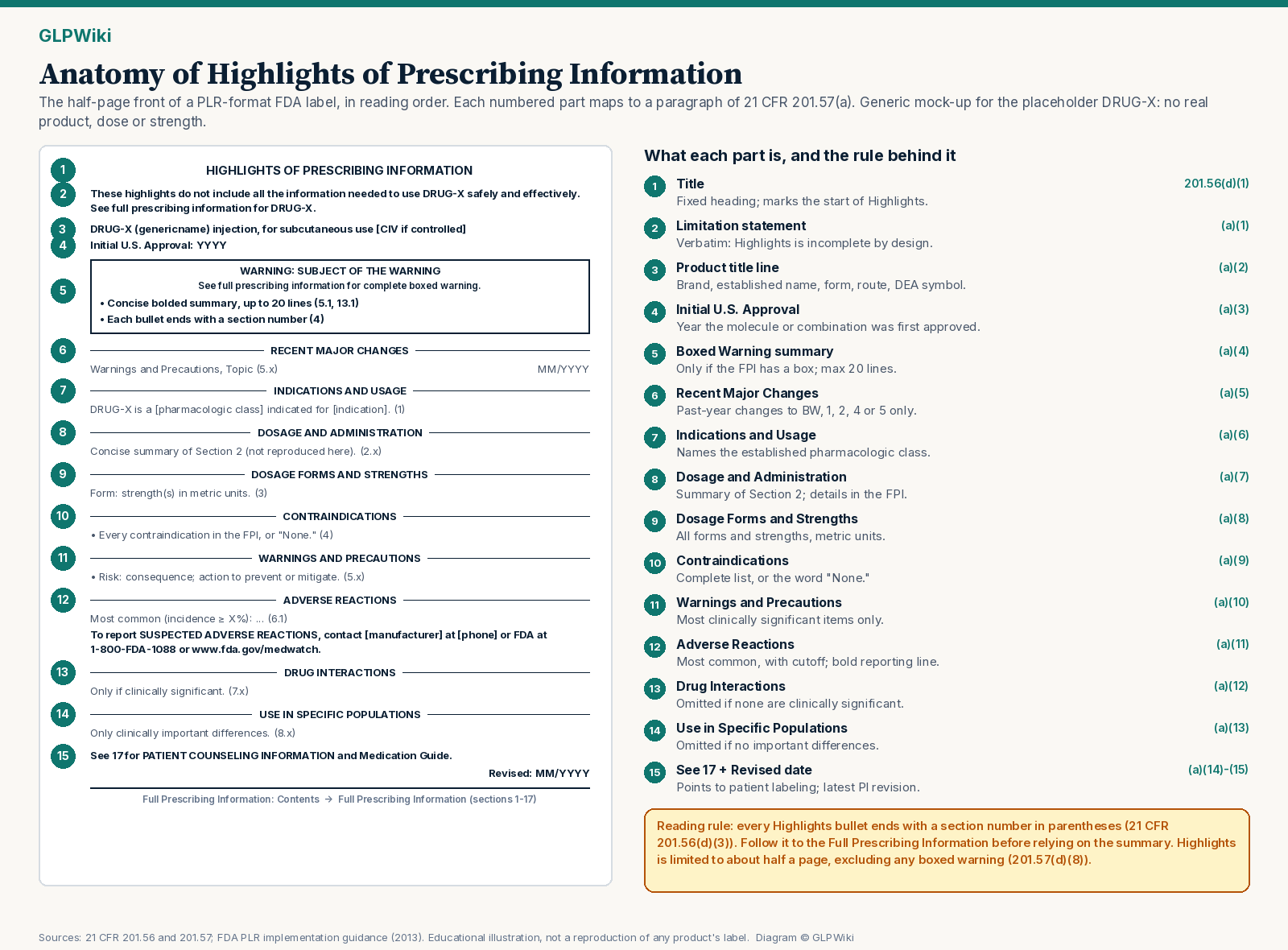
- Title: "HIGHLIGHTS OF PRESCRIBING INFORMATION" (201.56(d)(1)).
- Highlights limitation statement (verbatim, bold) (201.57(a)(1)).
- Product title line: proprietary name, established name, dosage form, route, and controlled-substance symbol if any (a)(2).
- Initial U.S. Approval with a four-digit year (a)(3).
- Boxed Warning summary, if the FPI has a boxed warning (a)(4).
- Recent Major Changes, if any qualifying change was made in the past year (a)(5).
- Indications and Usage (a)(6).
- Dosage and Administration (a)(7).
- Dosage Forms and Strengths (a)(8).
- Contraindications, or the word "None" (a)(9).
- Warnings and Precautions (a)(10).
- Adverse Reactions, plus the verbatim reporting statement (a)(11).
- Drug Interactions (a)(12), only if clinically significant interactions exist.
- Use in Specific Populations (a)(13), only if there are clinically important differences.
- Patient Counseling Information statement (a)(14), then the Revision date (a)(15).
Format rules that make Highlights recognizable
Format rules in 201.57(d) make the layout recognizable at a glance. Headings are bold, and reverse type is not allowed. Horizontal lines separate Highlights, Contents and the FPI. The headings from Recent Major Changes through Use in Specific Populations sit centered in a horizontal line. Multiple subheadings get bullets. The limitation statement, title line, Initial U.S. Approval, Boxed Warning, reporting statement and Patient Counseling statement must be bold. Minimum type size is 8 points. Section 201.56(d)(3) adds one more rule: any reference in Highlights to the FPI must carry the section number in parentheses.
The limitation statement: the label's own disclaimer
The first bold sentence is fixed by 201.57(a)(1):
"These highlights do not include all the information needed to use (insert name of drug product) safely and effectively. See full prescribing information for (insert name of drug product)."
The current Ozempic label reads: "These highlights do not include all the information needed to use OZEMPIC® safely and effectively. See full prescribing information for OZEMPIC." FDA's guidance recommends the product name in upper case for prominence.
This sentence is the single most useful reading instruction on the page. Highlights is selective by design, and the regulation makes the label say so. A screenshot of Highlights, a pharmacy handout that reproduces only Highlights, or an AI summary built from Highlights alone is, by the label's own admission, missing information needed for safe use.
The title line and "Initial U.S. Approval"
Title line. Under 201.57(a)(2), the bold product title gives the proprietary name and the established name (or, for biologics, the proper name), followed by the dosage form and route of administration. Examples from current DailyMed labels:
- "OZEMPIC (semaglutide) injection, for subcutaneous use"
- "WEGOVY (semaglutide) injection, for subcutaneous use" followed by a second line, "WEGOVY (semaglutide) tablets, for oral use." One label can cover more than one dosage form, and each gets its own title line.
- "MOUNJARO® (tirzepatide) Injection, for subcutaneous use"
- "QSYMIA (phentermine and topiramate extended-release capsules), for oral use, CIV." For a controlled substance, the DEA schedule symbol goes at the end of the line (our Day 46 guide explains Section 9 and the CII–CV symbols).
Initial U.S. Approval dates the molecule, not the brand
The title line tells you exactly which product, form and route the label covers. A different brand, form or route is a different label, even when the molecule is the same.
Initial U.S. Approval. Under 201.57(a)(3), the line immediately beneath the title reads "Initial U.S. Approval:" followed by "the four-digit year in which FDA initially approved a new molecular entity, new biological product, or new combination of active ingredients." FDA's guidance adds that this is "regardless of dosage form or indication (i.e., multiple dates should not be listed for different dosage forms or indications)."
This is the most commonly misread line in Highlights. It dates the molecule, not the brand. Initial U.S. Approval shown on current DailyMed labels (checked 2026-10-26):
- Ozempic (semaglutide) injection: 2017
- Wegovy (semaglutide) injection and tablets: 2017
- Rybelsus and Ozempic (semaglutide) tablets: 2017
- Mounjaro (tirzepatide): 2022
- Zepbound (tirzepatide): 2022
- Victoza (liraglutide): 2010
- Saxenda (liraglutide): 2010
- Trulicity (dulaglutide): 2014
- Qsymia (phentermine and topiramate): 2012
Why every semaglutide label shows 2017
Wegovy was first approved years after 2017, and semaglutide tablets came later still, but every semaglutide label shows 2017. Zepbound and Mounjaro share 2022, and Saxenda and Victoza share 2010. When you need the approval date of a specific brand, form or indication, look in Drugs@FDA's approval history, not the Highlights header.
The Boxed Warning in Highlights
If the FPI contains a Boxed Warning, 201.57(a)(4) requires Highlights to carry "a concise summary," "not to exceed a length of 20 lines." It must be inside a box, in bold, under an upper-case heading containing the word "WARNING," and immediately followed by the verbatim sentence "See full prescribing information for complete boxed warning."
FDA's guidance and the SRPI format checklist that FDA reviewers use add several conventions:
- The word is "WARNING," never "WARNINGS," even when the box covers several topics. Topics are joined by a lower-case "and" (e.g., "WARNING: SERIOUS INFECTIONS and ACUTE HEPATIC FAILURE").
- There is one box in the FPI and one summarized box in Highlights. Nothing may appear in the Highlights box that is not in the FPI box.
- Bullets are recommended, each one a discrete warning, and each carries section cross-references.
The GLP-1 boxed warning: Highlights summary vs full box
Every GLP-1 receptor agonist and GIP/GLP-1 label we checked (Ozempic, Wegovy, Rybelsus/Ozempic tablets, Mounjaro, Zepbound, Victoza, Saxenda, Trulicity) has the same heading: "WARNING: RISK OF THYROID C-CELL TUMORS." Comparing the Highlights box with the full box shows how summarizing works. The Ozempic Highlights bullet says semaglutide causes thyroid C-cell tumors in rodents and cross-references (5.1, 13.1). The full box adds that the tumors were "dose-dependent and treatment-duration-dependent … at clinically relevant exposures." The qualifiers live in the FPI. Our Warnings and Precautions guide covers how boxed warnings relate to Sections 4 and 5, and our Nonclinical Toxicology guide covers the rodent findings behind this one.
No box does not mean "no serious risks." Qsymia, for example, has no Boxed Warning but does have Contraindications and Warnings and Precautions entries. A Boxed Warning is FDA's tool for certain serious or life-threatening risks that warrant special prominence (FDA's 2011 guidance sets out when one is used); the rest of the safety picture is in Sections 4–6.
Recent Major Changes: the label's change log
Recent Major Changes (RMC) is the part of Highlights that tells you what has changed lately. The rules in 201.57(a)(5) and FDA's guidance are specific:
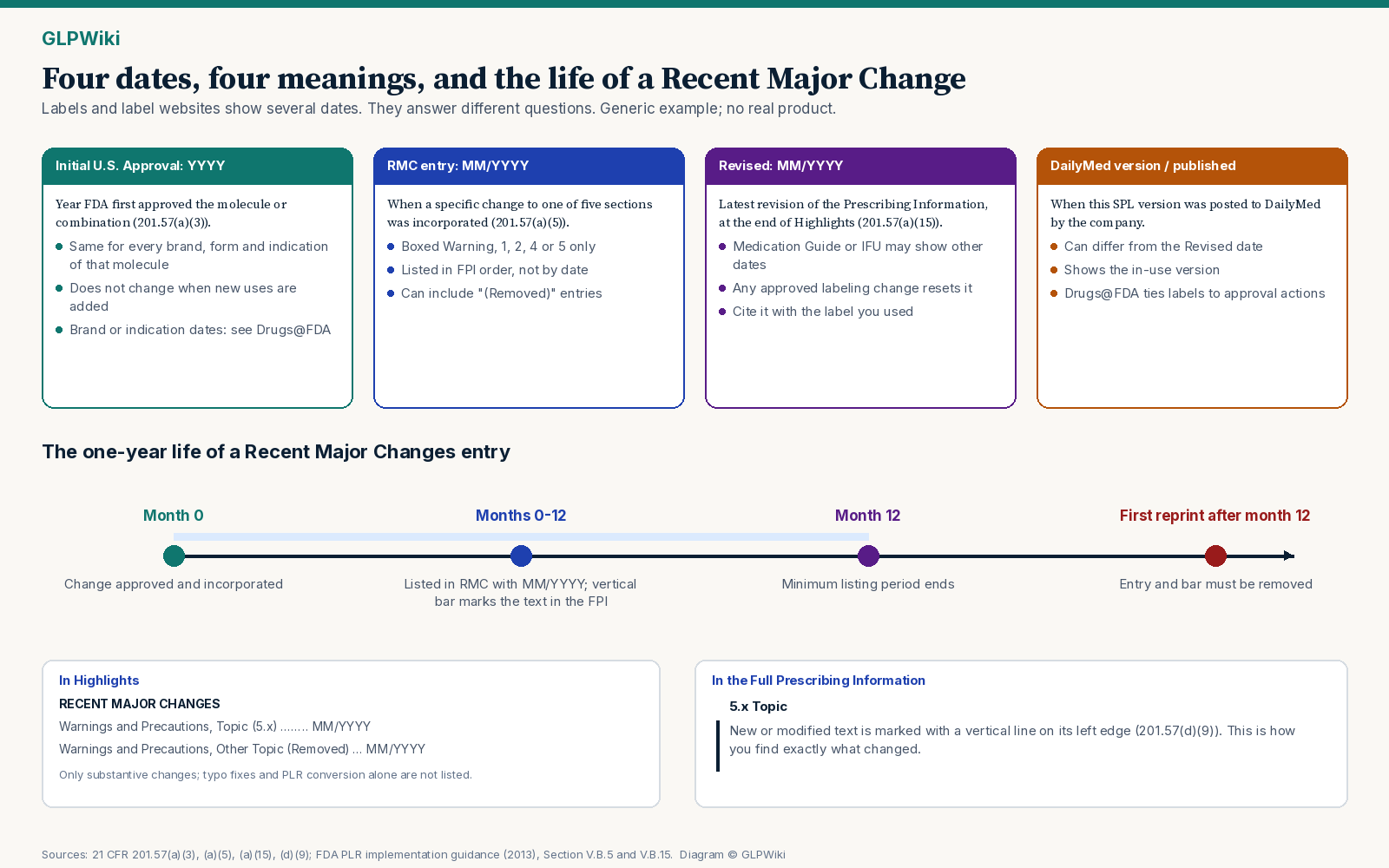
- Only five sections qualify: Boxed Warning, Indications and Usage, Dosage and Administration, Contraindications, and Warnings and Precautions. Changes to Adverse Reactions, Drug Interactions, Clinical Studies and other sections are never listed here, even when they are important.
- Only substantive changes. FDA's guidance excludes typo and grammar fixes, and changes that come only from converting to PLR format.
- Each entry gives the section heading, the subsection heading if appropriate, the section number and the month/year the change was incorporated (for prior-approval changes, the supplement approval date). Example from FDA's guidance: "Indications and Usage, Hypertension (1.2) 6/2011."
- Order follows the FPI, not the calendar. If space is short, only the main section heading and the latest date may be listed.
- Duration: an entry stays at least one year and must be removed at the first printing after that year.
- Vertical bar: under 201.57(d)(9), the corresponding new or modified text in the FPI is marked with a vertical line on its left edge. On DailyMed and in PDFs, that bar is how you find exactly what changed.
- Deletions: FDA's guidance says removals should be identified too. Current DailyMed labels show this in practice: the Wegovy, Saxenda and Zepbound RMC lists each include "Suicidal Behavior and Ideation … (Removed) 02/2026."
What current GLP-1 Recent Major Changes lists look like
What current GLP-1 RMC lists look like (DailyMed SPLs fetched 2026-10-26; wording abbreviated):
- Ozempic injection: Warnings and Precautions, Severe Gastrointestinal Adverse Reactions (5.7), 10/2025.
- Wegovy: Indications and Usage (1); Dosage and Administration (2); several Warnings and Precautions entries, including Never Share WEGOVY FlexTouch Between Patients (5.11), 06/2026; and a Removed entry, 02/2026.
- Mounjaro: Indications and Usage entries for pediatric patients 10 years and older (12/2025) and Major Adverse Cardiovascular Events (08/2026), plus Dosage and Administration and Warnings and Precautions entries.
- Zepbound: Dosage and Administration (2.4); Warnings and Precautions entries including Diabetic Retinopathy Complications in Patients with Type 2 Diabetes Mellitus (5.8), 08/2026; and a Removed entry, 02/2026.
- Trulicity: Warnings and Precautions, Severe Gastrointestinal Adverse Reactions (5.6), 03/2026.
Two reading cautions
Two reading cautions. First, RMC is a rolling one-year window, not a history: a change from three years ago will not appear, so use Drugs@FDA's supplement history (with its labeling PDFs and letters) for older changes. Second, an empty or missing RMC heading means no qualifying change in those five sections in the past year. It does not mean nothing in the label changed.
The middle of Highlights: concise summaries with section pointers
The middle of Highlights summarizes the corresponding FPI sections. Each one has its own GLPWiki deep dive, so here we focus only on how the Highlights version differs.
- Indications and Usage. Must name the established pharmacologic class when one exists, in the form "(Drug) is a (name of class) indicated for (indication(s))" (201.57(a)(6)). FDA's 2009 guidance on Established Pharmacologic Class defines how the class term is chosen. That is why the Ozempic Highlights begins "OZEMPIC is a glucagon-like peptide 1 (GLP-1) receptor agonist indicated:" and Zepbound's begins "ZEPBOUND is a glucose-dependent insulinotropic polypeptide (GIP) receptor and glucagon-like peptide-1 (GLP-1) receptor agonist indicated…". Major limitations of use must be briefly noted. See our Indications and Usage guide.
- Dosage and Administration, and Dosage Forms and Strengths. Concise summaries of Sections 2 and 3. FDA's guidance allows a pointer to the FPI when the regimen is too complex to summarize, and keeps appearance descriptors (color, shape, imprint) out of Highlights. GLPWiki does not reproduce dosing; see our Dosage Forms and Strengths guide for how strengths are written.
- Contraindications. Must list every contraindication in the FPI, or the word "None." This is one of the few Highlights headings meant to be complete.
- Warnings and Precautions. Only "the most clinically significant" items. FDA's guidance asks each bullet to name the risk, its consequence and the action to prevent or reduce it, and to avoid vague phrases like "use with caution." Not every Section 5 subsection appears.
- Adverse Reactions. The most common reactions, with the inclusion threshold stated (for example "≥5%"), followed by the bold reporting sentence: "To report SUSPECTED ADVERSE REACTIONS, contact [manufacturer] at [phone] or FDA at 1-800-FDA-1088 or www.fda.gov/medwatch." Vaccines point to VAERS instead. This line is the label's built-in route to MedWatch.
- Drug Interactions and Use in Specific Populations. Each heading appears only when there is something clinically significant to summarize. FDA's guidance says the absence of data in a population should ordinarily not be listed, and that a risk already summarized elsewhere in Highlights should not be repeated. For example, the Ozempic Highlights has a single Drug Interactions bullet about delayed gastric emptying and oral medications (7.2).
Follow the section number
Every one of these bullets ends in a parenthesized section number such as (5.2) or (8.3). That number is not decoration: 201.56(d)(3) requires it. Follow it before relying on any Highlights sentence.
The last two lines: patient labeling pointer and revision date
Patient Counseling statement. Under 201.57(a)(14), Highlights ends with "See 17 for PATIENT COUNSELING INFORMATION," extended to "…and Medication Guide" or "…and FDA-approved patient labeling" when those exist. FDA's guidance says a product with both a Medication Guide and Instructions for Use refers only to the Medication Guide. The current Ozempic and Zepbound Highlights end "See 17 for PATIENT COUNSELING INFORMATION and Medication Guide." This line tells you a patient-facing document exists; our Patient Counseling and Medication Guide guide explains how to read it.
Revision date. Under 201.57(a)(15), the date of the most recent labeling revision closes Highlights, preferably "Revised: Month/Year." FDA's guidance notes that "FDA-approved patient labeling or Medication Guides can have revision dates that differ from the revision date at the end of Highlights." On DailyMed you will often see several "Revised:" dates on one page. The Ozempic page we checked shows "Revised: 5/2026" at the end of Highlights, while its patient documents carry different dates.
Keep four dates apart (Figure 2):
- Initial U.S. Approval: the year the molecule or combination was first approved. It never changes.
- Recent Major Changes dates: when specific changes to those five sections were incorporated.
- "Revised:" at the end of Highlights: the latest revision of the Prescribing Information.
- DailyMed version or "published" date: when that SPL version was posted to DailyMed. It can lag or differ from the Revised date. Drugs@FDA labels are tied to specific approval actions; DailyMed shows the version the company currently has in use.
Common misreadings, and what Highlights cannot tell you
- "It's not in Highlights, so it's not a risk." Highlights is capped at half a page (a waiver is possible under 21 CFR 201.58), and FDA's guidance tells applicants to list each risk once, under the most appropriate heading. A drug interaction summarized under Warnings and Precautions, for example, is not repeated under Drug Interactions. Check the FPI.
- "Initial U.S. Approval 2017 means this product was approved in 2017." It dates the active molecule (Section 5 above).
- "No Recent Major Changes means the label hasn't changed." RMC covers only five sections and one year.
- "Highlights is the patient summary." Highlights is written for prescribers. The patient-facing documents are the Medication Guide, Patient Information and Instructions for Use, pointed to by the "See 17" line.
- "A Highlights from one product applies to another product with the same molecule." Each label covers the products, forms and routes named on its title line. Highlights from an approved brand does not describe a compounded or "research" product, which has no FDA-approved label at all (see our compounded vs FDA-approved guide).
- "The bullets are complete sentences of fact." They are summaries with qualifiers removed. The Ozempic boxed-warning example in Section 6 shows how much context lives only in the FPI.
How prescribers actually use labels
How prescribers actually use labels is an active research question. Studies led by FDA researchers have found that physicians often go to particular sections (such as dosing, warnings and interactions) rather than reading labels end to end, and that what they view can shape their impressions of a drug's risks and benefits (Sullivan et al., J Am Board Fam Med 2014; Sullivan et al., Res Social Adm Pharm 2022). That is exactly the reading habit Highlights was designed to support: a fast front door with signposts to the details.
A five-step way to read any Highlights
- Confirm the product. Read the title line (brand, established name, form, route, any schedule symbol) and make sure it matches the product you are asking about.
- Read the limitation statement as an instruction. Highlights is a map, not the territory.
- Check the box and the change log. Note any Boxed Warning heading, then scan Recent Major Changes and look for the vertical bars in the FPI.
- Follow every number in parentheses. Read the FPI section behind any bullet that matters to your question.
- Note the dates and the source. Record the "Revised:" date and where you read the label (Drugs@FDA, DailyMed or FDALabel), so you know which version you are citing.
Scope and disclaimer
GLPWiki is an educational resource. This guide explains how FDA prescription drug labeling is structured; it is not medical advice, does not provide dosing information, and does not recommend any treatment. Label contents change; always check the current FDA-approved labeling and talk with a licensed clinician or pharmacist about any medicine. To report a suspected adverse reaction, contact the manufacturer or FDA MedWatch at 1-800-FDA-1088 or www.fda.gov/medwatch. Last reviewed 2026-10-26.
Last reviewed: October 26, 2026. Labeling and guidance may have changed since; verify with Drugs@FDA, DailyMed, and your pharmacist or clinician.
Frequently asked questions
- What is Highlights of Prescribing Information?
- It is the concise front section of FDA prescription drug labeling in PLR format. Its required contents are listed in 21 CFR 201.57(a). It summarizes selected key information from the Full Prescribing Information and points to the numbered sections where the details are.
- Why does Highlights say it does not include all the information needed?
- 21 CFR 201.57(a)(1) requires that verbatim limitation statement. Highlights is limited to about half a page and is selective by design, so the full label must be consulted for safe and effective use.
- What does "Initial U.S. Approval" mean?
- It is the four-digit year FDA first approved the new molecular entity, new biological product or new combination of active ingredients. It is not the approval year of a particular brand, dosage form or indication. That is why every semaglutide label shows 2017.
- What qualifies for Recent Major Changes?
- Only substantive changes in the past year to the Boxed Warning, Indications and Usage, Dosage and Administration, Contraindications, or Warnings and Precautions sections. Each entry has a month/year date, stays at least one year, and is matched by a vertical line beside the changed text in the Full PI.
- Why do some Recent Major Changes entries say "Removed"?
- FDA's guidance says deletions from labeling should be identified in Recent Major Changes as well as additions. Several current GLP-1 labels list a Warnings and Precautions subsection as "(Removed)" with its date.
- Is the Highlights boxed warning the same as the full boxed warning?
- No. The Highlights version is a bolded summary of up to 20 lines followed by "See full prescribing information for complete boxed warning." The full box in the Full PI holds the complete wording and qualifiers.
- Why are there several "Revised" dates on one DailyMed page?
- The date at the end of Highlights is the Prescribing Information's revision date. Medication Guides and Instructions for Use can have their own revision dates, and DailyMed's version or publication date is separate from both.
- Do all prescription drugs have Highlights?
- No. Products approved before the PLR applicability dates that have not converted use the older format under 21 CFR 201.80, which has no Highlights. Products without an FDA-approved label, including compounded and "research-use" peptides, have no Highlights at all.
SOURCES
- 0121 CFR 201.57 — Specific requirements on content and format of labeling (PLR); (a) Highlights, (d) format— U.S. Government Publishing Office / eCFR
- 0221 CFR 201.56 — Requirements on content and format of labeling; (b) applicability, (d)(1) heading order, (d)(3) cross-references— U.S. Government Publishing Office / eCFR
- 0321 CFR 201.80 — Old-format labeling requirements— U.S. Government Publishing Office / eCFR
- 0421 CFR 201.58 — Waiver of labeling requirements— U.S. Government Publishing Office / eCFR
- 05Requirements on Content and Format of Labeling for Human Prescription Drug and Biological Products (final rule), 71 FR 3922, Jan 24, 2006— Federal Register
- 06Labeling for Human Prescription Drug and Biological Products — Implementing the PLR Content and Format Requirements (guidance, Feb 2013)— U.S. Food and Drug Administration
- 07Same guidance, PDF (Section V Highlights; waivers of the half-page requirement)— U.S. Food and Drug Administration
- 08Labeling for Human Prescription Drug and Biological Products — Determining Established Pharmacologic Class for Use in the Highlights of Prescribing Information (guidance, Oct 2009)— U.S. Food and Drug Administration
- 09Warnings and Precautions, Contraindications, and Boxed Warning Sections of Labeling — Content and Format (guidance, Oct 2011)— U.S. Food and Drug Administration
- 10Prescribing Information Resources (PLR format, SRPI checklist, sample template)— U.S. Food and Drug Administration
- 11Example FDA labeling review applying the Selected Requirements of Prescribing Information (SRPI) checklist (NDA 217064, 2024)— U.S. Food and Drug Administration / Drugs@FDA
- 12MedWatch: The FDA Safety Information and Adverse Event Reporting Program— U.S. Food and Drug Administration
- 13Ozempic (semaglutide) injection — Highlights, Boxed Warning, RMC— U.S. FDA / DailyMed
- 14Wegovy (semaglutide) injection and tablets — dual title lines, RMC incl. Removed entry— U.S. FDA / DailyMed
- 15Rybelsus and Ozempic (semaglutide) tablets— U.S. FDA / DailyMed
- 16Mounjaro (tirzepatide)— U.S. FDA / DailyMed
- 17Zepbound (tirzepatide)— U.S. FDA / DailyMed
- 18Victoza (liraglutide)— U.S. FDA / DailyMed
- 19Saxenda (liraglutide)— U.S. FDA / DailyMed
- 20Trulicity (dulaglutide)— U.S. FDA / DailyMed
- 21Qsymia (phentermine and topiramate) — CIV title line, no boxed warning— U.S. FDA / DailyMed
- 22Drugs@FDA: FDA-Approved Drugs (approval history, labels, letters)— U.S. Food and Drug Administration
- 23FDALabel: Full-Text Search of Drug Product Labeling— U.S. Food and Drug Administration
- 24Sullivan HW, O'Donoghue AC, Aikin KJ, et al. Primary care physicians' use of FDA-approved prescription drug labels. J Am Board Fam Med. 2014;27(5):694-698 (PMID 25201939)— Journal of the American Board of Family Medicine / PubMed
- 25Sullivan HW, Squire C, Aikin KJ, et al. Physicians' use of and preferences for FDA-approved prescribing information. Res Social Adm Pharm. 2022;18(6):3027-3037 (PMID 34364803)— Research in Social and Administrative Pharmacy / PubMed
EDUCATIONAL REFERENCE ONLY · Not medical advice. Nothing here diagnoses, treats, cures or prevents any disease, and nothing here is a dosing recommendation. Consult a licensed clinician before any treatment decision.