How to read the Indications and Usage section on peptide labels (Section 1): the indication sentence, Limitations of Use, and what "approved for" really means

GLPWiki's how-to-read-fda-peptide-labeling hub maps the whole Prescribing Information, and our GLP-1 indication guides list which product carries which use. This companion goes one level deeper on Section 1 itself: what 21 CFR 201.57(c)(2) requires an indication to contain, how to read an indication sentence in parts, why 'adjunct to diet and exercise' and 'reduce the risk of' are deliberate wording, how Limitations of Use differ from contraindications and from off-label use, what accelerated-approval wording signals, and why a molecule name is never an indication. Label-reading literacy only: no doses, no treatment recommendations, no medical advice.
UPDATED 24 OCT 2026 · 13 MIN READ
KEY TAKEAWAYS
- Section 1 Indications and Usage is governed by 21 CFR 201.57(c)(2). It must state that the drug is indicated for the treatment, prevention, mitigation, cure or diagnosis of a recognized disease or condition (or a manifestation of one), or for relief of its symptoms.
- When they apply, six extra elements are required: adjunct wording when the drug is used only with a primary therapy such as diet or another drug; limits of usefulness for selected subgroups or surrogate-endpoint approvals; tests needed to select or monitor patients; limits tied to dosing intervals or duration; situations the drug is reserved for; and conditions for long-term use.
- Every listed indication must rest on substantial evidence of effectiveness, and the rule says indications or uses must not be implied or suggested in other sections of the labeling if they are not in Section 1. Section 1 is the boundary of what the label claims.
- Read an indication sentence in parts: which product (brand), what claim type (treat, improve glycemic control, reduce the risk of), which condition, which population and age group, and any adjunct or combination wording. FDA's draft guidance prefers 'reduce the risk of' over 'prevent' because 'prevent' may imply a guarantee the data do not support.
- Limitations of Use are a separate subheading for situations where FDA reviewers have a reasonable concern or uncertainty. They are not contraindications (Section 4), where the risk clearly outweighs any possible benefit, and not every label has them.
- Current weight-management labels for Wegovy, Zepbound and Saxenda carry a Limitation of Use against combining with other products containing the same molecule or with other GLP-1 receptor agonists; the current Ozempic, Rybelsus and Mounjaro Section 1 texts we checked have no Limitations of Use subheading.
- A molecule name is not an indication. Semaglutide, tirzepatide and liraglutide each appear in more than one approved product with different Section 1 text. Off-label use is a use FDA has not determined to be safe and effective for that product, and compounded or research products have no FDA-approved Section 1 at all.
What this guide covers (and how it differs from sister pages)
How to read FDA peptide labeling explains the overall PLR layout, Highlights vs Full Prescribing Information, and Drugs@FDA vs DailyMed. GLP-1 medications by indication and GLP-1 labeled indication expansions map which approved product carries which use. This Day 45 guide is the deep companion for Section 1 as a piece of regulated text: what the regulation requires it to contain, how FDA recommends it be worded, and how to read any indication statement precisely.
It quotes current GLP-1 labels only to show structure and wording patterns. It deliberately reproduces no doses or strengths and does not suggest who should or should not use any medicine. For the product-by-product list of uses, use the two indication guides linked below rather than this page.
What Section 1 is: 21 CFR 201.57(c)(2)
In the PLR format, Section 1 Indications and Usage is paragraph (c)(2) of 21 CFR 201.57. Its core sentence is fixed by the rule: the section must state that the drug is indicated for the treatment, prevention, mitigation, cure, or diagnosis of a recognized disease or condition, or of a manifestation of a recognized disease or condition, or for the relief of symptoms associated with a recognized disease or condition.
FDA's draft guidance on this section (July 2018) describes its primary role as enabling health care practitioners to readily identify appropriate therapies by clearly communicating the approved indications, and stresses that other sections (Dosage and Administration, Contraindications, Warnings and Precautions, Use in Specific Populations) supply essential details. The label is meant to be read as a whole.
Paragraph (c)(2)(i) then lists information that must be included when the listed conditions apply:
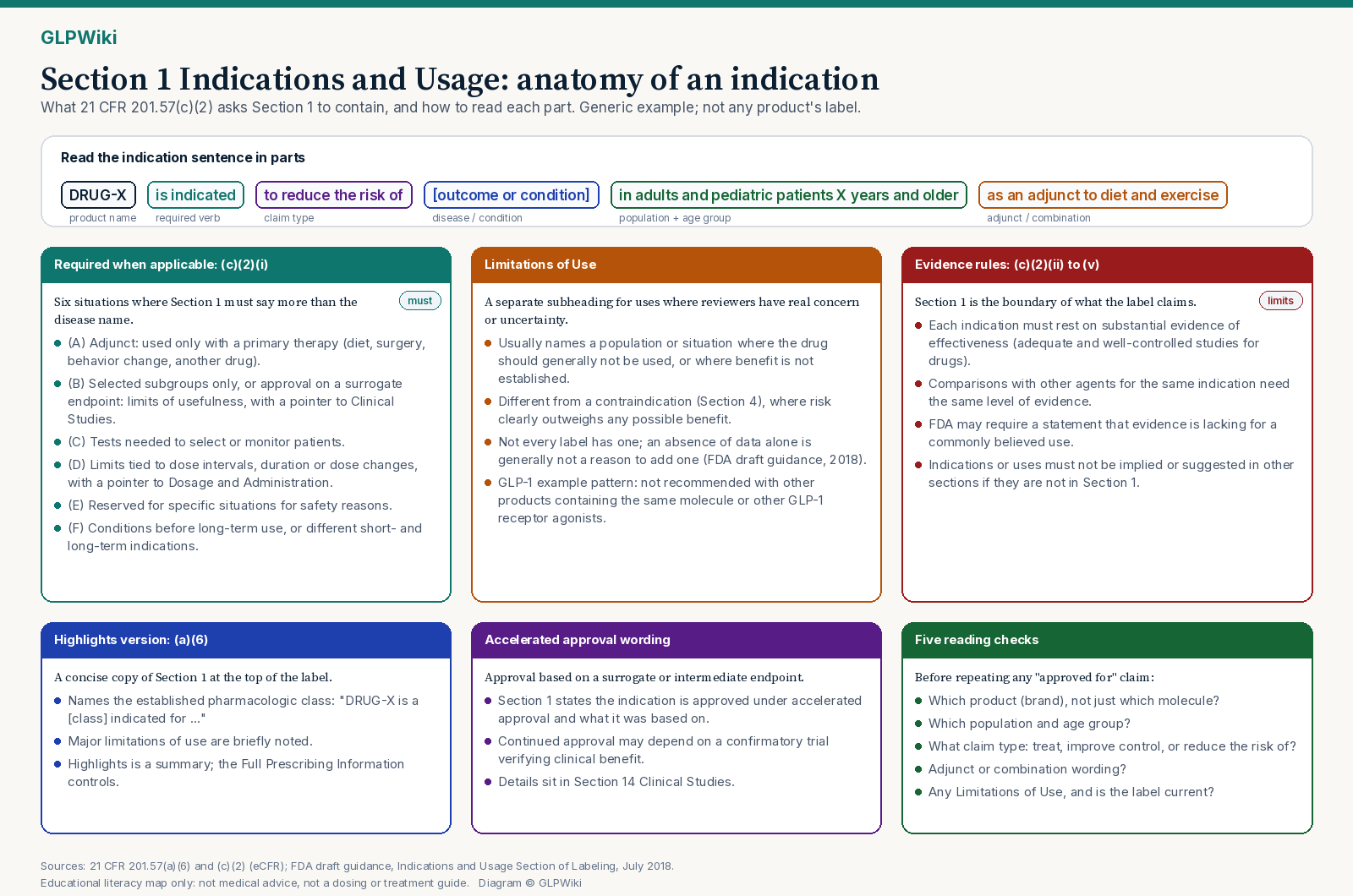
- (A) If the drug is used for an indication only in conjunction with a primary mode of therapy (for example diet, surgery, behavior changes, or another drug), a statement that it is indicated as an adjunct to that mode of therapy.
- (B) If evidence supports safety and effectiveness only in selected subgroups, or if the indication is approved based on a surrogate endpoint (accelerated approval under 21 CFR 314.510 or 601.41), a succinct description of the limitations of usefulness and any uncertainty about anticipated clinical benefits, with a reference to Clinical Studies.
- (C) If specific tests are needed to select or monitor patients, the identity of those tests.
- (D) If limitations of use or uncertainty about benefit are relevant to dosing intervals, treatment duration or dose modification, a concise description with a reference to Dosage and Administration.
- (E) If safety considerations mean the drug should be reserved for specific situations (for example, cases refractory to other drugs), a statement of that information.
- (F) If specific conditions should be met before long-term use, a statement of those conditions, or separate indications for short-term and long-term use if they differ.
The evidence rules: why Section 1 is the boundary of the label
Paragraphs (c)(2)(ii) to (v) set the evidence bar. For drugs other than biological products, every indication listed must be supported by substantial evidence of effectiveness based on adequate and well-controlled studies as defined in 21 CFR 314.126(b), unless that requirement is waived. Biological products need substantial evidence of effectiveness. Any statement in Section 1 comparing the drug's safety or effectiveness with other agents for the same indication must meet the same standard.
Two further rules matter for readers. First, if there is a common belief that a drug works for some use, but the preponderance of evidence shows it is ineffective or that its benefits do not generally outweigh its risks, FDA may require Section 1 to state that evidence is lacking for that use. Second, indications or uses must not be implied or suggested in other sections of the labeling if they are not included in Section 1.
The practical consequence: a result described in Clinical Pharmacology, Clinical Studies or Adverse Reactions is not an indication. A trial finding, a mechanism, or a secondary endpoint in Section 14 does not mean the product is approved for that outcome unless Section 1 says so.
Reading an indication sentence in parts
FDA's draft guidance says an indication should begin 'DRUG-X is indicated' and should use the proprietary (brand) name, with other details such as dosage form or route generally left out to avoid clutter. It also recommends that age groups be stated, for example 'in adults', 'in pediatric patients X years of age and older', or 'in adults and pediatric patients X years of age and older'. Reading each part separately prevents the most common misreadings:
- Product: the brand named in the sentence. Indications attach to a specific approved product, not to the molecule.
- Claim type: 'to improve glycemic control', 'to reduce excess body weight and maintain weight reduction long term', 'to treat', or 'to reduce the risk of' a defined outcome. These are different claims supported by different trials.
- Condition: the recognized disease or condition, sometimes with severity or stage (for example 'moderate to severe obstructive sleep apnea', or MASH 'with moderate to advanced liver fibrosis').
- Population: adults, specified pediatric ages, and qualifiers such as 'with established cardiovascular disease', 'at high risk for these events', 'with chronic kidney disease', or 'with obesity'.
- Adjunct or combination wording: 'as an adjunct to diet and exercise' (common on type 2 diabetes labels) or 'in combination with a reduced-calorie diet and increased physical activity' (common on weight-management labels). Under (c)(2)(i)(A) this wording is required when the drug is meant to be used with a primary therapy, so it is part of the indication, not decoration.
Why 'reduce the risk of' and not 'prevent'
The draft guidance notes that when an indication is to reduce the risk of a clinical outcome, phrases such as 'reduce the risk of' or 'reduce the incidence of' should be considered instead of 'prevent', because 'prevent' may imply a guarantee of success that the data do not support. It also says composite outcomes should be spelled out, which is why cardiovascular indications on GLP-1 labels list the components (cardiovascular death, non-fatal myocardial infarction, non-fatal stroke) rather than just 'heart protection'.
The same guidance discourages 'indicated only for' (the indication should be clear without 'only') and 'also indicated' for newly added uses, because it may imply the new use is less important. If you see a claim online that a product 'prevents heart attacks', compare it with the actual Section 1 wording and population.
The Highlights version: established pharmacologic class
Under 21 CFR 201.57(a)(6), Highlights of Prescribing Information contains a concise statement of each indication, briefly notes major limitations of use, and, if the product belongs to an established pharmacologic class, must identify the class in the form '(Drug) is a (name of class) indicated for (indication(s)).' That is why current Highlights read, for example, 'OZEMPIC is a glucagon-like peptide-1 (GLP-1) receptor agonist indicated...' and 'ZEPBOUND is a glucose-dependent insulinotropic polypeptide (GIP) receptor and glucagon-like peptide-1 (GLP-1) receptor agonist indicated...'.
Each Highlights bullet ends with a section number in parentheses, such as (1), pointing back to the Full Prescribing Information. The draft guidance notes that the established pharmacologic class appears with the indication only in Highlights. Highlights is a summary; when the wording differs in detail, read the full Section 1.
Limitations of Use: what they are, and what they are not
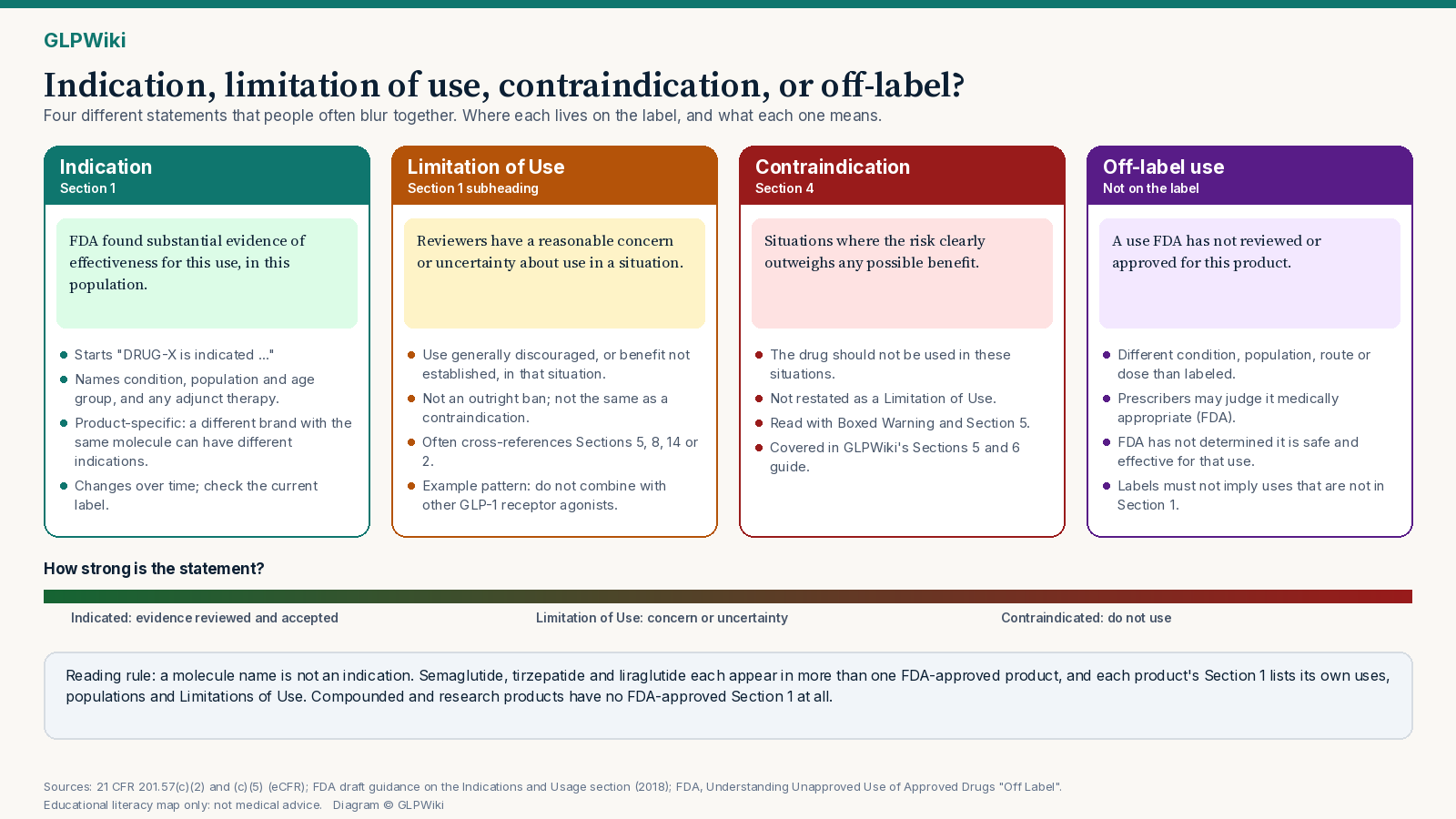
FDA's draft guidance describes Limitations of Use as a separate subheading within Section 1, included when there is reasonable concern or uncertainty among FDA's expert reviewers about a drug's benefit-risk profile in a particular situation. In most cases a limitation of use identifies a population or situation in which the drug should generally not be used, or in which benefit has not been established.
They are distinct from contraindications. Under 21 CFR 201.57(c)(5), a contraindication describes situations in which the drug should not be used because the risk clearly outweighs any possible therapeutic benefit, and the guidance says contraindications should not be restated as limitations of use. The guidance also says that an absence of data in a subgroup generally should not appear as a limitation of use unless there is reasonable concern, and that not every label will have one.
Typical situations where the guidance considers a limitation of use appropriate include concern outside the approved age group, a common use the evidence does not support, a drug approved without a benefit shown by other drugs in its class (for example, an effect on cardiovascular outcomes 'has not been determined'), and dose, duration or long-term-use considerations.
What current GLP-1 Section 1 texts look like (structure only)
Reading Section 1 across current DailyMed labels for six semaglutide, tirzepatide and liraglutide products shows clear patterns. This is a structural reading, paraphrased and without doses; for the full product-by-product list of uses, see GLP-1 medications by indication and GLP-1 labeled indication expansions.
- Type 2 diabetes labels (Ozempic, Rybelsus and Ozempic tablets, Mounjaro) open with glycemic control 'as an adjunct to diet and exercise' in adults with type 2 diabetes; the Mounjaro label also names pediatric patients from a stated age. Each then lists risk-reduction indications with defined populations, such as major adverse cardiovascular events in adults with type 2 diabetes and established cardiovascular disease (Ozempic) or who are at high risk for these events (Rybelsus, Mounjaro), and, on Ozempic, sustained eGFR decline, end-stage kidney disease and cardiovascular death in adults with type 2 diabetes and chronic kidney disease.
- Weight-management labels (Wegovy, Zepbound, Saxenda) use 'in combination with a reduced-calorie diet and increased physical activity', then define populations by obesity or overweight with at least one weight-related comorbid condition, with specified pediatric ages where approved. Zepbound adds moderate to severe obstructive sleep apnea in adults with obesity; Wegovy injection adds cardiovascular risk reduction in adults with established cardiovascular disease and obesity or overweight, and MASH with moderate to advanced fibrosis.
- Limitations of Use appear on the current Wegovy, Zepbound and Saxenda labels, each saying combination with other products containing the same molecule, or with any other GLP-1 receptor agonist, is not recommended. Saxenda adds that safety and effectiveness in pediatric patients with type 2 diabetes have not been established. The current Ozempic, Rybelsus and Mounjaro Section 1 texts we checked have no Limitations of Use subheading.
- Wegovy and Rybelsus SPL documents now cover more than one dosage form under one label (Wegovy injection and tablets; Rybelsus and Ozempic tablets), and Section 1 can list different indications for each form. Read which form each bullet refers to.
Where the evidence behind each indication lives
Section 1 names the use; Section 14 Clinical Studies describes the trials. The weight-management indication for Wegovy traces to the STEP program (for example, Wilding et al., NEJM 2021), cardiovascular risk reduction in people without diabetes to SELECT (NCT03574597; Lincoff et al., NEJM 2023), the kidney outcome indication on Ozempic to FLOW (NCT03819153; Perkovic et al., NEJM 2024), the Zepbound sleep apnea indication to SURMOUNT-OSA (NCT05412004; Malhotra et al., NEJM 2024), and the Wegovy MASH indication to ESSENCE (NCT04822181; Sanyal et al., NEJM 2025). GLPWiki's Clinical Studies (Section 14) guide explains how to read those trial summaries.
Accelerated approval wording in Section 1
FDA's Accelerated Approval Program allows earlier approval of drugs for serious conditions that fill an unmet medical need, based on a surrogate endpoint: a marker thought to predict clinical benefit but not itself a measure of it. Companies must still run studies to confirm the anticipated benefit; if a confirmatory trial does not show benefit, FDA has regulatory procedures that could lead to removing the drug from the market.
Because of 201.57(c)(2)(i)(B), Section 1 must say so. The current Wegovy label shows the pattern: the MASH indication 'is approved under accelerated approval based on improvement of MASH and fibrosis', and 'continued approval for this indication may be contingent upon the verification and description of clinical benefit in a confirmatory trial.' ClinicalTrials.gov lists the ESSENCE trial as still active, not recruiting.
The literacy point: an accelerated-approval indication is a real, current FDA approval, but the label itself tells you the clinical-outcome evidence is still being confirmed. Read the Section 1 sentence together with Section 14 for what the surrogate endpoint was.
Off-label use, and why Section 1 cannot 'imply' new uses
FDA explains that once a drug is approved, health care providers generally may prescribe it for an unapproved use when they judge it medically appropriate for their patient. That is often called off-label use, and it can mean a different condition, a different route, or a different dose than the labeling describes. FDA also says that for such a use, FDA has not determined that the drug is safe and effective.
That is exactly where Section 1 draws the line. Because the regulation bars implying or suggesting uses that are not in Section 1, the label is not the place to look for permission for other uses. Questions FDA suggests asking a provider include what the drug is approved for and whether other approved drugs or therapies exist for the condition.
Compounded and research-labeled products are a different category altogether. FDA states that compounded drugs, including compounded GLP-1 products, are not FDA-approved, so they have no FDA-approved Section 1. A website saying a compounded or 'research' peptide is 'for' a condition is not an FDA indication.
Section 1 changes over time
The draft guidance quotes 21 CFR 201.56(a)(2): the Indications and Usage section must be updated when new information makes the labeling inaccurate, false or misleading. GLP-1 labels have added cardiovascular, kidney, sleep apnea, liver and pediatric indications over the past several years, and in 2026 several of the labels checked for this guide had revisions within the past year.
So any statement that a product 'is approved for' something should name the label version or date. On DailyMed, check the label's revision date and version; on Drugs@FDA, check the approval history and letters for a supplement that added the indication.
A Section 1 verification path on Drugs@FDA and DailyMed
To check any 'approved for' claim:
- Find the exact brand on DailyMed or Drugs@FDA and confirm product name, dosage form and revision date.
- Read Highlights for the class statement and the short list of indications, then open 1 INDICATIONS AND USAGE in the Full Prescribing Information.
- Parse each indication: claim type, condition, population and age group, and adjunct or combination wording. Note which dosage form it applies to if the label covers more than one.
- Look for a Limitations of Use subheading and any accelerated-approval sentence.
- Follow cross-references to Section 14 for the trials and to Sections 4, 5 and 8 for who should not use the drug or needs extra caution. Then discuss any personal question with a prescriber or pharmacist.
Common misreadings
- Treating a molecule name as an indication ('semaglutide is approved for X') when only one specific product's Section 1 says so.
- Reading 'reduce the risk of' as 'prevents' or 'cures'.
- Dropping the population qualifier (for example, 'with established cardiovascular disease' or 'with obesity') when repeating an indication.
- Ignoring adjunct or combination wording, which is part of the approved use.
- Reading a Limitation of Use as a contraindication, or the reverse.
- Treating a trial result in Section 14 or a mechanism in Section 12 as an approved use.
- Assuming an accelerated-approval indication has the same evidence behind it as a traditional approval.
- Applying an approved label's Section 1 to a compounded or research product with the same ingredient name.
- Quoting an old label version after Section 1 has changed.
Scope, disclaimer and review date
This guide is educational. It maps how to read Section 1 Indications and Usage on FDA peptide and GLP-1 Prescribing Information under PLR: what 21 CFR 201.57(c)(2) and (a)(6) require, how FDA's draft guidance recommends indications and Limitations of Use be worded, how indications differ from contraindications and off-label use, what accelerated-approval wording signals, and how current semaglutide, tirzepatide and liraglutide Section 1 texts are structured. It does not provide doses, strengths, titration schedules, preparation or injection steps, treatment instructions, eligibility decisions, product or pharmacy recommendations, or individual medical advice, and nothing here recommends starting, stopping, switching or continuing any medicine or research chemical. Whether any medicine is appropriate for you is a decision for you and your prescriber.
Last reviewed: October 24, 2026. Labeling, indications and approval status may have changed since; verify with Drugs@FDA, DailyMed, and your pharmacist or clinician.
Frequently asked questions
- What is Section 1 Indications and Usage?
- It is the first section of the PLR Full Prescribing Information, governed by 21 CFR 201.57(c)(2). It states the diseases or conditions the specific product is approved to treat, prevent, mitigate, cure or diagnose, with any required qualifiers such as population, age group, adjunct therapy, and Limitations of Use.
- What does 'as an adjunct to diet and exercise' mean on a label?
- Under 201.57(c)(2)(i)(A), when a drug is approved for use only together with a primary mode of therapy such as diet, exercise, surgery or another drug, Section 1 must say it is indicated as an adjunct to that therapy. The wording is part of the approved use.
- What is the difference between a Limitation of Use and a contraindication?
- A Limitation of Use, a subheading in Section 1, flags a situation where FDA reviewers have a reasonable concern or uncertainty, so use is generally not recommended or benefit is not established. A contraindication, in Section 4, describes situations where the risk clearly outweighs any possible benefit, so the drug should not be used.
- Why do labels say 'reduce the risk of' instead of 'prevent'?
- FDA's draft guidance on this section recommends 'reduce the risk of' or 'reduce the incidence of' for outcome indications because 'prevent' may imply a guarantee of success that the data do not support. Composite outcomes are also spelled out component by component.
- If a trial result appears in Section 14, does that make it an approved use?
- No. The regulation says indications or uses must not be implied or suggested in other sections if they are not included in Section 1. Only what Section 1 lists is an approved indication for that product.
- What does accelerated approval mean in an indication?
- It means FDA approved the indication based on a surrogate endpoint that is reasonably likely to predict clinical benefit. Section 1 must say so, and continued approval may depend on a confirmatory trial. The current Wegovy MASH indication is an example.
- Is off-label use illegal?
- FDA explains that health care providers generally may prescribe an approved drug for an unapproved use when they judge it medically appropriate, but FDA has not determined the drug is safe and effective for that use. Discuss any such question with your prescriber; this page does not advise on it.
- Do compounded or research peptides have an Indications and Usage section?
- Not an FDA-approved one. Compounded drugs are not FDA-approved, and research-labeled products are not approved for human use. Statements about what they are 'for' are not FDA indications.
- Can this page tell me whether a GLP-1 medicine is right for me?
- No. It teaches how to read Section 1. It gives no doses, no eligibility decisions and no medical advice. Ask your prescriber or pharmacist about your own situation.
SOURCES
- 0121 CFR 201.57 — Specific requirements on content and format of labeling (PLR), including (a)(6) Highlights indications, (c)(2) 1 Indications and usage, and (c)(5) Contraindications— U.S. Government Publishing Office / eCFR
- 02Indications and Usage Section of Labeling for Human Prescription Drug and Biological Products — Content and Format (draft guidance for industry, July 2018)— U.S. Food and Drug Administration
- 03Labeling for Human Prescription Drug and Biological Products — Implementing the PLR Content and Format Requirements (guidance, February 2013)— U.S. Food and Drug Administration
- 04Prescribing Information Resources (PLR section map)— U.S. Food and Drug Administration
- 0521 CFR 314.126 — Adequate and well-controlled studies— U.S. Government Publishing Office / eCFR
- 0621 CFR 314.510 — Approval based on a surrogate endpoint or on an effect on a clinical endpoint other than survival or irreversible morbidity (accelerated approval)— U.S. Government Publishing Office / eCFR
- 07Accelerated Approval Program— U.S. Food and Drug Administration
- 08Understanding Unapproved Use of Approved Drugs "Off Label"— U.S. Food and Drug Administration
- 09FDA's concerns with unapproved GLP-1 drugs used for weight loss (compounded drugs are not FDA-approved)— U.S. Food and Drug Administration
- 10Drugs@FDA: FDA-Approved Drugs (approval history, letters and labels)— U.S. Food and Drug Administration
- 11Ozempic (semaglutide) injection — Highlights and Section 1 (DailyMed)— U.S. FDA / DailyMed
- 12Rybelsus and Ozempic (semaglutide) tablets — Highlights and Section 1 (DailyMed)— U.S. FDA / DailyMed
- 13Wegovy (semaglutide) injection and tablets — Section 1, Limitations of Use and accelerated approval statement (DailyMed)— U.S. FDA / DailyMed
- 14Mounjaro (tirzepatide) injection — Highlights and Section 1 (DailyMed)— U.S. FDA / DailyMed
- 15Zepbound (tirzepatide) injection — Section 1 and Limitations of Use (DailyMed)— U.S. FDA / DailyMed
- 16Saxenda (liraglutide) injection — Section 1 and Limitations of Use (DailyMed)— U.S. FDA / DailyMed
- 17Wilding JPH, Batterham RL, Calanna S, et al. Once-weekly semaglutide in adults with overweight or obesity (STEP 1). N Engl J Med. 2021;384(11):989-1002 (PMID 33567185)— New England Journal of Medicine / PubMed
- 18Lincoff AM, Brown-Frandsen K, Colhoun HM, et al. Semaglutide and cardiovascular outcomes in obesity without diabetes (SELECT). N Engl J Med. 2023;389(24):2221-2232 (PMID 37952131)— New England Journal of Medicine / PubMed
- 19Perkovic V, Tuttle KR, Rossing P, et al. Effects of semaglutide on chronic kidney disease in patients with type 2 diabetes (FLOW). N Engl J Med. 2024;391(2):109-121 (PMID 38785209)— New England Journal of Medicine / PubMed
- 20Malhotra A, Grunstein RR, Fietze I, et al. Tirzepatide for the treatment of obstructive sleep apnea and obesity (SURMOUNT-OSA). N Engl J Med. 2024;391(13):1193-1205 (PMID 38912654)— New England Journal of Medicine / PubMed
- 21Sanyal AJ, Newsome PN, Kliers I, et al. Phase 3 trial of semaglutide in metabolic dysfunction-associated steatohepatitis (ESSENCE). N Engl J Med. 2025;392(21):2089-2099 (PMID 40305708)— New England Journal of Medicine / PubMed
- 22SELECT: Semaglutide Effects on Heart Disease and Stroke in Patients With Overweight or Obesity (NCT03574597)— ClinicalTrials.gov
- 23FLOW: semaglutide vs placebo in people with type 2 diabetes and chronic kidney disease (NCT03819153)— ClinicalTrials.gov
- 24SURMOUNT-OSA: tirzepatide in participants with obstructive sleep apnea (NCT05412004)— ClinicalTrials.gov
- 25ESSENCE: semaglutide in people with non-alcoholic steatohepatitis (NCT04822181)— ClinicalTrials.gov
EDUCATIONAL REFERENCE ONLY · Not medical advice. Nothing here diagnoses, treats, cures or prevents any disease, and nothing here is a dosing recommendation. Consult a licensed clinician before any treatment decision.