How to read Clinical Studies on peptide labels (Section 14)

GLPWiki's how-to-read-fda-peptide-labeling hub notes that Clinical Studies in a label are selected evidence, not the whole literature. This companion goes deeper on Section 14 itself: what 21 CFR 201.57(c)(15) requires it to contain, how to read study design, enrolled population, endpoints, and results tables or figures, why primary-versus-secondary labels matter less than prospectively defined endpoints, why label results are trial-population averages rather than personal predictions, why separate trials of different products are not head-to-head evidence, and how to cross-check a Section 14 trial against its ClinicalTrials.gov NCT record and PubMed paper. Educational only: no doses, schedules, product picks, or outcome promises.
UPDATED 17 OCT 2026 · 15 MIN READ
KEY TAKEAWAYS
- Under 21 CFR 201.57(c)(15), Section 14 Clinical Studies must discuss the clinical studies that facilitate an understanding of how to use the drug safely and effectively — ordinarily the studies supporting effectiveness for the labeled indications, including study design, population, endpoints, and results.
- Section 14 is deliberately selective: the regulation says it must not be an encyclopedic listing of all, or even most, studies in the development program.
- Studies discussed in Section 14 must not imply indications, uses, or dosing regimens that are not stated in Section 1 Indications and Usage or Section 2 Dosage and Administration.
- FDA's Clinical Studies labeling guidance notes that the terms primary and secondary endpoint are used so variably that they are rarely helpful; the better question is whether a prospectively defined endpoint showed a well-documented, statistically and clinically meaningful effect.
- Results are group-level differences between a studied drug arm and its comparator in a specific enrolled population — trial-population averages, not a prediction for any one person.
- Two products' separate trials printed on two separate labels are not a head-to-head comparison; FDA requires explicit comparative claims to be supported by substantial evidence from trials designed for that comparison.
- Many current GLP-1 labels cite ClinicalTrials.gov NCT identifiers in Section 14, so a reader can open the registry record and search PubMed for the published paper.
- This page publishes no doses, schedules, titration numbers, product recommendations, weight-loss or glucose promises, or personal medical advice.
What this guide covers (and how it differs from sister pages)
How to read FDA peptide labeling already explains PLR Highlights vs Full PI, Drugs@FDA vs DailyMed, and — in one short section — why Clinical Studies in a label are selected evidence rather than the full literature. This Day 38 guide is the deep companion for Section 14 Clinical Studies itself.
It does not repeat how to read a peptide clinical study (trial phases, evidence framing, and paper-reading habits) or the ClinicalTrials.gov guide (how registry records work). It is also distinct from Clinical Pharmacology label literacy (Section 12), Warnings, Precautions, and Adverse Reactions literacy (Sections 4–6), Drug Interactions (Section 7), Use in Specific Populations (Section 8), and GLP-1 labeled indication expansions (how new indications are added over time). Today stays on reading the Section 14 trial summaries printed inside a finished product's Prescribing Information.
- Primary sources: 21 CFR 201.57(c)(15); FDA guidance Clinical Studies Section of Labeling for Human Prescription Drug and Biological Products — Content and Format (January 2006); FDA labeling FAQs and Prescribing Information resources; current finished-product PIs on DailyMed; ClinicalTrials.gov; PubMed.
- Two original GLPWiki diagrams: a Section 14 anatomy map, and a trial-result reading ladder.
- Out of scope: doses, titration schedules, product or pharmacy recommendations, outcome promises, and medical advice.
What Section 14 Clinical Studies is for
Under 21 CFR 201.57(c)(15), the Clinical Studies section must discuss those clinical studies that facilitate an understanding of how to use the drug safely and effectively. Ordinarily it describes the studies that support effectiveness for the labeled indication(s), including study design, population, endpoints, and results — but it must not include an encyclopedic listing of all, or even most, studies performed in the product's clinical development program.
The same paragraph sets two guardrails. For drugs other than biological products, any study discussed in labeling that relates to an indication or use must be adequate and well-controlled as described in 21 CFR 314.126(b), and must not imply or suggest indications, uses, or dosing regimens not stated in Indications and Usage or Dosage and Administration (biological products have a parallel substantial-evidence standard). And any discussion of a study that relates to a risk must refer to the other sections of labeling where that risk is identified or discussed.
FDA's 2006 Clinical Studies labeling guidance summarizes the section's job as presenting (1) the evidence supporting effectiveness in the subjects who were studied, (2) the critical design aspects, including the populations studied and endpoints measured, and (3) the important limitations of the available evidence. That framing is the reading key: Section 14 describes what was shown in specific trials, for specific people, on specific endpoints.
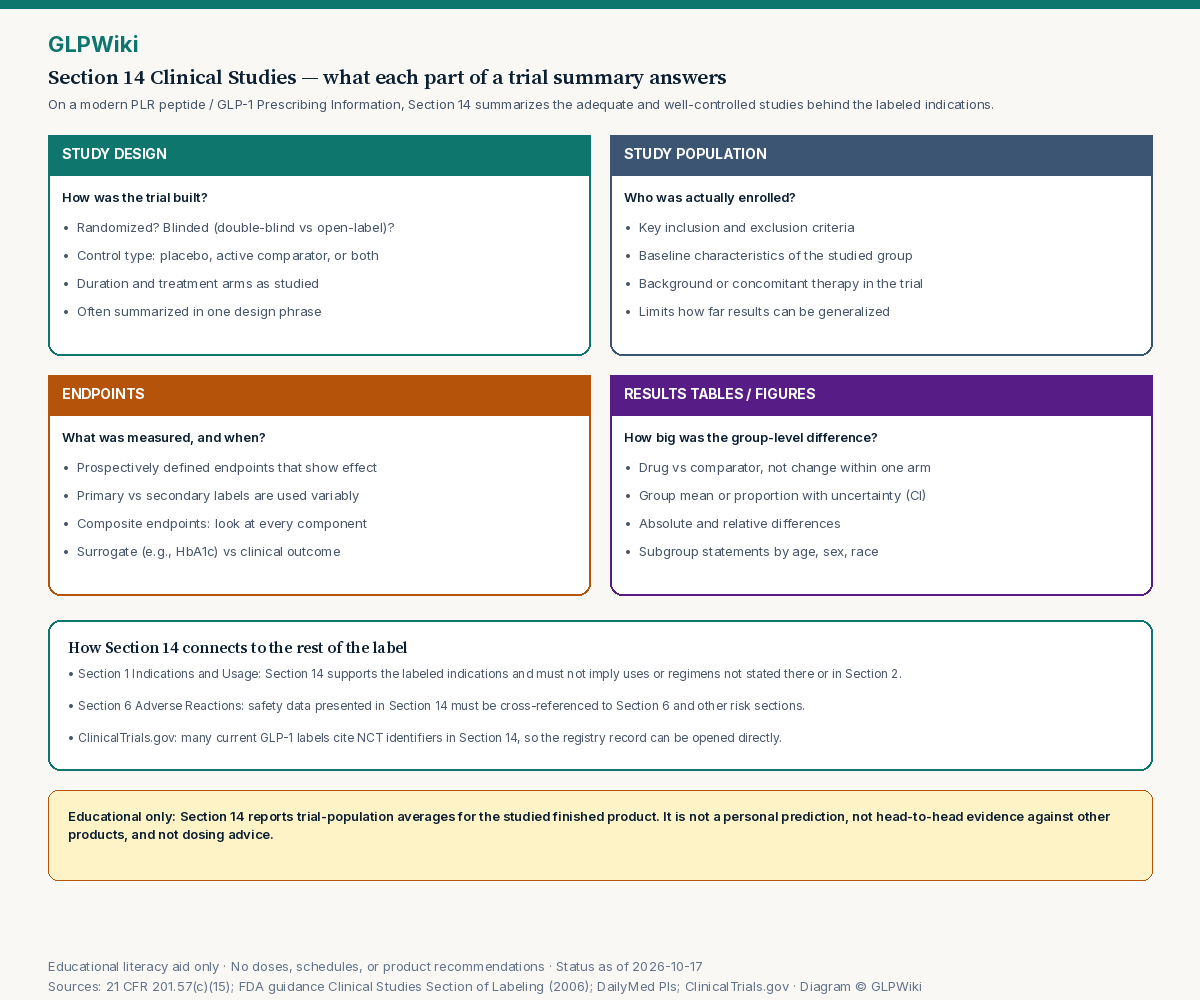
Section 14 anatomy — design, population, endpoints, results
Study design. The guidance recommends identifying blinding (double-blind, partially blinded, open-label), control type (placebo, active, or historical), study duration, method of allocation such as randomization, and any run-in period — often summarized in a phrase like randomized, double-blind, placebo-controlled study. Treatment arms and any titration procedure used in the trial are identified per arm; that is a description of the study protocol, not a dosing instruction for readers.
Study population. The description should identify important inclusion and exclusion criteria, demographics, clinically relevant baseline values, background or concomitant therapy, and anything that limits how far results can be generalized — for example, enrollment rules that exclude people prone to adverse effects, or a population more or less sick than usual.
Endpoints and results. Section 14 presents endpoints that establish effectiveness or show its limits, and results are typically shown as tables or figures comparing the drug arm with the comparator: group means or proportions, measures of uncertainty such as confidence intervals, and both absolute and relative differences where relevant. The guidance asks that composite endpoints show their components and that the section include a summary statement about required subgroup explorations by age, sex, and race.
What Section 14 looks like on current GLP-1 labels (structure only)
Section 14 is organized by the labeled indications it supports, so its subsection headings mirror Section 1. On the current Ozempic (semaglutide) injection PI posted on DailyMed (SPL effective June 2026), Section 14 is split into 14.1 Glycemic Control Trials in Adults with Type 2 Diabetes Mellitus, 14.2 a Cardiovascular Outcomes Trial (SUSTAIN 6, NCT01720446), and 14.3 a Kidney Outcomes Trial (FLOW, NCT03819153). The glycemic-control trials include both double-blind and open-label designs, and both placebo and active comparators.
On the current Zepbound (tirzepatide) injection PI on DailyMed (SPL effective August 2026), Section 14 is split into 14.1 Weight Reduction and Long-Term Maintenance Studies in Adults with Obesity or Overweight and 14.2 Obstructive Sleep Apnea Studies in Adults with Obesity, with trials labeled Study 1, Study 2, and so on alongside NCT identifiers (for example, Study 1 is NCT04184622, registered on ClinicalTrials.gov as SURMOUNT-1).
GLPWiki deliberately does not reproduce result numbers here. Section 14 tables are product-, population-, endpoint-, and timepoint-specific, and labels are revised; quote figures only from the current Agency-posted PI, with the trial name, population, endpoint, and comparator attached.
Primary vs secondary endpoints — and what to ask instead
A primary endpoint is the main outcome a trial is designed and powered to test; secondary endpoints are additional prespecified outcomes. Social-media posts often treat primary as real and secondary as bonus, or the reverse. FDA's Clinical Studies labeling guidance is blunt: the terms primary and secondary endpoint are used so variably that they are rarely helpful, and the appropriate inquiry is whether there is a well-documented, statistically and clinically meaningful effect on a prospectively defined endpoint.
Literacy habits: check the timepoint (results at one week number are not results at another), whether the endpoint is a surrogate such as HbA1c or a clinical outcome such as a cardiovascular event, whether a composite endpoint's components move in the same direction, and whether a subgroup claim comes from a prespecified analysis or an unplanned one — the guidance asks labels to caution about the inherent risks of unplanned subgroup analyses.
Placebo-controlled vs active-comparator trials
In a placebo-controlled trial, the treatment effect is the difference between the drug arm and the placebo arm. The guidance stresses that change from baseline within a single arm is usually not informative by itself; what matters is the between-group comparison — especially when the placebo group also changes a lot. A post quoting only the drug arm's change from baseline is missing the comparison Section 14 is built around.
In an active-comparator trial, the drug is compared with another treatment. The guidance says that when effectiveness can be shown against placebo, active-comparator data should generally not be included unless they are adequate to support an explicit comparative claim; when active-control data are included, labeling should make clear if no comparative claim has been established and disclose limitations, such as a comparator given at a suboptimal or unapproved regimen.
Reading rule: an open-label or active-comparator trial printed in Section 14 does not automatically mean the label claims one product is better than another. Read the exact wording, the design phrase, and any stated limitation.
Trial-population averages are not personal predictions
Section 14 typically reports a mean or median result with a measure of uncertainty, or the proportion of participants reaching a prospectively defined goal. FDA's guidance notes that means or medians, even with variability measures, may not convey how widely individual responses vary — which is why some labels add distribution or cumulative-response figures.
Those numbers describe a specific enrolled population, under specific trial conditions (eligibility rules, background therapy, visit schedules, adherence support, duration). They are not a forecast of what any individual will experience, and they are not a target. Personal expectations and decisions belong with a licensed clinician who knows the person's history and the current label.
Why cross-trial comparisons are not head-to-head evidence
It is tempting to line up the Section 14 tables of two different products and declare a winner. That is a cross-trial comparison: different trials, often with different populations, baseline characteristics, durations, background therapies, endpoints, analysis methods, and comparators. Differences between those tables can reflect trial differences rather than product differences.
FDA's Clinical Studies labeling guidance states that an explicit claim of superior or similar effectiveness must be supported by substantial evidence (21 CFR 201.56(a)(3)) — for superiority, adequate and well-controlled trials designed to establish superiority of one treatment over another. Separate labels are not that design. If a direct comparison exists, it is a specific randomized trial with both products as arms; find it by name and NCT number rather than inferring one from two labels.
For GLPWiki's broader molecule comparisons, treat any side-by-side page as orientation only — not as evidence that one finished product is better for anyone.
How Section 14 relates to Section 1 Indications and Section 6 Adverse Reactions
Section 1 Indications and Usage states the approved uses; Section 14 summarizes the evidence behind them. Under 201.57(c)(15)(i), Section 14 must not imply uses or dosing regimens not stated in Section 1 or Section 2 — so a trial result printed in Section 14 is never a license to infer a new indication, and a published trial that is not in Section 14 is not approved labeling. For how labeled uses change over time, see GLP-1 labeled indication expansions.
Section 6 Adverse Reactions is the usual home for safety data. FDA's guidance notes that safety information may sometimes appear in Section 14 — for example, data from controlled studies specifically designed to evaluate a safety endpoint — and that when it does, it must be cross-referenced to Adverse Reactions and other sections as appropriate. On GLP-1 labels, cardiovascular and kidney outcomes trials in Section 14 are good places to practice following those cross-references. Read the Section 6 tables with their own denominators and limits; see the Warnings, Precautions, and Adverse Reactions literacy guide.
Pharmacokinetic and mechanism detail lives in Section 12 Clinical Pharmacology, not Section 14. If a claim cites half-life or exposure numbers as though they were effectiveness results, it is mixing sections.
Cross-checking a Section 14 trial on ClinicalTrials.gov and PubMed
When Section 14 prints an NCT identifier, open https://clinicaltrials.gov/study/ followed by that NCT number. The registry record shows the registered title and acronym, design, arms, eligibility criteria, prespecified outcome measures, status, and — when posted — results. Compare those with the label summary: same population, same endpoint, same timepoint?
Then search PubMed for the NCT number (PubMed indexes trial registration numbers as secondary source IDs) to find peer-reviewed papers. For example, a PubMed search for NCT01720446 returns the 2016 New England Journal of Medicine paper Semaglutide and Cardiovascular Outcomes in Patients with Type 2 Diabetes, and a search for NCT04184622 returns the 2022 paper Tirzepatide Once Weekly for the Treatment of Obesity. Papers may report more endpoints, subgroups, and analyses than the label — useful context, but not approved labeling.
Keep document types straight: label summary (Section 14), registry record (ClinicalTrials.gov), peer-reviewed paper (PubMed), FDA review documents (Drugs@FDA), and press releases are different things. For registry mechanics, see the ClinicalTrials.gov peptides guide; for appraising a paper, see how to read a peptide clinical study.
A practical Section 14 reading path
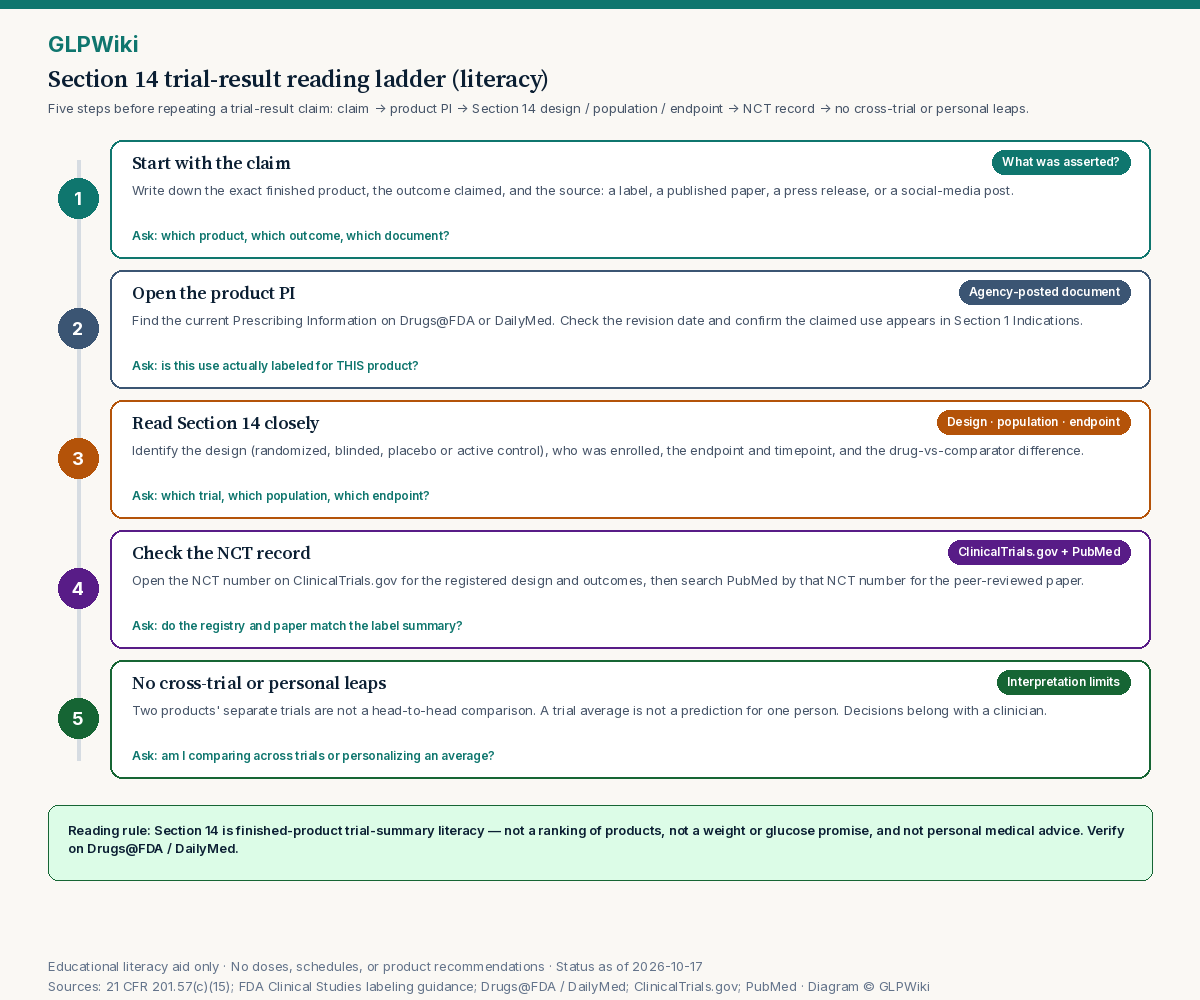
Start with the claim: exact finished product, the outcome claimed, and the document cited. Open the current PI on Drugs@FDA (Agency-posted PDF) or DailyMed / FDALabel (structured SPL) and note the revision date. Confirm the claimed use appears in Section 1. Read the relevant Section 14 subsection for design, population, endpoint, timepoint, comparator, and the between-group result with its uncertainty.
Open the NCT record and the PubMed paper to check consistency. Then apply the two interpretation limits before repeating anything: do not compare across separate trials as though they were head-to-head, and do not turn a trial-population average into a personal prediction.
- Approved finished-product Section 14: Drugs@FDA label PDF.
- Structured SPL search: DailyMed / FDALabel — still verify against the Agency-posted PI when precision matters.
- Registered design and outcomes: ClinicalTrials.gov (NCT record).
- Peer-reviewed paper: PubMed, searched by NCT number.
- Investigational compounds have no Section 14 at all — an NCT record or paper is not labeling.
Scope, disclaimer and review date
This guide is educational. It maps how to read Clinical Studies (Section 14) on FDA peptide and GLP-1 Prescribing Information under PLR — including what 21 CFR 201.57(c)(15) requires, study design, population, endpoints, results tables and figures, placebo vs active comparators, trial-population averages, cross-trial comparison limits, links to Sections 1 and 6, and NCT / PubMed cross-checks. It does not provide doses, titration schedules, administration tutorials, product or pharmacy recommendations, weight-loss or glucose-lowering promises, sourcing advice, or individual medical advice, and nothing here recommends starting, stopping, switching, or continuing any medicine or research chemical. Decisions about health care belong with a licensed clinician and, for approved medicines, the official label.
Last reviewed: October 17, 2026. Labeling, approval status, registry records, and literature may have changed since; verify with Drugs@FDA, DailyMed, FDALabel, ClinicalTrials.gov, PubMed, and your clinician or pharmacist.
Frequently asked questions
- What is Section 14 Clinical Studies for?
- Under 21 CFR 201.57(c)(15), it discusses the clinical studies that facilitate an understanding of how to use the drug safely and effectively — ordinarily the studies supporting effectiveness for the labeled indications, with study design, population, endpoints, and results. It is not a list of every study.
- Does Section 14 include every trial of the medicine?
- No. The regulation says it must not be an encyclopedic listing of all, or even most, studies in the development program. FDA guidance adds that studies reaching the same conclusion should be omitted or described briefly, and the subset shown should reflect the overall database.
- Are primary endpoints more trustworthy than secondary endpoints?
- Not automatically. FDA's Clinical Studies labeling guidance says the terms are used so variably that they are rarely helpful; the better question is whether a prospectively defined endpoint showed a well-documented, statistically and clinically meaningful effect.
- Can I compare two products by putting their Section 14 tables side by side?
- Not as head-to-head evidence. Separate trials differ in population, duration, background therapy, endpoints, and comparators. FDA requires explicit comparative claims to be supported by substantial evidence from trials designed for that comparison.
- Does a Section 14 result tell me what will happen to me?
- No. Section 14 reports group-level results in a specific enrolled population under trial conditions. It is not a personal prediction or target; personal questions belong with a licensed clinician.
- How does Section 14 relate to Section 1 Indications and Section 6 Adverse Reactions?
- Section 14 summarizes evidence for the uses stated in Section 1 and must not imply uses or regimens not stated in Sections 1 or 2. Safety data shown in Section 14 must be cross-referenced to Section 6 and other risk sections.
- How do I find the full trial behind a Section 14 summary?
- Many current GLP-1 labels print NCT identifiers in Section 14. Open the NCT record on ClinicalTrials.gov, then search PubMed by that NCT number to find peer-reviewed papers. Those sources add context but are not approved labeling.
- Does this page give dosing advice or recommend a product?
- No. Doses, schedules, titration numbers, product picks, outcome promises, and personal medical advice are out of scope. GLPWiki publishes educational label literacy only.
SOURCES
- 0121 CFR 201.57 — Specific requirements on content and format of labeling (PLR), including (c)(15) Clinical studies— U.S. Government Publishing Office / eCFR
- 02Clinical Studies Section of Labeling for Human Prescription Drug and Biological Products — Content and Format (Guidance for Industry, January 2006)— U.S. Food and Drug Administration
- 03Clinical Studies Section of Labeling guidance (PDF)— U.S. Food and Drug Administration
- 0421 CFR 314.126 — Adequate and well-controlled studies— U.S. Government Publishing Office / eCFR
- 05Frequently Asked Questions about Labeling for Prescription Medicines— U.S. Food and Drug Administration
- 06Prescribing Information Resources (PLR section map)— U.S. Food and Drug Administration
- 07Ozempic (semaglutide) injection Prescribing Information — Section 14 Clinical Studies (DailyMed)— U.S. FDA / DailyMed
- 08Zepbound (tirzepatide) injection Prescribing Information — Section 14 Clinical Studies (DailyMed)— U.S. FDA / DailyMed
- 09NCT01720446 — SUSTAIN 6 trial record— ClinicalTrials.gov / U.S. National Library of Medicine
- 10NCT04184622 — SURMOUNT-1 trial record— ClinicalTrials.gov / U.S. National Library of Medicine
- 11Marso SP et al. Semaglutide and Cardiovascular Outcomes in Patients with Type 2 Diabetes. N Engl J Med. 2016 (PMID 27633186)— PubMed / U.S. National Library of Medicine
- 12Jastreboff AM et al. Tirzepatide Once Weekly for the Treatment of Obesity. N Engl J Med. 2022 (PMID 35658024)— PubMed / U.S. National Library of Medicine
- 13Drugs@FDA— U.S. Food and Drug Administration
- 14DailyMed— U.S. National Library of Medicine
- 15FDALabel: Full-Text Search of Drug Product Labeling— U.S. Food and Drug Administration
- 16ClinicalTrials.gov— U.S. National Library of Medicine
- 17PubMed— U.S. National Library of Medicine
EDUCATIONAL REFERENCE ONLY · Not medical advice. Nothing here diagnoses, treats, cures or prevents any disease, and nothing here is a dosing recommendation. Consult a licensed clinician before any treatment decision.