503A vs 503B compounding for GLP-1 medicines: shortage rules and what changed
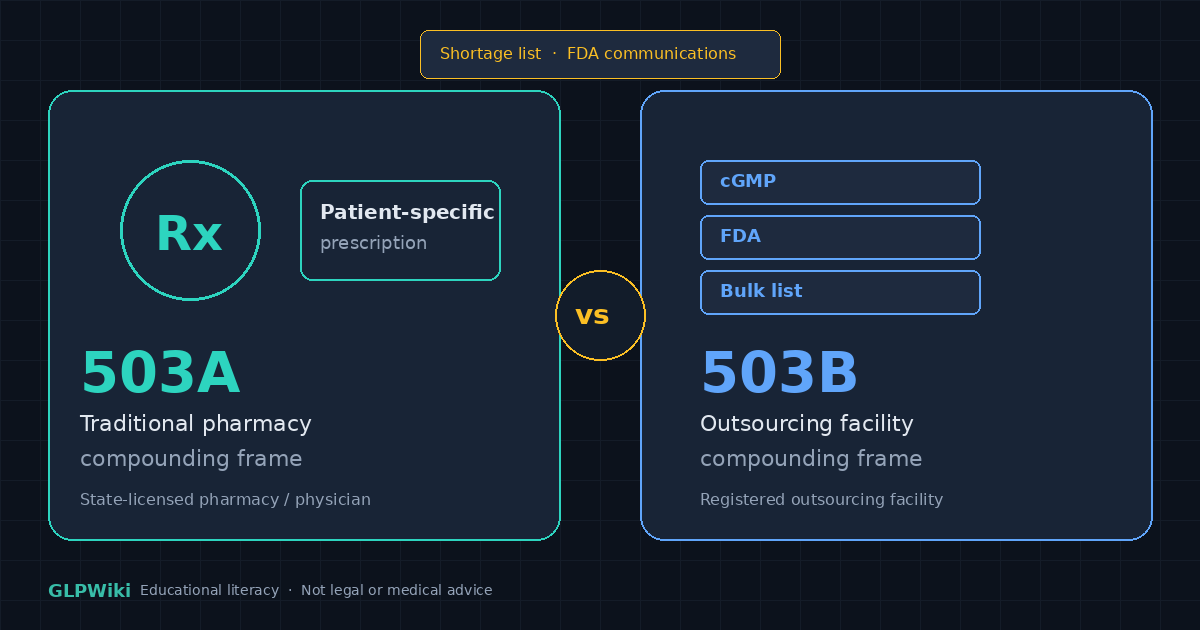
Sections 503A and 503B of the FD&C Act frame pharmacy compounding differently. This literacy guide explains the high-level differences for GLP-1 medicines, how shortage status interacted with compounding, what FDA has said about "essentially a copy," and how to read current public FDA communications — without legal advice, medical advice, doses, or product recommendations.
UPDATED 27 SEPT 2026 · 14 MIN READ
KEY TAKEAWAYS
- Sections 503A and 503B of the FD&C Act are different compounding frameworks: traditional patient-specific pharmacy compounding versus registered outsourcing facilities with different quality and oversight conditions.
- Compounded drugs are not FDA-approved finished products. FDA does not review them for safety, effectiveness, or quality before marketing — shortage status does not change that fact.
- "Essentially a copy" is a high-level statutory/guidance concept that restricts compounding copies of commercially available (503A) or approved (503B) drugs, with shortage-related interactions described in FDA communications.
- Tirzepatide and semaglutide shortage-resolution timelines and enforcement-discretion windows were announced by FDA historically; always check the CURRENT FDA shortage database and compounding communications rather than treating any article date as forever-true.
- FDA's April 30, 2026 announcement proposing to exclude semaglutide, tirzepatide, and liraglutide from the 503B bulks list is a proposal inviting comments — not a final determination.
- This page is educational literacy only: not legal advice, not medical advice, no doses, no pharmacy or product recommendations.
Why 503A vs 503B literacy matters for GLP-1 readers
Search results and telehealth pages often use "compounded GLP-1" as if it were one category. United States federal law actually frames two main pathways for human drug compounding under the Federal Food, Drug, and Cosmetic Act: section 503A and section 503B. The words sound similar; the oversight, quality expectations, and copy/shortage conditions differ.
GLPWiki's companion guide on compounded versus FDA-approved GLP-1 medicines explains the bigger approved-versus-compounded distinction and what FDA has warned about for unapproved products. This sibling page goes one level deeper into the 503A/503B frame and the shortage history that shaped public debate — still as literacy, not as a compliance manual.
Two facts stay constant across every period: (1) compounded finished preparations are not FDA-approved drugs, and (2) a shared molecule name is not the same as an approved finished product you can look up in Drugs@FDA. Approval attaches to a specific application, formulation, strength, and labeling — see also our approved-versus-investigational guide and how-to-read-FDA-peptide-labeling guide.
This page is not legal advice and not medical advice. It does not tell anyone whether a particular pharmacy, product, or arrangement is lawful. Operative questions belong with FDA's current primary sources, state boards, and qualified professionals. Never invent a dose or a purchase path from an encyclopedia article.
High-level frames: 503A traditional compounding vs 503B outsourcing facilities
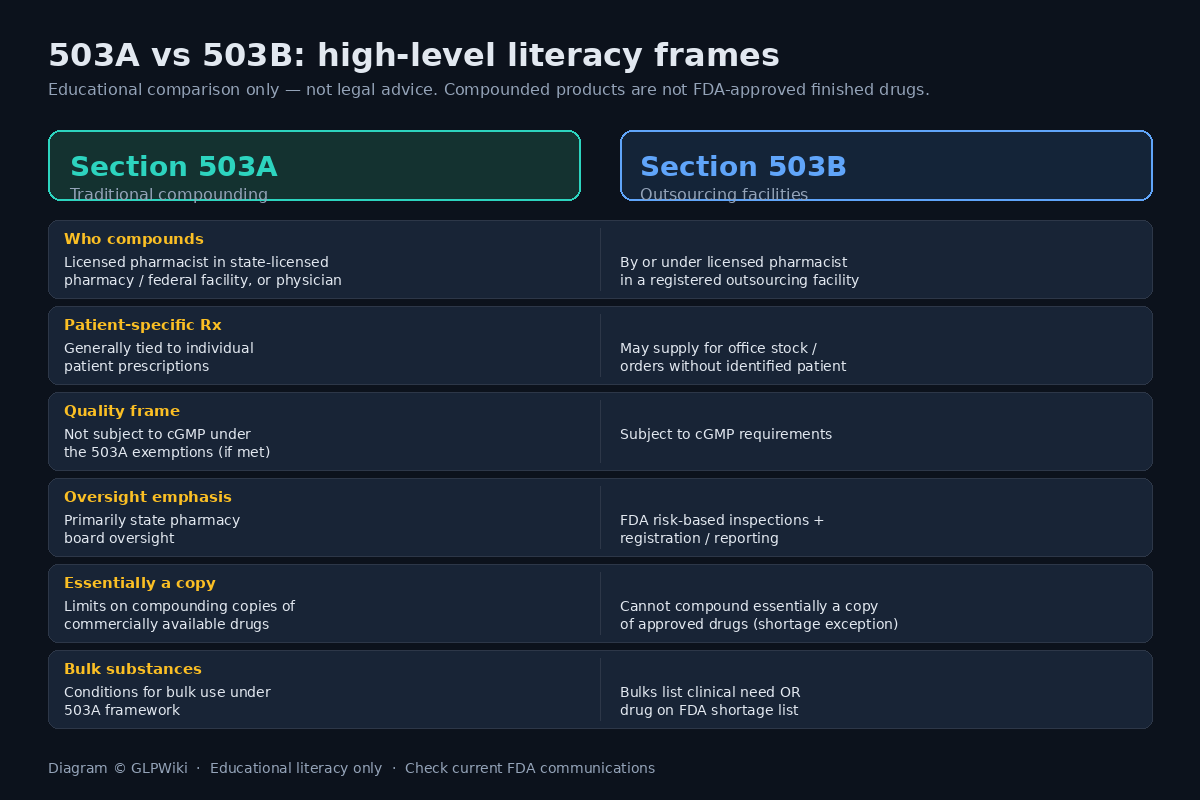
At a literacy level, section 503A addresses compounding by a licensed pharmacist in a state-licensed pharmacy or federal facility, or by a licensed physician, typically tied to individual patient prescriptions. When conditions are met, certain FD&C Act requirements — including new-drug approval, adequate directions for use labeling, and cGMP — may not apply in the way they do to conventional manufacturers. That exemption structure is why compounded products are not the same thing as FDA-approved finished drugs.
Section 503B, added by the Drug Quality and Security Act, created a voluntary category of registered outsourcing facilities. These facilities compound under different conditions: they are subject to current good manufacturing practice (cGMP) requirements, register with FDA, and are inspected by FDA on a risk-based schedule. They may, under the statute's conditions, distribute compounded drugs with or without patient-specific prescriptions (for example, office stock ordered by a healthcare facility).
FDA's Human Drug Compounding hub and the "FD&C Act Provisions that Apply to Human Drug Compounding" page are the right primary places to compare conditions side by side. This guide summarizes only enough for a reader to recognize which frame a claim is gesturing at — not enough to practice under either section.
Quality and labeling expectations differ between the frames. Outsourcing facilities under 503B remain subject to cGMP; traditional 503A compounding that meets its conditions is not held to that same cGMP exemption trade-off. Either way, the finished compounded product still did not go through FDA's premarket approval review for that specific preparation.
What "essentially a copy" means at a high level
Both sections restrict compounding drugs that are "essentially a copy" of available approved or commercially available drugs, with different statutory wording. FDA has published guidance elaborating how it interprets those phrases. The literacy takeaway is simple: compounding is not a standing permission to reproduce an approved GLP-1 medicine at scale because demand exists.
In FDA's April 1, 2026 clarification for compounders as national GLP-1 supply began to stabilize, the agency restated 503A conditions including that the compounder does not compound, regularly or in inordinate amounts, drugs that are essentially copies of a commercially available drug product. FDA described intending to consider a compounded product essentially a copy when it has the same API(s) in the same, similar, or easily substitutable strength and can be used by the same route of administration — unless a prescriber documents a significant difference for an identified individual patient.
That same communication discussed combination examples (for instance, semaglutide API plus another API such as vitamin B12) and how FDA may still view them as essentially a copy when strength and route criteria are met. It also noted a stated enforcement posture regarding very small monthly prescription counts — details that can change and must be read from the live FDA page, not from this summary.
Under 503B, outsourcing facilities are restricted from compounding drugs that are essentially a copy of one or more approved drugs; among other things, that means a compounded drug may not be identical or nearly identical to an approved drug unless the approved drug is on FDA's drug shortage list (subject to the statute's conditions). Bulk drug substance use under 503B is separately limited to substances on the 503B bulks list (clinical need) or drugs on the shortage list at the time of compounding, distribution, and dispensing.
None of the above is a determination about any specific product you may have seen online. It is vocabulary for reading FDA's own sentences accurately.
Shortage history for GLP-1 injections — read as historical announcements
From 2022 onward, several GLP-1 injection products appeared on FDA's drug shortage list amid elevated demand. Shortage status mattered for compounding conditions, especially under 503B's shortage-related pathway for bulk use and copy restrictions, and it interacted with FDA enforcement-discretion timelines described in public updates.
FDA's page "FDA clarifies policies for compounders as national GLP-1 supply begins to stabilize" is the primary chronological record readers should use. Historical highlights from that page (always verify current text): tirzepatide injection shortage was determined resolved (with later litigation-related reevaluation and a December 19, 2024 reaffirmation that the shortage was resolved), with stated 503A/503B enforcement-discretion windows into early 2025; semaglutide injection shortage was determined resolved on February 21, 2025, with stated 503A discretion into April 22, 2025 and 503B discretion into May 22, 2025, later tied to court decisions on preliminary injunction motions.
On April 1, 2026, FDA reminded compounders that certain conditions must still be met under 503A and 503B, restated essentially-a-copy concepts, and noted that tirzepatide and semaglutide did not then appear on the 503B bulks list or on FDA's drug shortage list. Treat that sentence as a dated agency statement — open the live shortage database before drawing a present-tense conclusion.
Other GLP-1 products (for example dulaglutide or liraglutide presentations) have appeared in FDA's shortage-status snapshots at various times. Manufacturer "available" notes are not automatically the same as an FDA determination that a shortage is resolved. The only durable habit is: check FDA's Drug Shortages database and current compounding communications, not a blog post's timestamp.
Litigation between outsourcing-facility associations and FDA affected interim timelines; court outcomes changed when discretion periods ended. This page does not analyze those cases. It only flags that enforcement windows were time-limited and case-linked in FDA's own updates.
April 2026 proposal: excluding three GLP-1 substances from the 503B bulks list
On April 30, 2026, FDA announced it is proposing to exclude semaglutide, tirzepatide, and liraglutide from the 503B bulks list, stating it did not identify a clinical need for outsourcing facilities to compound these drugs from bulk substances. The press announcement invited electronic comments through a docket by June 29, 2026, and said the agency will consider comments before a final determination.
Literacy point: a proposal is not a final rule or final list determination. Comment periods exist so interested parties can submit input. Do not treat the proposal headline as if the list action were already final, and do not treat this encyclopedia page as updating itself when the docket closes — re-check FDA's announcement and related dockets.
Separately, bulk-substance limits are only one piece of the 503B picture. Shortage-list status, essentially-a-copy limits, cGMP, registration, and adverse-event reporting remain part of the statutory frame. FDA's Human Drug Compounding resources remain the index for those pieces.
Risks of compounded drugs and FDA's unapproved GLP-1 concerns
FDA's "Understanding the Risks of Compounded Drugs" page states plainly that compounded drugs are not FDA-approved and that the agency does not review their safety, effectiveness, or quality before marketing. Poor quality — contamination or wrong strength — can cause serious harm. Labels may lack adequate directions. Those risk statements apply whether a preparation was made under a 503A or 503B frame.
FDA's "Concerns with Unapproved GLP-1 Drugs Used for Weight Loss" page catalogs additional issues specific to this product class: salt forms (for example semaglutide sodium or acetate) that are different active ingredients from approved products; fraudulent or mismatched labels; shipping/storage problems for refrigerated injectables; multidose-vial measurement confusion; and adverse-event reports. The agency has also stated that retatrutide and cagrilintide cannot be used in compounding under federal law.
Our sibling guide on compounded versus FDA-approved GLP-1 medicines walks through those concern pathways with diagrams. Use that page for formulation and measurement literacy; use this page for the 503A/503B and shortage frame.
Report suspected quality problems or adverse events through MedWatch. Clinical decisions belong with a licensed clinician using the official label for any approved product, or appropriate professional judgment where compounding is being considered for a documented medical need.
How to verify a claim — a practical literacy path
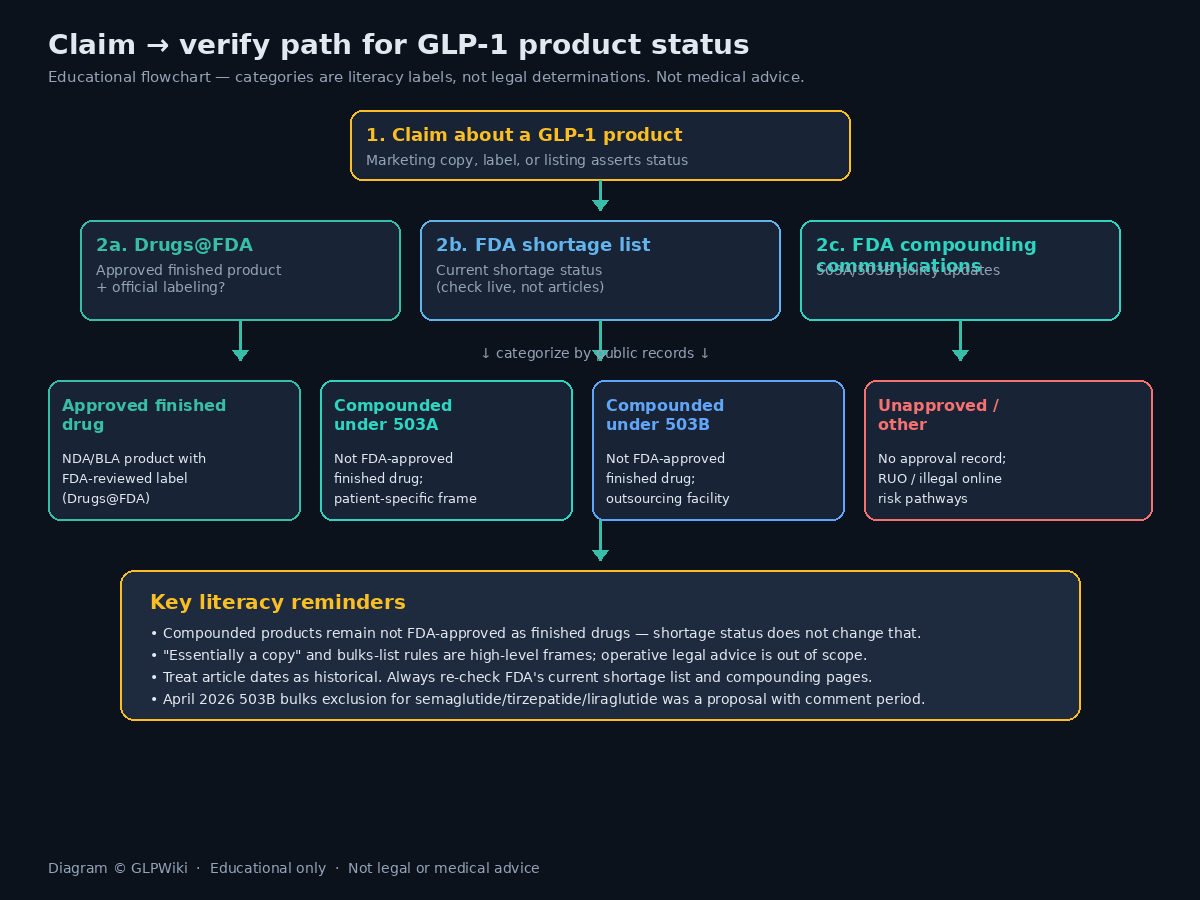
When a page claims a GLP-1 product is "the same as" an approved pen, or "503B quality," or "allowed because of shortage," treat the claim as a hypothesis and check public records.
Step one: Drugs@FDA — is there an approved finished product with official prescribing information matching what is being sold? If the claim is approval, the application and label should be findable. Step two: FDA Drug Shortages database — what is the CURRENT shortage status for the relevant presentations? Step three: FDA compounding communications — what do the latest 503A/503B policy pages and GLP-1-specific alerts say?
Then categorize honestly: approved finished drug; compounded under a 503A frame; compounded under a 503B outsourcing-facility frame; or unapproved/other (including fraudulent labels and research-use misbranding). Category labels are literacy tools, not a lawyer's opinion about a specific seller.
Certificates of analysis, blog comparison charts, and social posts are not substitutes for Drugs@FDA or FDA shortage/compounding pages. See our COA and vial-label guides for what those documents do and do not prove. For approved product labeling structure, see how-to-read-FDA-peptide-labeling. For the medications hub listing approved-oriented entries, see /medications.
What this page deliberately does not do
No doses, schedules, titration plans, reconstitution recipes, or stacks — for any approved or compounded product.
No pharmacy, telehealth, or supplier recommendations; no purchasing advice; no affiliate links.
No legal determination about whether any particular compounding arrangement is currently lawful in any jurisdiction.
No claim that 503B cGMP makes a compounded preparation "as good as" an FDA-approved drug. Different oversight is not the same as premarket approval of that finished product.
For symptoms, interactions, or whether any product is appropriate for a person, consult a licensed clinician. For legal questions, consult qualified professional advice and FDA/state primary sources.
Where to read next
Start with the sibling guide: compounded versus FDA-approved GLP-1 medicines. Then approved versus investigational peptides for the full status ladder, and how-to-read-FDA-peptide-labeling for Drugs@FDA and Prescribing Information literacy.
For packaging and lab-document literacy, use the vial-label and COA guides. For molecule pages, see semaglutide, tirzepatide, and liraglutide compound entries and the /medications hub.
Editorial standards and the medical disclaimer explain sourcing limits and what GLPWiki never publishes.
Frequently asked questions
- Is a 503B compounded GLP-1 medicine FDA-approved?
- No. Compounded drugs are not FDA-approved finished products, whether prepared under section 503A or 503B. 503B outsourcing facilities have different quality and inspection conditions (including cGMP), but that is not the same as FDA approval of the specific finished preparation.
- What is the difference between 503A and 503B in one sentence?
- 503A is the traditional patient-specific compounding frame for state-licensed pharmacies/physicians; 503B is the registered outsourcing-facility frame with cGMP and FDA risk-based inspection — both still produce non-approved compounded preparations when operating as compounders.
- Does a resolved shortage mean compounded copies are automatically allowed or banned?
- Neither automatic slogan is safe. Shortage status interacts with copy and bulk conditions differently under 503A and 503B, and FDA has issued time-limited enforcement-discretion statements in the past. Check current FDA shortage listings and compounding communications; this page is not legal advice.
- What does "essentially a copy" mean?
- It is a statutory/guidance concept limiting compounding of drugs that are essentially copies of commercially available (503A) or approved (503B) drugs. FDA has described API, strength, and route factors and significant-difference documentation concepts at a high level. Read FDA's current guidance and the April 2026 compounder clarification for the agency's wording.
- Did FDA finalize excluding semaglutide, tirzepatide, and liraglutide from the 503B bulks list in April 2026?
- No. The April 30, 2026 announcement was a proposal inviting comments (docket deadline stated as June 29, 2026 in the press release). A proposal is not a final determination.
- Does GLPWiki recommend a compounded product, dose, or pharmacy?
- No. GLPWiki publishes no doses or protocols, sells nothing, and links to no pharmacies or suppliers. This guide is educational literacy only — not medical advice and not legal advice.
SOURCES
- 01FDA clarifies policies for compounders as national GLP-1 supply begins to stabilize— U.S. FDA
- 02Human Drug Compounding— U.S. FDA
- 03Understanding the Risks of Compounded Drugs— U.S. FDA
- 04FDA's Concerns with Unapproved GLP-1 Drugs Used for Weight Loss— U.S. FDA
- 05FDA Proposes to Exclude Semaglutide, Tirzepatide, and Liraglutide on 503B Bulks List (Apr 30, 2026 proposal)— U.S. FDA
- 06FD&C Act Provisions that Apply to Human Drug Compounding— U.S. FDA
- 07Drugs@FDA: FDA-Approved Drugs database— U.S. FDA
- 08FDA Drug Shortages— U.S. FDA
- 09MedWatch: FDA Safety Information and Adverse Event Reporting Program— U.S. FDA
- 10Compounding and the FDA: Questions and Answers— U.S. FDA
EDUCATIONAL REFERENCE ONLY · Not medical advice. Nothing here diagnoses, treats, cures or prevents any disease, and nothing here is a dosing recommendation. Consult a licensed clinician before any treatment decision.